As the month of Muharram approaches, Muslims around the world prepare to remember the martyrdom of Imam Husain at Karbala. It is a good time to pause and reflect on who the Ahlul Bayt (the Prophet’s family) really are and why they matter so deeply to millions of believers.
Every year, Muharram draws attention not only to the tragedy of Karbala but also to the remarkable family at the heart of that event. The tears shed for Husain, the gatherings held in honour of the martyrs, and the deep love people feel for the Prophet’s household all stem from a bond that has shaped Muslim spirituality, ethics, and religious life for over 1,400 years.
So who exactly are the Ahlul Bayt?
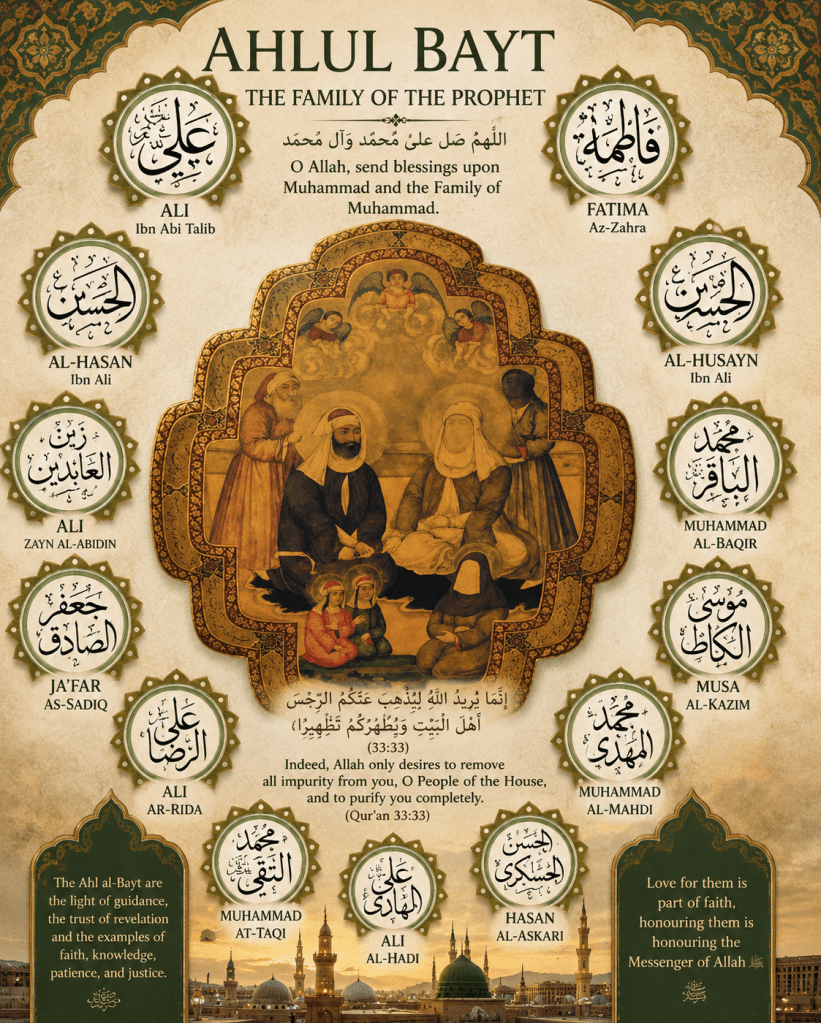
The term Ahlul Bayt simply means “the People of the House” or “the Household”. In practice, it refers to the family of the Prophet Muhammad. No other family in Islamic history has received such lasting reverence, affection, and devotion. And this isn’t just because they were blood relatives. It is because Muslims believe they played a unique role in preserving, living out, and passing on the Prophet’s teachings.
In both Sunni and Shi’i Islam, loving the Ahlul Bayt is seen as an extension of loving the Prophet himself. You cannot love him fully, the thinking goes, without also loving those closest to him.
What might be missing from this picture?
One thing that is often missing when people talk about the Ahlul Bayt is a simple explanation of who is actually included. In its narrowest sense (especially in Shi’i belief), the Ahlul Bayt refers to five people: the Prophet Muhammad, his daughter Fatima al Zahra, his cousin and son in law Ali ibn Abi Talib, and their two sons Hasan and Husain. The Shi’I expand the term to include not only the panjatan, but also the Imams who followed them: the 14 Impeccables (masūmīn). In a wider sense, many Sunni Muslims also include the Prophet’s wives, particularly Khadija and Aisha, as part of his household. So when you hear the term, it helps to know that context matters.
Another missing piece is why this matters to someone who isn’t Muslim. The story of the Ahlul Bayt is not just a religious story. It is a human story about family, love, loss, standing up against injustice, and keeping faith alive when everything seems lost. That is why people from many backgrounds, not just Muslims, have been moved by figures like Husayn.
Why are they so central to Islam?
Let’s start with the Prophet’s own attitude. Throughout his life, he openly showed his affection for Ali, Fatima, Hasan and Husain. He would carry Hasan and Husayn on his shoulders during prayer. He would stand up when Fatima entered the room and say, “She is a part of me. Whoever hurts her hurts me.” These weren’t just family moments. They were public lessons to the community.
The Qur’an also points to the Prophet’s family. One famous verse says:
“Indeed Allah only desires to remove all impurity from you, O People of the House, and to purify you completely.” (Qur’an 33:33)
This is often called the Verse of Purification. Another verse says:
“Say: I ask of you no reward for it except love for my near relatives.” (Qur’an 42:23)
For centuries, Muslim scholars have seen this as making love for the Prophet’s family a religious duty, not just a nice thing to do.
Stories that shaped their place in Islam
There is a well known event called the Hadith al Kisa (the Tradition of the Cloak). The story goes that the Prophet gathered Ali, Fatima, Hasan and Husain under his cloak and prayed, “O Allah, these are my Ahlul Bayt. Remove impurity from them and purify them completely.” This event is central to Shi’i belief because it identifies this small group as the innermost circle of his family.
Then there is the event of Mubahala, a peaceful challenge with Christians from Najran. When talks about the nature of Jesus reached a dead end, the Qur’an suggested both sides call on God’s judgement. The Prophet brought only Ali, Fatima, Hasan and Husain with him, calling them “our sons”, “our women” and “ourselves”. For Shi’a Muslims, this is powerful proof of their unique rank. Even Sunni scholars see it as a testament to their special standing.
Perhaps the most famous tradition is the Hadith al Thaqalayn (the Tradition of the Two Weighty Things). The Prophet said:
“I leave among you two weighty things: the Book of Allah and my Ahlul Bayt. If you hold fast to them, you will never go astray after me.”
This is recorded in both Sunni and Shi’i sources. It suggests that the Qur’an and the Prophet’s family together are the lasting guides for the Muslim community.
The Shi’i understanding: Imams and divine guidance
For Shi’a Muslims, the importance of the Ahlul Bayt goes even further. They believe that after the Prophet died, divine guidance continued through a line of twelve Imams, all descended from Ali and Fatima. The first Imam was Ali, followed by Hasan, then Husain, then nine more of Husain’s descendants. The twelfth Imam, Muhammad al Mahdi, is believed to be alive but hidden, and will return one day to bring justice to the world.
These Imams are not seen as prophets (prophethood ended with Muhammad). But Shi’a Muslims believe they were chosen by God to preserve and explain Islam. They were spiritual and moral leaders, not just political rulers.
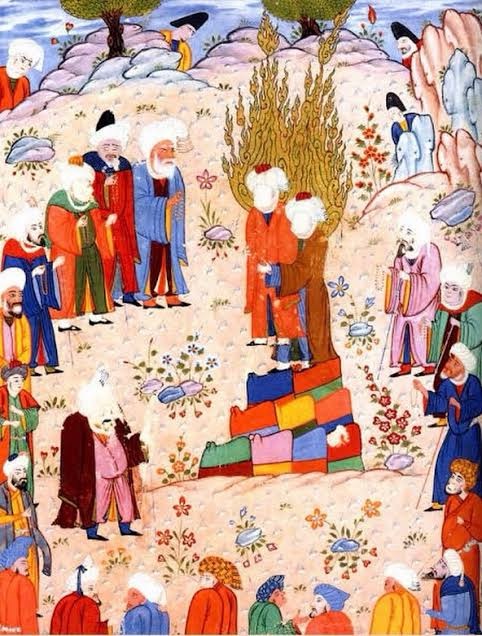
A key moment for Shi’a Muslims is the event of Ghadir i Khumm. On the way back from his final pilgrimage in 632 CE, the Prophet stopped at a place called Ghadir i Khumm, took Ali by the hand, and said to the crowd: “For whomever I am the mawla (leader or friend), Ali is his mawla.” Shi’a Muslims see this as the formal appointment of Ali as the Prophet’s successor. Sunni scholars generally see it as an expression of Ali’s closeness and virtue. Either way, it shows his exceptional standing.
Karbala: The tragedy that changed everything
No single event shaped the memory of the Ahlul Bayt more than the tragedy of Karbala in 680 CE. Imam Husain refused to pledge loyalty to a ruler he saw as unjust. He marched towards Iraq with a small band of family and companions. They were surrounded on the plain of Karbala, cut off from water for days, and then killed one by one. Husain himself was martyred, and his family was taken captive.
For Shi’a Muslims, Karbala is the defining moment in the struggle between truth and falsehood, justice and tyranny. Husain’s refusal to give in, even when he knew he would die, turned him into a universal symbol of moral resistance. His sacrifice showed that dignity and truth are worth more than life itself.
But Karbala is not just for Shi’a Muslims. Across the Muslim world, Husain is remembered as the beloved grandson of the Prophet who gave everything for what was right. Poets, scholars and mystics from many backgrounds have honoured his memory.
But what about Sunni Muslims?
It is a common mistake to think that loving the Ahlul Bayt is only for Shi’a Muslims. That is simply not true. Sunni Islam has always had a deep and enduring devotion to the Prophet’s family. The daily prayers of Sunni Muslims include blessings on “Muhammad and the family of Muhammad” every single time. That happens millions of times a day across the globe.
The Prophet himself said, “I remind you concerning my Ahlul Bayt. I remind you concerning my Ahlul Bayt. I remind you concerning my Ahlul Bayt.” Another saying goes: “Love Allah for His blessings upon you, love me for the sake of Allah, and love my family for my sake.”
Many great Sunni scholars expressed profound love for the Prophet’s family. Imam al Shafi’i, one of the most influential Sunni jurists, wrote poetry saying that love for the Prophet’s family is an obligation revealed in the Qur’an. He added that a prayer is incomplete without blessing the Prophet’s family.
So the difference is not about love. The difference is about the role of the Ahlul Bayt after the Prophet’s death. Shi’a Muslims believe they were divinely appointed leaders. Sunni Muslims honour them deeply but do not give them the same level of religious authority.
Why does this matter today?
The influence of the Ahlul Bayt goes far beyond theology. Their lives have inspired poetry, art, architecture, music and movements for justice. From the golden shrines of Najaf, Karbala, Mashhad and Medina to the mourning poetry of Iran, Iraq, Turkey, Pakistan and India, their presence can be felt across the Muslim world.
As Muharram begins and Muslims prepare to remember Karbala, it is worth remembering that the story of the Ahlul Bayt is not just a story of suffering. It is also a story of faith, courage, sacrifice, justice and staying true to your principles even when the cost is high. Whether you look through a Shi’i lens or a Sunni one, the Ahlul Bayt remain at the heart of Islam. They are the closest link to the Prophet himself. Their legacy continues to inspire believers across the world, and their example still speaks to anyone who cares about standing up for what is right.
The month of Muharram is nearly upon us. This year it starts on 16th June, and the 10th day, known as Ashura, falls on 26th June. As the month approaches, a familiar controversy begins again. Should Muharram be celebrated or commemorated? Do we greet each other as if it is a festival, or do we offer condolences as if a loved one has passed away? To answer this question, we must first understand what Muharram truly means and why it carries such weight in the Islamic tradition.
What is Muharram?
Muharram is the first month of the lunar Hegira calendar, which Muslims follow for religious dates and events. The word Hegira means migration, and it refers to the Prophet Muhammad’s journey from Mecca to Medina in 622 CE. This event marks the start of the Islamic calendar, and the first month of that year was Muharram. That is why Muharram became the first month, even before the tragedy of Karbala gave it a new and deeper meaning.
The word Muharram comes from hurmat, meaning sacred or forbidden. In pre-Islamic Arabia, this month was already considered sacred. War was forbidden during this month, and tribes would observe a truce. But after the event of Karbala in the year 61 AH, which corresponds to 680 CE, the month took on a completely new meaning. That was the year when Husain, the grandson of the Prophet Muhammad, was massacred along with his small band of family members and companions on the desert plain of Karbala in present day Iraq. From that point onward, Muharram became known as the month of mourning. It is not a month of celebration, and one does not wish Happy Muharram or send festive greetings. To do so is to misunderstand what happened, or worse, to ignore the suffering of the Prophet’s family.
Who Was Imam Husain and Why Does He Matter?
To understand why Muharram is a commemoration and not a festivity, we need to understand who Imam Husain was and what mission he stood for. Imam Husain was not an ordinary person. He was the grandson of the Prophet Muhammad through his daughter Fatima and his cousin and son in law Ali ibn Abi Talib. The Prophet loved Husain deeply and famously said, “Husain is from me and I am from Husain.” He also said that his grandsons Hasan and Husain are the leaders of the youth of paradise.
The Ahlulbayt, which means the people of the household of the Prophet, hold a special position in Islam. They were not just family members in a biological sense. They were the carriers of the Prophet’s message, the protectors of his Sunnah or way of life, and the living examples of Quranic ethics. The Prophet had clearly instructed Muslims to love and respect his Ahlulbayt and to follow their guidance after him. So when Imam Husain stood up against Yazid, he was not acting as a political rebel. He was acting as the guardian of Islam itself.
Who Was Yazid and How Did He Want to Harm Islam?
Yazid was the son of Muawiyah, who was the founder of the Umayyad dynasty. Muawiyah and his family had been among the strongest opponents of the Prophet before they accepted Islam later in order to save their wealth and status. After the death of the Prophet, and after the caliphates of Abu Bakr, Umar, Uthman, and Ali, Muawiyah managed to seize power and established a kingship style rule. This was very different from the consultation based system of early Islam. When Muawiyah died, in spite of a Treaty which he had signed with Imam Hasan to the contrary, he appointed his son Yazid as his successor.
Yazid was known for his love of wine, hunting, and entertainment. He had little regard for Islamic teachings. He was not a pious man. Yazid demanded that Imam Husain give him an oath of allegiance, meaning that Husain would have to accept Yazid as the legitimate leader of the Muslim community. For Imam Husain, this was impossible. To accept Yazid’s rule would mean endorsing a man who openly violated Islamic principles. It would mean giving legitimacy to corruption, oppression, and the transformation of the caliphate into a hereditary monarchy.
Yazid wanted to harm Islam from within. He did not need to destroy the religion from outside. He wanted to empty it of its spiritual content, reduce it to a tool of power, and silence any voice that spoke the truth. Imam Husain understood this clearly. He famously said that he was rising not out of arrogance or rebellion, but to reform the nation of his grandfather. He said he wanted to enjoin good and forbid evil, and to follow the way of his grandfather and his father Ali.
The Tragedy of Karbala
Imam Husain left Medina with his family and headed toward Kufa, where many people had invited him to lead them. On the way, he was intercepted by Yazid’s army and forced to stop at the barren land of Karbala. For days, the Umayyad army cut off water from Husain and his camp. Children cried from thirst. The women suffered terribly. On the 10th of Muharram, Ashura, the army attacked.
Imam Husain’s companions were killed one by one. Then his family members and his own sons were killed. Finally, Imam Husain himself was martyred. His six month old baby, Ali Asghar, was shot with an arrow while Husain held him in his arms asking for water. The tragedy is almost too great to bear. That is why Muslims mourn during Muharram. They mourn not just because of the death of a historical figure, but because of the systematic destruction of the Prophet’s family, the captivity of the women of Ahlulbayt, and the temporary triumph of falsehood over truth.
But the deeper message of Karbala is that truth eventually wins. The massacre of Husain turned out to be the death of Yazid in the pages of history. Today, no Muslim names their child Yazid with love, but millions name their children Husain. Yazid is remembered as a tyrant. Husain is remembered as a hero. That is why a famous couplet says, “Qatl e Husain asl mein marg e Yazid hai, Islam zinda hota hai bas Karbala ke baad.” The killing of Husain is actually the death of Yazid, and Islam is revived only because of Karbala.
Karbala Marks the Distinction Between Two Paths
Karbala marks the distinction between two completely different paths. One path is the path of extremism, force, and terrorism. Yazid and his followers believed that they could crush truth by brute force. They believed that power and violence could make people submit. That is the path of the oppressors in every age.
The other path is the path of peace, love, and mercy. This is the path exemplified by Imam Ali, Imam Hasan, and Imam Husain. Imam Ali taught justice and forgiveness even toward his enemies. Imam Hasan, the elder brother of Husain, chose a peace treaty with Muawiyah to avoid bloodshed among Muslims. He showed that peace is not weakness but a strategic choice to preserve the community. And Imam Husain showed that when the enemy breaks all agreements and attacks the very heart of faith, one must stand firm even if it costs one’s life.
This path is not about random violence or extremism. It is about principled resistance. It is about saying no to a tyrant without becoming a tyrant oneself. It is about suffering for truth without inflicting suffering on innocents. The enemies of Islam today often use the name of religion to justify terrorism, killing civilians, and spreading fear. That is the way of Yazid, not the way of Husain. The way of Husain is to sacrifice oneself and not to kill innocents. The way of Husain is to love humanity, to stand for justice, and to have mercy even on one’s enemies.
Muharram as the Revealer of Duplicity
There is another crucial dimension to this month. Muharram is the month that reveals duplicity and separates truth from falsehood. The events of Karbala help lift the veil of duplicity which some amongst the believers wrapped themselves with, causing confusion regarding what the real message of Islam was.
Islam was perhaps the first religion which unfolded in the full glare of history. Most things which happened from the time of the Prophet Muhammad are generally recorded in some form or another. From these records, it becomes apparent that since the beginning, those who received the message were of two kinds. First, there were those who received it from the heart. Second, there were those who thought it pragmatic to accept the new faith to safeguard their own interests. Some became Muslim with their heart, some for personal gain. But how to differentiate an Abu Talib from an Abu Sufyan was a difficult task for ordinary people.
Under the consequent and persistent official propaganda of two mighty caliphal states, the Umayyads and the Abbasids, the faith of the one who safeguarded the Prophet was made suspect, while the faith of Abu Sufyan, who had killed many Muslims and tormented the Prophet until the Prophet finally defeated him, was presented as a paragon of virtue. Abu Talib saved Islam, but he was not considered a Muslim by some. Abu Sufyan always fought against the Prophet but was called a great Muslim. Hind chewed the liver of Hamza, a revered uncle and commander of the Prophet, but she and Hamza were both called pious. A door was pushed on Fatima resulting in grievous injuries and miscarriage, but the perpetrators were all called honourable. This confusion was unbearable for those seeking truth.
The episode of Karbala cleared this mist of confusion and deceit. It helped separate right from wrong. After Karbala, there could be no fifth columnist hiding within the community. Yazid was Yazid, and Husain was Husain. There was no mixing the two. Husain removed the veil from the face of deceit. After him, you can see the real face of Islam and clearly identify those who were trying to use it for their own personal ends.
Karbala as a University of Humanity
Muharram is not just a month of mourning. It is a great education system, in fact a full fledged university. This university was founded for us by Ali ibn al Husain, who is known as Imam Zain al Abedin or Saiyid al Sajjad, and by Zainab bint Ali ibn Abu Talib. The entire episode of Karbala, like any great epic, offers through every character and every act a profound lesson for all those who care to learn.
Karbala is not a mere story. It is no mere name of a city. It is the name of a philosophy. It is a chain of events and responses that help us unravel the true message of what Husain’s grandfather taught. It is not a fight of two princes but a clash of two very different ideologies. Karbala is an answer to those who think that the success of Islam means empire building and political dominance. Karbala crushes empires. Its leader was no caliph. He was Abu Ahrar, the harbinger of freedom. He was a leader who taught us to take a stand against all tyrants, whether they are caliphs, kings, emperors, or anyone who represents brutal force and dictatorship.
Karbala is also a practical guide not only to what Islam is and what it stands for, but also to what its attitude is towards humanity, women, slaves, and even animals. It shows how a black slave and a pure Arab, a slave woman and the leader of the community, a slave and a high born free man are essentially equal, not only in front of God but amongst themselves. Karbala also teaches that ends do not justify means. The means too should be clean, upright, and dignified. Only then will your noble ends be met. A victory through deceit is no victory at all. A defeat suffered with honour is better than an ill gotten victory.
The Role of Zainab and Imam Zain al Abedin
Karbala also shows us the emergence of extraordinary leadership. Husain was the Imam, the leader. As long as he was alive, it was his authority. Zainab, until the head of her leader was brutally cut, was nothing but a follower. But as soon as Husain was martyred, she emerged as a strong leader herself. Even as a prisoner, she took charge. We find her leading in various capacities: as a protector of the other women and the surviving children, and as a protector shielding the newly anointed Imam of the age, Zainul Abedin. She not only protected the survivors but became the principal ambassador of Husain. Her speeches on the road to Damascus, in the markets and inns of Syria, and ultimately in the caliphal court at Damascus, all helped disseminate the message of Husain far and wide. She emerged as the first teacher of the School of Ahlulbayt. She was followed by Ali ibn al Husain, Imam Zain al Abedin, as the second teacher of this institution. Today, the institution they established is universal and worldwide. All those who want to learn about humanity and humanism are welcome to it.
How Is Muharram Observed in Practice?
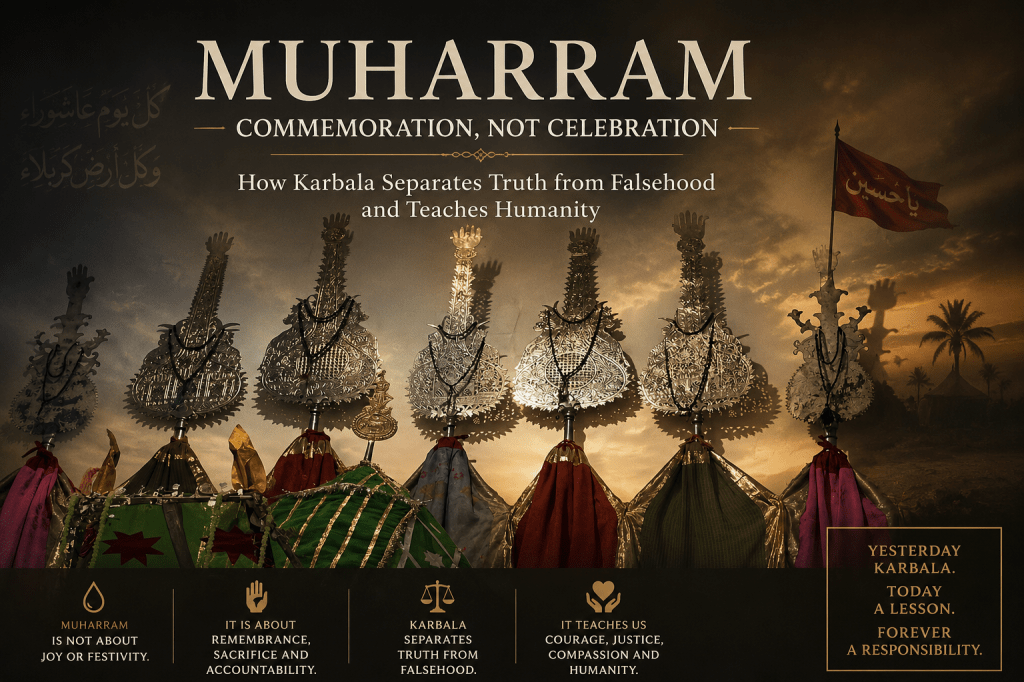
To understand Muharram fully, it helps to know what actually happens during the first ten days. Muslims gather in mosques and community halls known as Imambargahs or Azakhanas. These are places specifically dedicated to mourning gatherings. They listen to lectures about the events of Karbala. Poets recite elegies known as Marsiya and Nauha, which describe the tragedy in heart breaking detail. In some traditions, people express grief through chest beating called Matam. They also hold processions where they carry Alam, which are symbolic standards representing the banners of Husain’s army. Such objects are not relics of festivity but witnesses to centuries of commemorative grief.
The Practice of Fasting on Ashura
It is also important to mention the practice of fasting on Ashura, because this predates the tragedy of Karbala. The Prophet Moses is said to have fasted on this day to thank God for saving the Israelites from Pharaoh, and the Prophet Muhammad continued this practice. After Karbala, the meaning of Ashura became layered. For many Sunni Muslims, it remains primarily a day of fasting and gratitude, though they also acknowledge the tragedy of Karbala. For Shia Muslims, it is first and foremost a day of mourning for Husain. They do not fast but remain hungry, they do not partake food, as if a family member has died. They call it fāqa, starving. Acknowledging this diversity is important for a complete understanding of Muharram.
Different Observances Among Sunni and Shia Muslims
It is also true that not all Muslims observe Muharram in the same way. Shia Muslims observe it with intense mourning rituals, including the gatherings, processions, and chest beating described above. Many Sunni Muslims also acknowledge the tragedy of Karbala and mourn it, but they may not engage in the same physical expressions of grief. Some Sunni Muslims, particularly those influenced by certain schools of thought, discourage public mourning rituals. And a very small minority have historically viewed Yazid as a legitimate caliph, though this position is widely rejected by mainstream Islam. Acknowledging these differences does not weaken the argument of this essay. It shows honesty and prepares the reader for the fact that the meaning of Muharram is contested, which is precisely why an explanation like this one is needed.
Is Mourning Permitted in Islam?
A beginner might wonder whether it is even allowed in Islam to mourn someone who died over 1300 years ago. The answer is yes. The Prophet himself mourned the death of his son Ibrahim and his uncle Hamza. He also visited the graves of martyrs and wept there. Mourning for a righteous person who was killed unjustly is a well established practice in Islamic tradition. The key is that mourning should not violate Islamic principles such as harming oneself or abandoning religious duties. Within those boundaries, mourning for Imam Husain is not only permitted but is considered a form of spiritual devotion and a way of keeping his message alive.
The Universal Message for Today
Muharram is not only the first month of the lunar Hegira calendar. It is also a model for how we should lead our own lives. Every year, when these ten days arrive, Muslims around the world are reminded of the eternal struggle between right and wrong. They are reminded that wealth, power, and popularity are not signs of truth. Sometimes truth stands alone, thirsty, surrounded by enemies, with no army to support it. But that does not make truth false.
Imam Husain taught us that a life of dignity is better than a life of submission to a tyrant. He taught us that one should never bow to injustice. He taught us that if we cannot change the world, we should at least speak the truth. And if we cannot speak, we should at least feel grief in our hearts. That is why the commemoration of Muharram is so powerful. It is not a festival. It is a school of character. It teaches us courage, patience, loyalty, love for family, standing up for what is right, and never accepting humiliation.
Concrete Examples of Resistance in Everyday Life
What does it mean to stand like Husain against a modern Yazid? Here are some everyday examples. It might mean speaking the truth when a colleague is being bullied by a manager, even if you fear for your own job. It might mean refusing to sign a false document at work, even if everyone else is doing so. It might mean protecting a vulnerable person in your neighbourhood from harassment, even if the harassers are powerful. It might mean voting against a corrupt politician, even if your vote seems small. It might mean teaching your children to value honesty over success, and justice over convenience. These small acts of resistance are the living legacy of Karbala. They are how we keep Husain’s memory alive. They are how we make every place Karbala and every day Ashura.
Final Warning Against Happy Muharram Greetings
As Muharram begins on 16th June this year, and as Ashura comes on 26th June, let us remember the correct way to observe this month. Do not send Happy Muharram messages. Do not treat it as a time for weddings or parties. Instead, enrol yourself in this great university. Learn about the tragedy of Karbala. Attend remembrance gatherings if you can. Fast on the day of Ashura if that is your practice. Commemorate this day as if a near one has died. But most importantly, reflect on the message of Imam Husain. Ask yourself whether you are living a life of submission to truth or a life of convenience. Ask yourself whether you stand up against the Yazids of your time, whether they are corrupt politicians, abusive bosses, or oppressive social systems.
To conclude, Muharram is not just a month from the past. It is a living call to every human being. Every place is Karbala, and every day is Ashura. That means the struggle between truth and falsehood is happening everywhere, all the time. And we have to choose which side we are on. Imam Husain gave everything for Islam. Zainab carried his message in chains. Imam Zain al Abedin preserved the knowledge through immense suffering. The least we can do is understand their message and try to live by it. That is the true commemoration of Muharram. Not tears alone, but tears followed by action. Not mourning without meaning, but mourning that transforms us into better human beings. That is what the Ahlulbayt taught. That is what the Prophet wanted. And that is the mission of Imam Husain, which will remain alive until the end of time.
The Aligarh School of History stands as one of the most significant and influential historiographical traditions to emerge from modern India. Rooted in the intellectual soil of the Muhammadan Anglo-Oriental College and later Aligarh Muslim University, this school fundamentally reshaped how scholars understand medieval Indian history. Its practitioners, spanning several generations, moved the discipline away from chronicle based narratives of kings and battles towards a rigorous, source critical, and socially grounded analysis of structures, classes, and economic processes. At the heart of this tradition lies an unwavering commitment to primary sources, especially the vast and rich corpus of Persian chronicles, administrative manuals, and documentary records. To appreciate the school’s achievement, one must understand its origins, its methodological evolution, its key practitioners across multiple subfields, its engagement with archaeology and art history, and its enduring legacy.
The Origins and Foundational Commitment to Primary Sources
The origins of the Aligarh School lie in the late nineteenth century responses to colonial historiography. British historians, from James Mill to William Erskine, had painted Muslim rulers as fanatical despots who destroyed temples and oppressed Hindus as a matter of religious doctrine. This narrative served the colonial project by justifying British rule as a liberation of India from Muslim tyranny. In response, scholars associated with Aligarh did not simply produce a counter narrative of Muslim benevolence. Instead, they adopted the colonial empirical toolkit but turned it inside out. They accepted the importance of facts, coins, inscriptions, and revenue records, but used this positivism to dismantle colonial conclusions. The British diagnosis of medieval India was correct in its data but false in its causality.
What distinguished the Aligarh School from the very beginning was its insistence on returning to primary sources. Where earlier historians had relied on translated excerpts or secondary summaries, the Aligarh scholars demanded direct engagement with Persian manuscripts, farmans, inscriptions, and coins. This commitment was not merely technical. It was political. To read a Persian chronicle in its original language was to bypass the colonial translator who had already framed the text for British consumption. It was to recover a voice that had been mediated, distorted, and often silenced. The school produced generations of scholars fluent in Persian, trained in palaeography, and comfortable navigating the manuscript libraries of India, Pakistan, Iran, and the United Kingdom.
Mohammad Habib and the Marxian Turn
One of the first towering figure of the school was Mohammad Habib, who taught at Aligarh from the 1920s through the 1960s. Habib was the first Indian medievalist to systematically apply a materialist framework to the study of the Delhi Sultanate and Mughal India. Writing when Indian historiography was still dominated by either colonial narratives of Muslim tyranny or nationalist hagiography, Habib broke new ground by asking not what rulers said they did, but what economic interests drove their actions.
His seminal work, Sultan Mahmud of Ghazna, first published in 1927 and revised in 1951, exemplifies this approach. Rather than debating whether Mahmud was a fanatic or a hero, Habib analysed the Ghaznavid raids as rational responses to geopolitical and fiscal pressures. The Somnath temple, he argued, was not merely a religious target but a massive banking house controlling western Indian trade routes. Its destruction served to break a rival commercial military confederacy. Habib supported this controversial thesis using numismatic evidence, trade records, and a close reading of the Muslim polymath al Biruni’s ethnographic observations. More provocatively, he used coinage to show that Mahmud’s deference to the Abbasid Caliph was purely formal, not ideological. He also reclaimed Mahmud’s patronage of al Biruni and the poet Firdawsi to argue that the Ghaznavid court was a site of rationalist inquiry, not religious bigotry.
Beyond this specific argument, Mohammad Habib developed a broader hypothesis of urban and rural revolutions in medieval India. He proposed that the establishment of the Delhi Sultanate triggered an urban revolution, meaning the rapid growth of towns, monetisation of the economy, and emergence of a cash nexus that loosened the grip of caste based occupational restrictions. This was followed by a rural revolution, where the power of intermediary chiefs and zamindars was curtailed, and the peasant was brought into more direct relationship with the state. However, as his son and later colleague Irfan Habib noted, this formulation required qualification. The liberation of peasants from caste prejudices was matched by large scale enslavement of rural populations to supply urban labour. Nor did the curtailment of intermediaries necessarily improve peasant conditions. The great peasant revolt of the Doab during Muhammad Tughluq’s reign suggested otherwise.
Crucially, Mohammad Habib deployed Marxian categories not as dogma but as heuristic tools. He rejected the rigid application of the Asiatic Mode of Production to India, arguing instead that the Sultanate represented a unique formation, centralised, cash based, with a ruling class whose composition was determined by sovereign will rather than hereditary landed control. This was neither European feudalism nor oriental despotism, but something requiring its own analytical vocabulary. His introduction of class as an analytical category, his insistence on economic causality, and his refusal to accept religious explanations at face value became the foundational commitments of the school.
The Structural Turn: From Kings to Classes
If Mohammad Habib introduced the Marxian framework, it was Irfan Habib who transformed it into a rigorous, empirical research programme. His The Agrarian System of Mughal India, published in 1963, remains the magnum opus of the Aligarh School. The historian Tapan Raychaudhuri, no uncritical admirer of the school, called its publication one of those rare occasions that fundamentally reshaped a field.
Irfan Habib’s central methodological innovation was to shift attention from the court to the countryside. Where previous historians had focused on dynastic politics, administrative manuals, and court chronicles, Habib turned to revenue records, price data, royal orders, and land measurement statistics. His question was simple but revolutionary. Who produced the surplus? Who extracted it? How was it distributed?
The answer dismantled several prevailing myths. Against the colonial image of unchanging village republics, Habib demonstrated that the Mughal peasantry was deeply stratified. At the top were village headmen and richer peasants who often acted as local exploiters. At the bottom were landless labourers, primarily from untouchable castes, constituting one sixth to one fifth of the rural population. These people, he wrote, were prevented from holding land or setting themselves up as cultivating peasants, and they lived at the brink of starvation all the time.
Against the nationalist image of benevolent Mughal rule, Habib showed that the land revenue was regressive, falling more heavily on poorer peasants than on richer ones. The state’s primary purpose was not merely as the protective arm of the exploiting classes, but was itself the principal instrument of exploitation. Peasants were not free proprietors but near serfs, bound to the land, unable to legally abandon cultivation, and often forced into flight by impossible revenue arrears.
Against Marx’s own Asiatic Mode of Production, which posited a stagnant, undifferentiated village society, Habib’s evidence revealed dynamic commercialisation, class formation, and class struggle. He identified multiple forms of peasant resistance, including flight, tax refusal, and armed rebellion. The great Doab revolt under Muhammad Tughluq was not an anomaly but a symptom of systemic contradiction.
Satish Chandra extended this class analytic approach to political history. His Parties and Politics at the Mughal Court, 1707 to 1740, published in 1959, argued that the Mughal Empire’s decline was not caused by Aurangzeb’s bigotry, a colonial and communal trope, but by structural economic crisis. He identified the jagirdari crisis, where the number of nobles grew faster than revenue yielding lands. The resulting factional warfare among Iranis, Turanis, and Hindustanis cut across religious lines. Hindu Rajputs allied with Muslim nobles based on material interest, not faith. This replaced moral decline narratives with a secular, class analytic model. His later textbooks synthesised Aligarh methods and trained generations of students to see composite culture, or Ganga Jamuni tehzeeb, as politically produced, not accidental.
M. Athar Ali brought prosopography, the collective biography of groups, to bear on the nobility question. In The Mughal Nobility Under Aurangzeb, published in 1966, he constructed biographies of over fifteen hundred Mughal nobles. He proved that the percentage of Hindu nobles under Aurangzeb was nearly identical to that under Akbar, demolishing the thesis of a Hindu purge under the so called bigot emperor. He also showed that the jizya tax reimposed in 1679 was applied erratically, often waived, and coincided with military campaigns in the Deccan, suggesting fiscal rather than theological motives. His most original contribution was the argument that the Mughal nobility functioned as a class with common material interests in land and rank that overrode religious identity. The empire collapsed because this class became internally predatory, not because Hindus or Muslims betrayed it.
Shireen Moosvi pushed the quantitative turn further. Using the Ain i Akbari’s detailed price and wage data, she reconstructed Mughal per capita income, GDP, and standards of living in The Economy of the Mughal Empire, published in 1987. Her findings were startling. Mughal India in 1600 had real wages comparable to Elizabethan England. Peasant consumption baskets included not just grain but sugar, cloth, and spices, contradicting images of stagnant misery. She also demonstrated that tax extraction averaged twenty to thirty percent of produce, similar to contemporary Europe, not the predatory levels suggested by oriental despotism theories. Her most debated thesis was that the seventeenth century economy was proto capitalist in its commercial networks and bullion flows, but that this potential was blocked by the jagirdari system, not by religion.
The Contribution of Nurul Hasan
No account of the Aligarh School would be complete without recognising the profound contributions of S. Nurul Hasan, a historian who trained at Aligarh and later served as India’s Minister of Education but whose scholarly work remains central to the school’s legacy.
Nurul Hasan’s doctoral research, conducted under the supervision of Mohammad Habib, focused on the jagirdari system under the later Mughals. His thesis, later published in expanded form as Thoughts on Agrarian Relations in Mughal India, made several groundbreaking arguments. He was among the first historians to systematically analyse the difference between khalisa land, which was under direct state control, and jagir land, which was assigned to nobles in lieu of salary. He demonstrated that the proportion of khalisa land shrank dramatically during the seventeenth century, weakening the state’s direct fiscal base and making it increasingly dependent on jagirdars whose loyalty was always conditional.
More significantly, Nurul Hasan developed a typology of zamindari rights that moved far beyond the simplistic colonial understanding of zamindars as mere revenue collectors. He distinguished between zamindars who held ancestral rights to land, ta’alluqadars who held temporary revenue assignments, and chaudhris who functioned as village headmen. Each category had different relationships to the peasantry and to the state. This nuanced taxonomy allowed Aligarh historians to move away from the binary of state and peasant and to recognise the complex intermediary strata that shaped agrarian relations.
Nurul Hasan also pioneered the study of the Risala, a genre of administrative manuals written by Mughal officials. His analysis of works like the Chahar Gulshan and the Khulasat al Tawarikh revealed how Mughal bureaucrats themselves understood the problems of jagir administration, revenue arrears, and noble factionalism. By treating these texts as sources for bureaucratic consciousness rather than as transparent records of fact, he added a layer of intellectual history to the school’s predominantly social and economic focus.
His influence on the school extended beyond his own writings. As a teacher at Aligarh before entering politics, he mentored a generation of students who would carry forward the school’s methods. And his later career in government, though it removed him from active research, ensured that Aligarh style historical thinking had a voice in policy circles, particularly in matters of land reform and educational policy.
Writing People’s History: Peasants, Artisans, Technology, and the Middle Classes
The logical culmination of the structural turn was the writing of history from below. If classes and processes mattered, then the people who constituted those classes, peasants, artisans, merchants, and professionals, could no longer remain invisible.
Iqtidar Alam Khan pioneered the study of military technology as a window into social history. His work on gunpowder and firearms challenged the gunpowder empire thesis by demonstrating that Indian sultanates adopted firearms based on political need, not cultural openness or religious prohibition. More significantly, he showed that technology transfer was not a one way street from Europe to Asia but involved complex negotiations. Hindu gunners served in Muslim armies. Portuguese mercenaries served in Mughal service. His method was to use military technology history as neutral ground to prove that religious labels were irrelevant to state function.
Ahsan Jan Qaisar extended this technological focus to the study of everyday material life. His The Indian Response to European Technology, 1498 to 1700, published in 1982, argued that the Mughal state was technologically curious, not conservative as colonial historiography had claimed. Using letter writing manuals and official news reports, he showed that Aurangzeb’s court actively studied Portuguese naval designs. Mughal artisans selectively adopted European shipbuilding, mining, and clockmaking while rejecting what was inferior or culturally irrelevant. This was a rational, not passive, response. He also wrote a monograph on Building technology under the Mughals. I followed it up by exploring the organisation of building construction under the Mughals. I also wrote on the development of paper technology during the Mughal period.
Iqtidar Husain Siddiqui turned to textual criticism to recover subaltern voices. By cross reading Persian court chronicles against Sufi discourses and saint biographies, he reconstructed a picture of everyday Hindu Muslim coexistence. He found shared markets, temple repairs, and joint commercial ventures, a lived reality that elite chronicles ignored. His most provocative claim was that Sultan Muhammad Tughluq’s supposedly mad policies, like token currency and capital transfer, were rational experiments that failed due to logistics, not ideology.
Ishrat Alam carried forward the work of Irfan Habib on the field of technological innovations and focused on the history of craft production from the bottom up. Habib had contributed a number of incisive papers on the history of technology, ranging from military technology to textile technologies. Alam’s doctoral work on textile craft and trade in the sixteenth and seventeenth centuries, as well as his later research on textile tools as depicted in Ajanta and Mughal paintings, reconstructed the actual techniques of weaving, dyeing, and silk manufacture. By analysing Persian glossaries and miniatures showing pit looms, treadles, and spinning wheels, he brought the artisan into view, not as an abstraction but as a worker with specific skills, tools, and social conditions. All these works demonstrated that Mughal India had sophisticated textile technologies, including draw looms spread from China via royal workshops, and that artisans were not passive recipients of state orders but active agents in technological transfer.
Khaliq Ahmad Nizami balanced the school’s materialist emphasis by recovering the role of Sufi ethics in shaping social relations. Using Sufi discourses and letters, he argued that Sufi saints like Nizamuddin Auliya did not merely preach harmony but actively criticised rulers for injustice, not for religious identity. The Sufi hospice was a space where peasants, artisans, and merchants interacted with spiritual authorities outside the court’s control. This added a moral ethical dimension to the school’s rationalist materialist core.
Zahiruddin Malik made important contributions to the study of the late Mughal period, a phase often dismissed as mere decline. His The Reign of Muhammad Shah, 1719 to 1748, published in 1977, used neglected sources like the Ahkam i Alamgiri and Ibratnama to argue that cultural and economic life flourished under Muhammad Shah, with remarkable achievements in poetry, painting, and music, despite political fragmentation. His thesis was that political decline and cultural efflorescence can coexist, and that equating state power with civilisational health is a colonial error.
A significant gap in Aligarh historiography, despite its class focus, was the systematic study of the urban middle classes. Marxist historiography had naturally concentrated on the two antagonistic classes, the ruling class of nobility and zamindars, and the exploited direct producers of peasants and artisans. But what of the groups in between? The petty bureaucrats, lawyers, physicians, teachers, master artisans, and merchants who were neither noble nor labourer.
The French traveller Francis Bernier, writing in the seventeenth century, famously claimed that there was no middle state in India. This statement was accepted by the British economic historian W.H. Moreland and many subsequent scholars. The mid twentieth century scholar Wilfred Cantwell Smith challenged this, arguing that the Mughal Empire’s prosperity and monetisation necessarily created a substantial middle class. But systematic empirical work was lacking.
My own research, after Iqtidar Alam Khan, culminating in a doctoral dissertation on urban middle classes in Mughal India and subsequent publications, attempted to fill this gap. I defined the middle class operationally as a class between the two antagonistic classes, neither nobility nor peasant or artisan, drawing livelihood from the sale of skills or services rather than direct control over land or primary production.
My work examined several professional groups. There were bureaucrats and administrators below the mansabdar level, revenue officials, clerks, and record keepers who formed a nascent service class recruited based on skill rather than birth. There were legal professionals, judges and lawyers who practised civil law. Moreland had denied the existence of lawyers in Mughal India, but Persian documents from Gujarat and other regions revealed a functioning legal profession with practitioners who argued cases, drafted contracts, and advised clients. There were medical professionals, physicians and surgeons. I documented the existence of medical colleges, institutions imparting formal medical education, as well as systems of recruitment, salaries, and private practice. There were architects and engineers, the builders of Mughal cities, forts, and gardens. Although Mughal sources frustratingly rarely name individual architects, I reconstructed their social position through building inscriptions, wage records, and the physical evidence of structures themselves. There were artists and calligraphers, painters in the imperial atelier and private workshops of nobles, along with the paper makers, scribes, and apprentices who supported them. Miniature paintings themselves became sources, revealing not only artistic techniques but the self representation of professional groups through their clothing, housing, and tools.
This work also analysed the material culture of these middle classes, the types of housing they occupied as revealed through miniatures and archaeological evidence, the symbols and signatures they used revealing self perception and group identity, and their depiction in contemporary visual sources. The conclusion challenged Bernier’s dismissal. Mughal India did possess a substantial urban middle class, not identical to the European bourgeoisie but functionally analogous. This was a class of professionals and skilled workers whose existence was predicated on monetisation, urbanisation, and the cash nexus, and who possessed a degree of autonomy from both the nobility and direct producers.
The Visual Turn: S.P. Verma and Mughal Paintings
One of the most innovative developments within the Aligarh School was the systematic use of Mughal paintings as historical sources. This was pioneered by S.P. Verma, whose work Art and Material Culture in the Paintings of Akbar’s Court and subsequent publications transformed how historians understand Mughal visual culture.
Verma argued that Mughal miniature paintings were not merely illustrations accompanying chronicles. They were, in themselves, rich repositories of historical evidence. A painting of a court scene, properly analysed, could reveal details about clothing, jewellery, furniture, architecture, weapons, and even social hierarchies that no text described. He developed a rigorous methodology for reading paintings against texts, comparing the visual record with the written record to identify discrepancies, exaggerations, and silences.
His most striking finding concerned the representation of non elite groups. In the paintings of Akbar’s court, Verma noticed that servants, guards, and minor officials were depicted with consistent attention to their dress and deportment, even when the chronicles that accompanied the paintings said nothing about them. This suggested that the painters, working from direct observation, were recording social reality that the court chroniclers chose to omit. The paintings thus provided a kind of visual subaltern history, showing us how power was performed and reproduced at the everyday level.
Verma also used paintings to trace technological change. The appearance of European guns, clocks, and globes in Mughal paintings, often before these objects were described in texts, showed that the Mughal court was acquiring and displaying European technology earlier and more enthusiastically than the chronicles admitted. Similarly, changes in architectural style, the introduction of the curved Bengali roof or the Persian arched doorway, could be traced through paintings more precisely than through standing buildings, many of which had been altered over the centuries.
His work influenced a generation of art historians who recognised that Mughal paintings were not just aesthetic objects but historical documents. The Aligarh School, through Verma, extended its source critical approach to visual evidence, insisting that images too could be interrogated for class, power, and material life.
Epigraphy and Documentary Sources: Pushpa Prasad and Lekhapadhiti
The Aligarh School’s commitment to primary sources extended naturally to epigraphy, the study of inscriptions. Pushpa Prasad made foundational contributions in this area, particularly through her work on Lekhapadhiti, a collection of Sanskrit and Prakrit documentary formulas from medieval India.
Prasad argued that inscriptions on temple walls, copper plates, and stone pillars provided evidence for local society that Persian chronicles, focused on the court, entirely missed. A temple inscription recording a land grant revealed not only who gave the grant and to whom, but also the administrative terminology in use at the local level, the weights and measures, the categories of land, and the witnesses to the transaction. These details, when collected systematically, could reconstruct the texture of everyday life in a way that no court chronicle could match.
Her work demonstrated that the Mughal Empire did not impose a uniform Persianate administrative system everywhere. In Rajasthan, in the Deccan, and in South India, local documentary practices continued alongside Mughal institutions. The coexistence of Persian farmans and Sanskrit copper plates showed a state that was pragmatic, willing to work through local elites and local languages rather than displacing them. This finding complicated the Aligarh School’s earlier emphasis on centralised state power and pointed toward the negotiated, layered character of Mughal governance.
Prasad also trained a generation of epigraphists who continued the work of collecting, editing, and interpreting inscriptions from across the subcontinent. Without her work, the rich documentary record of medieval India, written in Sanskrit, Prakrit, and regional languages, would remain largely inaccessible to historians.
Urban History and Port Towns: The Work of M.P. Singh
Urban history, particularly the study of port towns, received significant attention from M.P. Singh. His research on the maritime cities of Mughal India, including Surat, Cambay, Daman, and Masulipatnam, filled a major gap in Aligarh historiography, which had tended to focus on inland agrarian relations.
Singh argued that port towns were not simply appendages to the agrarian economy but had their own dynamics. The merchants, brokers, shippers, and bankers of Surat, he showed, operated with a degree of autonomy from the Mughal state that would have been unthinkable for peasants or artisans. They maintained their own legal systems, their own credit networks, and even their own armed militias. The Mughal state, for all its power on land, could not simply command the port cities. It had to negotiate with them, offering tax concessions, trading privileges, and political favours in exchange for cooperation.
His study of Cambay, once a major port and then a silting, declining city, revealed the vulnerability of these urban centres to environmental change. The shifting course of rivers, the silting of harbours, and the arrival of European shipping all reshaped the fortunes of port towns in ways that no amount of imperial policy could control. Singh thus brought environmental history into the Aligarh framework, showing that material conditions included not just class relations but also geography and ecology.
Singh also used the records of European trading companies, the Dutch and English East India Companies, to supplement Persian sources. These company records, kept in meticulous detail, provided information on shipping volumes, commodity prices, and commercial credit that Persian chronicles, uninterested in such matters, never recorded. By reading European and Persian sources together, Singh was able to reconstruct the rhythms of maritime trade with unprecedented precision.
His work inspired later studies of other port cities, including Hughli, Chittagong, and Cochin, and established the study of maritime history as a respected subfield within the Aligarh tradition.
Medieval Archaeology and the Aligarh School
One of the most important but often overlooked dimensions of the Aligarh School is its contribution to the development of medieval archaeology in India. Traditionally, Indian archaeology had focused overwhelmingly on ancient civilisations, the Indus Valley, the Mauryas, the Guptas, with the medieval period left to textual historians. The Aligarh historians recognised that archaeology could provide evidence that texts alone could not, particularly for the lives of ordinary people, for technology, and for the material fabric of towns and villages. Iqtidar Alam Khan’s explorations along the Mughal highway from Amritsar to Allahabad, and his explorations of the Indigo vats at Bayana, coupled with my work on Fathpur Sikri, and a rural site, Kuldhara, in Jaisalmer established Aligarh as a prominent centre for Medieval Archaeology. RC Gaur’s excavations at Fathpur Sikri was a prominent contribution to this field. My Fathpur Sikri Revisited went on to demonstrate that the written sources were not enough, the past could be best reconstructed if along with them one uses material and archaeological evidence as well.
Irfan Habib was instrumental in promoting this turn. He argued that the uncritical acceptance of textual sources, even Persian chronicles, needed to be balanced by material evidence. Coins, pottery, architectural remains, and even the layout of medieval settlements could reveal patterns of trade, craft production, and urbanisation that chroniclers either ignored or misrepresented. His Atlas of the Mughal Empire, published in 1982, was not merely a cartographic exercise but a work of historical geography that integrated archaeological survey data with textual sources. The maps he produced, based on field surveys and site visits, remain the foundation for any serious study of Mughal urban and rural settlement.
Iqtidar Alam Khan’s encouragement to his students to use architectural evidence to understand noble factionalism. He pointed out that the distribution of noble built mosques, caravanserais, and gardens across the subcontinent correlated closely with the regional power bases of different noble factions. A Turani noble built in the north, an Irani noble in the west, a Hindustani noble in the central Deccan. The stones and bricks of Mughal architecture, he argued, were not silent. They spoke of political geography. His book Researches in Medieval Archaeology contains much of his work on the field.
Shireen Moosvi incorporated archaeological data into her economic history. She, and later myself, worked with excavation reports from medieval towns like Fatehpur Sikri, Champaner, and Vijayanagara to estimate house sizes, storage capacities, and consumption patterns. The physical remains of markets, warehouses, and residential quarters provided evidence of commercial activity that supplemented the price data in the Ain i Akbari. Moosvi also pioneered the use of numismatic finds, the distribution of hoards, to map the circulation of money across the Mughal Empire. A dense cluster of coin hoards indicated high monetisation and trade; a sparse cluster indicated barter economies or political instability. Manvendra Kumar Pundhir extensively surveyed medieval monuments of Agra, Meerut and certain places in Rajasthan and contributed to the knowledge of the material remains of the Medieval centuries in India.
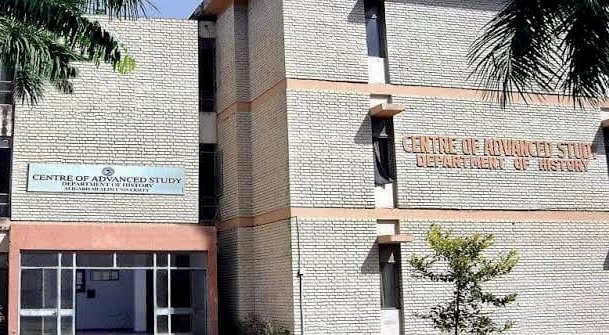
The Department of History at Aligarh, under the influence of scholars like Nurul Hasan, RC Gaur and Iqtidar Alam Khan, established a small but active archaeological laboratory. Students were trained in basic field survey techniques, pottery classification, and numismatic analysis. Several doctoral dissertations produced during this period combined textual and archaeological methods. One studied the medieval town of Sasaram through its surviving buildings and inscriptions. Another mapped the fortifications of the Deccan sultanates using both Persian chronicles and on the ground survey. A third analysed the ceramic sequences of medieval Gujarat to trace patterns of trade with the Persian Gulf. Perhaps Aligarh emerged as the only institution where since the last three decades Medieval Archaeology was introduced as a course at post graduate level.
This engagement with archaeology gave the Aligarh School a distinctive empirical edge. While the Cambridge and subaltern historians debated theory and discourse, Aligarh scholars continued to insist that history ultimately rests on evidence, and evidence includes not just what chroniclers wrote but what people left behind in the earth. The school at one time developed a full fledged archaeological wing, complete with a Chemical laboratory, like the Archaeological Survey of India, but its practitioners howsoever remained historians who used archaeology rather than professional archaeologists. But the turn was real and productive. It ensured that Aligarh history remained grounded in the material, not just the textual, world.
Another field promoted at Aligarh was the field of Cartography. Nurul Hasan established a Cartographic Lab which was promoted by Irfan Habib. With the help of Zahoor Ali Khan, as the Cartographer, and Faiz Habib as the assistant, a large number of maps were produced which found place in a number of publications throughout the world. Irfan Habib compiled two very important atlases on Indian history, the first, an Atlas of Medieval India, followed by an Atlas of Ancient India.
Works on Regional History
The Aligarh School is too rich and diverse to be captured by even a long list of names. Several other scholars deserve mention for their contributions to specific subfields.
Syed Jabir Raza went deep into sources of the Ghaznavid period in Punjab and wrote on this early period of Medieval History of India. His re-interpretation of Iqta, the use of elephants in warfare etc opened new vistas of study.
Mohibbul Hasan, though better known for his work on the history of Kashmir and the Mughal Empire, also contributed to the Aligarh tradition through his meticulous editing of Persian texts. His edition of the Tarikh i Kashmir provided scholars with a reliable text of a crucial source for the history of the Himalayan region. Satya Prakash Gupta opened new vistas in Agrarian System of Eastern Rajasthan and he along with his students delved deep in Rajasthani archival sources. His students like Muhammad Parvez and Sumbul Halim Khan are still carrying forward the field initiated by him and contributing to the field of Regional History. Muhammad Parvez also wrote and explored the history of Assam and the Northeast. Jamal Muhammad Siddiqui wrote in the history of District Aligarh and carried out extensive surveys of not only archaeological and architectural remains, but also inscriptions of the region. His book was a micro study of District Aligarh and a pioneering work in the field.
Other Notable Scholars
The pioneering work of Rafat Zahra Bilgrami on Religious and Quasi-Religious Departments of the Mughal Period (1556–1707, set the tone for legal studies to follow. This work went on to show that the religious and quasi-religious administrative apparatus of the Mughal Empire underwent significant shifts under different rulers, balancing the interests of a large non-Muslim populace with the Islamic principles of the state. Some others like Aziza Hasan and Najaf Haider worked on the coinage of the Delhi Sultanate and Mughal Empire, producing meticulous catalogues that remain the standard reference works. They demonstrated that changes in coinage, including metal content, weight standards, and iconography, correlated closely with fiscal crises and political instability. Their numismatic evidence often contradicted the chronicles, showing, for example, that periods described as prosperous by court historians were in fact marked by currency debasement and inflation.
Afzal Husain studied the administrative functioning of the Mughal Empire, producing in-depth study of Irani, Turani and Indian Shaikhzada nobles of Jahangir’s reign. His and M Athar Ali’s work made the technical language of Mughal bureaucracy accessible to non specialists and revealed the conceptual categories through which Mughal officials understood their world. Terms like zat, sawar, jagir, and khalisa were not merely technical but embodied a particular way of thinking about rank, obligation, and territory.
S.M. Azizuddin Husain worked on the history of education in medieval India, using the Malfuzat literature to reconstruct the curriculum of madrasas and the social background of students. He showed that medieval Indian education was more widespread and more socially diverse than previously believed, with students from artisan and trading families attending schools alongside the sons of nobles.
S. Liyaqat Hussain Moini contributed to the study of Sufi orders in the Medieval period, using Persian hagiographies to trace the spread of the Chishti and Qadiri orders into the southern peninsula. His work revealed that the Deccan had its own distinct Sufi traditions, shaped by local conditions and not merely derivative of north Indian models.
Ruquia Kazim Husain contributed to the undertaking of Armenian merchants and their trade activities. Abha Singh’s contribution to agrarian history, the Jats and the medieval canals, apart from her excellent contributions to the preparations of the IGNOU textbooks on Medieval Indian history have been much appreciated.
Recently Shadab Bano, Lubna Irfan and some others have started work on Gender and masculinity. Enayatullah, following the works of Irfan Habib, has been writing on environmental history. Moosvi too had contributed papers on climate and environmental issues like earthquakes.
The Persian Sources and Documentary Base
What united all these scholars, across subfields and generations, was their commitment to primary sources, and above all to Persian sources. The Aligarh School trained its students to read Persian manuscripts in the original, to understand the conventions of Persian historiography, and to recognise the biases and limitations of each text.
The most important Persian sources included the great court chronicles, such as Abu’l Fazl’s Akbarnama, Badauni’s Muntakhab al Tawarikh, and Shah Jahan’s official history, the Padshahnama of Abdul Hamid Lahori. These texts provided the narrative backbone of Mughal political history, but Aligarh historians read them critically, comparing them against each other and against non chronicle sources.
Equally important were the administrative manuals and revenue documents. The Ain i Akbari, part of the Akbarnama, was a statistical gazetteer of the Mughal Empire, containing detailed information on provinces, districts, revenues, and prices. The Chahar Gulshan, the Khulasat al Tawarikh, and other manuals provided additional data. The farmans, royal orders preserved in archives and published in collections, revealed the state in action, granting land, issuing instructions, and resolving disputes.
The Malfuzat, discourses of Sufi saints, and the Maktubat, letters of Sufi masters, provided access to religious and social life outside the court. The Waqai and Akhbarat, news reports and official newsletters, recorded events day by day, offering a granular view of politics and society that the grand chronicles smoothed over.
Beyond Persian, Aligarh scholars also worked with sources in Arabic, particularly for the early Sultanate period, and in Sanskrit, Prakrit, and regional languages for local history. Pushpa Prasad’s work on Lekhapadhiti and other documentary collections showed that a full history of medieval India required mastery of multiple linguistic traditions. The school’s emphasis on Persian never became exclusive. It remained a portal to other sources.
Critiques and Internal Debates
The Aligarh School’s emphasis on centralised, structural analysis did not go unchallenged. From the late 1970s onward, a new generation of historians raised significant critiques. Some of these critics came from outside the Aligarh tradition entirely. Others, more interestingly, were themselves products of the school who later moved away from its core assumptions. This internal critique carried particular weight precisely because it came from scholars who had mastered the Aligarh method before questioning its limits.
C.A. Bayly, trained at Cambridge and Oxford, in his book Rulers, Townsmen and Bazaars published in 1983, argued that Aligarh historians had overemphasised the state’s power and underemphasised the agency of local actors. Merchants, bankers, and intermediate groups, he showed, shaped the economy from below, not merely in response to state extraction. Bayly was an outsider to the school, but his respectful engagement with its work gave his critique force.
More significant was the case of Muzaffar Alam. Alam completed his M.Phil. and Ph.D. at Aligarh Muslim University. His doctoral work bore all the marks of the Aligarh method, rigorous source criticism, quantitative analysis, and a materialist framework. Yet as his career progressed, first at Jawaharlal Nehru University and later at the University of Chicago, Alam began to question the school’s emphasis on centralised state power and structural determinism.
Together with Sanjay Subrahmanyam, who was trained at the University of Delhi and the School of Oriental and African Studies in London and thus came from a different intellectual lineage, Alam argued for a processual understanding of the Mughal state. In a series of influential essays and edited volumes, they proposed that rather than a centralised road roller imposing its will from above, the Mughal Empire was more like a spider’s web, strong in some places, weak in others, constantly negotiated and renegotiated through alliances, gift exchanges, matrimonial ties, and local accommodations. The state did not simply command obedience, it had to produce it through everyday interactions with regional powers, zamindars, and local chieftains. This perspective, sometimes called the New Cambridge History approach, did not reject the Aligarh School’s findings so much as complicate them. Alam and Subrahmanyam accepted the importance of class and economic structure but insisted that these structures were always mediated by local politics, cultural practices, and contingent historical processes.
Farhat Hasan, another scholar who engaged deeply with the Aligarh tradition being a direct product of it, pushed this critique further in his book State and Locality in Mughal India. He argued that the Mughal state did not simply command obedience from below but had to manufacture it by embedding itself within local networks of power. Using documents from the port cities of Surat and Cambay, he showed that even subordinate groups like women, artisans, and petty merchants could use the ambiguities of Islamic law to defend their interests. Resistance, in other words, was not always outside the system in the form of peasant rebellions or noble conspiracies. It could also take the form of ritualised participation within the system, using the state’s own legal and administrative procedures to push back against exploitation.
These critiques enriched rather than demolished the Aligarh tradition. The school’s focus on class and structure remained indispensable. What was added was a sensitivity to negotiation, process, and locality, the recognition that the Mughal state was not a static machine but a dynamic, contested field. And significantly, the most effective critiques came not from hostile outsiders but from scholars like Muzaffar Alam who had internalised the Aligarh method, mastered its sources, respected its achievements, and then gently pushed beyond its limits. This is the mark of a mature historiographical tradition. It produces not just followers but thoughtful dissenters who carry its questions forward even as they offer new answers.
The Enduring Legacy
The Aligarh School transformed medieval Indian history from a discipline of chronicles and dynasties into a social science. Its key contributions can be summarised in several points.
Methodologically, the school insisted that every historical claim be grounded in source criticism, coins, inscriptions, revenue records, price data, paintings, archaeological evidence, not merely textual assertion. The Aligarh historian was trained to be sceptical of chronicles, to cross check one source against another, and to privilege documents produced for administration over those produced for courtly praise. The school produced more critical editions of Persian texts, more translations, and more source based studies than any other Indian historical tradition.
Analytically, the school demonstrated that religious identity is rarely the primary cause of historical events, and that material interests, class relations, and structural contradictions are more powerful explanatory tools. This was not a dogmatic secularism but an empirical finding. Again and again, when Aligarh historians looked closely at the evidence, they found that Hindus and Muslims cooperated or conflicted based on class position, fiscal interest, or political calculation, not on the basis of their faith alone.
Empirically, the school created a vast body of quantitative data on prices, wages, land revenue, noble composition, technology, settlement patterns, coin hoards, and painting conventions that remains the foundation for all subsequent scholarship. The Agrarian System, the Atlas, the prosopographical studies of the nobility, the work on urban middle classes, the studies of port towns, the epigraphical collections, the numismatic catalogues, these are not just arguments but repositories of evidence that any future historian must engage with.
Normatively, the school embodied an implicit commitment to secularism and social justice. By showing that Muslim rule was not uniformly oppressive and that exploitation was class based rather than communal, Aligarh historians provided intellectual ammunition against both colonial and Hindu nationalist narratives. They also, by focusing on peasants, artisans, labourers, and the urban middle classes, aligned their scholarship with the concerns of the dispossessed. This was not accidental. Many of the school’s leading figures came from backgrounds that were neither elite nor privileged. Their history writing was an act of solidarity with those who left few records of their own.
The school’s limitations are also real. There is a tendency toward state centrism, even in its agrarian history, the state remains the primary actor. There is a relative neglect of gender and cultural history. The questions of how women experienced Mughal rule, how religious identities were performed and negotiated in daily life, how art and literature shaped political consciousness, these received less attention than they deserved, despite the important work of S.P. Verma on paintings and Khaliq Ahmad Nizami on Sufi literature. And in its early phases, there was an under theorisation of why the Mughal state, despite its rational fiscal apparatus, ultimately failed to generate capitalist transformation. Irfan Habib himself addressed this last question in his later essays, identifying the jagirdari system and the absence of secure property rights as structural barriers, but a full explanation remains elusive.
Nevertheless, these limitations do not diminish the achievement. The Aligarh School, more than any other historiographic tradition in modern India, taught us to ask of any historical event a simple, rigorous, and relentlessly democratic question. Who benefited materially? That question remains its most valuable gift to the study of the past.
The school’s practitioners, from Mohammad Habib and Nurul Hasan in the founding generation, to Irfan Habib, Satish Chandra, M. Athar Ali, Mohibbul Hasan and Khaliq Ahmad Nizami in the second, to Shireen Moosvi, Iqtidar Alam Khan, Ahsan Jan Qaisar, Iqtidar Husain Siddiqui, S.P. Verma, Pushpa Prasad, M.P. Singh, Zafarul Islam, Afzal Husain, S.M. Azizuddin Husain, S. Liyaqat Hussaini,, Zahiruddin Malik, and others in the third, and to the present generation including my own work on the urban middle classes, S Jabir Raza on the political and administrative history of the Ghaznavid period, and Ishrat Alam on Technology, have shown that history writing is not a neutral recording of events but a political act. The names and works enumerated here are not complete and there is much more which is not being mentioned here. All of them have shown that the most powerful political act a historian can perform is to tell the truth about exploitation, class, and the material foundations of human life. This is why the Aligarh School matters, not only for students of medieval India but for anyone who believes that understanding the past is essential to building a more just future. The school has produced not just scholarship but a way of seeing the world, one that is sceptical of power, attentive to suffering, and committed to evidence. That is a legacy worth defending.
The Present
Yet it must be said, with regret rather than satisfaction, that the Aligarh School today is in severe decline. The intellectual energy that once flowed through the Department of History, producing generation after generation of rigorous, source critical, and socially engaged scholarship, has largely dissipated. Where once a student could find dozens of colleagues engaged in Persian paleography, numismatic analysis, or the quantitative study of agrarian systems, today one finds few. The institutional infrastructure that supported this work, the libraries, the manuscript collections, the archaeological laboratory, the doctoral fellowships, has withered under decades of neglect, underfunding, and shifting priorities within Indian higher education. More importantly, the intellectual culture itself has frayed. Few young scholars today choose to specialise in medieval Indian history with the same commitment to primary sources and materialist analysis that defined the school’s golden age. Those who do often find themselves isolated, without mentors, without peer review networks, and without the institutional backing that their predecessors enjoyed. The great names of the school are no longer being replaced. Mohammad Habib, Irfan Habib, Satish Chandra, M. Athar Ali, Khaliq Ahmad Nizami, Nurul Hasan, Shireen Moosvi, Iqtidar Alam Khan, Ahsan Jan Qaisar, Iqtidar Husain Siddiqui, S.P. Verma, Pushpa Prasad, Afzal Husain, Mohibbul Hasan, Zahiruddin Malik. These are names from the past. The present generation produces hardly any works that can stand beside theirs. The reasons are many, the rise of new fashionable theories from the West that dismiss materialist history as outdated, the pressure to publish quickly and superficially, the collapse of Persian language training in Indian universities, and a broader cultural retreat from the secular, rationalist, and socially committed values that animated the Aligarh project. One can only hope that this decline is a phase and not an ending. Historiographical traditions have a way of surprising us. They lie dormant, and then, in changed conditions, they revive. But for now, the observer of Indian historiography must record a painful truth. The Aligarh School, which once stood as a beacon of rigorous, democratic, and evidence based history, has fallen quiet. Its libraries grow dusty. Its methods are untaught. Its questions go unasked. And the history of medieval India is poorer for it.
A man works on a poster on Cockroach Janta Party (CJP) ahead of CJP’s protest on June 6th, in Mumbai, Maharashtra, on June 3, 2026. | Photo Credit: PTI
A protest is not a polite gathering. It is raw, human, and meant to be felt. It exists to pierce through indifference, to make strangers stop in their tracks, to force conversations at dinner tables, and to rattle the windows of power. When that power is stripped away, what is left is not protest. It is theatre. A stage where anger performs for itself while the rest of the world scrolls past.
The recent permission given to the Cockroach Janta Party (CJP) to demonstrate at Jantar Mantar in Delhi captures this quiet tragedy perfectly. On paper, it looks like democratic accommodation. In practice, it is democratic containment. Jantar Mantar and places like Azad Maidan in Mumbai have become official protest pits, designated zones where citizens are politely told: You may speak your truth here, and only here.
From the Heart of Power to the Edge of Hearing
Jantar Mantar was not built for slogans. It was an 18th-century astronomical observatory, a place of stars and precision. Today, it serves a different purpose: the careful mapping of where dissent is allowed to orbit without ever touching the centre.
Older Indians still speak with a certain ache about the Boat Club lawns on Rajpath. You could see Parliament from there. When thousands gathered, farmers with calloused hands, students burning with idealism, workers demanding dignity, the seat of power could not look away. The protest was not hidden behind barricades or drowned out by competing chants. It stood in the open, visible, impossible to ignore.
Then the rules changed. Security concerns. Traffic problems. Public inconvenience. Slowly, steadily, the state did not ban protest. It simply relocated it. Away from the eyes of the powerful. Away from the daily commute of the middle class. Into a cordoned-off enclosure where voices echo among the already convinced.
That single shift from “You cannot protest” to “Protest here” changed everything.
At Jantar Mantar, you can raise your voice until it cracks. You can wave placards until your arms ache. But the only audience is often other protesters, each carrying their own heavy sorrow. One group’s march becomes another’s background noise. The real public, the shopkeepers, the office-goers, the families planning weekend outings, continues untouched. The rage stays safely quarantined.
A Sophisticated Kind of Silencing
This is not old-school authoritarianism that throws people in jail for speaking. That was crude and visible. Modern management of dissent is gentler, almost courteous. It issues permissions. It erects metal barricades. It deploys police to maintain order. And then it returns to business as usual, satisfied that the thermometer has been allowed to let off steam without breaking the system.
The citizen is permitted to shout. Nobody important is required to listen.
The irony cuts deep. Every year on Republic Day and Independence Day, we celebrate the freedom struggle. School assemblies echo with stories of Gandhi’s Salt March, the Non-Cooperation Movement, Quit India. Children memorise tales of satyagraha and civil disobedience. Leaders lay wreaths at statues of revolutionaries.
Yet imagine if those same figures tried it today. Gandhi’s Salt March would likely be redirected to a designated site to avoid disrupting traffic. A massive gathering against unjust laws would be advised to obtain permission and not inconvenience the general public. The very methods that won us freedom, disrupting normality and forcing society to confront uncomfortable realities, have been sanitised out of democratic practice.
Because real protest must disturb. Not with violence, but with presence. It should make the comfortable feel uneasy. It should turn private pain into a public question. A protest that changes nothing in the rhythm of daily life is little more than performance art.
When Dissent Disappears from View
The media ecosystem makes this containment even more effective. In an age of endless content and shrinking attention, a protest tucked away in an enclosure can vanish from collective memory by evening. People living insulated lives rarely encounter the exhaustion of a young student crushed by competitive exams and uncertain futures, a farmer staring at mounting debt, or a worker whose dignity has been eroded by precarity. Instead, they are fed polished narratives of progress.
This creates two Indias living side by side. One that feels the daily bite of unemployment, inflation, educational pressure, and institutional decay. Another that mainly encounters slogans of achievement and shining statistics.
The bridge between them was supposed to be protest, the visible, inconvenient reminder that not everyone is thriving. When that bridge is dismantled or cordoned off, the suffering of one India becomes inaudible to the other.
The Farmers’ Lesson and the Danger of Managed Anger
The farmers’ movement showed what happens when dissent refuses the cage. Whatever one thought of the specific demands, it broke through. It occupied physical and mental space. It forced families across the country to discuss, argue, and confront realities that neat news cycles preferred to ignore. It reminded us that democracy is not just about elections every five years. It is about how governance feels to those living under it.
Today, the Cockroach Janta Party’s protest at Jantar Mantar stands as a fresh example of this very dynamic. Born from youth frustration over exam scandals and governance failures, this Gen Z-led movement has channeled widespread anger into a permitted gathering at the designated site. While it highlights genuine student anxieties about education and futures, its confinement to the enclosure risks limiting its reach, turning raw discontent into another contained spectacle rather than a force that disrupts daily complacency across the nation.
History warns us what happens when listening stops. Frustration can simmer quietly for years among students worried about jobs, young people staring at uncertain futures, ordinary citizens tired of being managed rather than heard. Then it erupts suddenly, as seen from Eastern Europe’s Velvet Revolutions to the streets of Sri Lanka or Bangladesh. The spark is often not one policy, but the accumulated sense that power has stopped caring.
What a Living Democracy Demands
Democracy is not merely the right to vote or the formal permission to protest. It is the right to be heard. It requires citizens brave enough to be disturbed by others’ pain. It requires governments secure enough to face criticism instead of regulating it into irrelevance.
A healthy democracy needs inconvenient protests. It needs voices that spill beyond designated enclosures. It needs leaders who understand that the loudest threat is not shouting in a cage, but the quiet withdrawal of trust by millions who no longer believe anyone is listening.
The question facing us today is not whether citizens are still allowed to protest. The question is whether those in power are still compelled to hear them.
When people can scream with everything they have and it changes nothing, when dissent becomes background noise rather than a call to conscience, that is when democracy begins to hollow out from within. Not with tanks in the streets, but with the polite, bureaucratic domestication of the citizen’s voice.
There is a proposal floating around to change the name of Barkatullah University in Bhopal. On the surface, it might sound like a routine administrative matter, the kind of thing that involves little more than a new signboard and some updated letterheads. But we all know that is not how these things work in India today. A name change of this sort is never just paperwork. It is a statement and a political act. And in this case, it is an act that raises profound questions about how we remember our freedom struggle, whose sacrifices we choose to honour, and which version of India we want to leave for our children.
To understand why this matters, we first have to go back and meet the man behind the name. Maulana Abdul Hafiz Mohammad Barkatullah was born in Bhopal on 7 July 1854. He grew up studying Arabic, Persian, and English, but his education was not confined to books. His real classroom was the world. He could not stand the sight of his country being ruled by a foreign power that treated Indians as less than human. And so, unlike most freedom fighters who worked from within the country, Barkatullah spent almost his entire life in exile. He travelled to England, Germany, France, Russia, Japan, China, Turkey, and the United States. Wherever he went, he talked, wrote, and argued for one thing: the liberation of India. He taught at the University of Tokyo. He worked with Lala Hardayal of the Ghadar Party in San Francisco. He connected with anti‑colonial movements across Asia and the Middle East. Distance never weakened his love for his homeland. If anything, it made his commitment fiercer.
What makes Barkatullah truly remarkable, and what sets him apart from many of his contemporaries, is his unshakeable belief that India could only be free if all its communities stood together. He was a deeply religious Muslim, but he understood something that the British were counting on Indians to miss. The British knew that a divided India was a weak India. So they encouraged suspicion between Hindus and Muslims, sowed distrust, and turned neighbours into rivals. Barkatullah refused to play that game. He worked with Hindu, Sikh, Christian, and Parsi revolutionaries without a moment’s hesitation. For him, the enemy was not the person who prayed in a different temple or mosque. The enemy was the Union Jack.
The best proof of this inclusive vision is the Provisional Government of India that was set up in Kabul in 1915. At the height of the First World War, Barkatullah joined hands with Raja Mahendra Pratap, a Hindu prince from Uttar Pradesh, and Maulana Ubaidullah Sindhi, a renowned Islamic thinker. Together, they formed a government in exile. Raja Mahendra Pratap became the President. Barkatullah became the Prime Minister. They issued stamps, appointed ambassadors, and sought military help from Germany, Turkey, and Afghanistan to push the British out. Think about what this meant in 1915, long before the Congress had even dreamt of Poorna Swaraj. A Muslim scholar from Bhopal, a Hindu king from North India, and a great theologian sat around the same table, trusted each other with their lives, and said: our India will be free, and it will be free together. That is the kind of man Barkatullah was.
He gave up everything. He never married, saying that the struggle for India was his only bride. He never owned a house or collected wealth. He died in exile in the United States on 20 September 1927, far from the land he loved. It is said that his last words were not bitter. He only regretted that he would not live to see a free India. But he told those around him with complete confidence that future generations would finish what he and his comrades had started. Twenty years later, when in 1947, India became independent, the nation remembered him. One of the most meaningful tributes was naming the university in Bhopal after him. Barkatullah University is not a random name on a map. It is a thank you. It is a promise. It tells every student who walks through its gates: you stand on the shoulders of a man who gave his entire life for this country.
Now, here is where the story gets uncomfortable. Because at the same time that some voices are demanding that Barkatullah’s name be removed, another freedom fighter from that very same Kabul government is being honoured. In September 2021, the Prime Minister himself laid the foundation stone for a new state university in Aligarh named after Raja Mahendra Pratap. The same Raja Mahendra Pratap who was Barkatullah’s comrade, his President, his partner in one of the most audacious acts of anti‑colonial defiance in history. Their names are tied together in the pages of history. They fought together, planned together, and dreamed the same dream. Yet one is being celebrated with a brand new university, while the other is being erased from an existing one.
The irony here is so sharp that it cuts. Because Raja Mahendra Pratap was no conventional ‘Hindu’ leader who fits neatly into a narrow, majoritarian version of history. Far from it. He was deeply critical of Hindu nationalist politics. He believed that religious divisions were a British creation. He started his own faith called Prem Dharam, the Religion of Love. His great grandson once told a newspaper that the Raja was “the kind of person who would say namaz in the morning, live a Buddhist life in the noon and listen to Ram and Krishna bhajans in the evening.” Imagine that. A man who prayed in a mosque, a temple, and a Buddhist shrine on the same day. And this is the man whose name is now being used to further a political narrative.
But there is more. In the 1957 Lok Sabha elections, Raja Mahendra Pratap contested from Mathura as an independent candidate. Who did he defeat? A young Atal Bihari Vajpayee, then the candidate of the Bharatiya Jana Sangh, the party that later became the BJP. Vajpayee finished fourth. The Raja won. He was a Marxist revolutionary, a follower of Mahatma Gandhi, and a man who openly rejected the Jana Sangh’s brand of politics. He saw the British, not Muslims or Hindus, as the real enemy. Yet despite all this, despite having fought against the ideological forefathers of today’s ruling party, a university has been built in his name. And not just anywhere. In Aligarh, the heart of Muslim identity in North India. For years, local BJP leaders had demanded that Aligarh Muslim University itself be renamed after Raja Mahendra Pratap. When that did not happen, a new state university was created as an alternative. A man who would have been horrified by the politics of exclusion was repackaged and turned into a weapon against the very institution he once supported.
What does this contrast teach us? It teaches us that the decision to honour or erase a freedom fighter has nothing to do with historical truth and everything to do with political convenience. Raja Mahendra Pratap is useful because he is a Hindu Jat king who donated land to AMU. His story can be twisted, simplified, and weaponised. Barkatullah, on the other hand, is being singled out for erasure precisely because he was a Muslim. Even though both men fought together, even though both believed in the same inclusive, syncretic vision of India, one is being raised on a pedestal and the other is being thrown into the dustbin. This double standard exposes the real motive behind the demand to rename Barkatullah University. It is not about history. It is about exclusion. It is about telling a generation of young Indians that some heroes are more Indian than others.
There is something else that gets lost in these debates, something that cannot be captured in political speeches or hashtags. It is the living, emotional connection that thousands of students and alumni have with the name Barkatullah University. For decades, young men and women have graduated from this institution. They have said with pride, on resumes and in job interviews, “I am from Barkatullah University.” The name is woven into their memories of late night chai breaks, of friendships that started in hostel corridors, of exams that felt like wars and results that felt like celebrations. For the people of Bhopal, this university is not a building. It is a part of their identity. Changing the name would feel like a betrayal of those memories. It would tell generations of alumni that the name they carried with them for years was somehow wrong, or shameful, or unfit. That is not an administrative change. That is an emotional wound.
And think about the message this sends to young Muslims in India today. At a time when they are already made to feel like outsiders in their own country, when their loyalty is questioned and their symbols are attacked, removing Barkatullah’s name from a major public university would confirm their worst fears. It would tell them that no matter how much you love your country, no matter how much you sacrifice, your religion will always be held against you. It would tell them that the freedom struggle, which their forefathers bled for, is being rewritten as a one‑community show. Is that the India we want to build? Is that the lesson we want to teach our children?
A confident nation does not erase its heroes. It remembers them, even when that memory is uncomfortable for some. It debates history with honesty, but it never confuses political convenience with historical truth. Barkatullah gave his life for India. That is not a matter of opinion. It is a fact. And the contrast with Raja Mahendra Pratap could not be clearer. Both men were comrades. Both shared the same dream. Both fought the same enemy. Yet one is being honoured and the other is being erased. If we truly respect the legacy of Raja Mahendra Pratap, we must also respect the legacy of Maulana Barkatullah. You cannot have one without the other. Their names are joined in history, and no amount of political maneuvering can untie that knot.
So let us be very clear. Barkatullah University must remain Barkatullah University. Not because of some abstract principle, but because names matter. They carry stories. They teach us who we are. And his story is not just a Muslim story or a Bhopal story. It is an Indian story. It tells us that India belongs equally to everyone who loves it, regardless of their faith. It tells us that the fight for freedom was a joint fight, won by joint sacrifice. It tells us that unity, not division, is what makes a nation strong. To keep his name is to keep faith with that vision. To remove it is to turn our back on the very best of what India has been and can still be. For the sake of our history, for the sake of every student who walks through those gates, and for the sake of the inclusive India that both these great men gave their lives for, the name must not change. Not now. Not ever.
Eid al Ghadir is one of the most profound occasions in the Islamic calendar, commemorating an event that took place on the 18th day of Dhu al Hijjah in the year 10 AH, which corresponds to 632 CE. The location was a sun baked crossroads known as Ghadir Khumm, situated between the holy cities of Mecca and Medina. The Prophet Muhammad had just completed his Farewell Pilgrimage, known as Hajjat al Wada, the only Hajj he would ever lead. As he and the large caravan of Muslims made their way back toward Medina, something unexpected happened. The Prophet ordered those who had ridden ahead to turn back, and he instructed those who were lagging behind to hurry forward. He wanted everyone to gather together in that barren valley under the scorching Arabian sun. The travellers must have wondered why they were stopping in such an unforgiving place. A makeshift pulpit was quickly assembled from camel saddles and woven panniers. The Prophet climbed onto this simple platform and began to speak at length, reminding the believers of his mission and his responsibilities toward them.
Then came the moment that would echo through history. The Prophet took the hand of his cousin and son in law, Ali ibn Abi Talib, and raised it high so that everyone could see. He then made a declaration that has been preserved in countless historical and hadith sources. He said, “Man kuntu mawlāhu fa hādhā `Aliyyun mawlāhu,” meaning, “For whoever I am his mawla, this Ali is his mawla.” He immediately followed this with a heartfelt prayer. “O God, befriend those who befriend him, oppose those who oppose him, support those who support him, and abandon those who abandon him.” The crowd stirred with emotion. The first to step forward and offer congratulations to Ali were the senior companions, including Abu Bakr and Umar, who reportedly said, “Well done, O son of Abu Talib. You have become the mawla of every believing man and woman.”
To understand why this moment carried such weight, we need to know who Ali ibn Abi Talib was. He was not a stranger suddenly elevated. Ali had been raised in the Prophet’s own household from the age of six. He was the first male to embrace Islam, only a boy of ten or eleven when he accepted the message. On the night of the Prophet’s migration from Mecca to Medina, when assassins surrounded the Prophet’s house, Ali bravely slept in the Prophet’s bed, risking his own life so that his cousin could escape safely. The Prophet had already declared on multiple occasions that Ali held the same position to him as Aaron had held to Moses, with the only difference being that no prophet would come after him. This is known as the Hadith al Manzilah and is recorded in the most trusted Sunni collections, including Sahih al Bukhari and Sahih Muslim. The Prophet had also famously said, “I am the city of knowledge, and Ali is its gate. So whoever wants knowledge, let him enter through the gate.”
The Prophet was not acting on his own at Ghadir Khumm. According to the overwhelming majority of classical sources, he had received a direct command from God just before the stop. The verse of the Qur’an revealed to him said, “O Messenger, convey what has been sent down to you from your Lord, and if you do not, then you have not conveyed His message. And God will protect you from the people.” This verse, chapter 5 verse 67, left the Prophet with no choice. He had to make the announcement publicly even though he feared that some might accuse him of favouring his own family. After the declaration at Ghadir, another well known verse was revealed, this time chapter 5 verse 3, which declares, “Today I have perfected for you your religion, completed My favour upon you, and chosen Islam as your religion.” For Shi’i Muslims, this verse signifies that the religion was completed only with the appointment of Ali as the Prophet’s successor and the guardian of the community.
The word mawla is the key to understanding why Ghadir became a dividing line in Islamic history. In Arabic, mawla can mean master, leader, guardian, protector, or friend. For Shi’i Muslims, the Prophet’s use of the word in that specific context, combined with the raised hand, the prayer, and the divine command to convey the message, could only mean one thing. The Prophet was publicly designating Ali as his successor, the vicegerent who would lead the community after him. This was not merely a praise of Ali’s virtues. It was the formal inauguration of the Imamate, a divinely ordained institution of leadership that would continue through Ali and his descendants. For Sunni Muslims, the event remains deeply important as a testament to Ali’s unparalleled virtue and closeness to the Prophet, but the word mawla is understood more in the sense of friendship and religious authority rather than political succession. Despite this difference in interpretation, Ghadir Khumm remains part of the shared historical memory of all Muslims, a moment when the Prophet publicly affirmed the special station of a man who embodied knowledge, courage, piety, and justice.
The Prophet also used the sermon at Ghadir to remind the community of what he called the two weighty things, or al Thaqalayn. He said, “I am leaving among you that which if you hold fast to it, you will never go astray after me. The Book of God and my progeny, my family. Indeed, the two will never separate until they return to me at the Pond.” This declaration, recorded in Sahih Muslim and other reliable collections, emphasises that spiritual guidance after the Prophet’s passing would require clinging to both the Qur’an and the Prophet’s household, especially Ali and his righteous descendants.
Ali’s personal qualities make it clear why the Prophet would have wanted such a man to lead. He was unmatched in his knowledge of the Qur’an and its inner meanings. He was the most courageous fighter in early Islam, carrying the standard in nearly every major battle, including Badr where he defeated the Quraysh champion, Uhud where he defended the Prophet when most of the army fled, and Khaybar where the Prophet said, “Tomorrow I will give the standard to a man who loves God and His Messenger, and whom God and His Messenger love.” Yet Ali was equally known for his justice and his simple way of life. As caliph years later, he patched his own sandals, ate coarse food, and distributed the state treasury’s wealth so quickly that nothing remained. He famously said that the world was a carcass and that those who fought over it were like dogs. His sermons, letters, and sayings, collected in the book Nahj al Balaghah, are celebrated for their eloquence and their deep insight into God, governance, and the soul.
One lesser known but important detail is that the declaration at Ghadir immediately provoked opposition. Shortly after the event, the Prophet sent Ali to Yemen to deliver a chapter of the Qur’an to the polytheists. On his way back to join the Prophet in Medina, some men who resented the Ghadir announcement plotted against him and attempted to ambush him. The Prophet learned of this and prayed for Ali’s safety. This early act of hostility showed that the question of leadership after the Prophet had already begun to stir conflict, confirming that the Ghadir declaration was understood by many as a political as well as a spiritual appointment.
For Shi’a Muslims around the world today, Eid al Ghadir is celebrated as the greatest of the Eids, even greater than Eid al Fitr and Eid al Adha in their spiritual significance. It is called the Eid of Wilayah, meaning the festival of divine guardianship and authority. On this day, believers fast if they are able, wear new or clean clothes, visit each other to exchange congratulations, and recite special prayers that repeat the Prophet’s original invocation, “O God, befriend those who befriend Ali and oppose those who oppose Ali.” It is a day of joy, but also a day of deep reflection on what it means to follow the Prophet’s teachings by holding fast to both the Qur’an and the example of his pure household.
Beyond any sectarian division, Ghadir Khumm remains a living symbol of loyalty to the Prophet’s message, the importance of righteous leadership, and the enduring love that millions of Muslims feel for Ali ibn Abi Talib, the gate to the city of knowledge, the lion of God, and the first guardian of a community that the Prophet prayed would never stray.