Syed Ali Nadeem Rezavi
As the month of Muharram approaches, Muslims around the world prepare to remember the martyrdom of Imam Husain at Karbala. It is a good time to pause and reflect on who the Ahlul Bayt (the Prophet’s family) really are and why they matter so deeply to millions of believers.
Every year, Muharram draws attention not only to the tragedy of Karbala but also to the remarkable family at the heart of that event. The tears shed for Husain, the gatherings held in honour of the martyrs, and the deep love people feel for the Prophet’s household all stem from a bond that has shaped Muslim spirituality, ethics, and religious life for over 1,400 years.
So who exactly are the Ahlul Bayt?
The term Ahlul Bayt simply means “the People of the House” or “the Household”. In practice, it refers to the family of the Prophet Muhammad. No other family in Islamic history has received such lasting reverence, affection, and devotion. And this isn’t just because they were blood relatives. It is because Muslims believe they played a unique role in preserving, living out, and passing on the Prophet’s teachings.
In both Sunni and Shi’i Islam, loving the Ahlul Bayt is seen as an extension of loving the Prophet himself. You cannot love him fully, the thinking goes, without also loving those closest to him.
What might be missing from this picture?
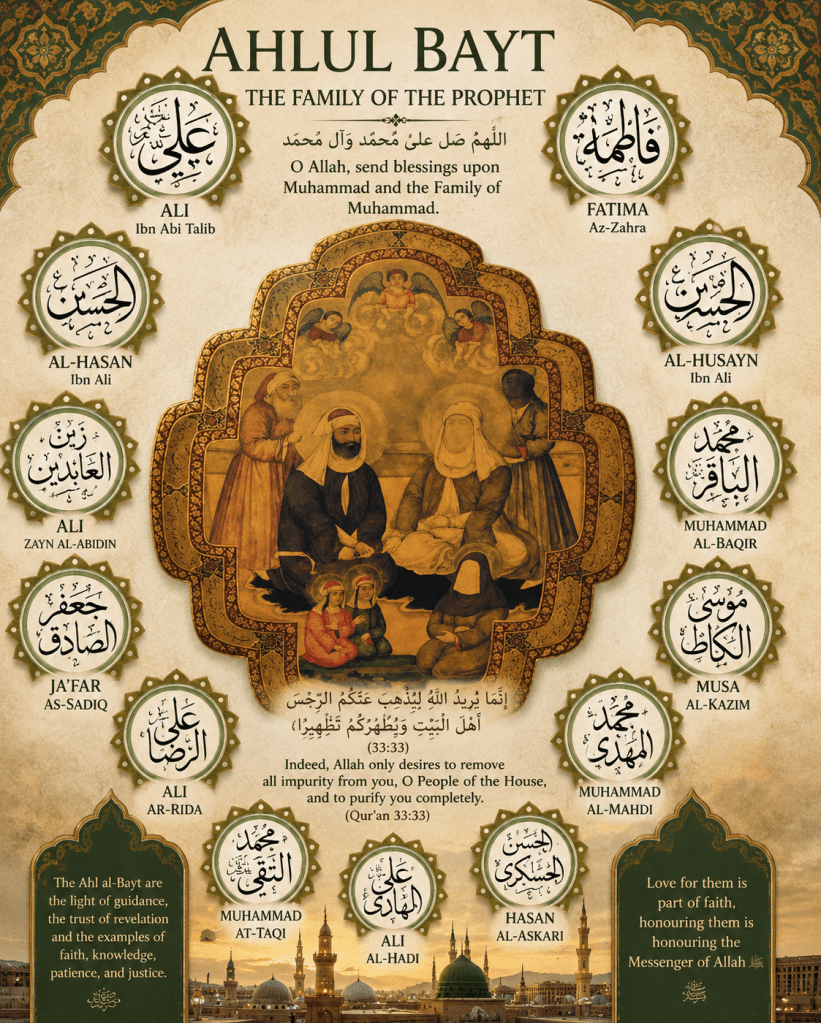
One thing that is often missing when people talk about the Ahlul Bayt is a simple explanation of who is actually included. In its narrowest sense (especially in Shi’i belief), the Ahlul Bayt refers to five people: the Prophet Muhammad, his daughter Fatima al Zahra, his cousin and son in law Ali ibn Abi Talib, and their two sons Hasan and Husain. The Shi’I expand the term to include not only the panjatan, but also the Imams who followed them: the 14 Impeccables (masūmīn). In a wider sense, many Sunni Muslims also include the Prophet’s wives, particularly Khadija and Aisha, as part of his household. So when you hear the term, it helps to know that context matters.
Another missing piece is why this matters to someone who isn’t Muslim. The story of the Ahlul Bayt is not just a religious story. It is a human story about family, love, loss, standing up against injustice, and keeping faith alive when everything seems lost. That is why people from many backgrounds, not just Muslims, have been moved by figures like Husayn.
Why are they so central to Islam?
Let’s start with the Prophet’s own attitude. Throughout his life, he openly showed his affection for Ali, Fatima, Hasan and Husain. He would carry Hasan and Husayn on his shoulders during prayer. He would stand up when Fatima entered the room and say, “She is a part of me. Whoever hurts her hurts me.” These weren’t just family moments. They were public lessons to the community.
The Qur’an also points to the Prophet’s family. One famous verse says:
“Indeed Allah only desires to remove all impurity from you, O People of the House, and to purify you completely.” (Qur’an 33:33)
This is often called the Verse of Purification. Another verse says:
“Say: I ask of you no reward for it except love for my near relatives.” (Qur’an 42:23)
For centuries, Muslim scholars have seen this as making love for the Prophet’s family a religious duty, not just a nice thing to do.
Stories that shaped their place in Islam
There is a well known event called the Hadith al Kisa (the Tradition of the Cloak). The story goes that the Prophet gathered Ali, Fatima, Hasan and Husain under his cloak and prayed, “O Allah, these are my Ahlul Bayt. Remove impurity from them and purify them completely.” This event is central to Shi’i belief because it identifies this small group as the innermost circle of his family.
Then there is the event of Mubahala, a peaceful challenge with Christians from Najran. When talks about the nature of Jesus reached a dead end, the Qur’an suggested both sides call on God’s judgement. The Prophet brought only Ali, Fatima, Hasan and Husain with him, calling them “our sons”, “our women” and “ourselves”. For Shi’a Muslims, this is powerful proof of their unique rank. Even Sunni scholars see it as a testament to their special standing.
Perhaps the most famous tradition is the Hadith al Thaqalayn (the Tradition of the Two Weighty Things). The Prophet said:
“I leave among you two weighty things: the Book of Allah and my Ahlul Bayt. If you hold fast to them, you will never go astray after me.”
This is recorded in both Sunni and Shi’i sources. It suggests that the Qur’an and the Prophet’s family together are the lasting guides for the Muslim community.
The Shi’i understanding: Imams and divine guidance
For Shi’a Muslims, the importance of the Ahlul Bayt goes even further. They believe that after the Prophet died, divine guidance continued through a line of twelve Imams, all descended from Ali and Fatima. The first Imam was Ali, followed by Hasan, then Husain, then nine more of Husain’s descendants. The twelfth Imam, Muhammad al Mahdi, is believed to be alive but hidden, and will return one day to bring justice to the world.
These Imams are not seen as prophets (prophethood ended with Muhammad). But Shi’a Muslims believe they were chosen by God to preserve and explain Islam. They were spiritual and moral leaders, not just political rulers.
A key moment for Shi’a Muslims is the event of Ghadir i Khumm. On the way back from his final pilgrimage in 632 CE, the Prophet stopped at a place called Ghadir i Khumm, took Ali by the hand, and said to the crowd: “For whomever I am the mawla (leader or friend), Ali is his mawla.” Shi’a Muslims see this as the formal appointment of Ali as the Prophet’s successor. Sunni scholars generally see it as an expression of Ali’s closeness and virtue. Either way, it shows his exceptional standing.
Karbala: The tragedy that changed everything
No single event shaped the memory of the Ahlul Bayt more than the tragedy of Karbala in 680 CE. Imam Husain refused to pledge loyalty to a ruler he saw as unjust. He marched towards Iraq with a small band of family and companions. They were surrounded on the plain of Karbala, cut off from water for days, and then killed one by one. Husain himself was martyred, and his family was taken captive.
For Shi’a Muslims, Karbala is the defining moment in the struggle between truth and falsehood, justice and tyranny. Husain’s refusal to give in, even when he knew he would die, turned him into a universal symbol of moral resistance. His sacrifice showed that dignity and truth are worth more than life itself.
But Karbala is not just for Shi’a Muslims. Across the Muslim world, Husain is remembered as the beloved grandson of the Prophet who gave everything for what was right. Poets, scholars and mystics from many backgrounds have honoured his memory.
But what about Sunni Muslims?
It is a common mistake to think that loving the Ahlul Bayt is only for Shi’a Muslims. That is simply not true. Sunni Islam has always had a deep and enduring devotion to the Prophet’s family. The daily prayers of Sunni Muslims include blessings on “Muhammad and the family of Muhammad” every single time. That happens millions of times a day across the globe.
The Prophet himself said, “I remind you concerning my Ahlul Bayt. I remind you concerning my Ahlul Bayt. I remind you concerning my Ahlul Bayt.” Another saying goes: “Love Allah for His blessings upon you, love me for the sake of Allah, and love my family for my sake.”
Many great Sunni scholars expressed profound love for the Prophet’s family. Imam al Shafi’i, one of the most influential Sunni jurists, wrote poetry saying that love for the Prophet’s family is an obligation revealed in the Qur’an. He added that a prayer is incomplete without blessing the Prophet’s family.
So the difference is not about love. The difference is about the role of the Ahlul Bayt after the Prophet’s death. Shi’a Muslims believe they were divinely appointed leaders. Sunni Muslims honour them deeply but do not give them the same level of religious authority.
Why does this matter today?
The influence of the Ahlul Bayt goes far beyond theology. Their lives have inspired poetry, art, architecture, music and movements for justice. From the golden shrines of Najaf, Karbala, Mashhad and Medina to the mourning poetry of Iran, Iraq, Turkey, Pakistan and India, their presence can be felt across the Muslim world.
As Muharram begins and Muslims prepare to remember Karbala, it is worth remembering that the story of the Ahlul Bayt is not just a story of suffering. It is also a story of faith, courage, sacrifice, justice and staying true to your principles even when the cost is high. Whether you look through a Shi’i lens or a Sunni one, the Ahlul Bayt remain at the heart of Islam. They are the closest link to the Prophet himself. Their legacy continues to inspire believers across the world, and their example still speaks to anyone who cares about standing up for what is right.


