Syed Ali Nadeem Rezavi
The month of Muharram is nearly upon us. This year it starts on 16th June, and the 10th day, known as Ashura, falls on 26th June. As the month approaches, a familiar controversy begins again. Should Muharram be celebrated or commemorated? Do we greet each other as if it is a festival, or do we offer condolences as if a loved one has passed away? To answer this question, we must first understand what Muharram truly means and why it carries such weight in the Islamic tradition.
What is Muharram?
Muharram is the first month of the lunar Hegira calendar, which Muslims follow for religious dates and events. The word Hegira means migration, and it refers to the Prophet Muhammad’s journey from Mecca to Medina in 622 CE. This event marks the start of the Islamic calendar, and the first month of that year was Muharram. That is why Muharram became the first month, even before the tragedy of Karbala gave it a new and deeper meaning.
The word Muharram comes from hurmat, meaning sacred or forbidden. In pre-Islamic Arabia, this month was already considered sacred. War was forbidden during this month, and tribes would observe a truce. But after the event of Karbala in the year 61 AH, which corresponds to 680 CE, the month took on a completely new meaning. That was the year when Husain, the grandson of the Prophet Muhammad, was massacred along with his small band of family members and companions on the desert plain of Karbala in present day Iraq. From that point onward, Muharram became known as the month of mourning. It is not a month of celebration, and one does not wish Happy Muharram or send festive greetings. To do so is to misunderstand what happened, or worse, to ignore the suffering of the Prophet’s family.
Who Was Imam Husain and Why Does He Matter?
To understand why Muharram is a commemoration and not a festivity, we need to understand who Imam Husain was and what mission he stood for. Imam Husain was not an ordinary person. He was the grandson of the Prophet Muhammad through his daughter Fatima and his cousin and son in law Ali ibn Abi Talib. The Prophet loved Husain deeply and famously said, “Husain is from me and I am from Husain.” He also said that his grandsons Hasan and Husain are the leaders of the youth of paradise.
The Ahlulbayt, which means the people of the household of the Prophet, hold a special position in Islam. They were not just family members in a biological sense. They were the carriers of the Prophet’s message, the protectors of his Sunnah or way of life, and the living examples of Quranic ethics. The Prophet had clearly instructed Muslims to love and respect his Ahlulbayt and to follow their guidance after him. So when Imam Husain stood up against Yazid, he was not acting as a political rebel. He was acting as the guardian of Islam itself.
Who Was Yazid and How Did He Want to Harm Islam?
Yazid was the son of Muawiyah, who was the founder of the Umayyad dynasty. Muawiyah and his family had been among the strongest opponents of the Prophet before they accepted Islam later in order to save their wealth and status. After the death of the Prophet, and after the caliphates of Abu Bakr, Umar, Uthman, and Ali, Muawiyah managed to seize power and established a kingship style rule. This was very different from the consultation based system of early Islam. When Muawiyah died, in spite of a Treaty which he had signed with Imam Hasan to the contrary, he appointed his son Yazid as his successor.
Yazid was known for his love of wine, hunting, and entertainment. He had little regard for Islamic teachings. He was not a pious man. Yazid demanded that Imam Husain give him an oath of allegiance, meaning that Husain would have to accept Yazid as the legitimate leader of the Muslim community. For Imam Husain, this was impossible. To accept Yazid’s rule would mean endorsing a man who openly violated Islamic principles. It would mean giving legitimacy to corruption, oppression, and the transformation of the caliphate into a hereditary monarchy.
Yazid wanted to harm Islam from within. He did not need to destroy the religion from outside. He wanted to empty it of its spiritual content, reduce it to a tool of power, and silence any voice that spoke the truth. Imam Husain understood this clearly. He famously said that he was rising not out of arrogance or rebellion, but to reform the nation of his grandfather. He said he wanted to enjoin good and forbid evil, and to follow the way of his grandfather and his father Ali.
The Tragedy of Karbala
Imam Husain left Medina with his family and headed toward Kufa, where many people had invited him to lead them. On the way, he was intercepted by Yazid’s army and forced to stop at the barren land of Karbala. For days, the Umayyad army cut off water from Husain and his camp. Children cried from thirst. The women suffered terribly. On the 10th of Muharram, Ashura, the army attacked.
Imam Husain’s companions were killed one by one. Then his family members and his own sons were killed. Finally, Imam Husain himself was martyred. His six month old baby, Ali Asghar, was shot with an arrow while Husain held him in his arms asking for water. The tragedy is almost too great to bear. That is why Muslims mourn during Muharram. They mourn not just because of the death of a historical figure, but because of the systematic destruction of the Prophet’s family, the captivity of the women of Ahlulbayt, and the temporary triumph of falsehood over truth.
But the deeper message of Karbala is that truth eventually wins. The massacre of Husain turned out to be the death of Yazid in the pages of history. Today, no Muslim names their child Yazid with love, but millions name their children Husain. Yazid is remembered as a tyrant. Husain is remembered as a hero. That is why a famous couplet says, “Qatl e Husain asl mein marg e Yazid hai, Islam zinda hota hai bas Karbala ke baad.” The killing of Husain is actually the death of Yazid, and Islam is revived only because of Karbala.
Karbala Marks the Distinction Between Two Paths
Karbala marks the distinction between two completely different paths. One path is the path of extremism, force, and terrorism. Yazid and his followers believed that they could crush truth by brute force. They believed that power and violence could make people submit. That is the path of the oppressors in every age.
The other path is the path of peace, love, and mercy. This is the path exemplified by Imam Ali, Imam Hasan, and Imam Husain. Imam Ali taught justice and forgiveness even toward his enemies. Imam Hasan, the elder brother of Husain, chose a peace treaty with Muawiyah to avoid bloodshed among Muslims. He showed that peace is not weakness but a strategic choice to preserve the community. And Imam Husain showed that when the enemy breaks all agreements and attacks the very heart of faith, one must stand firm even if it costs one’s life.
This path is not about random violence or extremism. It is about principled resistance. It is about saying no to a tyrant without becoming a tyrant oneself. It is about suffering for truth without inflicting suffering on innocents. The enemies of Islam today often use the name of religion to justify terrorism, killing civilians, and spreading fear. That is the way of Yazid, not the way of Husain. The way of Husain is to sacrifice oneself and not to kill innocents. The way of Husain is to love humanity, to stand for justice, and to have mercy even on one’s enemies.
Muharram as the Revealer of Duplicity
There is another crucial dimension to this month. Muharram is the month that reveals duplicity and separates truth from falsehood. The events of Karbala help lift the veil of duplicity which some amongst the believers wrapped themselves with, causing confusion regarding what the real message of Islam was.
Islam was perhaps the first religion which unfolded in the full glare of history. Most things which happened from the time of the Prophet Muhammad are generally recorded in some form or another. From these records, it becomes apparent that since the beginning, those who received the message were of two kinds. First, there were those who received it from the heart. Second, there were those who thought it pragmatic to accept the new faith to safeguard their own interests. Some became Muslim with their heart, some for personal gain. But how to differentiate an Abu Talib from an Abu Sufyan was a difficult task for ordinary people.
Under the consequent and persistent official propaganda of two mighty caliphal states, the Umayyads and the Abbasids, the faith of the one who safeguarded the Prophet was made suspect, while the faith of Abu Sufyan, who had killed many Muslims and tormented the Prophet until the Prophet finally defeated him, was presented as a paragon of virtue. Abu Talib saved Islam, but he was not considered a Muslim by some. Abu Sufyan always fought against the Prophet but was called a great Muslim. Hind chewed the liver of Hamza, a revered uncle and commander of the Prophet, but she and Hamza were both called pious. A door was pushed on Fatima resulting in grievous injuries and miscarriage, but the perpetrators were all called honourable. This confusion was unbearable for those seeking truth.
The episode of Karbala cleared this mist of confusion and deceit. It helped separate right from wrong. After Karbala, there could be no fifth columnist hiding within the community. Yazid was Yazid, and Husain was Husain. There was no mixing the two. Husain removed the veil from the face of deceit. After him, you can see the real face of Islam and clearly identify those who were trying to use it for their own personal ends.
Karbala as a University of Humanity
Muharram is not just a month of mourning. It is a great education system, in fact a full fledged university. This university was founded for us by Ali ibn al Husain, who is known as Imam Zain al Abedin or Saiyid al Sajjad, and by Zainab bint Ali ibn Abu Talib. The entire episode of Karbala, like any great epic, offers through every character and every act a profound lesson for all those who care to learn.
Karbala is not a mere story. It is no mere name of a city. It is the name of a philosophy. It is a chain of events and responses that help us unravel the true message of what Husain’s grandfather taught. It is not a fight of two princes but a clash of two very different ideologies. Karbala is an answer to those who think that the success of Islam means empire building and political dominance. Karbala crushes empires. Its leader was no caliph. He was Abu Ahrar, the harbinger of freedom. He was a leader who taught us to take a stand against all tyrants, whether they are caliphs, kings, emperors, or anyone who represents brutal force and dictatorship.
Karbala is also a practical guide not only to what Islam is and what it stands for, but also to what its attitude is towards humanity, women, slaves, and even animals. It shows how a black slave and a pure Arab, a slave woman and the leader of the community, a slave and a high born free man are essentially equal, not only in front of God but amongst themselves. Karbala also teaches that ends do not justify means. The means too should be clean, upright, and dignified. Only then will your noble ends be met. A victory through deceit is no victory at all. A defeat suffered with honour is better than an ill gotten victory.
The Role of Zainab and Imam Zain al Abedin
Karbala also shows us the emergence of extraordinary leadership. Husain was the Imam, the leader. As long as he was alive, it was his authority. Zainab, until the head of her leader was brutally cut, was nothing but a follower. But as soon as Husain was martyred, she emerged as a strong leader herself. Even as a prisoner, she took charge. We find her leading in various capacities: as a protector of the other women and the surviving children, and as a protector shielding the newly anointed Imam of the age, Zainul Abedin. She not only protected the survivors but became the principal ambassador of Husain. Her speeches on the road to Damascus, in the markets and inns of Syria, and ultimately in the caliphal court at Damascus, all helped disseminate the message of Husain far and wide. She emerged as the first teacher of the School of Ahlulbayt. She was followed by Ali ibn al Husain, Imam Zain al Abedin, as the second teacher of this institution. Today, the institution they established is universal and worldwide. All those who want to learn about humanity and humanism are welcome to it.
How Is Muharram Observed in Practice?
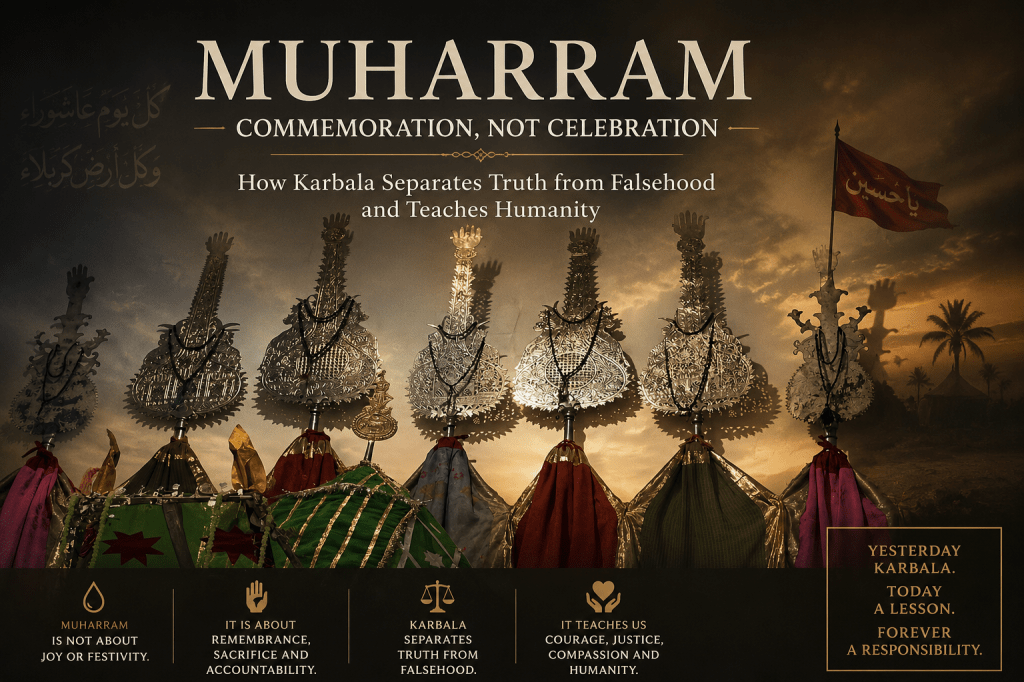
To understand Muharram fully, it helps to know what actually happens during the first ten days. Muslims gather in mosques and community halls known as Imambargahs or Azakhanas. These are places specifically dedicated to mourning gatherings. They listen to lectures about the events of Karbala. Poets recite elegies known as Marsiya and Nauha, which describe the tragedy in heart breaking detail. In some traditions, people express grief through chest beating called Matam. They also hold processions where they carry Alam, which are symbolic standards representing the banners of Husain’s army. Such objects are not relics of festivity but witnesses to centuries of commemorative grief.
The Practice of Fasting on Ashura
It is also important to mention the practice of fasting on Ashura, because this predates the tragedy of Karbala. The Prophet Moses is said to have fasted on this day to thank God for saving the Israelites from Pharaoh, and the Prophet Muhammad continued this practice. After Karbala, the meaning of Ashura became layered. For many Sunni Muslims, it remains primarily a day of fasting and gratitude, though they also acknowledge the tragedy of Karbala. For Shia Muslims, it is first and foremost a day of mourning for Husain. They do not fast but remain hungry, they do not partake food, as if a family member has died. They call it fāqa, starving. Acknowledging this diversity is important for a complete understanding of Muharram.
Different Observances Among Sunni and Shia Muslims
It is also true that not all Muslims observe Muharram in the same way. Shia Muslims observe it with intense mourning rituals, including the gatherings, processions, and chest beating described above. Many Sunni Muslims also acknowledge the tragedy of Karbala and mourn it, but they may not engage in the same physical expressions of grief. Some Sunni Muslims, particularly those influenced by certain schools of thought, discourage public mourning rituals. And a very small minority have historically viewed Yazid as a legitimate caliph, though this position is widely rejected by mainstream Islam. Acknowledging these differences does not weaken the argument of this essay. It shows honesty and prepares the reader for the fact that the meaning of Muharram is contested, which is precisely why an explanation like this one is needed.
Is Mourning Permitted in Islam?
A beginner might wonder whether it is even allowed in Islam to mourn someone who died over 1300 years ago. The answer is yes. The Prophet himself mourned the death of his son Ibrahim and his uncle Hamza. He also visited the graves of martyrs and wept there. Mourning for a righteous person who was killed unjustly is a well established practice in Islamic tradition. The key is that mourning should not violate Islamic principles such as harming oneself or abandoning religious duties. Within those boundaries, mourning for Imam Husain is not only permitted but is considered a form of spiritual devotion and a way of keeping his message alive.
The Universal Message for Today
Muharram is not only the first month of the lunar Hegira calendar. It is also a model for how we should lead our own lives. Every year, when these ten days arrive, Muslims around the world are reminded of the eternal struggle between right and wrong. They are reminded that wealth, power, and popularity are not signs of truth. Sometimes truth stands alone, thirsty, surrounded by enemies, with no army to support it. But that does not make truth false.
Imam Husain taught us that a life of dignity is better than a life of submission to a tyrant. He taught us that one should never bow to injustice. He taught us that if we cannot change the world, we should at least speak the truth. And if we cannot speak, we should at least feel grief in our hearts. That is why the commemoration of Muharram is so powerful. It is not a festival. It is a school of character. It teaches us courage, patience, loyalty, love for family, standing up for what is right, and never accepting humiliation.
Concrete Examples of Resistance in Everyday Life
What does it mean to stand like Husain against a modern Yazid? Here are some everyday examples. It might mean speaking the truth when a colleague is being bullied by a manager, even if you fear for your own job. It might mean refusing to sign a false document at work, even if everyone else is doing so. It might mean protecting a vulnerable person in your neighbourhood from harassment, even if the harassers are powerful. It might mean voting against a corrupt politician, even if your vote seems small. It might mean teaching your children to value honesty over success, and justice over convenience. These small acts of resistance are the living legacy of Karbala. They are how we keep Husain’s memory alive. They are how we make every place Karbala and every day Ashura.
Final Warning Against Happy Muharram Greetings
As Muharram begins on 16th June this year, and as Ashura comes on 26th June, let us remember the correct way to observe this month. Do not send Happy Muharram messages. Do not treat it as a time for weddings or parties. Instead, enrol yourself in this great university. Learn about the tragedy of Karbala. Attend remembrance gatherings if you can. Fast on the day of Ashura if that is your practice. Commemorate this day as if a near one has died. But most importantly, reflect on the message of Imam Husain. Ask yourself whether you are living a life of submission to truth or a life of convenience. Ask yourself whether you stand up against the Yazids of your time, whether they are corrupt politicians, abusive bosses, or oppressive social systems.
To conclude, Muharram is not just a month from the past. It is a living call to every human being. Every place is Karbala, and every day is Ashura. That means the struggle between truth and falsehood is happening everywhere, all the time. And we have to choose which side we are on. Imam Husain gave everything for Islam. Zainab carried his message in chains. Imam Zain al Abedin preserved the knowledge through immense suffering. The least we can do is understand their message and try to live by it. That is the true commemoration of Muharram. Not tears alone, but tears followed by action. Not mourning without meaning, but mourning that transforms us into better human beings. That is what the Ahlulbayt taught. That is what the Prophet wanted. And that is the mission of Imam Husain, which will remain alive until the end of time.


