Syed Ali Nadeem Rezavi
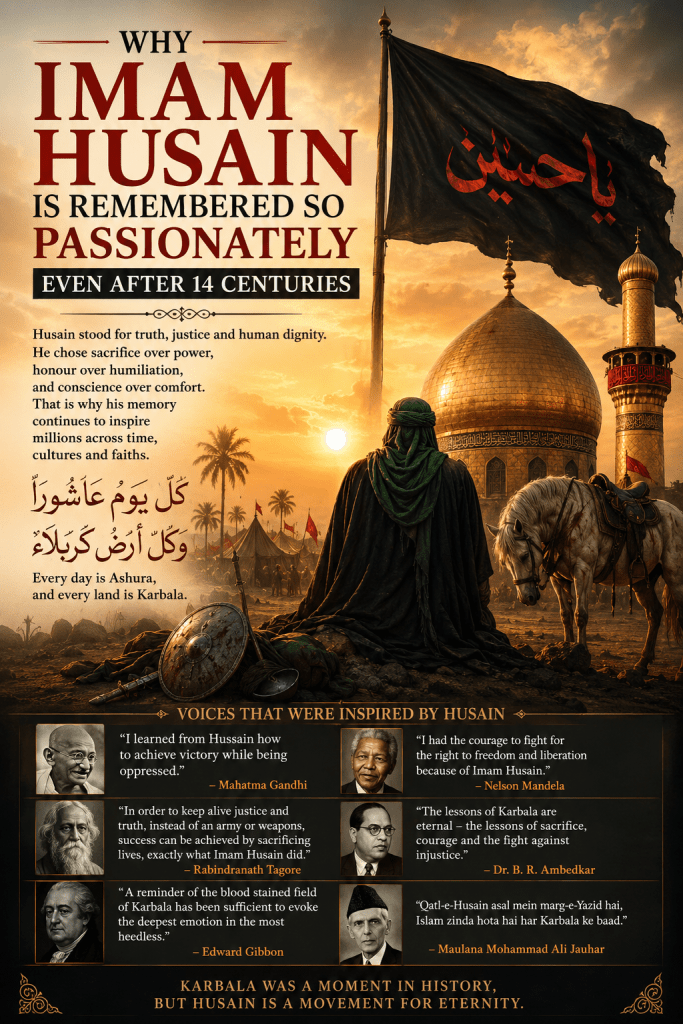
When the month of Muharram returns each year, millions across the world turn their thoughts towards a small, unremarkable plain in Iraq where one of the most transformative events in human history unfolded. Perhaps on 27th June 2026 would be 10th Muharram 1448, the day when Husain was massacred. More than fourteen centuries have passed since the martyrdom of Imam Husain ibn Ali at Karbala, yet his memory remains astonishingly alive. His name continues to evoke grief, reverence, admiration, and inspiration among people of different nations, religions, and cultures. Few personalities in history have retained such vitality in the collective memory of humanity for so long. The question naturally arises: why does Imam Husain continue to be remembered so passionately after all these centuries? The answer lies not merely in the tragedy of his death but in the ideals for which he lived and died.
Karbala was never simply a military encounter. It was a confrontation between truth and falsehood, justice and tyranny, conscience and power. What could have remained a forgotten skirmish in the history of the Umayyad dynasty instead transformed itself into an eternal moral symbol. Each generation sees something of its own struggles reflected in Karbala, and that is why the memory of Husain never fades. He was the beloved grandson of the Prophet Muhammad, the son of Imam Ali and Lady Fatima, belonging to the Ahl al-Bayt (about whom we did an earlier blog) whom Muslims hold in the highest esteem. Yet his enduring significance rests not upon lineage alone. Many individuals have descended from noble families, but few have altered the course of history through the force of their moral example. Husain’s greatness emerged from his refusal to legitimise injustice, even when doing so would have saved his life.
When Yazid demanded allegiance to his unjust rule, Husain understood that the issue was not one of personal rivalry or political ambition. By recognising Yazid’s authority, he would have legitimised a form of rule that he regarded as fundamentally incompatible with the ethical principles of Islam. Compliance would have brought safety, comfort, and prestige. Resistance would bring suffering and death. Husain nevertheless chose resistance. He declared openly that he had not risen out of arrogance, rebellion, corruption, or oppression, but only to seek reform in the community of his grandfather. These words reveal that Karbala was not a struggle for power. It was a struggle for values.
This is why the noted scholar Allama Fazl-e-Hanswi Saiyid Sibtul Hasan described Imam Husain as the Doosra Bāni-e-Islam, the Re-establisher of Islam. The expression reflects a profound truth. If the Prophet Muhammad established Islam through revelation, Husain preserved its moral essence through sacrifice. Many Muslim thinkers have argued that while Islam was founded in Makkah and Madinah, it was saved at Karbala. The philosopher-poet Muhammad Iqbal expressed this idea with remarkable eloquence. For Iqbal, Karbala ensured that Islam remained a religion of conscience rather than becoming merely an instrument of dynastic authority. Husain’s blood drew a permanent distinction between religion and tyranny.
Yet Husain’s significance extends far beyond Islam. This is why Allama Syed Ali Naqi Naqan Sahib referred to him as Shahīd-e-Insāniyat, the Martyr of Humanity. Husain’s stand addressed questions that concern all human beings. What should one do in the face of injustice? Is personal safety more important than truth? Can a small group challenge a powerful system? Is dignity worth sacrificing one’s life for? Karbala provides answers to these questions through action rather than theory. The battle itself was unequal. Husain stood with a small group of family members and companions against a vastly superior force. His camp included elderly men, women, and children. Water was denied to them. One by one his companions fell. His eighteen-year-old son Ali Akbar was martyred. His infant child Ali Asghar was killed. His brothers, nephews, and friends sacrificed their lives. Finally Husain himself fell on the burning sands of Karbala.
From a military perspective it was a defeat. Yet in the moral judgement of history it was a victory of extraordinary magnitude. The empire that killed Husain has long vanished. The rulers who imagined themselves victorious are remembered only for their oppression. Husain, however, remains alive in the hearts of millions. This moral triumph explains why he came to be known as Abul Ahrār, the Father of the Free. Freedom, in Husain’s understanding, was not merely political independence. It was freedom of conscience. It was the refusal to surrender one’s principles in exchange for security or privilege. It was the ability to say no to injustice even when the consequences were severe. When confronted with the choice between surrender and death, Husain declared simply that he would not accept humiliation. These words have echoed across the centuries. They explain why oppressed peoples in different parts of the world continue to find inspiration in Karbala. Husain demonstrated that there are circumstances in which death with honour is preferable to life with humiliation.
The memory of Karbala has survived not only because of what happened there but because of what it continues to teach. Muharram is therefore far more than a period of mourning. It is an annual moral awakening. It reminds humanity that silence before oppression is itself a form of complicity. Every year, the remembrance of Karbala acts as a call to self-examination. It asks individuals and societies whether they stand with truth or accommodate injustice. The sacrifice at Karbala also embodies values that transcend resistance alone. It teaches compassion, selflessness, and concern for others. The example of Hazrat Abbas remains particularly inspiring. When he reached the waters of the Euphrates after enduring intense thirst, he refused to drink because the children in Husain’s camp remained thirsty. His actions exemplified īthār, the Islamic ideal of preferring others to oneself. Likewise, the role of women in Karbala is central to its enduring legacy. Had it not been for the courage and eloquence of Lady Zainab, the message of Karbala might never have reached subsequent generations. If Husain gave Karbala its sacrifice, Zainab ensured that the sacrifice was not forgotten.
The universality of Husain’s appeal is evident from the remarkable range of personalities who have paid tribute to him. Mahatma Gandhi openly acknowledged his admiration for Husain. Gandhi declared that he had not brought anything new to India but had merely conveyed lessons drawn from the hero of Karbala. He stated that he had learned from Husain how victory could be achieved while enduring oppression. Gandhi understood that moral force is ultimately stronger than physical force. Like Husain, he believed that suffering willingly endured for a righteous cause possesses transformative power. Jawaharlal Nehru similarly regarded Karbala as a lesson for all communities. He observed that numerical superiority counts for little when truth confronts falsehood. Muhammad Ali Jinnah admired Husain because he accepted death, thirst, and suffering for himself and his family rather than submit to unjust authority. Rabindranath Tagore praised Husain’s willingness to sacrifice life itself in order to preserve truth and justice.
Western scholars expressed similar admiration. Edward Gibbon wrote that the memory of the thirsty grandson of the Prophet, surrounded by the bodies of his slain relatives, possesses the power to move even the most indifferent reader. Thomas Carlyle regarded Karbala as proof that numbers do not determine victory when truth is at stake. Charles Dickens argued that Husain’s willingness to bring his family into danger demonstrated that he was motivated not by worldly ambition but by principle. Washington Irving concluded that Husain’s struggle can only be understood as a sacrifice for faith and justice. The Scottish orientalist William Muir believed that Karbala shaped the course of Islamic history long after the Caliphate itself had declined. The Lebanese Christian writer Antoine Bara went even further, arguing that no battle in human history has generated greater admiration, sympathy, and moral instruction than Karbala.
The influence of Husain has not been confined to scholars and writers. It has inspired freedom movements, anti-colonial struggles, and campaigns for justice throughout the modern world. Whether in colonial India, apartheid South Africa, or elsewhere, Karbala has served as a symbol of perseverance in the face of oppression. The revolutionary poet Josh Malihabadi perhaps expressed Husain’s universal appeal most memorably when he wrote that once humanity awakens, every community will proclaim that Husain belongs to us. “Insān ko bẽdār to ho leney do, har qaum pukārēgi: hamārey chain Husain!” These lines capture the essence of his legacy. Once people understand the meaning of Karbala, they cease to see Husain as belonging exclusively to one sect or one community. He becomes the inheritance of all who value freedom, justice, and human dignity. Similarly, Muhammad Ali Jauhar immortalised the lesson of Karbala in the famous observation that the killing of Husain is, in reality, the death of Yazid, and that Islam is reborn after every Karbala. “Qatl e Husain asl me marg e Yazīd hai. Islām zinda hota hai har Karbala ke bād!” This couplet encapsulates one of history’s deepest truths. Tyranny may appear victorious for a time, but moral courage ultimately prevails. Every age produces new forms of oppression, yet every age also rediscovers Husain.
This is the secret of Husain’s immortality. Countless rulers have commanded armies and governed vast empires, yet their names survive only in history books. Husain possessed neither an army nor a kingdom, yet his memory remains alive in the hearts of millions. His greatness lies not in worldly power but in moral authority. He transformed suffering into strength, sacrifice into inspiration, and martyrdom into immortality. That is why he is remembered as Abul Ahrar, the Father of the Free. That is why Allama Ali Naqi called him Shahid-e-Insaniyat, the Martyr of Humanity. That is why Allama Fazl-e-Hanswi called him the Doosre Bani-e-Islam, the Re-establisher of Islam. And that is why, fourteen centuries after Karbala, the name of Imam Husain continues to illuminate hearts, inspire struggles for justice, and remind humanity that truth, however lonely, can never ultimately be defeated. Every Muharram renews that message. Every remembrance of Karbala reaffirms that dignity is greater than submission, conscience is stronger than power, and that a single individual standing for truth can change the moral course of history.


