Syed Ali Nadeem Rezavi
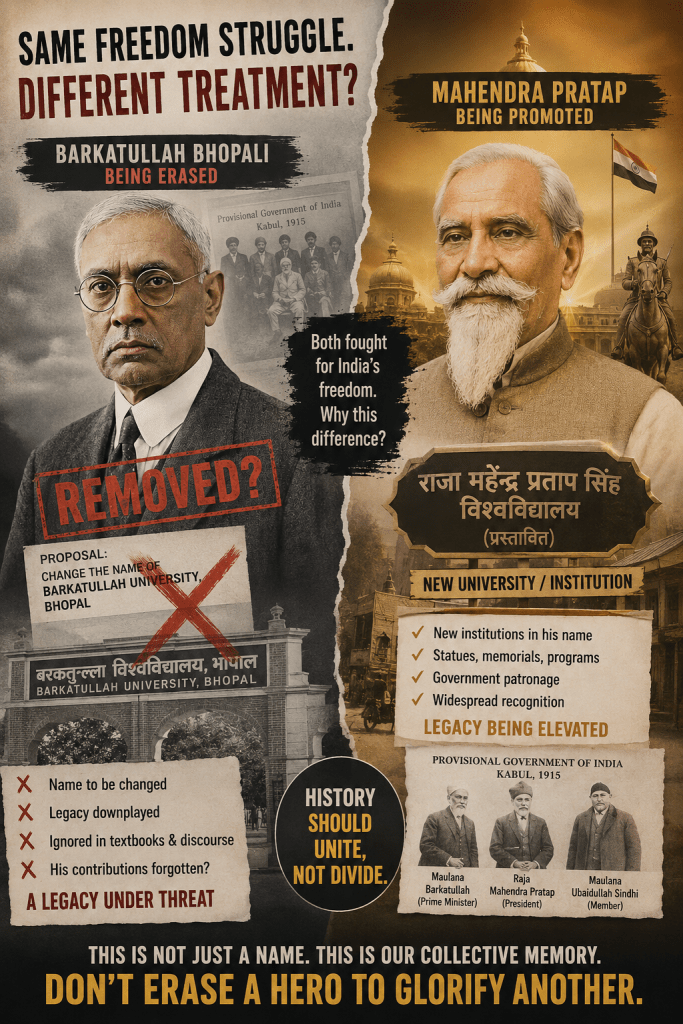
There is a proposal floating around to change the name of Barkatullah University in Bhopal. On the surface, it might sound like a routine administrative matter, the kind of thing that involves little more than a new signboard and some updated letterheads. But we all know that is not how these things work in India today. A name change of this sort is never just paperwork. It is a statement and a political act. And in this case, it is an act that raises profound questions about how we remember our freedom struggle, whose sacrifices we choose to honour, and which version of India we want to leave for our children.
To understand why this matters, we first have to go back and meet the man behind the name. Maulana Abdul Hafiz Mohammad Barkatullah was born in Bhopal on 7 July 1854. He grew up studying Arabic, Persian, and English, but his education was not confined to books. His real classroom was the world. He could not stand the sight of his country being ruled by a foreign power that treated Indians as less than human. And so, unlike most freedom fighters who worked from within the country, Barkatullah spent almost his entire life in exile. He travelled to England, Germany, France, Russia, Japan, China, Turkey, and the United States. Wherever he went, he talked, wrote, and argued for one thing: the liberation of India. He taught at the University of Tokyo. He worked with Lala Hardayal of the Ghadar Party in San Francisco. He connected with anti‑colonial movements across Asia and the Middle East. Distance never weakened his love for his homeland. If anything, it made his commitment fiercer.
What makes Barkatullah truly remarkable, and what sets him apart from many of his contemporaries, is his unshakeable belief that India could only be free if all its communities stood together. He was a deeply religious Muslim, but he understood something that the British were counting on Indians to miss. The British knew that a divided India was a weak India. So they encouraged suspicion between Hindus and Muslims, sowed distrust, and turned neighbours into rivals. Barkatullah refused to play that game. He worked with Hindu, Sikh, Christian, and Parsi revolutionaries without a moment’s hesitation. For him, the enemy was not the person who prayed in a different temple or mosque. The enemy was the Union Jack.
The best proof of this inclusive vision is the Provisional Government of India that was set up in Kabul in 1915. At the height of the First World War, Barkatullah joined hands with Raja Mahendra Pratap, a Hindu prince from Uttar Pradesh, and Maulana Ubaidullah Sindhi, a renowned Islamic thinker. Together, they formed a government in exile. Raja Mahendra Pratap became the President. Barkatullah became the Prime Minister. They issued stamps, appointed ambassadors, and sought military help from Germany, Turkey, and Afghanistan to push the British out. Think about what this meant in 1915, long before the Congress had even dreamt of Poorna Swaraj. A Muslim scholar from Bhopal, a Hindu king from North India, and a great theologian sat around the same table, trusted each other with their lives, and said: our India will be free, and it will be free together. That is the kind of man Barkatullah was.
He gave up everything. He never married, saying that the struggle for India was his only bride. He never owned a house or collected wealth. He died in exile in the United States on 20 September 1927, far from the land he loved. It is said that his last words were not bitter. He only regretted that he would not live to see a free India. But he told those around him with complete confidence that future generations would finish what he and his comrades had started. Twenty years later, when in 1947, India became independent, the nation remembered him. One of the most meaningful tributes was naming the university in Bhopal after him. Barkatullah University is not a random name on a map. It is a thank you. It is a promise. It tells every student who walks through its gates: you stand on the shoulders of a man who gave his entire life for this country.
Now, here is where the story gets uncomfortable. Because at the same time that some voices are demanding that Barkatullah’s name be removed, another freedom fighter from that very same Kabul government is being honoured. In September 2021, the Prime Minister himself laid the foundation stone for a new state university in Aligarh named after Raja Mahendra Pratap. The same Raja Mahendra Pratap who was Barkatullah’s comrade, his President, his partner in one of the most audacious acts of anti‑colonial defiance in history. Their names are tied together in the pages of history. They fought together, planned together, and dreamed the same dream. Yet one is being celebrated with a brand new university, while the other is being erased from an existing one.
The irony here is so sharp that it cuts. Because Raja Mahendra Pratap was no conventional ‘Hindu’ leader who fits neatly into a narrow, majoritarian version of history. Far from it. He was deeply critical of Hindu nationalist politics. He believed that religious divisions were a British creation. He started his own faith called Prem Dharam, the Religion of Love. His great grandson once told a newspaper that the Raja was “the kind of person who would say namaz in the morning, live a Buddhist life in the noon and listen to Ram and Krishna bhajans in the evening.” Imagine that. A man who prayed in a mosque, a temple, and a Buddhist shrine on the same day. And this is the man whose name is now being used to further a political narrative.
But there is more. In the 1957 Lok Sabha elections, Raja Mahendra Pratap contested from Mathura as an independent candidate. Who did he defeat? A young Atal Bihari Vajpayee, then the candidate of the Bharatiya Jana Sangh, the party that later became the BJP. Vajpayee finished fourth. The Raja won. He was a Marxist revolutionary, a follower of Mahatma Gandhi, and a man who openly rejected the Jana Sangh’s brand of politics. He saw the British, not Muslims or Hindus, as the real enemy. Yet despite all this, despite having fought against the ideological forefathers of today’s ruling party, a university has been built in his name. And not just anywhere. In Aligarh, the heart of Muslim identity in North India. For years, local BJP leaders had demanded that Aligarh Muslim University itself be renamed after Raja Mahendra Pratap. When that did not happen, a new state university was created as an alternative. A man who would have been horrified by the politics of exclusion was repackaged and turned into a weapon against the very institution he once supported.
What does this contrast teach us? It teaches us that the decision to honour or erase a freedom fighter has nothing to do with historical truth and everything to do with political convenience. Raja Mahendra Pratap is useful because he is a Hindu Jat king who donated land to AMU. His story can be twisted, simplified, and weaponised. Barkatullah, on the other hand, is being singled out for erasure precisely because he was a Muslim. Even though both men fought together, even though both believed in the same inclusive, syncretic vision of India, one is being raised on a pedestal and the other is being thrown into the dustbin. This double standard exposes the real motive behind the demand to rename Barkatullah University. It is not about history. It is about exclusion. It is about telling a generation of young Indians that some heroes are more Indian than others.
There is something else that gets lost in these debates, something that cannot be captured in political speeches or hashtags. It is the living, emotional connection that thousands of students and alumni have with the name Barkatullah University. For decades, young men and women have graduated from this institution. They have said with pride, on resumes and in job interviews, “I am from Barkatullah University.” The name is woven into their memories of late night chai breaks, of friendships that started in hostel corridors, of exams that felt like wars and results that felt like celebrations. For the people of Bhopal, this university is not a building. It is a part of their identity. Changing the name would feel like a betrayal of those memories. It would tell generations of alumni that the name they carried with them for years was somehow wrong, or shameful, or unfit. That is not an administrative change. That is an emotional wound.
And think about the message this sends to young Muslims in India today. At a time when they are already made to feel like outsiders in their own country, when their loyalty is questioned and their symbols are attacked, removing Barkatullah’s name from a major public university would confirm their worst fears. It would tell them that no matter how much you love your country, no matter how much you sacrifice, your religion will always be held against you. It would tell them that the freedom struggle, which their forefathers bled for, is being rewritten as a one‑community show. Is that the India we want to build? Is that the lesson we want to teach our children?
A confident nation does not erase its heroes. It remembers them, even when that memory is uncomfortable for some. It debates history with honesty, but it never confuses political convenience with historical truth. Barkatullah gave his life for India. That is not a matter of opinion. It is a fact. And the contrast with Raja Mahendra Pratap could not be clearer. Both men were comrades. Both shared the same dream. Both fought the same enemy. Yet one is being honoured and the other is being erased. If we truly respect the legacy of Raja Mahendra Pratap, we must also respect the legacy of Maulana Barkatullah. You cannot have one without the other. Their names are joined in history, and no amount of political maneuvering can untie that knot.
So let us be very clear. Barkatullah University must remain Barkatullah University. Not because of some abstract principle, but because names matter. They carry stories. They teach us who we are. And his story is not just a Muslim story or a Bhopal story. It is an Indian story. It tells us that India belongs equally to everyone who loves it, regardless of their faith. It tells us that the fight for freedom was a joint fight, won by joint sacrifice. It tells us that unity, not division, is what makes a nation strong. To keep his name is to keep faith with that vision. To remove it is to turn our back on the very best of what India has been and can still be. For the sake of our history, for the sake of every student who walks through those gates, and for the sake of the inclusive India that both these great men gave their lives for, the name must not change. Not now. Not ever.
Jai Hind!


