Sir Syed Ahmad Khan and the Reconstruction of Muslim Thought: Reason, Revelation and the Challenge of the Modern Age

Syed Ali Nadeem Rezavi
Much has been written on Sir Syed Ahmad Khan. His life, the Aligarh Movement, his educational programme, his response to the events of 1857, his attitude towards British rule, his political ideas and his role in the intellectual awakening of Indian Muslims have all received considerable scholarly attention. Indeed, few figures of nineteenth-century India have generated such an extensive and often contentious literature. Yet within this enormous body of writing two aspects of Sir Syed’s intellectual personality have generally received less attention than they deserve: Sir Syed as a historian and Sir Syed as a religious thinker.

I have attempted to deal with the former elsewhere, particularly his understanding of history, his antiquarian interests, his use of inscriptions and monuments, and the historical method reflected in works such as the Āsār al-Ṣanādīd. Here my concern is with the second and, in many ways, considerably more difficult Sir Syed. The purpose of this essay is to grapple with his religious ideas and perspectives: his understanding of God and nature, his conception of revelation, his attitude towards the Qurʾan and hadith, his rejection of taqlīd, and above all his striking attempts to reinterpret miracles, angels, jinn, the miʿrāj and other elements of the supernatural world traditionally associated with Islam.

This dimension of Sir Syed is particularly important because his educational programme cannot really be separated from his religious thought. The founder of the Muhammadan Anglo-Oriental College could encourage Muslims to embrace modern science because the religious thinker had first convinced himself that genuine scientific knowledge could never contradict genuine revelation. His educational modernism, in other words, rested upon a theological foundation.

The Intellectual World of the Young Sir Syed

Sir Syed was born in Delhi in 1817 into a distinguished Sayyid family connected with the declining Mughal court. He grew up within the complex religious and intellectual culture of late Mughal Delhi, a world in which Persian literary culture, Islamic scholarship, Sufism, philosophy and the rational sciences continued to interact. The religious atmosphere surrounding him was recognisably Sunni, and Sir Syed himself remained a Sunni Muslim, although the Indo-Muslim intellectual culture in which he was formed was much less hermetically divided along sectarian lines than later accounts sometimes suggest.

This point deserves some emphasis because intellectual influence does not necessarily imply sectarian affiliation. Sunni and Shiʿi scholars in Delhi and northern India disputed questions of doctrine, authority and history, sometimes with considerable bitterness, but they also participated in overlapping traditions of Persian learning, philosophical speculation and theological argument. Rationalist tendencies in kalām, discussions concerning divine justice and human responsibility, and the use of ʿaql as an instrument of religious reasoning were not confined to a single sectarian tradition.

Saiyid Athar Abbas Rizvi’s discussion of Sir Syed in the second volume of his A Socio-Intellectual History of the Isnā ʿAsharī Shīʿīs in India is useful in precisely this limited but important sense. It reminds us of the wider intellectual environment within which Sir Syed developed. It would, however, be misleading to infer from Rizvi’s placement of him that Sir Syed was himself a Shiʿi. He was not. Indeed, the young Sir Syed’s engagement with Shah ʿAbd al-ʿAziz Dihlawi’s Tuhfa Ithna ʿAshariyya, a major Sunni polemical work directed against Ithna ʿAshari Shiʿism, points in quite another direction. What Rizvi helps us appreciate is not a hidden sectarian identity but the permeability of the intellectual world from which Sir Syed emerged.

This wider background is worth keeping in mind, but it should not be made to carry more explanatory weight than the evidence allows. Sir Syed’s mature rationalism cannot simply be derived from Shiʿi theology, any more than it can be explained entirely through Muʿtazilism, the intellectual legacy of Shah Waliullah, British empiricism or Victorian science. Elements from several intellectual traditions eventually converged in his thought, and his originality lay in the particular synthesis he fashioned from them.

The young Sir Syed was, in any case, very different from the controversial religious rationalist of his later years. His early writings reveal a man thoroughly embedded in the Indo-Muslim scholarly world of his time. His Āsār al-Ṣanādīd, first published in 1847, demonstrates his extraordinary interest in the buildings, inscriptions, personalities and historical traditions of Delhi. There is already something significant here, for Sir Syed was interested in things that could be observed, recorded, compared and verified. The antiquarian instinct of the young scholar was eventually to become part of the critical disposition of the mature religious thinker.

1857 and the Search for Causes

During the great rupture was 1857, Sir Syed witnessed the destruction of the political and cultural world to which his family had belonged. The Mughal dynasty disappeared, Delhi was devastated and many members of the old Muslim elite were killed, dispossessed or impoverished. Yet his reaction to this catastrophe was characteristic. Instead of explaining the uprising simply through providence, conspiracy or moral decline, he attempted to investigate its causes. In Asbāb-i Baghāwat-i Hind he examined administrative failures, political grievances and the absence of adequate communication between rulers and ruled.

The importance of this approach goes beyond Sir Syed’s political thought, for it reveals an intellectual habit that became increasingly pronounced in his later life. Events had causes, those causes could be investigated, and received explanations were not necessarily true merely because they had been repeated for generations. The same intellectual disposition would eventually be applied to religion.

The aftermath of 1857 confronted Sir Syed with another problem. The Muslims of northern India, or at least those sections with which he was most closely associated, had suffered a profound political and psychological shock. British power appeared overwhelming, and that power seemed closely associated with new forms of knowledge, scientific enquiry and educational organisation. Could Muslims acquire that knowledge without compromising their religion? Sir Syed increasingly came to believe that they could, but before he could persuade others, he had to establish this proposition intellectually for himself.

Christianity and the Problem of Revelation

His engagement with Christianity formed an important stage in this development. Nineteenth-century India witnessed increasingly vigorous encounters between Christian missionaries and Muslim scholars. Missionaries criticised the Qurʾan, the Prophet and Islamic doctrines, while Muslim scholars responded with attacks upon Christian theology and the textual history of the Bible. Sir Syed gradually moved beyond straightforward polemics. His Tabyīn al-Kalām, his commentary upon the Bible, represented an attempt to identify common ground between the Abrahamic revelations. Christianity might have undergone historical development and textual difficulties, but revelation itself could not fundamentally contradict revelation.

This principle would eventually be extended much further. If one genuine revelation could not contradict another genuine revelation, could revelation contradict nature? Sir Syed’s mature answer was no.

The Word of God and the Work of God

At the heart of Sir Syed’s religious thought lay a deceptively simple proposition. God was the author both of revelation and of nature. The Qurʾan represented the Word of God, while the universe represented the Work of God. Since both proceeded from the same divine source, genuine contradiction between them was impossible. This became the foundation of his mature theology.

If scientific investigation conclusively demonstrated that nature operated according to particular laws, genuine revelation could not contradict those laws. If an apparent contradiction emerged, either the scientific conclusion was mistaken or the human interpretation of scripture required reconsideration. Once a fact concerning nature had been securely established, Sir Syed was prepared to reconsider the interpretation.

This was the intellectual origin of the naturalism for which his opponents called him a necharī. The term was intended as an accusation, suggesting that he had elevated nature above God and revelation, but Sir Syed understood the matter quite differently. Nature itself was God’s creation, its laws were manifestations of the divine will, and to discover a law of nature was therefore not to discover something outside God but to understand something of the order established by God.

Here Sir Syed’s thought possessed affinities with older rationalist currents within Islamic theology, including aspects of Muʿtazili thought and, at points, rational traditions cultivated within Shiʿi kalām. Rizvi’s account is useful in reminding us that the intellectual history of Indian Islam contained such currents before the nineteenth-century encounter with Europe. But Sir Syed cannot simply be turned into a latter-day Muʿtazili, still less into a representative of Shiʿi rational theology. His central problem was distinctly nineteenth-century. Geology, astronomy, modern medicine, historical criticism and the growing authority of natural science had created intellectual problems very different from those confronted by medieval theologians, and his theology was therefore a new response to a new intellectual situation.

Miracles and the Laws of Nature

Sir Syed’s difficulty with miracles followed directly from his conception of natural law. If God had established a coherent system through which the universe operated, would He violate His own laws in order to demonstrate prophetic authority? Sir Syed increasingly answered in the negative.

He did not necessarily deny the Qurʾanic narratives themselves. What he denied was the assumption that they had to represent violations of natural law. Events traditionally regarded as miracles therefore had to be explained as natural occurrences whose causes had been misunderstood, as figurative expressions, or as visionary experiences. This distinction was fundamental to his method.

The parting of the sea associated with Moses, for example, could be understood through natural phenomena rather than as the temporary suspension of physical laws. Similarly, extraordinary events associated with Jesus had to be interpreted in ways compatible with the established order of nature. To his traditionalist critics, this emptied the Qurʾanic miracle of its meaning. To Sir Syed it did something very different, for it protected revelation from being placed in opposition to demonstrable truth.

His argument was ultimately theological. The laws of nature represented the order established by God, and a miracle understood as an actual violation of natural law would therefore require God to suspend the very order which He Himself had established. This was one of the most radical consequences of Sir Syed’s theology.

What, Then, Were Angels?

His treatment of angels followed from the same reasoning. Traditional Islamic belief understood angels as a distinct category of unseen beings created by God, but Sir Syed found the conventional conception of independently existing supernatural beings moving between heaven and earth difficult to reconcile with his understanding of the universe. He therefore reinterpreted the Qurʾanic language concerning angels. Rather than treating every reference to an angel as describing a separate supernatural being in the conventional sense, he could understand angelic language as referring to divine powers, agencies or capacities through which God’s order operated within creation.

This created an obvious difficulty in relation to Gabriel. The traditional account of revelation envisaged Gabriel communicating God’s revelation to Muhammad, and once the conventional conception of angels had been questioned, the mechanics of revelation itself required reconsideration. Sir Syed did not deny revelation; he reinterpreted the manner in which revelation occurred. This is an important distinction, for his critics often represented his position as simple disbelief. Sir Syed regarded himself as doing something quite different. The Qurʾan remained true, and what could be mistaken was the literal manner in which generations of human beings had interpreted its descriptions of realities beyond ordinary perception. The consequences were nevertheless enormous, for one of the principal components of the traditional Islamic understanding of the ghayb, the unseen world, had effectively been transformed.

Jinn and the Supernatural World

Sir Syed approached the jinn in much the same way. He was unwilling to accept the popular understanding of an invisible species of supernatural beings capable of appearing to humans, possessing them or intervening in everyday life. He therefore attempted to interpret Qurʾanic references to jinn through natural, historical or linguistic categories. In certain contexts the word could refer to remote, unfamiliar or uncivilised groups of human beings, while elsewhere the terminology could be understood without requiring the existence of supernatural creatures operating outside the normal order of nature.

The significance of this position went far beyond theology. Belief in jinn, spirits, possession, magical intervention and supernatural causation formed part of everyday religious culture. Sir Syed’s rationalism was therefore challenging not only scholastic propositions but also the manner in which ordinary people explained illness, misfortune and extraordinary events. His universe was becoming progressively less populated by supernatural agencies, and causes were to be sought within nature.

The Miʿrāj: A Spiritual Rather Than Bodily Journey

Perhaps the most delicate issue was the Prophet’s miʿrāj. The bodily ascension of the Prophet had become firmly established in mainstream Islamic belief. According to the conventional understanding, Muhammad was miraculously transported and ascended through the heavens, an event intimately connected with the isrāʾ from Mecca to Jerusalem. Sir Syed could not accept the physical ascent in this supernatural sense. He understood the experience as visionary or spiritual rather than as a bodily journey through the physical heavens. The Prophet had undergone an extraordinary religious experience, but Sir Syed did not believe that his physical body had travelled through the celestial universe in violation of the ordinary laws of nature.

Again, his reasoning was consistent. The religious significance of the miʿrāj could remain even when its conventional physical explanation was abandoned. This provides perhaps the clearest illustration of his entire hermeneutical method. Sir Syed sought to distinguish the religious truth contained within a narrative from the supernatural interpretation traditionally attached to it.

Revelation Without a Supernatural Cosmology

By this stage it becomes clear that Sir Syed was attempting something considerably more ambitious than reconciling a few difficult Qurʾanic passages with nineteenth-century science. He was reconstructing the relationship between God and the universe.

Traditional Islamic cosmology, like the cosmologies of Christianity and Judaism, contained an extensive unseen world populated by angels, jinn and other realities. Miracles occurred, prayers could bring divine intervention, and God could interrupt the ordinary course of nature. Sir Syed sought to preserve belief in God, prophecy and revelation while drastically reducing the role of supernatural intervention in the physical universe.

This immediately raised another problem. How could revelation itself occur? If Gabriel was not necessarily to be understood as a supernatural being physically conveying words between heaven and earth, what was revelation? Sir Syed’s answer once again involved naturalisation. The capacity for prophetic revelation could itself form part of the order God had implanted within creation and within exceptional human beings. Prophethood did not therefore require God repeatedly to suspend natural laws. This was perhaps the most daring aspect of his religious thought, for he was no longer merely interpreting a few miracles differently. He was reconsidering the very mechanism through which divine revelation reached humanity.

Prayer and Divine Intervention

The same difficulty appeared in relation to prayer. If the universe operated according to divinely established and consistent laws, could prayer persuade God to alter physical events? Sir Syed’s theology made such an understanding difficult. Prayer retained immense moral and spiritual importance, but it could not simply become a mechanism through which human beings persuaded God to suspend natural causation.

Theologically, Sir Syed could present this as an exalted conception of God. God did not need continually to intervene in order to repair His creation, and the perfection of divine wisdom was demonstrated precisely by the consistency of the order He had established. Yet there was an emotional price to this conception. The God of Sir Syed’s rational universe could appear more distant than the God of popular devotion who answered prayers, performed miracles and intervened dramatically in individual lives. This tension was never entirely resolved.

The Qurʾan and Its Commentators

Sir Syed’s theology necessarily required a new approach to Qurʾanic interpretation. His unfinished Tafsīr al-Qurʾān, together with his writings concerning the principles of tafsīr, represents the fullest expression of that method. Its foundation was the distinction between revelation and interpretation. The Qurʾan was divine; tafsir was human. However eminent the classical commentators might have been, they remained human beings interpreting revelation according to the intellectual knowledge available in their own age. Their interpretations therefore could not possess the same authority as revelation itself.

This distinction liberated Sir Syed intellectually. A traditional interpretation could be rejected without rejecting the Qurʾan. Indeed, Sir Syed could argue that abandoning an interpretation demonstrably incompatible with truth was actually necessary to defend the Qurʾan. If a nineteenth-century Muslim student encountered a scientific fact apparently incompatible with a medieval commentary, Sir Syed did not want that student to believe that he had to choose between science and Islam. The commentary could be wrong; the Qurʾa remained.

Hadith and the Problem of Historical Transmission

The same critical approach affected his treatment of hadith. Sir Syed did not simply reject the Prophetic tradition, but neither was he prepared to place every transmitted report on the same epistemological level as the Qurʾan. Hadith had passed through human chains of transmission and had been collected, assessed and classified by human scholars. It therefore possessed a history, and what possessed a history could be historically examined.

Reports describing supernatural occurrences became particularly vulnerable to this method. If a tradition described an event which contradicted the Qurʾan, reason or the established order of nature, Sir Syed was prepared to question the report rather than abandon reason. Classical hadith criticism had developed sophisticated methods for evaluating transmitters and chains of transmission, and Sir Syed effectively introduced another test: compatibility with reason and nature. The implications were revolutionary, for a report could possess an apparently respectable chain of transmission and still be rejected if what it described could not, according to Sir Syed’s understanding of the universe, have happened.

Taqlīd, Ijtihād and the Authority of the Past

Behind all these positions stood Sir Syed’s hostility towards taqlīd, the unquestioning acceptance of inherited scholarly authority. The great scholars of Islam deserved respect, but they were not infallible. They had responded to the knowledge and problems of their own ages, and Muslims living in the nineteenth century could not simply repeat medieval answers to questions transformed by modern knowledge. The right of ijtihād therefore had to be recovered.

Sir Syed extended this principle beyond conventional juridical ijtihād. He was effectively asserting the right to reconsider large parts of the accumulated intellectual tradition of Islam. This again brought him into proximity with several older rationalist traditions of Islamic thought. One can recognise echoes of Muʿtazili arguments, certain tendencies within rationalist Shiʿi theology, and the wider Indo-Islamic tradition of maʿqūlāt, the rational sciences. Rizvi is useful here because his work demonstrates how alive some of these intellectual traditions remained in India. But it would be a mistake to search for a single genealogy for Sir Syed’s thought. His rationalism was eclectic, and its immediate challenge was modern.

England and the Intensification of Rationalism

Sir Syed’s visit to England in 1869–70 represented an important stage in this development. His admiration for British educational institutions, scientific organisation, libraries, publishing and associational life intensified, and Oxford and Cambridge provided institutional models which influenced his conception of the college eventually established at Aligarh. But he did not travel to England as an intellectually untouched traditionalist and return as a rationalist. The transformation had begun much earlier. His historical interests, his experience of 1857, his engagement with Christianity and his work on Tabyīn al-Kalām had already forced him to confront questions concerning evidence, revelation and reason. England accelerated the process; it did not create it.

This is why the description of Sir Syed as simply a product of Western influence is inadequate. He certainly borrowed from European thought, but borrowing is not surrender. Ideas were selected, modified and incorporated into an intellectual framework created in response to the problems of Indian Muslim society. The resulting synthesis was distinctly his own.

Tahzīb al-Akhlāq and the Reform of the Muslim Mind

His religious thought consequently flowed directly into his programme of social reform. When Sir Syed began publishing Tahzīb al-Akhlāq in 1870, his objective was not merely to encourage Muslims to learn English. He wanted to transform habits of thought. Superstition, intellectual lethargy, inherited custom and unquestioning submission to authority became objects of criticism. The reform of society required the reform of the mind, and education meant learning to ask why.

The Muhammadan Anglo-Oriental College therefore cannot be separated from Sir Syed’s theology. If modern science and Islam were fundamentally incompatible, his educational project would have contained a fatal contradiction. Muslim students exposed to modern science would ultimately have been compelled to choose between knowledge and faith. Sir Syed’s theology was intended to ensure that no such choice was necessary. The laws discovered by science were God’s laws, and studying nature therefore could not threaten religion. In this sense, Aligarh itself was an institutional expression of Sir Syed’s theology of nature.

The Price of Rationalisation

There was nevertheless a price to be paid. Once Sir Syed had reinterpreted angels, jinn, miracles, the miʿrāj, prayer and numerous extraordinary Qurʾanic narratives, his critics could reasonably ask whether the religion which emerged remained recognisable as the Islam understood by generations of believers. This criticism cannot simply be dismissed as obscurantism.

Sir Syed had created a hermeneutical principle with potentially unlimited consequences. Whenever revelation appeared to contradict reason or natural law, interpretation had to change. But who determined what constituted established reason? And what happened when science itself changed? Nineteenth-century science was not the final stage of human knowledge. There was therefore a danger that Sir Syed was defending the Qurʾan from nineteenth-century scientific criticism by making nineteenth-century scientific assumptions themselves the standard by which scripture was interpreted. His critics recognised this vulnerability, yet many of them failed to recognise the seriousness of the problem he was attempting to solve. Sir Syed had encountered educated Muslims for whom elements of the traditional cosmology no longer appeared intellectually credible. Simply commanding them to believe was unlikely to restore belief. He attempted something much more difficult: he tried to reconstruct belief itself.

The Paradox of Sir Syed

Here lies the central paradox of Sir Syed’s religious thought. The man accused of undermining Islam believed that he was defending it. He did not reinterpret miracles because he wished to destroy the Qurʾan; he reinterpreted them because he believed that the Qurʾa could contain nothing contrary to truth. He did not question conventional descriptions of angels because he wished to abolish revelation; he did so because he believed that revelation could be understood without requiring acceptance of a supernatural cosmology incompatible with reason. He did not deny a bodily miʿrāj because he lacked reverence for the Prophet; he regarded the experience as real but spiritual because a physical ascent through the heavens conflicted with his conception of the divinely established order of nature.

Whether one accepts these interpretations is quite another question. Historically, however, his purpose needs to be understood before his conclusions are judged. Sir Syed’s project was therefore not secularisation in the simple sense. It was the rationalisation of faith. Precisely because he remained a believer, the project became so intellectually audacious.

The Religious Thinker Behind the Founder

The Sir Syed who emerges from these writings is consequently much more complex than the familiar portrait of the founder of Aligarh. He was a Sunni formed within the intellectual culture of Delhi, but that culture itself contained multiple currents. The legacy of Shah Waliullah and his successors, Sufism, the rational sciences, older Islamic theological arguments, Shiʿi traditions of rational disputation, Christian missionary challenges and eventually European science all formed parts of the intellectual environment within which he worked. None alone explains him, and his modernism emerged from their interaction.

Most importantly, Sir Syed was prepared to follow his principle of natural law into areas where few Muslim reformers of his generation were willing to go. Angels, jinn, miracles, the bodily miʿrāj, supernatural intervention and the authority of transmitted traditions could all be reconsidered. Nothing except revelation itself was protected from enquiry, and even revelation had to be interpreted. That is why Sir Syed’s religious thought generated such intense hostility. The controversy was never simply between English education and conservatism. It concerned the much deeper question of where religious authority ultimately resided. Was Islam identical with the interpretations inherited from its classical scholars? Sir Syed’s answer was no.

At the centre of his thought was ultimately an extraordinary confidence in God. Truth could not contradict truth. The Word of God could not contradict the Work of God. If the two appeared to conflict, human beings had misunderstood one or the other. This principle explains his naturalistic interpretation of miracles, his treatment of angels and jinn, his rejection of a bodily miʿrāj, his critical approach towards hadith, his hostility to taqlīd, his advocacy of ijtihād, his engagement with Christianity, his enthusiasm for science and, ultimately, his educational project at Aligarh. They were not separate Sir Syeds. They were different expressions of the same intellectual project.

Sir Syed belonged to the old Indo-Muslim world even as he dismantled some of its assumptions. He inherited Sunni Islam while inhabiting a wider intellectual culture in which theological and philosophical arguments had long crossed sectarian boundaries. He encountered European science not as a blank slate but as someone already formed by the intellectual traditions of Delhi.

His particular solutions need not persuade us today. Some appear strained, and some of his attempts to naturalise Qurʾanic narratives raise as many questions as they answer. Yet the intellectual courage behind them is difficult to miss. Sir Syed recognised earlier than many of his contemporaries that the crisis created by modern knowledge could not be answered merely by condemning modern knowledge. Nor could Islam be defended indefinitely by demanding acceptance of interpretations which educated believers themselves had ceased to find intellectually convincing. He therefore attempted to separate revelation from the historical interpretations surrounding it.

In doing so he opened questions that have never really been closed. What is permanent in religion and what belongs to history? How much authority should inherited interpretation possess? Can the supernatural be reinterpreted without transforming the religion itself? What happens when scripture appears to conflict with established knowledge? And, above all, can reason operate freely within faith without eventually becoming the judge of faith? Sir Syed never completely resolved these tensions. Perhaps no one could. His importance lies partly in having confronted them so directly.

Behind the founder of the Muhammadan Anglo-Oriental College, behind the educational reformer, behind the controversial political thinker and behind the monumental figure subsequently created by Aligarh, there stood a far more restless personality: Sir Syed the religious thinker. It is this Sir Syed who questioned the conventional understanding and insisted that God’s revelation could never ultimately contradict God’s universe.

If Sir Syed the historian, whom I have discussed elsewhere, reveals his concern with evidence, monuments, texts and the recoverable past, Sir Syed the religious thinker reveals another side of the same questioning mind: his refusal to accept that faith could survive by insulating itself from reason. It is perhaps this Sir Syed, rather than the safely commemorated founder whose portraits adorn Aligarh, who remains intellectually provocative even today.

A Basic Reading List

Sir Syed Ahmad Khan, Tafsīr al-Qurʾān wa Huwa al-Hudā wa al-Furqān. The principal primary source for Sir Syed’s mature religious thought and his interpretations of nature, miracles, angels, jinn and revelation.

Sir Syed Ahmad Khan, Taḥrīr fī Uṣūl al-Tafsīr. Important for understanding the principles underlying his interpretation of the Qurʾan and his relationship with the inherited exegetical tradition.

Sir Syed Ahmad Khan, Tabyīn al-Kalām fī Tafsīr al-Taurāt wa’l-Injīl ʿalā Millat al-Islām. His engagement with the Bible and Christianity and an important stage in the development of his understanding of revelation.

Sir Syed Ahmad Khan, Tahzīb al-Akhlāq (multiple issues of his period). Indispensable for understanding the connection between his religious rationalism, ethical thought and programme of social reform.

Sir Syed Ahmad Khan, Khutbāt-i Ahmadiyya [A Series of Essays on the Life of Muhammad and Subjects Subsidiary Thereto]. Important for his defence of the Prophet and his response to nineteenth-century European criticism of Islam.

Altafhusain Hali, Hayāt-i Jāved. An indispensable contemporary biography by a close associate, though naturally to be read critically.

Saiyid Athar Abbas Rizvi, A Socio-Intellectual History of the Isnā ʿAsharī Shīʿīs in India, Vol. II, Canberra: Ma’rifat Publishing House, 1986. Valuable particularly for understanding the broader Indo-Muslim theological and intellectual environment within which Sir Syed developed and the rationalist currents that crossed formal sectarian boundaries.

J. M. S. Baljon, The Reforms and Religious Ideas of Sir Sayyid Ahmad Khan. An important study concentrating specifically upon Sir Syed’s religious reform and theological ideas.

Bashir Ahmad Dar, Religious Thought of Sayyid Ahmad Khan. A sustained examination of his rationalism, theology and understanding of revelation.

Christian W. Troll, Sayyid Ahmad Khan: A Reinterpretation of Muslim Theology. Particularly valuable for Sir Syed’s encounter with Christianity, modern science and the consequent reconstruction of Muslim theology.

David Lelyveld, Aligarh’s First Generation: Muslim Solidarity in British India. Essential for understanding the social and intellectual world within which the Aligarh Movement developed.

Margrit Pernau, “Fluid Temporalities: Saiyid Ahmad Khan and the Concept of Modernity”, History and Theory, 58:4 (2019), pp. 107–131. Essential to understanding his religious ideas.

Dr Yasmin Saikia and M. Raisur Rahman, eds., The Cambridge Companion to Sayyid Ahmad Khan. A major recent collection covering different dimensions of Sir Syed’s life and thought, including particularly useful discussions of religion, science and the relationship between prophetic and natural revelation.

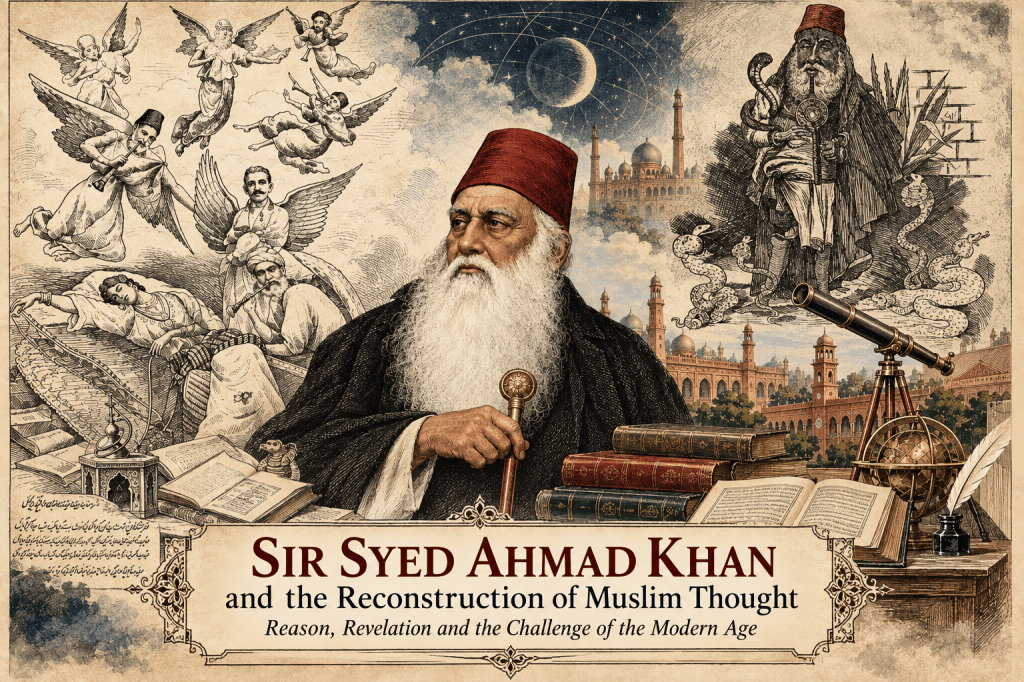
Note: In the accompanying image one can see two cartoons of Sir Syed. One made during his lifetime, and the other, much after his death. In the first, the Muslim orthodoxy depicts him as a “Natury Jogi”: ‘Natury’ as he stood for Science and (thus) Darwin, and ‘Jogi’, an allusion to his un-Islamic ways. His limbs are shown tangled with serpents on the head of each of which is written “chanda” (donation) which he used to seek for his college.

The second cartoon actually highlights him, and his companions, who like angels are trying to wake up the “sleeping beauty”, the Muslim community from a deep slumber (of ignorance).

It is unfortunate that the community is still in deep slumber, and many still hold Sir Syed as a devil!

Akbar in Twenty-First-Century India: The Continuing Relevance of an Imperial Experiment

Syed Ali Nadeem Rezavi

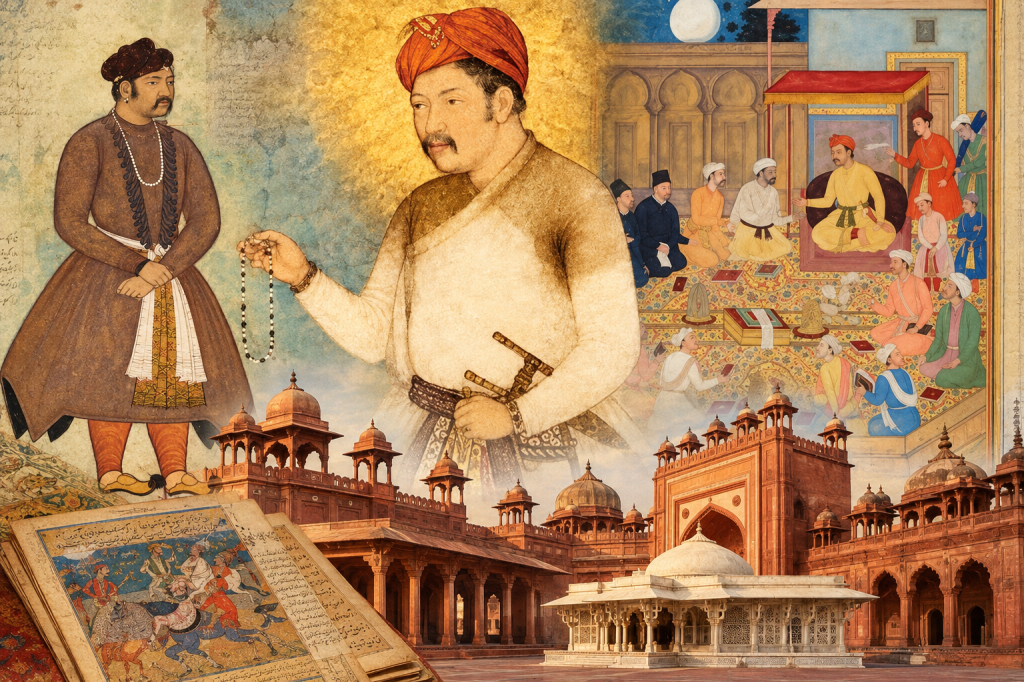
Today is 15 October 2026. According to the chronology followed by Abul Fazl, Akbar was born at Amarkot on 15 October 1542, at a moment when his father Humayun was a fugitive and virtually without a kingdom. Sixty-three years later, in October 1605, Akbar died at Agra, leaving behind an empire vastly different from the precarious inheritance that had come to him in 1556. October, therefore, provides an appropriate occasion not merely to remember Akbar, but to ask a question which has acquired a certain urgency in our own times: what relevance can a sixteenth-century emperor possibly have for the India of the twenty-first century?

The question matters because Akbar has never remained confined to the sixteenth century. Successive generations have interpreted him according to their own concerns. Colonial historians often represented him as the exceptional ‘tolerant’ Muslim monarch. Indian nationalist historians saw in him an important figure in the growth of political unity and composite culture. Gandhi, Nehru and others invoked him in discussions of India’s plural traditions. In Pakistan, by contrast, certain strands of nationalist historiography viewed him with suspicion precisely because his religious and political policies appeared to dilute an exclusively Islamic conception of sovereignty. While he continued to be invoked positively in India, he was frequently criticised in Pakistan for supposedly having harmed Islam.

More recently, however, Akbar has again become contested in India. Attempts have been made to reduce his significance, question the older image of ‘Akbar the Great’, and increasingly foreground the violence associated with his conquests. This tendency has moved from social media and popular polemics into school textbooks. Recent NCERT revisions describe his reign as a ‘blend of brutality and tolerance’, while the medieval section is prefaced by a discussion of what it calls the ‘darker periods’ of history. The new Class IX textbook, released at the end of September 2026, introduces the seven centuries between approximately 1000 and 1700 through the overarching framework of ‘Resistance and Resilience’, emphasising resistance to external threats while giving considerably less prominence to processes of cooperation and the formation of composite political and cultural traditions.

This makes it all the more necessary to return to the historical Akbar, neither to defend him as a modern secular hero nor to condemn him as an alien invader, but to understand what was distinctive about the political experiment over which he presided.

Akbar Was Not a Modern Secularist

We must begin with a caution. Akbar was neither a democrat nor a constitutional secularist. He was an emperor whose authority ultimately rested upon military power. His empire was hierarchical, its resources came overwhelmingly from the agrarian surplus, and its expansion involved warfare and conquest. To transform him into a modern liberal ruler would be as historically misleading as reducing him to a foreign Muslim conqueror.

His significance lies elsewhere.

Akbar confronted a problem which remains remarkably familiar to us: how does a state govern a population divided by religion, language, ethnicity, caste, region and cultural tradition without requiring all its inhabitants to become alike? His response evolved slowly. It was neither formulated at the beginning of his reign nor implemented according to some predetermined programme. What emerged over several decades was a conception of sovereignty in which the ruler increasingly attempted to place himself above competing sectarian identities.

The concept most closely associated with this development was sulh-i kul, or peace with all. It would be anachronistic simply to translate sulh-i kul as ‘secularism’. Its intellectual genealogy belonged to a very different world. Yet under Akbar and Abul Fazl it acquired an important political meaning. The ruler was not to discriminate among his subjects merely on account of their religious beliefs. Political loyalty and service to the state were increasingly separated from religious affiliation.

In an age when the religion of the ruler could profoundly determine the relationship of subjects to the state, Akbar increasingly sought to unite people across barriers of dogma and showed an unusual willingness to engage seriously with differing religious traditions.

It is here that Akbar begins to acquire significance for twenty-first-century India.

The Ibādat Khāna and the Habit of Enquiry

One of the most fascinating expressions of Akbar’s intellectual development was the Ibādat Khāna at Fathpur Sikri. What began as a space for discussions among Muslim religious scholars gradually expanded into something considerably more ambitious. Sunni and Shi’i scholars were joined by Brahmins, Jain monks, Christian Jesuits, Zoroastrians and representatives of other traditions. The diversity of those invited to participate in these discussions was itself remarkable.

The Ibādat Khāna should certainly not be romanticised. Its discussions could become acrimonious, and the emperor remained the arbiter of proceedings. Nevertheless, the principle underlying the experiment was extraordinary for its time. Difference was to be encountered through conversation rather than simply condemned from a distance.

Perhaps even more important was Akbar’s willingness to question received wisdom. He listened, questioned, doubted and sometimes changed his mind. His religious development cannot adequately be explained through the once-popular notion that he abandoned Islam and created a new religion called the Din-i Ilahi. What emerged was far more complex: an intellectual search in which Islamic, Sufi, Hindu, Jain, Zoroastrian and Christian ideas were encountered and examined.

There is something particularly relevant here for our own age. We live at a time when technology has enormously increased our capacity to communicate while frequently diminishing our willingness to listen. Social media encourages certainty, instant judgement and outrage. Akbar’s experiment at Fathpur Sikri suggests another intellectual habit: before condemning another person’s beliefs, listen to what that person has to say about them.

The ability to question one’s own certainties is not a weakness of intellectual life. It is one of its greatest strengths.

Translation as an Instrument of Understanding

Akbar’s engagement with India’s diversity did not remain confined to theological discussion. One of the most remarkable intellectual enterprises of his reign was the translation movement associated with the Maktab Khāna. Sanskrit works were translated into Persian, the principal language of Mughal administration and high culture. The Mahabharata became the Razmnama. The Ramayana, Rajatarangini and the story of Nala and Damayanti were among the other works that entered the Persian intellectual world.

This was not merely literary patronage. Translation became an instrument through which one intellectual tradition could become accessible to another.

The significance of this project for India should not be underestimated. Indian civilisation was never produced within hermetically sealed cultural compartments. Sanskrit, Persian, Arabic, Prakrit and numerous regional languages continually encountered one another. Ideas travelled between religious traditions, literary forms borrowed from one another, and artistic vocabularies were repeatedly transformed through contact.

Akbar’s translation project institutionalised this curiosity. Instead of asking which tradition should defeat the other, it asked how one tradition might become intelligible to another.

That remains an important lesson for twenty-first-century India. Civilisations are not weakened when their constituent traditions converse with one another. They are enriched.

Diversity within the Structures of Power

Akbar’s pluralism was not confined to ideas. Its most consequential expression lay in the composition of the Mughal ruling class.

The nobility that developed under him incorporated Turanis, Iranis, Indian Muslims, Rajputs and others. Rajput chiefs were not merely provincial allies who were grudgingly tolerated by the Mughal state. Many entered its highest ranks. Raja Bhagwant Das and Raja Man Singh are obvious examples, while Raja Todar Mal occupied an important position within the administrative establishment.

The diversity was substantial. By around 1580 the mansabdars included Rajputs, Iranis, Indian Muslims and Turanis in significant numbers.

This was certainly not democracy or equality in the modern sense. The Mughal nobility remained an enormously privileged ruling class. Nor should we ignore political calculation. Incorporating different groups strengthened the emperor by preventing any single ethnic or sectarian faction from monopolising power.

Yet political calculation does not diminish the historical importance of the development. Akbar had recognised something fundamental, which should be a lesson to our modern day rulers: a durable state governing a diverse society can not indefinitely remain the possession of a narrow ethnic or religious group.

The question has not entirely disappeared. Does a state visibly belong to the entire diversity of the people whom it governs? Akbar’s answer was necessarily imperial. Modern India’s answer is constitutional. But the underlying political problem bears comparison.

Akbar and the Making of an Indian Empire

Akbar did not create the Indian nation, nor was he the originator of an ‘idea of India’. Such claims would be historically untenable. India possessed geographical, cultural and political conceptions of itself long before the Mughals, while the modern nation-state belongs to a much later historical development.

What happened under Akbar was nevertheless significant. A dynasty of Central Asian origin gradually created an empire whose political and cultural foundations became deeply rooted in the Indian subcontinent.

Akbar remained conscious of his Timurid ancestry throughout his life. Yet the empire over which he ruled became increasingly Indian in its personnel, resources and cultural expressions. Persian remained the principal language of administration, but Sanskrit texts entered Persian. Rajputs entered the imperial nobility. Persianate artistic traditions encountered Indian conventions and produced new forms. Architecture at Agra and Fathpur Sikri similarly brought together architectural traditions with different genealogies.

This is why describing the Mughals simply as ‘foreign invaders’ explains remarkably little about the history that followed their conquest. Babur certainly entered India as a conqueror from Central Asia. But what precisely does the category ‘foreign’ explain about his grandson Akbar, who was born at Amarkot in Sindh, ruled from Agra, Fathpur Sikri and Lahore, obtained his revenues from Indian agriculture, recruited Rajputs and Indian Muslims into his nobility, patronised translations of Sanskrit literature, and created institutions which continued to shape thea subcontinent long after his death?

Conquest may explain how an empire begins. It cannot by itself explain what that empire becomes.

Chittor Cannot Be Forgotten

None of this requires us to sanitise Akbar’s reign. There was violence, sometimes on a terrible scale. His empire expanded through warfare. Gujarat, Bengal, Rajasthan, Kashmir, Sind and parts of the Deccan were incorporated through a combination of military action, negotiation and alliance. Most importantly, the siege of Chittor in 1567–68 and the massacre following its capture cannot be wished away because they disturb the image of the tolerant emperor.

They should disturb it.

History is not improved by protecting admired figures from uncomfortable evidence. But neither is it improved by selecting one episode and making it the interpretative key to an entire reign.

The same Akbar who presided over the violence at Chittor subsequently developed sulh-i kul, abolished discriminatory taxation, widened recruitment into the nobility, participated in discussions with representatives of different religions and sponsored translations of Sanskrit texts. The contradiction is real. The historian’s task is to explain it, not to eliminate one side in order to preserve the other.

Historical personalities do not have to be converted into either saints or villains. Indeed, Akbar becomes considerably more interesting when we cease demanding that he be either.

Recasting Akbar in the New Textbooks

It is against this background that the treatment of Akbar in some recent NCERT textbooks deserves attention.

There is nothing objectionable in principle about revising textbooks. Historical knowledge changes. New research questions older interpretations, and every generation of historians revisits the past. Nor should school textbooks suppress imperial violence merely because earlier textbooks may not have adequately discussed it.

The issue is one of proportion, context and framing.

The new Class VIII Social Science textbook, Exploring Society: India and Beyond, describes Akbar’s reign as a ‘blend of brutality and tolerance’. It devotes attention to the massacre following the conquest of Chittor and discusses violence associated with the Delhi Sultanate and Mughal periods. The history section itself is preceded by a ‘Note on Some Darker Periods in History’. NCERT has stated that its intention is not to blame anyone living today for historical events and has defended the approach as evidence-based and intended to avoid sanitising history.

The textbook does not erase Akbar’s more accommodative policies. It refers to sulh-i kul, interfaith dialogue and the appointment of Hindu officials. It would therefore be inaccurate to suggest that Akbar has simply disappeared from the curriculum.

Something subtler has happened. The framework within which the child encounters him has changed.

This becomes even more apparent in the Class IX textbook released on 29 September 2026. Some seven centuries of medieval Indian history, from approximately 1000 to 1700, are presented through the theme of ‘Resistance and Resilience‘. The emphasis falls upon invasions and the resistance offered by Rajputs, Ahoms, Vijayanagara, Marathas, Sikhs, Jats and others. While the textbook mentions both conflict and cooperation, its treatment focuses upon resistance rather than upon cooperation and the development of composite culture, themes which had occupied an important place in Indian historiography for decades.

Here lies the larger historiographical problem. If seven centuries of Indian history are organised principally around the categories of ‘invaders’ and ‘resistance’, what happens to the immense processes of accommodation, alliance, migration, cultural exchange and institutional transformation that occurred during precisely the same centuries?

Maharana Pratap unquestionably belongs to the history of Akbar’s reign. But so does Raja Man Singh. Haldighati belongs to that history, but so does the incorporation of Rajputs into the Mughal nobility. Chittor belongs to it, but so does sulh-i kul. Military conquest belongs to it, but so do the Ibadat Khana and the Maktab Khana. The sword is part of the historical record, but so is the Razmnama.

To remember one while marginalising the other does not necessarily make history more truthful. It may merely replace one simplification with another.

Who Was the ‘Invader’?

The terminology also raises a larger question. At what point does an invader cease to be an invader?

This is not merely a semantic issue. It lies at the heart of how we understand medieval India. Turks, Afghans and Mughals undoubtedly entered the subcontinent through conquest at different moments. But historical societies do not remain frozen at the moment of conquest. People settle, marry, acquire local interests, establish institutions and become part of the societies they once entered.

If Akbar, born in the subcontinent and ruling an empire whose human and material resources were overwhelmingly Indian, is permanently understood through the origins of his grandfather, then we are employing a conception of belonging which history itself makes difficult to sustain.

More importantly, Akbar’s empire refuses to fit neatly into a binary opposition between ‘Hindu India’ and ‘Muslim invaders’. Rajputs fought Akbar, but Rajputs also commanded his armies. Some resisted Mughal authority while others helped extend it. Hindu zamindars could oppose the Mughal state, while other Hindu elites participated in its administration. Muslims too could rebel against the emperor. Political allegiance did not invariably follow religious identity.

The history of medieval India becomes unintelligible if every political conflict is retrospectively converted into a religious confrontation.

From ‘Akbar the Great’ to ‘Akbar the Brutal’?

There is certainly room to question the older nationalist image of Akbar. Earlier historiography sometimes transformed him into an almost prophetic precursor of modern Indian secularism. That too was an anachronism. Akbar was a man of the sixteenth century and must first be understood within that world.

But historical revision should make our understanding more complex, not simply reverse its moral signs.

Replacing ‘Akbar the Great‘ with ‘Akbar the brutal conqueror‘ does not necessarily bring us any closer to the historical Akbar. Both can become constructions fashioned according to the requirements of the present.

Indeed, there is an intriguing comparison with Pakistan. Some Pakistani textbooks have traditionally treated Akbar negatively for almost exactly the opposite reason. He has been accused there of compromising Islam through his religious experiments, his accommodation of non-Muslims and what is represented as the Din-i Ilahi. Some of these textbook claims go well beyond what the primary evidence can sustain.

The irony is difficult to miss. One kind of identity-based history can distrust Akbar because he supposedly compromised Muslim identity; another can distrust him because he remains associated with Muslim rule in India.

Perhaps that tells us something about why Akbar continues to matter.

He is inconvenient to historical narratives constructed around permanently separated religious communities because his reign demonstrates how frequently those boundaries were crossed. His empire was created through conquest, certainly, but also through negotiation, accommodation, intermarriage, collaboration and cultural exchange. It cannot adequately be understood by imagining Hindus and Muslims as two self-contained political blocs confronting one another across the centuries.

The Right to Be Different

Perhaps this is where Akbar speaks most clearly to twenty-first-century India.

The great challenge confronting any plural society is not merely to permit different communities to exist. It is to create a political culture in which difference does not diminish one’s relationship with the state.

Akbar could never have expressed this principle in the language of citizenship, fundamental rights or constitutional equality. Those concepts belong to another historical age. His political order rested upon imperial sovereignty; modern India rests upon popular sovereignty expressed through a democratic Constitution. The distinction is fundamental.

Yet there is an unmistakable historical resonance. Sulh-i kul can be compared with the modern constitutional promise of equality and freedom of religion. The two should not be equated, but they can certainly be placed in conversation.

Akbar’s solution was imperial; ours is constitutional.

His experiment ultimately depended upon the personality and authority of an emperor. Ours is supposed to depend upon rights, institutions and laws. Yet both confront an enduring reality of Indian history: India is irreducibly plural.

This is why Akbar’s relevance does not lie in providing twenty-first-century India with a political programme. The sixteenth century cannot provide ready-made answers to the problems of the twenty-first. His importance lies instead in the questions his reign continues to raise.

Can political unity exist without cultural uniformity? Can deeply held religious convictions coexist with respect for the convictions of others? Can a state govern people of different faiths without identifying itself exclusively with one of them? Can knowledge travel across religious and linguistic boundaries? Can difference be regarded as a resource rather than a threat? Can we possess strong convictions while retaining enough intellectual humility to listen to those who disagree with us?

Akbar confronted versions of these questions more than four centuries ago.

Why Akbar Still Matters

October, then, should be more than an occasion for remembering the dates of an emperor’s birth and death. Akbar’s military victories belong to the sixteenth century. His empire eventually disappeared. The mansabdars, jagirs, imperial camps and court ceremonials belong to a political world which cannot return.

But the problem that confronted Akbar has not disappeared. How are many peoples, many languages, many religions and many memories to inhabit the same political space?

His answer, gradually formulated and never perfectly realised, was sulh-i kul.

Modern India has given itself another answer through democracy, citizenship, fundamental rights and the Constitution. The two belong to entirely different historical worlds, but across more than four centuries there remains a fascinating conversation between them.

Perhaps this also explains why Akbar’s memory has once again become contested. Debates over Akbar are rarely only about a Mughal emperor who died in 1605. They are also debates about how we imagine India’s past and, through that past, how we understand India itself.

Was medieval India essentially a battlefield between indigenous peoples and foreign invaders? Or was it also a world in which conquest was followed by settlement, conflict by accommodation, and encounter by the creation of new political, linguistic, artistic and cultural forms?

A historian need not choose between these realities. Both existed. There was conquest and there was accommodation. There was Chittor and there was sulh-i kul. There was Haldighati and there was Man Singh. There was imperial violence and there was the Ibadat Khana. There were battles for territory, but there was also the translation of the Mahabharata into Persian.

The historian’s responsibility is to explain how all these could belong to the same historical world.

That is why attempts to diminish Akbar may, paradoxically, make him more relevant. The more our past is represented as a history of permanently antagonistic communities, the more important it becomes to recover those historical moments which refuse to fit that division. The more medieval history is reduced to a story of ‘us’ and ‘them’, the more inconvenient becomes the evidence of a political order in which those categories continually overlapped.

Akbar need not be made into a modern secularist to recognise the significance of what he attempted. Nor need the violence of his empire be concealed in order to appreciate the originality of sulh-i kul. His achievement becomes more meaningful when placed within all the contradictions of his age.

Akbar belongs neither to the Hindus nor to the Muslims of modern India. He cannot legitimately be appropriated exclusively by one or rejected as belonging exclusively to the other. He belongs to the complicated, frequently violent, remarkably creative and deeply intertwined history of India.

And that, perhaps, is why Jalaluddin Muhammad Akbar remains so relevant even after 421 years after his death.

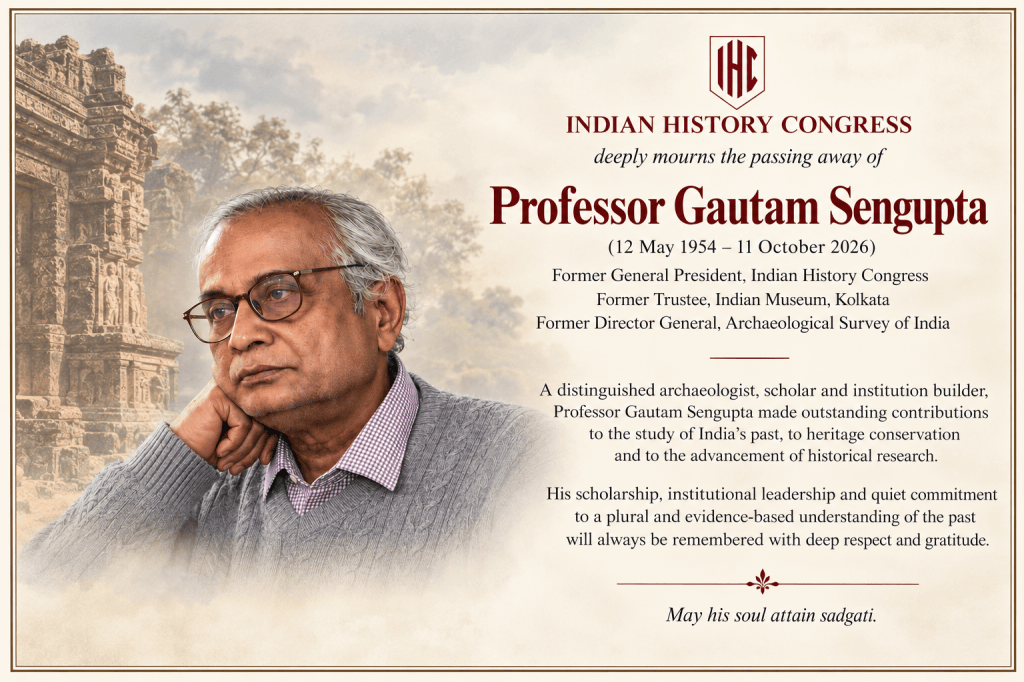
Remembering Gautam Da: An Archaeologist, Scholar and Friend

Syed Ali Nadeem Rezavi

My association with Professor Gautam Sengupta, whom we affectionately called Gautam da, goes back many years. I was introduced to him by Professor Aniruddha Ray. My first interaction with him came when he organised a seminar under the auspices of the Centre for Archaeological Studies and Training, Eastern India (CASTEI), Kolkata, an institution earlier inaugurated by Professor Irfan Habib. Gautam da invited us to Kolkata, and I was asked to present a paper on Fathpur Sikri. That was the beginning of an association which continued over the years, bringing us together on numerous academic and institutional occasions.

Subsequently, he invited me to CASTEI as a Visiting Fellow, where I was asked to deliver a series of ten lectures. What I remember most vividly is that Gautam da attended every single one of them. Despite his own academic commitments and administrative responsibilities, he would sit through the lectures, listening attentively and joining the discussions. This reflected something fundamental about his personality. He was not merely an organiser or administrator who brought scholars together. He was himself deeply interested in scholarship and remained an enthusiastic student of history and archaeology throughout his life.

Our interactions continued when he became Director General of the Archaeological Survey of India in New Delhi. On several occasions, I met him in the company of Professor Irfan Habib, who held him in considerable esteem. Gautam da belonged to that tradition of Indian archaeology which regarded the material remains of the past not simply as monuments to be preserved or objects to be classified, but as evidence through which the history of society, its economy, cultural interactions and everyday life could be reconstructed.

One of my most vivid memories of him relates to the 2023 session of the Indian History Congress at Patiala. When we were considering whom to invite as General President, I telephoned Gautam da, and he graciously accepted our invitation. By then his health was already a matter of concern, but he showed no hesitation in accepting the responsibility. What followed was a remarkable demonstration of his commitment to the institution. Despite his physical difficulties, he attended the proceedings on all three days. He would remain present even during the late evening sessions and would enthusiastically ask me where else his presence was required.

I particularly remember the late-night meeting of the Executive Committee. It was a cold Punjab winter, and the meeting followed an already long and exhausting day. Yet Gautam da not only presided over the proceedings but participated actively in the deliberations. Every now and then, he would lean towards me and whisper, asking what he was expected to say or how he should proceed with a particular matter. There was something deeply endearing about those exchanges. Here was a distinguished archaeologist, a former Director General of the ASI and the General President of the Indian History Congress, completely free from any sense of self-importance. He was willing to seek guidance, to listen and to work collectively. His concern was never with asserting his authority but with ensuring that the proceedings were conducted properly.

When I spoke to him in April this year and mentioned that the next session of the Indian History Congress might possibly be held in Bangalore, he was immediately enthusiastic. “Oh! I live there,” he exclaimed, “and I will surely attend.” He also promised to participate in the panels being organised by the Aligarh Society of History and Archaeology (ASHA) and the Aligarh Historians Society (AHS). Even when I informed him more recently that the venue had been shifted, his enthusiasm had not diminished. He assured me that he would still try to attend, health permitting. Unfortunately, that was not to be. Before we could meet again, Gautam da left us.

His contributions to archaeology were substantial, both as a scholar and as an institution-builder. His work was particularly important in expanding the scope of archaeological research in eastern and north-eastern India. He helped bring into focus regions, sites and categories of material evidence that had often remained peripheral to the larger narratives of Indian archaeology. His interests extended from early settlements, terracotta traditions and sculptural remains to the historical landscapes and urban centres of medieval Bengal.

His publications provide ample evidence of this breadth. Among the important works associated with him were Archaeology of Eastern India: New Perspectives (2002), edited with Sheena Panja; An Annotated Archaeological Atlas of West Bengal (2005), edited with B. D. Chattopadhyaya and Sambhu Chakrabarty; Past and Present: Ethnoarchaeology in India (2006), edited with Suchira Roychoudhury and Sujit Som; and Archaeology of Early Historic South Asia (2008), edited with Sharmi Chakraborty. These volumes brought together scholars working on different periods and regions, encouraging approaches that connected archaeological discoveries with broader historical questions.

Equally significant was Archaeology in India: Individuals, Ideas and Institutions (2009), edited with Kaushik Gangopadhyay, which explored the development of archaeology as a discipline and the people and institutions that shaped it. His Eloquent Earth: Early Terracottas in the State Archaeological Museum, West Bengal (2007), prepared with Sima Roy Chowdhury and Sharmi Chakraborty, reflected his concern with documenting and interpreting material culture. Later, as Director General of the ASI, he co-edited Custodians of the Past: 150 Years of the Archaeological Survey of India (2012) with Abha Narain Lambah. His more recent Ganga-Brahmaputra & Beyond: Exploring Art and Iconography of Eastern and North-Eastern India (2023) demonstrated that his engagement with the archaeological heritage of the region continued well into his later years.

But perhaps what deserves particular emphasis today is the intellectual integrity with which Gautam da approached the discipline. The later decades of his professional career coincided with a period when the growing influence of Hindutva began casting its shadow over the study and interpretation of India’s past. Archaeology, like history, was increasingly becoming a contested field, with attempts to privilege certain periods and traditions while marginalising others. It was in this atmosphere that Gautam da’s contribution acquired a significance extending beyond his individual research.

As Professor Irfan Habib pointed out on several occasions, Gautam da ensured that the secular traditions of archaeology were not abandoned and that the medieval remains of Bengal, including those associated with its Islamic past, continued to receive scholarly attention. This was no small achievement in an atmosphere in which the medieval period was increasingly being subjected to selective interpretations. Under his stewardship, archaeological work in West Bengal continued to reflect an understanding of the region’s past as a product of multiple cultural, religious and social traditions.

One particularly telling example was the attention devoted to the medieval city of Gaur. The thematic volume Gaur: The Medieval City of Bengal, edited by Gautam Sengupta and Sheena Panja, brought together studies of a city whose architectural and archaeological remains testify to the richness of Bengal’s Sultanate heritage. Such work was important not simply because it documented monuments, but because it resisted the tendency to treat the Islamic centuries as an interruption in India’s historical development.

Gautam da understood that the archaeological record could not be divided into compartments of religious identity. The temples, mosques, monasteries, settlements, fortifications, sculptures, inscriptions and everyday objects of the past were all part of the same historical inheritance. To study one while deliberately neglecting another was to distort the past itself. His approach was grounded in the conviction that archaeology must remain an evidence-based discipline, free from the demands of contemporary political ideologies.

His association with CASTEI was equally important. The Centre became a meeting ground for archaeologists and historians, encouraging interdisciplinary conversations and providing opportunities for younger scholars. It was this spirit of intellectual exchange that I had personally experienced during my visits to Kolkata. Gautam da believed in institutions, in collective scholarship and in the necessity of bringing people together. His administrative positions never diminished his interest in academic discussion. Rather, he used the opportunities provided by those positions to promote research and strengthen the institutions with which he was associated.

It is difficult for me to separate the scholar from the man I knew. His warmth, simplicity, intellectual curiosity and complete absence of pretension made every encounter memorable. He could preside over an important academic gathering with dignity and, a moment later, turn to a colleague with the informality and affection of an old friend. Even when his health was failing, his enthusiasm for academic work and institutional responsibilities remained undiminished.

When I think of Gautam da today, I remember not merely the distinguished archaeologist or the former Director General of the ASI, but the man who sat through all ten of my lectures at CASTEI, who remained at the Executive Committee meeting in Patiala late into a freezing winter night, and who, despite his failing health, was still looking forward to attending another session of the Indian History Congress.

His passing is a loss to Indian archaeology, to the Indian History Congress and to all those who believe that the study of the past must remain committed to evidence, reason and the recognition of India’s composite historical inheritance. For me, it is also the loss of an affectionate friend and senior colleague whose kindness and encouragement I shall always remember.

Farewell, Gautam da. You will be missed, not only for what you contributed to our understanding of the past, but also for the warmth and humanity with which you enriched our lives.

Faith, Tolerance and Empire: The Age of Akbar

Syed Ali Nadeem Rezavi

October in some ways is a month which makes us talk about Jalaluddin Muhammad Akbar. He was not only born, but died during this month. 15 October 1542, is the alleged date when Hamida Bano Begim gave birth to him in the Rajput court of Umarkot in Sindh, where his father Humayun had taken refuge after losing his Indian territories. Sixty-three years later, on 27 October 1605, Akbar ultimately closed his eyes at Agra, leaving behind an empire vastly different from the fragile inheritance into which he had been born. Between those two October dates unfolded one of the most consequential reigns in Indian history, an age that witnessed not only the consolidation of Mughal power but also a remarkable experiment in reconciling faith, political authority and the religious diversity of the subcontinent.

Few rulers have exercised such a profound influence on the political, social and cultural life of medieval India. At the age of 14 he inherited an empire whose foundations were still insecure, whose ruling elite was divided by competing interests, and whose population embraced an extraordinary range of religious beliefs, languages and customs. By the time he left this world, he had transformed this fragile inheritance into one of the most formidable empires of the early modern world. Yet his achievement was not confined only to territorial expansion or administrative consolidation. It lay equally in his recognition that a durable empire in India could not be sustained by military superiority alone, nor by the assertion of a single religious authority. It required a political order capable of accommodating diversity and securing the allegiance of people who did not share the faith of their sovereign.

Akbar’s reign is often celebrated as an age of religious tolerance. The description is not misplaced, but it does not fully convey the complexity of his political and intellectual experiment. What distinguished Akbar was not simply a willingness to tolerate religious difference, but a gradual movement towards a conception of sovereignty in which the ruler’s responsibility extended beyond the boundaries of any particular religious community. His policy of sulh-i kul, or universal peace, was the culmination of a process in which political necessity, personal enquiry, intellectual engagement and the practical demands of imperial government came together. To understand this development, we must place Akbar within the historical circumstances of his age rather than interpret his actions through modern assumptions about secularism or religious freedom.

When Akbar ascended the throne in 1556, the Mughal position in India was precarious. Humayun had only recently recovered Delhi, and the Afghan challenge remained formidable. The victory over Hemu at the Second Battle of Panipat secured the dynasty’s immediate survival, but the task of building a stable political order had scarcely begun. During the early years of his reign, Akbar remained under the influence of Bairam Khan and subsequently of powerful figures within the imperial household. His gradual assertion of independent authority was accompanied by a growing understanding of the problems confronting a ruler in India.

The empire Akbar sought to establish was neither an exclusively Turkish nor a narrowly Muslim enterprise. Its population was overwhelmingly non-Muslim, while its political landscape contained numerous established centres of authority, including Rajput ruling houses, Afghan chiefs, zamindars and regional dynasties. The older political traditions of India could not simply be swept aside. They had to be understood, negotiated with and, wherever possible, incorporated into the developing imperial structure.

It was in this context that Akbar’s relations with the Rajputs acquired particular importance. His matrimonial alliances with certain Rajput families, beginning with the house of Amber, formed part of a much wider policy of political accommodation. Rajput chiefs were admitted into the imperial nobility, entrusted with important military and administrative responsibilities, and allowed considerable freedom in observing their religious and social customs. Raja Bhagwant Das and Raja Man Singh emerged as influential figures within the Mughal establishment, while Raja Todar Mal became closely associated with the organisation of imperial revenue administration.

Such appointments represented more than gestures of goodwill. They signified the gradual transformation of the Mughal ruling class into a politically integrated nobility whose membership was not determined solely by religion or ethnic origin. Imperial service brought together Turanis, Iranis, Indian Muslims, Rajputs and, increasingly, other groups within a common institutional framework, converting it into a cosmopolitan ruling class not found in any other contemporary empire of the period. The political standing of this ruling groups rested on their relationship with the emperor and their position within the evolving mansabdari system.

Nevertheless, Akbar’s policy towards the Rajputs should not be romanticised as an uninterrupted story of friendship and reconciliation. The conquest of Chittor in 1568, accompanied by extensive killing after the fortress fell, remains a stark reminder that imperial expansion could be ruthless. The resistance of Mewar, particularly under Rana Pratap, demonstrates that accommodation was not universally accepted. Akbar’s empire offered opportunities for cooperation, but it also demanded submission to imperial authority. Religious accommodation and military coercion were not mutually exclusive features of his rule; both formed part of the same process of empire-building.

The changing character of Akbar’s religious outlook can be traced through a series of measures undertaken during the earlier decades of his reign. In 1563, he abolished the tax on Hindu pilgrims, and the following year he removed the jizya, the poll tax traditionally imposed on non-Muslim subjects under certain interpretations of Islamic law. These measures carried considerable symbolic significance. They weakened the distinction between Muslim and non-Muslim subjects in the fiscal practices of the state and indicated that Akbar was beginning to question inherited conventions of religious differentiation.

His actions did not amount to a rejection of Islam. Akbar had been brought up within a Muslim environment and remained deeply engaged with Islamic religious thought throughout much of his life. He respected Sufi saints, visited their shrines and maintained a particular attachment to the Chishti order. His association with Shaikh Salim Chishti at Sikri is well known. The birth of his son Salim in 1569, following his prayers and visits to the saint, strengthened this connection. The establishment of Fathpur Sikri as an imperial capital subsequently gave architectural expression to the relationship between kingship, spiritual authority and imperial ambition.

Yet Akbar’s religious interests were never confined to inherited devotional practices. His intellectual curiosity encouraged him to question the authority of religious scholars and to examine the grounds on which competing claims to truth were made. This tendency became especially pronounced during the 1570s, when the imperial court at Fathpur Sikri emerged as a centre of theological debate and philosophical enquiry.

The construction of the Ibadat Khana, or House of Worship, in 1575 marked an important stage in this development. Initially intended for discussions among Muslim scholars, theologians and Sufis, it soon became the setting for increasingly contentious debates. Differences between Sunni scholars, disagreements involving Shiʿi participants, and disputes over theological interpretation revealed the absence of the unanimity that religious authorities frequently claimed for themselves.

The discussions eventually expanded to include representatives of other religious traditions. Brahmans, Jain scholars, Christian missionaries and Zoroastrian interlocutors took part in exchanges that brought diverse systems of belief into direct contact with the imperial court. The arrival of Jesuit missionaries from Goa, beginning with the first mission in 1580, introduced Akbar to Christian theology, biblical narratives and European religious imagery. Jain teachers, including Hiravijaya Suri, influenced his thinking on non-violence, animal slaughter and the ethical responsibilities of rulers. His interest in Hindu philosophical and devotional traditions similarly broadened the range of ideas under consideration.

These encounters were not without tension. Participants often sought to establish the superiority of their own beliefs, and the surviving accounts reflect the prejudices and expectations of their authors. The Jesuits hoped for Akbar’s conversion to Christianity, while some Muslim chroniclers viewed his experiments with growing suspicion. Yet the significance of these discussions lay in the fact that the emperor was willing to listen to competing religious claims without accepting that any single group of theologians possessed an exclusive right to determine imperial policy.

The disputes also had important implications for the nature of sovereignty. In 1579, a document commonly known as the Mahzar was issued, affirming the emperor’s authority to choose among differing interpretations of Islamic law where qualified jurists disagreed, provided that his decision conformed to the principles of the Quran and the welfare of the community. Its provisions were more limited than the sweeping claims sometimes made on its behalf. It did not declare Akbar infallible, nor did it formally transfer all religious authority to the emperor. Nevertheless, it strengthened his position against the claims of individual religious scholars and helped establish the principle that the requirements of government could not remain subordinate to the interpretations of any particular theological faction.

The intellectual foundations of this developing conception of kingship were articulated most systematically by Abu’l Fazl, Akbar’s close associate, adviser and historian. In the Akbarnama and the Ain-i Akbari, Abu’l Fazl presented sovereignty as an institution invested with a special responsibility for maintaining justice, order and the welfare of humanity. The emperor was represented as the recipient of farr-i izadi, or divine radiance, an idea that drew on Persian traditions of kingship while being reinterpreted within the political circumstances of Mughal India.

This conception did not make the emperor a prophet or the founder of a new revealed religion. Rather, it invested kingship with an ethical responsibility that transcended sectarian divisions. A just sovereign was expected to rise above narrow religious prejudices and protect the interests of all his subjects. Abu’l Fazl’s emphasis on reason, enquiry and freedom from blind imitation reflected the intellectual atmosphere cultivated at Akbar’s court.

It was from this setting that sulh-i kul emerged as a central principle of imperial governance. Although often translated as universal tolerance, the expression carried a wider meaning. It implied a condition of peace among different communities and a political order in which the state did not identify itself exclusively with one religious group. Its practical significance lay in the expectation that the ruler should treat his subjects with justice irrespective of their religious affiliations.

Such a principle was particularly suited to the circumstances of a vast and diverse empire. It offered a means of reconciling the political unity sought by the Mughal state with the religious and cultural plurality of Indian society. In this sense, sulh-i kul was not merely an expression of personal benevolence. It was also a principle of imperial integration, enabling the state to draw on the services and loyalties of groups whose traditions differed substantially from those of the ruling dynasty.

At the same time, it would be misleading to describe Akbar’s political order as secular in the modern constitutional sense. Religion remained closely associated with the language and symbolism of kingship, while the emperor continued to exercise extensive authority over religious and social life. What changed was the basis on which religious differences were accommodated within the imperial system. The sovereign was increasingly represented not as the political representative of a single religious community, but as the guardian of an order embracing many communities.

The much-discussed “Din-i Ilahi”, or more accurately the spiritual discipleship associated with Akbar’s Tauhid-i Ilahi, must be understood within this broader development. It has frequently been represented as an attempt to establish a new religion combining elements of Islam, Hinduism, Christianity, Zoroastrianism and other traditions. Such an interpretation exaggerates both its institutional character and its historical significance. The circle of disciples was small, and there is little evidence that Akbar intended to create a mass religion with a separate scripture, organised priesthood or system of public worship. It was more closely associated with ethical discipline, personal loyalty and the emperor’s spiritual authority.

The controversy surrounding these developments also illustrates the difficulties of reconstructing Akbar’s religious ideas from contemporary sources. Abu’l Fazl presented the emperor as an enlightened sovereign whose pursuit of truth placed him above sectarian prejudice. Abdul Qadir Badauni, by contrast, regarded many of the same developments as dangerous departures from established Islamic practice. The Jesuit accounts offer yet another perspective, often interpreting Akbar’s interest in Christianity through the expectations of missionaries seeking converts. None of these narratives can be accepted uncritically. Their differences are themselves valuable evidence of the intellectual and religious tensions generated by Akbar’s experiments.

Akbar’s engagement with India’s religious traditions also extended beyond theological discussion into literature, language and artistic production. His translation bureau, the Maktab Khana, established at Fathpur Sikri, brought together scholars capable of working across Sanskrit and Persian intellectual traditions. The translation of the Mahabharata into Persian, known as the Razmnama, was among the most ambitious undertakings of this enterprise. The Ramayana, Harivamsha and other Sanskrit works were also translated or adapted into Persian.

These projects were not simply exercises in literary curiosity. Persian was the principal language of Mughal administration and elite intellectual life. By making Sanskrit texts available in Persian, the court opened important elements of Indian philosophical, religious and literary traditions to readers who might otherwise have remained unfamiliar with them. The translations were shaped by the assumptions of their patrons and translators, and they did not always reproduce the originals without alteration. Nevertheless, they created opportunities for intellectual exchange across linguistic and religious boundaries.

The imperial painting atelier similarly reflected the cultural encounters encouraged by the court. Artists trained in different regional traditions worked alongside one another, while the arrival of European engravings and paintings introduced new techniques of representation. The resulting Mughal style was neither a simple continuation of Persian painting nor an unaltered adoption of Indian forms. It emerged from a sustained process of experimentation, adaptation and collaboration.

Architecture provides another striking expression of this cultural synthesis. The buildings of Fathpur Sikri, particularly the palaces and residential structures, incorporated forms and techniques associated with different architectural traditions of the subcontinent. Trabeate construction, carved brackets, projecting eaves, chhatris and other features appeared alongside arches, vaults and forms associated with the wider Persianate world. Such combinations should not automatically be interpreted as deliberate symbols of religious harmony, since architectural forms do not belong exclusively to particular religious communities. Yet they reveal the ability of imperial workshops to draw on a wide range of regional skills and established building practices.

The Jami Masjid and the monumental gateways of Fathpur Sikri, together with the palace complexes, demonstrate how the imperial capital brought different architectural languages into a coherent political setting. The city itself embodied Akbar’s ambition to create a courtly environment in which political authority, religious devotion, artistic production and intellectual activity could coexist.

The same processes were visible in the social composition of the empire. Mughal administration required the cooperation of accountants, revenue officials, merchants, artisans, military specialists, scholars and local intermediaries drawn from diverse backgrounds. The consolidation of the mansabdari and jagirdari systems, the expansion of revenue administration and the growing integration of regional elites helped create institutional bonds extending beyond religious affiliation. The empire was sustained not merely by the emperor’s ideas but by the material interests and practical relationships that connected different sections of society to the imperial state.

This does not mean that religious distinctions disappeared from everyday life or that social inequalities were overcome. Caste hierarchies, local conflicts, sectarian rivalries and inherited prejudices continued to shape society. The Mughal state itself remained hierarchical and coercive. Peasants bore substantial revenue demands, military campaigns inflicted suffering, and the imperial nobility enjoyed privileges unavailable to the majority of the population. Akbar’s religious accommodation did not constitute a programme of social equality in the modern sense.

Nor was the emperor’s tolerance entirely consistent. Certain measures, particularly those associated with restrictions on animal slaughter or the regulation of religious practices, reflected his own ethical convictions and could affect different communities unequally. His increasingly elaborate court rituals and claims to exceptional spiritual insight also raised questions about the relationship between personal belief and political authority. The very concentration of power that enabled Akbar to challenge religious orthodoxy also allowed him to impose his own preferences on others.

These contradictions should not be ignored, for they help us distinguish historical achievement from idealised memory. Akbar was an early modern monarch, not a modern democrat. He sought to consolidate an empire, not establish a constitutional order founded on individual rights. His policies of accommodation were inseparable from the requirements of sovereignty. Yet it would be equally mistaken to dismiss them as mere political expediency. His sustained engagement with religious ideas, his willingness to question inherited authority and his patronage of intellectual exchange suggest a genuine interest in understanding the diversity of human belief.

Indeed, the distinction between conviction and political calculation may itself be too rigid. In the world of early modern kingship, ethical ideas and practical considerations frequently reinforced one another. Akbar’s recognition that religious exclusiveness could weaken imperial unity did not prevent him from developing a serious intellectual commitment to broader principles of justice. His achievement lay partly in transforming the necessities of government into a more comprehensive vision of political responsibility.

The long-term significance of this experiment becomes clearer when Akbar is situated within the wider history of early modern empires. Religious conflict was a defining feature of much of the sixteenth-century world. Europe experienced the upheavals of the Reformation and Counter-Reformation, including the devastating violence of the French Wars of Religion. The Ottoman and Safavid empires also confronted the relationship between political sovereignty and competing religious identities, although they developed different institutional and ideological responses.

Against this background, Akbar’s efforts to create an imperial order capable of accommodating religious plurality acquire particular importance. They were not wholly unprecedented, nor did they eliminate conflict. Traditions of coexistence, negotiation and shared cultural practices had long existed in India. Sufi and Bhakti movements, regional courts, mercantile networks and local societies had already created numerous spaces of interaction. Akbar’s contribution was to elevate accommodation into a consciously articulated principle of imperial governance and to give it institutional expression through the composition of the nobility, the practices of the court and the language of sovereignty.

The consequences extended beyond his own lifetime. Under Jahangir and Shah Jahan, many features of the composite Mughal political order continued, although the balance between imperial authority and religious accommodation changed according to circumstances. The later history of the empire, including the policies of Aurangzeb, cannot be reduced to a simple contrast between tolerance and intolerance. Mughal political culture remained complex, and religious policies were shaped by changing administrative, ideological and military considerations. Nevertheless, the conception of sovereignty articulated during Akbar’s reign became an enduring reference point in discussions of the nature of the Indian state.

Akbar’s legacy also invites reflection on the ways in which history is remembered and appropriated. In modern India, he has often been celebrated as a symbol of religious harmony and cultural synthesis. At other times, his achievements have been minimised or interpreted primarily through the language of conquest and religious identity. Both approaches can obscure the historical circumstances in which he operated. A critical understanding requires us to recognise the violence of imperial expansion without overlooking the intellectual and institutional innovations that distinguished his reign.

The importance of Akbar lies neither in presenting him as a flawless champion of tolerance nor in reducing him to a foreign conqueror. He was a ruler who understood that the diversity of India was not a temporary obstacle to be removed but a permanent reality with which political power had to engage. His response was to construct an imperial order in which allegiance to the sovereign could coexist with differences of religion, custom and cultural inheritance.

There is also a deeper lesson in the intellectual culture fostered at his court. The debates of the Ibadat Khana demonstrated that religious certainty did not necessarily produce agreement, and that those claiming exclusive possession of truth could themselves be divided by bitter disputes. Akbar’s willingness to hear different voices represented an important departure from the assumption that political authority must depend on the enforcement of a single religious interpretation. His experiments suggested that the pursuit of knowledge required openness to disagreement, and that the responsibilities of government demanded a wider perspective than sectarian loyalty.

In this respect, Abu’l Fazl’s formulation of sulh-i kul remains perhaps the most enduring contribution of the age. It recognised that peace was not simply the absence of conflict but a condition sustained by justice, restraint and the acceptance of difference. Although framed within the language of imperial sovereignty, it expressed an insight whose relevance extended beyond the immediate requirements of Mughal administration.

The age of Akbar was therefore remarkable not because it resolved the tensions between faith and political power, but because it attempted to negotiate them through a new understanding of kingship. Faith remained important, empire remained coercive, and tolerance remained conditioned by the authority of the sovereign. Yet within these limitations emerged a political imagination that sought to transcend the narrow boundaries of religious affiliation.

More than four centuries after Akbar’s death, his reign continues to invite debate because the questions with which he grappled have not disappeared. How can political authority secure the loyalty of people belonging to different religious traditions? Can a state maintain its legitimacy without privileging the beliefs of one community over those of others? What place should reason, dialogue and intellectual enquiry occupy in public life? These are not questions confined to the sixteenth century.

Akbar’s answer was shaped by the institutions and assumptions of his own age, and it cannot simply be transplanted into the present. Nevertheless, his recognition that political unity need not demand religious uniformity remains historically significant. His greatest achievement was perhaps the realisation that an empire as diverse as India could not be held together by the sword alone. It required a broader conception of justice, a willingness to accommodate difference and an understanding that the strength of political authority ultimately depended on its ability to command allegiance across the divisions of faith.

As we approach 15 October and we move towards the anniversaries of Akbar’s birth and death, we remember an emperor and reflect on the political and intellectual experiment associated with his reign. His legacy was neither without violence nor free from contradiction, but it included a conception of political authority that recognised the necessity of accommodating India’s many faiths and traditions. Between the October of 1542 and that of 1605, Akbar had travelled a remarkable distance, from the vulnerable child of a displaced dynasty to a sovereign who sought to make diversity a foundation of imperial strength rather than a cause of political division. That remains one of the most significant and enduring aspects of his place in Indian history, and we honour it by remembering him and his legacy.

The Military Rule over AMU: The Lt General Zameeruddin Shah Years

Syed Ali Nadeem Rezavi

This is, perhaps, the last write up of mine on the executive heads of AMU. The period after his time are too close to us to assess: they were mostly a continuation or a response to what happened under Shah. And I am writing this as yet another ‘crisis’ involving mass mobilisation of both boys and girls and another vc appears to be moving towards resolution (hopefully).

The Vice-Chancellorship of Lt General Zameeruddin Shah, from 2012 to 2017, remains one of the more unusual chapters in the recent history of Aligarh Muslim University. He came to Aligarh after a distinguished career in the Indian Army, carrying with him the reputation of a soldier, an administrator and a man accustomed to discipline. When he arrived, there were many within the University, including myself, who welcomed precisely these qualities. Aligarh had known periods of indiscipline, factionalism and administrative drift, and there was a widespread feeling that a firm hand might restore order. To an extent, particularly during the earlier part of his tenure, this expectation was fulfilled. The campus appeared more orderly, discipline became visible, cleanliness received attention and the administration projected an impression of decisiveness.

It would therefore be unfair to write the history of the Shah years merely as a catalogue of controversies. There were achievements, and there were people within the University who admired him. He was energetic, physically active, accessible in his own fashion and capable of taking decisions rapidly. He placed considerable emphasis upon punctuality, cleanliness and discipline. The campus, for substantial periods, was peaceful, and the endless disruptions which had afflicted Aligarh at other moments did not define his entire tenure. He wanted AMU to rise in national rankings and repeatedly spoke of improving its standing. Nor should every attempt to enforce discipline be dismissed merely because it came from a former General. A residential university with thousands of young students requires rules, and Aligarh certainly had problems which demanded firm action.

Yet the great weakness of the Shah administration lay elsewhere. Lt General Shah appeared never fully to understand the difference between administering a college and presiding over a research university. Still less did he appear to understand that the habits of command which serve a military officer extraordinarily well cannot simply be transplanted into an academic institution. A university is not merely a larger college. A college may principally concern itself with teaching prescribed courses, examinations, attendance and student discipline. A university must also create knowledge. Research, doctoral supervision, laboratories, archives, archaeological exploration, museums, libraries, seminars and intellectual disagreement constitute its life. Its professors are not simply employees delivering lectures according to a timetable. They belong to disciplines extending far beyond the boundaries of their own institution. A Vice-Chancellor therefore administers something he does not intellectually own. This distinction repeatedly became blurred during the Shah years.

One small but extraordinarily revealing example concerned the appointment of examiners for PhD theses. Restrictions were placed upon inviting examiners from distant places and departments were encouraged to choose scholars located nearer Aligarh. The administrative logic presumably appeared impeccable: why incur unnecessary expenditure when an examiner could be found closer home? But this was precisely where the difference between a college administrator and the head of a research university became apparent. A PhD examiner is not selected according to railway distance. The question is not whether an examiner lives in Delhi rather than Chennai, Kolkata or elsewhere. The question is who possesses the expertise necessary to judge the thesis. If the leading authority on a subject lives a thousand kilometres away, the thesis should travel a thousand kilometres. Scholarship has never recognised geographical proximity as an academic qualification.

Nothing, however, illustrated this incomprehension of university life more painfully than what happened to the Archaeology Section of the Department of History. The Archaeology Section was one of the prides of our Department. It represented decades of painstaking work by archaeologists and historians, including Professor Nurul Hasan, Professor R. C. Gaur and others who had created at Aligarh a significant tradition of archaeological teaching, exploration and excavation. The University’s own account today acknowledges the importance of finds from Atranjikhera, Jakhera, Lal Qila, Daulatpur, Sidhpur and Fatehpur Sikri, while the restored Archaeology Section now houses more than 15,000 artefacts and antiquities. It was considered as good as, if not better, the Archaeological sections of ASI itself. It had all the equipment, staff and expertise required from such units. During the Shah administration the building in which this Section functioned was identified for another purpose. As those of us who were present in the University witnessed, the premises were wanted to provide an office for a fellow Army officer who had been inducted into the administration. An academic institution painstakingly built over decades suddenly became expendable because its physical space appeared administratively useful.

What followed was far worse than a simple relocation. Archaeological collections are not collections of beautiful things. Much of archaeology consists of objects which appear singularly unimpressive to the untrained eye: potsherds, fragments of terracotta, bricks, pieces of metal, slag and other apparently insignificant remains. Their importance lies not in their beauty but in their archaeological context. A potsherd may establish chronology. A piece of pottery may reveal trade connections. A fragment may identify a cultural phase. The archaeologist is trained precisely to discover historical meaning in things which others might throw away. During the displacement of the Archaeology Section, however, much of this material appeared to be treated as though it were useless. Why, after all, should anyone preserve ugly potsherds when there were sculptures and attractive antiquities which could be placed in showcases?

The consequences were disastrous. Material regarded as sufficiently attractive or worthy was selected for removal to the University Museum. Other archaeological material (a back bone for any research) was dumped into a structure which had itself earlier been identified for demolition. The transfer was anything but the careful movement of a scholarly collection. Furniture and tables were damaged, some expensive pieces crumbled during the process, and archaeological material was in places treated virtually as garbage. The technical staff of the Archaeology Section were transferred elsewhere. Once the collections, staff and working space had been separated from one another, meaningful archaeological work became virtually impossible. There is an almost painful symbolism here. The potsherd which appeared ugly and useless was actually a test of whether the administration understood what a university was. A museum curator may display the beautiful sculpture, but an archaeologist also needs the broken pot. Knowledge frequently resides in precisely those things which have no aesthetic appeal.

The University’s present account of the Musa Dakri Museum itself confirms the provenance of the collection. It acknowledges the sculptures collected by Sir Syed Ahmad Khan, the archaeological material subsequently assembled through Professor R. C. Gaur’s excavations and explorations, and the eventual shifting of the collection to the Kennedy Hall complex. There was a further irony. The collection had an obvious historical association with Sir Syed Ahmad Khan, whose Āsār-us-Sanādīd itself demonstrates his remarkable interest in monuments, inscriptions and the material remains of the past. Yet the Museum came to be named not after Sir Syed but after Musa Dakri, described in the University’s own account simply as a magnificent donor. There is nothing wrong with honouring philanthropy. Universities need donors and should acknowledge generosity. But the academic identity of a museum ought surely to reflect the intellectual history of its collections. Sir Syed possessed a direct relationship with archaeology and antiquarian scholarship. A donor need possess no such qualification beyond generosity. It was therefore a matter of considerable satisfaction that the Archaeology Section could subsequently be revived and rebuilt. The later cataloguing of its holdings and the publication of History Through Archaeology in 2019 represented, in a sense, the intellectual reclamation of something which ought never to have been dismantled. The present Section again possesses technical staff, a laboratory, drawing facilities, archaeological collections and other facilities, but at a much reduced level: something once violently dismantled, can never gain its former glory. Till date the vacancies in the technical staff due to subsequent retirements have yet to be filled.

There was another curious feature of these years. Alongside the ordinary professoriate appeared a small category whom one might, with some humour, call the super professors. These were individuals whose arrival and position within the University appeared to many teachers to bypass the normal rhythms through which academic careers are built. Questions were consequently raised about qualifications, procedures and the relationship between the posts against which people were appointed and the functions they actually performed. One particularly revealing case involved an individual appointed as a Professor who, as we observed within the University, did not function in the Department where his selection was, in the normal manner. His work was instead associated with students entering the University from the Deeni Madaris and with the special programme established for them.

There was nothing inherently objectionable about the programme. Indeed, the Bridge Course for Graduates of Deeni Madaris was one of the genuinely imaginative initiatives associated with the Shah years. The attempt to equip madrasa graduates with English and other subjects required for entry into mainstream higher education addressed a real educational problem. The programme survives at AMU today, which itself demonstrates that the underlying idea had value. The question was different. Why should someone appointed as a Professor of English not function as an ordinary Professor within the Department of English? If the Bridge Course required a Director, Coordinator or Professor, an appropriate position could have been be created or advertised according to the University’s procedures. A professorship is not simply a salary grade which can be detached from the discipline against which it was sanctioned.

This became particularly galling when placed alongside the treatment meted out to established teachers who disagreed with the administration. During these years three teachers were suspended, including the Secretary of the Teachers’ Association (AMUTA). I too was subjected to disciplinary proceedings and suspension following my public criticism of the Vice-Chancellor. Contemporary reporting records the special meeting of the Executive Council convened in July 2014 in connection with my Facebook remarks. This was where the military conception of authority became particularly troublesome. In the Army, public criticism of a commanding officer by a subordinate is incompatible with the chain of command. In a university, the situation must necessarily be different. A professor or any teacher is not the intellectual subordinate of the Vice-Chancellor. Universities exist because people disagree. Historians challenge interpretations, scientists overturn established propositions and teachers criticise institutions. A Vice-Chancellor has to possess the capacity to be criticised, sometimes unfairly and sometimes unpleasantly, without confusing criticism of himself with an attack upon the University. The Vice-Chancellor is not the University.

Mustafa Zaidi too was suspended. He was suspended in October 2015 after participating in an AMUTA dharna. The agitation was a cause considered genuine by the majority of the staff: it was not for a personal cause. The administration characterised the matter as dereliction of duty and misconduct; AMUTA regarded it as action against dissent. 

The Shah administration justified the action against Zaidi on the grounds that he had remained absent from his assigned academic duties without obtaining proper leave and had conducted himself inappropriately towards the Vice-Chancellor. Shah subsequently portrayed his activities as “disruptive”. Zaidi, however, argued that he had been taking part in a peaceful protest in his capacity as Secretary of the Teachers’ Association. AMUTA, together with the Federation of Central Universities Teachers’ Associations, viewed the disciplinary action rather differently, seeing it as an attempt to curb organised criticism of the administration.

The matter did not end with suspension. In 2016, the Executive Council under Shah’s direction went considerably further and ordered Zaidi’s compulsory retirement on charges that included neglect of duty, misleading the authorities, misconduct and insubordination. Zaidi challenged the decision in the Allahabad High Court, which set aside the compulsory retirement order on 6 April 2017. The change of Vice-Chancellor subsequently brought the episode to a close. After Professor Tariq Mansoor assumed office, Zaidi was reinstated, the period of suspension was counted as duty with full pay and allowances, and both the charge-sheet and the disciplinary proceedings against him were withdrawn.

The third was a case where the charges were obscure and never explained: Professor Hasan Mateenul Islam of the Department of Statistics and Operations Research was suspended following two fact-finding enquiries. One, conducted by Professor Ali Athar, concerned “issues relating to his appointment”, that is, his earlier forms / documents had Syed and S prefixed to his name, while the later documents did not; the other, by Professors Iqbal Parwez and Shoaib Zaheer, examined allegations of “misconduct, violation of University rules and wilful disobedience”. He had actually indulged in a lawful practice which many do in Aligarh: he had sent a substitute to perform his invigoration duties. The Shah administration maintained that both enquiries substantiated the allegations and consequently initiated disciplinary proceedings. However, it was never publicly clarified as what those specific alleged irregularity in his appointment were nor details of his alleged acts constituting misconduct ever revealed. Islam contested the proceedings, and Executive Council records of August 2015 show that he objected to his continued suspension, the sealing of his chamber, and the conduct of the enquiry without first obtaining his clarification.

What followed the suspension made Professor Hasan Mateenul Islam’s treatment particularly degrading. His chamber in the Department of Statistics and Operations Research was sealed, depriving a senior academic of access to his normal place of work and to the papers and other academic material kept there. Similar action was reportedly taken in the my case and that of Mustafa Zaidi. Mine was locked after one month into suspension. To many teachers, the locking of chambers appeared unnecessarily punitive, turning an administrative suspension into a visible demonstration of exclusion before colleagues and students.

There was also a powerful symbolism in physically sealing a professor’s room. Suspension from official duties did not necessarily require that an academic be literally locked out of his chamber. Such an action publicly marked him as someone who had been cast out of the institution’s normal academic life.

The controversy over dress reflected the same desire to regulate university life from above. In 2013 male students wishing to meet the Vice-Chancellor were instructed to wear sherwanis. At Abdullah Hall an order went further, prescribing salwar-kameez with dupatta for women residents, regulating mobile telephones and movement outside the hostel, and threatening disciplinary action including a five hundred rupee fine. Following criticism, the dress order was withdrawn. There was something almost touching in Shah’s desire to recover the old Aligarh sherwani. But riwāyat cannot be resurrected by administrative order and tahzīb cannot be produced through circulars. The sherwani had meaning in the old Aligarh precisely because generations of students voluntarily made it part of their identity. Once culture becomes compulsory, it ceases to operate as culture and begins to operate as regulation.

But by far the darkest episode in this sphere was the controversy concerning the undergraduate women students of the Women’s College and the Maulana Azad Library. It deserves to be remembered precisely because it exposed, in a single moment, the limitations of the administrative outlook which had developed. The immediate issue possessed complications which subsequent public discussion sometimes obscured. Women postgraduate students and research scholars already had access to the Maulana Azad Library, while undergraduate students of the Women’s College had their own library. Shah subsequently maintained that the real difficulty was shortage of space in the central library, and the administration pointed to money sanctioned for improving the Women’s College library. These facts need to be recorded if the episode is to be judged historically rather than polemically. But none of them can erase the extraordinary statement which came to define the controversy. When the demand was raised that undergraduate women students should have access to the Maulana Azad Library, Shah remarked that admitting the girls would bring four times more boys into an already overcrowded library. The Allahabad High Court subsequently issued notices to the Vice-Chancellor and Registrar on a PIL seeking access for the women students, while the Union HRD Ministry sought an explanation.

For me this remains one of the darkest moments of the Shah Vice-Chancellorship. A library is the intellectual heart of a university. Access to books cannot be made dependent upon speculation about how male students might respond to the presence of women. If there was insufficient space, create more space. If there was overcrowding, regulate numbers according to academically neutral criteria. If there were problems of discipline, discipline those who misbehaved. But why should the possible behaviour of boys determine whether girls were entitled to enter a library? The argument was troubling not merely because it disadvantaged women. It transferred responsibility from those whose conduct was supposedly feared to those whose presence might supposedly provoke that conduct. The girl seeking a book became the problem because boys might follow her. For a university which had played such an important historical role in the advancement of women’s education, this was a particularly unfortunate message. The controversy also did considerable damage to the public image of AMU. It allowed an institution with a long and complicated history of women’s education to be caricatured nationally as a university which did not permit women into its library. That caricature was inaccurate: women postgraduates and research scholars already used the Maulana Azad Library. But the administration had itself supplied the sentence which made the caricature possible. Even the Students’ Union became involved in protesting what it regarded as misleading media coverage. Good leadership does not merely require making the correct decision. It requires understanding how one’s words represent an institution.

Yet balance demands that the other side of the Shah years also be remembered. There was, particularly for substantial stretches of his tenure, a visible sense of order on campus. Discipline improved in several areas. He attempted to confront unauthorised occupation and criminal elements. He emphasised cleanliness and physical appearance. The Bridge Course was an innovative experiment. His supporters believed that after years of drift the University once again possessed an administration willing to take decisions rather than endlessly postpone them. Indeed, one reason Shah initially attracted support was that many Aligarians were tired of disorder. A Vice-Chancellor who walked around the campus, demanded punctuality and insisted upon discipline could appear refreshingly different. There is much to be said for administrative energy, and no serious university can flourish in an atmosphere where rules have ceased to matter. The tragedy was that discipline gradually became too closely associated with obedience.

And even the claim of restored order suffered a devastating blow in April 2016. On the night of 23 April rival groups clashed on the campus, firearms were used, two people were killed, vehicles were torched and a mob attacked the Proctor’s Office and vandalised the office of the Dean Students’ Welfare. Shah himself subsequently acknowledged that some mistakes may have been made by University authorities while demanding a CBI or Special Task Force investigation to identify those responsible. The Teachers’ Association accused his administration of failing to contain criminal gangs, an allegation Shah rejected as part of a campaign by disgruntled elements. The irony was painful. A former Lieutenant General had been brought to Aligarh amid expectations that he would restore discipline, yet one of the most serious armed confrontations in the recent history of the campus occurred during his tenure.

More disturbing were the persistent allegations that, in the effort to control student agitation, the administration came increasingly to depend upon favoured non-student and anti-social elements who enjoyed an unusual degree of access and protection. Within the University they were sometimes spoken of, with bitter irony, as a species of ‘official goondas’. The charge acquired greater seriousness after the violence of April 2016, when AMUTA publicly alleged that unauthorised occupants of University hostels were able to operate with impunity because they enjoyed patronage from sections of the administration, and demanded a CBI enquiry to uncover their sponsors and financiers. Shah emphatically denied such accusations, maintaining instead that criminal outsiders, expelled students and a handful of serving students were responsible for the violence. What remained deeply troubling was the widespread perception that, in attempting to contain organised student opposition, the administration had allowed a parallel culture of patronage and muscle power to take root.

Still, that tragedy should not retrospectively erase every peaceful day which preceded it. History should resist such simplification. Shah did bring a certain order to AMU. He did restore confidence amongst those who believed that the University required firmer administration. He did undertake initiatives which deserve acknowledgement. The Bridge Course is one. His insistence upon cleanliness and punctuality was another. There were periods of genuine campus peace, and many students went about their studies without the repeated closures and disturbances that had characterised some other phases of Aligarh’s history.

The problem was not discipline itself. It was the conception of discipline. A university needs discipline, but it needs the discipline of scholarship rather than the discipline of the parade ground. The scholar’s discipline consists in checking evidence, acknowledging contrary arguments, respecting expertise, submitting oneself to criticism and accepting that intellectual authority cannot be created by administrative rank. This is why the seemingly minor restriction concerning PhD examiners, the destruction of the Archaeology Section, the dispersal of its technical staff, the emergence of the super professors, the suspension of teachers, the dress-code controversies and the library episode belong within the same history. They were not identical events. But behind them one can discern a recurring difficulty in understanding the peculiar character of a university.

The Archaeology Section offers perhaps the perfect metaphor. To an administrator, a broken potsherd may look like rubbish and a room containing thousands of such objects may look like valuable office space being wasted. To an archaeologist, that same room is a laboratory of history. The difference between those two ways of seeing is precisely the difference between administering buildings and understanding a university. This was ultimately the contradiction of the Zameeruddin Shah years. He possessed many qualities of a strong administrator: energy, decisiveness, physical courage, personal discipline and an impatience with disorder. These qualities produced some positive results. But the virtues of a military commander do not automatically become the virtues of an academic leader. Indeed, without modification, some can become liabilities.

A General commands. A Vice-Chancellor must persuade. A General operates through a chain of command. A Vice-Chancellor presides over colleagues who possess independent intellectual authority. A General expects an order to be obeyed. A Vice-Chancellor must sometimes listen while a professor tells him that his decision is wrong. A military establishment requires uniformity for operational effectiveness. A university requires disagreement for intellectual effectiveness. This does not mean that universities should become anarchic. Quite the contrary. AMU needed discipline then and needs discipline now. Criminality, intimidation, unauthorised occupation and violence cannot be romanticised as student politics or academic freedom. Shah was right to recognise these as problems and right to attempt to confront them. Where his administration went wrong was in allowing the boundary between enforcing legitimate discipline and demanding conformity to become blurred.

His five years therefore resist a simple verdict. They contained peace as well as violence, administrative energy as well as institutional disruption, worthwhile initiatives as well as deeply questionable decisions. The Bridge Course deserves acknowledgement. The greater emphasis upon discipline had positive consequences. His desire to see AMU perform better nationally was legitimate and welcome. But there were also wounds. For those of us associated with the Department of History, the treatment of the Archaeology Section remains one of them. For teachers who saw colleagues suspended for confronting authority, the assault upon academic dissent remains another. And for the history of women’s education at Aligarh, the Maulana Azad Library controversy remains especially difficult to forget. The image of undergraduate women students standing outside the intellectual heart of their own University while their access was debated partly in terms of how many boys might follow them is not an image which belongs comfortably with Aligarh’s claims to educational progress. It should remain in our institutional memory precisely so that it is never repeated.

Lt General Zameeruddin Shah came to Aligarh believing, I think genuinely, that discipline could cure many of its ailments. In some respects he was right. Aligarh needed discipline. What he did not sufficiently understand was that the greatest discipline of a university is the discipline imposed by scholarship upon power itself. A university is not a parade ground. Its professors are not soldiers, its students are not recruits, its departments are not battalions and its Vice-Chancellor is not a commanding officer. Its strength lies not in how obediently everybody falls into line but in how freely its members can think, research, question and disagree. The Shah years brought Aligarh a measure of order. They also demonstrated the price that can be paid when order becomes confused with academic governance. That is why his Vice-Chancellorship deserves neither unqualified condemnation nor nostalgic celebration. It deserves to be remembered as a period of achievement, contradiction and controversy, but above all as a warning that administering a university requires something more difficult than command. It requires understanding what a university actually is.

Reading Atif Syed’s Aligarh: The City That Outlasted Empires

Atif Syed, Aligarh: The City That Outlasted Empires, John Murray India/Hachette India, 2026, 336 pp., ISBN 9789357317092, ₹799. Foreword by Irfan Habib.

Syed Ali Nadeem Rezavi

Some cities are overshadowed by the institutions they contain. Aligarh is a striking example. To most people outside the region, the name immediately evokes Aligarh Muslim University, Sir Syed Ahmad Khan and the movement for Muslim educational regeneration that grew around the Muhammadan Anglo-Oriental College. So powerful has this association become that the considerably older city within which the College arose has almost disappeared from popular historical memory. Atif Syed’s Aligarh: The City That Outlasted Empires seeks to recover that city and restore to it a history extending far beyond, and long before, the University.

It is an ambitious undertaking. Syed follows Aligarh, known for much of its earlier history as Kol or Koil, across a remarkably long chronological span. Archaeology and traditions concerning the earliest settlement lead into the medieval period, the Delhi Sultanate and the Mughals, followed by the political turbulence of the eighteenth century, when Jats, Marathas, Afghans, regional magnates and European military adventurers struggled over this part of the upper Gangetic plain. The narrative subsequently encounters British expansion, colonial Aligarh, Sir Syed and the MAO College, before moving towards the modern city. The publisher appropriately describes the result as a “panoramic biography” of Aligarh.‌

Syed himself has an interesting relationship with his subject. He grew up in Aligarh but is not a professional historian. Trained in computer engineering in Singapore, he eventually settled in Austin, Texas, and pursued a career in technology. His engagement with his native city, however, is clearly much more than an exercise in nostalgia. He has read widely, investigated monuments and archaeological remains, followed scattered references in textual sources, and paid attention to the histories concealed within neighbourhoods, buildings and place names. The result is a book written with affection, but also with the curiosity of someone who repeatedly asks what existed here before the familiar Aligarh took shape.‌

Irfan Habib and the Problem of Recovering Koil

The volume carries a brief but significant Foreword by Professor Irfan Habib. It deserves attention because Habib does more than provide the customary words of commendation. He identifies quite precisely what he considers Syed’s principal historical contribution. Habib begins by giving Syed credit for producing a comprehensive study of Aligarh, or Kol/Koil as it was known in medieval times. He then draws attention to the central difficulty confronting anyone attempting such a history. For long periods Koil remains practically unmentioned in written sources. Syed has therefore had to make archaeological evidence perform work that written documents cannot. Habib particularly commends his survey of this archaeological material. When the textual record becomes somewhat firmer from the thirteenth century onwards, Syed painstakingly assembles scattered references in medieval sources and combines them with the evidence of a remarkable surviving thirteenth-century inscription. Habib again singles out the archaeological material for the later period and draws attention to the notable examples of Anglo-Indian architecture that Aligarh acquired.

This endorsement is important because Irfan Habib himself represents an Aligarh historical tradition in which archaeology, historical geography, cartography and material remains have long been taken seriously. His observation that Syed’s use of archaeological evidence is “particularly noteworthy” should therefore not be regarded as casual praise. It identifies one of the genuine strengths of the book: its willingness to allow objects, buildings, inscriptions and landscapes to supplement the silences of chronicles. Yet Habib’s Foreword is also admirably restrained. He does not claim that Syed has discovered an entirely unknown history of Aligarh or overturned an existing historiography. His emphasis is upon comprehensiveness, careful reconstruction and the assembling of dispersed evidence. His concluding hope that Syed’s work receives a broader readership points towards another of the book’s achievements. Material scattered through archaeological studies, medieval chronicles, inscriptions, local histories and specialist scholarship has been brought together into a narrative accessible to readers outside the professional historical community.

Before Atif Syed: Jamal Muhammad Siddiqui

This qualification is important because the history of pre-modern Aligarh was certainly not an untouched field. Any assessment of Syed’s achievement must acknowledge the pioneering contribution of Jamal Muhammad Siddiqui’s Aligarh District: A Historical Survey, from Ancient Times to 1803 A.D., published by Munshiram Manoharlal for the Centre of Advanced Study, Department of History, Aligarh Muslim University, in 1981. A limited reprint was made in 2018. The substantial volume ran to 346 pages, with plates, maps and an extensive bibliography. Siddiqui’s book belonged to a somewhat different genre. It emerged from an academic tradition of regional history and historical archaeology cultivated at Aligarh. Its range of sources was formidable, extending across historical works, mystical and administrative literature, travel accounts, memoirs, letters, archaeological reports, administrative records, biographies, regional and local histories, topographical works, gazetteers, settlement and census reports, and linguistic material. Its very organisation, with substantial sections devoted to the Sultanate, Mughal and eighteenth-century periods, reveals the seriousness with which the pre-British history of Aligarh had already been investigated.

Thus the Dor traditions, Sultanate Koil, Mughal administration, Sabit Khan, Suraj Mal, Najaf Khan, the Jats and Marathas, local zamindars and the complicated political developments preceding British occupation were not chapters entirely forgotten until the appearance of Syed’s book. Siddiqui had already demonstrated more than four decades earlier how much could be recovered by combining the written record with historical geography, inscriptions and archaeology. This does not reduce Syed’s achievement. It enables us to define it more accurately. Siddiqui wrote primarily as an academic historian of a district. Syed writes something closer to the biography of a city. The relationship between the two works is consequently better understood as one of continuity and enlargement rather than discovery and repetition. Indeed, Habib’s Foreword makes it difficult to dismiss Syed as simply a populariser of material already available in Siddiqui. Syed has returned to archaeological evidence, gathered dispersed medieval references, used inscriptions and attempted to bridge periods in which written documentation becomes frustratingly thin. Moreover, his narrative continues far beyond 1803. He is interested not simply in who controlled Aligarh, but in what traces successive political and cultural worlds left upon the city.

From Kol or Koil to Aligarh

One of the most attractive features of the book is its recovery of Koil as a historical place. The modern name Aligarh has become so dominant that it can obscure the earlier identity of the settlement. Syed restores the continuity between the two. Here, however, lies one of the difficulties inherent in writing history across such an enormous chronological span. The earliest phases have to be reconstructed from evidence of very unequal value. Archaeology, local traditions, later gazetteers and textual references cannot automatically be placed upon the same evidential plane. Traditions concerning early rulers or communities may preserve important historical memories, but they require a different kind of handling from contemporary inscriptions or chronicles. At places, therefore, the reader must remain alert to the distinction between what can be demonstrated, what can reasonably be inferred and what belongs to remembered antiquity.

One object demonstrates particularly well both the possibilities of material history and the remarkable continuity connecting medieval Koil with modern Aligarh. This is the inscription from the minaret erected at Koil in the reign of Sultan Nasiruddin Mahmud when Balban, the future Sultan Ghiyasuddin Balban, was an enormously powerful figure in the Sultanate. The inscription is dated 10 Rajab 652 AH, corresponding to 26 August 1254. The minaret itself was eventually demolished under the colonial administration in 1862, but its inscription survived. The story of its survival deserves to be told, but Syed misses out on it. Sir Syed Ahmad Khan recognised the historical importance of the inscription, acquired it after the demolition of the minaret and ensured its preservation within the institution he founded. It was eventually fixed into a wall of the building which had housed the Nizam Museum of the MAO College. Thus, even before the professional institutionalisation of archaeology at Aligarh, Sir Syed was acting as a custodian of the material remains of Koil’s past.

The history of the inscription did not end there. When I was in charge of the University Museum, I felt that an object of such significance should no longer remain embedded in a wall but should be displayed as part of the archaeological history of Aligarh and of Sir Syed’s own antiquarian interests. In 2019, with the necessary permission and the technical assistance of the Archaeological Survey of India, the slab was carefully removed and transferred to the Sir Syed Gallery within the University Museum. Its removal produced an unexpected discovery. The reverse of the slab carried earlier sculptural work in the Jain tradition, apparently datable to the tenth or eleventh century. The same piece of stone therefore preserves multiple layers of Aligarh’s past. An earlier Jain sculptural fragment was reused for an inscription associated with Balban’s thirteenth-century Koil; the inscription was rescued by Sir Syed in the nineteenth century; it became part of the MAO College’s museum heritage; and in the twenty-first century it was moved to the Sir Syed Gallery for proper display. Few objects could illustrate more vividly the idea of Aligarh as a historical palimpsest. Wish Syed had included some of this in his book.

The Mughal Landscape and an Unexpected Link with the Taj Mahal

From the medieval period onwards, Koil can be placed more securely within the political geography of northern India. Its importance was related to its position in the upper Gangetic doab and to its relationship with Delhi, Agra and the routes connecting the two. Political authority, agricultural resources, military movement and revenue administration tied the locality to much larger structures of power. Aligarh’s history was never simply that of an isolated town. A fascinating documentary survival provides an unexpected illustration of this relationship during Shah Jahan’s reign. Preserved in the Taj Museum within the Taj Mahal complex at Agra is a document recording that the revenues of the village of Dodhpur in Kol were reserved for the maintenance of the Maqbara-i Munawwara, the Taj Mahal. Dodhpur, now so completely absorbed into the urban geography of modern Aligarh, was thus once connected through the Mughal revenue system with Shah Jahan’s celebrated mausoleum at Agra.

The significance of this evidence extends beyond local curiosity. Great Mughal monuments did not exist as isolated architectural creations. Their continued maintenance required resources, personnel and revenue assignments extending across a much wider imperial landscape. The document concerning Dodhpur reveals one small part of that fiscal geography. An apparently ordinary locality in modern Aligarh was connected economically with one of the most celebrated monuments of the Mughal Empire. It is precisely evidence of this kind that makes local history important. A village name, an inscription displaced from its original monument or a document preserved in a museum a hundred kilometres away can suddenly connect the history of Koil with the larger structures of the Sultanate or Mughal Empire. The inclusion of this would have made the book richer.

An Eighteenth-Century Crossroads

The eighteenth century is among the most fascinating parts of Syed’s story. Here Aligarh becomes entangled in the redistribution of political authority that followed the weakening of central Mughal power. Jats, Marathas, Afghan interests, Mughal grandees and European military officers enter the narrative, while the fort assumes increasing strategic importance. The story also warns us against treating the eighteenth century merely as an age of “decline”. What we encounter at Aligarh is not the simple disappearance of authority but its reorganisation. New military establishments emerged, revenue resources were contested, alliances changed rapidly and European military knowledge became incorporated into Indian political formations.

The French connection is particularly revealing. European officers serving Indian powers belonged to a world very different from that produced by mature British colonialism. Some became deeply immersed in Indo-Persian and north Indian cultural environments. Syed’s references to Europeans participating in Urdu literary culture are therefore more than amusing anecdotes. They reveal the fluidity of an age in which political allegiance, military employment, language and cultural affiliation had not yet hardened into the colonial binaries of European ruler and Indian subject. Aligarh Fort stands at the centre of much of this history. Its importance eventually brought the locality directly into the military expansion of the East India Company. The events of 1803 thus represent not simply another change of rulers but a decisive alteration in the political order within which Aligarh operated.

The Physical City as Historical Evidence

Syed is particularly effective when he turns our attention from dynasties and battles to the physical landscape. The Jāmiʿ Masjid, the fort, the memory of Koil Minar, shrines, temples and neighbourhoods cease to be merely familiar landmarks and names. They acquire histories. For anyone who has lived in Aligarh, this is perhaps the book’s most appealing quality. We frequently pass through places without asking why they bear particular names or what older settlement lies beneath a modern colony. Urban expansion is especially ruthless towards such memory. Tanks disappear, old houses are demolished, gateways vanish, roads are widened and archaeological remains become absorbed into densely populated neighbourhoods. Once the physical evidence disappears, even the questions that might have been asked about it are easily forgotten.

The Balban inscription and the Dodhpur document demonstrate the two different ways in which these histories can survive. The first is an archaeological object whose successive uses extend from the pre-Sultanate period to the present. The second is a written record preserved outside Aligarh which suddenly illuminates the history of a familiar Aligarh locality. Together they remind us that the archive of a city is never confined to one repository. Syed’s book therefore has an important heritage dimension. By attaching histories to apparently ordinary locations, it reminds us that preservation begins with recognition. A monument cannot be valued if nobody remembers what it represents.

Sir Syed, Beck and the Making of Modern Aligarh

Eventually any history of modern Aligarh must encounter the personality who transformed its identity. Sir Syed Ahmad Khan did not create Aligarh, but the institution he founded fundamentally altered what the city would subsequently mean in India and beyond. Syed is right to make the establishment of the MAO College a later chapter in Aligarh’s history rather than its point of origin. The College entered an existing city with its own social geography and accumulated historical landscape. Yet within a few decades the new institution began transforming that landscape itself. The episode of Balban’s inscription also reminds us of an aspect of Sir Syed that can easily be overshadowed by the educational reformer and political thinker. He possessed a serious antiquarian interest and an acute awareness of the importance of monuments and inscriptions as historical evidence. The author of Āsār-us-Sanādīd understood that stones could preserve histories which texts had forgotten. His decision to save the Koil inscription was therefore entirely consistent with his larger intellectual personality.

Syed’s discussion of Theodore Beck and his influence upon Sir Syed is interesting, though this is one area where greater qualification is necessary. There can be little doubt about Beck’s imperial loyalism or his hostility towards the developing Congress movement. Nor should his political activities around the MAO College be minimised. But it would be too simple to explain Sir Syed’s changing political position primarily through the influence of an English Principal. Sir Syed was far too formidable and independent an intellectual personality to be understood in those terms. His political evolution needs to be located within the experience of 1857, the Hindi-Urdu controversy, debates over representative institutions, Muslim educational backwardness, emerging majoritarian anxieties and the changing politics of the North-Western Provinces. His opposition to the Congress and his apprehensions regarding representative government had roots extending beyond Beck. Beck mattered, but he operated within an intellectual and political transformation already under way. To acknowledge his influence is not the same as making him the architect of Sir Syed’s politics.

The MAO College itself should similarly resist retrospective simplification. It was neither merely an instrument of colonial loyalism nor simply the prehistory of later Muslim separatism. It was simultaneously an educational experiment, an arena of religious and social reform, a site of intellectual debate and an institution through which a new Muslim middle class attempted to negotiate the realities of colonial India. The contradictions within it were partly the contradictions of the age itself.

What the Book Does Not Attempt

Apart from some exclusions pointed above, a balanced assessment requires acknowledging the some other limitations of the book alongside its considerable achievements. The most significant of these is the absence of sustained social and economic analysis. A comprehensive urban history of Aligarh would require systematic treatment of its markets and artisans, caste and community structures, mohallas, landholding patterns, demography, water systems, municipal administration, migration, occupational groups and economic relationships with the surrounding countryside. It would demand detailed examination of the transformation produced by colonial urbanism, particularly the relationship between the old city, Civil Lines and the new institutional settlement developing around the MAO College. Syed touches upon many of these worlds, but he does not attempt the kind of systematic social and economic anatomy that would justify describing the work as urban history in the strict sense. The book’s organisation around successive political formations and prominent architectural landmarks, while effective as narrative, tends to privilege the exceptional over the ordinary. We learn a great deal about rulers, monuments and significant events, but comparatively little about how the majority of Aligarh’s inhabitants lived, worked or organised their social worlds across the centuries.

A related limitation concerns the treatment of the pre-Sultanate and Sultanate periods. The evidential base for these centuries is extraordinarily thin, as Habib acknowledges. Syed’s willingness to work with archaeological fragments and scattered textual references is commendable. Yet the narrative occasionally smooths over the gaps in a manner that a more sceptical historian might resist. The distinction between what the material can support and what belongs to the realm of informed speculation is not always clearly maintained. A reader unfamiliar with the historiographical debates might come away with greater confidence in the reconstruction of early Koil than the evidence strictly warrants. The book would have benefited from more explicit discussion of its methodological choices and their limitations.

The treatment of Sir Syed’s political evolution similarly requires qualification. While Syed the author is right to resist reducing Sir Syed to a mere instrument of Beck’s influence, the countervailing danger is to underplay the significance of the colonial institutional context altogether. The MAO College was not established in a political vacuum. Its relationship with the British administration, the expectations placed upon it by its donors and well-wishers, and the broader dynamics of colonial educational policy all shaped the intellectual environment within which Sir Syed operated. A fuller account would need to situate the College within the wider landscape of nineteenth-century Indian educational experimentation, including comparison with institutions such as the Banaras Hindu University, whose founding followed a comparable though distinct trajectory. The book gestures towards these contexts but does not explore them in depth.‌

There is also the question of the book’s temporal imbalance. The pre-modern sections, while valuable, are comparatively brief. The eighteenth and nineteenth centuries, where the documentary record is richer, receive more extended treatment. The modern city – post-independence Aligarh – is treated somewhat cursorily, almost as an epilogue. Yet the twentieth and twenty-first centuries have witnessed transformations at least as consequential as anything that preceded them: the growth of AMU into a major national institution, the changing demographic and political composition of the city, the decline of traditional industries such as lock-making, the pressures of urban expansion and communal politics. A fuller biography of the city would need to engage more substantially with these contemporary dynamics.

Conclusion

Aligarh: The City That Outlasted Empires is an important and welcome book. It should be read not because it provides the final history of Aligarh, but because it opens so many doors through which future histories may enter. It also needs to be situated within the scholarship that preceded it. Jamal Muhammad Siddiqui’s Aligarh District: A Historical Survey remains fundamental. To describe Aligarh’s pre-modern past as previously “unexamined” would erase an important scholarly tradition associated with the Department of History at AMU. Siddiqui had already shown how textual evidence, inscriptions, archaeology and historical geography could be brought together to reconstruct the district’s history down to 1803. Atif Syed, however, does something sufficiently different to deserve recognition in his own right. As Irfan Habib perceptively observes, his particular strength lies in the use of archaeological material for those long stretches when Kol virtually disappears from written records and in his careful reconstruction of medieval history from scattered textual and inscriptional evidence. He then carries the story far beyond the chronological limits of Siddiqui’s study. If Siddiqui established an important scholarly foundation for the historical archaeology and political geography of Aligarh district, Syed has returned to the same landscape with additional material, different questions and a different audience. He has attempted to transform the accumulated fragments of Aligarh’s past into the biography of a city.

Perhaps the greatest compliment that can be paid to Atif Syed’s book is that it encourages precisely the kind of historical curiosity that a city like Aligarh deserves. After reading it, one begins to look differently at familiar surroundings. The modern city begins to appear as a palimpsest in which successive histories survive, sometimes openly and sometimes in places where we least expect to find them.

Empires came to Koil, contested it, occupied it and renamed it. Sultans, Mughals, Jats, Marathas, Europeans and the British left their marks. Sir Syed then gave the place an entirely new intellectual significance, and the institution he founded eventually made the name Aligarh known throughout South Asia and far beyond it. Yet beneath all these transformations the city endured. In that sense, Atif Syed’s subtitle is more than a literary flourish. Aligarh really is a city that outlasted empires.