Syed Ali Nadeem Rezavi
In two previous blogs, we discussed the history of the festival of lights, and the introduction of pyrotechnics in India. Today we come to more contemporary times.
Today Diwali, the festival of lights, has acquired another distinction. It is now also a festival of noise, smoke, sleepless nights and breathlessness. What was once associated with the triumph of light over darkness has, in many neighbourhoods, become a competition to determine who can produce the loudest explosion and the greatest discomfort to his neighbours.
One wonders what Lord Rama would have thought of this development. According to tradition, Ayodhya celebrated his return with lamps and rejoicing. There is no mention of citizens assembling outside their neighbours’ houses at midnight to detonate explosives, nor can one imagine Hanuman arriving with a sack of crackers and insisting that the festivities would remain incomplete without a few deafening explosions. Somewhere along the way, the diya has been overshadowed by the bomb, and illumination has surrendered to detonation.
The problem, of course, is not Diwali. It is what we have increasingly chosen to do in its name. We burst crackers as children too. They were never entirely harmless, but today the enthusiasm for increasingly powerful explosives has acquired an additional dimension. For some, the louder the explosion, the greater the devotion; a quiet Diwali is almost an admission of insufficient religious commitment. Should someone complain, the response is immediate: “Why are you attacking our religion?” Apparently, the Almighty has become extraordinarily sensitive to the absence of gunpowder.
The consequences are considerably less amusing. Firecrackers release fine particulate matter, toxic gases and metallic compounds. Their smoke aggravates respiratory and cardiac conditions, particularly among children and the elderly. Then there are burns, injuries, accidental fires and the distress caused to animals by sudden explosions. Dogs disappear under beds, birds flee in panic, and infants are introduced rather abruptly to the sounds of warfare. All this is described as celebration.
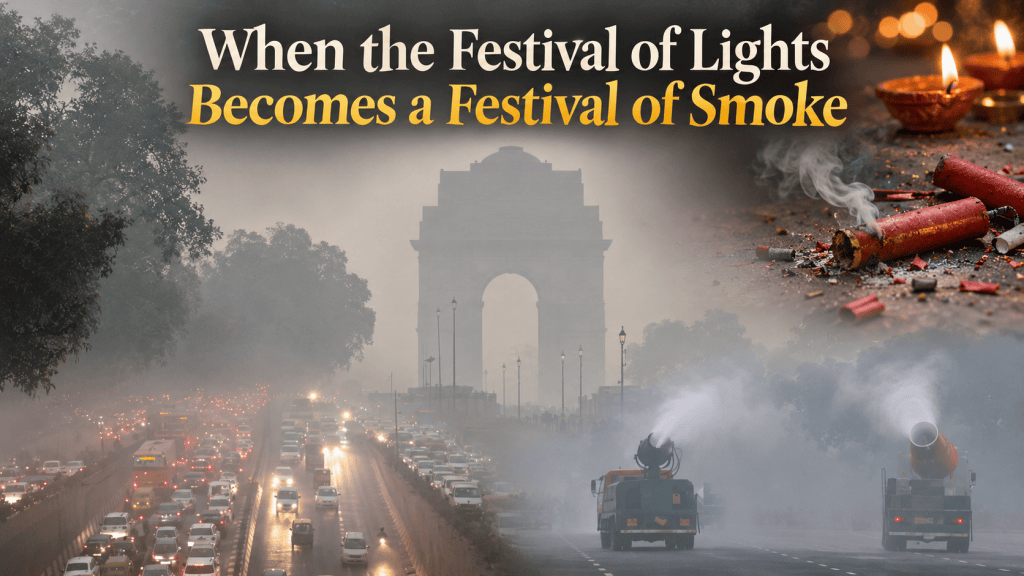
Delhi provides perhaps the most spectacular illustration of this annual absurdity. Every winter, the capital descends into a poisonous haze. The air deteriorates, hospitals see more respiratory complaints, and the government discovers, with remarkable regularity, that pollution is a serious problem. Then comes Diwali, and everyone suddenly discovers the neighbour. He has burst crackers, polluted the atmosphere, endangered children and possibly contributed to the decline of civilisation. Social media erupts with accusations and photographs of smoke-filled streets. Meanwhile, the government can sit back, sip its tea and watch the public quarrel.
This is politically convenient. The more exclusively we blame Diwali, the easier it becomes to overlook the structural causes of Delhi’s pollution. Vehicular emissions, industrial activity, construction dust, waste burning, agricultural fires and winter weather all contribute to a crisis that begins well before the festival and continues long afterwards. Firecrackers make an already dangerous situation considerably worse, but they do not explain why Delhi’s atmosphere is unhealthy for so much of the year.
This year’s Diwali provided a particularly disturbing illustration. As crackers exploded across the capital, concentrations of fine particulate matter rose to extraordinary levels. At some monitoring locations, reported PM2.5 concentrations ran into thousands of micrograms per cubic metre. These were pollutant concentrations rather than AQI readings, but they were alarming enough. And just when the public most desperately needed reliable information, something curious happened. Numerous air-quality monitoring stations stopped reporting readings during the worst hours of the night. Reports indicated that 29 of Delhi’s 59 stations were not reporting data at midnight, rising to 36 by 1 a.m. Investigations also highlighted missing particulate readings and discrepancies between public displays and official dashboards. The pollution was rising, but the figures were disappearing.
There were allegations of manipulation, including claims that water was being sprayed near monitoring stations to influence readings. Whether these accusations are true requires independent investigation, for technical failures and deliberate concealment are not the same thing. But the government owes the public an explanation for why crucial information became unavailable precisely when it was most needed. One is reminded of a doctor discovering that his patient’s temperature has reached 105 degrees and promptly hiding the thermometer. The fever, unfortunately, remains unimpressed.
And this brings us to the larger failure. Delhi’s pollution crisis did not arrive with the first Diwali cracker. It has developed over decades, while successive governments have offered promises, programmes, committees and emergency measures. Every winter brings fresh restrictions, inspections and assurances. Roads are sprinkled with water, dust is temporarily suppressed, and press conferences inform us that the situation is being closely monitored. The National Clean Air Programme and related initiatives have yet to deliver the transformation citizens need. The contrast with Delhi’s earlier transition towards CNG-based public transport is instructive. Undertaken following judicial directions and implemented during Sheila Dikshit’s government, it demonstrated that sustained administrative action could reduce important categories of vehicular pollution. It was not a complete solution, but it was a structural intervention rather than another seasonal announcement.
Today, after more than a decade of the Modi government at the Centre, Delhi continues to struggle for breathable air. Responsibility is shared by governments at the Centre, in Delhi and in neighbouring states, but the Centre cannot escape accountability for a national public-health crisis, nor can politicians endlessly blame one another while citizens are left coughing in the smog. Yet government failure cannot become an excuse for individual irresponsibility. Consider a patient suffering from advanced lung disease who insists on smoking another packet of cigarettes. The additional cigarettes will undoubtedly worsen his condition. But imagine a hospital that has neglected his treatment for years and now announces that its entire medical strategy consists of confiscating the packet. The patient needs to stop smoking; equally, the hospital needs to start treating him. Our governments have become rather accomplished at confiscating the packet.
This brings us to another annual ritual. Whenever the harmful effects of crackers are discussed, someone inevitably asks: “What about Bakrid? Why don’t you complain about animal sacrifice?” The question is usually presented as a devastating argument. In reality, it often serves to change the subject. Animal sacrifice and firecrackers raise different ethical questions. The former concerns animal welfare, religious practice and food consumption; the latter concerns the release of smoke, noise and harmful substances into a shared environment. Both practices can legitimately be questioned, and neither deserves immunity merely because religion is involved. And even if, for the sake of argument, animal sacrifice is as objectionable as its critics make it out to be, how does that justify another harmful practice? One vice cannot become a virtue merely because another vice exists. Two wrongs do not make a right, however loudly one chooses to celebrate them, so please spare us the whataboutery. It neither purifies the air nor strengthens the argument.
There is, of course, a broader philosophical question about the taking of life. Human existence depends upon other forms of life, whether animals, plants or microorganisms. Plants respond to injury and environmental threats, although this does not establish that they experience pain as animals do. But whatever one’s views on food, sacrifice or the ethics of living creatures, none of these questions justifies filling the neighbourhood with smoke. The central issue with crackers is that their effects are imposed upon people who have made no choice to participate. A person may decide what food to eat or whether to attend a religious ceremony, but a child suffering from asthma cannot choose not to breathe the smoke entering his bedroom, nor can an elderly cardiac patient opt out of the atmosphere surrounding his house. Air, unfortunately, cannot be reserved for private use.
And here lies perhaps the most disturbing development. For some people, bursting crackers has ceased to be merely an expression of festivity. It has become an assertion of identity, a demonstration of defiance and, occasionally, an exercise in intimidation: “I will burst crackers because nobody can stop me!” One wonders whether this expresses religious devotion or merely an adolescent dislike of being told what to do. Religion surely deserves a more dignified defence than the right to disturb a sleeping infant.
Nor are the hazards of firecrackers peculiar to Delhi. Smoke does not acquire toxic properties only after entering Ghaziabad or Noida. A cracker is not harmless in Lucknow, Jaipur or Mumbai and suddenly dangerous upon crossing the Delhi border. The same principles apply to fireworks in London, New York and elsewhere. If firecrackers pose risks to health, public awareness must be national rather than selectively seasonal. Education, sensible regulation and encouragement of safer celebrations should become part of a sustained effort to reduce unnecessary harm.
None of this requires abandoning Diwali. Homes illuminated with lamps, streets decorated with lights, families exchanging sweets and communities coming together can preserve the beauty of the occasion without making breathing a hazardous occupation. Unfortunately, our public discussions increasingly turn every practical problem into a contest of religious loyalties. A suggestion to reduce firecrackers becomes an attack on Hinduism; a discussion of animal welfare becomes an attack on Islam. Environmental concerns are interpreted through communal identities while the actual problems remain unresolved. Politicians benefit, television studios acquire another evening of shouting, social media warriors collect their applause, and ordinary citizens continue to inhale the consequences.
Perhaps the time has come to recover a little common sense. Governments must be held accountable for long-term air pollution through effective transport policies, industrial regulation, construction controls, waste management and regional coordination. Citizens, in turn, must recognise that government failure does not entitle them to worsen the situation. A polluted city does not become less polluted because the smoke has been produced in the name of faith.
Diwali is, after all, a celebration of light, hope and renewal. Its beauty lies in the warmth of lamps, the gathering of families and the symbolic triumph of knowledge over ignorance. Surely these are values worth preserving. We might even discover that a festival can be joyous without making the neighbourhood resemble a battlefield, and that children can enjoy Diwali without being introduced prematurely to the services of a pulmonologist. Until then, the annual spectacle will continue. Citizens will burst crackers, neighbours will curse them, politicians will issue statements, and the government will assure us that everything is under control. The following morning, everyone will look towards the sky and wonder why it has disappeared.
And if Lord Rama were to return to Ayodhya today, perhaps his first request would not be for a throne, a palace or a grand welcome. It might simply be for a good-quality air purifier. As for the government, perhaps it would reassure him that the pollution-monitoring display has been switched off.
The instinct to dress up harmful traditions as ancient wisdom, however, is not confined to the laity. This past week, West Bengal BJP MLA Papiya Adhikari informed a Kali Puja gathering that bursting firecrackers could cure several diseases, a claim she later attributed to an old saying from our ancestors. When the inevitable ridicule followed, she clarified that she had meant lamps and rituals, acknowledged that science has advanced somewhat since the era of grandmotherly germ theory, apologised to anyone hurt, and declared the remark retracted . One admires the speed of the withdrawal. One merely notes that the original sentiment, voiced at a festival already choking the city, suggests the message has not quite travelled from the podium to the pulmonology ward. The ancestors, one suspects, would have prescribed a diya and a quiet evening, not a course of antibiotics administered by explosion.


