Syed Ali Nadeem Rezavi
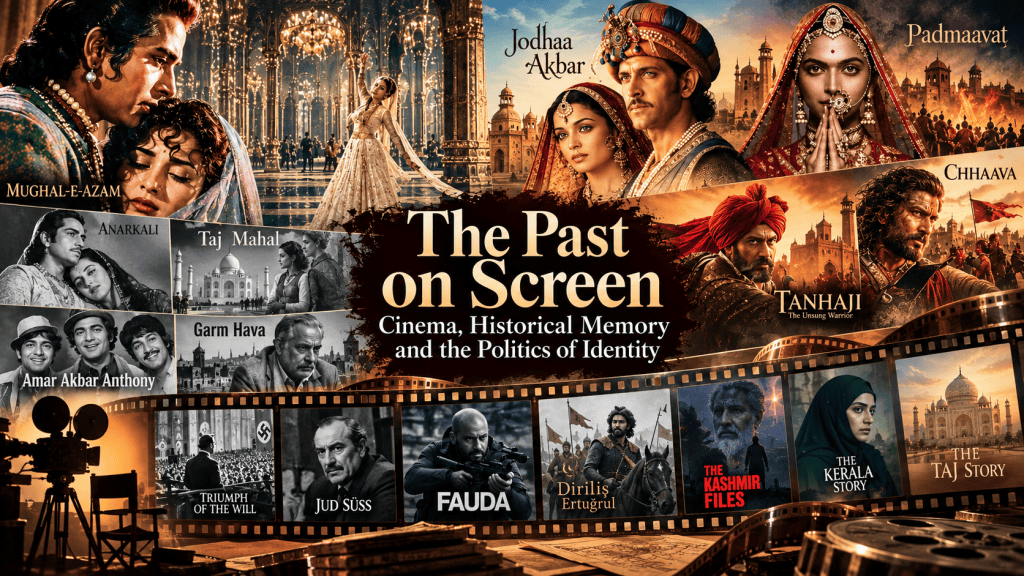
History and cinema have always maintained an uneasy relationship. Both attempt to reconstruct the past, yet their methods and objectives remain fundamentally different. The historian seeks to understand historical developments through a critical examination of evidence, while the filmmaker strives to create a compelling narrative. Historical accuracy is essential to the former; dramatic effect is frequently the principal concern of the latter. Yet cinema has exercised a far greater influence upon popular historical consciousness than the writings of professional historians. Millions who have never read the Tārikh e Fīruzshāhi, Akbarnāma, the Tuzuk-i Jahāngīrī or a modern work on medieval India nevertheless possess definite images of Akbar, Alauddin Khalji, Aurangzeb, Shivaji and the Rajputs, largely acquired through films and television serials.
This influence makes cinema something more than a medium of entertainment. It can shape public opinion, construct collective memories and influence the manner in which a society understands its identity. Unlike historical scholarship, which usually accommodates competing interpretations, cinema tends to present a single, emotionally persuasive narrative. Alternative explanations are pushed aside, and the interpretation chosen by the filmmaker gradually becomes, in the minds of many viewers, the history of the event itself. The visual image possesses an authority that the printed word seldom enjoys.
The political possibilities of cinema were recognised quite early. During the First World War, governments experimented with films to influence public opinion, but it was Nazi Germany that demonstrated their potential on an extraordinary scale. Joseph Goebbels understood that cinema could communicate ideological messages more effectively than political speeches. Leni Riefenstahl’s Triumph of the Will (1935), depicting the Nazi Party rally at Nuremberg, transformed a political gathering into a carefully orchestrated spectacle of national unity and unquestioning loyalty to Hitler. Through monumental imagery, music, camera angles and mass formations, it created an impression of irresistible political authority.
Even more disturbing was Veit Harlan’s Jud Süß (Jew Süss, 1940), a historical drama based upon the life of Joseph Süß Oppenheimer, an eighteenth-century Jewish court financier in Württemberg. The film converted a complicated historical episode into an instrument of antisemitic propaganda. Its Jewish protagonist was represented through stereotypes of greed, manipulation and sexual predation, while German society appeared as the innocent victim of his actions. Fritz Hippler’s Der ewige Jude (The Eternal Jew, 1940) employed the apparently authoritative form of a documentary to promote similar prejudices. History, or what purported to be history, was thus used to justify contemporary political hostility.
The significance of these examples lies in the methods employed. A community was glorified, its supposed adversary reduced to a collection of objectionable characteristics, and selected events arranged to support a predetermined conclusion. The audience was encouraged to experience prejudice as historical truth. Although Nazi Germany’s centrally organised propaganda apparatus cannot be equated with the commercial film industries of democratic societies, the techniques through which cinema constructs heroes, enemies and collective identities deserve comparison.
Such possibilities were not confined to totalitarian states. Oliver Stone’s JFK (1991), dealing with the assassination of President John F. Kennedy, demonstrated how dramatic reconstruction could influence public understanding of a controversial event. Closer home, the extraordinary popularity of the Doordarshan serials Ramayan and Mahabharat during the late 1980s showed how visual narratives could shape a common religious and cultural imagination. Their reception coincided with the growing political mobilisation around the Ram Janmabhoomi movement, although the relationship between television and political change cannot be reduced to a simple cause-and-effect explanation. Earlier productions such as Hum Log and Buniyaad had reflected a different concern, emphasising social relationships, national integration and the human consequences of Partition.
The international use of historical television drama offers another instructive comparison. Turkish productions such as Diriliş: Ertuğrul, Payitaht: Abdülhamid and Kuruluş: Osman have contributed to the popular revival of interest in the Ottoman past. Their narratives celebrate Turkish martial traditions, Islamic identity and the political achievements of the Ottoman dynasty. They have also been associated with the cultural and political aspirations of Recep Tayyip Erdoğan’s Turkey, where Ottoman history has acquired renewed public importance.
Yet Ertuğrul demonstrates both the possibilities and limitations of historical reconstruction. Very little reliable contemporary information survives about Ertuğrul himself, and much of the narrative is necessarily fictional. Nevertheless, the depiction of nomadic encampments, yurts, weapons, clothing and aspects of tribal life offers an imaginative reconstruction of the material environment of the frontier societies from which the Ottoman polity emerged. A production may therefore be historically imaginative and culturally illuminating while remaining highly selective in its political message.
An equally revealing example is the Israeli television series Fauda, created by Lior Raz and Avi Issacharoff, which has completed five seasons. Unlike the Turkish historical serials, Fauda deals with the contemporary Israeli-Palestinian conflict. Its significance lies in the sophistication with which it constructs a particular understanding of that conflict. Rather than resorting to crude propaganda, it employs realistic settings, convincing characters, emotional complexity and gripping action to encourage viewers to identify with Israeli undercover operatives. Their violence is generally presented as a reluctant necessity, imposed upon them by dangerous circumstances, while their personal suffering and moral dilemmas receive sustained attention. Palestinian characters are not invariably demonised, but their experiences of occupation, dispossession and violence remain comparatively peripheral. The resulting narrative encourages viewers to see Israeli operatives primarily as victims of circumstances rather than as agents exercising coercive power. This interpretation stands in contrast to accounts that foreground Palestinian suffering and Israeli responsibility for violence. The achievement of Fauda as political storytelling lies precisely in this subtlety: it does not need to deny Palestinian suffering explicitly, for its selective distribution of sympathy can make Israeli actions appear understandable, even unavoidable. It demonstrates how sophisticated entertainment can shape political perceptions without adopting the obvious language or appearance of propaganda.
These international examples provide a useful background for examining Indian historical cinema. They also establish an important methodological point: films must be studied in relation to the circumstances of their production. A film about the sixteenth century may reveal as much about the twentieth or twenty-first century as about the period it claims to portray.
The earliest Indian feature film, Dadasaheb Phalke’s Raja Harishchandra (1913), drew upon a familiar mythological tradition. Mythological and historical subjects remained important in the development of Indian cinema, providing audiences with stories already embedded in popular cultural memory. As filmmaking developed, the Delhi Sultanate, the Mughals, the Rajputs and the Marathas offered an apparently inexhaustible supply of rulers, battles, romances and heroic sacrifices.
The interpretation of these subjects was never independent of the historiography inherited from colonial rule. James Mill’s division of Indian history into Hindu, Muslim and British periods encouraged the identification of political authority with religious communities. Later colonial historians, particularly those who selectively emphasised conquest, temple destruction and religious persecution, reinforced the impression that medieval India represented an age of Muslim domination over a Hindu population. The complexities of political institutions, economic relationships and social interaction were frequently subordinated to this religious division.
Such an understanding was historically misleading. Neither the Delhi Sultanate nor the Mughal Empire functioned simply as a Muslim establishment ruling over a homogeneous Hindu society. Their political structures depended upon alliances with regional elites, military commanders, landholders and administrators drawn from different backgrounds. Religious affiliation did not invariably determine political loyalty, and conflicts between Muslim rulers were as much a part of medieval Indian history as conflicts involving Hindu and Muslim sovereigns.
Indian nationalism produced an alternative to this colonial understanding. The inclusive strand of the freedom movement emphasised the long history of interaction between the peoples and cultures of the subcontinent. Akbar, in particular, came to be regarded as a ruler whose attempts at political accommodation provided a historical precedent for an inclusive Indian nation. Gandhi and Nehru both recognised the importance of Akbar’s policies, while the archaeological discoveries at Harappa and Mohenjo-daro during the 1920s strengthened the nationalist conviction that India possessed a distinguished civilisation long before colonial rule.
It was within this intellectual atmosphere that the early Mughal films acquired their particular significance. Shahenshah Babar (1944), Humayun (1945) and Shahjahan (1946) appeared during the closing years of British rule. They celebrated Mughal rulers as historical personalities belonging to India’s past rather than as representatives of an alien civilisation. The decades following Independence witnessed further productions, including Anarkali (1953), Adl-e-Jahangir (1955), Mughal-e-Azam (1960), Taj Mahal (1963), Jahanara (1964) and Noor Jahan (1967).
One striking feature of these films was their preoccupation with romance. The Mughal emperors were remembered not so much for their administrative achievements, military campaigns or economic policies as for their relationships with women. The love of Shah Jahan and Mumtaz Mahal, the supposed romance of Salim and Anarkali, and the relationship between Jahangir and Nur Jahan became recurring cinematic subjects. The films were frequently musicals, enriched by Urdu poetry, elaborate costumes and representations of a refined courtly culture.
This romanticisation certainly distorted history. Yet it also reflected the aspirations of a society emerging from the trauma of Partition. The Mughal past was represented as part of a shared cultural inheritance, and the relationships between Hindu and Muslim characters generally affirmed the possibility of coexistence.
K. Asif’s Mughal-e-Azam remains the finest example of this tradition. Conceived in 1944, while India was still under colonial rule, it was finally released in 1960, when the ideals of Nehruvian pluralism continued to shape public life. The film presented Akbar as a powerful sovereign whose responsibility towards the empire conflicted with his affection for his son. Its central drama was not a struggle between religious communities but between imperial authority and individual desire.
The historical foundations of the story were nevertheless extremely uncertain. K. Asif drew upon Imtiaz Ali Taj’s Urdu play Anarkali, written in 1922, rather than a contemporary Mughal account. The legend itself had developed through stories recorded by European travellers, including William Finch, who visited India during Jahangir’s reign. Shireen Moosvi has demonstrated how the legend grew out of rumours surrounding the secluded imperial household and acquired a life of its own through repeated retelling.
There is no convincing contemporary evidence for the familiar story of Anarkali being condemned because of her relationship with Prince Salim. Salim did rebel against Akbar, but the rebellion arose from the politics of succession, the prince’s ambitions and his strained relationship with the imperial establishment. The romantic explanation belongs to literature and cinema rather than documented Mughal history.
Nevertheless, the film incorporated genuine historical circumstances. Salim’s rebellion was real, and Akbar’s attempts to establish an inclusive imperial order were important features of his reign. The distinction between the historical event and its fictional explanation is precisely what the historian must establish.
An equally revealing example is Ashutosh Gowariker’s Jodhaa Akbar (2008). Although separated from Mughal-e-Azam by nearly half a century, the two films shared a broad commitment to presenting Akbar as a ruler capable of transcending religious divisions. Their political circumstances, however, were quite different. K. Asif’s film emerged from the nationalist and Nehruvian environment, while Jodhaa Akbar appeared after the Ram Janmabhoomi movement, the demolition of the Babri Masjid and the communal violence in Gujarat in 2002. Its story of a Muslim emperor and a Rajput princess could therefore also be understood as an attempt to recover the possibility of accommodation in a society increasingly divided by communal politics.
Unlike Mughal-e-Azam, the makers of Jodhaa Akbar consulted professional historians, including Irfan Habib, Satish Chandra and Shireen Moosvi. The film also acknowledged that its narrative was a fictionalised account inspired by historical personalities. Yet scholarly consultation did not eliminate its historical inaccuracies.
Akbar’s marriage to the daughter of Raja Bharamal of Amber in 1562 is well established. The name Jodha Bai, however, does not occur in contemporary Persian sources as that of Akbar’s Rajput wife. Its association with the emperor developed much later, particularly through nineteenth-century historical writing and local traditions surrounding the monuments of Agra and Fathpur Sikri. The familiar identification of a palace at Sikri as the residence of Jodha Bai helped perpetuate a name whose historical foundation remains doubtful. Satish Chandra has drawn attention to the confusion between Akbar’s Rajput consort and the Marwar princess who married Prince Salim.
Here we encounter an interesting historical process. A name popularised through later traditions was reinforced by cinema until the fictionalised character became more familiar than the woman who actually entered the Mughal household. The controversy surrounding the film, including objections raised by sections of the Rajput community, further demonstrated how cinematic representations could become entangled with contemporary questions of caste, community and historical honour.
The film also compresses and rearranges events from Akbar’s early reign. Maham Anaga, Akbar’s foster mother, is portrayed as a scheming woman attempting to undermine his relationship with the Rajput princess. Maham Anaga undoubtedly exercised political influence during the emperor’s early years, particularly following Bairam Khan’s removal. But her influence had effectively ended in 1562, following the downfall and execution of her son Adham Khan. The prolonged intrigues attributed to her in the film therefore distort the chronology and circumstances of Akbar’s marriage.
Other episodes possess genuine historical foundations. Akbar’s daring encounters with unruly elephants are recorded in contemporary sources and depicted in illustrated manuscripts of the Akbarnāma. His early reign also witnessed serious challenges from powerful Turani nobles, while the growing incorporation of Rajputs into imperial service strengthened the Mughal political establishment. The film transforms these developments into a dramatic narrative, but it does not invent them entirely.
The treatment of Akbar’s religious policies requires similar care. Both Mughal-e-Azam and Jodhaa Akbar invoke, directly or indirectly, the principle of sulh-i kul, or universal peace. Historians have differed over the chronology of its development. Iqtidar Alam Khan placed particular emphasis upon the transformation of Akbar’s policies during the later decades of his reign, while Shireen Moosvi drew attention to earlier indications of religious accommodation. Akbar’s Rajput marriage alliance, the abolition of the pilgrimage tax in 1563 and the abolition of jizya in 1564 preceded the more explicit formulation of sulh-i kul as an imperial principle.
The film therefore captures an important historical tendency even while simplifying its development. Akbar’s policy was not merely the consequence of affection for a Rajput wife, as cinematic romance might suggest. It emerged from the political requirements of an expanding empire, the emperor’s changing intellectual outlook and his attempts to establish a more inclusive basis for sovereignty.
There is another aspect of these films that has received insufficient attention: their representation of Mughal architecture. The palaces of Mughal-e-Azam, with their vast enclosed halls, mirrored interiors, marble surfaces and elaborate cusped arches, owe more to the architectural vocabulary of later Mughal periods and cinematic imagination than to Akbar’s actual buildings.
The surviving structures at Fathpur Sikri provide a very different picture. Akbar’s architecture was characterised by extensive use of red sandstone, trabeate construction, open courtyards, pavilions, verandahs and relatively small enclosed chambers. Many permanent structures reflected the spatial organisation of temporary imperial encampments, with their tents, awnings and interconnected open spaces. The white marble tomb of Shaikh Salim Chishti was an exceptional structure within this predominantly sandstone environment.
The great mirrored hall in Mughal-e-Azam, where Anarkali performs before Akbar, may be one of the most memorable settings in Indian cinema, but it belongs to a visual world far removed from the actual architecture of his reign. Jodhaa Akbar came somewhat closer to historical reality, partly because several scenes were filmed in the palaces and forts of Amber and Jaigarh. Even there, however, architectural features belonging to later periods appear alongside structures intended to represent Akbar’s court.
These are not merely questions of architectural detail. Buildings constitute historical evidence. Their plans, construction techniques and spatial arrangements reveal patterns of courtly life, ceremonial practices, domestic organisation and cultural interaction. To replace them with a conventional image of Oriental magnificence is to lose an opportunity to understand the society that produced them.
Language provides another example. Earlier Mughal films frequently assigned highly Persianised Urdu to Muslim characters while Hindu or Rajput figures spoke a more Sanskritised Hindi. This distinction reflected modern linguistic and communal assumptions rather than the actual complexity of language in medieval India. The irony is that Hindi cinema itself owed much of its popularity to Urdu writers, poets, lyricists and dialogue writers. The spoken language of popular films was often Hindustani, a shared idiom that resisted the rigid separation of Hindi and Urdu into religiously exclusive languages.
Mohammad Asim Siddiqui’s Muslim Identity in Hindi Cinema (2025) is particularly useful for understanding these developments. His examination of historical films, Muslim socials, communal violence, gangster narratives, terrorism and the representation of Muslim women reveals how cinematic identity is constructed through recurring cultural signs. Earlier films frequently presented Muslims as poets, musicians, loyal friends or representatives of a refined aristocratic culture. Such portrayals were often sympathetic, but they could also reduce an extraordinarily diverse community to a limited collection of stereotypes.
The films of the 1970s continued to affirm religious coexistence. Amar Akbar Anthony (1977) transformed the religious diversity of three brothers into a celebration of national unity. Garm Hava (1973), set in Agra, offered a more realistic account of the insecurity experienced by an Indian Muslim family after Partition. Its protagonist was not a representative of an alien civilisation but an ordinary Indian whose attachment to his home was tested by communal suspicion.
A different tendency became increasingly visible from the late 1980s and 1990s. The Ram Janmabhoomi movement and the demolition of the Babri Masjid in December 1992 brought medieval history into the centre of contemporary political mobilisation. Babur, once represented in cinema as a conqueror, poet and founder of a dynasty, increasingly acquired another identity in public discourse: that of a foreign invader associated with an alleged historical injury.
The changing political atmosphere also affected the representation of contemporary Muslims. In certain genres, Muslim characters increasingly appeared as gangsters, terrorists or individuals whose loyalty to India required special demonstration. The conflict with Pakistan, militancy in Kashmir and the global discourse on terrorism after September 2001 reinforced these tendencies.
Sarfarosh (1999) offers an instructive example. Its Muslim police officer Salim faces suspicion despite his professional commitment and patriotism. Although the film ultimately challenges this prejudice, the necessity of doing so reveals the changing assumptions surrounding Muslim citizenship. In many earlier films, the loyalty of Muslim characters was taken for granted. In later productions, it increasingly became something that had to be established through exceptional conduct or sacrifice.
Siddiqui also draws attention to another development: the disappearance of minorities and poorer communities from the affluent social worlds created by many popular films of the liberalisation era. The elaborate weddings, prosperous households and consumer lifestyles celebrated in several mainstream romances of the 1990s offered little space for artisans, labourers and marginalised groups. Exclusion could therefore occur not only through hostile representation but also through absence.
This transformation was neither uniform nor uncontested. Films such as Bombay (1995), Zakhm (1998), Parzania (2007) and Firaaq (2008) questioned communal violence and explored the predicament of minorities. Shyam Benegal’s Bharat Ek Khoj (1988), drawing upon Nehru’s The Discovery of India, had earlier demonstrated that television could present Indian history as a complex process of social, political and cultural change rather than a succession of religious confrontations.
Nevertheless, the years following 2014 have witnessed a more pronounced tendency in certain historical films to interpret medieval India through the opposition between Hindu heroism and Muslim aggression. Padmaavat (2018), Panipat (2019), Tanhaji: The Unsung Warrior (2020) and Chhaava (2025) provide examples of how conflicts involving medieval and early modern rulers can be framed in strongly religious or civilisational terms.
There is nothing inherently objectionable about celebrating Rajput or Maratha achievements, nor should historians conceal the violence, coercion or religious discrimination practised by particular Muslim rulers. The difficulty arises when complex political conflicts are transformed into a continuous struggle between two supposedly homogeneous religious communities.
In Padmaavat, Alauddin Khalji is portrayed as brutal, uncontrolled and morally repulsive, in sharp contrast to the refinement and honour associated with the Rajput court. This opposition is established through costume, lighting, music, bodily behaviour and the organisation of cinematic space. The Rajput world appears dignified and orderly, while the Sultan’s surroundings suggest excess and barbarism.
The historical foundation of the central narrative is itself uncertain. Malik Muhammad Jayasi composed his Padmāvat in 1540, more than two centuries after Alauddin’s conquest of Chittor in 1303. His composition belongs to the tradition of Sufi romance and allegorical literature, not contemporary political reportage. The transformation of its narrative into an apparently authentic account of the Sultan’s campaign confuses literary imagination with historical evidence.
Equally significant is what disappears from the cinematic portrait. Alauddin’s market regulations, revenue measures, military reforms and attempts to control the nobility were important developments in the history of the Delhi Sultanate. They have little place in a narrative that requires him to function primarily as the embodiment of an alien and threatening civilisation.
A similar problem arises in films dealing with Mughal-Maratha conflicts. Tanhaji presents the struggle for Kondhana fort through a dramatic opposition between Maratha heroism and Mughal authority. Yet Udaybhan Rathod, the Mughal commander opposing Tanaji Malusare, was himself a Rajput. This fact alone complicates the interpretation of the conflict as a straightforward Hindu-Muslim confrontation.
The same caution is necessary when examining representations of Sambhaji and Aurangzeb, including Chhaava. Sambhaji’s capture and execution were brutal historical events, and there is no reason to minimise their violence. But these events belonged to a prolonged struggle involving imperial expansion, regional sovereignty, revenue resources and the political difficulties of Mughal rule in the Deccan. To interpret the entire conflict as an encounter between Hindu patriotism and Muslim tyranny is to impose the categories of modern nationalism upon a very different political world.
The Mughals themselves cannot be regarded as permanently foreign. Babur entered northern India from Central Asia, but the dynasty he founded became deeply rooted in the subcontinent. Its nobility expanded to include Indian Muslims, Rajputs, Marathas and other regional elites. Its institutions, economy, architecture and cultural traditions developed through sustained interaction with Indian society. By Akbar’s reign, the Mughal Empire had become an integral part of India’s political and social order.
The cinematic construction of homogeneous religious communities also obscures distinctions of caste, class, occupation, region and gender. Medieval Hindus did not constitute a single political community with uniform interests, nor did Muslims. Rajput rulers fought one another, entered alliances with the Mughals and competed for political influence. Muslim rulers fought rival Muslim dynasties, while their administrations depended upon cooperation with local landholders and regional elites.
The glorification of jauhar in historical spectacles raises related questions. Collective death is frequently transformed into an expression of unquestioned communal honour, leaving little room for examining the patriarchal structures and coercive circumstances that shaped women’s lives. Their bodies become symbols of territory and collective purity, while their experiences as historical individuals disappear behind the honour of the community.
The political significance of such representations becomes clearer when the Muslim ruler of historical cinema and the Muslim criminal or terrorist of contemporary films are examined together. Although belonging to different genres, they are sometimes constructed through similar visual conventions. Religious symbols, costume, aggression and expressions of masculinity become recurring signs of danger or alienness. The actions of individual medieval rulers can thereby be made to suggest characteristics supposedly belonging to an entire community.
This is where the earlier examples of Nazi propaganda, Turkish historical drama and Fauda acquire their wider relevance. They illustrate different ways in which cinematic narratives can shape collective identities and distribute sympathy, although the political circumstances and intentions of their creators differ substantially. The historian must distinguish deliberate state propaganda from commercial entertainment and contested political storytelling. Nevertheless, the questions remain similar: whose experiences are foregrounded, whose actions are explained, whose suffering is remembered and whose history disappears?
The relationship between cinema and political authority adds another dimension. In contemporary India, certain films dealing with contentious historical or political subjects have received conspicuous official encouragement. Vivek Agnihotri’s The Kashmir Files (2022), dealing with the displacement of Kashmiri Pandits during the insurgency, was declared tax-free by several BJP-governed states, while political leaders publicly recommended it and attended screenings.
The suffering of Kashmiri Pandits was a genuine human tragedy involving targeted killings, intimidation and the loss of homes. It deserves serious historical examination and public remembrance. The controversy surrounding the film concerns the selection and presentation of events, particularly whether the suffering of one community is reconstructed in ways that encourage suspicion towards another.
The Kerala Story (2023), dealing with religious conversion, radicalisation and recruitment into extremist organisations, also received tax concessions in states including Uttar Pradesh and Madhya Pradesh. Its narrative and numerical claims generated considerable controversy. The existence of extremist recruitment does not automatically establish the accuracy of broader generalisations about a religious community.
Official encouragement has also extended to historical spectacles. Samrat Prithviraj (2022), depicting the conflict between Prithviraj Chauhan and Muhammad Ghori, was declared tax-free in several states. The film belongs to a longer tradition of interpreting medieval political struggles as episodes of indigenous resistance to foreign conquest. Such narratives require particular care when modern notions of national identity are projected onto the political formations of the twelfth century.
The controversy surrounding The Taj Story (2025) illustrates another aspect of the struggle over historical memory. Its narrative raised questions about the accepted history of the Taj Mahal and its construction under Shah Jahan. The monument’s Mughal origin is supported by contemporary textual evidence, architectural history and the documented development of the complex. Claims that it was originally a Hindu temple have not been established through credible historical or archaeological evidence. Although the filmmakers disputed allegations that their production asserted such a theory, the controversy reflected a wider attempt to reinterpret the religious ownership of India’s architectural heritage.
It is important to distinguish the different forms of official involvement. Tax concessions for The Kashmir Files, The Kerala Story and Samrat Prithviraj are documented; The Taj Story should not be placed in the same category without evidence of a comparable concession. Nor does a tax exemption, by itself, prove that a government directed the content of a film. It does, however, raise questions about the relationship between political endorsement and the public authority acquired by particular historical narratives.
The irony is that some contemporary attempts to recover a supposedly authentic Indian past reproduce the very religious division of history inherited from colonial scholarship. The claimed liberation of Indian history from colonial interpretations may thus result in the revival of one of their most enduring assumptions: that medieval India was essentially a struggle between Hindus and Muslims.
The historian’s responsibility is to challenge this reduction without romanticising the past. Religious conflict, temple destruction, political persecution and coercion were historical realities. They must be examined critically and without embarrassment. But the evidence also reveals political alliances across religious boundaries, patronage of diverse religious institutions, cultural exchange and shared economic interests. Temple destruction, for instance, cannot be explained through a single motive applicable to every ruler and period. Political conquest, punishment of rebellion, appropriation of wealth, religious hostility and the symbolic assertion of sovereignty could all play a part, sometimes in combination.
Historical cinema rarely allows sufficient room for such distinctions. Its preference for identifiable heroes and villains encourages simplified explanations. Yet this limitation is not unavoidable. Some of the most valuable possibilities of historical filmmaking remain largely unexplored.
The history of medieval India was not merely the history of battles, rulers and courtly romances. It was also the history of agrarian production, commerce, urban development, craftsmanship, religious movements, intellectual exchanges and technological innovation. The cities of Delhi, Agra, Lahore, Ahmedabad and Fathpur Sikri offer abundant material for reconstructing everyday life. Their architecture, streets, workshops, markets, waterworks and residential spaces reveal social relationships that rarely appear in court-centred cinematic narratives.
The construction of the Taj Mahal, for example, is usually presented as an expression of Shah Jahan’s love for Mumtaz Mahal. Yet it was also an extraordinary achievement of architectural planning, engineering, material procurement and labour organisation. The experiences of the craftsmen who carved its marble screens, the workers who transported its materials and the engineers who planned its foundations could provide compelling stories in their own right.
The written sources are equally rich. The Āʾīn-i Akbarī provides information about occupations, economic production, revenue administration and imperial institutions. The Tuzuk-i Jahāngīrī reveals interests extending from political affairs to painting, natural history and unusual occurrences. The Majālis-i Jahāngīrī offers insights into intellectual exchanges at the imperial court. Travellers’ accounts, regional chronicles, inscriptions and archaeological remains can supplement and sometimes challenge the narratives preserved in official histories.
The possibilities are not confined to the Mughals. The Delhi Sultanate offers equally rich subjects, from the political career of Razia Sultan to the economic policies of Alauddin Khalji, the intellectual world of Amir Khusrau, the experiences of Ibn Battuta and the development of Sufi establishments and urban communities. There is no shortage of dramatic material in these histories. What is required is a willingness to move beyond the assumption that medieval India becomes interesting only when presented as a battlefield between religious civilisations.
I recall a discussion at a seminar in Mumbai where historians and filmmakers debated the relationship between historical accuracy and cinematic storytelling. Shyam Benegal reminded the historians that filmmakers were storytellers whose principal concern was to engage an audience, not to reproduce the arguments of scholarly works. There is considerable truth in this observation. Cinema has its own conventions, and no historian should expect a feature film to function as an academic monograph.
Yet Benegal’s own Bharat Ek Khoj demonstrated that historical scholarship and engaging storytelling need not be incompatible. Drawing upon Nehru’s The Discovery of India and benefiting from scholarly consultation, the series situated political events within broader historical developments. Its treatment of the Mughals and the Marathas acknowledged complexities often absent from conventional historical spectacles.
More recently, Nikkhil Advani’s The Empire (2021), based upon the historical novels published under the name Alex Rutherford, offered a fictionalised but relatively human portrayal of Babur. The series acknowledged his Central Asian struggles, his rivalry with Shaibani Khan and the importance of Timurid political traditions. Particularly interesting was its treatment of women, including Aisan Daulat Begum, Babur’s grandmother, and Khanzada Begum, his sister.
Their political influence finds support in contemporary and near-contemporary sources, including the Bāburnāma, the Tārīkh-i Rashīdī and Gulbadan Begum’s Humāyūnnāma. Timurid women were not merely secluded spectators of political events. They advised rulers, negotiated relationships and participated in the management of dynastic affairs.
Yet The Empire also demonstrates the selectivity of cinematic reconstruction. Despite dealing with Babur’s career, its first (and perhaps the only) season omitted his confrontation with Rana Sanga and the Battle of Khanwa, an event of considerable importance in establishing Mughal authority in northern India. The omission is particularly striking when compared with Bharat Ek Khoj, which incorporated the confrontation within its treatment of Babur’s Indian campaigns.
Nevertheless, after years in which Babur had increasingly been represented in public discourse as a symbol of foreign conquest and religious hostility, The Empire offered a recognisably human historical personality. Its Babur was ambitious, vulnerable, politically resourceful and shaped by the uncertainties of his circumstances. The series was far from historically accurate in every respect, but it demonstrated that fictionalisation need not necessarily result in demonisation.
This brings us back to the essential problem. The historian must examine not only what a film says, but also what it leaves unsaid. The selection of events, the choice of protagonists, the treatment of language, costume and architecture, and the distribution of sympathy among characters all contribute to the construction of historical meaning. Films themselves consequently become valuable historical sources, not necessarily for the periods they depict, but for the political and cultural circumstances in which they were made.
Mughal-e-Azam tells us something about the aspirations of Nehruvian India. Jodhaa Akbar reflects an attempt to recover a language of accommodation in a society marked by communal tensions. Padmaavat and other recent historical spectacles reveal how the past can be reorganised around contemporary ideas of religious identity and heroism. The Empire, despite its fictional excesses, demonstrates that alternative representations remain possible.
There is, finally, an important distinction between historical fiction and historical falsification. A filmmaker may invent dialogue, compress events, introduce fictional characters or rearrange incidents to create a coherent narrative. Such liberties are intrinsic to historical drama. But when invention systematically transforms political conflicts into religious wars, attributes collective characteristics to entire communities or presents unsupported claims as established historical facts, its consequences extend beyond artistic freedom.
The responsibility of historians is not to police imagination, but to make historical evidence and its complexities available to a wider public. Filmmakers, in turn, have an opportunity to engage with scholarship, archaeology and material culture in ways that can enrich rather than diminish their work.
The changing representation of medieval India in Hindi cinema ultimately raises a fundamental question about the relationship between history and national identity. Are we interested in understanding how Indian society developed through centuries of conflict, cooperation, migration, accommodation and transformation? Or are we seeking from the past a collection of heroes to celebrate and enemies to condemn?
The Delhi Sultanate and the Mughal Empire were neither ages of uninterrupted harmony nor periods of perpetual religious warfare. They were complex political and social formations whose histories included conquest and accommodation, coercion and cooperation, inequality and cultural creativity. Their rulers must be judged through evidence and historical context, not through the religious loyalties of contemporary audiences.
Cinema has the power to bring these complexities to life. It can recover forgotten experiences, challenge inherited prejudices and introduce audiences to worlds that historical scholarship has painstakingly reconstructed. But it can also reduce the past to emotionally charged images that reinforce the divisions of the present.
The challenge before historians and filmmakers is therefore not merely to make films more accurate. It is to resist the temptation to convert history into an instrument of collective accusation. The past cannot be understood by dividing its inhabitants into the ancestors of today’s patriots and the ancestors of today’s enemies. History seeks to explain how people lived, struggled, governed, worked, believed and interacted within the circumstances of their own times.
If cinema can contribute to that understanding, it offers possibilities far greater than the celebration of dynasties or the glorification of battles. If it merely projects contemporary prejudices backwards, it risks replacing historical knowledge with manufactured memory. The greatest irony would be for a cinema claiming to recover India’s authentic past to reproduce the very colonial categories that once divided that past into Hindu and Muslim ages.
Note: This article draws substantially upon my own paper on films ‘Representations of the Mughals in Present-Day India: From K. Asif’s Akbar to the Babur of Nikkhil Advani’, published in Studies in People’s History (vol. 9, no. 2, 2022, pp. 241–254), as well as Mohammad Asim Siddiqui’s Muslim Identity in Hindi Cinema (2025). The perceptions and conclusions advanced here are, however, entirely my own.


