Syed Ali Nadeem Rezavi
The celebration of Diwāli under the Mughal emperors offers a revealing glimpse into the cultural history of medieval India. Although the Mughals were Muslims, their court remained closely connected to the religious and social traditions of the people they ruled. Hindu festivals, particularly Holi, Diwali, Basant and Raksha Bandhan, became familiar features of the imperial cultural environment. Their observance reflected the interaction between the ruling elite and wider society, though the degree of imperial participation varied from one reign to another.
Diwali, with its associations of light, prosperity and renewal, occupied a distinctive position among these festivals. Its celebration was not confined to religious rituals. It was also an important social and commercial occasion, particularly among merchants, bankers and other urban communities. At the Mughal court, the festival became associated with illuminations, festive gatherings and, in later periods, fireworks. Its history therefore reveals how a festival rooted in Hindu religious tradition became part of the broader cultural life of Mughal India.
The reign of Akbar (1556–1605) marked an important stage in the accommodation of Indian festivals within imperial culture. His policy of ṣulḥ-i kul, or universal peace, encouraged an atmosphere in which the customs of different religious communities could receive recognition at court. Abu’l Fazl, in the Ā’īn-i Akbarī and Akbarnāma, describes Akbar’s interest in Indian religious practices, auspicious occasions and the symbolism of light. His reverence for the sun and fire as manifestations of divine illumination is particularly significant in understanding the cultural environment in which festivals associated with light could acquire an imperial presence.
Harbans Mukhia, in The Mughals of India (2004), has emphasised the importance of cultural accommodation in the development of Mughal kingship. Akbar’s willingness to engage with the traditions of his subjects was closely connected with his conception of sovereignty. The recognition of festivals such as Diwali formed part of this larger process, although the precise arrangements for its celebration during Akbar’s reign are not described in sufficient detail to reconstruct the festivities with certainty.
Under Jahangir (1605–1627), Diwali continued to be recognised at the imperial court. His memoirs, the Jahāngīrnāma, contain references to the festival and its association with the commercial communities of India. Jahangir was familiar with the practice of merchants settling accounts and commencing new financial transactions on this auspicious occasion. He also referred to the custom of gambling during Diwali, which was regarded by some participants as a means of inviting good fortune.
These observations are important because they demonstrate that Diwali was not merely a religious celebration. It was also closely connected with the commercial calendar of Mughal India. In cities such as Agra, Lahore, Ahmedabad, Surat and Delhi, merchants and bankers marked the occasion by opening new account books, worshipping Lakshmi and seeking prosperity for the coming year. Irfan Habib’s studies of the Mughal economy and Shireen Moosvi’s work on its commercial and financial structure provide a useful background to understanding the importance of these communities. The festival’s association with commercial renewal helped ensure its continued observance irrespective of changes in imperial policy.
During the reign of Shah Jahan (1628–1658), Diwali became associated with the elaborate culture of illuminations and festivities that characterised the Mughal court. The palaces and courtyards of the imperial establishment provided impressive settings for ceremonial displays. Lamps, candles and fireworks were already familiar features of Mughal celebrations, and Diwali offered a particularly appropriate occasion for such illuminations.
The construction of Shahjahanabad and the Red Fort created a magnificent architectural setting for royal festivities. Later accounts associate Diwali with the lighting of palace buildings and public spaces, although it is necessary to distinguish these recollections from contemporary evidence specifically relating to Shah Jahan’s reign. Ebba Koch, in Mughal Art and Imperial Ideology (2001), has demonstrated the importance of architecture and ceremonial display in the representation of Mughal sovereignty. Her observations help explain the significance of the illuminated palace as a setting for imperial celebration, even though her work does not specifically document Diwali festivities.
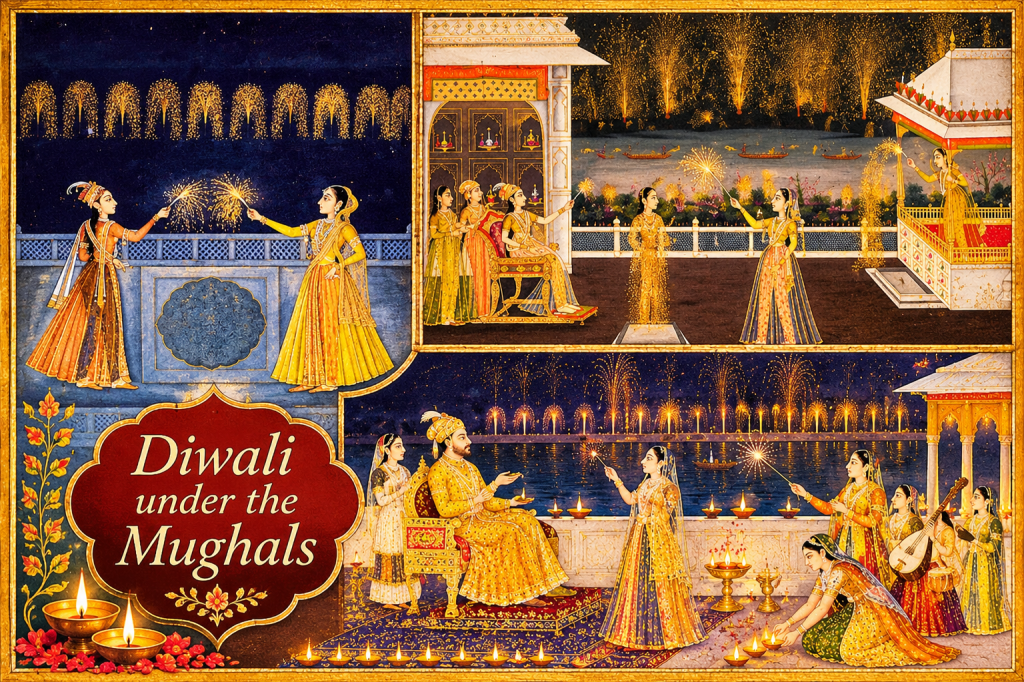
The Mughal imperial household also played an important part in the ceremonial life of the court. Ruby Lal, in Domesticity and Power in the Early Mughal World (2005), has shown that the domestic establishment of the Mughal dynasty was closely connected with its political and cultural activities. Her work too offers a useful perspective from which to consider the participation of women and other members of the imperial household in courtly celebrations. The presence of women holding sparklers and participating in festive gatherings in Mughal paintings suggests the importance of such occasions within elite domestic culture. These images, however, cannot invariably be identified as depictions of Diwali, since fireworks were also used during other celebrations.
Under Aurangzeb (1658–1707), the official attitude towards certain public festivities became more restrictive. Contemporary evidence refers to limitations imposed upon illuminations in particular places, including an order concerning Diwali lighting in the bazaars of Ahmedabad in 1665. Such measures indicate that imperial policy could affect the public celebration of the festival. They do not, however, establish that Diwali was prohibited throughout the empire. Hindu merchants, nobles, officials and ordinary subjects continued to observe their religious and social customs. The distinction between restrictions imposed in particular circumstances and a general prohibition is important in assessing the history of the festival during Aurangzeb’s reign.
Diwali appears prominently in accounts of the later Mughal court, particularly during the eighteenth century. Under Muhammad Shah (1719–1748), a ruler remembered for his patronage of music, painting and festive culture, illuminations and fireworks became important features of courtly entertainment. The festival is associated in later traditions with Jashn-i Chirāghān, or the celebration of lights.
The Red Fort at Shahjahanabad became particularly associated with these festivities. Descriptions of Diwali celebrations speak of rows of lamps illuminating the palaces and courtyards, while fireworks added to the spectacle. One of the more striking features mentioned in later accounts was the ākāsh dīyā, an elevated lamp placed upon a tall pole so that its light could be seen from a distance. The precise arrangements and dimensions described in popular recollections require verification, but the tradition itself reflects the importance attached to illumination in the festive culture of Mughal Delhi.
The organisation of fireworks also involved specialised craftsmen. The Mughal court possessed considerable expertise in pyrotechnics, and the mīr-i ātish, associated primarily with the imperial artillery establishment, belonged to the administrative world in which knowledge of gunpowder and related technologies was maintained. Fireworks were used on several ceremonial occasions, and their association with Diwali formed part of a wider tradition of spectacular courtly displays.
The paintings produced during the later Mughal period provide further glimpses of this festive atmosphere. Scenes showing women with sparklers, illuminated courtyards and gatherings accompanied by fireworks suggest the popularity of such entertainments. These visual representations are particularly valuable when read alongside written accounts, although their identification with particular festivals must be made cautiously.
The tradition of Diwali celebrations continued into the nineteenth century, when the political authority of the Mughal emperors had been greatly diminished. During the reign of Bahadur Shah Zafar (1837–1857), the Red Fort remained an important centre of Delhi’s ceremonial and cultural life. Diwali was celebrated throughout Shahjahanabad, particularly in its bazaars and residential neighbourhoods, while the imperial household continued to be associated with the festive traditions of the city.
Stephen P. Blake’s Shahjahanabad: The Sovereign City in Mughal India, 1639–1739 (1991) provides a useful understanding of the relationship between the Mughal court and the urban society surrounding it. The festivities of the palace were closely connected with the commercial and social life of the city. Diwali was therefore not simply a celebration confined to the emperor and his nobles. It was equally a festival of merchants, shopkeepers, artisans and ordinary households.
What is particularly striking about the history of Diwali under the Mughals is the continuity of its celebration despite changes in the religious outlook and political priorities of successive emperors. Akbar’s accommodation of Indian religious traditions, Jahangir’s familiarity with the commercial customs associated with the festival, the culture of illumination under Shah Jahan and the later Mughals, and the continuation of celebrations in nineteenth-century Delhi all reveal different aspects of this history.
It would be an exaggeration to suggest that every Mughal emperor celebrated Diwali with equal enthusiasm or that the festival enjoyed uninterrupted imperial patronage. The evidence does not support such a generalisation. Yet it is equally difficult to sustain the notion that Hindu religious festivals remained entirely outside the cultural world of the Mughal court.
The history of Diwali under the Mughals reminds us that religious identity and cultural participation were not necessarily mutually exclusive. A Muslim emperor could acknowledge or participate in a Hindu festival without abandoning his own religious beliefs. Similarly, the celebration of Diwali by Hindu merchants, officials and nobles formed part of the everyday social and economic life of an empire in which communities were connected through numerous relationships.
The festival thus offers an important example of the cultural interactions that characterised Mughal India. Its lamps illuminated not only temples and private homes, but also, at different moments, the palaces and public spaces associated with the imperial establishment. The history of Diwali under the Mughals is therefore not merely a story of emperors celebrating a Hindu festival. It is also a reminder of the shared cultural practices that developed in India over centuries, without necessarily erasing the distinct religious identities of those who participated in them.
Select References
Abu’l Fazl, The Ain-i Akbari, translated by H. Blochmann and H. S. Jarrett, 3 vols. (Calcutta: Asiatic Society of Bengal, 1873–1894).
Jahangir, The Jahangirnama: Memoirs of Jahangir, Emperor of India, translated and edited by Wheeler M. Thackston (New York: Oxford University Press, 1999).
Mukhia, Harbans, The Mughals of India (Oxford: Blackwell Publishing, 2004).
Lal, Ruby, Domesticity and Power in the Early Mughal World (Cambridge: Cambridge University Press, 2005).
Blake, Stephen P., Shahjahanabad: The Sovereign City in Mughal India, 1639–1739 (Cambridge: Cambridge University Press, 1991).


