The Call of Destiny VI: Beginning of a Career

Syed Ali Nadeem Rezavi
If the earlier chapters of this memoir were about discovering history, this one is about discovering that becoming a historian was, in itself, a rather long historical process. One might even say it required the patience of a medieval scribe and the constitution of a Mughal revenue collector.

Those were the days when the academic system was very different. Admission was formally to the PhD programme, but the first stage was effectively an MPhil. One had to complete a substantial piece of research before being allowed to proceed seamlessly to doctoral work. It was not the neatly packaged coursework one encounters today, where students are handed reading lists like supermarket shopping catalogues. Under Professor Irfan Habib, the MPhil had already become a miniature PhD – which is to say, it was a PhD in miniature, but without the miniature expectations.

My assigned topic was Lower Bureaucracy under the Mughals.

To an unsuspecting student, the title sounded harmless enough. Little did I know that it meant months and years buried beneath manuscripts, Persian chronicles, archival documents, rotographs, photographs of manuscripts, and endless reels of microfilm. Those who have never used microfilm can never appreciate the peculiar form of torture it represented. After hours spent peering into the dimly lit machine, every passing pedestrian appeared to be made of blurred black and white images. I occasionally found myself wondering whether the entire world had been reduced to grainy negative strips, and whether I too might soon dissolve into celluloid.

Friends in other universities often remarked that the MPhil was merely a training exercise. Not in Aligarh. Professor Habib had converted it into a full-fledged exercise in original research based on primary sources. There was no escaping the archives. Every assertion had to be traced back to documentary evidence. Every conclusion had to be earned. You could not simply wave your hands and declare something to be ‘generally accepted’. You had to produce the exact folio, waqai or the akhbarat or the particular farman that proved your point, or else retreat in ignominy.

In retrospect I remain grateful for that uncompromising training, although at the time I confess I entertained less charitable thoughts. I occasionally wondered whether Professor Habib had been sent by some celestial authority to test the patience of aspiring historians, much as the Mughal emperors tested the patience of their karkhanas.

There was, however, one great consolation. Under the UGC regulations prevailing then, an MPhil qualified one to apply for a university lectureship. It was comforting to know that one might at least find employment before completing the seemingly endless PhD. This was rather like being told that one could start building a house before finishing the architectural drawings—slightly unorthodox, but reassuring.

The viva voce remains one of my most vivid memories which perhaps I can never forget.

Professor Harbans Mukhia had been invited as the external examiner, while Professor Habib sat beside him as my supervisor.

Naively, I imagined the examination would consist of questions directed at me.

How mistaken I was.

Within minutes the discussion had ceased to be about my dissertation. Instead it transformed into a spirited scholarly contest between the two distinguished historians. One would make a point. The other would disagree. References flew across the table like arrows at Panipat. Counter-arguments followed. Interpretations collided. Professor Habib’s face gradually turned crimson with intellectual excitement, while Professor Mukhia’s famous mane shook energetically as he defended his position. It was rather like watching two heavyweight champions spar, except the blows were delivered in Persian citations and the footwork consisted of academic footnotes.

I, meanwhile, sat silently between them like an accidental spectator who had wandered into the wrong room. I felt rather like the unfortunate clerk in a Mughal diwan who finds himself caught between two contending nobles, each demanding his allegiance.

Occasionally I would turn hopefully towards one, then towards the other, wondering whether someone might remember that I was actually the candidate. I even considered raising my hand, but thought better of it.

After what seemed an eternity- and I suspect the actual duration was considerably less than what my anxiety suggested – Professor Mukhia smiled and announced, “Congratulations. You are awarded the MPhil degree leading to the PhD.”

My immediate reaction was one of immense relief.

Not because I had passed.

Because my supervisor had finally won.

I had acquired the valuable academic skill of knowing when to remain silent and allow the senior scholars to resolve their differences. This, I later discovered, was a survival strategy that would serve me well in countless committee meetings.

The years that followed were devoted almost entirely to satisfying Professor Habib’s exacting standards. Material had to be collected, references checked, arguments refined and evidence expanded. It was rather like being a Mughal munshi who must verify every revenue record before submitting it to the diwan. During this period I also began presenting papers at the annual sessions of the Indian History Congress. Some found their way into publication, while others appeared in edited volumes. And some, I confess, vanished into that mysterious void where unpublished papers go to rest, occasionally haunting their authors at inconvenient moments.

Looking back, those years quietly laid the foundations of whatever confidence I later acquired as a researcher. They were the academic equivalent of learning to walk – painful, frequently humiliating, but ultimately necessary.

Then, sometime around 1985, Professor Habib summoned me to his chamber.

“I want you to work on urban housing at Akbar’s capital,” he said.

The proposal itself was fascinating. Fathpur Sikri had already begun exercising a strange attraction over me. Yet another puzzle had been occupying my mind – a puzzle that, I confess, had been irritating me for some time.

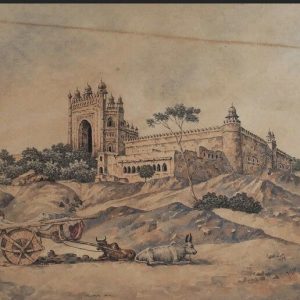
For years Professor Habib had entrusted me with taking groups to Fathpur Sikri. Sometimes they were participants in the Teachers’ Workshops organised by the Department. At other times they were visiting scholars from abroad or researchers passing through Aligarh. I had walked through the ruins so often that I almost knew every street, courtyard and building by instinct. I could have navigated the city blindfolded, or at least with one eye closed.

And almost invariably someone would stop before a wall and ask, “What do these strange marks carved on the stones signify?”

I always had an answer.

Unfortunately, it was rarely the correct one.

Like all confident young scholars, I possessed the remarkable ability of converting ignorance into plausible-sounding explanations. This is a skill that is not taught in any university curriculum but is, I suspect, unconsciously acquired by every postgraduate student within the first six months.

The visitors generally appeared satisfied. They would nod sagely, murmur something about ‘fascinating’, and move on to the next structure.

I was not.

The marks continued to haunt me. They appeared everywhere – on walls, on pillars, on lintels. They were not inscriptions in any conventional sense. They were symbols, signs, mysterious glyphs that seemed to say something but refused to speak. I found myself lying awake at night, staring at the ceiling and wondering what those marks might mean. This was not, I should add, a healthy development.

Eventually I confessed to Professor Habib that before taking up urban housing I wished to solve this particular mystery. I wanted to understand the masons’ marks and symbols scattered across the monuments of Fathpur Sikri.

To my delight he agreed.

That decision altered the course of my academic life. It was rather like setting out to investigate a minor footnote and discovering that the footnote contained an entire library.

My first sustained research on Akbar’s capital was therefore not on palaces, planning or imperial ideology, but on the humble marks left behind by anonymous craftsmen centuries earlier. I spent months crawling through ruins, squinting at stones, making rubbings, photographing symbols, and generally behaving in a manner that caused the local guides to regard me with deep suspicion. I suspect they thought I was either a spy or a madman. Possibly both.

Let me narrate an episode: One day while I was collecting and sketching the mason’s marks on my notebook at Akbar’s tomb at Sikandara, I heard a young voice “Mama, I am feeling so sorry for that guy! He is handsome, youthful but mad. Instead of looking at the monument, he is walking in circles with his head down!” I went to the child, smiled at her and told her that I was looking for such and such scrawling on the stone slabs. After some time I heard her call me: “Hey Man! Look here, those scratching are here too”.

Once that work was completed, I moved on to surveying the excavated residential structures of the city. This was archaeology of a different sort – not the digging kind, but the patient, systematic examination of what had already been uncovered. It required the eye of a detective, the patience of a saint, and the capacity to spend hours contemplating a broken wall without losing one’s sanity.

Without realising it, I had crossed an invisible frontier.

I was no longer merely reading about medieval history.

I was walking through it.

Every ruined wall became a document. Every foundation trench became a text. Every discarded fragment of pottery demanded to be read with the same care as a Persian manuscript. I found myself developing a new vocabulary, a new way of seeing, a new appreciation for the material remains of the past. It was rather like learning a new language, except this language was spoken in stone and mortar.

Those years were enriched enormously by Professor Habib’s Regional Teachers’ Workshops. Lasting nearly a fortnight, these workshops attracted scholars from universities across the country. Many who later emerged as some of India’s finest historians first crossed my path during those gatherings. For a young researcher they were an extraordinary education. The lectures were stimulating, the discussions often fierce, and the conversations over tea sometimes even more enlightening than the formal sessions. I learned as much from the gossip in the corridors as from the papers in the auditorium.

Looking back, those workshops created a generation of historians who remained connected through friendship as much as scholarship. We argued fiercely in the seminar rooms and drank chai together afterwards. We disagreed about interpretations but never about the importance of the enterprise. It was, I now realise, a golden age of academic camaraderie – the sort of thing that probably only exists in retrospect, but which felt real enough at the time.

Then came 1989.

For me it was the year in which history finally began paying a salary. This was, I should add, a welcome development, as my previous method of subsistence had involved eating less and hoping for the best.

In January the local Selection Committee selected both my friend Jawaid Akhtar and me for appointment as Lecturers. Curiously, both of us had also been selected for the post of Research Assistant.

This created a genuine dilemma – the sort of dilemma that only academia can produce, where one is offered two jobs and must choose between them, each with its own advantages and disadvantages.

One evening we found ourselves walking Professor Shireen Moosvi home from the Department, as we frequently did. Seizing the opportunity, we asked for her advice.

Jawaid spoke first.

“Madam, which post should I join?”

She replied without the slightest hesitation.

“The Research Assistant’s post is permanent. The lectureship is temporary. Join as Research Assistant.”

A perfectly sensible answer. Logical, prudent, the sort of advice one would expect from a wise and experienced academic.

Then, without missing a step, she turned towards me.

“Nadeem, don’t even think about it. Join as Lecturer. It is, after all, a teaching post. Don’t worry. This is a clear vacancy. You won’t be thrown out.”

Jawaid and I exchanged bewildered glances.

There we were, walking on either side of Professor Moosvi, both asking precisely the same question, and receiving two completely opposite pieces of advice.

To one she said, “Don’t join the lectureship.”

To the other she said, “Join the lectureship immediately.”

She had assessed not the posts, but the people.

It was one of those moments that only a truly perceptive teacher could produce. She had looked at us, weighed our temperaments, our capabilities, our likely futures, and had tailored her advice accordingly. It was rather like watching a chess grandmaster make two entirely different moves on two different boards, each perfectly suited to the position.

Jawaid and I walked on in bemused silence, each digesting our respective advice. I have often wondered what would have happened if we had asked the question on different days, or in different order. But such speculations are the stuff of counterfactual history, and I have long since learned to leave that to others.

On 10 February 1989 I formally joined the Department as a Lecturer.

I did not know it then, but that appointment marked the beginning of several journeys simultaneously.

It began my career as a teacher, a career that would see me standing in front of hundreds of students, occasionally making sense, frequently being asked questions I could not answer, and learning to say “That’s an excellent question, let me think about it” with sufficient gravitas to convince everyone that I actually knew the answer.

It strengthened my lifelong engagement with Fathpur Sikri, an engagement that would eventually produce books, articles, and a collection of anecdotes that grow taller with every telling.

It gradually drew me towards what would eventually become my second academic identity: that of a historian working through archaeology. This was not a planned development. It was rather like discovering that you have been speaking a second language all along without realising it.

In the years that followed, as I established myself within the Department, I had the privilege of introducing a specialised course on Medieval Archaeology. To the best of my knowledge, it remains one of the very few university courses in India devoted exclusively to that subject. I say ‘to the best of my knowledge’ because I have learned never to make absolute claims in academia—there is always someone who knows better.

The research too continued to evolve.

The work on Fathpur Sikri eventually resulted in my first major book on the city. Field explorations later took me far away into the abandoned settlements of the Jaisalmer region, where deserted villages opened yet another window onto India’s medieval past. There is something profoundly moving about walking through a village that has been empty for centuries – the silence, the crumbling walls, the sense of lives once lived and now vanished. It is rather like reading a history book in which every page has been torn out, but the shadows remain.

And after what often felt like an archaeological excavation of my own unfinished research, complete with layers of delay, periods of abandonment, and occasional discoveries, I finally submitted my long-delayed PhD on the Middle Classes. (Those who have followed this memoir will know that ‘long-delayed’ is something of an understatement, but I am trying to be charitable to myself.)

Its examiners represented three distinguished traditions of historical scholarship: Professor Satish Chandra, Professor Indu Banga and Professor Frank Perlin. I remember sitting through the viva and thinking that, unlike my MPhil examination, I was actually being asked questions. This was both reassuring and alarming, reassuring because I was clearly the subject of the examination, alarming because I had to answer.

Looking back now, I sometimes smile at how uncertain everything had seemed.

The student who once invented explanations for mysterious marks on the stones of Fathpur Sikri would spend decades trying to understand the city. The universe, it seems, has a sense of irony.

The bewildered candidate who watched two eminent historians debate across his MPhil viva would one day himself examine generations of research scholars. (I try to ensure that my own vivas are more interactive for the candidate, though I confess I occasionally find myself getting drawn into scholarly disputes that are, strictly speaking, irrelevant.)

And the young lecturer who walked into the Department on a February morning in 1989, uncertain of what lay ahead, had no inkling that the profession he had entered would soon cease to be merely a career.

It had already become a way of life.

Beyond Mahabharat: Recovering the Larger Literary Legacy of Professor Rahi Masoom Reza on His Centenary

Syed Ali Nadeem Rezavi

On 1 August 2026, as we commemorate the birth centenary of Professor Rahi Masoom Reza (1926–1992), there is a curious irony that deserves reflection. The man who spent his entire life resisting labels has himself become imprisoned within a single cultural memory. For millions of Indians, Rahi survives chiefly as the writer of the television serial Mahabharat (1988–90), whose unforgettable opening invocation of Samay – “Time” – became etched into the consciousness of an entire generation:

“मैं समय हूँ…” I am Time…

Rahi Masoom Reza’s opening invocation presented Time (Samay) as the eternal witness to all of human history. It was sutradhar through whose eyes we view our past to understand what we are. Samay declared that it had seen empires rise and fall, kings and warriors come and go, and countless generations repeat the same struggles between justice and ambition, truth and falsehood. The Mahabharata, it was thus suggestsed was not merely the story of one ancient family but the story of humanity itself, for the conflicts of greed, power, duty, love and sacrifice recur in every age. The narration invited the viewer to see the epic not as distant mythology but as a timeless mirror in which every generation can recognise its own moral dilemmas.

For nearly two years, every Sunday morning at 9.30, India appeared to suspend itself. Streets fell silent. Public transport ran half empty. Shops opened late. Families, neighbours and friends gathered around television sets in villages and cities alike. Religious identity momentarily dissolved before a shared narrative that belonged to everyone. It is difficult today to explain to younger generations the extraordinary cultural phenomenon that Mahabharat became. There had been successful television serials before it, but none that united India in quite the same manner. That a Muslim scholar from Ghazipur should become the voice through which much of modern India rediscovered the Mahabharata remains one of the finest illustrations of India’s composite civilisation. For countless Indian Muslims too, the serial offered their first sustained encounter with one of the foundational epics of the subcontinent. It reminded them that the Mahabharata, like the Ramayana, was not the property of any single community. It belonged to the civilisational inheritance of everyone who called India home.

Yet therein lies the tragedy of memory. The overwhelming success of Mahabharat has obscured the larger literary personality of Rahi Masoom Reza. He deserves to be remembered not merely as the scriptwriter of an immensely popular television serial but as one of the most original Urdu poets of the twentieth century, an important Hindi novelist, a fearless public intellectual, a distinguished academic and among the finest dialogue writers Indian cinema has ever produced.

Rahi Masoom Reza was born on 1 August 1926 in Gangauli, a village in Ghazipur district of eastern Uttar Pradesh. The landscape of Purvanchal, with its mingling of Hindu and Muslim traditions, its dialects, festivals, shared memories and everyday coexistence, never left him. Even after migrating to Bombay and achieving fame in cinema, the soil of eastern Uttar Pradesh continued to nourish his imagination. His village became not merely a geographical location but a metaphor for India itself.

His education at Aligarh Muslim University shaped him profoundly. At Aligarh he completed his higher studies in Urdu and eventually earned his doctorate. He later joined the Department of Urdu as a lecturer. The intellectual atmosphere of Aligarh in the years immediately following Independence exposed him simultaneously to classical Persian and Urdu literature, modern literary criticism, Marxist thought, progressive literature and the complex debates surrounding nationalism, language and identity.

Although later generations often remember him as a novelist, Rahi first established himself as a poet. He published seven collections of Urdu poetry and was recognised by critics as one of the most distinctive poetic voices to emerge after Independence. His verse combined lyricism with political consciousness, tenderness with irony, and personal experience with historical reflection. Unlike poets who remained imprisoned within inherited conventions, Rahi continually experimented with language while retaining an unmistakably Indian sensibility. Among his poetic achievements, his long poem 1857 occupies a unique place. Rather than presenting the uprising merely as military history or nationalist mythology, he transformed it into a meditation upon memory, loss, betrayal and the making of modern India. The poem mourns not simply a defeated rebellion but the fragmentation of a civilisation whose composite culture had once flourished across north India. It remains one of the significant long poems in modern Urdu literature and alone would have secured him an honoured place in the Urdu canon.

Yet poetry was only one aspect of his creativity. His novels fundamentally altered modern Hindi fiction. The irony itself is striking. An Urdu scholar by training chose Hindi as the principal language of his novels, demonstrating that the division between Hindi and Urdu was largely political rather than cultural. His masterpiece, Aadha Gaon (Half a Village), published in 1966, remains one of the greatest novels produced in post-Independence India. Set in Gangauli during the final years of British rule and the trauma of Partition, it refuses simplistic narratives of communal conflict. Instead, it portrays a society whose shared relationships are slowly eroded by political developments imposed from outside. The novel captures the rhythms of rural life with extraordinary authenticity while exposing the tragic absurdity of identities that become hardened under the pressures of modern politics. Its language itself was revolutionary. Rahi allowed the speech of ordinary villagers to enter literature without apology. Bhojpuri, Awadhi, Urdu, Persian expressions and colloquial Hindi coexist naturally, reproducing the multilingual reality of north India rather than the artificial purity demanded by language ideologues.

His subsequent novels, including Topi Shukla, Os Ki Boond, Himmat Jaunpuri, Dil Ek Saada Kagaz and others, repeatedly explored questions of identity, belonging and secularism. In Topi Shukla, perhaps his most explicitly political novel, friendship becomes the prism through which the hypocrisies of post-Partition India are examined. It remains one of the sharpest literary critiques of communalism written in modern Indian literature. Throughout his writings, Rahi refused to accept that religious identity determined cultural identity. This conviction became the defining principle of his intellectual life.

Perhaps no episode illustrates this better than the controversy surrounding his authorship of Mahabharat. Some objected that a Muslim had been entrusted with writing dialogues for what they regarded as a sacred Hindu text. Rahi’s response has since become legendary. He reminded his critics that he was neither an Arab nor a Turk. He was an Indian. The Mahabharata belonged as much to him as to anyone else born in this land. It was part of his inheritance. That simple assertion represented something much larger than personal defence. It articulated an understanding of India rooted not in religious exclusivism but in shared civilisation. It rejected the notion that literature, history or culture could be partitioned according to faith.

His adaptation of the epic reflected precisely this understanding. Rather than reducing the Mahabharata to theological instruction, he presented it as an exploration of moral ambiguity, political power, human frailty and ethical responsibility. The dialogues retained a literary dignity while remaining accessible to millions of viewers. Characters were rendered psychologically complex rather than merely symbolic. The serial succeeded not because it preached religion but because it revealed humanity. His famous opening narration on Time itself possesses remarkable philosophical depth. Time appears not merely as chronology but as the ultimate witness before whom kings, empires, victories and defeats all pass away. In many respects, that meditation reflects the historical imagination of a novelist rather than the outlook of a television scriptwriter.

Bombay brought Rahi another arena in which to display his astonishing versatility. He wrote dialogues, screenplays and lyrics for numerous films over several decades. His association with filmmakers such as Gulzar, Hrishikesh Mukherjee, B. R. Chopra and others produced dialogues that combined literary elegance with everyday speech. Unlike many writers who regarded cinema as a compromise, Rahi treated popular culture with seriousness. He understood that films could communicate ideas to audiences vastly larger than literary journals ever could. Even while working within commercial cinema, he retained his unmistakable voice. His characters spoke like real people rather than literary abstractions. Humour, irony and emotional restraint characterised much of his writing. He possessed an extraordinary ear for spoken language.

Yet behind the celebrated public figure stood a deeply committed secular intellectual. Rahi consistently opposed every attempt to divide Indian society along communal lines. He criticised both Hindu and Muslim communalism with equal courage. He believed that India’s strength lay precisely in its shared cultural traditions and its capacity to absorb multiple histories into a common civilisation. His lifelong attachment to the Ganga became almost symbolic. He often described himself not in terms of religion but in relation to the river and the landscape that had shaped him. The Ganga represented continuity, memory and belonging beyond sectarian identities. In one of his most moving reflections, he wrote that if anyone asked who he was, the answer was simple: he was a son of the Ganga.

This profound attachment to place also explains why nostalgia never became sentimental in his writings. He mourned the disappearance of an older India not because he rejected modernity but because he feared the destruction of its composite social fabric. He recognised that villages were changing, languages were becoming standardised and identities increasingly politicised. Much of his fiction is therefore an attempt to preserve voices, memories and relationships before they disappeared.

As a teacher at Aligarh Muslim University, Rahi inspired students not merely through scholarship but through intellectual independence. He belonged to that generation of academics for whom literature was inseparable from public responsibility. Writers were expected not simply to entertain but to intervene in the moral life of society.

Today, more than three decades after his death, his concerns appear remarkably contemporary. Questions of identity, language, history and belonging continue to dominate public discourse. Attempts to claim exclusive ownership over India’s past have become increasingly frequent. In such a climate, Rahi Masoom Reza’s life offers an alternative vision of patriotism, one grounded not in exclusion but in cultural confidence. Remembering him only as the writer of Mahabharat therefore does him an injustice, even though that achievement remains monumental. He was far more than the creator of memorable television dialogues. He was among the finest Urdu poets of his generation. He transformed the Hindi novel through works of enduring significance. He enriched Indian cinema with language of rare literary quality. Above all, he embodied the composite civilisation that he celebrated throughout his life.

This remembrance is also personal to me. I was fortunate enough to meet him on a number of occasions with my father – a man of religion, to boot – and those encounters left an indelible impression upon a young mind. I remember the warmth of his presence, the quiet wit that sparkled in his conversation, and the complete absence of any pretension despite his towering achievements. He made you feel that literature was not a distant pursuit but a living, breathing engagement with the world. The Rahi I met was not the celebrated public figure alone but a man of deep affection, keen observation and an abiding faith in the essential goodness of ordinary people. He belonged to that rare breed of writers whose life and work were seamless.

It would also be remiss not to recall his elder brother, Moonis Raza (d.1994), who shared the same intellectual soil and was an eminent Indian academic administrator, geographer, and a founder-chairman of the Jawaharlal Nehru University (JNU). The third brother was Prof Mehdi Raza, (d.2015) who was the head and professor of geography at Aligarh. The Raza family of Gangauli produced not one but three sons of extraordinary calibre, each in his own way contributing to the nation’s life. The brothers remained close, and one can only wonder at the conversations that must have passed between the novelist who chronicled India’s soul, the geographer and the diplomat who represented India’s face to the world. Their shared inheritance – the same village, the same river, the same composite culture – nourished two distinct but equally remarkable careers.

On his centenary, the greatest tribute we can offer Professor Rahi Masoom Reza is to recover the whole writer. The poet who mourned the wounds of history. The novelist who chronicled the disintegration of rural India. The scholar who crossed linguistic frontiers with effortless ease. The screenwriter who brought an ancient epic alive for modern audiences. And the Indian who insisted that culture cannot be divided by religion because civilisation is always larger than faith. His Mahabharat gave India unforgettable words. He did to Mahabharata what Tulsi had done to Ramayana: brought it to the masses. His larger body of work gave India something even more precious: a language through which it could recognise itself. As we honour his memory, let us remember that the voice which once invoked Time itself now belongs to eternity – and yet, in his pages, he remains forever our contemporary, speaking to us across the decades with undiminished urgency and love.

From Scientific Temper to Political Theatre: Who Is Rewriting India’s Idea of Science?

Syed Ali Nadeem Rezavi

The uproar over Priyanka Gandhi’s speech in Parliament reveals far more about the condition of public discourse in India than it does about the speech itself.

Within hours, an entire ecosystem had mobilised to accuse her of insulting a distinguished academic. Television debates, social media campaigns and partisan commentators all converged on a single phrase she used. Almost no one bothered to engage with the question she had actually raised.

That question was simple. Should those who publicly advance scientifically unverified claims be entrusted with shaping the future of Indian education?

It is a question that deserves an answer.

Priyanka Gandhi did not deny Professor V. Kamakoti’s accomplishments as a computer scientist. Those achievements are real, substantial and deserving of respect. Scientific excellence in one discipline, however, does not exempt anyone from scrutiny when making empirical claims in another. Science does not recognise authority. It recognises evidence.

That principle is the very foundation of modern civilisation.

Every scientific proposition, whether it concerns quantum computing, vaccines or the medicinal properties of cow urine, must pass through the same process of observation, experimentation, peer review and reproducibility. Reputation cannot substitute for evidence. Institutional office cannot replace scientific proof.

Yet this elementary distinction has increasingly become blurred in India’s public life.

A Pattern, Not an Isolated Incident

The controversy surrounding Professor Kamakoti’s appointment is not an isolated episode. It belongs to a much larger pattern that has unfolded since 2014, one in which the language of science has repeatedly been appropriated to legitimise assertions that belong either to mythology, faith or speculation rather than empirical inquiry.

One of the earliest signals came from the highest political office in the country.

At the 2015 Indian Science Congress, Prime Minister Narendra Modi referred to the story of Lord Ganesha as evidence that ancient India possessed plastic surgery and cited Karna’s birth in the Mahabharata as suggesting knowledge of genetic science. Many defended these remarks as expressions of cultural pride or metaphor. That defence misses the point entirely. The issue was never whether Indians should celebrate their civilisation. The issue was whether historical and scientific claims made before an audience of scientists should be supported by evidence rather than sentiment.

The distinction matters.

Civilisations earn respect through what they actually achieved, not through claims made on their behalf centuries later.

India possesses one of the richest scientific traditions in human history. Aryabhata transformed mathematics and astronomy. Brahmagupta developed concepts that changed numerical thought. Sushruta’s surgical observations continue to command scholarly attention. Ancient Indian metallurgy produced achievements that remain objects of admiration. None of these accomplishments requires embellishment through extravagant assertions unsupported by historical or archaeological evidence.

Ironically, exaggeration diminishes genuine achievement. It replaces scholarship with mythology masquerading as history.

The same tendency became visible in successive sessions of the Indian Science Congress, where presentations claiming the existence of ancient aircraft, interplanetary travel, advanced stem-cell technology and other extraordinary achievements received national attention. Many eminent Indian scientists expressed deep embarrassment that one of the country’s oldest scientific institutions appeared willing to provide a platform for claims that would not survive elementary scientific scrutiny.

The criticism came not from enemies of Indian civilisation but from some of India’s most respected scientists. Their concern was straightforward. Scientific conferences exist to test hypotheses against evidence, not to confer legitimacy upon ideological preferences.

Science has only one language.

Evidence.

Everything else is opinion.

The Erosion of Intellectual Independence

Unfortunately, a wider intellectual climate has emerged in which evidence increasingly appears negotiable. Mythological narratives are presented as historical fact. Ancient texts are treated as repositories of modern scientific discoveries. Rational criticism is dismissed as hostility towards Indian culture. Scholars who ask inconvenient questions are frequently accused of lacking patriotism rather than being answered with evidence.

The consequences extend well beyond academic debate.

Universities are not merely institutions that award degrees. They are where societies teach future generations how knowledge itself is created. Students do not merely learn physics, biology or history. They learn habits of mind. They learn whether difficult questions are welcomed or discouraged, whether evidence matters more than authority, and whether intellectual disagreement is an essential feature of scholarship or an act of ideological disobedience.

It is precisely for this reason that appointments to educational bodies matter.

Following repeated controversies surrounding public examinations, particularly the NEET crisis, India expected committees composed of specialists in assessment, pedagogy, psychology, educational administration and examination reforms. Instead, the debate once again shifted to the public positions of some of those appointed. That was entirely avoidable.

The deeper concern is not one appointment. It is a philosophy of governance that increasingly appears comfortable allowing ideological symbolism to occupy spaces where intellectual independence ought to prevail.

The consequences are already visible across education.

School textbooks have been repeatedly revised in ways that many historians, scientists and educationists have criticised as privileging ideological narratives over established scholarship. Historical complexity is often replaced with simplified civilisational binaries. Mythological traditions are sometimes presented alongside historical evidence without clearly distinguishing between the two. Universities have witnessed growing pressure over curricula, appointments and research priorities. Academic disagreement is increasingly interpreted through political rather than scholarly lenses.

One need not agree with every criticism levelled against these developments to recognise the cumulative direction in which they point.

The Constitutional Promise

The Constitution anticipated precisely such dangers.

Article 51A(h) declares that every citizen has the duty “to develop the scientific temper, humanism and the spirit of inquiry and reform.” These words were not inserted accidentally. They reflected the conviction that democracy depends upon citizens capable of asking questions, evaluating evidence and resisting dogma, irrespective of its source.

Scientific temper does not require hostility towards religion.

It requires honesty about the difference between belief and evidence.

A citizen may believe that the universe was created through divine intervention. A scientist investigating the origins of the universe must nevertheless rely upon observation and demonstrable evidence. Both occupy different domains. Confusing them impoverishes both science and faith.

Jawaharlal Nehru understood this distinction better than most. For him, scientific temper was not merely the cultivation of laboratories or the expansion of technological education. It was an attitude of mind. It meant intellectual humility, respect for evidence, openness to criticism and the willingness to abandon cherished assumptions when facts demanded it.

That ideal now appears under strain.

The Real Tragedy

The real tragedy is not that politicians exchange sharp words in Parliament. Parliamentary democracy has always thrived on vigorous disagreement. The tragedy is that asking for scientific evidence has itself become controversial.

When demands for proof are portrayed as insults, when criticism of pseudoscience is interpreted as disrespect for civilisation, and when loyalty to ideological narratives becomes more valuable than intellectual honesty, science ceases to function as science. It becomes political theatre.

Priyanka Gandhi’s critics have concentrated on a phrase.

They have carefully avoided confronting the principle behind it.

The issue was never one professor. Nor was it one speech.

It is whether India wishes to be governed by a constitutional commitment to scientific temper or by the political convenience of pseudoscience.

A civilisation confident of its past does not invent discoveries it never made. A nation confident of its future does not fear evidence. It welcomes it.

India has produced some of humanity’s greatest mathematicians, astronomers, physicians and philosophers. Their legacy was built upon observation, argument and intellectual courage.

If we truly wish to honour that inheritance, then the highest offices in our scientific and educational institutions must stand for one principle above every other.

Not ideology.

Not mythology.

Not political expediency.

Evidence.

Book Review: Ayatollah Sayyid Ali Khamenei. Tabyeen: The Neglected Obligation. Collected from the Speeches of Ayatollah Sayyid Ali Khamenei. London: Ahlulbayt Islamic Mission (AIM), 2023. 422 pp. ISBN 978-0-9957589-6-4.

Syed Ali Nadeem Rezavi

Few concepts have assumed greater prominence in the contemporary discourse of the Islamic Republic of Iran than Jihād al-Tabyīn (‘the Struggle for Clarification’), and few books attempt to present this concept as systematically as Tabyeen: The Neglected Obligation. Published by the Ahlulbayt Islamic Mission (AIM), this substantial volume gathers speeches delivered by Ayatollah Sayyid Ali Khamenei over several decades and organises them into a coherent thematic exposition. Rather than being an original treatise, it is an editorial reconstruction of Khamenei’s thought on one of the defining concepts of his intellectual and political project.

The editors have arranged the material into five broad sections covering the conceptual foundations of tabyeen, its practical requirements, methods of implementation, areas requiring clarification, and the responsibilities of various sections of society. The organisation succeeds remarkably well in transforming scattered speeches into what almost reads as a unified philosophical work. Detailed references to the original speeches further enhance its scholarly value as a documentary source.

The central thesis of the volume is straightforward but far-reaching. Khamenei argues that clarifying truth has itself become one of the highest forms of jihad. The struggle is no longer confined to military confrontation but encompasses education, scholarship, journalism, media, cyberspace and public discourse. The principal battlefield of the twenty-first century is the arena of ideas and narratives. Scholars, students, writers, teachers and ordinary believers all become participants in this intellectual jihad.

One of the book’s strengths is its insistence that jihad should not be narrowly understood as armed conflict. Khamenei repeatedly defines jihad as sustained, purposeful struggle against obstacles, whether intellectual, political, educational or cultural. This wider understanding has deep roots in Islamic thought and allows the concept to be relocated within the domains of scholarship, research and public communication.

To appreciate the full weight of Khamenei’s argument, one must first understand how Shi’i tradition conceptualises jihad. In classical Shi’i jurisprudence, jihad is typically divided into two categories: the ‘greater jihad‘ (al-jihād al-akbar), which denotes the inner struggle against one’s own baser desires and spiritual shortcomings, and the ‘lesser jihad‘ (al-jihād al-asghar), which refers to external armed struggle in defence of the faith. This distinction, rooted in a famous saying attributed to the Prophet Muhammad, has long given Shi’i thought a rich vocabulary for discussing moral and spiritual endeavour alongside military defence. However, Shi’i scholars have also historically recognised a third category: the jihad of the tongue and the pen (jihād al-lisān wa al-qalam), which encompasses the duty to speak truth, refute falsehood and disseminate religious knowledge. It is this latter tradition that Khamenei revives and expands, elevating intellectual and communicative struggle to a status comparable with, and in the contemporary context even surpassing, physical combat. By anchoring his doctrine in this established jurisprudential framework, Khamenei presents tabyeen not as an innovation but as the recovery of a neglected obligation whose time has now come.

Equally noteworthy is the ethical framework within which this struggle is situated. Throughout the opening chapters Khamenei insists that clarification must not descend into slander, rumour, deception or abusive polemics. Rather, it should proceed through reasoned argument, ethical conduct and intellectual honesty. These passages represent some of the strongest sections of the book and distinguish tabyeen, at least in principle, from mere political propaganda.

The work also demonstrates how deeply Shi’i historical memory informs Khamenei’s political theology. Karbala occupies a central place in his conception of clarification. Sayyida Zaynab’s speeches in Kufa and Damascus are presented as the paradigmatic example of preserving truth through testimony after military defeat. Likewise, Imam ‘Ali’s teachings on truthfulness and moral steadfastness are repeatedly invoked to provide scriptural and ethical legitimacy to the concept of Jihād al-Tabyīn.

Yet the real significance of this volume becomes apparent only when it is situated within the broader tradition of modern Shi’i political thought.

Although Khamenei presents tabyeen as an essential Islamic obligation, the underlying idea is by no means entirely new. The duty to explain truth (tablīgh), remove misunderstanding and defend religion has long occupied an important place in Shi’i scholarship. What distinguishes Khamenei is the unprecedented scope he gives to the concept by making it the central organising principle of political communication in the age of mass media and cyberspace.

The intellectual lineage begins most obviously with Imam Khomeini. Indeed, the editors themselves open the volume with an extended selection from Khomeini’s speeches emphasising the responsibility of scholars and preachers to awaken society and defend Islam through explanation. Khamenei’s work therefore represents continuity rather than rupture. Yet there is also an important evolution. Khomeini generally discussed propagation in the context of revolutionary mobilisation, whereas Khamenei transforms it into a comprehensive doctrine governing media, education, universities and digital communication. The battlefield shifts from revolution itself to the contest over public consciousness. To fully grasp the evolution from Khomeini to Khamenei, one must consider how Khomeini’s concept of clarification was inextricably tied to his doctrine of Wilāyat al-Faqīh (Guardianship of the Jurist). In his seminal essays and lectures collected in Wilāyat al-Faqīh: Islamic Government, Khomeini argued that religious scholars bear not only the authority but the sacred duty to guide the political community in the absence of the Imams. Within this framework, propagation (tablīgh) served primarily as an instrument of revolutionary awakening and institutional consolidation. Khomeini’s speeches during the 1970s and early 1980s were characteristically urgent and mobilising, calling upon clerics, students and the broader public to expose the tyranny of the Pahlavi regime and rally behind the nascent Islamic state. His famous lectures in Najaf and Paris were exercises in clarification aimed at transforming passive believers into active revolutionaries. Yet for Khomeini, the ultimate objective remained the establishment and preservation of the Islamic polity itself; explanation was the means, not the end. Khamenei, by contrast, operates in a very different context. Having inherited a fully established Islamic Republic, he confronts not the challenge of building a state but of sustaining its legitimacy across generations in an environment saturated with competing narratives and digital misinformation. Consequently, Khamenei’s deployment of tabyeen is more systemic, more institutionally embedded and more defensive in character. Whereas Khomeini used clarification to dismantle an old order, Khamenei uses it to fortify a new one, embedding the duty of explanation within the very fabric of governance, education and media policy. This shift reflects not a departure from Khomeini’s vision but its adaptation to the demands of longevity, as the revolutionary movement transforms into a permanent civilisation project requiring constant intellectual renewal.

The comparison with Ayatollah Muhammad Baqir al-Sadr is equally illuminating. Like Khamenei, al-Sadr regarded intellectual struggle as indispensable for preserving Islamic civilisation against competing ideologies. His Falsafatunā and Iqtisādunā were themselves exercises in explaining Islam rationally before an educated audience. Yet al-Sadr’s engagement remained primarily philosophical. He debated Marxism and capitalism through systematic reasoning. Khamenei, by contrast, is less concerned with constructing philosophical systems than with countering what he regards as organised campaigns of misinformation. His principal adversary is not philosophical materialism but media distortion.

A similar distinction emerges when one compares this work with the writings of Murtaza Mutahhari. Mutahhari consistently argued that misconceptions about Islam should be removed through reasoned explanation and that every generation requires a fresh intellectual presentation of religion. In many respects Khamenei follows this educational impulse. Nevertheless, Mutahhari’s concern remained principally pedagogical and philosophical. In Tabyeen, clarification becomes inseparable from preserving the political order established by the Islamic Revolution. The educational project is thus incorporated into a theory of governance.

Perhaps the greatest contrast is provided by Allama Muhammad Husayn Tabataba’i. His monumental al-Mīzān fi Tafsīr al-Qur’ān is itself an exercise in clarification, but one grounded in Qur’anic hermeneutics, philosophical reflection and rational inquiry. Khamenei shares Tabataba’i’s confidence that truth must be explained rather than imposed. Yet whereas Tabataba’i asks how revelation should be interpreted, Khamenei asks how truth should be defended amidst global information warfare. Hermeneutics yields to communication strategy.

The most significant divergence within contemporary Shi’ism appears in comparison with Grand Ayatollah Ali al-Sistani. Both scholars regard clarification as a religious responsibility, but they locate its institutional expression very differently. Sistani’s Najaf tradition generally favours moral authority exercised from a distance from state power, intervening directly only during exceptional crises. Khamenei, writing from within the doctrine of Wilāyat al-Faqīh, frequently identifies the defence of the Islamic Republic with the defence of Islam itself. This distinction reflects the continuing divergence between the Najaf and Qom schools of political thought.

Historical comparison with Ayatollah Muhammad Husayn Naini is equally revealing. In Tanbīh al-Ummah wa Tanzīh al-Millah, Naini viewed public explanation as a means of exposing tyranny and limiting arbitrary authority through constitutional government. Khamenei similarly opposes falsehood but directs his attention primarily towards foreign intervention, sanctions, media campaigns and ideological infiltration. Whereas Naini feared despotism from within, Khamenei emphasises manipulation from without.

The comparison with Ali Shariati reveals another important dimension. Both thinkers stress intellectual awakening, youth mobilisation and resistance to cultural domination. Yet Shariati frequently challenged established religious institutions themselves, whereas Khamenei speaks from within the clerical establishment. Shariati’s primary concern was stagnation within Muslim society; Khamenei’s is distortion imposed through hostile narratives.

Ali Shariati’s understanding of jihad departed significantly from both traditional jurisprudence and the clerical establishment of his time. For Shariati, jihad was not primarily a military or even a defensive legal category, but rather an existential and revolutionary call to action against all forms of oppression, injustice and intellectual stagnation. He reimagined jihad as the perpetual struggle of the oppressed (mustad’afūn) against their exploiters, drawing heavily on his distinctive synthesis of Islamic symbolism and Third World liberationist thought. In Shariati’s reading, the tragedy of Karbala was not merely a historical event to be mourned but a revolutionary paradigm requiring active emulation: Imam Husain’s stand was the ultimate act of jihad against tyrannical power, regardless of the odds. Crucially, Shariati also emphasised what he called the ‘red martyrdom’ (shahādat-i surkh) – a dynamic, life-affirming struggle against injustice – over the passive, otherworldly piety he associated with established religious authority. His jihad was thus thoroughly this-worldly, politically engaged and deeply suspicious of clerical quietism. This stands in marked contrast to Khamenei’s more institutionally anchored vision, where jihad is channelled through state structures and framed as defence of the Islamic Republic against external threats. Where Khamenei sees clarification as a duty to protect an established order, Shariati saw clarification – or what he termed ‘enlightenment’ (rūshanfikrī) – as a weapon to dismantle all established orders that perpetuated inequality, including, at times, the very religious establishment from which Khamenei now speaks.

Seen against this wider background, Tabyeen emerges not as a novel theological doctrine but as a distinctive synthesis. Khamenei combines Imam ‘Ali’s emphasis on truthfulness, Imam Husain’s witness against oppression, Sayyida Zainab’s preservation of Karbala through testimony, Imam Khomeini’s revolutionary activism, Mutahhari’s intellectual defence of Islam and al-Sadr’s ideological confidence into a unified theory for the age of digital communication. His original contribution lies in identifying information itself as the principal arena of jihad.

At the same time, the volume inevitably reflects its ideological location. Discussions of Yemen, Syria, Iraq, sanctions, the Pahlavi monarchy and Western media all proceed from the perspective of the Islamic Republic. Alternative interpretations receive relatively little attention, and criticism of the Revolution is frequently interpreted as the product of organised external distortion. From an academic standpoint, this represents the principal limitation of the work. The concept of clarification occasionally risks becoming synonymous with defending a particular political order rather than facilitating genuinely open intellectual inquiry.

Another weakness arises from the nature of the source material itself. Since the volume is compiled from speeches delivered over many years, certain themes recur repeatedly. While this repetition reinforces the centrality of the concept in Khamenei’s thinking, tighter editorial condensation and fuller historical introductions explaining the circumstances of each speech would have enhanced the book’s scholarly utility.

The English translation is generally smooth and readable, successfully preserving the sermonic tone of the original Persian. The editors have also performed a valuable service by documenting the provenance of individual passages, enabling researchers to locate the original speeches and trace the evolution of Khamenei’s thought over time.

Ultimately, Tabyeen: The Neglected Obligation should not be read simply as a work of religious instruction or political advocacy. It is a major primary source for understanding the intellectual vocabulary of the Islamic Republic during the twenty-first century. Whether one agrees with its political assumptions or not, it reveals how contemporary Shi’i political thought has reconceptualised jihad, authority, communication and historical memory in response to the age of digital media.

For historians of modern Iran, scholars of Shi’i Islam and students of political theology, the book provides invaluable insight into one of the most influential contemporary Shi’i conceptions of religion and politics. Its greatest significance lies less in its originality than in its successful synthesis of classical Shi’i ethical traditions with the realities of modern information warfare. It therefore deserves careful reading not merely as a statement of Ayatollah Khamenei’s views, but as an important document in the continuing evolution of modern Shi’i political thought.

Book Review: Sutapa Dutta and Shivangini Tandon (eds.), Making the ‘Woman’: Discourses of Gender in 18th–19th-Century India. Abingdon and New York: Routledge, 2024. Pp. xxi + 215. ISBN 978-1-032-60904-1 (Hardback).

Syed Ali Nadeem Rezavi

The historiography of women and gender in South Asia has undergone profound transformations over the past four decades. Early scholarship sought primarily to recover women who had been marginalized or overlooked in conventional historical narratives. More recent work has shifted towards interrogating the very categories through which femininity, masculinity and sexuality have been historically imagined. Making the ‘Woman’: Discourses of Gender in 18th–19th-Century India, edited by Sutapa Dutta and Shivangini Tandon, belongs firmly to this latter tradition. Rather than merely asking how women participated in history, the volume asks how the category of “woman” itself was historically produced through competing political, literary, social and cultural discourses. It is an ambitious undertaking that opens several important avenues of inquiry, even if it does not always fully realize all of its theoretical promises.

The editors provide an extensive introduction that serves as the intellectual backbone of the collection. Drawing upon contemporary feminist theorists including Judith Butler, Natalie Stoljar, Nancy Chodorow and Sally Haslanger, they reject essentialist understandings of womanhood and instead argue that “woman” is a historically contingent category shaped by intersecting structures of caste, class, religion, language, region and political authority. Their objective is not simply to write women back into history but to investigate the historical processes through which particular notions of femininity came to acquire legitimacy and normative force. This is an important and welcome intervention, particularly in the context of eighteenth and nineteenth century India, where discussions of gender have often remained confined within the familiar framework of colonial social reform and its nationalist responses. However, it is worth noting that the editors have not contributed individual essays to the collection themselves, confining their scholarly engagement to the introductory framework. While this is not unusual in edited volumes, the absence of their own case studies means that readers must look to the contributors for the empirical instantiation of the theoretical perspectives laid out in the introduction.

One of the major strengths of the volume is its chronological perspective. The editors resist the temptation to treat colonialism as the sole catalyst for changes in gender relations. Instead, they argue compellingly that many of these transformations had their origins in the late Mughal and regional polities of the eighteenth century. This longer historical perspective enables the contributors to situate colonial modernity within earlier processes of political, cultural and intellectual change. Such an approach represents a useful corrective to narratives that privilege colonial intervention at the expense of indigenous historical developments and pre-colonial trajectories of transformation.

The volume is organized into four thematic sections dealing with the public and private worlds, normative constructions of gender, marginalised identities and narratives of femininity. The range of subjects is impressive. Essays discuss Kashmiri hafizas, the Awadhi zenana, Mughal masculinity, Dalit counter-histories, tribal identities, goddess iconography, tawa’ifs, eunuchs, Tamil literary traditions, Bengali ritual songs and Assamese women’s writing. Collectively, these chapters demonstrate the extraordinary diversity of gendered experiences across the subcontinent and successfully undermine any notion of a singular or universal Indian womanhood. This diversity is not merely additive but fundamentally challenges the conceptual frameworks through which South Asian gender history has often been narrated.

Several contributions are particularly noteworthy. Tara Sami Dutt’s study of Wajid Ali Shah’s Ishqnama effectively challenges the long-standing assumption that the zenana was merely a secluded domestic space, demonstrating instead its political and cultural significance within the Awadhi court as a site of artistic patronage, intellectual exchange and political negotiation. Riya Gupta’s examination of the Mirzanama offers a valuable contribution to the growing scholarship on masculinity by showing that elite Mughal masculinity was itself a carefully cultivated social performance rooted in prescribed conduct manuals rather than a natural or stable identity. Lubna Irfan’s chapter on eunuchs similarly stands out for bringing architectural and spatial history into conversation with gender studies, thereby broadening the evidentiary base beyond textual sources and illuminating how built environments both reflected and constituted gendered hierarchies. These essays exemplify the interdisciplinary possibilities that the volume seeks to promote and suggest productive directions for future research.

Another commendable feature is the geographical breadth of the collection. Too often studies of gender in colonial India gravitate towards Bengal, with occasional forays into Maharashtra or the Punjab. Here, the inclusion of material from Kashmir, Awadh, Delhi, western India, Assam and Tamil Nadu significantly broadens the discussion and reminds readers that gender was negotiated differently across regional contexts, each with its own literary traditions, political structures and social formations. The volume also makes effective use of diverse source materials including paintings, literary texts, songs, manuscripts, colonial records and visual culture. Such methodological plurality enriches the historical narrative and reflects the increasingly interdisciplinary nature of gender studies, though it also raises questions about how these different genres of sources relate to one another.

Farhat Hasan’s foreword deserves particular mention. It is much more than a conventional prefatory note. By situating the volume within wider debates on early modern South Asian modernity, multilingual literary cultures, household politics and the relationship between textuality and gender, the foreword provides an elegant historiographical framework that complements and occasionally even extends the arguments developed in the chapters themselves. Hasan’s insistence on the need to historicise gender categories without assuming their universality sets the tone for the collection and offers a concise statement of the volume’s intellectual commitments.

Yet the collection is not without its limitations. The first concerns the relationship between theory and practice. The introduction presents a sophisticated theoretical critique of essentialist notions of womanhood and promises a sustained interrogation of the category of gender itself. However, not all the subsequent chapters engage with these conceptual concerns to the same degree. While some contributors critically interrogate categories such as gender, agency and identity, others employ these terms rather conventionally without fully exploring their historical contingency. Consequently, there is occasionally a discernible gap between the theoretical ambitions announced in the introduction and the empirical analyses offered by individual essays. A more sustained dialogue between conceptual frameworks and case studies would have strengthened the collection’s overall coherence.

The quality of the contributions is also uneven. Some chapters make substantial historiographical interventions and engage critically with both primary sources and existing scholarship, advancing novel arguments that reshape our understanding of specific contexts. Others remain closer to descriptive case studies that, while informative, do not fully exploit their analytical potential. This unevenness is perhaps inevitable in any edited collection, yet the volume sometimes resembles conference proceedings rather than a sustained collective intellectual project. Greater editorial cross-referencing between chapters, or a concluding essay drawing together their wider implications and identifying shared themes, would have enhanced the coherence of the collection and helped readers navigate its diverse offerings.

A more substantive criticism concerns the nature of the archive upon which the volume rests. Although the editors repeatedly emphasise recovering women’s agency and exploring marginalised voices, much of the evidence is drawn from elite literary, artistic and courtly sources. Consequently, the women who emerge most vividly are dancers, courtesans, royal women, literary figures and members of educated elites. The experiences of peasant women, artisans, labouring women and those inhabiting more ordinary social worlds remain largely absent from the analysis. This undoubtedly reflects the limitations of surviving sources and the archival biases that privilege elite and textual materials, but the implications of these archival silences could have been explored more explicitly. A more sustained reflection on what cannot be known, and on the methodological strategies available for approaching subaltern gendered experiences, would have added depth to the volume’s critical project.

Closely related to this is the volume’s overwhelming emphasis on discourse and representation. Most contributors are concerned with how women were imagined, depicted and represented across various textual and visual genres rather than how they actually negotiated economic, legal or institutional structures in their daily lives. Questions of property, inheritance, labour, taxation, commercial activity, education and legal rights receive comparatively limited attention. Yet these were precisely the arenas in which gender relations were materially constituted and contested. A closer engagement with social and economic history would have provided a stronger balance between representation and lived experience, and would have grounded the discursive analysis in the material conditions that shaped women’s lives.

From the perspective of Mughal historiography, another omission is noteworthy. The collection convincingly argues that domestic spaces were deeply political and that the boundaries between public and private were porous and contested. However, relatively little attention is devoted to the institutional dimensions of gender within the machinery of the Mughal state and its successor polities. Recent scholarship has increasingly demonstrated the importance of women, eunuchs and members of the imperial household in diplomacy, patronage, commerce and administration. These broader political implications remain only partially explored here. As a result, the discussion occasionally risks replacing one binary, namely public versus private, with another that continues to privilege representation over institutional practice.

The treatment of colonial modernity also offers less that is genuinely new than the discussions of the eighteenth century. The volume revisits familiar debates concerning social reform, domesticity and nationalist constructions of womanhood that have already been extensively analysed by scholars such as Lata Mani, Tanika Sarkar, Mrinalini Sinha and Partha Chatterjee. While these discussions are competently synthesised and provide useful overviews, the collection’s most original contributions lie elsewhere, particularly in its exploration of the late Mughal and regional worlds where different configurations of gender were in play. A sharper focus on these less familiar terrains would have distinguished the volume more clearly from existing scholarship.

This points to a broader chronological limitation. Although Farhat Hasan’s foreword invokes the sixteenth and seventeenth centuries, situating the volume within a longer history of early modern gender relations, the essays themselves confine their analysis to the eighteenth and nineteenth centuries. The classical Mughal centuries, the period of Akbar, Jahangir and Shah Jahan, remain largely unexamined here. This chronological boundary is not a flaw in itself, as the volume is explicitly framed around the later period. Yet the foreword’s invocation of an earlier era creates certain expectations that the essays do not fulfil. The reader is left with a sense that the history of gender in the Mughal world is only partially told, and that a companion volume addressing the sixteenth and seventeenth centuries would be a necessary complement to this collection. The present volume thus opens a door but leaves the earlier period, with its own distinctive configurations of gender, power and cultural production, awaiting a similarly sustained treatment.

Despite these reservations, Making the ‘Woman’ remains a valuable contribution to the expanding literature on gender in South Asian history. Its greatest achievement lies in demonstrating that gender identities in eighteenth and nineteenth century India cannot be understood through static categories or simple binaries. Instead, they were continually negotiated across multiple linguistic, political, cultural and regional contexts, shaped by both pre-colonial trajectories and colonial interventions. The volume successfully broadens both the geographical and methodological horizons of gender history and encourages historians to move beyond narrowly colonial or nationalist frameworks in their analyses.

The collection also raises important questions that future scholarship might address more fully. How did gender intersect with caste in the production of social identities beyond the elite spheres represented here? What were the economic dimensions of gender that shaped women’s lives in more ordinary circumstances? How did regional literary traditions produce different gender norms and subjectivities? And how did women themselves respond to, appropriate or resist the various discourses that sought to define them? The volume opens these questions without fully answering them, which is perhaps a measure of its generative potential rather than a failing. Moreover, the chronological gap between the foreword’s framing and the essays’ focus invites further inquiry into the classical Mughal centuries, suggesting an agenda for future research that the volume implicitly establishes.

Ultimately, this is a stimulating and thought-provoking collection. It is stronger in posing questions than in providing definitive answers, and stronger in cultural analysis than in social or institutional history. Nevertheless, these are limitations of emphasis rather than of scholarship. The editors have assembled an impressive group of contributors who collectively challenge readers to rethink familiar assumptions about women, gender and power in South Asian history. The volume will be read with profit by historians of early modern and colonial India, as well as by scholars of gender studies, literary history and cultural history. It deserves a place in the continuing conversation on how gender was imagined, contested and lived in the complex world of eighteenth and nineteenth century India, while also pointing towards the need for a complementary study that would extend this analysis back into the classical Mughal centuries.

Book Review: David Halberstam, The Children. New York: Random House, 1998, pp.783

Syed Ali Nadeem Rezavi

Few books capture the moral energy, intellectual seriousness and emotional texture of a social movement as compellingly as David Halberstam’s The Children. Although widely recognised as one of America’s greatest journalists, Halberstam was also a historian of remarkable sensitivity. In this monumental work he reconstructs, with extraordinary narrative power and meticulous research, the story of the young men and women whose courage transformed the American Civil Rights Movement from an ideal into a political force capable of reshaping a nation. More than two decades after its publication, The Children remains one of the finest studies of student activism and democratic resistance in modern historical writing.

Unlike many histories of the Civil Rights Movement that revolve around Martin Luther King Jr. and the major legislative victories of the 1960s, Halberstam deliberately shifts attention away from the celebrated leaders towards the largely unknown students who became the movement’s driving force. His central argument is deceptively simple. Great historical transformations are not achieved by extraordinary individuals alone but by ordinary young people who discover within themselves an extraordinary capacity for courage, discipline and sacrifice.

The opening pages immediately establish this theme through the unforgettable figure of Diane Nash. Halberstam dismantles the popular myth of the fearless revolutionary. Nash is portrayed not as someone devoid of fear but as someone who experienced fear more intensely than almost anyone around her. Before every demonstration she trembled with anxiety, sat through university lectures unable to concentrate, and wondered whether she possessed the strength to continue. Yet every day she chose to return to the streets. It is precisely this distinction between fearlessness and courage that gives the narrative its enduring moral force. Courage, Halberstam suggests, is not the absence of fear but the determination to overcome it.

The psychological depth with which he reconstructs these experiences is one of the book’s greatest achievements. He does not merely chronicle demonstrations and arrests. Instead, he recreates the inner lives of those who participated in them, showing the doubts, friendships, rivalries, hopes and fears that accompanied every act of resistance. The result is history written with the sensitivity of a great novelist while remaining firmly anchored in documentary evidence and extensive interviews.

Equally impressive is the author’s insistence that the Civil Rights Movement was fundamentally a movement of students. The young activists who gathered in Nashville came from different regions, social backgrounds and educational institutions. Many hardly knew one another when they first met. Yet through shared commitment they forged a new political identity that transcended these differences. Halberstam beautifully captures how they gradually ceased thinking of themselves primarily as students of Fisk University, Tennessee A&I, Meharry Medical College or American Baptist Seminary. They became, above all else, the “sit-in kids”, bound together by a common moral purpose.

This transformation lies at the heart of the book. Halberstam demonstrates that political commitment itself creates community. Friendships formed in struggle often become stronger than those inherited through family, class or region. Many of these relationships endured throughout life. Some participants later entered politics, others academia, medicine and public service. A few became nationally known figures, while others quietly returned to ordinary lives. Yet all remained united by the knowledge that, for one defining moment in history, they had stood together in defence of justice.

One of the most fascinating dimensions of The Children is its treatment of nonviolence, not merely as a political tactic but as a disciplined ethical philosophy. Here Halberstam introduces Jim Lawson, whose years in India studying Gandhian methods profoundly shaped the direction of the Civil Rights Movement in America. Lawson’s return from India and his meeting with Martin Luther King Jr. at Oberlin constitute one of the pivotal episodes in the narrative. Halberstam demonstrates that the movement’s commitment to nonviolence was not spontaneous. It emerged from sustained intellectual engagement with Gandhi’s philosophy and its adaptation to the American context.

These chapters possess particular significance for Indian readers. They remind us that Gandhian ideas did not remain confined to India’s struggle against colonialism. They travelled across continents and became one of the intellectual foundations of the American Civil Rights Movement. Lawson’s years in Nagpur studying nonviolence and King’s recognition that Lawson possessed precisely the experience the movement required underscore the global influence of Indian anti-colonial thought.

Halberstam’s narrative method deserves particular appreciation. Although trained as a journalist, he writes with the patience of a historian. The book rests upon years of interviews, archival research and contemporary documentation. Yet he never allows the weight of scholarship to overwhelm the narrative. Conversations flow naturally, personalities emerge vividly, and historical events unfold with remarkable immediacy. Readers are made to feel the uncertainty of the moment. Unlike retrospective histories that impose inevitability upon the past, The Children restores contingency. The participants themselves never knew whether they would succeed. They simply believed that remaining silent was no longer morally possible.

The portrayal of Martin Luther King Jr. is equally nuanced. King remains central to the movement, but Halberstam resists reducing history to the biography of one great man. Instead, King appears within a wider network of organisers, ministers, students and local leaders whose collective efforts sustained the movement. Leadership is shown to be collaborative rather than solitary, moral rather than hierarchical.

As a work of history, The Children also exemplifies the best traditions of oral history. Halberstam demonstrates how individual memory, when critically examined and woven together with documentary evidence, can illuminate dimensions of the past inaccessible through official archives alone. The emotional landscape of history, its fears, aspirations and everyday acts of courage, emerges with unusual clarity.

No work of this scale, in my opinion, is without limitations. Halberstam’s admiration for his subjects is evident throughout, and at times his narrative becomes almost hagiographical. Readers looking for sustained analysis of internal ideological disagreements within the Civil Rights Movement, questions of gender politics, class divisions or later historiographical debates may find these issues less fully explored than in more recent scholarship. Likewise, broader structural analyses of race, capitalism and state power occasionally recede behind the vividness of individual lives.

These, however, are relatively minor reservations. The achievement of the book lies elsewhere. Halberstam succeeds in reminding us that democracy survives only when ordinary citizens refuse to surrender their moral agency. His history restores dignity to those whose names rarely appear in textbooks but whose courage made history possible.

For readers in contemporary India, The Children possesses a relevance that extends far beyond the history of the United States. At a time when the country witnessed a massive resurgence of student participation in public life, with young people increasingly raising their voices against what they perceive as injustice, discrimination and the erosion of democratic rights, Halberstam’s work acquires a renewed urgency. Whatever one’s political position, it is difficult to ignore the symbolic significance of young citizens reclaiming the public sphere and insisting that they, too, possess a stake in the future of the republic. The book reminds us that transformative social movements rarely begin in the corridors of power. They begin in classrooms, university campuses, churches, community halls and on the streets, where young people discover that silence is itself a political choice.

The students of Nashville possessed neither wealth nor institutional authority. They confronted entrenched systems of power armed only with moral conviction, careful organisation and the willingness to bear personal costs for a larger public good. Their example speaks powerfully across generations. It reminds us that youth is not merely an age but a historical force. The awakening of young minds has repeatedly altered the course of history, whether in the struggle against colonialism, in the Civil Rights Movement in America, or in countless democratic movements across the world.

It is in this context that The Children becomes much more than a history of the American South. It becomes a meditation on the enduring relationship between youth and democracy, between moral courage and political transformation. Just as those young men and women changed the direction of American history in the 1960s, the youth of India today possess the capacity to shape the moral and political future of their own country.

I remain grateful to Mr Masoodul Hasan, former Chief Bureau, Hindustan Times, Lucknow, who drew my attention to this remarkable volume at precisely such a historical moment. His recommendation proved both timely and invaluable. Reading Halberstam today is not simply an exercise in understanding another country’s past. It is an invitation to reflect upon our own present. The lesson of The Children is ultimately timeless: history belongs not only to rulers and governments, but also to those young men and women who, despite fear, find the courage to stand for justice.