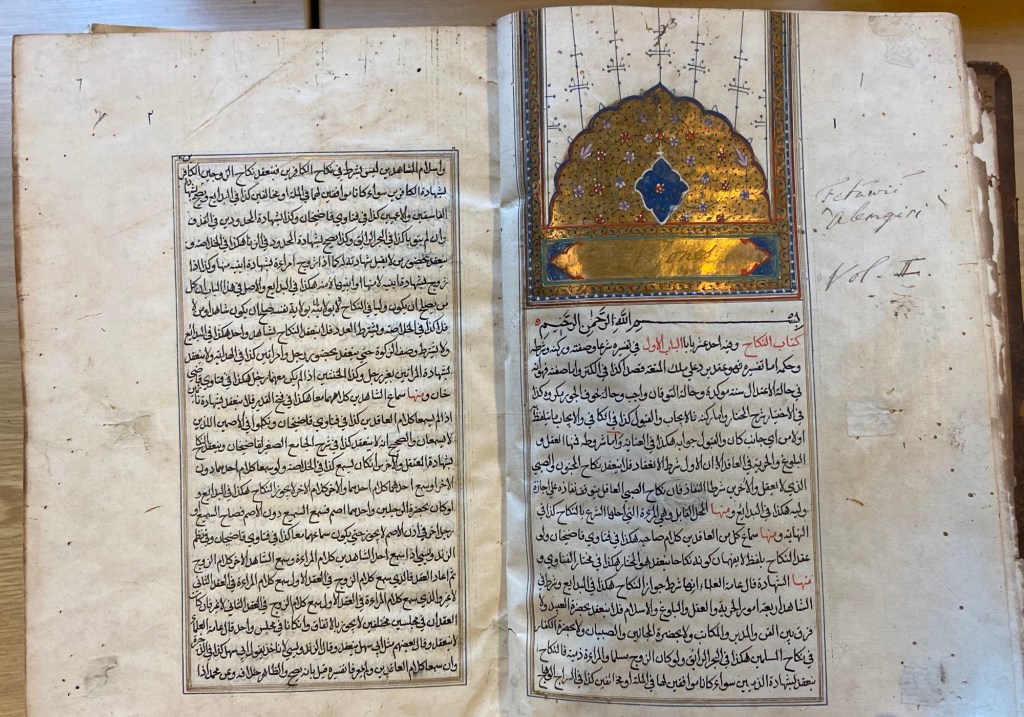
Sir William Jones’ manuscript copy of al-Fatawa al-‘Alamgiriyyah
The reign of the Mughal emperor Aurangzeb ‘Ālamgīr (r. 1658-1707) occupies a singular place in the legal and intellectual history of South Asian Islam. If Akbar came to be remembered for experiments in sovereignty that seemed to place the emperor above the competing claims of jurists, theologians, and Sufi divines, Aurangzeb’s memory became closely tied to an opposite movement: the restoration of a more visibly sharīʿah-minded idiom of kingship, the strengthening of the place of the ‘ulamā’ in the imperial order, and the sponsorship of the monumental Ḥanafī compendium known as the Fatāwá-i ʿĀlamgīrī, or al-Fatāwá al-Hindiyyah.¹ Yet the significance of this text lies not merely in imperial patronage. It lies more fundamentally in the way it crystallized a long Indian engagement with Ḥanafī fiqh, gathered together authoritative rulings dispersed over centuries, and placed juristic discourse in a new relationship with Mughal governance. Properly understood, the Fatāwá-i ʿĀlamgīrī was neither simply an abstract manual of law nor a modern code; it was a vast juristic digest that simultaneously preserved the cumulative structure of Ḥanafī legal reasoning and enhanced the capacity of the Mughal state to govern through a more uniform and authoritative legal language.²
Central to this achievement was the figure of Aurangzeb himself. While Alan M. Guenther rightly cautions against reducing the emperor’s motivations to pure piety or pure expediency, the historical record demonstrates that Aurangzeb was not merely a patron but an active, engaged, and decisive force in the compilation’s creation.³ His role transcended the traditional model of royal sponsorship; he functioned as a sovereign deeply involved in the juristic enterprise, shaping the text’s content, monitoring its progress, and ultimately using it to redefine the relationship between imperial authority and Islamic law.
The Historical and Juristic Precedent
The relationship between temporal power and religious authority has been a persistent tension in Islamic history. From the earliest caliphs, Muslim sovereigns required legal legitimation and practical guidance, while the jurists (fuqahā) sought to preserve the autonomy of the sharīʿah from direct absorption into political power.⁴ This structural tension persisted in South Asia. Some ‘ulamā’ accepted offices as qāżīs or muftīs under royal patronage; others preferred a critical or semi-detached stance toward the state. The evolution of the madhāhib (legal schools), and especially the Ḥanafī school, provided a durable framework for transmitting legal authority across regions and generations. Originating in the teachings of Abū Ḥanīfah (d. 767) and his disciples Abū Yūsuf (d. 798) and Muḥammad al-Shaybānī (d. 805), the Ḥanafī school developed a method giving prominence to reasoned argument and the cumulative authority of prior jurists.⁵ Over time, its rulings were elaborated in commentaries, abridgements, responsa collections, and compendia that became normative for later scholars.
In India, Ḥanafī fiqh arrived already furnished with a mature textual tradition from Transoxiana and the wider Persianate world. Works such as al-Marghīnānī’s Hidāyah (d. 1196) became foundational teaching and reference texts.⁶ However, Indian Muslim scholars did not remain mere consumers of Central Asian and Middle Eastern jurisprudence. They began to produce their own compendia and fatwā collections, selecting from prior authorities in ways that responded to Indian conditions. The Fatāwá-i Ghiyāthiyyah (13th century), the Fatāwá-i Tātār Khānī (14th century), and later Indian juristic works demonstrate that by the Delhi Sultanate and Mughal periods, India had become a productive centre of Ḥanafī legal scholarship in its own right.⁷ The Fatāwá-i ʿĀlamgīrī emerged from this long trajectory. It was not an isolated eruption of Aurangzebian zeal but the culmination of centuries of juristic accumulation, adaptation, and regionalization within the Ḥanafī school.
Legitimacy, Piety, and the Imperative for Codification
The political context of Aurangzeb’s accession is essential to understanding why this compilation assumed such importance. Aurangzeb’s seizure of power in 1658 was shadowed by a crisis of legitimacy. He had deposed his father Shāh Jahān (r. 1628-1658) and defeated his brothers, most notably Dārā Shukoh (d. 1695). The chief qāżī initially refused to recite the khuṭbah (sermon) in his name.⁸ Contemporary scholarship notes that Aurangzeb had to secure the support of scholars such as Shaykh ‘Abd al-Wahhāb (d. 1675) to persuade the chief qāżī of the legality of his accession, demonstrating that his rule depended fundamentally upon religious sanction.⁹ However, Aurangzeb was not content with merely securing a one-time endorsement. He sought to permanently embed his sovereignty within a framework of Islamic law, thereby making his legitimacy self-sustaining. A visibly Islamic mode of rulership carried immense political value, and his appeal to sharīʿah-based governance, including prohibitions of intoxicants, music, dancing, and extravagant pilgrimages to Hindu places of worship, helped present him as a ruler whose authority was aligned with Sunnī orthodoxy rather than the eclectic theological claims associated with his predecessors.¹⁰
Yet, it would be reductive to treat Aurangzeb’s patronage as mere political theater. As Guenther argues, one must not force a simple opposition between piety and expediency.¹¹ What matters historically is that Aurangzeb believed, or consistently acted as though, the strengthening of Ḥanafī jurisprudence was integral to just government. The Mughal historian Khāfi Khān records: “the Emperor gave such extensive powers to the Qāḍis in the civil administration and general and detailed affairs of the state that it become a cause of jealousy and envy of the leading nobles of the Empire.”¹² The commissioning of the Fatāwá-i ʿĀlamgīrī therefore signaled both an ideological preference for orthodox Sunnism and a practical administrative need. Existing Ḥanafī doctrines were dispersed across a large number of texts, often with contradictory opinions and variant levels of authority. For qāżīs and muftīs charged with issuing rulings, this body of literature had become unwieldy. According to tradition, the project was begun relatively early in his reign and completed roughly between 1667 and 1675, absorbing enormous imperial resources.¹³
The Emperor as Editor-in-Chief: Personal Supervision and Scholarly Selection
What distinguishes Aurangzeb’s role from that of typical royal patrons is the depth of his personal involvement. According to the accounts preserved by Shāh Walī Ullāh (d. 1762) through his father, Shāh ‘Abdurraḥīm Ṣāḥib Dehlvi (d. 1719), one of the compilers, Aurangzeb did not merely authorize the compilation and then withdraw. Shaikh Niẓām (d. 1679), the project’s overseer from Burhānpūr, read finished pages to the emperor daily.¹⁴ On one occasion, when Shaikh Niẓām accidentally read a marginal note along with a confusing text, the emperor immediately noted the inconsistency and demanded an explanation, leading to an investigation and ultimately the dismissal of Shāh ‘Abdurraḥīm.¹⁵ This anecdote implies not only a “keen interest” but also a “knowledgeable evaluation of the contents” by Aurangzeb. As Guenther concludes, “One can estimate that such regular scrutiny of the sharīʿah would have had a considerable impact on his own law-making, and motivated an on-going reform rooted in Islamic principles.”¹⁶ The emperor was, in effect, acting as the final editor-in-chief of the entire enterprise.
Aurangzeb’s personal authority extended to the selection and dismissal of the scholars themselves. Historical accounts describe him conducting periodic examinations of the list of all those employed in compiling the fatwās, personally issuing orders for appointments and removals.¹⁷ The composition of the scholarly board reveals a calculated balance between expertise and loyalty. Guenther notes that the collaborators included ‘ulamā’ from diverse regions of Mughal India, Jaunpūr, Awadh, Bihār, Agra, Delhi, Lahore, and even Sindh, under the oversight of Shaykh Niẓām.¹⁸ Some estimates suggest that as many as 500 experts in Islamic jurisprudence were involved, drawn not only from South Asia but also from Iraq and the Hejaz, demonstrating that Aurangzeb sought not merely a regional legal text but a work of pan-Islamic authority.¹⁹ This breadth ensured that the final work could claim to represent the considered judgment of a wide Indo-Ḥanafī scholarly network rather than a local clique.
Crucially, Aurangzeb demonstrated a capacity to prioritize scholarly competence over political enmity. Several of the chief editors, including Shaykh Wajīhud Dīn and Qāz̤ī Muḥammad Ḥusayn, had served under Shāh Jahān and been linked to his rival Dārā Shukoh. Rather than purging them, Aurangzeb recognized that “their scholarship and organizational abilities were more important than their rival political affiliations.”²⁰ This strategic inclusivity suggests a ruler who understood that the authority of the final text depended on the credibility of its authors, not merely their political compliance.
The Magnitude of Patronage and the Imperial Message
The scale of the project testified to Aurangzeb’s commitment in unmistakable terms. The Mughal historian Khāfi Khān recorded that Rs. 200,000 of the imperial coffers were spent on the project.²¹ Such expenditure was not merely administrative necessity; it was a public declaration of priorities. In a culture where rulers competed to be remembered as patrons of learning, Aurangzeb was sending a clear signal regarding his commitment to a sharīʿah-centered governance.
The Fatāwá-i ʿĀlamgīrī, rather than being a collection of primary fatwās (answers to specific questions) as the name might imply, is a comprehensive legal text of Ḥanafī fiqh.²² It cited at least 124 sources, including not only classic transregional authorities but also Indian works such as the Fatāwá-i Ghiyāthiyyah, Fatāwá-i Qarā Khānī, Fatāwá-i Tātār Khānī, and Fatāwá-i Barhāniyyah.²³ In size, it is four times that of the Hidāyah, containing a greater number of cases in each of its sections. The work was organized deliberately to follow the Hidāyah while adding new sections on judicial procedure (muḥāḍir wa al-sijillāt), legal forms (shurūṭ), legal devices (ḥiyal), and inheritance (farāʾiḍ).²⁴ These additions are significant because, unlike the fifty-seven other sections dealing with details of laws regarding religious rites, economic transactions, and land, they appear to deal more with principles of determining and applying the laws.
The project’s completion resulted in a text that, while originally composed in Arabic for scholarly prestige, was soon translated into Persian for practical use across the empire. The Mirāt al-ʿĀlam records that ‘Abd Ullāh Chalpi Rūmī, a scholar from Asia Minor, was appointed along with his pupils to translate the work into Persian.²⁵ The fact that it later circulated in Ottoman and Central Asian domains under the title al-Fatāwá al-Hindiyyah confirms that Aurangzeb’s patronage had successfully inscribed Indian scholarship into the mainstream of Sunnī legal tradition across the Arabic-writing world.²⁶
The Text, Its Juristic Function, and the Question of Codification
In form and content, the Fatāwá-i ʿĀlamgīrī remained thoroughly rooted in the Ḥanafī tradition. Its discussion of the qāżī’s role (in the section Ādāb al-Qāḍī) explicitly acknowledges the limitations of contemporary scholarship, noting that “in our days” no one possesses the qualifications for full ijtihād (independent legal reasoning).²⁷ As Guenther observes, the repeated use of the phrase “in our days” indicates the compilers’ conscious adaptation of legal theory to their context, a pragmatic dynamism within a tradition that outwardly revered the past.²⁸ The text also addresses the order of authorities to be observed in the practice of law: the Qur’ān, then the Ḥadīth, then the consensus (ijmāʿ) of the Prophet’s Companions and the Successors, and finally, where there is disagreement or no ruling, the qāżī (if qualified as a mujtahid) is to give a ruling consistent with established principles of jurisprudence (uṣūl al-fiqh).²⁹
Crucially, the text was not a collection of primary fatwās issued by Aurangzeb, nor a promulgated state code. Rather, it was a systematic work of substantive law (furūʿ), a collection of “secondary fatwās” (in Wael Hallaq’s typology) that had been edited and abstracted to delineate principles of Ḥanafī law.³⁰ Hallaq describes the function of such furūʿ works as providing “jurisconsults with a comprehensive coverage of substantive law … expected to offer solutions for all conceivable cases so that the jurisconsult might draw on the established doctrine of his school, and to include the most recent as well as the oldest cases of law that arose in the school.”³¹ This description aptly applies to the Fatāwá-i ʿĀlamgīrī.
However, as Muhammad Khalid Masud and other scholars have argued, the question of whether the Fatāwá-i ʿĀlamgīrī represented an “official” codification requires careful qualification. Schacht characterized the Hanafi school as having “enjoyed exclusive official recognition in the whole of the Ottoman Empire,” while describing its position in India more cautiously as “well represented.”³² Masud has argued that for a madhhab to be officially recognized, it must become “the exclusive source of legislation in the state, and the judges are required to adhere to it exclusively”, a threshold not met in Mughal India.³³ Yet this distinction is not a diminishment of Aurangzeb’s achievement. The Fatāwá-i ʿĀlamgīrī was neither a modern state code nor a purely private scholarly digest. It was, as some recent scholarship terms it, a “proto-codification”, an intermediate form that engaged the Islamic juristic devices of siyāsa (public policy) and taqnīn (codification) in new ways.³⁴ This intermediate character is precisely what made it so effective: it provided standardization without rigid codification, enhanced the state’s legal capacity without completely displacing juristic mediation.
The Emperor’s Independence from His Own Creation
Paradoxically, Aurangzeb’s active role in the compilation also gave him the authority to depart from it when political necessity demanded. The emperor was not a prisoner of the text he had helped create; rather, the text was an instrument at his disposal. A revealing anecdote illustrates both his legalism and his independence. When captured rebels received a relatively lenient Ḥanafī ruling, Aurangzeb rejected it, remarking that “This decision [is] according to the Hanafi school; decide the case in some other way, that control over the kingdom may not be lost.”³⁵ He explicitly invoked the plurality of legal madhhabs as justification for seeking a different outcome. The qāżī and muftīs returned with a new ruling, still based on the Fatāwá-i ʿĀlamgīrī and therefore still within Ḥanafī fiqh, which decreed execution.³⁶ This incident reveals that Aurangzeb understood Islamic law not as a monolithic, inflexible code but as a tradition containing internal plurality that could be mobilized for reasons of state. The Mughal sovereign governed not by surrendering to the text but by drawing upon it as an authoritative reservoir while retaining ultimate political discretion.
This is further demonstrated by Aurangzeb’s use of other legal sources alongside the Fatāwá-i ʿĀlamgīrī. Guenther shows that the emperor also relied on Ẓawābiṭ-i ʿĀlamgīrī and other qānūn-i ʿurfī or customary law.³⁷ A farmān (directive) issued to Gujarat in 1669/1670 reflects sections of the Fatāwá-i ʿĀlamgīrī on land revenue administration but stipulates rates of taxation in excess of those given in the text and omits clauses bearing no relation to Indian realities.³⁸ Mughal governance under Aurangzeb did not collapse the distinction between fiqh and siyāsa; it managed their relationship. The Fatāwá-i ʿĀlamgīrī strengthened the reach of fiqh within administration without abolishing the ruler’s practical discretion.
The Afterlife of the Text and Its Scholarly Legacy
The enduring importance of the Fatāwá-i ʿĀlamgīrī is confirmed by its reception in subsequent centuries. English translations of portions were made in the mid-nineteenth century by Niel B. E. Baillie (d. 1883), who considered it a pity that the Hidāyah had been adopted instead of the Fatāwá-i ʿĀlamgīrī as the standard authority for the East India Company’s courts of civil justice.³⁹ Baillie argued that the Fatāwá-i ʿĀlamgīrī had the advantage of being compiled in India by the authority of an Indian Muslim ruler.⁴⁰ The work was first translated and published in Urdu in the late nineteenth century by Maulānā Sayyid Amīr ʿAlī of Lucknow (d. 1919).⁴¹ Under British colonial rule, it became a foundation of Anglo-Muhammadan law, particularly in matters such as waqf (religious endowments).⁴²
Modern scholarship has continued to engage with the text. Aziz Ahmad describes the compilation as “the theoretic crystallization of Awrangzīb’s theocratic principles.”⁴³ S. A. A. Rizvi sees in the choice of the ‘ulamā’ a shift from a reformist message to a co-option of their efforts by the state and a focus on fiqh.⁴⁴ More recently, scholars such as Mouez Khalfaoui have examined the text’s methodology and its treatment of non-Muslims, while others have explored its role in the development of Ḥanafī jurisprudence in South Asia.⁴⁵
Conclusion
In the final analysis, the Fatāwá-i ʿĀlamgīrī stands as a monument to Aurangzeb’s distinctive vision of sovereignty, one in which the emperor’s authority was both grounded in and legitimated by active engagement with Islamic jurisprudence. Aurangzeb was not merely a patron who funded scholars and then withdrew; he was personally involved in the daily review of the text, the selection and dismissal of its compilers, and the strategic deployment of its rulings in governance. The text simultaneously preserved the cumulative structure of Ḥanafī legal reasoning, incorporated Indian scholarship into the global Ḥanafī tradition, and enhanced the Mughal state’s capacity to govern through a more uniform legal language.
Seen in the broader sweep of Muslim history, the compilation of the Fatāwá-i ʿĀlamgīrī and what it demonstrates of the relationship between the ‘ulamā’ and the ruler is consistent with the pattern established in the formative period of Islamic law. Yet with the fuller involvement of the ‘ulamā’ both in the scholarly activity of researching the texts of fiqh and in influencing state laws, it is perhaps closer to the ideal relationship desired by the ‘ulamā’ than under the previous Mughal rulers in India.⁴⁶ Under British colonial rule, it became the foundation of Anglo-Muhammadan law, demonstrating that Aurangzeb had not merely commissioned a court manual for immediate administrative use but had helped produce one of the great enduring monuments of Indo-Islamic jurisprudence. The emperor’s role in its creation, as legitimator, supervisor, editor, and ultimate arbiter, remains central to understanding both the text’s content and its lasting historical significance.
Footnotes
¹ On the contrast between Akbar and Aurangzeb, see M. Athar Ali, Mughal India: Studies in Polity, Ideas, Society and Culture (Delhi: Oxford University Press, 2006), 163-195; and S. A. A. Rizvi, Religious and Intellectual History of the Muslims in Akbar’s Reign (New Delhi: Munshiram Manoharlal, 1975). The Fatāwá-i ʿĀlamgīrī is also known as al-Fatāwá al-Hindiyyah in the Arab world, reflecting its reception beyond South Asia.
² Alan M. Guenther, “Hanafī Fiqh in Mughal India: The Fatāwá-i ʿĀlamgīrī,” in India’s Islamic Traditions, 711-1750, ed. Richard M. Eaton (New Delhi: Oxford University Press, 2003), 209-230. For the distinction between juristic digests and modern codes, see Wael B. Hallaq, An Introduction to Islamic Law (Cambridge: Cambridge University Press, 2009), 42-58.
³ Guenther, “Hanafī Fiqh in Mughal India,” 215-218.
⁴ For the classic treatment of this relationship, see Ira M. Lapidus, “The Separation of State and Religion in the Development of Early Islamic Society,” International Journal of Middle East Studies 6, no. 4 (1975): 363-385. Also relevant is Patricia Crone, God’s Rule: Government and Islam (New York: Columbia University Press, 2004), 235-260.
⁵ On the formative period of the Ḥanafī school, see Christopher Melchert, The Formation of the Sunni Schools of Law, 9th-10th Centuries C.E. (Leiden: Brill, 1997), 31-46; and Nurit Tsafrir, The History of an Islamic School of Law: The Early Spread of Hanafism (Cambridge, MA: Harvard University Press, 2004).
⁶ On the Hidāyah and its importance, see J. Duncan M. Derrett, “The Hedaya: A Study of the Reception of Islamic Law in British India,” in Law and Tradition in England and India, ed. J. D. M. Derrett (Bombay: Tripathi, 1967), 126-145.
⁷ Guenther, “Hanafī Fiqh in Mughal India,” 210-212. On the Fatāwá-i Tātār Khānī, see Khaliq Ahmad Nizami, “The Fatāwā-i Tātārkhānī and its Importance,” Islamic Culture 34, no. 4 (1960): 231-242.
⁸ Guenther, “Hanafī Fiqh in Mughal India,” 215.
⁹ Ibid. See also Rizvi, Religious and Intellectual History, 312-318.
¹⁰ On Aurangzeb’s decrees, see J. N. Sarkar, History of Aurangzib, 5 vols. (Calcutta: M. C. Sarkar & Sons, 1912-1924), 3: 125-148.
¹¹ Guenther, “Hanafī Fiqh in Mughal India,” 215-216.
¹² Khāfi Khān, Muntakhab al-Lubāb, cited in Guenther, “Hanafī Fiqh in Mughal India,” 216.
¹³ Guenther, “Hanafī Fiqh in Mughal India,” 217. The dating varies slightly across sources; some place the beginning in 1664 and completion in 1672.
¹⁴ The account is preserved in Shāh Walī Ullāh’s writings. See Guenther, “Hanafī Fiqh in Mughal India,” 218-219.
¹⁵ Ibid., 219.
¹⁶ Ibid.
¹⁷ Guenther, “Hanafī Fiqh in Mughal India,” 219-220.
¹⁸ Ibid., 222-224.
¹⁹ On the composition of the scholarly team, see Saiyid Athar Abbas Rizvi, A Socio-Intellectual History of the Isna ‘Ashari Shi’is in India, 2 vols. (Canberra: Ma’rifat Publishing House, 1986), 2: 145-147.
²⁰ Guenther, “Hanafī Fiqh in Mughal India,” 224.
²¹ Khāfi Khān, cited in Guenther, “Hanafī Fiqh in Mughal India,” 218.
²² Guenther, “Hanafī Fiqh in Mughal India,” 219-221.
²³ Ibid., 220.
²⁴ Ibid.
²⁵ Ibid., 221.
²⁶ On the reception of the Fatāwá al-Hindiyyah in the Ottoman Empire, see Guy Burak, The Second Formation of Islamic Law: The Hanafi School in the Early Modern Ottoman Empire (Cambridge: Cambridge University Press, 2015), 142-148.
²⁷ Guenther, “Hanafī Fiqh in Mughal India,” 225-226.
²⁸ Ibid., 226.
²⁹ Ibid., 226-227.
³⁰ Wael B. Hallaq, “From Fatwās to Furūʿ: Growth and Change in Islamic Substantive Law,” Islamic Law and Society 1, no. 1 (1994): 29-65.
³¹ Hallaq, “From Fatwās to Furūʿ,” 48.
³² Joseph Schacht, An Introduction to Islamic Law (Oxford: Clarendon Press, 1964), 87.
³³ Muhammad Khalid Masud, “The Official Madhhab and the Judicial System in India,” paper presented at the conference “The Madhhab in Islamic History,” Harvard University, 1999, cited in Guenther, “Hanafī Fiqh in Mughal India,” 215n.
³⁴ On the concept of “proto-codification,” see Mouez Khalfaoui, “Al-Fatāwā al-Hindiyya: A Hanafī Legal Compendium from Mughal India,” Journal of Islamic Studies 25, no. 3 (2014): 291-312.
³⁵ Guenther, “Hanafī Fiqh in Mughal India,” 229, citing Khāfi Khān.
³⁶ Ibid.
³⁷ Guenther, “Hanafī Fiqh in Mughal India,” 227-229.
³⁸ Ibid., 228.
³⁹ Niel B. E. Baillie, A Digest of Moohummudan Law, 2 vols. (London: Smith, Elder & Co., 1865-1869), 1: viii-ix.
⁴⁰ Ibid.
⁴¹ Guenther, “Hanafī Fiqh in Mughal India,” 221.
⁴² On the colonial reception of the Fatāwá-i ʿĀlamgīrī, see Scott Alan Kugle, “Framed, Blamed and Renamed: The Recasting of Islamic Jurisprudence in Colonial South Asia,” Modern Asian Studies 35, no. 2 (2001): 257-313.
⁴³ Aziz Ahmad, Studies in Islamic Culture in the Indian Environment (Oxford: Clarendon Press, 1964), 205.
⁴⁴ S. A. A. Rizvi, Shah Wali-Allah and His Times (Canberra: Ma’rifat Publishing House, 1980), 148-152.
⁴⁵ Khalfaoui, “Al-Fatāwā al-Hindiyya,” 291-312; also Ebrahim Moosa, “The Indian Appropriation of Hanafi Fiqh: The Case of the Fatāwā ʿĀlamgīriyya,” Islamic Law and Society 22, no. 3 (2015): 215-245.
⁴⁶ Guenther, “Hanafī Fiqh in Mughal India,” 230.
Syed Ali Nadeem Rezavi


