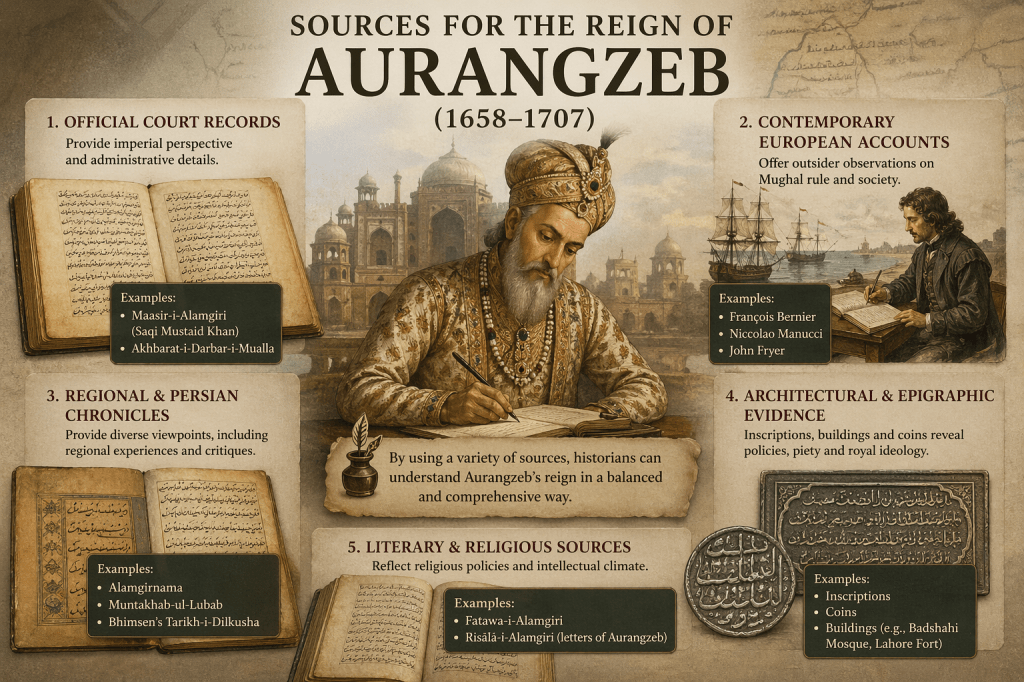
The reign of Mughal Emperor Aurangzeb Alamgir presents a unique paradox for historians. While the emperor himself discontinued the tradition of official court historiography after his tenth regnal year, his period is paradoxically one of the richest in terms of historical source material, both quantitatively and qualitatively. Collectively, the archives in India and abroad contain more records for Aurangzeb’s reign than for all preceding Mughal emperors combined. To understand this crucial epoch, however, one must look beyond the Persian court chronicles to a diverse body of evidence including official histories, private memoirs, epistolary collections, European travel accounts, Maratha bakhars, legal compendia, numismatic and epigraphic remains, and vernacular chronicles from regional courts. Each source carries its own biases, and a balanced reconstruction requires their careful triangulation.
Aurangzeb halted the practice of commissioning a formal imperial history after 1668, and the reasons cited in contemporary speculation are multiple: a desire to suppress his political failures, most notably the execution of his brothers Dara Shukoh and Murad Bakhsh as well as the imprisonment of his father Shahjahan, financial strain resulting from the protracted Deccan campaigns, or his orthodox religious inclinations which viewed the chronicling of royal glory as un-Islamic. Regardless of the motive, this decision means that the only official history of his reign is the Alamgirnama of Muhammad Kazim Shirazi, which covers only the first ten years from 1658 to 1668. As an official work, the Alamgirnama is invaluable for its chronological precision, detailed records of mansab appointments and promotions, and its access to state archives. However, its subjectivity is pronounced. It suppresses embarrassing events such as Shivaji’s sack of Surat in 1664 and avoids any direct reference to famines or food grain scarcity. It also provides a partisan justification for the War of Succession, placing the entire blame on Shahjahan and Dara Shukoh while invoking shariat to legitimise Aurangzeb’s actions. Muhammad Kazim Shirazi, despite being an eyewitness to most events he describes, consistently presents the official version of controversial developments. For instance, the treatment meted out to Dara, Murad, and other supporters is justified on religious grounds, even though other sources reveal that this religious slogan was raised primarily to justify political acts. Nevertheless, the Alamgirnama remains irreplaceable for the period it covers, and later historians have tended to follow its framework for the first decade.
For the War of Succession itself, the Alamgirnama is corroborated by another important source, the Waqi’at-i ‘Alamgiri of Aqil Khan Razi. Aqil Khan was not merely a contemporary but an active participant in the struggle on behalf of Aurangzeb, and his account is extremely rich in detail and accurate in dates. Remarkably, despite being a partisan, he exhibits a degree of objectivity by omitting the religious preamble of the agreement entered into between Aurangzeb and Murad Bakhsh, which had labelled Dara as the rais-i mulahida or chief of heretics. Aqil Khan gives the impression that the war was fought on political and personal considerations, not on religious grounds, thus offering a valuable counterpoint to the later official narrative.
After the Alamgirnama ends, the historian must rely heavily on semi-official and private chronicles. The Ma’asir-i Alamgiri of Saqi Musta’id Khan, compiled soon after Aurangzeb’s death, functions as a gazetteer of the entire reign. It is a vital source for the last forty years, listing promotions, transfers, and the workings of the administrative system. The author’s candid remarks on the character and functioning of officers and nobles are of great value, and his work is based on contemporary state archives and documents. However, Saqi Musta’id Khan was not a great scholar of history; he wrote as a loyal servant of the emperor, presenting Aurangzeb as a devout Muslim ruler who set himself upon establishing the rule of Sharia and humiliating the infidels, namely the Rajputs and Marathas. Unlike other writers, he found no fault in Aurangzeb’s policies and offers little information about society or the economic condition of the people. His approach is that of a court official recording dry facts in strict chronological order without analysis. Yet, despite these shortcomings, the Ma’asir-i Alamgiri is invaluable because no other contemporary or semi-contemporary account exists for the last forty years in such comprehensive form.
In contrast, the Muntakhab ul Lubab of Muhammad Hashim, better known as Khafi Khan, is arguably the most comprehensive and analytical source for the entire reign. Khafi Khan was born in 1664 and served down to the reign of Muhammad Shah, dying around 1731-32. His work is a history of India from its Muslim conquest down to his own time, but the portion dealing with Aurangzeb is of particular importance. He claims, and appears to have been, an eyewitness to most events, and he also consulted other eyewitnesses, checked imperial office records, and drew upon contemporary chronicles including the Alamgirnama and the Ma’asir-i Alamgiri, spending sixteen to seventeen years on its compilation. Khafi Khan was conscious of the duties of a historian, stating that a historian should be faithful, without hope or fear, showing no partiality or enmity. He follows this principle to a great extent: he praises Aurangzeb for his religious zeal and concern for public good, yet he does not conceal his disapproval of the emperor’s attitude towards Shahjahan, Dara, Murad, and others. His account is balanced and reliable. Unlike the Ma’asir-i Alamgiri or the Nuskha-i Dilkusha, which merely mention grants of mansabs and military expeditions, Khafi Khan provides a total picture of the entire reign, showing the interaction of political and economic developments. He gives valuable details about the imperial policy towards the Marathas and Deccani rulers, the condition of the fighting parties during prolonged campaigns, and the influx of Deccani nobles into the Mughal nobility. He also offers comments on the agrarian and economic crisis of the period, the mutual jealousies among princes and nobles, and the effects of these jealousies on the administration. Although Khafi Khan is said to have been a Shi’i and thus possibly prejudiced in favour of Iranis, he does not refrain from criticising them, and he remains a great admirer of Aurangzeb. The Muntakhab ul Lubab is therefore extremely valuable, and no other source contemporary or semi-contemporary approaches it in terms of content, narrative scheme, and analysis.
Another important indigenous source is the Nuskha-i Dilkusha of Bhimsen, a Hindu officer born at Burhanpur in 1648-49 who served under Rao Dalpat Bundela in the Deccan and took part in many wars. After the death of Prince Kambakhsh in 1709, he left imperial service and settled at Burhanpur, where he compiled his work based on personal observations and recollections. His account covers Aurangzeb’s reign from the march from the Deccan in 1658 to the defeat of Prince Kambakhsh in 1709, with a special focus on military transactions in the Deccan. Bhimsen had close contacts with numerous officers and nobles, had travelled widely, and was an actual witness to the state of affairs. His information on appointments, promotions, postings, and transfers is accurate and dated, and his work functions as a kind of gazetteer. After the Alamgirnama, details of this kind are not found in any other source, making the Nuskha-i Dilkusha indispensable for the military and administrative history of the Deccan.
The non-Persian Sources
Beyond these Persian chronicles, a crucial set of sources that is often underutilized consists of the Maratha bakhars. These are chronicles written in Marathi that provide the perspective of the Maratha polities against whom Aurangzeb campaigned for decades. The Sabhasad Bakhar and the Chitnis Bakhar are particularly important, offering an opposing view of Shivaji’s guerrilla warfare, the siege of Jinji, and the execution of Sambhaji. Where the Persian sources portray Maratha leaders as rebels and infidels, the bakhars present them as defenders of Hindavi swarajya (self-rule). Reading these alongside the imperial chronicles allows the historian to escape the one-sided narrative of the Mughal court and to understand the conflict as a clash of competing state-building projects rather than simply a religious war.
The Fatāwa
Another major omission from the standard list of sources is the Fatawa al-Alamgiriyya, also known as the Fatawa-i Hindiyya. This massive compendium of Hanafi law was compiled under Aurangzeb’s patronage by a board of jurists and completed in the 1670s. While it is a legal text rather than a historical chronicle, it is an essential source for understanding the ideological framework of Aurangzeb’s reign. The emperor’s frequent invocation of shariat to justify political actions, from the execution of Dara to the reimposition of jizya in 1679, is given concrete form in this legal digest. The Fatawa reveals what the official interpretation of Islamic law was on matters of state, taxation, treatment of non-Muslims, and the conduct of war. Without consulting this text, any assessment of Aurangzeb’s religiosity or his policies towards the Rajputs and Marathas remains incomplete.
Epistolary and archival sources add another dimension. The letters of Aurangzeb himself, collected in the Kalimat-i Taiyebat and the Raqaim al Karaim, reveal the crisis with which the empire was faced towards the close of his reign, as well as the emperor’s determination to face that crisis. These letters also throw light on his relations with his sons and nobles. In addition, the Factory Records, reports sent by the factors of European trading companies to their home governments, are a mine of raw material for the study of the economic condition of the empire. They provide detailed information on trade and commerce, corrupt practices of Mughal officials, the functioning of mint-houses, rates of interest, the role of banias, and the system of hundis or indigenous bills of exchange. For the study of seventeenth-century trade and commercial activity within the Mughal Empire, these factory records are extremely useful and full of information.
European travellers’ accounts also provide unique perspectives. Niccolao Manucci, an Italian traveller, wrote the Storia do Mogor, which has been translated by William Irvine into four volumes. Although Sir Jadunath Sarkar dismissively called him “gossipy Manucci,” a careful study reveals that this judgement cannot be sustained. Manucci gives the salaries of different mansabdars which tally with the dastur-ul-amals (official rate-books), provides lists of titles given to Hindu and Muslim nobles, and mentions titles given to persons of various professions including scribes, musicians, dancing girls, and elephant-drivers. He also provides important clues for understanding the functioning of the administrative apparatus. While he does include certain scandals regarding the imperial household, these can be easily discarded, and the remainder is highly useful for the study of the second half of the seventeenth century. Another important European traveller is Francois Bernier, a Frenchman who came to India at the close of Shahjahan’s reign in 1656 and joined the service of Dara Shukoh. His account, written in the form of letters to his overlords back home, provides one of the most detailed contemporary analyses of the Mughal Empire. In his letter to Lord Colbert, he elaborates on the causes of Mughal decline, pointing to the agrarian crisis and the transfer system inherent in the mansabdari and jagirdari system. Bernier looked at India through European glasses and dedicated his account to the French emperor, but his observations on the economy and administration remain valuable. He famously called the War of Succession “The Tragedy,” and his letters provide a vivid, if biased, outsider’s view.
Beyond written texts, the historian must also consider non-literary sources. Numismatic evidence, the coins minted during Aurangzeb’s reign, provides important information about the chronology of his rule, the extent of his imperial control, and his ideological declarations. Coins bearing the Kalima or the names of the first four Caliphs reflect his religious orthodoxy, while the mint names indicate which provinces remained under loyal control during the revolts of his later years. Epigraphic evidence, including inscriptions on mosques, wells, bridges, and forts, similarly provides dated records of imperial patronage, military campaigns, and public works. For example, inscriptions recording the construction of mosques in newly conquered territories or the repair of roads in the Deccan offer material confirmation of events described in the chronicles. Likewise, the architectural remains of the period, including Aurangzeb’s own modest tomb at Khuldabad and the Bibi ka Maqbara in Aurangabad (a poor imitation of the Taj Mahal), offer visual sources for understanding the changing aesthetic and ideological priorities of the empire. Finally, regional vernacular chronicles from Rajput courts such as Mewar and Marwar, written in Rajasthani and Braj Bhasha, provide non-Mughal perspectives on state policy, particularly on the reimposition of jizya and the Rajput wars of the 1680s. These chronicles often preserve details of local resistance, diplomatic negotiations, and the lived experience of Mughal rule that are absent from the Persian court narratives.
In conclusion, the sources for Aurangzeb’s reign, despite the lack of a continuous official history, are remarkably abundant and varied. The core Persian corpus of the Alamgirnama, Ma’asir-i Alamgiri, Muntakhab ul Lubab, and Nuskha-i Dilkusha provides the backbone of political and administrative history, but each must be read critically for its particular biases, from official suppression to private analysis. The War of Succession is illuminated by Aqil Khan Razi’s participant account, while the economic and commercial history is richly documented in the Factory Records. European travellers like Manucci and Bernier offer external perspectives, flawed but invaluable. To these traditional sources must be added the Maratha bakhars for the opposing viewpoint, the Fatawa al-Alamgiriyya for the legal-ideological framework, numismatic and epigraphic evidence for material confirmation, vernacular Rajput chronicles for regional perspectives, and architectural remains for visual and aesthetic history. Critically employed and triangulated, this diverse body of evidence allows the historian to reconstruct not just the political and military events of Aurangzeb’s half-century of rule, but the deeper administrative, economic, social, and ideological crises that defined the twilight of the Mughal Empire. No single source tells the whole story, but together they illuminate one of the most consequential and contested reigns in Indian history.
Syed Ali Nadeem Rezavi


