The following writeup is based on a dialogue which I held with Guru Shrivatsa Goswami Ji of Vindravan held in October 2020. It can be accessed on my YouTube channel. The talk, on which this is based, was transcribed by Ms Paridhi Massey.
This is being posted in view of the 500th Anniversary of the establishment of the Mughal rule in India on 21st April 2026.
*
In an era defined by stark dichotomies, sacred versus secular, tolerance versus destruction, spirit versus matter, the voice of a tradition rooted in the Braj region of India offers a radical alternative. To sit in discussion with a figure like Shrivatsa Goswami of Vrindavan is to encounter a theology that refuses these divisions. Yet this theological vision did not develop in a vacuum. It unfolded within the complex political realities of Mughal India, where temples were neither simply patronized nor simply destroyed, but actively negotiated. The history of Vrindavan’s sacred architecture thus becomes a powerful case study: the living temple, born of divine love (prema), was also a political institution shaped by imperial pragmatism.
The Theology of Place
The first pillar of the Goswami philosophy is the re-enchantment of the material world. In the Gaudiya Vaishnava tradition, the world of Vrindavan is non-different from the divine abode of Krishna. The soil, the trees, and the rivers are not metaphors but manifestations of bhakti. To walk through the groves of Vrindavan, as Goswami might describe, is to walk through the living heart of the divine. The highest spiritual truth is not found in renunciation of the world, but in the transformation of one’s relationship to it through the lens of prema, unconditional, selfless love.
Furthermore, this tradition elevates relationship over abstraction. The highest rasa (aesthetic flavor) is madhurya-rasa, the love of the gopis for Krishna, not mundane eroticism, but the soul’s ultimate longing to lose itself in the beloved. The goal is not to dissolve the ego but to purify it so that it may love perfectly.
The Historical Construction of Sacred Geography
What is striking, however, is that this sacred geography was not merely inherited but actively constructed, and relatively late. The very idea of “Braj” as a defined sacred territory emerges clearly only in seventeenth-century Persian sources. The revival of Vrindavan as a pilgrimage landscape was closely tied to Chaitanya Mahaprabhu’s movement in the sixteenth century. And crucially, this movement was characterized by strategic engagement rather than confrontation. Rather than resisting the Indo-Islamic political environment, Chaitanya’s disciples, the Goswamis—sought to work within it, establishing relationships with imperial and regional powers.
The Moment of Synthesis: Govind Dev Temple
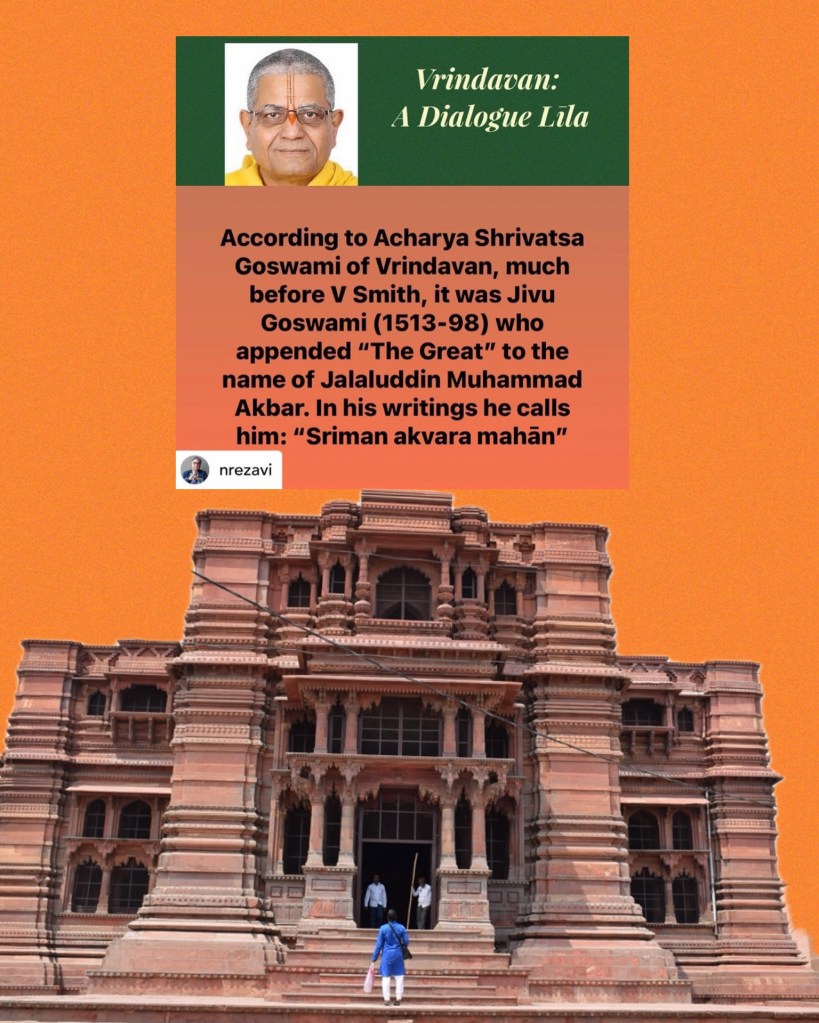
The construction of the Govind Dev temple in the late sixteenth century, under Raja Man Singh of Amber during Akbar’s reign, stands as the most compelling example of this interaction. The temple reflects not only Rajput devotion but also Mughal sanction and support. The use of red sandstone, associated with imperial architecture, and, the involvement of artisans trained in Mughal building traditions suggest a close connection with contemporary projects like Fatehpur Sikri. In this sense, the temple cannot be seen as a purely “Hindu” monument standing apart from Mughal culture; rather, it embodies a shared architectural language.
Its relative restraint in external sculptural ornamentation, unusual for a temple of its scale, represents an aesthetic negotiation with the sensibilities of an Islamic political environment. This was not merely patronage but “dialogue”, different cultural systems interacting to produce something new. The temple was at once a divine dwelling and a political document.
The Pragmatic Empire
This dialogical framework extended to the administrative sphere. Mughal records from Vrindavan contain numerous grants, land assignments, revenue remissions, and protections, issued to temples and religious leaders. Temples were integrated into the imperial order as economic nodes controlling land and pilgrimage traffic. The Mughals treated them not as idols to be smashed for doctrinal purity, but as institutions to be managed for imperial stability. Akbar’s inclusive approach (sulḥ-i kul) gave way to tightening under Shah Jahan and rupture under Aurangzeb, but even destruction was often linked to political control and rebellion rather than simple religious intolerance.
The Fragility of Synthesis
The partial destruction of the Govind Dev temple in the later seventeenth century exemplifies this complexity. While traditionally attributed to Aurangzeb’s religious policy, such actions were likely connected to broader political developments, including tensions with Rajput elites. The same empire that facilitated monumental temple construction could also sanction their destruction under different circumstances. The grandeur of Vrindavan was built not in spite of the Mughals, but in dialogue with them. The eventual destruction was not the inevitable outcome of a “clash of civilizations” but the result of specific political failures.
The Living Dialectic
In conclusion, an amalgamated understanding, drawing from both Shrivatsa Goswami’s theology and Mughal historical records, reveals that sacred space in early modern India was neither purely transcendent nor merely political. It was both. The temples of Vrindavan were living embodiments of divine love, demanding the devotee’s total surrender. Yet they were also material institutions that required land grants, imperial protection, and architectural negotiation with sovereign power.
To reduce this history to a single narrative, of unbroken tolerance or of systematic destruction, is to miss the point entirely. The Mughals were neither secular humanists nor religious fanatics; they were pragmatic sovereigns. And the Goswamis were neither political collaborators nor quietist renunciants; they were strategic architects of a sacred landscape. Their shared history is one of coexistence and contestation, synthesis and rupture. It offers a profound lesson for our own polarized times: that the sacred is always already embedded in the political, that love does not escape power but negotiates with it, and that the truest understanding of the past requires us to hold contradiction together.
Syed Ali Nadeem Rezavi


