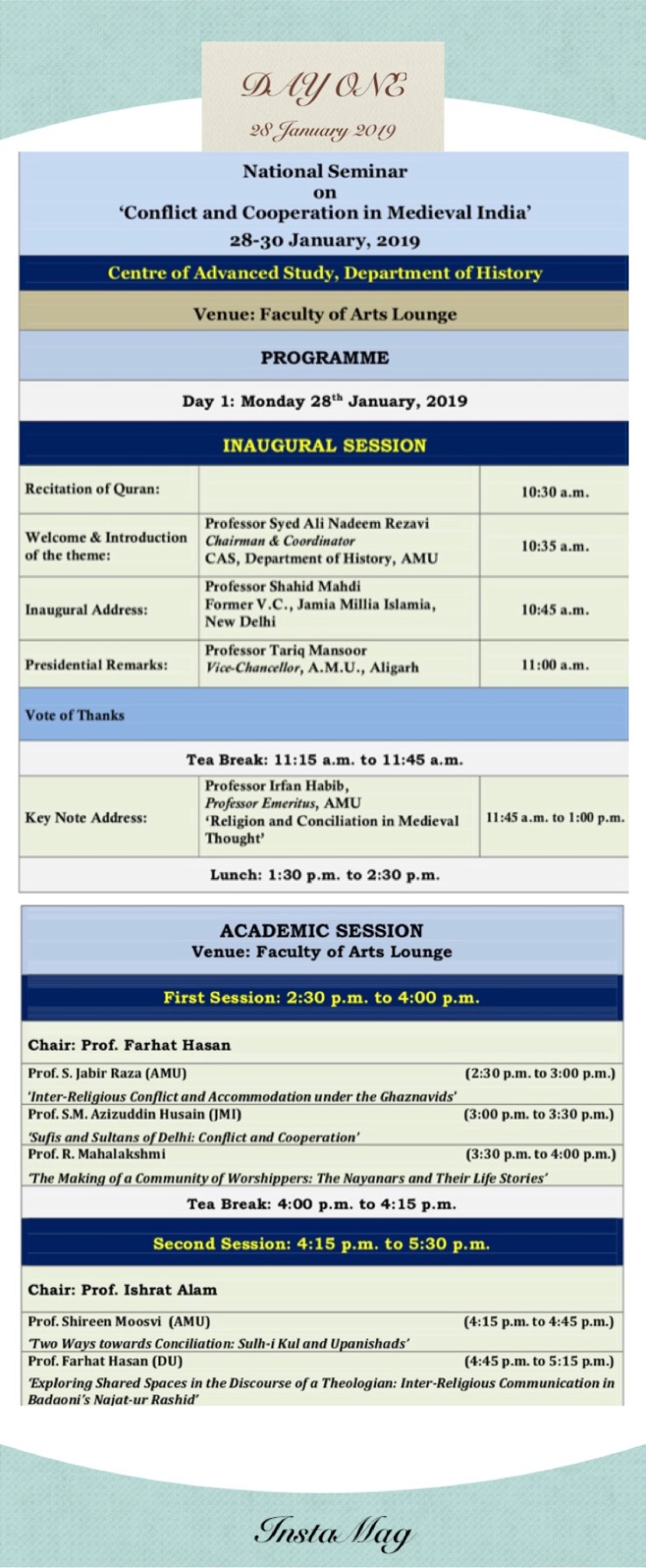
Contemporary and Near Contemporary Sources for Akbar’s Reign

The study of the sources of Akbar’s reign is a topic which has to be tackled in three parts, viz.

• A general Survey of the sources: the broad categories

• Abul Fazl’s approach to the study of history; his world out-look with special reference to Ain-i Akbari

• Basic structure of Badauni and his Muntakhab ut Tawarikh; his world out-look and also the general bias that we find in his historical writings.

General Survey:

The sources are mainly written in Persian language and their total number is very large for this period. It is possible to place the sources we have for the Akbar’s reign under different categories, keeping in mind the world out-look and political loyalties of the authors, their cultural predilections, their social status and also keeping in mind the themes with which their work is primarily concerned.

If we try to work out the characterization of our sources, both primary and some later sources giving primary information of this period, we may get the following seven categories:

1. Official Histories

2. Semi-Official Histories

3. Histories written by theologians (ulema)

4. Insha collections

5. Regional histories

6. Biographical Dictionaries

7. Later sources and histories

There were other sources also – for example the Jesuit Portuguese Fathers writing letters and reports to their superiors in Goa and Lisbon – comprising very interesting sources of information. We also have Traveller’s Accounts, for example that of Finch, who came during the reign of Akbar, or the Ottomon traveller Sidi Ali Reis, whose ship wrecked and he came to Delhi on the eve of Akbar’s accession. The accounts which he left behind for just before and after Akbar’s accession are the only accounts of these political and eventful days.

We also have a very large number of inscriptions and coins of Akbar’s time. Then we have quite a considerable number of original documents of Akbar’s reign which add much to our knowledge on the period under consideration.

Let us start with the Official Histories.

Amongst the official histories we have Akbarnama compiled between 1593-94 – 1597: The last portion of the volume III was completed sometime in 1597. Another important source of this category is the Tarikh-i Alfi compiled in 1582 and completed in 1588.

Then we have the Takmila-i Akbarnama. It is in a way a continuation of the Akbarnama after 1597. But it is an account which is in a different style and a different approach. This was written as a concluding part after the assassination of Abul Fazl in 1602 by Faizi Sirhindi. It covers a period from 1602 to 1604.

Official histories are important as they project the official version of the contemporary events as well as of past developments which naturally tend to be in conformity with the cultural predilections or leanings of the monarch under whose perusal such works are produced. They are actually in the nature of justification of many of the measures taken by a particular ruler.

Therefore it is indeed very useful that in Akbar’s reign we have two official histories written at different times – one is from an early stage during his reign and the other was completed at the end of his reign when he had adopted his policies for which his reign is distinguished. A comparison of the interpretations of the same events in the two works enables us to ascertain as to what the main stages were through which his main outlook was passing through and how they were being perceived. For some events and policies we have one interpretation in the Tarikh-i Alfi, while another is given in the Akbarnama which was completed 10 – 15 years after the former.

Tarikh-i Alfi and Tarikh-i Khandan-i Taimuria:
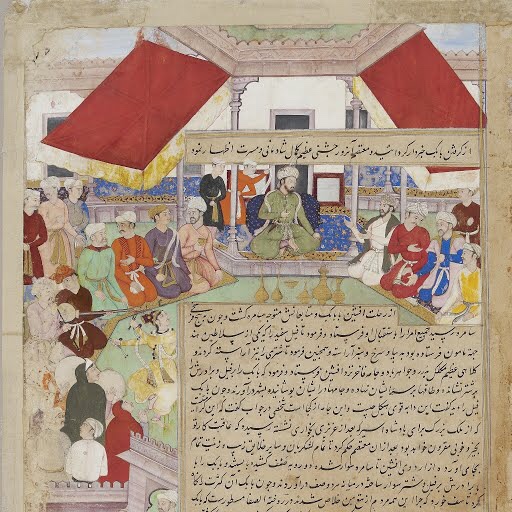
Tarikh-i Alfi, as its name indicates, was conceived by Akbar as a comprehensive history of the first millennium of the Islamic era. It was undertaken towards the close of the millennium and the idea was that in this book the account which began from the dawn of Islam would be brought till the end of 1000 years. The task of compiling this work was entrusted to a team of historians consisting of Mulla Ahmad Thattavi, Asaf Khan and Abdul Qadir Badauni.

The book was planned as the history of the world in which the political developments in the then known world were to be put under individual chapters. But the era used here is not exactly the ‘Islamic’ era. In fact Akbar altered the Islamic era by calculating it not from the hijrat i.e., 622 AD but by calculating it from the date of Rihlat, i.e., Prophet’s demise in 632 AD. The justification that Akbar gave for this change was that, as Abul Fazl says, it is not proper to start the Islamic era from an episode which actually represented the temporary success of forces of evil. Its better to start it from the date of the Prophet’s demise which is a more momentous date. Therefore the years under which individual chapters were organized were rihlat years and not hijrat years.

The chapter would open with developments at the Mughal court of a particular year; it would then abruptly switch to an account of events on the Ottoman empire of the same year before recounting the events that took place in the Safavid court, the Uzbeks and then back to the Deccan for the same year. This was quite an arbitrary approach which squeezed in varied information in one single chapter. Thus this is a narrative of dis-connected events and happenings in different parts of the world.

In fact we do have at our disposal one interesting work providing an insight in the manner in which this book was compiled. This is a work preserved in the Khuda Bakhsh Library at Patna known as Tarikh-i Khandan-i Taimuria. The only copy of this work that has survived contains paintings in large numbers by some of the well-known painters of Akbar’s court which is testimony to the fact that it is a manuscript which was completed at Akbar’s court. Like Tarikh-i Alfi in this book also the account is divided into chapters that commence with rihlat years. But this is only an account of the political history of the Timurids from the time of Timur to that of Akbar in 1576. If one compares the account of the history in this book with the passages on Timurid history in the yearly account in the Tarikh-i Alfi, one will find that this account is exactly the same as given there. This goes to indicate that perhaps Tarikh-i Alfi was initially compiled by its team of authors as separate histories each of which was divided on an yearly basis. And then these accounts were put together to create and constitute a large account represented by Alfi.

Badauni tells us that the Timurid account was compiled mainly by Ghiyasuddin Asaf Khan. Thus we can say that the Khuda Bakhsh manuscript was authored by Ghiyasuddin Asaf Khan.

So far as the nature of this source is concerned, this source included some facts omitted in the Akbarnama. In this official history written in 1582, some information later suppressed in official history is re-produced without any inhibition. This would naturally indicate that by this time Akbar had not yet arrived at a state of mind to suppress some developments of the earlier period that did not present some people close to him in a favourable light.

For example, in Tarikh-i Alfi it is mentioned that at the time of Tardi Beg’s execution in October-November 1556 Bairam Khan had succeeded in securing the co-operation of Akbar’s favourite wet-nurse Maham Anaga through bribery. This fact is missing in the Akbarnama. According to Akbarnama she was against Bairam Khan from the very beginning and organized Bairam’s downfall in 1560.

This indicates the manner in which a tailored history was prepared by Akbar; and which facts Akbar was subsequently trying to hide.

Another similar discrepancy between the two accounts regards the capture of Hemu. In the Akbarnama Abul Fazl devotes a long passage to the famous episode of Hemu’s capture at the Battlefield and his execution at the hands of Bairam Khan after Panipat. Abul Fazl says that when Hemu was brought before Akbar in a wounded state, Akbar refused to raise his own hand towards him and attributes a full speech to the effect that it is not right to attack a man injured. This was to shift the blame on Bairam Khan. Abul Fazl was trying to build a particular image of Akbar which shows him generaus and farsighted.

But in the Tarikh-i Alfi the episode is narrated in total frankness: the speech attributed to Akbar is not quoted here. It is possible that Akbar invented it to Abul Fazl who incorporated it. But what is important to note is that till 1582, Akbar did not had it included and that it is not reproduced in the account written in 1582.

Thus a reading of both the accounts helps us understand how the political image of Akbar and his history was being tailored.

Similarly in the Akbarnama Abul Fazl makes an explicit statement that Akbar had abolished jizya and the Pilgrimage tax in 1562-64. Abul Fazl goes out of his way to explain the significance of this on Akbar’s Rajput Policy. Jizya was not justified and Abul Fazl denounces earlier rulers for imposing it. Now, he says, relief was provided to the non-Muslims.

But then, these two measures are not mentioned in the 1582 text! It is not to suggest that Abul Fazl invented them; perhaps these orders were there but were not enforced in a regular manner and even Akbar did not give much importance to them. He did not regard them as great achievement. But in the subsequent history, attempt was made to give an impression that they were the starting point of Akbar’s religious policy. When subsequently the principles of sulh-i kul were evolved, they were mentioned with great fanfare!

Apart from all this, certain sections of Tarikh-i Alfi relating to Babur and Humayun are important as they were copied by later Mughal histories of Babur and Humayun’s reign.

Semi-Official Histories:

So far as the semi-official histories are concerned, they are histories written by persons in imperial service or one of those who was a noble at Akbar’s court at the time when he wrote his account. These accounts were written by these persons in their individual capacity and not on the order of the king. They were generally written on their own initiative. But at the same time as they identified themselves with the Mughal state and were involved in its working, they tended to give an imperial bias which does not reflect changing situations and policies at the court. Their information tends to justify the role of the authors or that of their immediate superiors and employers.

In this connection one can list the following:

a)Nafais-ul Ma’asir, Alaud Daulah Qazwini (c. 1575)

b)Tarikh-i Akbari, Haji ‘Arif Qandhari (1580’s)

c)Tazkira-i Humayun wa Akbar, Bayazid Bayat (1590)

d)Tabaqat-i Akbari, Nizamuddin Ahmad Bakhshi (1594)

e)Risala-i Asad Beg, Asad Beg (1604)

One thing that is common to all of them is that the authors of these histories were in the service of the Mughal state in one or the other capacity. Some were minor or important nobles. Nizamuddin Ahmad was an imperial bakhshi of the central government. Similarly Alauddaulah Qazwini was the son of a distinguished Persian scholar Khwaja Abdul Latif Qazwini who came in 1555 and had acted as Akbar’s ataliq during the last one year of Humayun’s reign.

But then, Bayazid Bayat was a petty officer who could reach to the position of 200 sawars towards the end of his career as a mansabdar. However, he was close to the royal family and had access to them as a close servant. At the time of writing his account, he was not a regular noble.

Same was the condition of Arif Qandhari who was in the service of Bairam Khan. Later he served Muzaffar Khan. At the time of writing he was still in the service of the same noble.

So far as the Nafais ul Ma’asir is concerned, it comprised two sections, one is the political history of the Mughal rule in Hindustan from the time of Babur’s conquest in 1526 to 1575 – the conquest of Bengal.

The second part comprises of biographical notices of poets etc which are not found anywhere else. Much information contained in the III volume of Badauni on the biographies the contemporaries is drawn from Nafais-ul Ma’asir.

Tazkira-i Humayun wa Akbar is mor a memoir than a regular history. A great significance of this account is that Bayazid’s account of Akbar is focussed mainly on developments taking place in different provinces where Bayazid was staying and posted at different points of time.

In fact Bayazid joined the service of Munim Khan Khan-i Khanan in 1555 and stayed with him at Kabul down to 1560. For this crucial period, Bayazid’s account helps us to understand how the Mughal nobles placed at a long distance to the court were reacting to the tussle that was going on at the court between the regent Bairam Khan and his opponents.

Subsequently Bayazid was made the in-charge of Munim Khan Khan-i Khanan’s jagir at Hisar Firuza where he remained between 1560 and 1567. Again during this period his account is the only account helping us to understand what repercussions’ were created in a provincial town due to the events taking place at the court. For example, when in 1562 Mirza Sharafuddin revolted against Akbar he escaped towards Hisar Firuza and much fighting took place between him and the royal officers in the vicinity of this town where Bayazid was stationed. So there is an account of the manner in which military operations against Sharafuddin were organized.

Subsequently Bayazid stayed with Munim Khan at Jaunpur from 1567 to 1573. Again we find the developments and repercussions at Jaunpur to the eventsat the court as well as preparations at Jaunpur for further expansion towards Bihar & Bengal known to us only as a result of Bayazid’s account at this provincial headquarters.

Bayazid’s account is presented from the Imperial point of view: thus it is a tailored account.

Same is true for Risala-i Asad Beg as it covers a period for which no other history is present. He served Abul Fazl for a number of years and was in his party when Abul Fazl was assassinated. After that in 1602 he was sent by Akbar as his envoy to the Deccan from where he returned sometime before 1604. His Risala contains a detailed account of his activity in the Deccan and the journey to Agra and the presents he brought with him to the court. First mention of tobacco in medieval sources occurs in his Risala and he displayed how it was smoked.

Histories Written by Theologians (Ulema):

General Nature: These histories represent the reactions and assessments of the Muslim religious elite, the social category which was known in the medieval period as ashraf living on madad-i ma’ash or suyurghal grants (revenue free grants for charitable purposes). It is therefore understandable that in these histories the authors seem to be particularly sensitive about Akbar’s measures relating to the management of suyurghal grants and also Akbar’s policies which in any other manner effected the position of the orthodox people. For this reason these sources represent a very important evidence that relates to the religious policy of the Mughal state under Akbar.

The second important feature of these accounts is that all of them suffer from a religious bias and an attempt is made by these authors to interpret political history on doctrinal lines – i.e. their own understanding of the shariat. But at the same time it is also true that in spite of this doctrinal approach, individual interpretations of different authors of this category are at variance with each other as a rule. Therefore it is of great interest for a student of political history that how a particular measure of Akbar is variously assessed by historians and chroniclers, all of whom are writing from an Islamic orthodox point of view.

For example, on the one hand we have Mulla Abdul Qadir Badauni. He in his Muntakhab ut Tawārīkh denounces Akbar as well as most of his close associates as heretics. He also denounces policies and measures of Akbar as aimed at destroying Islamic religion as such.

But on the other hand we have persons like Shaikh Abdul Haq Muhaddith in Tarikh-i Haqqi or his son Nurul Haq Dehlavi in Zubdat ul Tawarikh, wherein we find in spite of an attempt (of ulema) to long for an Islamic age, they have no such harsh assessment as is made by Badauni.

There are a number of important works in this category to be remembered, viz.

Muntakhab ut Tawarikh by Abdul Qadir Badauni completed by him sometime in 1595

Akbarnama compiled by Ilahadad Faizi Sirhindi in 1601

Tarikh-i Haqqi by Abdul Haq in 1605

Zubdat ut Tawarikh by Nurul Haq in 1605

All these are the works compiled by the ulema of Akbar’s period.

Insha Collections:

So far as insha collections are concerned, their number is very large. Here we will mention only the important collections.

Insha Collections are works in which specimen copies of different kinds of documents, including letters written by people belonging to different categories are collected together. These collections were compiled with the aim of presenting collections of the model documents that could serve as instructions to people who sought training as administrators and munshis. Actually when people would write these ‘manuals’, they would take out original letters and copy. So documents which survived, were original documents selected as model documents.

They provide a variety of evidence on political and social history: And are as valuable as information coming from any other contemporary sources.

Insha-i Abul Fazl is available in a number of editions. Abul Fazl’s writings were regarded for long as models of prose writing. They were used in Persian madrasas for purposes of instruction of students. So a number of editions of Abul Fazl’s writings under different titles are available. In these are included letters written on Akbar’s behalf to contemporary rulers of the Deccan, Abdullah Khan Uzbek and the rulers of the Safavid Empire. Some of the letters are written by Abul Fazl on behalf of Akbar and addressed to individual nobles.

Ruqqat-i Abul Fath Gilani published from Lahore is important as it dates back to 1580-81. It is one of the earliest collections left behind by one of Akbar’s noble.

In this collection are included a large number of letters written by Abul Fath Gilani to his contemporaries in which he has made references to the current developments particularly developments taking place in Bihar and Bengal where a revolt by some nobles was going on in 1580-81.

Then we have the Maktubat-i Imam Rabbani – a collection of letters written by the famous Naqshbandi sufi, Shaikh Ahmad Sirhindi, who is also sometimes remembered as the Mujaddid-i Alf-i Sāni – the Lawgiver of the Second Millenium. His Radd-i Rawafiz indicates him as a man of intolerant views of Sunni Muslims, especially the Isna ‘Ashari Shias. Naturally he was greatly provoked by the liberal religious policy followed by Akbar.

In this collection, compiled during the reign of Jahangir, there are available a number of letters that were written by him to some of the leading nobles of Akbar’s court: i.e., Shaikh Farid, Abdur Rahim Khan-i Khanan, Mirza Aziz Koka etc, in which he had pleaded with them that they should use their influence to have Akbar’s policy of separating religion from state be reversed. Shaikh Ahmad wanted this because according to him, it caused, and was causing, great harm to Islam in India.

This collection is very important for the study of Akbar’s Religious Policy that Akbar pursued towards the close of his reign and more particularly for the reaction of the Sunni orthodoxy against Akbar’s policies during this time.

Then we have Munsha’āt-i Namakīn by Abul Qasim Namakin, who was a noble in Akbar’s service and who was stationed for a considerable period in Sind and the Salt Range area of the Punjab. It was during his tenure as the jagirdar in the Salt Range area that he gave a present to Akbar made of salty rock, and as a reward for this, Akbar gave him the title ‘Namakin’, i.e., ‘salty’.

This work was completed sometime between 1595-99. It is in fact a very large collection of official letters and documents which were collected by Abul Qasim during his long tenure as a mansabdar. In this we have separate sets of documents relating to different units of administration: revenue administration, the department of sadarat, fathnamas, etc. In fact the information supplied by these documents is so overwhelming that when it was edited by Prof. I.A. Zilli, it became apparent that unless the administrative history of Akbar’s reign is re-written in the light of these documents, the study would remain incomplete. These documents give a new dimension on the administrative history of Akbar’s reign. They also furnish information on the political aspects of the reign as well.

There is given in this collection a document known as Fathnama-i Chittor, a copy of declaration that Akbar had issued after his victory over the Sisodias at Chittor in 1568. Thus it lays down his policy towards the Rajputs and the drastic measures that he had taken against the Rajputs on this occasion. It talks about establishing Islam in the territories inhabited by non-Muslims. Akbar says that since the beginning of his reign till now, he has waged warfare against kafirs. He takes pride in the fact that he was responsible for the destruction of a large number of townships inhabited by the kafirs. He massacred a lot of kafirs and converted quite a few of them. This is in sharp contrast to Akbar’s policy projected by Abul Fazl in 1597. Akbarnama describes Akbar’s victory in Chittor, but all the religious bias in this original document is missing. Thus this document helps us to understand Akbar’s attitude at this time towards the Rajputs and his role at Chittor in 1568 itself, and how it is different from his own image he is seeking to project in the official history written subsequently. Thus we can say that definite change has taken place in his personal religious approach as well as his attitude towards the Hindus and the Rajputs.

Regional Histories:

They are available mainly for the history of Gujarat, Sind, Deccan and Kashmir. These histories, as it is seen, are histories focussed on political and administrative developments taking place in different regions from the time these regions were controlled by independent kingdoms down to the end of Akbar’s reign when these regions were integrated into a new imperial system which evolved under Akbar. Therefore, these sources are very important in so far as they highlight the circumstances that led to the annexation of the individual regions to the Mughal Empire and also highlight the settlements that were made in these regions after the conquest which accounted for the diverse administrative forms that are sometimes discernible in the different Mughal subahs.

The important histories of this category are as follows:

1. Tarikh-i Gujarat compiled by Abu Turab Wali sometime before 1597 and which covers the history of the Gujarat region from 1526, i.e., from the coming of Bahadur Shah to the throne, down to the final suppression of the revolt of the Gujarat nobles against Akbar in 1584. So this book covers a very important period of the history of the struggle between the Mughal Imperial Authority and the local ruling dynasty of Gujarat which finally culminated in the absorption of Gujarat in the Mughal Empire.

2. Tarikh-i Ma’sumi or Tarikh-i Sindh written by Masum Bhakkari in 1606-07. This is a local history of Sindh giving account of the Arghun ruling dynasty of Sindh from very early time down to the time of annexation of Sindh to the Mughal Empire under Akbar. Masum Bhakkari at the time of writing was serving as a minor mansabdar of the Mughal Empire who belonged to an old family of Sindh nobility.

3. Tarikh-i Firishta. This is important from the point of view that it is a general history which is a near contemporary source for us. We are concerned here only with that part of it in which histories of various regional kingdoms including those of Gujarat, Malwa, Sindh, Kashmir, Bengal and Bahmani kingdoms are given from beginning of the 15th Century down to the annexation of some of these to the Mughal Empire under Akbar. It was only the Bahmani kingdom which stayed out of the Mughal Empire.

4. Then we have Mirat-i Sikandari by Sikandar bin Manjhu, compiled in 1611;

5. The Baharistan-i Shahi of Kashmir compiled in 1614;

6. The Mirat-i Ahmadi, another history of Gujarat compiled by Ali Muhammad Khan in 1761.

All these are later works but focus on the period when these territories were annexed.

Tazkiras:

They are biographical notices of the Ulema and the Mashaikh, and occasionally, of poets. Then we have a number of instances of tazkiras covering the biographies of the people in the fighting profession or holding positions as nobles. For example, the second part of Nafais ul Ma’asir compiled by Ala ud Daulah Qazwini in 1575, which is a tazkira of the nobles under the garb of the tazkira of poets.

Amongst the tazkiras of ulema and mashaikh which also contain biographical notices of nobles may be included:

1. Muzakkar-i Ahbab (1562) containing biographical notices on a number of persons serving in the Mughal Empire under Akbar, compiled at Samarqand. Incidentally it contains biographies of some of those who migrated to Hindustan in 1562 or after, and a number of poets, scholars and other persons and groups of intelligentsia who are not known otherwise.

2. Akhbar ul Akhyar compiled by Abdul Haq Muhaddis Dehlavi contains biographical notices of ulema and mashaikh.

3. Another such tazkira is ‘Arafat ul ‘Ashiqin written by Taqi Auhadi.

4. Then we have the Zakhirat al Khawanin written by Shaikh Farid Bhakkari in 1652-53. It is important as it is entirely a biography of nobles who were serving Akbar. We get access to detailed information about Akbar’s nobility which we get nowhere else. It was however written much later.

5. Ma’asir ul Umara was compiled in 1742-47 by Shahnawaz Khan. This also contains original information. However, it had a particular bias – its author was a staunch Shia, while Farid Bhakkari was a staunch Sunni. Thus both these works had their own particular bias. However, Shahnawaz Khan borrowed extensively from the earlier work.

6. Tazkirat ul Umara was compiled in 1728 by Kewal Ram. This is important because, even for the earlier period, information about the non-Muslim nobles is quite detailed which is not found in other tazkiras.

Other Later Sources:

Source like Tarikh-i Firishta was compiled in the Deccan in 1606-07. It provides information not only about the Mughal Empire, but also about the Delhi Sultans of earlier centuries as well, which is not found in earlier sources. Its introduction quotes a large number of sources not available now to us. So, much information is derived from authentic contemporary sources to which we now have no access. Lastly, Firishta is the first account where an attempt is made to interpret early history of the 16th Century and Mughal Empire, in terms of the controversies, for example, the Shia-Sunni controversy, and the differences being the basic reason for the rise of factional struggle during the regency.

Ma’asir-i Rahimi was written by ‘Abdul Baqi Nahawandi sometime in 1614-16. This deals with Abdur Rahim Khan-i Khanan – it is a sort of an apology for the role played by Bairam Khan and Abdur Rahim himself earlier. So it is in bias, and favour of, two nobles who served Akbar in high positions.

Iqbalnama-i Jahangiri compiled in 1620 is very important because it is an attempt made in the reign of Jahangir to elaborate the political history in such a way that it can be used as auseful guide and help to interpret the verbose statements made by Abul Fazl in the Akbarnama. It also adds information in addition to that of Abul Fazl.

Even the Tuzuk-i Jahangiri when referring about the last few years of Akbar’s reign, provides us information. It also contains an assessment of Akbar’s policies and measures.

Lastly we have the Dabistan-i Mazahib compiled sometimes towards the mid-17th Century by an anonymous author, most probably a Zoroastrian (Parsi). This book is conceived as an encyclopaedia of different religions practiced in Hindustan and for the study of the political and institutional history of Akbar’s reign: It covers what is described by the author as the so-called Din-i Ilahi, the concept of religious tolerance introduced by Akbar. It also gives a detailed summary of discussions which had taken place in the Ibadatkhana in 1575. Resume of discussions reproduce mainly relate to those acrimonious exchanges which took place between Sunni Ulema and the Jesuits, between Shi’i and Sunni ulema and also with the Hindus. It seems that this section is based on some authentic record of discussions. This is borne out by the great resemblance between it and that of the summary of the discussions given by Badauni in volume II of his Muntakhab.

For details on Badauni click here Muntakhab

Copyright: Syed Ali Nadeem Rezavi

THE PLAN AND LAYOUT OF FATHPUR SIKRI

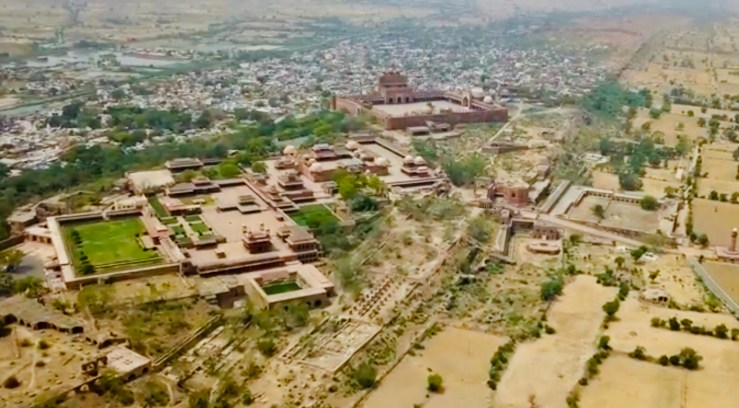
In the previous blog we saw what were the inspirations and sources for urban design. Now let us turn to the actual plan of the capital city of Akbar, initial orders to build which were given in 1571. In order to do so, we will be analysing a number of primary sources of the period.

Describing the plan of Fathpur Sikri, Abul Fazl writes:

A stone masonry fort (sangīn qila`) was erected and two stone-carved elephants at its gate inspired astonishment. Several noble buildings (kākh-hā) also arose in completion, and although the royal palace (daulatkhāna-i Shāhi) and the residences of many of the nobles are upon the summit of the hill (bar farāz-i koh), the plains (dasht wa sahra) likewise are studded with numerous mansions (manzil-ha) and gardens. By the command of His Majesty, a masjid, a madrasa and a khānqāh were also built upon the hill, the like of which few travellers can name. Adjacent to the town (piwast-i Shahr) is a reservoir (golābi), 12 kuroh in circumference, and on its embankments, His Majesty constructed a spacious courtyard (suffa) (lit. platform), mīnār and a chaugāngāh, where elephant fights are organized. In its vicinity is a quarry of red sandstone (sang-i surkh) whence columns and slabs of any dimensions can be excavated…. Under His Majesty’s patronage, carpets and fine stuffs are woven and numerous handicraftsmen have full occupation.

Arif Qandhari also points out that when in 1571 orders were issued to begin building Fathpur Sikri, the Emperor ordered:

… it (the shahr) is to have a two three kuroh circumference on the face of the earth and for houses (khāna-ha) to be built on the top of the hill and that they should lay out orchards (basātīn) and gardens (bāghāt) at its periphery and centre …. Trees were planted in the environs which had formerly been the habitat of rabbits and jackals, the mosques, markets (bāzār-ha), baths (hammāmāt), caravan sarais (kārwān sarā-ha) and other fine buildings (biqa`) were constructed in the city (shahr).

Arif Qandhari further writes that in 1576-77 the architects and engineers were ordered to:

…draw the picture (sūrat) of the city consisting of a wide rampart (sur) the circumference of whose wall is Akbarshāhi zira` (cubits)…. and the height of the wall from the foundation (bunyād) to the top of the battlements (shuraf) would be approximately thirty gaz. On the sides there are wide gateways (darvāz-ha). It is hoped that very soon it will be completed.

Fr. Monserrate, who visited the court of Akbar in 1580, also gives a very detailed account of the city. Describing the city, he writes:

It is placed on a spur of the mountain range which in former times was called, I believe, Vindius, [Vindhyas] and which stretches westward for a hundred miles towards Azmiris [Ajmer]. This site is rocky and not very beautiful, near to an old town which for this reason is called Purana Siquiris, [Purāni Sikri] (for Purana means ‘old’ in the vernacular and Siquiris is the name of the place). In the past nine years the city has been marvelously extended and beautified, at the expense of the royal treasury and the great nobles and courtiers, who eagerly follow the king’s example and wishes. The most noteworthy features of Fattepurum are, firstly, the king’s audience chamber, which is of huge size and very beautiful in appearance, overlooking the whole city: secondly, a great building supported on arches around which is a very spacious courtyard: thirdly, the circus where elephants fight, gladiatorial displays take place, and a game is played, on horseback, with wooden ball which is hit by hammers also of wood: fourthly, the baths, fifthly the bazar, which is more than half a mile long, and is filled with an astonishing quantity of every description of merchandise, and with countless people, who are always standing there in dense crowds.

Father Monserrate goes on to say:

… the citadel is two miles in circumference embellished with towers at very frequent intervals, though it has only four gates. The Agarena [Agra] Gate is to the East, the Azimirina [Ajmeri Gate] to the west, that of the Circus [Hathipol] to the north, and that of the Daulpurum [Dholpur Gate] to the south. The most striking of these is the Circus gate….

From these passages it becomes clear that (a) most of the Imperial structures and the houses of the influential sections of the nobility were on the top of the ridge;

(b) the civic population inhabited the areas below the ridge, where were also be located the gardens;

(c) the vicinity of the lake was adorned with pleasure resorts;

(d) there was a brisk commercial activity in the township;

(e) the town was oriented towards the lake where was situated the main gateway to the official area; and

(f) the whole town, along with its civic population, was placed within fortified walls.

Walls & Gates:

The fortification wall of Fathpur Sikri is provided with eight gateways to the city (see Plan II) starting from the west, the Ajmeri Darwaza, Tehra Darwaza, Dholpur/Gwalior Darwaza, Chandra Pol, Birbal/Bir Pol, Agra Darwaza, Lal Darwaza and the Dehli Darwaza.

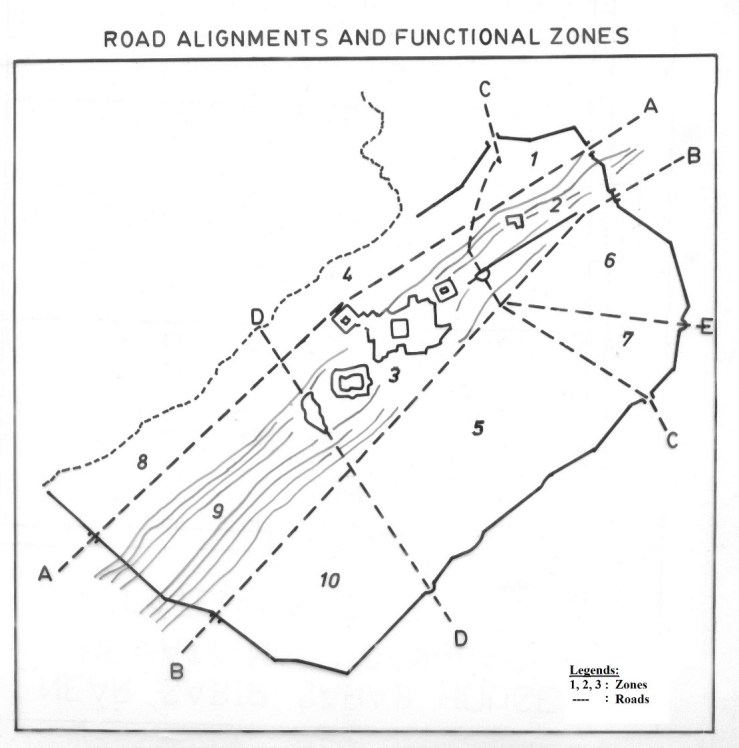
Plan II

Constructed as gate-houses, they comprise an arched opening surround by porticos, guard rooms on the ground floor. Two external flights of steps, one on each side of the complex lead to galleries and rectangular chambers with centralized windows on the top. The arched openings are covered with low domed vaults. The Chandra Pol facing the east and Bir Pol facing south east appear to be less monumental in form than the other gates. The Ajmeri Darwaza, apart from being the grandest, appears to be unique in that the spaces above its arches are filled with rosettes inscribed with “Allah” in a beautiful hand. Each of the gate-house was flanked with a guard room which was situated to the left of the roads passing out of these gates.

As in the case of the Central Asian cities, where the walls encompassed not only the madīna or shahristān (the town proper with the palace), but the rabāt (the suburbs) as well , the city wall and gates of Fathpur Sikri contained within them not only the imperial quarters, and nobles’ houses but also habitation of the common population comprising merchants, traders, professionals and others. This would suggest a fairly close relationship between the political authority and the commercial classes.

Roads & Streets:

If one looks at the Plan II it would appear that the whole town was intersected by two horizontal roads, one (AA) running between Ajmeri Darwaza to the north-west and the Lal Darwaza to the north-east, and a second (BB) connecting Terha Darwaza, to the south-west, with Agra Darwaza in the south-east of the Palace. A branch of Road B branched off from the Agra Gate itself and went straight to the eastern opening of the Diwān-i Ām. Another two roads cut the township vertically. The Dehli Darwaza in the north-east was connected with Chandra Pol through road CC., while the Indarawali area towards the lake was joined with Gwalior Darwaza through DD. Another road (E) led from Birpol and joined BB just before the market area.

These roads were planned on a grid pattern and laid out with stone pieces dressed to wedge shape and set in mortar with their thinner ends projecting downwards. This setting allowed a smooth surface and gave stability and strength to the road. During the excavations it was found that the thickness or packing of the road varied between 5 cm to 50 cm. The main arterial roads (for example B: the road from Agra Gate to the Eastern gate of Diwan-i Am) were 15.40 m wide, with a packing thickness of between 34 and 50 cm.

There were a number of secondary roads which emanated from these arterial roads, which were approximately 3.6 m in width.

Excavations revealed four roads, each with secondary lanes, emanating at right angles from road ‘B’. One such road (Road CC in our Plan II.5) connected it with the Dehli Darwaza. It was constructed with rubble bound by thick lime mortar. A path near the eastern gate of the Diwan-i Am branched off from the main road and led to the structures constructed towards the south. This subsidiary road was 3.5 m wide with a 5.6 cm thick packing. Some portions of Roads ‘AA’ and ‘BB’ too, have survived. The stretch of Road ‘AA’ which survives (near the Indāra Ghāti) and a portion of Road DD (behind Indārāwāli Bāoli, portion on the spurs of the ridge) were located during our surveys conducted in March 1996 and July 1997. The surviving portion of Road AA is 4.36 m. and that of Road DD, 3.60 m in width.

Zones & Districts:

These intersecting roads divide the whole town into ten quarters, of which the central (Zone 3 of Plan II) was reserved for the Imperial establishments and bureaucratic offices. The area between roads AA, BB’ and CC (i.e. Zone 2 of the Plan II.5) was reserved for the higher nobility, while Zone 5 (between Roads, BB, DD & CC) was given to the ‘new’ township of Fathpur. The modern city of Fatehpur is also situated in the same zone.

In the open spaces towards the ramparts were located numerous gardens. Part of the old village of Sikri-Nagar, with its 13th-14th century monuments, was confined to Zone 1 (formed by roads CC & AA). Nagar, with its interesting Khalji mosques, lies outside the city walls, to the north of Zone 1. The Hiran Mīnar encircled with kārwān sarāis, Chaughan gāh, maidān etc. was located in Zone 4 (situated between the lake, and roads AA, DD & CC). Zone 8 (between roads AA & DD) and Zone 10 (between BB & DD) were mostly given to gardens and pleasure pavilions. Some residential structures were also located in Zone 8. Incidentally it was from this zone, the PGW and the associated wares, including the Sunga and Kushana artifacts were located.

Zone 9 can be divided into two districts, one on the top of the ridge, where a number of residential structures, hammāms, etc., are located, and the other, the Indāra Ghāti, where rows of gardens, pleasure pavilions and step-wells were situated. This area requires much closer attention than it has received so far.

The Īdgāh was placed to the west of the zone, outside the city walls. Zones 6 & 7 appear to have formed a single unit. The area, although devoid of standing structures, appears to have been reserved for the garrison, which might also have occupied certain quarters in zones 9 and 10 as well. Thus we see that the whole township was divided into eight functional zones by the interesting roads passing through its eight gates. These, probably, were further sub-divided into various districts by the subsidiary lanes and bye-lanes.

Grid Layout

The maxi grid of Petruccioli (based on that of Satish Davar) also divides the city into eight ‘squares’ .

The Maxi-Grid

This grid, as has been mentioned, is however based on gaz-i ilāhi, a unit of measurement which was introduced a year after Akbar had left Fathpur. (At the time Fathpur Sikri was built the gaz in use was the modified gaz-i sikandari. Before 1586-87, the gaz-i sikandari had a length of 30.36″.The gaz-i ilāhi on the other hand was 32.1 inches or 81.53 cm ).

In spite of this serious lapse, the middle vertical and the upper horizontal external segments of the modular grid traced by Petruccioli, intersect at the point where hiran minar is situated, which thus becomes the starting point for the maxi grid. This is logical. We have already seen that the hiran minar is not only located at the main entry point of the palace complex, but axially aligned with it.

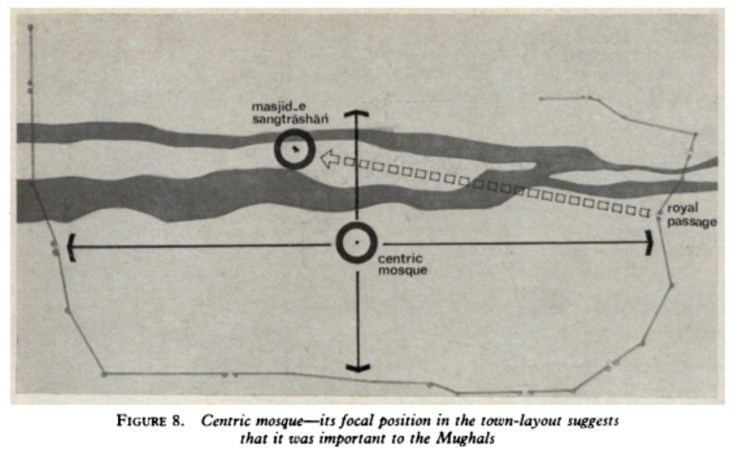
On the other hand, to Satish Davar the focal point of the town (and the grid) lay at a small mosque situated near the city market in the east. This small mosque, which Davar calls “Centric Mosque”, along with the Masjid Sangtarashan behind Akbar’s Jami Masjid acted as the focal position of the plan.

The ‘Centric Mosque’ & the ‘Cross

shaped’ Bazar

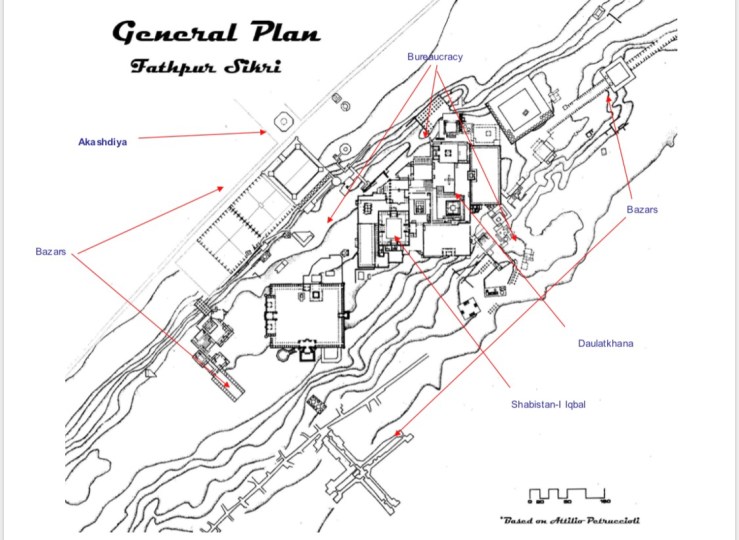
In accordance with the Mughal tradition of placement of functional zones around the Imperial court, exemplified by the standard plan of the Mughal Encampment explained by Abul Fazl, the Imperial palaces at Fathpur Sikri were surrounded by the various offices and bureaucratic establishments. The area adjoining the Imperial structures in the east, north and west appears to have been allotted for the buyutat/karkhanas or workshops. A few structures towards the south of the palace also reveal remains of a few structures identifiable as ‘offices’ or bureaucratic establishments (See Plan III).

Plan III

Bazars & Markets:

As in the case of other Central Asian towns (for example Balkh), the markets and shopping complexes at Fathpur Sikri were located between the Shahristān (the town proper with the palace and the bureaucratic establishments) and the rabāt (the suburbs comprising the houses of the general masses).

Our survey of Fathpur Sikri revealed five Akbari markets and at last four sarais which appear to have catered to the needs of the merchants visiting the markets. As in the case of London till the 18th century , the main shopping complex and commercial area at Fathpur Sikri was situated at a distance to the east within the city walls. In both the cities, the industrial area and artisans’ dwellings were located at the farthest point away from the Imperial quarters: the bulk of this area, in fact, was situated outside the city walls. At Fathpur Sikri, the areas of indigo cultivation, leather works, meat sellers etc. were situated either close to the city wall or outside of it. Our survey of a structure excavated by the ASI near the Dehli Darwaza revealed that it was an ironsmith’s cottage comprising two rooms and a masonry furnace.

Residential Areas:

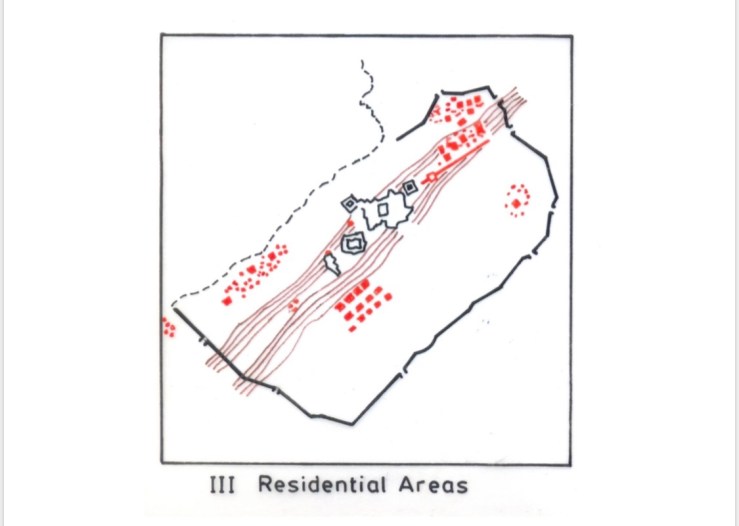
Residential structures could not but be near the markets. There are at least two residential neighbourhoods within the town mentioned by our sources and one outside its walls. The first one of these is the ‘area of Salim Chishti’ also known as Shaikhpura or Nayabad, located behind the Jami’ Masjid and the other, the neighbourhood of Khwaja-i Jahan. The first was the area where the house and the old khānqāh of the Shaikh as well as other houses of the Chishti family and the Islam Khan Chowk were located. The second residential neighbourhood was that of ‘Khwāja-i Jahān’ where Mulla Abdul Qadir Badauni used to live.

Outside the city walls was the neighbourhood inhabited by the prostitutes known as Shaitānpura (the Neighbourhood of Vice). We also hear of Khairpura, Dharampura and the Jogipura situated outside the city limits. But whether these were exclusive colonies / ghettos catering to the Shaikhs, Hindu poor and the mendicants or just structures to ‘feed’ the poor as Badauni alleges we do not know .

We have the testimony of Abul Fazl that the residences of the Akbari nobles were situated on the summit of the hill, while the other residential structures were situated below it in the plains.

Following the excavations by the Archaeological Survey of India and the team from the Centre of Advanced Study in History, Aligarh, it was found that a large number of noble’s structures were constructed on the northern ridge, between the so-called “Tansen Baradari” (near the Dak Bungalow of Lord Curzon) and the sarāi near the Agra Darwaza (Zone 2 in Plan II). The discovery of a marble tablet (sijdagāh) used by Shi`ites while praying, in one of the excavated structures in this area, suggests that this area was possibly inhabited by members of the Iranian nobility.

The second area where the nobility (according to Athar Abbas Rizvi, the Rajputs) had their residences was the Indārāwāli Ghāti (the Indārā Ghāti) area (Zone 8 and Zone 9 — section below the ridge, Plan II.5), situated between the ridge and the lake. The area, although now taken up by cultivated fields, is marked by a large number of gardens and a number of ruined structures. A massive mound, known popularly as ‘Matiya Mahal’, revealed during the course of our survey (July 1997), a massive complex comprising at least three courtyards with foundations of rooms all around them. Nothing more can be said regarding this structure until a detailed study is made possible by cleaning up the mound. It is located to the north-west of a large well known as the Indāra kuān, (from where an inscription of Babur has been taken) and south of the bank of the lake. A little to its south-west is another set of ruins known as the “Kalān Mahal”, comprising a residential structure and a hammām: the name is most probably a corruption of the term kalān mahal which stands for ‘great palace’.

The area also revealed extensive ruins of other houses, gardens, tanks and baths. Kale Khan, a local venerable guide and poet, testifies to the presence of a “Naumahla”, a multi-storeyed structure which was pulled down by his father in the early decades of this century. No trace of it is now extant. The area has spread over its surface a rich amount of painted blue China pottery sherds of very fine and medium fabric which give proof of the presence here of the richer strata of Mughal society.

The third area where the nobles had their houses was on top of the southern ridge (Zone 9) at some distance behind the Shaikh Ibrahim Mosque in the Nayabad Quarters. During one of our (July 1997) Surveys, the author encountered the ruins of residential structures and a hammām at a place where the modern cremation ground is located. A massive square tank (very similar to the Anup Talao in the daulatkhāna) with chambers all around it, is also located in this area. Unfortunately, the area is badly mutilated by stone-mining activity which is taking place in spite of an official ban imposed on it. A small narrow opening in the fortifications (Chor Khirki) towards this side connects this area with the old Mughal cemetery and Idgah outside the city walls. The Idgah and the cemetery have recently become the victim of illegal quarrying, and have been practically completely blasted away.

A fair number of Mughal residential structures (in ruins) and mosques still survive in the village of Sikri (Zone 1 and the district on the lower spurs of the ridge in Zone 2) and Fatehpur town (Zone 4). A large number of Vaishnavite, Shaivite and Jain idols, including those of the tīrthankaras of the 17th century, some of them now adorning the stone platforms in Sikri, have been located and discovered at Fatehpur, Nagar and Sikri, confirming the presence a sizeable non-Muslim population. Apart from the Khalji mosques, one trabeate street gate and extensive ruins of Akbari residential structures are encountered on the main road of Sikri. This and other areas are yet to be intensively explored.

Areas containing separately the votaries of vice and virtue, viz., the Shaitānpura (the district of prostitutes), the Jogipura (the settlements of jogis and pundits) and Shaikhpura (the quarters of the mullas) were all put outside the city limits.

Describing the “red-light” area outside the city limits, Badauni tells us that the Emperor appointed a number of bureaucratic officers and clerks in this “quarter”:

…so that any one who wished to associate with these people, or take them to his house, provided he first had his name and condition written down,might with the connivance of the imperial officers have connection with any of them that he pleased. But he did not permit any man to take dancing-girls to his house at night, without conforming to these conditions, in order that might keep the matter under proper control. But if any one wished to have a virgin, if the petitioner was a well-known courtier, he sent a petition by the Deputy, and obtained permission from Court.

Badauni further informs that a number of nobles including Raja Birbal who were caught breaking the code were reprimanded.

Pleasure Pavilions, Gardens & Water Supply:

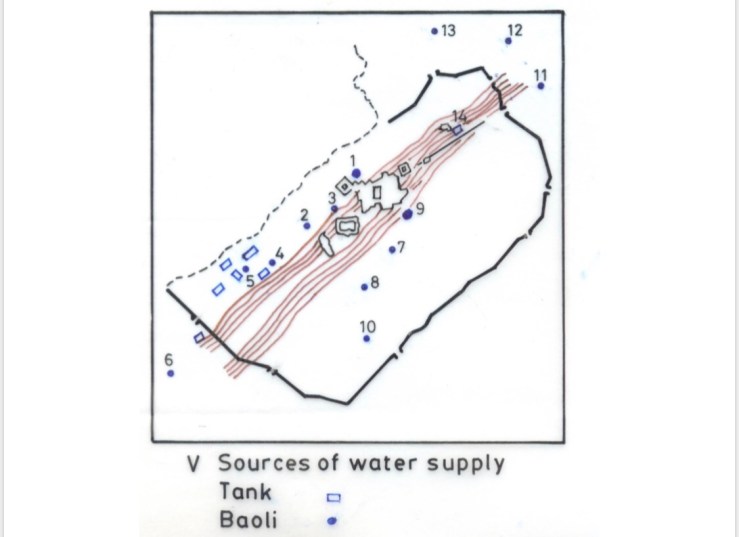
The area around the periphery of the town as well as the banks of the lake was given over to pleasure pavilions, open fields and gardens. Within the township our surveys revealed at least 14 gardens apart from the three gardens in the palace complex and in a number of individual house structures. The demand for potable and irrigation water was taken care of by a number of baolis (step wells), tanks and wells dispersed all over the town.

Thus we see that the plan of Fathpur Sikri accords fairly well with that of the Imperial encampment described by Abul Fazl. It also duly takes into account the contours of the site: the main mosque and the Imperial palaces and offices were put on the ridge where water-supply was secured through lifting it by wheels from the lake, and having it carried by aqueducts.

In the plains on both sides where the lake and wells could directly give access to water, the civil population had its quarters assigned, the nobility and the lower strata being well separated. The planned construction of shops on long avenues (see infra), built obviously at Imperial expenditure, and then presumably leased out to private shop-keepers is a very notable feature of the planned city; as is the construction of the caravan sarais, built again under Imperial aegis, to accommodate merchants and travellers. Not only was Fathpur Sikri, then, well planned; there was also a considerable investment of imperial resources in it, to ensure that it fulfilled its proper functions as an Imperial town of a new Empire.

Copyright Syed Ali Nadeem Rezavi

Extracts from Fathpur Sikri Revisited (OUP) 2013

https://global.oup.com/academic/product/fatehpur-sikri-revisited-9780198084037?cc=us&lang=en&

Theories and Sources of Mughal Urban Design with Reference to Fathpur Sikri

MODELS AND THEORIES OF URBAN DESIGN:

The study of planning and building a city during the seventeen century, and the sources and determinants of its urban designs has perhaps yet to receive adequate attention.

The students of urban planning have put forward a number of ‘models’ of planning. Traditionally three models, namely

(a) the European,

(b) the ‘Islamic’ and

(c) the ‘Hindu’

All these three have been put forward as alternative models.

On a closer analysis of these, it appears that there is hardly any difference between them — in all the three, the central place is given to the palace or citadel and the place of worship.

The Shilpa-śāstra (especially the vāstu puruśa mandala) on the other hand categorise the town models on the basis of their physical pattern. Thus according to this categorisation there were towns which were either

(a) Circular,

(b) Crescent or half-moon,

(c) Cross,

(d) Square, or

(e) rectangular.

In each of these ‘models’ as well, the citadel along with the public buildings and the main place of worship is placed at the centre with roads from all sides leading to them. Attention was concentrated on the citadel which was the seat of power. All around it was the fortification; the rest of the city was generally left defenceless and unfortified.

In the recent years, yet another theory of urban design has been put forward for Mughals. Basing himself on the description of the genesis, organization, and decline of the ‘patrimonial’ states formulated by Max Weber , Stephen Blake distinguishes between the European capital cities and the sovereign cities of the Asian Empires, and goes on to show how Shāhjahānabād, the Mughal city of Delhi evolved and developed as a city of the latter type.

The Asian empires, according to him were “patrimonial -bureaucratic empires”, the controlling metaphor of which was the patriarchal family and the “central element” was the imperial household.

According to this thesis, the capital was an enormously extended household. At the macro-level, it was a miniature version of the kingdom. The palace-fortress stood for the city, and the mansions of great nobles for the provinces, districts and other subdivisions of the state. The various mansions, mosques, shops and gardens in the city were elaborations and copies of the buildings of the palace complex. In other words, the capital city in the “Asian Empires” was nothing but the extension of the Imperial household where everyone was bound by personal ties with the emperor who presided over the city — and the whole kingdom — as a father over his sons. The markets, the production relations, the cultural life and every thing else including the process of consumption were all dominated by the great households.

What this in effect meant was what was offered in the Weberian argument that the non-western cities did not generate the same degree of urban autonomy as may be found in the West. These non-Western cities neither achieved significant measures of municipal self-government, nor produced city dwellers conscious of themselves as a distinct class or social group.

Does this model of the city in “Asian Empire” apply to Fathpur Sikri?

Our surveys in fact go out to reject this Weberian thesis. Although having a strong centralizing basis, Fathpur Sikri appears to be no different than London of the pre-Industrial Revolution era as far as the placements of its functional elements are concerned. Its colossal hydraulic works for water-supply, the efficient well-planned roads, streets and bye-lanes and the presence of a large number of monumental gardens, sarāis and well defined suburbs, point to the desire of the Mughal architects to not only redesign the urban landscape but also to provide for public services. The fact that the Mughal towns, including the Imperial cities were flourishing centres of commerce and crafts is not only attested to by the archaeological remains or deductions based on comparisons with European and colonial cities, the contemporary sources and authorities also help to underline this fact. Fathpur Sikri even after it ceased to be an Imperial town survived as an important commercial centre.

Depending on its size, a town in Mughal India was classified as (a) balda or shahr, and (b) qasba. While the qasba was a township, the shahr/balda was a big city.

Whether a balda or a qasba, a typical medieval city had a number of features common to all urban settlements. Containing a civic population which was largely non-agricultural, the city was surrounded by an outer wall (fasīl) and/or a deep trench.

For Western Europe we know that the term ‘town’ or ‘burg’ appear to have been derived originally from names for large areas enclosed by fortifications which served as places of “refuge during wars.” Robert Lopez, thus symbolized the notion of the city as “the cross” or “cross roads” within the “walls”.

This notion suggests a combination of protected social space and intercommunication between those coming from different directions to the crossroads of urban life. Now if we look at the different “Asiatic” cities and Imperial towns we find that almost all these towns were either protected by a fortification or a deep trench encompassing the inhabited areas. Dealing with Trans Oxiana and surrounding regions, Barthold mentions the walls with a number of gates encompassing the towns and suburbs in Balkh, Bukhara and Samarqand.

In the Mughal cities, the towns were usually protected by thick walls with battlements, string-courses and towers. Lahore, Ahmadābād, Broach, Baroda, Cambay, Sūrat, Shāhjahānābād and Fathpur Sikri were all walled cities. Ajmer, Multan, and Koil (modern Aligarh) are examples of cities which had both walls and a deep trench encircling them. Agra and Ujjain on the other hand were towns with no city walls. Agra was protected only with a deep trench. It was only during the 18th century that walls were constructed around these cities.

SOURCES AND INSPIRATIONS OF URBAN DESIGN:

The Mughal emperors being often on the move, the traditional plan of the Mughal Encampment appears to have been the principal inspiration for the Mughals, when they built their towns. Being one of the first organized towns to develop, Fathpur Sikri appears to have drawn on the various principles used in setting up of such camp cities. Even the vocabulary applied by the Persian sources to describe the permanent stone structures is often the same as was used for the temporary portable dwellings. The public audience hall (now called Dīwān-i Ām) is sometimes referred to as bārgāh-i Ām (the large audience tent), the sleeping or retiring room (khwābgāh) of the emperor as khilvat kada-i khās (the tent of privacy), the haram (female quarters) as Sarāpardā, Sarāpardā-i ismat (the screened-in area of Chastity), Shabistān-i daulat (the Imperial bed-chamber or haram) or Shabistān-i Iqbāl, (The Bed-Chamber of Good Fortune or haram), such being the names also of different categories of tents.

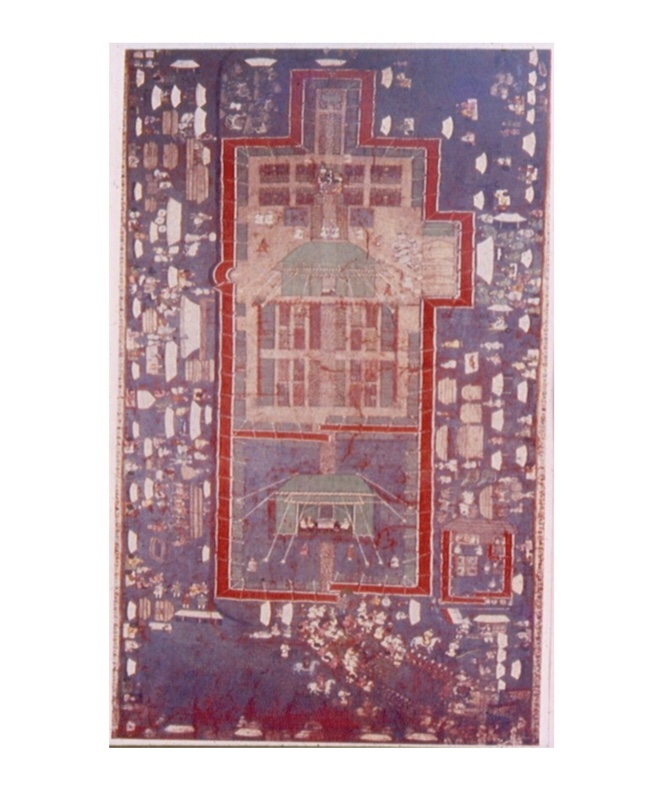
Explaining the plan of a Mughal Imperial encampment, Abul Fazl writes:

They pitch the Shabistān-i iqbāl [the haramsarā], the daulatkhāna [the Imperial palace or quarters] and the Naqqārkhāna [the drum house] all within a distance of 1530 gaz (yards). To the right and left of these, and behind them, an open space of 300 yards is reserved for guards. Within the principal enclosure, at a distance of 100 yards from the centre, are pitched the tents of Maryam Makāni (Akbar’s mother), Gulbadan Begum (Akbar’s sister), other chaste ladies, and the tents of Prince Daniyal; to the right, those of Prince Sultan Salim; and to the left, those of Prince Shah Murad. Behind the tents, at some distance, the buyūtāt [kārkhānās or workshops] are placed; and at a further distance of 30 yards behind them, at the four corners of the camp, the bazars (the markets). The nobles encamped on all sides, according to their rank, outside the complex reserved for the Imperial use.

According to this scheme the central area was reserved for Imperial use, flanked by the princes’ area which was surrounded by that of the nobility. Beyond this zone, on the sides were the service areas. The markets were situated at the corners. Secondly, there was a hierarchical progression from the public to the private areas.

Satish Davar was the first to point out that, irrespective of the topography, the Mughals tended to reproduce the same scheme as that of the Encampment in their permanent palace-complexes so as to make a veritable stone encampment. Athar Abbas Rizvi also assumed that there was a similarity between the layout of the Mughal camp and the plan of Fathpur Sikri. It was on the basis of this assumption that he tried to look for the Prince’s quarters and noble’s houses in the areas outside and around the main palace.

If we compare the structure composing the Imperial camp as explained by Abu’l Fazl, a number of parallels can be drawn. While on the move, the Emperor would stay in a portable double-storied pavilion (kākh-i du Āshiyāna) within the eastern corner of a cloth-covered wooden screen known as Gulālbār. Adjoining the du-āshiyāna, within the same enclosure (sarāpardah) was a chobīn rāvati, a wooden structure. The jharokha was provided in the du-āshiyāna, which was also the pavilion where the king would perform his prayers, and the nobility performed kūrnish (bowing) before him.

Between the area of daulatkhāna-i khās (the Emperor’s personal encampment) and the women’s quarters was left an open area known as māhtābi, in the middle of which was a platform (suffa) which was protected by a namgīrah (awnings) supported by four poles. This is where the Emperor would sit during the evenings.

Within the sarāparda-i ismat or the women’s enclosure were raised 24 wooden rāvatis, adjoining which was yet another enclosure, 60 gaz square, meant for Urdubēgis or armed women guards and other female servants.

Another enclosure comprised the bārgāh or the court which had 72 rooms and two openings. Outside the enclosures of shabistān-i iqbāl (women’s enclosure), the bārgāh and daulatkhāna (Imperial quarters) was placed an enclosure used as dīwānkhāna-i khās beyond which stood the Ākāshdiya (lamp bearing pole).

Interestingly at Fathpur Sikri, within the enclosure of the daulatkhāna, to the east is the double storied building which must be the khwābgāh in which the Emperor slept and offered jharokha darshan (morning public appearance). Within the same enclosure, at a little distance from this khwābgāh, is a structure comprising a chamber raised on a platform, which has been explained as Ābdārkhāna (Water Stores). Between the haramsara and daulatkhāna area is constructed a four-platformed structure surmounted with a chhatri (cupola) raised on four pillars, the so-called ‘Panch Mahal’. The affinity between this stone structure and its placement vis-a-vis the suffa or platform of the camp is too close to escape attention. Like the sarāparda-i ismat or Shabistān-i iqbāl, the haram sara area at Fathpur Sikri had a rectangular enclosure beyond the main buildings, which was probably meant for the female guards.

Although Abu’l Fazl does not mention it, it appears that in the Timurid tradition the Imperial camps were aligned on a north-south axis. Secondly, in the Mongol tradition there was a left-right hierarchy with southward orientation —the west being on the right-hand side, so that the king could be seated facing south. Both these axes are found at Fathpur Sikri. Sitting on the jharokha window, Akbar faced the south with his daulatkhāna behind to the north. Further north was the Naqqārkhāna and the Ākāsh diya, the Hiran Minār. To his right (the west) was the Tomb of Salim Chishti, the Jami‘Masjid and the Ibādatkhāna.

Alina Macneal, holding the view that Fathpur Sikri was based on the Timurid plan of encampment, however opines that at Fathpur Sikri due to the topography of the site, the camp’s single north-south axis was broken into two constituents: the axis of progression from public to private and the axis of royal appearance. The axis of progression was laid out from north-east to north-west, aligning Dīwān-i Ām, daulatkhāna and haramsara. The main ceremonial access to the Emperor’s sight was obtained by an opening from Hāthipol to Khwābgāh, on a north-south axis. Further, like a Mughal encampment, the language of the palace at Fathpur was one of pavilion and enclosure. Large spaces alternated with stone pavilions.

As in an Encampment, we find that the palace was surrounded by rings of bureaucratic establishments, nobles’ houses and habitations of the common people. The markets were constructed in a linear fashion along the sides.

Another possible source of its design appears to have been the Mughal-garden, the Chahārbāgh. According to Petruccioli, the centripetal symmetry of the chahārbāgh could be an inspiration for the Mughal urban design. The axes, joints and nodules of a garden were turned architecturally into pavilions, the chabutaras, waterfalls, pools, kārwān sarāis and symmetrical roads. Thus it was the modular grid which became a systematic design instrument. The town was divided into various distinct divisions revolving around a localized central structure on the one hand, and aligned symmetrically with the main centre, on the other.

Bāgh i Fath

For the individual structures and buildings, the inspiration came from a number of traditions. By the time Fathpur Sikri began to be constructed, the traditions of Rajput and Gujarat architecture had already been incorporated in the buildings of the pre-Mughal Muslim rulers of India. At Fathpur Sikri the dominant influence appears to be that of the Timurid and Gujarati Sultanate Architecture. In a number of structures at Fathpur Sikri the central vaults over the chambers are masked by a flat roof. This may at one level be a combination of the structurally arcuate (the ‘Saracen’ or Delhi Sultanate style) with the visibly trabeate (recalling the attractive Gujarat Sultanate style). We have this example in the Khwābgāh, the Emperor’s seat in the Diwān-i Ām, the ‘Daftarkhāna’, the ‘Tansen bārādari’, ‘Todarmal’s bārādari, ‘Hādā Mahal’, ‘Qūshkhāna’ and the city gateways. The vaults consisting of four large intersecting ribs, which create a central vaulted area, four squinches and four rectangular fields are mostly found in the hammāms.

The most typical example is that of the so-called ‘Hakim’s Baths’ (the Imperial hammām). Central Asian features are also encountered in the other hammāms, kārwānsarāis and pavilions on top of palace buildings where Timurid masonry vaults form the ceilings. The Rang Mahal and complexes around it (Petruccioli’s Badi‘ Mahal), the four-storied pavilion erroneously known as ‘Panch Mahal’, and the ‘Hawa Mahal’ adjoining the haramsara are all based on the Iranian and Timurid post-and-beam porches.

In Iran such structures were known as tālār and in Trans Oxiana as Aiwān. The Trabeate construction of these structures is marked by a strong sense of weight and measure. The sense of heaviness encountered in the construction of the palace of Mahmud Begra at Sarkhej and the Nagina Mahal at Khimlassa Fort (15th C. A.D) is overcome here. Geometrical precision appears to be the hall-mark of Akbari structures.

In the so-called ‘Birbal’s palace, the Buland Darwaza, and the Hathipol, arcuate and trabeate styles have been followed in equal proportions. Echoes of wooden architecture are also encountered — the ceilings of the hujra-i Anūptalāo (Turkish Sultana’s house) and the Chahārkhāna (“Ānkhmichauli”), the pillars of the Rang Mahal and the so-called Badi‘ Mahal all remind us of wooden structures.

Extracts from

https://global.oup.com/academic/product/fatehpur-sikri-revisited-9780198084037?cc=us&lang=en&

Copyright: Syed Ali Nadeem Rezavi

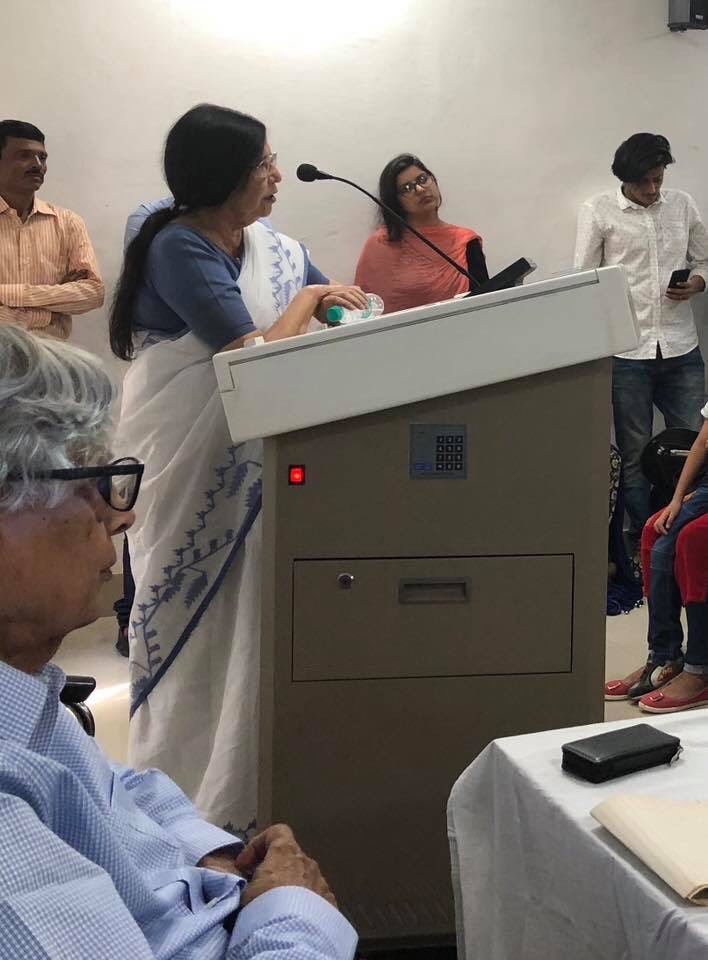
The Academic Activities and Programmes of  the CAS Department of History between March 2018 and March 2019

Carrying forward from the previous session when we were able to hold two Seminars, one International and the other national, apart from Symposiums and Workshops as well as producing Six books ( of which two were important primary sources), the academic activities and programmes of  the CAS Department of History between March 2018 and March 2019 have been as follows:

1) The Centre organised two National Seminars: 

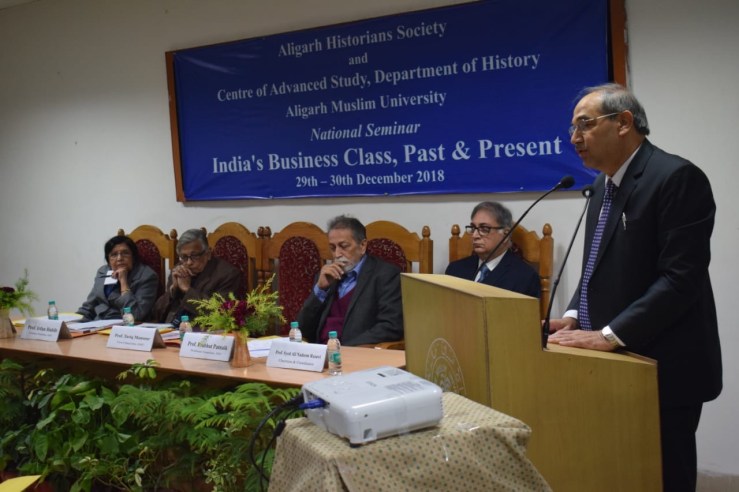
   (a) Indian Business Class Past and Present 

[In Collaboration with Aligarh Historians Society]

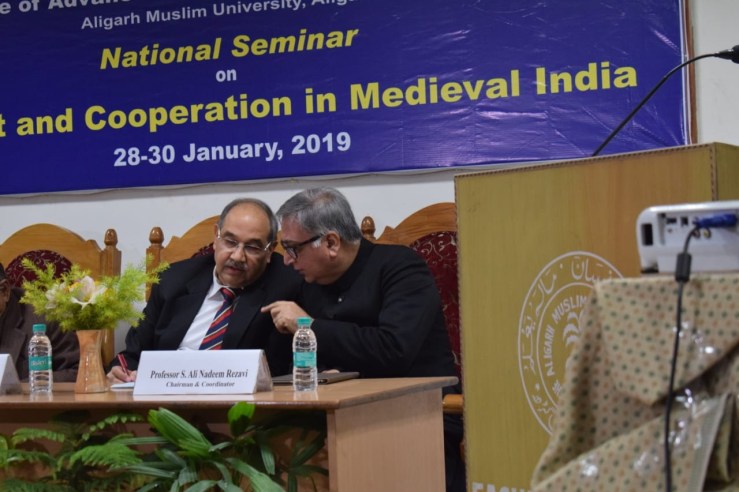
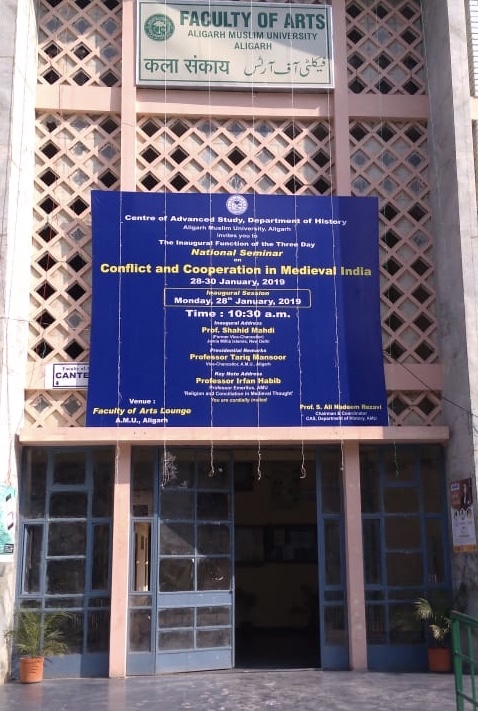
   (b) Conflict and Cooperation in Medieval         India 

2) Two Symposiums, viz

    (a) Our Heritage at Risk: The Problem of Managing our National Monuments

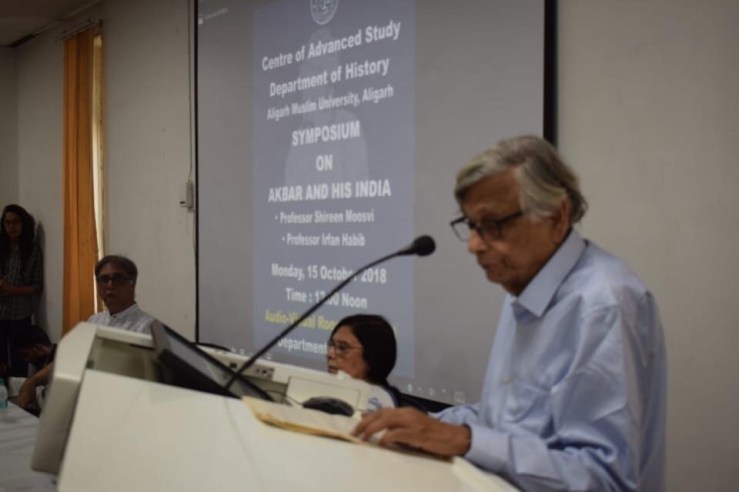
    (b) Akbar and His India 

3) We also tried to organise a Workshop for the students of Aligarh Colleges. We invited 20 students each from DS College, Tika Ram Girls College and Sri Varshney College. Unfortunately at the last minute they all declined to come to AMU and their Principals gave various excuses 

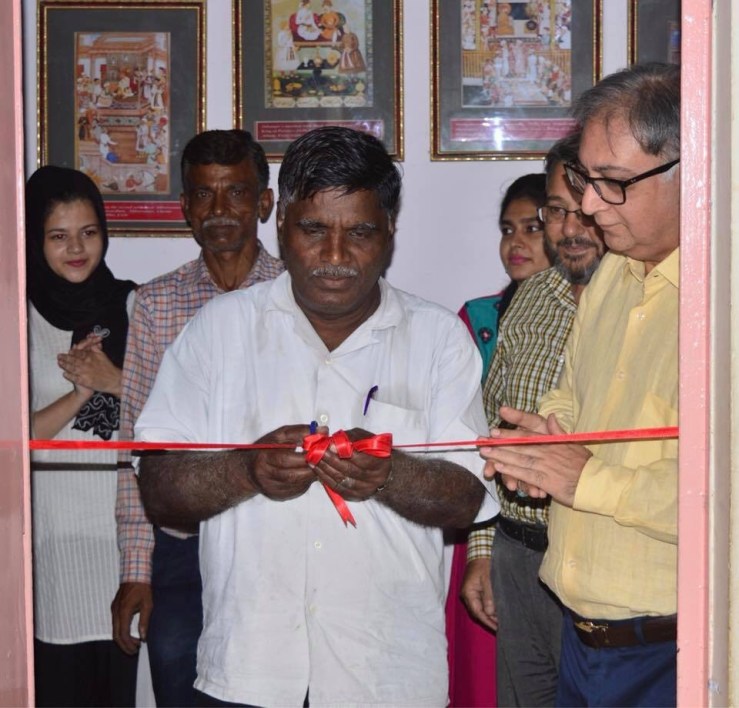
4) The Centre also commemorated Gandhiji on his Jayanti and organised an Exhibition and a Symposium on Commemorating the Mahatma: Relevance of Gandhi in Today’s India’ in which scholars like Irfan Habib were invited to deliver lectures.

True to the spirit of Gandhiji’s teachings the Exhibition was inaugurated by our Safai karamchari, Mr Suresh.

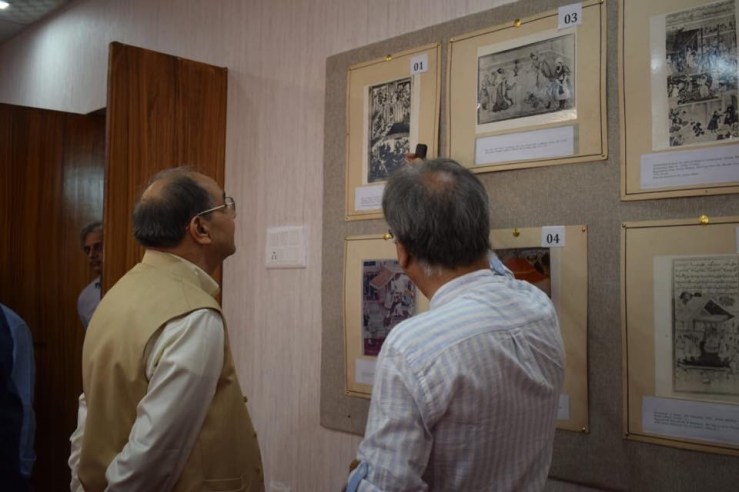
5) A two and a half month long Exhibition on Akbar and His India was held by the Centre at the Musa Dakri Museum (17 October to 31 December 2018)

6) Weekly Seminars of the Sultania Historical Society were held in which PG students, Research Scholars and Faculty members delivered lectures and presented papers

7) Publications:

This academic year also saw a number of publications by the Centre:

   (a) Two issues of the Bulletin of the Sultania Historical Society were published and printed. We were also able to get an ISBN number for the last issue. One of these issues is devoted to the theme of Myth and History, and the other to Aurangzeb. 

   (b) Two Monographs:

        i) Iqtidar Alam Khan, Exploring Archaeological Remains From Medieval Times.       

        ii)Zahoor Ali Khan, Studies in Indian Historical Geography.

   (c) Reprints:

    (i) Journal of the Aligarh Historian Research Institute, Vol.1, No.1. 

   (ii) Journal of the Aligarh Historian Research Institute, Vol.1, No.2-3.

8 ) Digitisation of Resources: We have digitised all our photographs of various sites excavated and / or explored. We also have digitised a number of rotographs and transcripts held by our library 

9) A number of Visiting Fellows were called and they delivered lectures. Thus we had Professor Najaf Haidar, Professor Farhat Hasan and Dr Audrey Truchke. Dr Truchke delivered two lectures. She was interviewed by the Sultania Historical Society editors for its bulletin. 

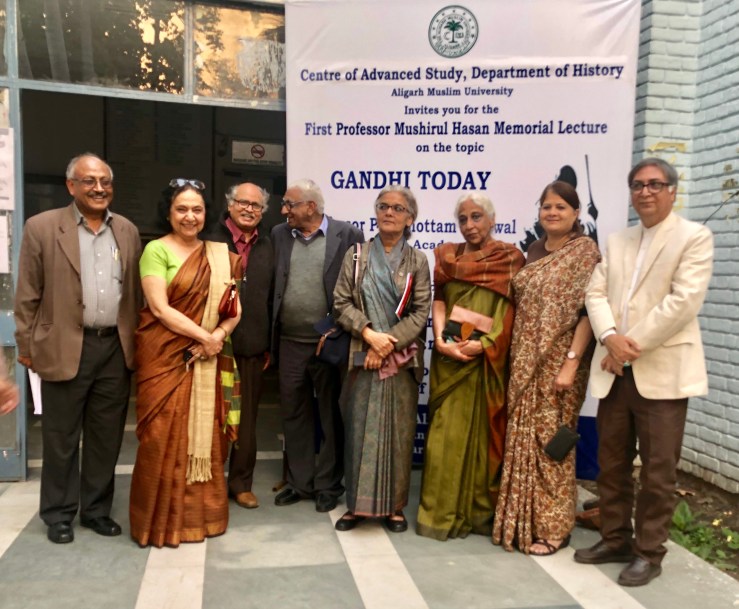
10) The First Mushirul Hasan Lecture was organised on 11th March 2019. Professor Purshottam Agarwal delivered the lecture on the theme ‘Gandhi Today’

11) Project to Digitally Photograph all the archaeological remains and monuments of Agra Region has been initiated. We will be digitally recording all the monuments and sites in detail. This would form a part of the Digital Archives to be maintained by the Centre.

12) The Centre’s Project on recording archaeological sites related to Indigo production launched last year continued.

13) The Centre also initiated a project on Mapping the Archaeological Remains and Monuments of Medieval Period in Meerut. The project is being conducted on the Centre’s behalf by Professor Manvendra Kumar Pundhir who presented his first preliminary report in a Seminar held on 6th April 2019

14) The Catalogue of the holdings of the Archaeological Section has almost been completed and more than 10,000 artefacts have been accounted for. The process of cataloging continues 

15) The renovation and re-wiring of the Building of Archaeological Section has almost been completed and within a few months the Section would be inaugurated formally.

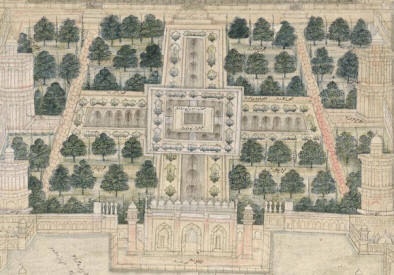
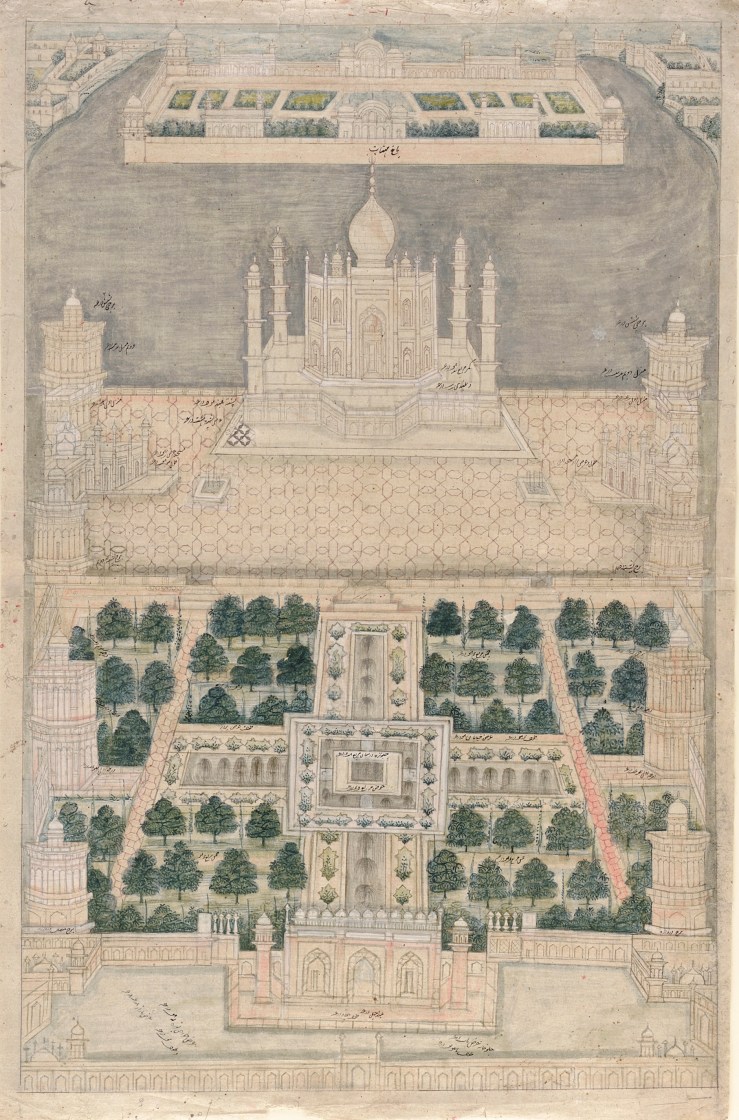
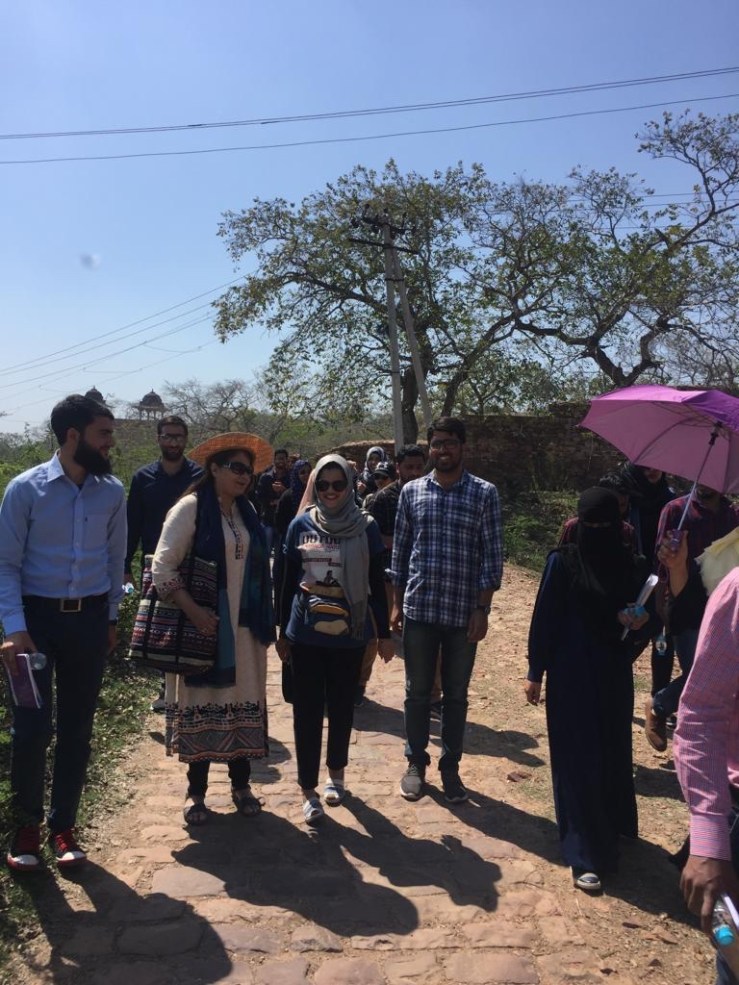
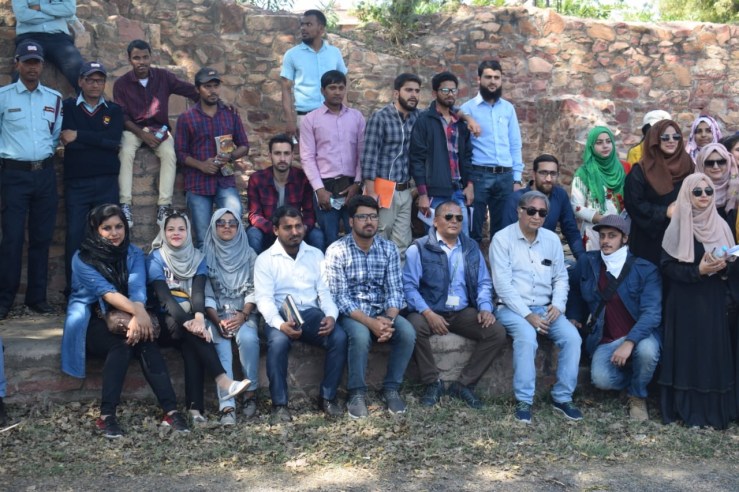
16) An exploratory and Study Tour of those who are offering/ offered Archaeology, Historical Archaeology and or Medieval Archaeology with on site lectures was organised. The Historical sites where the students were taken and on site lectures delivered were the various archaeological sites and monuments at Fathpur Sikri and Bagh-i Nur Afshan at Agra.

______________________________________

We resolve to further this momentum and keep striving to make the CAS Department of History, AMU vibrant again!

Join the movement build an Institution!

Professor Syed Ali Nadeem Rezavi 

Chairman & Coordinator 

CAS Department of History 

AMU Aligarh 

Delhi With especial reference to Tughluqabad

The history of Delhi goes back to the period of Mahabharata which is said to be akin to PGW Culture. Painted Grey Ware has been associated with Indraprastha, a village situated within and in the environs of Purana Qila. [Indrapath, along with Panipat, Sonepat, Tilpat and Baghpat are all mentioned in the epic.]

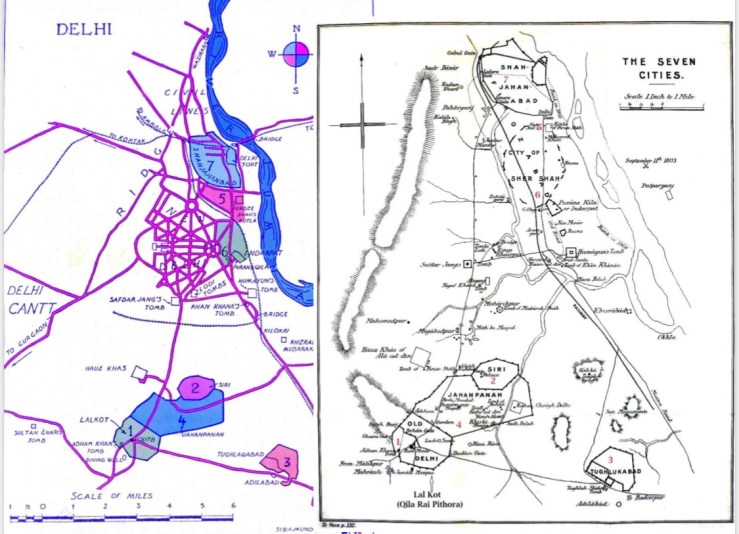
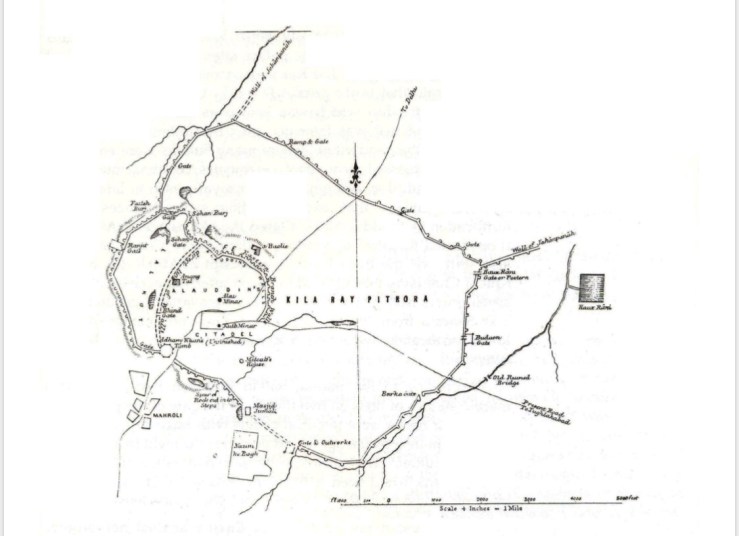
However, the history of Delhi is traced through Seven Cities starting with the Lal Kot of Anagpal. Prithviraja Raso attributes him to be the founder of Dhilli or Dhillika.

In the 12th Century, the Tomar Rajputs were overthrown by the Chauhans of Ajmer who built the Qila-i Rai Pithora (Prithvi Raj III) with massive stone ramparts to defend it from the Turks.
Starting from this fort till Shahjahanabad, there are seven major cities which are counted – however, to be more accurate, there were approximately 14 distinct ‘cities’ concentrated in three main areas of urban population.

The ‘Seven cities’ were in fact citadels, which are:

I.) Indarpat, the first city; then area east of Surajkund, Lal Kot / Qila Rai Pithora (1052 AD;

II) Kilokhari; Siri (1303 AD;

III) Tughluqabad (1321 AD;

IV) Jahanpanah (1334 AD;

IV) Ferozabad (1354 AD;

V) Khizrabad; Mubarakabad; Dinpanah (1530 / 1540;

VI) Shahjahanbad (1648;

VII) New Delhi

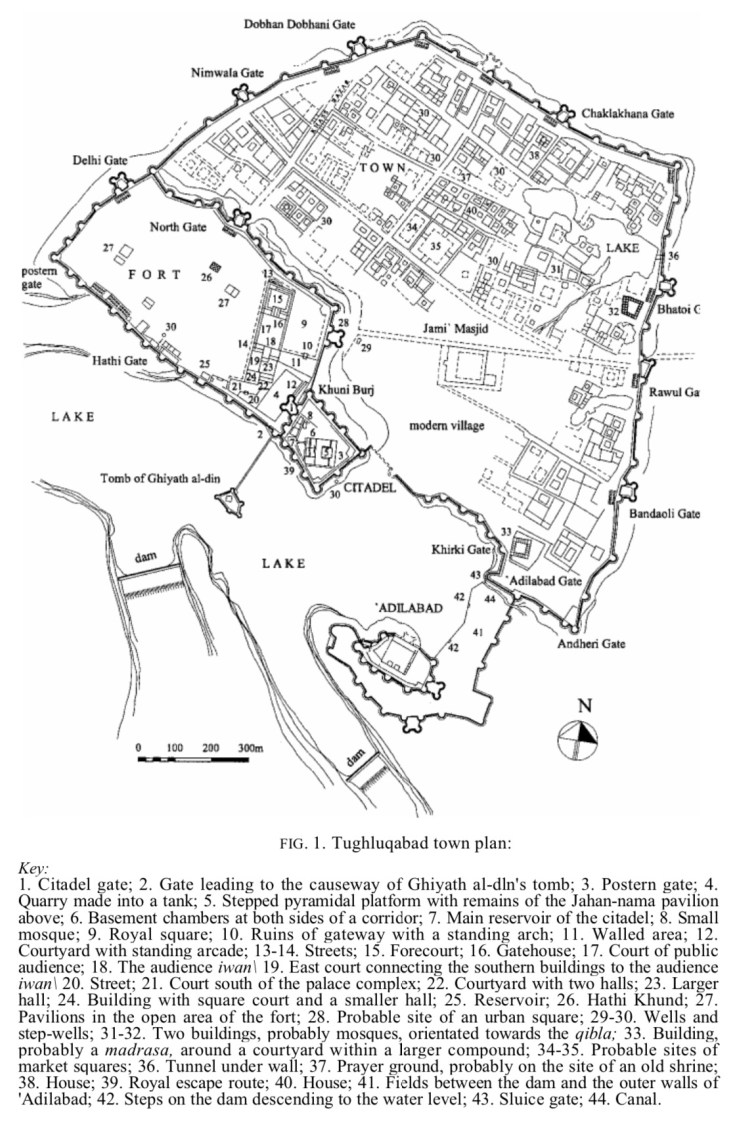
Let me dilate a little on the planned city of Tughluqabad:

Tughluqabad is conventionally the fourth city of Delhi. Built between 1320 and 1325 AD by Ghiyasuddin Tughluq, it was abandoned within a generation. According to Zia Barani, its construction started soon after Ghiyasuddin Tughluq’s accession. According to Ibn Battuta, its site was in the mind of the Sultan even when he was a minister in the court of Mubarak Shah. The architect was Ahmad bin Ayaz, an Anatolian (Rumi) malikzada.

It was built over a period of around 2 years and it was declared the dar us sultanate in 1322-23. In 1352 Ghiyasuddin died and was succeeded by Muhammad Tughluq who soon after ordered the construction of Adilabad, which was a new citadel. Tughluqabad and Adilabad are connected with each other by a causeway, which was also a dam to hold the lake water. Soon after was founded the new city of Jahanpanah. Thus Tughluqabad ceased to be the capital. A severe draught in North India and the transfer of capital to Daulatabad appears to have caused a total collapse. Firuzshah (1351-88) during his reign shifted to his new city of Firuzabad, far north of Tughluqabad. This led to a total desertion of the Tughluqabad site.

Thus like Fathpur Sikri, Tughluqabad is a fossilized town having buildings dating back to a brief period and a single reign.

For the brief period that it did exist, it was a splendid city, the magnificence of which is attested to by Ibn Battuta:

“Tughluq’s treasury and palaces are located there, and in it is the greatest palace, covered with golden brick, which, when the sun shines, reflects dazzling light, preventing the eyes from looking at it for long…”

This probably was a reference to the lustre painted ceramic tiles, which were extensively used in Iran during the 13th and 14th Century.

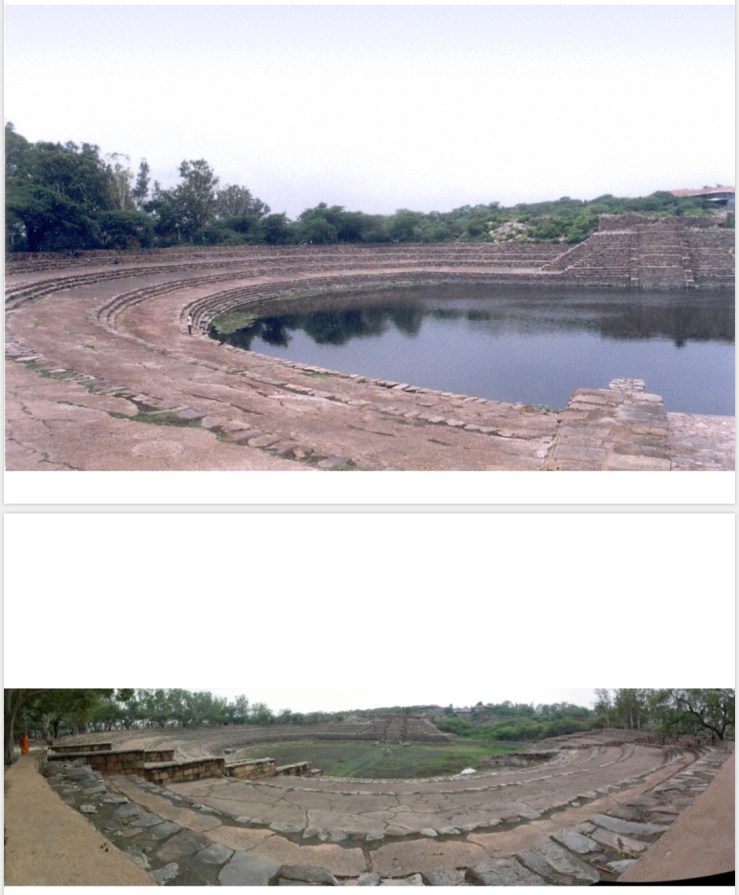
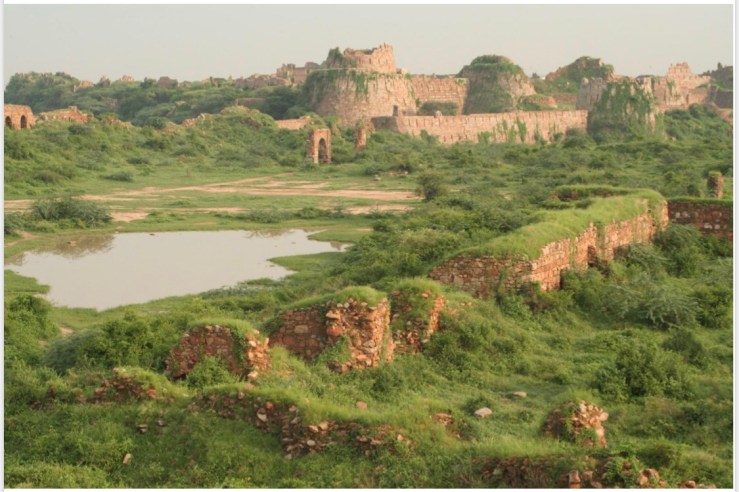
The site of this town, spread over some 300 acres, is located on a hill surrounded by a low lying area ( a basin) where water collected during the rainy season. This seasonal lake was regulated by the construction of a number of dams. The result was that a lake was created to the south of the city which supplied water to the town as well as irrigated the fields all around.

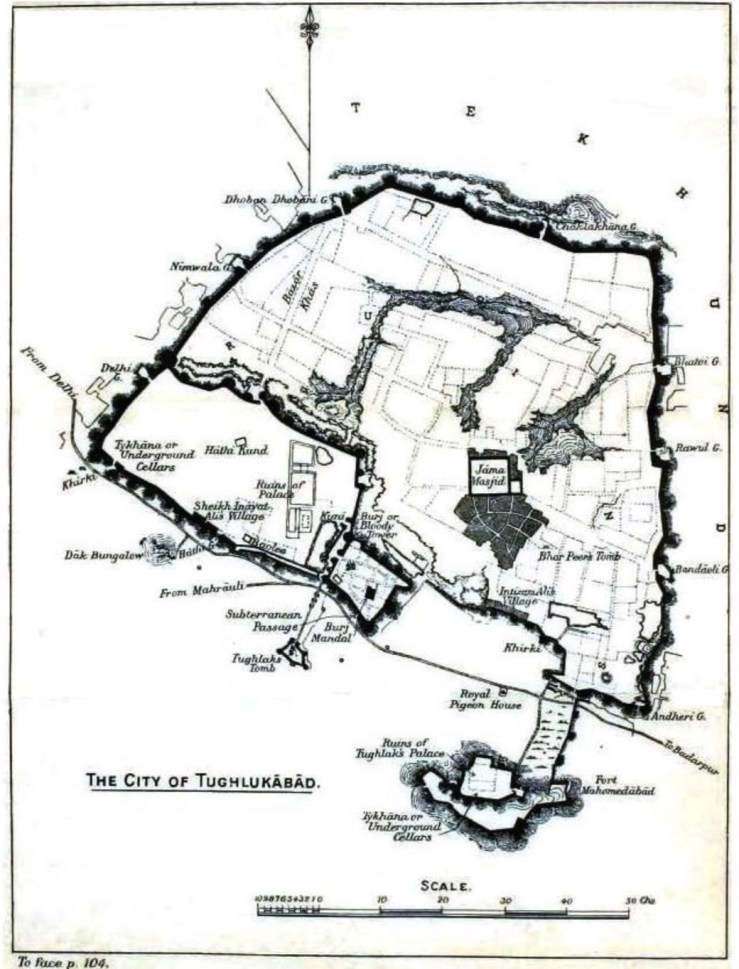
The plan of the city of Tughluqabad appears to have been inspired from Khurasanian (or Iranian) models represented by such towns as Bust, Nishapur and Tus: It comprises of three distinct areas – (a) the lower town (pā‘īn shahr); (b) the upper town (bālā hisār); and (c) the citadel (arg). Generally the Iranian towns conspired of two enclaves, the main town (shahristān) and the citadel.

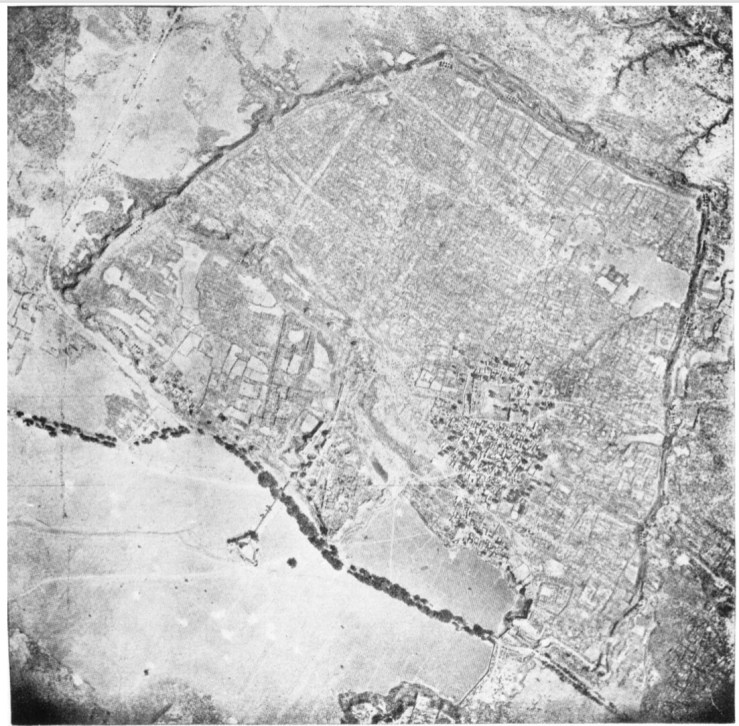
The main town of Tughluqabad appears to have been larger than Siri: its ramparts enclose an area of around 6 Km. The main streets were almost 2 Km long. These ramparts do not appear to follow any geometrical pattern or form, but follow the natural contours of the hill on which the city is located. The general layout of the city is in the form of a trapezium, i.e., a quadrilateral with only one pair of sides parallel. Its massive walls are made of rubble and sand mortar and cased with dressed stones quarried locally. The casing stones are large blocks of stones measuring generally 0.5 × 0.5 × 2 m. Some are bigger and some even as large as 3m.

The thickness of these walls differs: the maximum is 10m. The height reaches up till 30m, but on an average, it varies between 10 to 15m. These walls are pierced with round towers at regular intervals and 12 gates on the outside, while 2 gates are situated between the fort and the town. A single gate connects the fort with the citadel.

Typical of the period, the ramparts, the bastions and the gates are all tapering (i.e. cyclopean / battered) in form.

The citadel is situated to the south of the town, on the highest point of the hill. It comprised private imperial structures, and thus it is here that we find a three-tiered defence system: (a) a sharply battered first tier with a 2m wide ledge protected with battlements (parapet with indentations), loopholes (slits in walls for firing guns), and merlons (crenellations, or solid wall between two openings); (b) a second wall 5 – 10 m high with a barrel-vaulted gallery; and then (c) on top of this arch-shaped battlements with loopholes.

The most prominent structure in the citadel appears to be a pavilion (no.5), the Jahan numa, which possibly was Ibn Battuta’s ‘great palace of golden brick’.

Most of the buildings and palaces in the citadel have disappeared and what remains is only the under ground cells which made up the plinth / platform on which these structures were situated. The only surviving building in the area is a small mosque.

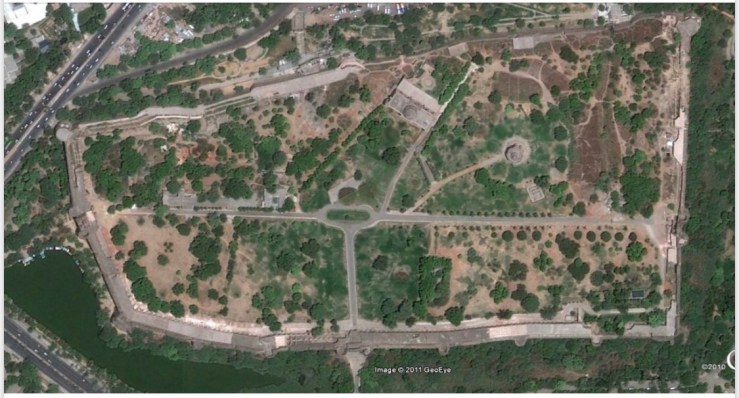
The fort is situated to the south-west of the town. On its south is the lake. The other exposed sides are defended by a moat.

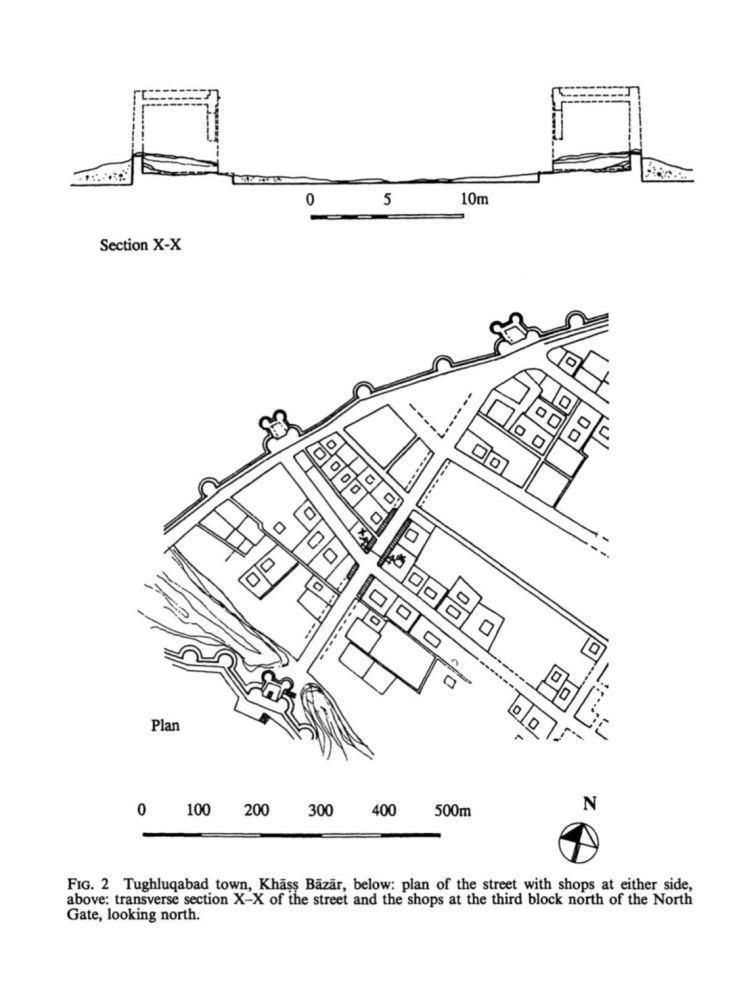
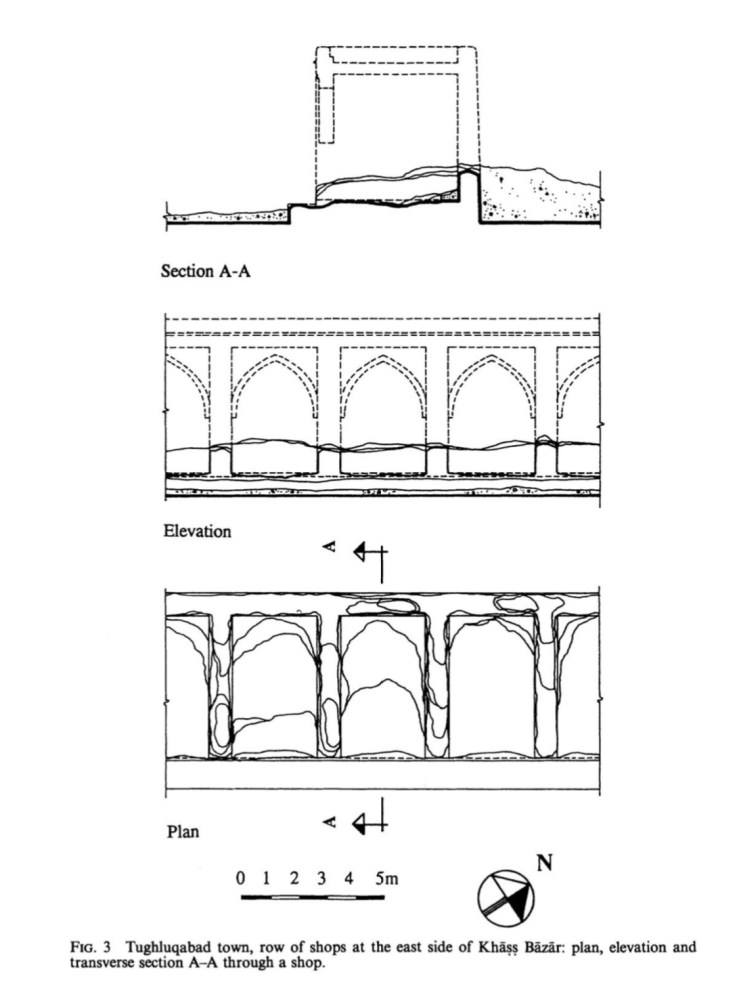
This fort consists of four main gates and two postern gates. A gate from the north leads from this fort to a straight street known as Khās Bazar ending at the Dhoban Dhobani Gate. The East Gate opened on a short processional street leading to the Jami’ Masjid.

Behind the East Gate was the Royal Square (maidan) [no.9] measuring 180 × 120 m to the south and west of which are the ruins of various buildings, probably public buildings including audience halls, stables etc.

Inside the town, most of the street layout is still preserved. There appears to be a well defined grid-plan for the roads which run from gate to gate. The main streets are fairly straight and some of them are aligned with north-south or east-west coordinates.

Three of these streets, which end at the gates, may be called the main streets: two of these commence at the north-east corner of the fort, one leading north and the other east.

The road between the East Gate of the fort and the gate in the centre of the Eastern side (Rawul Gate) although short, appears to be the main ceremonial and bureaucratic passage. Probably just outside the East Gate of the fort, there was a chauk (square) as the Iranian tradition also followed in many Sultanate towns like Nagaur, Bidar and Ahmadabad. And probably as in those places, it was surrounded with buildings and shops, but nothing survives. Probably it was a square for common people and a place for civic and commercial activity. According to Mehrdad and Natalie Shokoohi, an old aerial photograph hints of traces of buildings surrounding this area.

Another road from the north of this square led to the end of the town. This street was parallel to the one of Khas Bazar, and it was along this that two market squares are located in the middle of the town.

These two principal roads are linked with at least 3 streets. A street also ran along the fortifications and was probably meant for access to the walls and their defence.

The house structures and other buildings were generally oriented along the streets. Probably the residential areas of the town were towards the north and the houses were planned around one or several courtyards. The residential areas were compactly built with narrow side-streets giving access to the main streets. Some residential structures also probably comprised private gardens. The residential areas also contained a number of small mosques for each quarter. There were some grander mosques as well.

As far as the commercial areas were concerned, we have noted at least two in the centre of the town. These are rectangular areas which probably were the whole sale grain markets (mandi). Shops and bazaars were also located along the main streets. The Khas Bazar appears to have been the main market street of the town with shops on either side. The ruins of shops have been found in the middle portion of this street. Such shops ran alongside the entire length of the road.

This street is about 20 m wide and at each side of it is situated a platform about 0.65 m high over which the shops were constructed in a row of equal sized units. Each of this shop was 3 m wide and 5 m deep. The platform fronting these shops was around 1 m wide. Although at Khas Bazar, only the lower parts of the shops survive, but it is enough to give the earliest example of how they were constructed.

An east-west street from the Khas Bazar area ran between Nimwala Gate in the north west and passed on to the Bazar squares in the centre of the town and the continued up to the Rawul Gate.

Another remarkable feature encountered at Tughluqabad are the silos – the grain storage chambers – which have been found in large numbers built next to the walls both in the town and the fort. Ibn Battuta mentions anbārs of grain (granaries) in the cities of Delhi ‘some having edible grains from the time of Balban’.

These are massive but simple structures. One such set of silos is found near the Northern Gate: They are in the form of a large platform about 10m high having 10 circular domed chambers which are 6.50 m wide and 9 m deep. They are set 1 m apart from each other. The walls are solidly constructed with rubble stone and mortar. On one side of the flat domed roofs is a sloping chute by means of which the chamber could be filled and the filling would be monitored through a central hole in the dome. Once filled, both the chute and the hole could be closed and sealed.

Similar silos are found near other gates as well, for example the Hathi Gate, Rawal Gate, Bandoli Gate, and other places in the town and the fort.

A number of wells and reservoirs have also been located in and around Tughluqabad. There are two big baolis or step-wells, one in the Palace area and the other in the citadel. The main hydraulic works however are the sluice gates which regulated the lake. They have been initially surveyed by Tatsuro Yamamoto and his team.

Note: The above account is a summary of the recent works done on Delhi, especially those of Shokoohy and Shokoohy, and a host of others. Plans used here are also from Shokoohy

A Personal Tribute to Mushirul Hasan (15 August 1949 – 10 December 2018)

Recent passing away of Professor Mushirul Hasan removed many cobwebs from my memory and I was transported back around half a century to a period when our families were not only very close to each other, but also neighbours. We used to live in an old evacuee property known as Azhar Manzil, situated on a corner of a large fresh-water pond popularly known as “Hāthidūba”: it was rumoured that its depths were enough to drown a fully grown elephant! In fact it was situated just behind the Azhar Manzil.

In front of our house was a large barren field with just a skeletal ruins of a house popular as “Bhūt Bangla”, it being a common belief that if anyone tried to renovate it or roof it, he would immediately die! It’s owner was MC Chhagla, a well-known personality who lived in the newly built Chandigarh. Beyond it, at an angle, was the rambling and ochre coloured Hamid Lodge, the residence of Nawwab Hamid Ali Khan ( Hamid Chacha, as I used to call him!). He was a bespectacled tall thin man with a flowing white beard and an extremely loud voice. I remember him always wearing a sherwani with a slender silver handled walking stick.

And just where the front lawn of Hamid Lodge finished was the road leading to a “chauraha” comprising of a few shops, mostly of a few tailors, one or two very small general stores and a small bakery. This market later on, was going to be known as “Amīr Nishān” due to a house of a similar name situated there.

Between the chauraha and the Hamid Lodge (in fact connecting both) was the Hyder Villa, which had once belonged to the father of Salman Hyder ( and husband of Mumtaz Apa, the founder Principal of Abdullah Girls College). From him it was passed into the hands of a certain Dr. Seymour from whom Dr Muhibbul Hasan (father of Mushir) had bought it after coming back from Calcutta.

Our families, apart from thus being neighbours (at a time when Aligarh was a city of large open spaces dotted with kothis), were also related in another way: My father, before partition had been the chief librarian of the Mahmudabad Estate and been a close friend of the last Raja of Mahmudabad, Muhammad Amir Ahmad Khan. Muhibbul Hasan Sahib was related with that family.

From Left: Raja Sahib Mahmudabad, my father, Professor Muhibbul Hasan (Mushir’s father) and Maharajkumar Mahmudabad at Azhar Manzil, Aligarh

Mushir’s mother was a friend of my mother and that is why we always called her “Khālā” [maternal aunt] and her husband as “Khālū” [maternal uncle]. Not a day passed when either they were not visiting our house, or they ours.

Khālu had first served as a lecturer in Calcutta University and then at AMU. He also served for sometime at Jamia Millia Islamia and the Kashmir University, Srinagar. He authored two very important monographs: one on Babur and the other on Tipu Sultan. Both the works remained the last word for decades. It was only after Stephen Dale’s work on Babur that Muhibbul Hasan’s biography of Babur found a competitor in the field.

Khālu had a daughter (Salma Baji) and four sons: Mujeeb, Najmul, Mushir and Najeeb. Mujeeb was doing Civil Engineering and destined to first go to Pakistan and then to US, where he retired after serving in the US Army and the NATO force as a civil engineer. He first married a Kashmiri girl and then later, after their divorce, one of my sisters, Azra.

Najmul Hasan (Sunny, as he was called by friends and family) after his education became a journalist. His last assignment was as a correspondent of Reuter’s posted to cover Iran-Iraq War, where he died after stepping over an Iraqi landmine. His wife Babra belongs to Rampur and still lives with their daughter in Delhi.

Mujeeb ul Hasan (Mushir’s eldest brother) and my sister, Azra in Mushir’s House during the period of his illness after the accident

Mushir got his early education at Calcutta where Khālu was then posted. He soon joined ST School (Minto Circle) at AMU. From Aligarh he also did his graduation and post graduation in History. Amongst his brothers (including the youngest Najeeb) he was the most social, popular and active. He would take part in debates, recite nauha, as sāhib-i bayāz, in the Shab-i Āshūra procession taken out from our house, and participate in student politics. Once he also fought for the AMU Students Union elections and stood for the post of Vice Presidentship.

At AMU he and his father were identified with the Left. Like most others, Mushir too chose to offer courses in Medieval Indian History and studied from teachers like Muhammad Habib, Irfan Habib, Nurul Hasan and Khaliq Ahmad Nizami amongst others. At one place in his writings, Mushir does lament that Aligarh had hardly anything to offer as far as Modern period in history is concerned. One of his angst was that he was taught about all and sundry in Medieval Indian History but nothing about events much closer in time, especially the history of India’s partition, political role of Muslims or that of Sir Syed Ahmad Khan.

Let us not forget the time in History that Mushir was studying at Aligarh! It was in 1950’s that the first Prime Minister of India, Jawaharlal Nehru had ordained special grants to Aligarh for Medieval Indian History. And then just a decade back, Aligarh had survived the partition with most of it’s staff and students migrating to the newly created Nation! The cross of Partition at that time still lay heavily on Aligarh! The neglect of modern and contemporary period at Aligarh of those days is understandable.

According to Professor Irfan Habib, Mushir was one of the most diligent student of his time. He was not only the topper in his batch but also an active member of a number of cultural and literary clubs on the campus. He was also an active member of SFI.

After a brief stint at Ramjas College, Mushir was destined then to go to Cambridge from where he completed his PhD. His thesis on Nationalism and Communal Politics in India during 1885-1930 broke a new ground when it was published, and subsequently ran into many editions. As if to counter the drawback at Aligarh of having neglected more recent times and the Muslim question, he later, did meticulously well-researched works on India’s partition which too got wide acclaim across the globe.

When he returned back to India from Cambridge, Mushir started his long innings at Jamia Millia Islamia where his father had once served. There he was appointed as one of the youngest Professors and slowly and gradually emerged as its Vice Chancellor.

Mushir Bhai in his Office

Probably JMI doesn’t owe as much to any one else as it does to Mushir: he converted it from being a glorified “madrasa” to a University of world repute! Most of its famed institutes and centres were created by him. He modernised the campus, gave it academic excellence and took up the charge of constructing new buildings and structures. In fact he is taken to be the Shahjahan of Jamia!

As I got the news of his death, I was also reminded of the type of a VC that he was! I will narrate only some instances of which I was a personal witness. Having been used to the regal style of the functioning of the VCs at Aligarh, each of these incidents were not only refreshing but came as a surprise! In AMU a VC is a “khudā-i kul”, of whom even a Balban would be jealous of!

Once I had gone to meet my eldest brother in law, Professor Rizwan Husain, who was a Visiting Professor at JMI. He and my sister, Najma (Bajjo) were staying in one of the rooms of the University Guest House. I found Mushir walking around on the campus un-inhibited and un-escorted. He was simply walking alone!

At another occasion when I had gone to a seminar, we saw him emerge from his office. He saw us standing in the lawns. Instead of taking the road, he simply jumped a fence and came to us all smiling! And then I remember him refusing to take a plate out of turn but standing in the queue and insisting to wait for his turn! That too in a function on his own campus where he was the VC!

His humbleness had always been there! I also remember when I was frequently visiting Delhi at a time when we were waiting for the German Visa for my sister married to his elder brother who was serving in the NATO army those days. Mushir was living in a house at JNU allotted to his wife, Zoya. Express orders were that we (I and one of my friend) were to stay with him. He would see to it that we were properly fed and taken care of! And then he would, in the evenings, sit with us and joyfully hear the “Aligarh Stories”!

Mushir never had any airs or pretensions. While interacting with him you could never make out that he was the same man who had authored around 50 books, or that he was or had been a VC or was the Director General of the National Archives of India: a charge which he took after leaving Jamia. Once I was there at the National Archives for a meeting held to acquire certain manuscripts and documents. There too his unpretentious nature was in the forefront. The way he was interacting with his subordinates was something in contrast to what generally is the case!

He had a very soft corner for anything affiliated with Aligarh, which though he kept calling as a “small town” with “limited intellectual capacity”. He would also condemn those at AMU as “ kueñ ke mendhak” (frogs in a well)! But only a fool would be misled by these epithets. His love for his alma mater was such that he could never ignore anyone related with it. Be it the petty tailors of the Amir Nishān or any student, researcher or teacher of Aligarh: if anyone needed any kind of help or push, Mushir was there!

Professors Shireen Moosvi and Irfan Habib at Mushir’s House paying condolences to Professor Zoya Hasan and Salma Baji (Mushir’s sister)
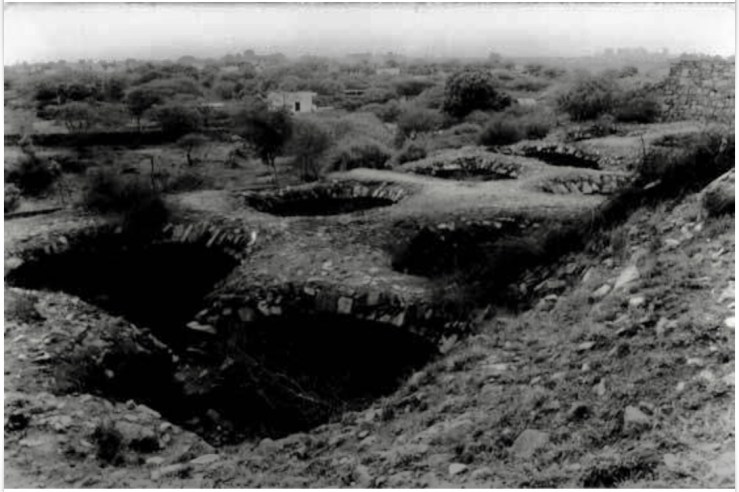
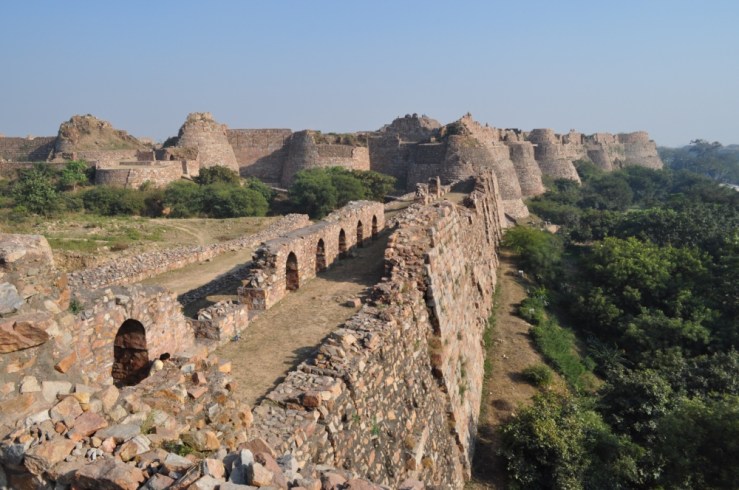
Amongst us “youngsters” who looked up towards him, he was very much fond of Najaf Haider, who now is himself a Professor at JNU.

Mushir with Irfan Habib and others in Najaf’s house at Oxford in 1991

[Courtesy: Najaf Haider]

Academically I never had any direct contact with him, I having confined myself to themes in Medieval Indian History with which he was apparently never interested. Once however he told me that you keep writing papers and articles. They don’t count in today’s world: What counts is authorship of books! And when I told him, one cannot become an author of multiple books overnight, he say: “edit them!“

He was perhaps correct to some extent!

Mushir did not die on 10th December 2018: He finally left us all on that date. He actually died the day he met with that horrible accident on a Haryana road way back in 2014. The accident left him physically and mentally in a condition that he could not keep himself engaged in his academic and intellectual activities. That year, I remember the Indian History Congress offered him the General President-ship. He had to decline it. It was that day that we realised that we had lost Mushir Bhai!

Mushir Bhai (after the accident) with Zoya and his friend Professor S. Irfan Habib

He finally left as he had lived! Two namāz-i janāza were offered for him: one at the Shi’a centre, Bābul ‘ilm, and the other at the Jama Masjid of Jamia. Not only Shias and Sunnis but even others joined in the prayers. Both men and women walked him through his last journey. He finally came to rest on the campus which he served and of which he was labelled as the Shahjahan! Many a satrap had tried to hound him out, he worsted them all at that: he would instead remain in Jamia till eternity!