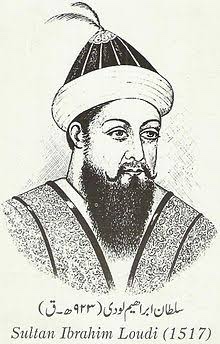
The Lodi Empire was an Afghan Empire. The majority of the officers and nobles were from the Afghan regions. The Afghan identity gave it an advantage as there existed a large number of Afghan populations in N. India as a result of the continuous process of migration throughout the Sultanate period. By Tughluq period two Afghan rebellions against Mohd Tughluq had occurred. Then in 1441 Bahlul captured power with large Afghan following. He made a direct to Afghan tribal sentiments. The text of Bahlul’s announcements and farmans have been quoted by Abbas Khan and other Afghan history, the Tarikh-i Khan Jahani. Mushtaqi also wrote that he made an appeal to the Afghan tribals.
To quote Abbas Khan: ‘God in his goodness has granted kingdom of Delhi to Afghans….whatever be conquered shall be shared with us’.
Thus RP Tripathi calls it the Afghan Confederacy. But then, not withstanding the Declaration, not all Afghans were given a share in the empire. Distribution was made between the favoured and the privileged on the one hand and those not important to be given position. For example, nobles under Bahlul and Sikandar Lodi were recruited from the clans of Lodis, Sarwanis, Lohanis and Farmulis (the Shakhzadas of Ghazni). The others were ignored and totally excluded. For example the Niazis, who were supposed to be the uncouth people and not fully fit even for the army. Similarly ignored were the Surs and the Kakkars etc.
Thus one can say that the Lodi Empire, which Babur replaced, was not an empire with Afghans having equal share.
Let us also be clear that from the very beginning, in the Lodi Empire the non-Afghan section was given a considerable share. Thus it was not exclusively an Afghan concern. The Indian Shaikhzadas were recruited in large numbers in the nobility. Thus for example, Shaikh Ghuran of Koil, the Syeds of Amroha, the Shaikhzadas recruited from the Gangetic plain and the Punjab. Then there were also incorporated a large number of Rajputs under Sikandar Lodi.
So by Sikandar’s time, the Lodi nobility was divided into two groups, the Privileged Afghan clan groups; and People of Non-Afghan origin, some of whom were non-Muslim and Rajput chieftains. This made the social base of the Lodi state very wide, in fact much wider than the early Mughals.
There was a large Afghan population. It has been roughly estimated in the range of 80 lakh families, i.e., 4 crore Afghans. Afzal-ut Tawarikh gives this number to explain Humayun’s defeat at the hands of Sher Shah. In addition to this, a very large section of Hindu chiefs were given a share in the Empire. The Lodis could rally the population paying allegiances to these groups.
This is reflected in the hymns of Guru Granth Sahib (tr. Macaulay in Sikh Religion vol.I) which suggests that the overthrow of the Lodis was a loss to the people. But in spite of the large social base behind them, the Lodis were not able to throw back the Mughal challenge. This can be explained if we keep in mind the contradictions in the Lodi state between the Lodi aspirations and centralization on the one hand and the decentralization of aspirations of the Afghan nobility. The history of the struggle between the two date back to the period of Sikandar Lodi. He gave up many of the policies and measures of Ibrahim Lodi pacifying nobles of equal position. This was altered and resulted in wide-spread discontent. Sikandar had no alternative but to depend on the section comprising the non-Afghan nobility in order to deal with the dis-satisfied Afghan nobles. The kind of autonomy which the Afghan nobles enjoyed till that time, and sought to be curbed by Sikandar Lodi, can be gauged by going through Abbas Khan Sarwani’s section on Sher Shah’s early career and his description of Sher Shah’s administration of his father’s jagir at Sahsaram.
Now what impression does this account of Abbas Khan create as far as the position of the Afghan noble’s are concerned?
First. That the nobles were free to decide the mode of assessment and mode of collection from their iqtas: ghallabakhshi or measurement. This indicates that there was no policy laid out by the centre. This is a situation of autonomy.
Secondly Any extra collection from the iqta or the assignment was pocketed by the noble himself. This was a laxity of the administration. In strong administration, this had to be deposited with the state. But this was not being done so during the reign of Sikandar. Sher Shah talks of ‘extra revenue’ being a boon to his iqta.
Third. The noble’s were free to wage a war against local chiefs. They had assumed authority to create jagirs and zamindars to uproot established chief. The job of creation of new zamindars was never allowed or given to a noble, before or after this reign.
Fourth. Afghan nobles in some cases were holding iqtas practically (not in theory) on hereditary basis. When Hasan Khan Sur died, a tussle arose in which Sher Khan won over his brother to hold over his iqta.
Fifth. The principle of transfer of iqta followed under the Khanljis was conspicuous by its absence at this time.
During the reigns of Sikandar and Ibrahim Lodi revolts became more accentuated. For eg. Daulat Khan Lodi who controlled Punjab revolted and invited Babur to come to Hindustan. Alauddin Khan Lodi also turned against Ibrahim. The revolt of the Farmuli nobles was also a result of this situation.
The contradiction between the king and the nobles further accentuated and differences sharpened due to yet another factor. This was the shortage of precious metals which eventually resulted in the minting of smaller number of silver and gold coins during the Lodi period. This is borne out by the surviving collection of the silver and gold coins of this country. The surviving coins from the pre-Lodi period as well as those from the Mughal and Sur period is quite large. The surviving gold and silver coins of the contemporary states are also considerable. Their number is quite large indeed. This for the first time is noticed by John F.Richards, ‘Economic History of Lodi period’, JESHO, Aug’65
This paucity would naturally affect the position of the nobles. Further on account of slowing down of the pace of the money economy, resulting from the absence of silver and gold currency would promote the custom of collecting revenues in kind and not in cash. Naturally this would lead to paucity of money to raise troops. Absence of ready cash would also affect the ostentatious pretences.
Most probably the shortage of precious metals was due to short supply due to coming in existence of independent states on the coast. Lodi Empire had become land-locked, says Moreland. Edward Thomas, ‘Economy of Pathan Kings’, says this short supply was a result of Timur’s plunder of 1498. Richards has however pointed out that if this was the result of land-locked nation, then why the other land-locked states not experienced the same shortage? In case of Kashmir or Mewar or Malwa, we don’t observe this phenomenon. Richards also points out that Timur’s plunder is also not a good explanation. His explanation is that Bahlul paid lip-service to the nobles as the brothers wanted to curb their independence and power by withdrawing gold and silver currency deliberately.
Whatever the cause, the nobles were hurt due to this. During Ibrahim’s reign this situation became almost unbearable for the nobles. Under Ibrahim, for several consecutive years, there were very good rains, and thus bumper crops. This resulted in a sharp fall in the prices of food grains and especially influenced the general price index. Side by side to this, before Ibrahim Lodi, there was the introduction of a new coin. Bahlul had introduced this coin which came to be known as the Bahluli Tanka. This was different from the tanka of the Sultanate period. It was of copper (tanka-i siyah) and had a ratio of 1:20 with earlier coins. Thus this was a debased tanka and this was a further catastrophe. The result was that the peasants were not in a position to make payments or submit revenue to the nobles in cash or in the new copper tanka. And whatever revenue was collected in kind was almost entirely valueless as there was no market for it. Thus the income of the nobles was further adversely affected by this. Thus we encounter widespread revolts during Ibrahim’s reign. Thus the fiscal policy was partly responsible for the extinction of the Lodis.
India on the eve of Babur’s invasion provided a peculiar scene on its political as well as social levels. It was a theatre of chaos. There was a scene of divisions, tensions and frustrated ambition. It appeared as if politically the country was in decline. Every one had plans for enlargement to some extent which was wrecked by the conspiratorial circumstances. The beginning of the 16th C in India was one of the transitional phases of its extended history. Let us first deal with the political conditions and in order to do so scrutinize the hypotheses propounded by Rushbrooke Williams.
Rise of Large Rajput Zamindaris:
Apart from the coming of the Portuguese in the Indian Waters and its consequences, which we would be dealing subsequently, an important development which took place just on the eve of Babur’s invasion was the rise of large Rajput zamindars within the areas controlled by the Delhi Sultanate as well as by other regional states. This was important from two angles:
For the first time we find a situation in which different clan holding zamindars in different places came to identify themselves as belonging to the same caste, viz. the Rajputs.
Secondly As compared to the earlier situation which existed in the 13th & 14th C., the zamindars that had existed in the heartland of the Delhi Sultanate and the heartland of other states like Malwa, Gujarat and other states in the Deccan were comparatively creating bigger units and zamindaris.
If one reads the sources of Delhi Sultanate, one comes to references to local chiefs and zamindars. But one notes a significant difference in the sources of Sultanate period and those of the 15th C. From 15th Century onwards, we find all the local chiefs and zamindars mentioned as Rajputs. But in the earlier period, they are referred to as individual kshatriya clans: eg. Katihar chiefs, Chauhans, Khos, Bundelas, etc.
In the sources of the 13th & 14th C. it is nowhere mentioned or indicated that they together formed a caste – the caste of Rajputs. In some modern works, the misconception is reflected that non-Muslim chiefs of the 13th C. were Rajputs. Inscriptions from Rajasthan, in Rajasthani and Persian, do not make any reference to these groups as being Rajput or there being a bigger unit called Rajput. It was only from the 15th & 16th C. that one finds so. This important development had very important consequences.
This point is established by Prof. Irfan Habib in his article “Social Distribution of Landed Property”, pub. In Enquiry in 1965 (pp.54-56 & 67-69) where one comes across data to establish the point that Rajputs as a zamindar caste emerged in the 15th & 16th C. and were not there in the 13th & 14th C. This emergence of the Rajput caste during this time was a result of different processes: Sometimes by gradual absorption of aboriginal groups having land into groups. As an example we know that the Gond rulers of Chauragarh (Chhattisgarh area) were not regarded by other chiefs as Rajput caste down to the 15th C. One ruler of this dynasty made a proposal of marriage to Durgavati, the daughter of the Mahoba ruler. This proposal was put down on the ground that the Chauragarh rulers were not Rajputs! Ultimately Durgavati was taken by force. From that time onwards, these Gonds came to be regarded as new clan of Rajputs: the Nagvanshi Rajputs. Thus we see the rise of a new clan.
Similarly we have the case of the Cooch ruler of Cooch Bihar in North Bengal. They belonged to the Cooch tribe, which was a sub-tribe of the Ahom race, who were not a part of the varna system till now. As a process of Sanskritization, they were also absorbed. They started claiming for themselves the status of Kshatriyas and also part of the larger Rajput caste. This legitimization was again brought out through a myth: i.e., the Purohit of one ruler of Cooch Bihar in the 16th C. had a dream. In the dream he met Goddess Bhawani who informed him that the ruler was a Kshatriya and a thakur. Thus they were taken to be Rajputs and were incorporated in this group as such. According to Abul Fazl, the territory of Cooch Bihar was 200 kuroh in length and 20 to 30 kurohs in breadth.
Then there was another way in which this came to happen. Displacement of earlier groups who refused to be incorporated as Rajputs by those incorporated as Rajputs. Defeat those who refused and establish themselves. An example can be given of Ujjainiya Zamindars, now represented in the Shahabad district of Bihar. The Cheros of this region were overthrown by the Ujjainiya Rajputs. They were the people migrated from Ujjain. What was their actual clan group is not certain: sometimes they are supposed to be the Panwars. They overthrew the aboriginal Cheros who refused to be absorbed in the Rajput caste.
The Afghan chiefs also helped in this replacement process. Sher Shah also contributed to this. When Abbas Khan Sarwani talks of abolition of zamandars by zamindars, he is speaking of the Cheros.
Similarly the Meenas were evicted from Amber region and replaced by the Kachhawahas.
As a result of this process, in the whole of the Gangetic plain and region constituting the heartland of Malwa and Gujarat were established large zamindaris controlled by groups claiming to be belonging to a large unit, the Rajput caste. The only exception was Bengal, where the zamindaris emerging were of the Kayastha class and not the kshatriyas.
The fact that these zamindaris, comparatively speaking, were larger units is important. In the sources of the Delhi Sultanate reference to zamindars tends to indicate two kind of local chiefs and zamindars.
Barani speaks of rais, ranas and rawatas. It is obvious that they were autonomous chiefs located on the periphery of the area controlled by the Turks. But then, side by side he also refers to Chaudhuries, khuts and muqaddams. It is obvious these were zamindars located within the concentrated territory controlled by the Turks all over. Chaudhuries it seems were bigger zamindars and intermediaries with 100 or more villages. Muqaddams were village level chiefs. These chiefs and zamindars were small and village level officials. Chaudhuries were bigger but were small units as compared to the rais. They were not in a position to resist or defy imperial authority on their own. So the rebellion in the Gangetic plain of these petty chiefs was possible only when famines or great pressure occurred; or they received help from one or the other section of the Turkish nobility like the revolt of Malik Chhajju. They could not rebel on their own strength.
But in the 16th C. this situation had been altered. With territories controlled, there emerged large zamindari units not located on periphery but in the heartland of the imperial territory. We have Bachgoti zamindars who held sway over a large tract in Awadh. By the beginning of the 16th C. they were so strong that they succeeded in overthrowing the Lodi administration over a large area. And this is borne out by an interesting reference in Lataif-i Quddusi, a collection of anecdotes and sayings of Shaikh Abdul Quddus Gangohi who was forced to migrate from Rudauli in Barabanki District to Shahabad sometime in 1491-92. The Bachgotis had overthrown Lodis in this region and established practices repugnant to Shariat. Thus the saint had migrated to Shahabad in Haryana.
Thus we can say that this period saw two important developments: (1) emergence of larger zamindar class: the Rajput class; (2) these zamindaris were now comparatively big units by the end of 15th C.
The second point can be further stressed by the example of the Bhadorias. According to Abul Fazl, the Bhadorias controlled areas in the vicinity of Agra itself. In the vicinity of Agra according to Abul Fazl, there is no one as powerful as the Bhadorias. Mainpuri and Etah districts were under the Bhadorias.
While dealing with the Rajput policy, Arif Qandhari writes in Tarikh-i Akbari, that there are 2 or 3 hundred zamindar chiefs. Their suppression is very difficult as they possess strong forts. If they are able to hold on to each one of these forts, say for six months, or one year, they can be contented about their safety for the next two hundred years.
Thus as the Rajput zamindars were very strong, Akbar had to enter into matrimonial alliance. If force was used, 2 or 3 hundred years would have been needed to subdue them.
Then there was another complication. As all belonged to the same caste, there was much more degree of solidarity with each other as compared to the earlier situation.
This is borne out by the example of Medni Rai of Chanderi who had entered service of the Khalji ruler of Malwa. He first tried to gain power in Malwa by mobilizing the Afghans and the Rajputs behind him. He sought the intervention of the Sisodias of Mewar in his favour. In 1419 as a result of a coup de tat the Khalji ruler had to flee and could be brought back by the Gujarat ruler.
Medni Rai wrote to the Rana Sanga, that being the chief of the Rajputs, he should help him. Thus this caste solidarity compelled them to work together. Then in 1529, Rana Sanga mobilized a large number of Rajputs under him. Shaikh Zain says 10 kafir chiefs had been employed by Rana Sanga to throw out the Islamic rule.
Mewatis, from south of Delhi down to Amber was under Hasan Khan Mewati, who was a Muslim and not a Rajput. The Mewatis were non-Muslims in the 13th C. and were converted in the 14th C. The Bhatti clans in Punjab and the Ghakkars were also Muslims who identified themselves with the Rajputs.
Babur had to tackle this Rajput-Zamindar factor. Akbar’s Rajput policy should not be taken as a result of his religious policy. Mughals were not in a position to control Hindustan without the Rajput help. It had nothing to do with religion. From Sikandar Lodi’s time, evidences suggest that a large number of Rajputs had been enrolled and given positions. (See IH Siddiqui, ‘Composition of nobility under Lodi Sultans’, Miscellany)
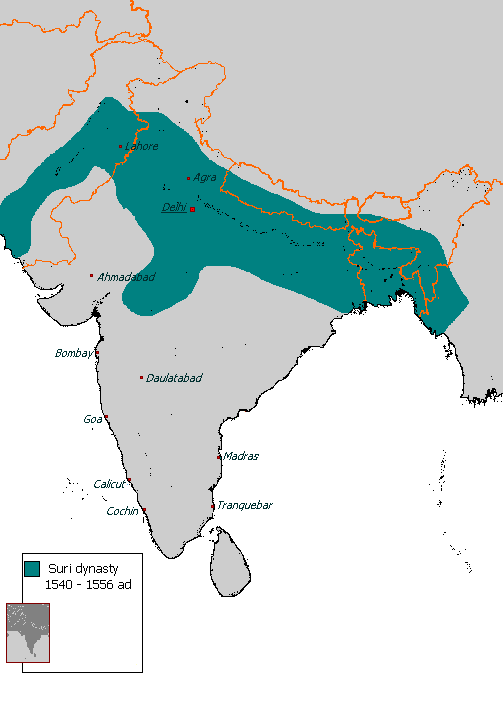
The most conspicuous feature of the Sur administration was its highly centralized nature despite a large participation of numerous Afghan groups. It was a highly centralized political system. If we examine the working of this system, we can discern significant features which go to establish that this system had a high degree of centralization from the very beginning, and it went of increasing.
We find that Sher Shah and Islam Shah, in their policy of recruiting nobles, tried to undermine the position of the privileged groups of the Afghan chiefs, which naturally resulted in the coming into existence of a new kind of nobility which did not have the same kind of high claims. And as they were the creation of Sher Shah or Islam Shah, they were loyal to them.
Secondly we find that both Sher Shah and Islam Shah were very particular in enforcing a high degree of discipline amongst these nobles – thus we have the transfer of iqtas, introduction of dagh wa chehra regulation or the measure of putting the entire nobility on cash payment under Islam Shah.
Thirdly there was also a close supervision by the king of the working of the central government – a sharp contrast with the Mughal central government, where various officers were responsible for various departments; and the wakil us saltanat, the intermediary between the king and the nobles, ran the central government on behalf of the king. Sher Shah on the other hand, personally supervised the working of each and every department. He did not leave it in the hands of independent officers.
Fourthly, we have a peculiar kind of local administration which was sought to be created at the pargana and sarkar level. The degree of the supervision of the central government personally under the king is unique.
Fifthly, there was also the creation of a large standing army. In Sher Shah’s case, one finds that this standing army was in fact deployed all over the empire in such strength that it could be used against the defiant nobles whenever anyone of them should try to go against the central government.
Lastly, a new pattern of revenue administration was introduced in which was the introduction of the zabti system – a system providing the mode of assessment and realization of revenues was on the basis of area under cultivation.
Nobility
So far as the composition of the Sur nobility was concerned, it is a false notion that the Lodi Empire was an Afghan concern in the sense that in this Empire all the Afghan people had an equal share. This negative assessment is important because some of the statements that are attributed by the Afghan historians to Bahlol Lodi do go to create the impression that at the time of its establishment, the Lodi empire was conceived by its founder as a state in which the power would rest – perhaps sovereignty as well – in the entire Afghan group. The author of Waqiat-i Mushtaqi says that Bahlol sent a message to nobles that we have established in India and Afghan rule, and share with me this empire. Thus an impression is created that it was a common concern of Afghan people.
But when we scrutinize the list of nobles of the Lodi empire, it emerges that only a few of the Afghan Khails were singled out for recruitment: the rest did not have any share in the nobility. At best they supplied personnel for recruitment as ordinary troopers.
Similarly under the Surs, the nobility comprised of a large number of minor Afghan clans, who did not get much share in power and privileges in the Lodi empire.
This situation was the result of a number of circumstances: One circumstance for the rise of only minor clans in the nobility was the rivalry and clash which developed between minor Afghan officers led by Sher Khan and some of the Lodi nobles who had come to Bihar after the defeat at the hands of the Mughals. In fact the rise of Sher Khan was a result of this struggle. He out-manouvred the Nauhanis, and such prominents groups as those led by Shaikh Bibban and Farmuli. Thus he would not be in a position to recruit in service nobles belonging to these clans.
Thus in his nobility there were basically two groups: (a) the majority belonging to minor clans, and (b) the khasa khails, i.e., those who were independent of clan ties and had a personal loyalty towards him. Thus the term ‘The Royal Clan’. Amongst them were the three sons of his personal slave Sukha: Khawas Khan senior, Sahib Khan and Khawas Khan Jnr. They were thus people of obscure origin who had been given highest positions. Then there were others: Shuja’at Khan Sur, Sarmast Khan Sarbini, Haibat Khan Niazi [about Niazis Waqiat-i Mushtaqi comments that they were not good enough even as ordinary troopers and were looked down upon as just menials!] Haibat Khan was even given the title of Azam Humayun and the charge of whole Punjab. The Niazis also controlled Malwa.
In addition, after 1553 Sher Shah had also taken some Lodis in service after their complete defeat: Amongst them was Isa Khan Sarwani, the ancestor of Abbas Khan Sarwani, the author of Tuhfa-i Shershahi. They were given minor appointments with the exception of Isa Khan who was made incharge of sarkar Sambhal.
When Islam Shah came to power, he made further changes in the composition of the nobility: he attempted to do away with the Khasa Khails whom he suspected of treacherous designs against his person. This bitternes was due to the fact that some of them had taken part in the tussle for succession and had sided with Adil Shah. Thus after coming to the throne, Islam Shah promoted enblock 6000 persons from his own contingents to positions of nobility. This information comes to us from Risqullah Mushtaqi. He says that this disturbed the old arrangement and displeased the nobles of Shershah. The Niazis were totally eliminated and ordinary troopers of his own khasa khail were promoted. Result was that the strength of non-Afghan section was augmented. Certain non-Muslim personnel was also appointed. One such person was Hemu who had held the small post of shahna-i bazaar under Shershah.
Measures to Control Nobility
Under Shershah, strict discipline had been imposed on his nobility: he saw to it that they did not enjoy uninhibited powers which they exercised under the Lodis. Their freedom was limited by sending periodic written instructions to them which gave detailed advice how they should run their administration or meet problems arising from time to time. This practice seems to have been carried on by Islam Shah as well. This is actually borne out by Badauni as well:
“Also the amirs of 5000, 10,000, and 20,000 used every Friday to pitch a lofty tent supported by 8 poles and bring the shoes of Salim Shah together with a quiver (tarkash) which he had given to the sardars, in front of the throne; and first of all commanders of the troops and after him the munsif, that is to say amin followed by others in due precedence with bowed heads and every expression of respect, would take their seats in their appointed palces, then a secretary would come and read out aloud that order, chapter and verse, which occupied 80 sheets of paper more or less. Any question which presented them any difficulty was referred by them in the conclave to the various provisions and rulings of that document, by which it was finally decided and if it should wo happen that any amin acted in contravention of that order, the secretary used to write a report of that action and despatched it to the sourt and the disobedient amin would forthwith be visited with punishment together with his family and his relations.”
Badauni writes from personal experience: he saw it once in Rajasthan where he was staying at that time. This shows that regular orders were issued to the nobles by the Sur Sultans.
In addition to this we find Shershah also tried to impose very strict discipline on his nobles and did not pardon anyone who committed indiscretion.
For example, the case of Khizr Khan in Bengal. He had married the daughter of the deposed king of Bengal. It was reported against him that he was behaving in a very haughty manner. He was not only removed but care was also taken to abolish governorship of that place and replace it with a sarkar administration. The governor was removed and in his place an amin was appointed.
We have an interesting account of Dattu Sarwani, who wrote his recollections and dreams in 1535 which are now part of Latiaf-i Quddusi. He writes that when Sher Shah ordered some Afghan families to Gwalior, fort, eunuchs were appointed to record their names in registers and in case if they refused, to set their houses on fire and send them forcibly in disgrace.
Similarly Shershah re-enforced branding of horses. According to Abbas Khan Sarwani this was done due to ‘liars and double faced persons who showed a large number of troops at the time of assignment, but once the jagirs had been assigned they would deprive their soldiers oftheir dues’. He further writes that Sher Shah proclaimed “ I have introduced the system of branding with this object in view that there should be no discrimination between the rights of the nobles and the troopers, that the nobles may not be able to deprive the troopers of their dues and the chiefs must maintain the soldiers in consonance with their mansabs and be not able to vary their numbers.’
When a report was mad against Shujaat Khan Niazi that his troopers were not being given their due Sher shah reportedly wrote to him:
‘Before the wakil of your troopers reach here, restore to the troopers their payments and pacify them. If their wakil comes to me and submits their complaints, I will deprive you of your jagirs and give you an exemplary punishment.’
One measure already discussed is that Islam Shah would send detailed instructions to his nobles which had to be strictly adhered to.
Orders were given that they should not lead an easy life and drive out of their establishments dancing girls. They were also asked to abolish akharas. They were directed that nobles would not be permitted to use red or crimson tents, as they were reserved for imperial use. They were to surrender all their elephants to central authority: only a few weak elephants were allowed for their personal use. Finally Islam shah also introduced the measure of converting a major part of the land into khalisa – Badauni says he brought whole country into personal control [ khasa-i khud saakht] and in accordance with this regulation and the custom of dagh, the troopers were paid in cash.
Badauni’s account of Islam Shah is very detailed. He is actually referring, albeit indirectly towards khalisa. But then it is difficult to believe that he succeeded in this as no other tells us about this. This is to be taken as an attempt. This would have affected the position of the nobles seriously.
Now the third aspect: the personnel and the close supervision of the central government by Shershah. Evidence in this regard has to be gleaned carefully. There is a passage in Abbas Khan where he quotes Sher Shah’s criticism of the working of the Mughal state as witnessed by him in 1528 during the brief visit that he had paid to the Mughal camp. He had gone to the Mughal camp with Junaid Barlas:
‘Since I have been amongst the Mughals and know their conduct in action, I see that they have no order or discipline and that their king do not personally supervise the govt bu leave all the affairs of the state to their nobles and ministers in whose sayings and doings they put perfect confidence. These grandees act on corrupt motives in every case whether it be that of a soldier or a cultivators or a rebellious zamindars.”
This was a defect which Shershah tried to rectify on coming to the throne. According to Abbas Khan:
‘He (king) should not repose much confidence in the pillars of the state (arkan-i daulat), for he said, I have always remained acquainted with the affairs of the kingdom and that whenever I have tested on the touchstone of my experience the words and acts of these pillars of the state and their agents. I have not found them to be wholly true. The means of my gaining possession of the kingdom lay in bribe taking habits of these officers of the state (Mughal officials).’
Abbas Khan further tells us:
‘ Shershah personally attended to all important campaigns and the affairs of the realm high or small, never allowed hours meant for prayers to go without offering them.’ ‘ The huliya (descriptive roles) of these soldiers and jorses were caused to be recorded before they were brought before him and with his own tongue he announced the fixation of their monthly salaries. After this he had the horses branded in his own presence.’
Thus evidence suggests that (a) Shershah’s experience indicated that if the king didn’t supervise personally then it was a loose administration and thus (b) the king should directly supervise the minutest details. This type of evidence made Qanungo to suggest that Shershah had no ministers but secretaries who manned his administration.
The Local Administration
As far as the local administration is concerned, it appears that it was a result of significant improvements in the communication system. The improvements achieved by constructing regular highways on all major routes of the empire. From Sonargaon to Rohtas was constructed the famous GT road. Then there was another between Agra and Burhanpur; another between Agra and Jodhpur; between Lahore and Multan etc.
Secondly, a number of sarais were established at regular intervals all along these important routes. These were multi-purpose structures. Abbas Khan informs that in each of these sarais, a space was reserved for official use, known as khana-i padshahi. In another part of the sarai was established the dakchauki, in which a few riders were always available for the relay horses. According to Abbas Khan in all 3400 horses were deployed in these sarais for the purpose of the dak chaukis.
This construction of roads, highways and sarais radically improved the communication system in the empire. Thus Abbas Khan testifies that for example, one messenger, Husain shiqdar travelled on one occasion 300 kurohs in one day (one kuroh = 2 ½ miles), i.e., more than 600m in one hour a record achievement! It was this which facilitated Islam Shah’s system of sending weekly instructions to all sarkar HQs
These sarais also acted as mini-fortresses and military establishments which further helped in consolidating the administration and places where the central standing army could be placed if needed. According to Abbas Khan the hashm-i qalb stood at 1 ½ lakhs. In addition were 25,000 matchlockmen, the infantrymen with guns. One should also remember that under the Mughals and the Surs, the central authority had a monopoly over firearms: it was not to be given to local nobles.
The General Administration:
The most important aspect of the Sur administration was the building up of an elaborate administrative machinery at the Sarkar level. If we believe Abbas Khan Sarwani, then there existed three levels of administration under Sur Empire: the Central administration, the Sarkar administration and the Pargana level administration. The Suba (provincial) level administration of the Mughals (between the central & Sarkar level) was missing. Under the Lodis and Syed, in place of Sarkars there used to be a number of designations: shiqs, khittas, wilayats, iqtas etc
Thus at Pargana level, the basic administrative unit, we find mention of shiqdar, amil, munsif, amin. Then at the Sarkar level, Abbas Khan in his concluding section says, the equivalent functionaries were shiqdar-i shiqdaran, munsif-i munsifan. The functions of the shiqdar at both Pargana and Sarkar level was basically military:
‘If the people from lawlessness or rebellious spirit creat disturbance regarding the collection of revenue, they were so to eradicate and destroy them with punishment that there wickedness and rebellion should not spread to others.’ The munsif / amin at the Pargana level was measurement of land and assessment of revenue demand. While the officer at the Sarkar level, though performing similar duties, was actually given the role of a supervisor over the Pargana munsif, as well as the arbiter between the munsifs of different parganas in their jurisdiction.
But then elsewhere in his account, especially in the narrative part of the history of Shershar’s reign, there is a different kind of information: there is no mention of such designations as shiqdar-i shiqdaran or munsif-i munsifan. Different terms are used to designate the heads of Sarkar level administration, viz., shiqdar, faujdar, munsif, muqta. Possibly terms like shiqdar-i shiqdaran was a figurative designation invented by Abbas Khan to give a standard term for the heads of Sarkar level administration indacting their supervisory role over a number of smaller shiqdars.
For example in Sarkar Delhi, Sher shah appointed three officers, the shiqdar, faujdar, and munsif. Now what was the need to have a faujdar and a shiqdar for Delhi? There should have been either a faujdar or shiqdar with the designation of shiqdar-i shiqdaran. Perhaps the person being appointed as shiqdar was only for adm & military control of the city, while the person appointed as faujdar was for the rest part of the sarkar apart from the city.
Flight of Sultan Bahadur During Humayun’s Campaign in Gujarat, 1535, Folio from an Akbarnama (History of Akbar), Dharamdas, Los Angeles County Museum of Art
Soon after the defeat of the Lodis at the hands of Babur, Bahadurshah, , the Muzaffarid ruler of Gujarat, who had participated in the battle of Panipat along with Ibrahim Lodi, left Delhi for Gujarat where he gained the Gujarat throne a second time. His brother, Chand Khan was expelled and he fled to take shelter with the Malwa ruler, Sultan Mahmud Khalji.
Bahadurshah soon busied himself in consolidating his rule and started putting pressure against the Ahmadnagar Kingdom. As a result of two expeditions which he led against Ahmadnagar, he forced them to accept his overlordship. This naturally not only boasted his morale but added to his prestige as well.
It was only after adding to his prestige and impressing his neighbours, he started making a demand upon Mahmud Khalji to return Chand Khan to him as a prisoner or at least expel him from Malwa. The demand was made in such an aggressive manner that the Malwa ruler had no option but to turn it down.
It is borne out by subsequent evidence that Bahadurshah was not so much interested in gaining the custody of Chand Khan but to find some suitable pretext for invading and annexing Malwa.
In fact the history of Gujarat’s relations with Malwa is full of instances of Gujarati aggression against that state: But at no occasion are we able to discern a desire on the part of Gujarati rulers to annex the Malwa territory.
But Bahadurshah’s subsequent behaviour (i.e., 1531 onwards) is clearly indicative of his real aim: annex Malwa to his empire.
The only explanation for this basic change in policy was that perhaps the Gujarati assessment of the total political situation of the sub-continent had a basic transformation after the establishment of the Timurid rule in North Indian plains.
Apparently the Gujarati rulers feared that as soon as the Mughals would succeed in consolidating their position in North India after having suppressed the Afghan resistance against them, which was still active in Bihar and certain parts of Jaunpur and Awadh, they would turn their attention towards Malwa, Gujarat as well as territories of the Deccan plateau.
In other words, the assessment was that the security of the kingdom of Gujarat was dependent on the de-stabilized state of the Mughal control in North India. The Gujaratis felt that it was their task to do everything possible to frustrate Humayun’s hectic military moves for consolidating his position in the territory which he had inherited from his father.
For this purpose, Bahadurshah had no option but to try to gain a foothold in Malwa. He could hope to create military diversion for thwarting Humayun’s measures against Afghans only if he would be controlling the territory on two fronts, viz.
The southern flanks of the Empire – i.e., Malwa
The Western flanks of the Empire – Eastern Rajasthan, with its military and political headquarters at Ranthambhore.
This was necessitated due to the nature of the terrain: The difference between the terrain between Malwa and Gujarat was such that it made it difficult to rapidly move large number of troops from one region to another.
As a matter of fact, as one enters the confines of Malwa, there is a sudden rise in the altitude. The terrain on the Malwa side, represented by the Vindhyan hills served as a natural barrier between the two regions, thwarting easy military penetration of Malwa from the Gujarat side.
Some idea of this can be had if one keeps in mind that the altitudes of the Malwa plain was in the range of 15ft from sea level. But then the change takes place suddenly: From Champaner to Mandu it rises to 300 – 400 ft.
This nature of the range made it obligatory on Gujaratis to take Malwa. It was imperative for them to firmly establish themselves there, i.e., annex it.
This topographic and strategic reason explains Bahadurshah’s decision in 1531 to annex Malwa on the pretext of imprisoning Chand Khan.
Humayun’s accession to the throne coincided with Bahadurshah’s invasion of Malwa. Bahadurshah actually entered Malwa in January 1531 and at this time he was careful enough to make a temporary military alliance with the ruler of Chitor, Ratan Singh and other Rajput chieftains allied with Chitor, e.g., the rulers of Raisen, Bhilsa and Gagraon.
Salhadi was one chieftain with whom Bahadurshah made an alliance. This was an indication that Bahadurshah was deviating from the policy of Gujarati rulers of never making alliance with Mewar and other Rajput states. In fact a treaty in 1442 with Malwa laid down that the two powers would co-operate with each other in putting down Mewar etc. It was stated in this treaty that each power would have the right to annex the territory of Mewar. And down to 1530 Gujarat and Malwa abided by this treaty even while they fought elsewhere. They never allowed their conflict to come in any way to co-operate against Mewar. But in 1531, the Gujaratis, although briefly, are found making a common cause against Malwa.
The invasion started in January 1531. Humayun came to the throne in the end of December.
This expedition progressed in the next 3 months culminating in the total annexation of Malwa in March 1531. Mahmud Khalji was taken prisoner and sent to Champaner under guard of Gujarati officers who killed him on the way. Malwa ruling dynasty was thus extinguished and Malwa came under Gujarat. Bahadurshah now decided to stay back at Mandu.
Thus from Jan 1531, a new situation developed in Malwa to which Humayun could not remain indifferent in spite of his other occupations. And thus the relations between Humayun and Bahadurshah were activated. From now on both were constantly keeping an eye on each other’s military moves. This exchange of information included diplomatic exchanges. Humayun had reasons to be particularly perturbed by the Gujarati occupation of Malwa:
There appears to exist at least some evidence indicating that soon after coming to Mandu, Bahadurshah had started making moves for establishing contacts with Humayun’s adversaries in the east – namely Sher Khan resisting Mughal penetration of Bihar; and Nusrat Shah, the ruler of Bengal.
Evidence which we have on this count is such that it can’t be ignored. A passage given by Abul Fazl speaks for itself:
“In a short space of time he (Sher Khan) by craft and un-righteousness surpassed the rebels of the age. Accordingly Sultan Bahadur Shah of Gujarat sent him a subsidy by the hands of merchants and summoned him to his side. Farid made the money into capital for sedition, and sent excuses for going”.
Exact timing of this episode is not mentioned. Abul Fazl writes this after he has reported Hasan Khan Sur’s death and Sher Khan’s gaining control of Sahsaram and other territories from Nauhani Afghan chiefs.
This in turn creates an impression that most probably this exchange took place sometimes in 1531 or 1532.
In any case it is obvious that Bahadurshah made this move only after coming over to Mandu and at a time when the Afghan groups in Bihar were trying to mobilise themselves around Sultan Mahmud Lodi for making yet another bid to out the Mughals from the Gangetic plain – the Battle of Dadra we know took place in 1533.
Another very significant inference which can be drawn is the exact nature of message which these merchants brought: put pressure your side and I from mine!
It is also clear that Bahadurshah also made considerable funds available to Sher Khan: this would bolster Sher Khan against Humayun.
This would explain Humayun’s tension and anxiety to come to Gujarat.
Then there is another piece of evidence: This is an information furnished by Nizamuddin Ahmad Bakhshi.
In the volume III of Tabaqat-i Akbari while dealing with Bengal, he informs us that in 939 AH / August 1532 to September 1533, Sultan Nusrat Shah of Bengal sent an embassy to Bahadurshah. This reached Bahadurshah when he was in Mandu. It was headed by a confidant khwajasara, Malik Marjan who also brought costly presents for Bahadurshah. He was received very cordially.
Implication of this arrival of Bengali embassy at Mandu is a clear indication of contact between the two – the Gujaratis and the Bengalis. The real aim of this naturally was to make a concerted military moves against the Mughals.
Then we find that Bahadurshah continued to stay at Mandu continually for the next 2 1/2 years – from jan 1531 to mid-1533: He left Mandu only for 2 or 3 months in 1532 when he led a minor expedition in the direction of Asirgarh.
After his brief expedition against Asirgarh, he returned to Mandu and picked up a quarrel with some Rajputs of Raisen, Gagron, Bhilsa & Chanderi in a very deliberate manner. The pretext to start against Salahdi was that Salahdi was having a number of Muslim women in his haram. This was not the real reason – it was a mere pretext. The real reason was to bring under control the vital territory which lay on the southern border of the Mughal control.
After Gagron he could further penetrate in a north-easterly direction and bring in the North-eastern Rajputana as well, i.e., Ranthambore which was controlled by the Mughals. And once he would occupy Ajmer and Nagore in eastern Rajputana, his plan would be complete. His forces on the southern flank of the empire would also be at Ajmer to put pressure on Bayana and Agra.
This was perhaps Bahadurshah’s only aim when he picked quarrel with the Rajput chieftains. Subsequent developments show that he was successful in achieving his aim for which he had started against Raisen, Gagron, Bhilsa & Chanderi. In a very short time, within the first half of 1533, he controlled all these places and had established in the region from where he could put pressure on Kalinjar and Gwalior.
Naturally Humayun would feel concerned at these developments – (a) coming of Bahadurshah to Malwa and annexing it and not only annexing it but also staying at Mandu. (b) He would still be more concerned by the fact that at Malwa he was contacting Humayun’s adversaries like Sher Khan and Nusrat Shah. (c) The Final provocation came in 3 – 4 months with the over throw of Rajput provinces which were a buffer between Malwa and the Mughal Empire.
It was in these circumstances that either towards the end of 1532 or in 1533 Humayun decided to move to Gwalior with his entire army.
This is borne out by a very cryptic evidence furnished by Khwandmir who says that it was in March-April 1533 that the King decided to return from Gwalior to Agra.
This is the only information we have. But it is from a contemporary source. Most modern historians have ignored it on the plea that according to some other information gleaned from later sources like Ain, and Jauhar Aftabchi, Humayun was busy elsewhere.
The information given by a contemporary should be taken at face-value, unless contradicted by some significant source.
Then there is evidence that something else happened during the period Humayun’s counter move had an impact on Bahadurshah who promptly sent an envoy to Humayun with a proposal for settlement of the dispute that was arising between them. Bahadurshah had taken Humayun’s move as an aggressive gesture. Evidence for this comes from Abul Fazl:
“As the echo of HM’s victories and conquests was high sounding in various kingdoms, Sultan Bahadur, the ruler of Gujarat, sent in 940 (=July’33 – July’34) experienced ambassadors bearing valuable presents to him and set in motion the process of friendship. HM received Bahadur’s overtures with Imperial kindness and set his heart at rest by sending him diplomas of amity.”
This indicates that between July 1533-34 Bahadurshah sent an embassy which resulted in a Treaty of Friendship. This could not have happened in 1534 as in that year there was open hostility. In fact this is not even after Nov’33. Hostilities between the two powers had begun in a way. So it is obvious that this is a reference to what happened between July & November 1533.
This impression of amity is also re-inforced by the subsequent correspondence that took place between Humayun and Bahadurshah in 1534.
In fact in the first letter of Humayun to Bahadurshah around March-April 1534, demanding that he should not give shelter to Mughal fugitives, particularly Muhammad Zaman Mirza, contains a clear reference to a same kind of understanding that had been arrived between the two earlier. This cannot but be treated as the understanding hinted in Abul Fazl’s passage.
Again, we find that one of the histories written by a Gujarati official, Abu Turab Wali, during Akbar’s reign, specifically refers to an embassy sent by Bahadurshah to Humayun sometime before 1534 in which a Gujarati officer, Khurasan Khan and a theologian, Qazi Abdul Qadir were included. At the occasion of the visit, Humayun had taken a vow on the holy Book that he did not have hostile intentions regarding Bahadurshah.
This is apparently a reference to the same treaty.
Then there are references to this treaty in letters written by Bahadurshah to Humayun after March-April 1534.
This establishes well that some kind of understanding had been arrived towards mid-1533 when Humayun was persuaded to withdraw from Gwalior.
What were the terms of this treaty to which reference is made? Some idea can be had from a letter written by Bahadurshah from Chitor in April 1534:
“In these days, as the necessity of uprooting the foundation of the firangis (Portuguese) appeared pressing, I had to go to Dieu. Your Majesty hearing of this immediately took opportunity to push on as far as Gwalior, dismissing from your mind the Quranic precept: ‘Break not your agreements, after their ratification’.”
This letter is dated March-April 1534. Reference being made, is not the previous visit to Gwalior but of March 1533.
We know that after Bahadurshah withdrew from Mandu in 1533, immediately had to rush as Portuguese were besieging Dieu in October 1533. The siege commenced in September as, we are informed by the Portuguese sources. When he went to Dieu, Humayun again came to Gwalior violating the agreement.
Thus one condition was that Humayun won’t return to Gwalior in the absence of Bahadurshah from Malwa.
Perhaps the other part of the treaty was that if Humayun abides on this obligation, Bahadurshah would also withdraw from Mandu which was treated as a provocation by the Mughals.
It seems that the first phase of Humayun’s relations was over by the middle of 1533, when the treaty to which reference was made, had been concluded.
The overall characterization of the developments of this phase would be that this is the phase of the initial tensions resulting from Bahadurshah’s actions and then of comparative cordiality rsulting from successful negotiations and the conclusion of the Peace Treaty.
The next phase would roughly cover the period from the middle of 1533 down to March-April 1534. The general nature of development of this period seems to be the growing tension which very soon resulted in hostility. Thus the beginning of the conflict which manifested in the invasion of Gujarat.
In March 1535 Chittor fell into the hands of the Gujarát king but near Mandsore his army was shortly afterwards routed by Humáyún. According to one account, the failure of the Gujarát army was due to Bahádur and his nobles being spell-bound by looking at a heap of salt and some cloth soaked in indigo which were mysteriously left before Bahádur’s tent by an unknown elephant. The usual and probably true explanation is that Rúmi Khán the Turk, head of the Gujarát artillery, betrayed Bahádur’s interest. Still though Rúmi Khán’s treachery may have had a share in Bahádur’s defeat it seems probable that in valour, discipline, and tactics the Gujarát army was inferior to the Mughals. Bahádur Sháh, unaccustomed to defeat, lost heart and fled to Mandu, which fortress was speedily taken by Humáyún. From Mándu the king fled to Chámpáner, and finally took refuge in Diu. Chámpáner fell to Humáyún, and the whole of Gujarát, except Sorath, came under his rule.
When Gujarat had fallen to the Mughal Empire, Bahadur Shah was forced to court the Portuguese. On 23 December 1534 while on board the galleon St. Mattheus he signed the Treaty of Bassein. Based on the terms of the agreement, the Portuguese Empire gained control of the city of Bassein (Vasai), as well as its territories, islands, and seas which included Daman and Bombay islands too. He had granted them leave to erect a factory in Diu. Instead of a factory the Portuguese built a Dieu Fort.
When he recovered his kingdom, Bahádur, repenting of his alliance with the Portuguese, went to Sorath to persuade an army of Portuguese, whom he had asked to come to his assistance, to return to Goa. In February 1537, when the Portuguese arrived at Diu, five or six thousand strong, the sultan hoping to get rid of them by stratagem, went to Diu and endeavored to get the viceroy into his power. The viceroy excused himself, and in return invited the king to visit his ship anchored off the coast of Gujarat. Bahádur agreed, and on his way back was attacked and killed by the Portuguese and his body was dumped into the Arabian Sea. He was then thirty one years old and in the eleventh year of his reign. According to the author of the Mirăt-i-Sikandari the reason of Bahádur’s assassination was that a paper from him to the kings of the Deccan, inviting them to join him in an alliance against the Portuguese, had fallen into the hands of the Portuguese viceroy. Whatever may have been the provocation or the intention, the result seems to show that while both sides had treacherous designs neither party was able to carry out his original plan, and the end was unpremeditated, hurried on by mutual suspicions. These events were followed by the 1538 Siege of Diu which resulted in the permanent occupation of Diu by Portuguese which lasted till 1961.
In the same period when the Turani Revolts were taking place that Akbar decided to recruit Rajput Chiefs employed by the previous rulers as well: the difference however between Akbar’s policy and that of the others was that the policy now initiated was a policy of en mass recruitment. This resulted in a basic transformation in the basic character of the Mughal nobility and the empire. In 1562 was recruited Bharamal with his entire Kachhwaha clan.
Akbar wanted to establish a new group to counterbalance the Turani faction in the nobility. Simultaneously, from the āīn-i nuāzdeh sālā, an inference can be drawn that in the 10th RY an attempt was made by the authorities to accomplish a less inflated jama’ by calculating separate price lists for the provinces year by year. Thus, probably, to meet an important problem agitating the nobles, these measures were adopted in 1566-67. But then this is only an inference!
But before we start a discussion on this topic, let us first deal with the concept of the term ‘noble’: the amir (pl. Umara). Generally speaking, a mansabdar holding a mansab of 500 or above was considered a noble. In the contemporary surces, the personnel in the Mughal service are actually divided into two categories: the ordinary mansabdars and the umara. Abul Fazl includes every one holding the rank of 500 or above into the category of the amir. Similarly in other Mughal sources up till the 18th Century as well, we find two terms being applied: umara-i reza and umara-i ‘uzzam. Reza for ordinary and ‘uzzam for higher grades. M. Athar Ali who makes a study of the Mughal nobility [The Apparatus of Empire & Mughal Nobility under Aurangzeb] also uses the same criteria.
What were the characteristic features of this class? First, it was not a hereditary class but comprised individuals, many of whom were recruited in the service as mercenaries. Each had to make a start as a fresher from a low rank and would then progress to a high grade. They did not have any hereditary claim, titles, offices, assignments or privileges. But all the same, at the same time the element of continuity within the institution of nobility was quite considerable. This was represented by the presence of khānazāds in the ranks. Khānazāds were those people who were descendants of the nobles. But again, the khānazāds would be accepted in the nobility on an individual basis according to their individual capacity. The element of continuity can be gauged from the fact that towards the end of the reign of Akbar, the khānazāds represented 40 % of the nobility, the list of which is given by Abul Fazl in the Ain. According to Atahr Ali’s calculations for the subsequent period, the khānazāds stood at 60 %. So we see that the element of continuity became stronger with the passage of time.
Another feature of the Mughal nobility was that it was a heterogeneous group in which persons having different kinds of ethnic or racial background, different culture and religious tradition were represented in considerable strong strength.
It is also quite apparent that the norms and notions that governed the behaviour of this group and its relationship with the sovereign was derived from different traditions represented in the heterogeneous body of different racial, religious, cultural and ethnical groups.
In the Mughal Empire, the share of the nobility in the total resources of the Empire was enormous: in fact [according to AJQaisar & Moosvi] around 80 to 85 % or more of the total revenues of the empire were earmarked for payments to nobles for services they rendered, mostly in the form of jagirs and sometimes in cash as well ( naqdis).
Within the category of this group of mansabdars to whom 85 % revenues were actually made available, the share of nobles of higher grade was much larger than the share of a large number of ordinary mansabdars.
For Akbar’s reign, the important question that needs to be discussed at some length with regard to the nobility are as follows:
First is the aspect of the changing composition of the nobility from 1556 to 1594-96; and the corresponding changes that occurred in the notion or principles that governed the behaviour, rights and privileges of the group.
Secondly the question as to what was the exact share of the nobility in the total revenues and resources?
Thirdly, What were the changing forms of the disbursement of the nobility’s share amongst the individuals constituting the group? Which would mean as to what were the stages through which the jagirdari system was evolving under Akbar?
Lastly the question of the organization of this nobility under Akbar: this is to be seen in the perspective of the changes made in this system – the origin and the growth of the mansabdari system under Akbar.
Of these four questions, we would here deal with the first issue, while the rest would be dealt in the unit II. The question which concerns us here is what were the changes in the composition of the nobility and the corresponding changes in the theoretical framework determining the position of the groups within the polity? [See Afzal Husain, Iqtidar A Khan, Muzaffar Alam]
To begin with, the Mughal Nobility was predominantly a Turani concern. This can be gauged if one examines the racial and cultural background of individual nobles whose names are found in Abul Fazl’s list of officers who were with Humayun in 1555 on his expedition to Hindustan as given in the Akbarnama.
As a result of this examination as done by Iqtidar Alam Khan it can be established that on the eve of Akbar’s accession to the throne, out of a total number of highly placed nobles serving in Hindustan, 52.9 % were Turanis and 31.37 % were Iranis.
From these figures it is obvious that in the nobility which Akbar inherited from his father, Turanis were in a predominant position, but the Iranis were also represented in a sizeable strength. These Iranis were officers who had been recruited during Humayun’s stay in Persia between 1542-45; but most of them were holding minor positions as compared to their Turani counterparts.
But then the list we are analysing does not include a number of officers who were left behind by Humayun at Kabul to serve there under the command of Munim Khan. Names of such officers are mentioned by Bayazid Bayat. Their acknowledged position at Kabul goes to indicate that most of these nobles at Kabul were Turanis. It is quite understandable also as the governor of Kabul was a senior Turani noble. His sub-ordinates were naturally belonging to the same racial group.
Perhaps the strength of the Turanis in absolute number would thus be much greater than what is indicated by the percentage worked out basing on Abul Fazl’s list. This factor naturally influenced the norms that governed the position of the nobility or their relations with the sovereign.
Turanis had a great attachment, being Chaghtais who had served the Chaghtai ruler and had a great regard for the Mongol tradition of kingship.
We find that in the Mongol tradition of Kingship, the position of the noble was very different from that of the Turkish theory of Kingship, in the sense that unlike Turkish nobles, a noble serving in the Mongol polity would be regarded as a free person having a legal claim to property. This means, that, the notion of banda-i dargah would not carry much force within the nobility. So institution of bureaucracy would be absent from a typically Mongol polity.
We find that under Humayun, there was no scope of considering a noble as banda-i dargah. In 1542 when Humayun had taken a small loan from one Mughal officer, he was very anxious that this be written off in the presence of two formal witnesses. The right of the noble to his property had religious sanctity. Or for that matter, we find that the Mughal nobles under Humayun continued to assert independence, a thing which was inconceivable during the subsequent period when the Chaghtai tradition underlining the privileges of nobles were tending to disappear from Mughal polity.
Just before Humayun marched to Punjab in 1553, nobles en mass defied orders to march to Kashmir, as according to them, it was not a practical proposition. Again, in 1551, when Humayun was defeated in the Battle of Kipchaq by Mirza Kamran, the nobles forced Humayun to take an oath that he would not act or take significant steps without obtaining the consent of the nobles. This was being done to ensure that the king would always act according to the wishes of the nobles.
Firishta observes that each one of the Turani noble serving under Akbar during the period of regency considered himself as important as the ancient Sassanid rulers Kaikaus and Kaiqubad: that is Turanis had the eye to assert independence and it was difficult to manage them as they were granted privileges by Chaghtai traditions in the Timurid state.
Then we find that in the course of the struggle that took place between Akbar and the dominant groups of his nobility who were mainly Turanis, between 1560-67 there came about a radical change in the composition of the nobility. At the same time a time a significant change took place in the general composition of the nobility as well.
There are two specific features of these changes as a result of this struggle of Akbar and his Turani nobles which continued for around four years:
One factor of change was that Irani nobles emerged at par with the Turanis in the higher echelons of the nobility.
Secondly, there entered into the nobility Indian elements, the Rajputs and the Indian Shaikhzadas in considerable strength which resulted in the decrease and retrogression in both Turani and Iranis in absolute numbers and absolute strength of the nobility.
This is borne out by an analysis of the list of the nobles who were serving the Empire during the period of eight years from 1567-75 (by putting together occasional lists in Akbarnama together) and then by singling out persons in higher echelons by ascertaining their mansabs held at the time.
Analysis of this list indicates that (a) there was considerable improvement in the position of the Irani nobles who came in the higher grades particularly at par with the Turani nobles; and (b) there emerged two entirely new groups, both of Indian origin: the Indian shaikhzadas and the Rajputs.
If previously in 1555 Turanis: 52.9 % and Iranis: 31.37 %. Now in 1567-75 the figures were:
Composition 1567-75
From this tabulation we see that the Iranis were getting higher promotions but there was no influx in their total strength, which in fact fell from 31.37 % to 27.27 %. The Indian shaikhzadas and the Rajputs, however, appear to maintain parity with each other. Akbar was thinking in terms of an Indian ruling group and not just about Rajputs as a counter weight against the foreign elements as a whole.
Then there is yet another shift in the situation. This shift is borne out by an analysis of the list of nobles from the period 1575 to 1595. The list of this period was again prepared by Iqtidar Alam Khan. He prepared it on the following manner: he takes Abul Fazl’s list in the Ain as the basis in which names of all nobles who served during this period are included. But this list as such is not a very faithful list for the study of the composition as it includes names of large number of those nobles was well who had either died or were eliminated from the nobility for some other reason before 1575. This list would become a good sample if we alienate all those names who had been removed from the ranks of nobility for one reason or the other before 1575. As Iqtidar is not sure how many were exactly excluded, he takes into account those who held the position of 1000 or above.
Composition 1575-95
Compare this now: the strength of the Turanis is further reduced in the Total list and in nobles of higher grades. In case of Iranis an interesting phenomenon is witnessed: Slight decline in total list again indicated here. The recruitment of Iranis is not seen keeping pace with others, particularly the Indian elements. In the higher grades, the strength of the Iranis undergoes a steep fall – as radical as the improvement witnessed in their position in the preceding period. It was in 1567-68 that the Iranis were promoted out of turn. But now there is a change in position. In case of the Indian elements, parity between the Indian Shaikhzadas and Rajputs in the higher position is strictly maintained. The Indian Shaikhzadas however almost double their strength. In the total numbers, however, the increase is there but not as radical as in the earlier phase. This indicates that the process of recruitment of Indian elements was growing, in the initial stages very rapidly, and continued even later.
Now let us look at the figures for 1580:
Composition 1580
In 1580 we find Iranis position affected. Along with the Turanis they were present in the rebellions and thus their position is low. It is however significant that the participation of the Indian elements in these revolts is very nominal and they continued to play the same role in 1580 as the Iranis in 1560-67.
According to Afzal Husain this trend continued up till the end of Akbar’s reign. There was a some fall in the total position of the Iranis, Turanis and the Rajput, although the later in fact rose in percentage. The only significant change was in a sharp decline in the numerical strength of the Indian Shaikhzadas.
Composition 1605
What kind of corresponding changes were occurring in the norms and principles governing the privileges of the nobles and their relationship with the king?
One basic fact and trend growing towards this time was the gradual erosion of the influence of the Mongol traditions in the Mughal polity due to the dwindling strength of the Turanis. As the Turanis were getting less and less, the influence of the Tura-i chaghtai was also getting less.
Let us mention one case to illustrate this point. It dates back to 1575. Badauni tells us that when the Chaghtai prince of Badakhshan, Mirza Sulaiman visited Akbar’s court, Akbar tried to revive many of the customs and court etiquettes prescribed by the tura that had gone into disuse. That such customs were being tried to be revived shows that the Chaghtai customs were declining. Badauni tells us that they remained in vogue only till Mirza Sulaiman was there and after he left, they disappeared like ‘naqsh bar āb’, painting over water.
Thus we see that the racial composition underwent a great change on account of political compulsion and measures adopted by Akbar to check the recalcitrant nobles. Akbr gave a fair degree of representation to not only Iranis but also to Indian elements to counter the old nobility. However, according to Afzal Husain, each group of nobles or more properly speaking – family groups – continued to enjoy a pre-eminent position as long as they remained loyal to the emperor. The temporary setback which these families experienced was usually the outcome of their own political conduct.
Mughal relations with the Deccan are important not only for the study of Akbar’s conquest of Khandesh, Berar and Ahmadnagar which took place in 1596 and 1600, but it is also important for understanding the factors and circumstances which gradually goaded Akbar to adopt an expansionist policy towards the Deccan.
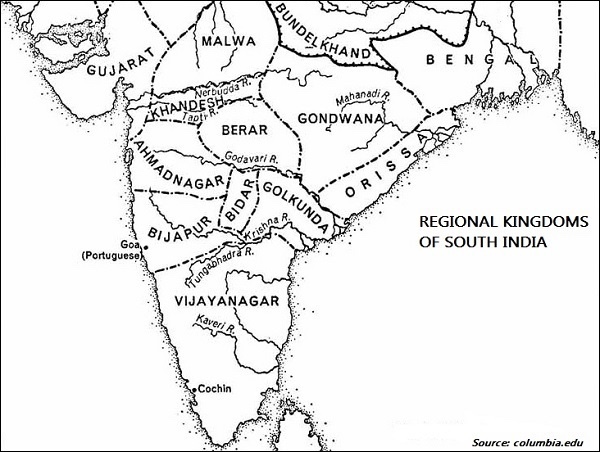
As it is well known, the Deccani states, namely the Nizamshahi kingdom of Ahmadnagar, the Adilshahi kingdom of Bijapur, the Imadshahi kingdom of Berar, the Qutbul Mulk dynasty of Golkonda and the Barid family of Bidar came into existence as a result of the dis-integration of the Bahamani kingdom.
During the 14th Century, the Bahamani kingdom was a powerful state encompassing the entire Deccan and having its capital at Bidar. The process of the emergence of these independent states began during the reign of Sultan Mahmud Shah Bahmani (1482-1518). It was during his reign that in 1490, his governor, Malik Ahmad Nizamul Mulk, administering the territory in the area of present day Maharashtra, with his headquarters at Junar, declared himself independent and assumed the title of Nizam Shah. Side by side, two other governors also declared their independence: They were Adil Shah Yusuf of Bijapur, i.e., situated south of Godavari, on the western coastal regions of Maharashtra; and the governor of Berar, situated to the east of Ahmadabad and Bijapur and the wewst of Telangana region.
Then in 1508, Qutbul Mulk, the governor of Golkunda declared independence. Finally Bidar also passed into the hands of the Bahmani Wazir family – the Barids. Amir Barid declared himself the ruler in 1528 after eliminating the last Bahmani ruler. So starting in 1491 the process was completed by 1528.
Khandesh had also emerged independent of the Bahmani control and the Faruqis of Khandesh were having their headquarters at Burhanpur. The Nizamshahis were at Ahmadnagar. Daulatabad was another important place.
Let us briefly deal first with the geographical significance of these states and the territorial disputes which existed between them.
The territory of the Kingdom of Khandesh was roughly located in the Valley of Tapti: between Narbada and Tapti. Parts of it were controlled by Malwa. From Abul Fazl’s account of Pir Muhammad Khan Sarwani’s campaign against Baz Bahadur it appears that certain parts of Malwa region passed into the Mughal hands in 1562. According to Abul Fazl, Baz Bahadur was expelled to Bijagarh sarkar, which at this time was a part of Malwa region. Again in the same area, between Narbada and Tapti, towards the east was the region of Sultanpur, which was a source of long-standing dispute between Khandesh and Gujarat. For some time this place was under the control of the Gujaratis, but the Khandesh kingdom was trying to get it.
South of Tapti, the frontier of the Gujarati kingdom extended from the coast of Ahmadnagar and came face to face with the frontier of Khandesh. Sarkar of Nandurbar was at this time again a source of friction between Gujaratis and Khandesh.
The dispute over Sultanpur and Nandurbar was inherited by the Mughals from the Gujaratis in 1572.
The territory of Berar was located to the south-east of Khandesh. In fact its upper reaches were marked by Tapti. Towards south, Godavari demarcated the territory of Berar from Bidar and Golkunda. On the eastern and western side it was sandwiched between Gondwana and Bidar.
Berar’s territorial dispute with Ahmadnagar mainly revolved round a certain place, Pathri, on the left border of Godavari at a point close to the Ahmadnagar side which wanted to control it. There were repeated clashes between the two over this territory. Till 1518 Pathri was with Berar. It was then occupied by Nizamshahis and the same year it was rescued by Imaduddin. Burhan Nizamshah once again occupied it and it remained with Ahmadnagar down to 1564 when Ahmadnagar extinguished the Imadshahi dynasty. It resulted in total destruction of Berar and its annexation to Ahmadnagar.
Then it is significant to remember that the famous coastal port-town of Chaul, occupied by the Portuguese in 1507, was located on the Ahmadnagar coast, and was a part of the Ahmadnagar territory. The Portuguese gained this port from the Nizamshahi kingdom and there was a long standing dispute over it between the Portuguese and the Nizamshahis.
So far as the territory of Bijapur is concerned, the frontiers of Bijapur and Ahmadnagar passed through the Maratha territory in such a manner that the Sarkar of Sholapur was in dispute between them.
Tungabhadra River demarcated Bijapur from Vijaynagar and the two had a long standing dispute over Tungabhadra and Krishna Dwar. Vijaynagar thought that the river Krishna was the frontier and not the Tungbhadra: over this region frequent wars occurred.
The Bijapur kingdom also had dispute with the small state of Bidar. It represented the heartland of the original Bahmani Empire. Therefore the rulers of Bidar had a natural tendency to think that the Gulbarga township in Bijapur belonged to them – it being originally the kingdom of the Bahmanis. So one source of conflict was Gulbarga; coveted by Bidar but controlled by Bijapur.
Adil Shah coveted Kalyani, which was within Bidar. It was situated close to Ahmadnagar frontier and the Bijapur control would have given them advantage over Nizamshahis conflict over Sholapur.
Lastly we come to Qutb Shahi state of Golkunda which was on the eastern coast and covered the Telegu speaking regions (Andhra). It was separated in the north from Orissa and Bidar by the river Godavari. Towards the south was the river Krishna which was accepted as the boundary separating the Vijayanagar Empire from Golkunda. Towards the west, it was flanked by Bidar.
Let us now deal with the second issue:
As far as the history of Akbar’s relations with Deccan states are concerned, Akbar’s involvement in the Deccan states starts with the conquest of Malwa in 1562. They became more deeper with the conquest of Gujarat in 1572, as after crossing Malwa, the Mughal frontiers advanced upto Khandesh and involved it in the conflicts. Malwa controlled Bijagarh and also sarkar Nandurbar. With the annexation of Gujarat, the Mughals came to have common frontier with Khandesh and Ahmadnagar as well. In addition, they also inherited yet another legacy: the dispute between the Khandesh and Gujarat over Sultanpur and Nandurbar. Both the places were occupied by the Mughals and this created a hostile feeling between them and the rulers of Khandesh.
Once the Mughals had occupied Malwa and Gujarat, they became increasingly involved in the Deccan states in general and Khandesh, Ahmadnagar and Berar in particular: more particularly Berar, as it was the territory through which it was possible to penetrate Ahmadnagar.
It was a result of this involvement that gradually the Mughals started developing ambitions to penetrate the Deccan peninsula first by trying to hegemonize over Khandesh and Berar tactically and then by force through military invasion in 1595. In 1596, Ahmadnagar was besieged and a treaty concluded when Nizamshah’s successor decided to give Berar to the Mughals. Four years later another expedition was launched and Ahmadnagar was captured and the last of its ruler sent to Gwalior and the kingdom was extinquished. Akbar also decided to extinguish the kingdom of Khandesh, though its ruler co-operated with the Mughals from 1595 onwards. But in 1600, Akbar felt that the ruler of Khandesh was conspiring against him. Asirgarh the second capital of Khandesh was also attacked and after a long siege it was captured and the Faruqi dynasty was extinguished. Khandesh, Berar and Ahmadnagar were included in the Mughal territory.
Thus, the history of Akbar’s relation with Deccan states became eventful roughly from 1562-63 after the conquest of Malwa when the Mughal frontiers were extended upto the confines of Khandesh across Narbada.
Then the second important landmark was 1572 when the conquest of Gujarat took place and the Mughal frontiers reached the western confines of Khandesh and the northwest of Ahmadnagar.
The third important landmark in this development was 1577 when Raja Ali Khan came to the throne in Khandesh. He was a prince of the Faruqi dynasty who had taken shelter in the Mughal Empire sometime before 1576 after falling out with the then ruler of Khandesh, Miran Muhammad, who was allied with Ahmadnagar. After Miran’s death in 1576, Raja Ali Khan returned to Khandesh with Akbar’s consent and was stalled as the ruler. This was a turning point. From this time, Khandesh was by and large allied with the Mughals and with Akbar.
As a result of this, ground was prepared for the induction of Khandesh into the Mughal area of influence. It was not annexed by Akbar till 1600. Till then he treated it as an area of influence and preserved the right to march through it when he had to go to Ahmadnagar or the territory of Berar.
Then another landmark was in 1583, when Akbar formally approached all the rulers of the Deccan, including Ahmadnagar, Bijapur and Golkunda, to accept his overlordship. This policy of Akbar also highlighted by the subsequent developments indicating that Akbar was not averse to take military action and force for forcing Ahmadnagar and others to accept his overlordship.
Then the final landmark was in 1595 when a decision was taken by Akbar to launch a full fledged military offensive against Ahmadnagar with the aim of annexing Berar and Ahmadnagar to the Empire. In 1577 was followed the policy of persuasion. From 1595, the policy was to annex Ahmadnagar and Berar by force and to secure the allegiance of other states, Bijapur, Golkunda, Bidar etc through intimidation. This policy culminated in the annexation of Khandesh in the same year with the fall of Asirgarh.
Keeping in mind these landmarks, the history of this can be again divided in three phases: (1) From 1562 to 1582 when Akbar is interested in the Deccan as his frontiers reached the confines of the Deccan but he did not take any concrete moves to bring military pressure to force an acceptance of Mughal overlordship. The only exception was Khandesh, but it was not a Bahmani kingdom but an independent power which was in between the Nizamshahis and the Bahmanis. So far as Akbar was concerned, his design was to keep Khandesh on his side and so military pressure was resorted to. But for other states there is no indication that any workable military of diplomatic pressure was built or resorted to. But then diplomatic contacts were established with Ahmadnagar, Bidar, Golkunda and Bijapur. There were exchanges of letters and presents.
In 1562 after Malwa had been conquered, the Mughal commander Pir Muhammad Khan crossed Narbada in pursuit of Baz Bahadur, the ruler of Malwa, and occupied Bijagarh, an important stronghold to the south of Narbada which till time belonged to Malwa. After having occupied Bijagarh, Pir Muhammad was encouraged to march upon Burhanpur, the capital of Khandesh, on the pleas that the ruler of Khandesh, Miran Muhammad had given shelter to Baz Bahadur.
But the Mughal advance into Khandesh and the occupation of Burhanpur created a sharp reaction in the Deccan resulting in the establishment of an alliance between the Rulers of Khandesh, Ahmadnagar and Berar as well as the remnant forces of Baz Bahadur. These joint forces advanced against Pir Muhammad and forced him to vacate regions south to the south of Narbada. In fact in trying to cross Narbada, Pir Muhammad was killed and in this manner the first ever attempt made by the Mughals to gain control of the Khandesh territory resulted in a failure.
But then it should be remembered that Pir Muhammad’s advance on Burhanpur was on his own initiative and not on the orders of the central authority. And thus no further moves to avenge Pir Muhammad’s death or defeat were made. It was explained away as a consequence of his own rash action.
From this time down to 1572, we find although there were occasional diplomatic contacts of the Mughals with the rulers of Khandesh and Ahmadnagar as well, but there were no cordial relations with the Deccanis.
But the situation underwent a radical change in 1572. Mirza Muhammad Husain, who had rebelled against Akbar and had a large Mughal retinue, now took shelter with the ruler of Ahmadnagar. So now Akbar acquired a grievance against the ruler of Ahmadnagar for giving the rebel shelter.
Abul Fazl writes in the Akbarnama that in 1572 itself Akbar received the envoy of Murtuza Nizam Shah of Ahmadnagar at Agra who brought with him many precious presents as well as a letter of Murtuza Nizam Shah explaining the position of Ahmadnagar ruler regarding the rebel Mirza. The person who brought this letter was Mir Muhammad Rizvi Mashhadi. According to Abul Fazl, Murtuza Nizam Shah assured Akbar to drive out the Mirza but refused to accede to Akbar’s demand that the Mirzas be arrested by the Ahmadnagar authorities and be handed over to the Mughals.
Thus it appears that Ahmadnagar was not meeting Akbar’s demand fully, thus giving rise to Mughal grievance.
Then sometime in 1572-76, it seems that Akbar decided to extend his influence over Khandesh. He was tempted to do so for obvious reasons. The ruler of Khandesh, Miran Muhammad Shah was closely allied with Murtuza Nizam Shah with whom Akbar nursed a grievance.
To bring force on Nizam Shah, the Mughals needed a foothold in the Khandesh region, without which the pressure could not be built.
Akbar gave shelter to Raja Ali Khan, the prince of the Faruqi dynasty; he extended him a mansab and jagir in Malwa from where he would be threat to Miran Shah at Khandesh.
Another indication of the changed orientation was the general mobilation which Akbar ordered in 1576 under the command of Shihabuddin Ahmad Khan, the Mughal governor of Malwa with the declared aim of invading Khandesh – but the intriguing aspect of this evidence is that Abul Fazl mentions this just once and then does not report what actually happened thereafter: whether the penetration occurred, pressure exerted on Khandesh or not? But then mobilization along Narbada is reported. It was probably just a show of force by the Mughals probably.
For Akbar, a very fortunate development took place the same year. Miran Shah died and his death enabled Raja Ali Khan to establish himself at Burhanpur with Mughal consent.
With him coming to the throne, the whole nature of Mughal relations with Khandesh underwent a basic transformation. Raja Ali Khan made it abundantly clear that he accepted Akbar’s formal over-lordship by not assuming the title of Shah. He simply continued to call himself Raja. Secondly, his close ties with Akbar and the Mughal officers stationed at Malwa made him a suspect in the eyes of Ahmadnagar.
He had no option but be on the right side of the Mughals by and large. Still he was not in favour of conceding to Akbar the right to pass through the territory of Khandesh in his future campaigns and expeditions against Ahmadnagar or Berar. This question became important in 1574 when the Ahmadnagar kingdom overran the kingdom of Berar and a large number of the Berari nobles who were not reconciled to the establishment of the Nizamshahi control over their territory came to Khandesh with the intention of going to the Mughal court to seek its help to re-establish their lost territory. Raja Ali Khan correctly anticipated that if these nobles were allowed to proceed to Malwa – the Mughal territory, this would create a serious problem for him, as the Mughals being hostile, would miss no opportunity of doing something to humiliate the Nizamshahis and the request of the nobles of Berar would serve Akbar with a pretext of doing so. And if he decided so, there was no option but for the Mughal forces to march through Khandesh territory. So if these nobles reached Akbar’s court, it was very likely that Akbar would demand a right of passage which Raja Ali Khan was not prepared to concede, but was not in a position to resist as well.
Thus the nobles were to be prevented from going to the Mughal court. This action of Raja Ali Khan was interpreted as a hostile action and Akbar ordered a general mobilization of troops in 1577. The command was given to Shahbaz Khan, mirbakhshi, with the declared aim of marching into Deccan (i.e., Khandesh & Berar).
But this was again meant not for actual invasion but aimed at making some kind of a demonstration of military might as done on the earlier occasion, in order to make the ruler of Khandesh change his overall attitude. Abul Fazl says after sometime, the orders were reversed and the troops dispersed.
Probably by the show of force, the submission of Raja Ali Khan was temporarily achieved and the tensions between the two eased. It appears so because we find that in 1577 once again there arrived an embassy from Murtuza Nizamul Mulk with a letter carried by his envoy, Waqar Khan, couched in a cordial language and accompanied by precious presents including a large number of elephants.
Up till 1581 the relations between the Mughals and the Deccan were no longer very tense. They were marked with friendly exchanges, particularly with Khandesh and Ahmadnagar.
In January 1580, Akbar sent one of his important nobles, Peshrau Khan, as his envoy to Ahmadnagar. Abul Fazl says that the ruler of Ahmadnagar who had become almost insane by this time and had completely withdrawn from active life, went out of his way in meeting Akbar’s envoy and sent him back with one of his own officers who, again, carried all sorts of presents. This envoy, in 1580 was Asaf Khan.
From 1582 onwards, it seems Akbar followed a policy of forcing Deccan states, particularly Ahmadnagar, to accept Mughal over-lordship. Akbar tried to obtain his objective through diplomatic as well as military pressure.
Instance of this are the letters that Akbar sent to all the Deccani rulers including the ruler of Ahmadnagar, advising them to accept his over-lordship. But this move does not appear to have been very fruitful: In reply to this letter, all Deccani states wrote back courteous letters expressing friendly sentiments for Akbar but abstaining from any clear statement of acceptance of Mughal over-lordship.
Another similar kind of move, with similar nature was Akbar’s decision to give shelter to Burhan, the younger brother of Murtuza Nizam Shah whom he had first imprisoned and when he escaped, made attempts to eliminate him. Burhan first took shelter at Bijapur and subsequently came over to Gujarat from where he proceeded to Fathpur Sikri. Akbar admitted him as a noble and a jagir was awarded. This was in fact a very hostile posture directed towards Ahmadnagar ruler and indicated Akbar’s plan to use Burhan as his pawn in any future conflict with Murtuza Nizamshah.
Subsequently in March 1585, when there was an attempt on the part of the nobles of Berar to overthrow the Ahmadnagar domination and revive the Berar principality which had been extinguished as a result of annexation of Berar to Ahmadnagar in 1574, Akbar came forward to extend moral support and material help to these nobles. After this rebellion was crushed by Ahmadnagar, the nobles of Berar crossed into Khandesh and took shelter with Raja Ali Khan. Subsequently on Akbar’s direction, Raja Ali Khan sent these people to the Mughal province of Malwa, where they were provided with rich jagirs for their maintenance. So once again Akbar was trying to pay back to Murtuza Nizamshah for his hostile action of giving shelter to Muhammad Husain Mirza and also for his refusal to hand him over to Akbar when such a demand was made by him. This action of Akbar was again a clear indication of a particular hostility that he felt against Ahmadnagar Kingdom and it testified of his plans to take military measures for suppressing the Nizamshahi kingdom. This happened in 1585. Then in the next year, in March 1586 Akbar deputed Khan-i Azam Mirza Aziz Koka, the governor of Gujarat, and Shihabuddin Ahmad Khan, the governor of Malwas, to join their forces and advance to conquer Berar. They were also directed to take with them Berari officials and nobles who had taken shelter in Malwa. On this occasion, attempt was also made by Akbar to persuade Raja Ali Khan to join the expedition against the Ahmadnagar authorities at Berar.
The Raja however was greatly panicked by this sudden decision, which also meant the passing of Mughal forces across Khandesh territory on many points: It was to proceed to Berar across Khandesh territory north of river Tapti. The forces led by Shihabuddin Khan were to cross Burhanpur and Asirgarh before they could reach Berar region. Thus Raja Ali Khan panicked.
So in 1586, before they could reach Berar, the Mughals were confronted in the Khandesh principality by the joint forces of Ahmadnagar and Khandesh. The story of this expedition is rather long. In the beginning the Mughal officers, Mirza Aziz Koka and Shihabuddin Khan could get not synchronize their moves, thus could get no upper hand. Subsequently, the forces of Mirza Aziz Koka decided to avoid the enemy and tried to reach Berar sidetracking the forces of Ahmadnagar and Khandesh. They tried to penetrate Berar from the north. But the attempt was not successful. While withdrawing to Gujarat, they were followed and serious losses were inflicted on the Mughals. Koka, when he reached Nandurbar, purchased peace with Khandesh and Ahmadnagar. The talks were conducted by Abu Turab Wali. The only condition of peace was that the Deccanis would not invade the Mughal territory of Gujarat. So the attempt to dislodge the Ahmadnagar authority from Berar failed partly on account of Raja Ali Khan, and partly on account of a lack of co-ordination between the Mughal officers.
However this move of Akbar made it clear that he now considered the conquest of Deccan a practical proposition. But of course it is obvious that Akbar was not in a position to undertake another such invasion the next year as he was confronted with a delicate situation on his North West frontier – In 1584 Badakhshan had been annexed. Negotiations were going on through Hakim Hummam, and Akbar was trying to prevent Abdullah Khan Uzbek from over-running Khurasan. Akbar at this time was not sure whether he would be able to fight a long drawn war with Uzbeks.
Thus in spite of the humiliation of the absence of a success in 1586, Akbar did nothing. But it was clear that if circumstances were favourable, Akbar would not be averse to the use of force to pacify the Deccan.
This is also indicated by a letter that Akbar wrote to Abdullah Khan Uzbek, sent through Hakim Hummam. The content of this letter have been discussed earlier. He went out of his way to state that he was contemplating attack on the Deccan principalities and that he had direct access to coastal regions and expelled the Portuguese, but that he had postponed a full-fledged invasion of the Deccan due to present pre-occupations. What is clear from this letter is his intent and contemplation on attack of Deccan in 1586.
Question arises as to what could have been the basic consideration and aim of Akbar in demanding to annex parts of Deccan to his empire – particularly Berar and Ahmadnagar? In this connection, basing himself on Akbar’s statement made in the letter to Abdullah Khan Uzbek, Smith suggests that in addition to Akbar’s general expansionist policy, one consideration which prevailed with him was the presence of the Portuguese on the western coast of India. Perhaps he regarded this as a very great threat to his own position and was very interested in the elimination of the Portuguese pockets like Dieu, Daman, Chaul and Goa. The main evidence on which Smith assumes this aim of Akbar is the following para of Akbar’s letter to Abdullah Khan Uzbek:
I have kept before my mind the idea that when I should be entirely at liberty from these tasks (in N.W.), I should, under the guidance of God’s favour, undertake the destruction of the firangi kafirs who have come to the coastal regions (jazair-i daryai), and have lifted up the head of turbulence and stretched out the hand of oppression upon the pilgrims to the Holy Places….They (the Portuguese) have become a great nuisance and are stumbling blocks to the pilgrims and traders. We thought of going in person and cleansing that road of thorns and weeds, but as We heard that some of the officers of Persia had proved disloyal to the sovereign…I thought of going to help of the Persian…
It seems Akbar’s real grievance was that of the serious threat to the administration and Mughal authority in these regions. This is borne out by his moves from 1562 onwards. We know that in 1562 at a time when on the one hand, he was trying to give an impression to the Portuguese authorities in Goa that he was very friendly towards them through a special treatment extended to the Jesuit fathers – in fact trying to induce the Jesuits to assure their authorities that he was quite friendly towards Christians in general. He also gave the impression of getting converted. But in 1582, he was also planning an expedition against Dieu and Daman in the region of Gujarat. This attack when it came, was sought to be explained by Akbar before the Jesuit fathers as a local episode. He said that the commander of the Mughal forces in Gujarat, Qutbuddin Khan, had moved against Dieu in 1582 on his own without Akbar’s knowledge. The Jesuits then requested the emperor, in that case to direct him to withdraw and apologise. Akbar said how can I ask him to do that? However, the attempt was not successful.
The next year another attempt was made, this time on Daman. It is obvious that these attempts were a part of a policy to push out the Portuguese, but if the attempt failed, the prestige of Akbar might not be hurt. The sentiments expressed in Akbar’s letter to Abdullah Khan were thus for real and revealed an attempt of the Mughals to push back the Portuguese: whether for facilitating Hajj or to safeguard his empire.
The question is why Akbar should think that unless he himself is controlling the Deccan region, it was not possible to oust the Portuguese from the west coast?
This is partly borne out by the history of relations of the Deccani states with the authorities at Goa and Chaul. One part of Chaul was in the territory of Ahmadnagar; Goa was in the kingdom of Bijapur. And thus unless ousted from here, they could not be ousted from Daman and Dieu: naval enforcements from Chaul and Goa would frustrate any attempt on the other two.
Secondly, the history of Ahmadnagar’s relations with the Portuguese at Chaul and Bijapur’s relations with Goa indicated that the two on account of limited resources and continuing conflict within themselves were not in a position to make any headway against the Portuguese. For example, the case of Chaul: It was occupied in 1507 by the Portuguese but very soon they lost it to the joint armada of Indian and Mamluk forces. In the very next year, the Portuguese re-occupied Chaul and Ahmadnagar was not in a position to check their power. Then in c. 1569-70, Murtuza Nizamshah of Ahmadnagar made yet another attempt to occupy Chaul with the help of the Zamorin of Calicut. This attempt again proved to be a failure. In 1592, Burhan Nizamul Mulk made another attempt, but failed and Chaul continued to be controlled the Portuguese.
Similarly in the case of Goa, after its occupation in 1510, Adil Shahi dynasty did succeed for a brief period, but were ultimately ousted out by the Portuguese. From 1511 onwards Goa remained in Portuguese hands and became the headquarters of the Portuguese Empire in the East. In 1548, the Bijapuris made a serious attempt to regain Goa, but the net result of this attempt was that they lost two more strongholds in the vicinity of Goa to the Portuguese – Salsette and Bardez.
So history indicated that the Deccani states had failed to arrest the growth of th Portuguse and Akbar surmised that the entire Deccan had to be captured in order to oust the Portuguese. But Akbar knew that he could not push out the Portuguese from Gujarat – but this was again partly due to the Portuguese presence in Chaul and Goa.
In 1589 Murtuza Nizamshah died – he had become insane but had enjoyed great prestige – and as soon as this news reached Akbar, he recalled Burhan from Kabul region and sent him to Malwa so that he try to march to Ahmadnagar and establish himself there with the help of Mughal forces and Raja Ali Khan.
When Burhan reached Khandesh, he proved clever: the joint forces of Mughal officers and Khandesh were prepared to march with him to Berar, but Burhan told them that if he marched with the Mughal forces, it would lead to some kind of local resistance which would make his task difficult. So Khan-i Khanan and the others who were there were asked not to accompany him. Only 1000 horsemen and 300 banduqchis (the Gujarati and Berari deserters in the Mughal territory) entered with him into Berar. With the help of the local mobilization of the Gujarati officers he advanced to Ahmadnagar which was being controlled by Kamal Khan, a Nizamshahi noble. Kamal Khan had established Murtuza’s son Ismail as ruler.in the ensuing battle Burhanul Mulk emerged victorious. But this development did not prove to be much helpful to the Mughals: Akbar had anticipated that this would bring Ahmadnagar under his control without having formally annexing the territory. However, once Burhanul Mulk established himself, he made it clear to all that he was not going to compromise the sovereignty of Nizamshahi dynasty in any manner. So Akbar was back to the same position.
The Persian histories fail us to provide a proper understanding of what happened in these late years: Nizamuddin Ahmad closes his account in 1593, Badauni in August 1595 and Abul Fazl is very sketchy for the last few years befor closing in 1602 when he was murdered.
However, what appears is that in 1595 Burhanul Mulk died and was succeeded by his son Ibrahim, who in 1595 itself was defeated by the army of Bijapur.
In the meanwhile, it appears that in 1593 Akbar had ordered Abdur Rahim Khan-i Khanan and the subadar of Gujarat, Prince Murad, to launch an attack against the Deccanis. Thus Ahmadnagar was invested and the Mughals had to face Chand Bibi, the sister of late Burhanul Mulk and the widowed queen of Bijapur. She forced the Mughals to agree on terms deemed ‘unworthy’ by Abul Fazl. Under this treaty signed in early 1596, a minor, Bahadur, the grandson of Burhan was to be recognized as the king of Ahmadnagar, and, apart from some valuables, Berar was to be ceded. Thus for the time being Ahmadnagar was saved.
However in 1597 the respite gained by Ahmadnagar by Chand Bibi gave way when her authority was overthrown. In a battle fought at Supa, Khan-i Khanan emerged victorious. It was a small victory for the Mughals with heavy losses. Raja Ali Khan who had fought along the imperial forces was also killed. Murad and Khanan were recalled and Mirza Shahrukh of Badakhshan was appointed as the new commander.
In 1598 came the news of Abdullah Khan Uzbek’s death. Now Akbar was free not only to leave North West but also to lead a campaign in the Deccan. Thus in July 1599, Akbar decided to proceed himself. In May Murad also died. In the mid-1599 Akbar occupied Burhanpur and Daniyal along with Khan-i Khanan were sent to conquer Ahmadnagar. The town was stormed in 1600. Chand Bib was either murdered or consumed poison and the king of Ahmadnagar sent to prison in Gwalior.
The Imperial armies then marched to Asirgarh against Raja Ali Khan’s successor and forced its surrender. Operations there were conducted by Shaikh Farid Bukhari and Abul Fazl. According to Jesuit accounts, i.e., Du Jarric, the surrender was more a result of bribe rather than Mughal arms. In August 1600, Ahmadnagar was taken. In August Salim’s rebellion occurred, forcing Akbar to free himself from the Deccan affairs.
The newly acquired territories were organized as three subas, i.e., Ahmadnagar, Berar and Khandesh. And all the three along with Malwa and Gujarat were placed under Prince Daniyal, the viceroy of the Deccan.