Syed Ali Nadeem Rezavi
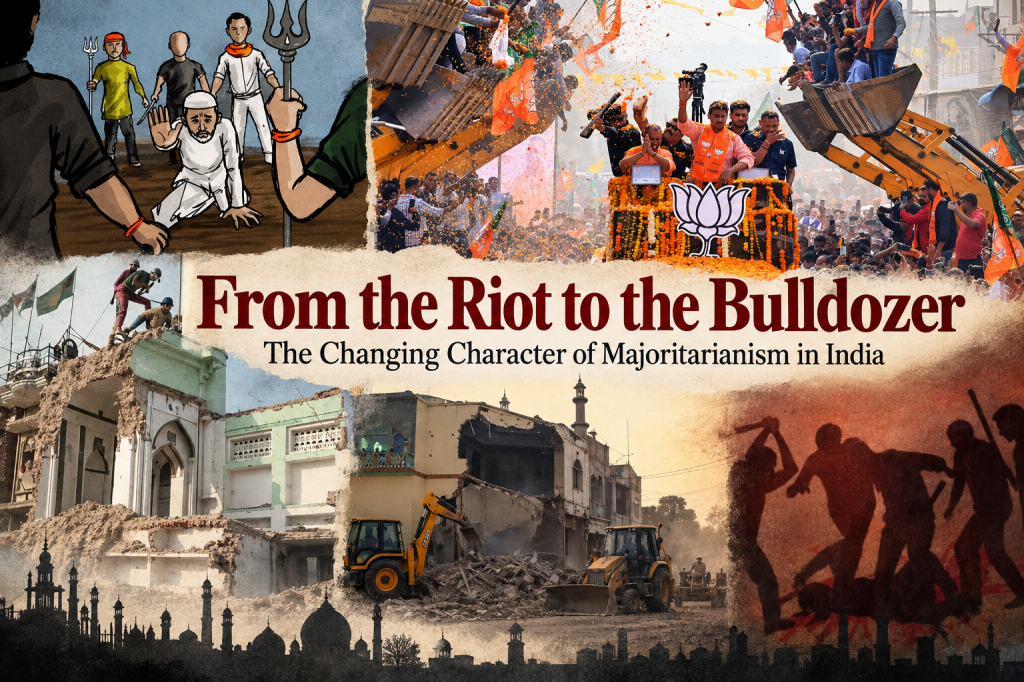
The violence exists, the modes of violence have changed.
The Old Violence
For most of independent India’s history, communalism announced itself through the riot. Cities burned, curfews fell, and neighbourhoods barricaded themselves. Aligarh, Meerut, Moradabad, Sambhal, Delhi, Ahmedabad, Bhagalpur, Bhiwandi, Hyderabad, each acquired its own history of conflagration.
The official vocabulary was ritualistic: “clashes between two communities,” curfew imposed, peace committees formed, normalcy declared. Yet research consistently showed that such violence was rarely spontaneous or symmetrical. Political organisations, local networks, electoral calculations and police behaviour determined whether a quarrel became a conflagration.
Crucially, the riot was understood as a breakdown of order, something the state was expected to prevent, stop and investigate. Hence the long succession of commissions: Shiv Dayal Srivastava (Jabalpur, 1961), Raghubar Dayal (Ranchi-Hatia, 1967), Jaganmohan Reddy (Ahmedabad, 1969), D.P. Madon (Bhiwandi-Jalgaon-Mahad, 1970), B.P. Sinha (Aligarh, 1961), M.P. Saxena (Moradabad, 1980), Srikrishna (Bombay, 1992-93), Liberhan (Babri Masjid), Nanavati-Mehta (Gujarat, 2002).
These inquiries were imperfect. Reports were delayed, suppressed, ignored. Recommendations went unimplemented. Yet they performed a democratic function: they produced an official archive, examined witnesses, scrutinised police records, and acknowledged that something abnormal had occurred. The underlying question was constitutionally vital: How did we allow this to happen?
The New Repertoire
Since 2014, something has changed – not the disappearance of violence, but its character. The classical riot no longer occupies the same central place. Majoritarianism has developed a wider repertoire: lynching, vigilantism, economic exclusion, attacks on religious structures, disputes over graveyards and shrines, administrative demolition, challenges to minority institutions, cultural marginalisation, and the communalisation of ordinary public space.
The older riot concentrated fear into a few terrifying days. Contemporary majoritarianism distributes fear across everyday life. A Muslim man suspected of possessing beef may be assaulted. A cattle trader intercepted on a highway. An interfaith couple harassed. A shopkeeper faces boycott calls. A procession becomes an assertion of territorial possession.
None of this requires a city-wide riot.
The lynching occupies a distinctive place: it needs neither thousands of participants nor sustained breakdown of public order. An accusation, a victim, a small crowd, sufficient confidence, and a camera. The victim becomes a message. Exemplary violence works precisely because it is unnecessary to attack everybody if enough people can be persuaded to regulate their behaviour through fear. The records are maintained.
The minority citizen’s question changes. No longer simply, “Will there be a riot?” but: Can I transport cattle? Can I sell meat? Can I rent a house here? Can I conduct business under my own name? Can I marry whom I choose? Can I pray here? Will an allegation circulating on social media bring a crowd to my door?
This is the movement from exceptional violence towards everyday insecurity.
The Bulldozer as Political Symbol
No object symbolises this transformation more vividly than the bulldozer.
Ostensibly an administrative machine, clearing encroachments, removing illegal construction, it has acquired political meaning, particularly when properties belonging to persons accused of protest or communal disturbance are demolished soon after the alleged offence.
There is nothing inherently communal about removing illegal structures. The constitutional issue arises when demolition appears to become punishment, especially when guilt has not been established by a court. In November 2024, the Supreme Court held that the executive could not assume the role of judge, pronounce guilt, and punish through demolition. It laid down nationwide safeguards concerning notice and due process.
The contrast with the classical riot is revealing. The riot represented a breakdown of law. “Bulldozer justice” threatens to present punishment as law.
Sacred Space Under Contest
The question becomes more sensitive when demolition touches places of worship.
Mosques, madrasas, dargahs and mazars have increasingly figured in demolition drives, encroachment disputes and administrative action. In Haldwani in February 2024, demolition of a mosque and madrasa during an anti-encroachment operation was followed by serious violence and deaths. Documented cases span multiple states.
The issue cannot be that a mosque automatically stands above the law. An illegal structure does not become legal merely by becoming sacred. The proper questions concern consistency, proportionality and due process. Are equivalent encroachments treated equivalently? Is notice provided? Are legal remedies available? Why does administrative urgency arise in particular cases? And why, occasionally, is demolition publicly celebrated rather than reluctantly undertaken?
A mosque is more than bricks and mortar. An old mosque records generations of presence. The same is true of the dargāh or mazār. Its disappearance can acquire meaning far exceeding the removal of a physical structure. That too when most of them have existed even before the concept of the new laws, or even the Constitution was ever established.
Even the dead have not remained outside communal politics. The political juxtaposition of shamshan and qabristan is revealing. Equal provision for cremation and burial is legitimate. But when these become rhetorical symbols of competing claims upon public resources, even death is drawn into majoritarian politics.
A qabristān is an archive without paper. Its gravestones preserve names and dates, record generations of occupation, demonstrate that a community has belonged to a locality not merely for an electoral cycle but sometimes for centuries. A dispute over a graveyard can become a dispute over historical belonging itself.
The mazār raises an even more complicated question. India’s sacred geography has historically refused to conform to modern communal boundaries. Dargāhs were visited by Hindus as well as Muslims, people tied threads, offered chādars, sought blessings without seeing these practices as contradictions of their religious identities. This shared culture should not be romanticised; pre-modern India knew conflict as well as accommodation. Yet it produced sacred spaces whose constituencies crossed formal boundaries. The attack upon such a shrine potentially erases something different from the attack upon a mosque: not merely masonry, but a memory of coexistence.
Festivals, Markets, and the Discipline of Everyday Life
The same transformation is visible in festivals. Indian festivals were historically far less hermetically sealed than modern categories suggest. Muslims participated in Holi and Diwali; Hindus in Muharram. Artisans of one community manufactured objects used by another. A Muslim participating in his neighbour’s festival did not cease to be Muslim, any more than a Hindu visiting a Sufi shrine ceased to be Hindu.
Attempts to exclude Muslim traders from Hindu festivals challenge the older understanding of festival, market and neighbourhood as overlapping social spaces. The paradox is worth noting: a politics claiming to defend Indian tradition can undermine precisely those habits of borrowing and coexistence through which Indian traditions historically developed.
Economic exclusion represents another important development because it can discipline a community without visible violence. Calls to boycott Muslim businesses, demands that names revealing religious identity be displayed – these transform ordinary commerce into an arena of communal identification. No shop has to burn. Customers need only be persuaded not to enter it.
This is potentially more enduring than riot because economic marginalisation can occur beneath the surface of apparently normal civic life. Markets remain open, traffic continues, no curfew is required. Yet the social geography of the city changes.
Education, Culture, and Memory
The same process reaches institutions of learning. Minority educational institutions occupy a special constitutional position: Article 30 recognises the right of religious and linguistic minorities to establish and administer educational institutions. Aligarh Muslim University and Jamia Millia Islamia illustrate the complexity, both became important centres of modern Indian education. AMU’s continuing minority-status litigation demonstrates how questions of institutional history and constitutional protection remain contested.
Madrasas occupy an even more vulnerable position. Reform, regulation and scrutiny of educational standards are legitimate. But regulation is different from treating an entire category of institutions as intrinsically suspect. In October 2024, the Supreme Court stayed recommendations that could have closed government-aided madrasas not complying with particular RTE requirements. More recently, drives against allegedly unauthorised madrasas and mosques have continued in parts of Uttar Pradesh. Authorities describe these as actions against unrecognised institutions and illegal constructions; critics question their scale and selectivity.
The distinction must be preserved. Regulation is a function of government. Stigmatisation is a function of majoritarian politics. Demolishing a house intimidates a family. Weakening an educational institution can affect generations.
Majoritarianism reaches further still when cultural inheritance itself becomes divided according to religious identity. Urdu provides an obvious example. Historically it cannot sensibly be described simply as a Muslim language. Its literary culture was created by Hindus, Muslims and Sikhs alike – Mir, Ghalib, Munshi Tek Chand Bahār, Daya Shankar Nasim, Ratan Nath Sarshar, Brij Narain Chakbast, Firaq Gorakhpuri, Rajinder Singh Bedi. To identify Urdu exclusively with Muslims does violence not merely to Muslims but to the history of Urdu itself.
The same is true of Indo-Persian architecture, Hindustani music, Sufi traditions, culinary culture. Centuries of interaction created forms whose ingredients can be traced historically but cannot now be separated without doing violence to the whole. Majoritarianism nevertheless demands ownership. A monument constructed under a Muslim ruler can cease to be regarded primarily as Indian heritage and be recast as evidence of conquest. A Persian inscription can become foreign. A shared cultural form can retrospectively be assigned to one community.
The struggle is not merely over territory. It is over memory.
The Battle over History
This is why the rewriting of history and changes in school curricula cannot be regarded as separate from contemporary majoritarianism. Majoritarianism requires a usable past. If one community is to appear as the natural and continuous owner of the nation, minorities must somehow be explained – assimilated, tolerated, or represented as descendants of outsiders.
The medieval period is particularly vulnerable. Seven centuries of transformation can be compressed into a simple narrative of invasion and resistance. But the evidence refuses to cooperate. Shivaji’s military world included Muslim commanders. Aurangzeb’s imperial service contained large numbers of Hindu nobles, including Rajputs. Mirza Raja Jai Singh commanded the Mughal campaign that defeated Shivaji. Akbar’s Sulh-i Kul cannot be understood within a simple Hindu-Muslim binary.
History becomes inconvenient precisely because the past was more entangled than majoritarian memory wishes it to have been.
The Structural Difficulty
We can now return to the commissions of inquiry, for they help us understand what has structurally changed.
A riot was an event. It had a date, a location, a casualty figure. A commission could reconstruct its causes, identify failures, recommend action.
But how does one appoint a commission to investigate an atmosphere?
Who investigates hundreds of separate acts of intimidation, boycott calls, contested demolitions, attacks upon shrines, disputes over graveyards, inflammatory speeches and instances of cultural exclusion when each can be presented as an isolated occurrence?
This is one of the distinctive strengths of contemporary majoritarianism. Its parts can be defended individually even when their cumulative effect is transformative. One demolition becomes an encroachment matter. One lynching becomes a criminal case. One hate speech becomes an irresponsible individual’s remark. One boycott becomes a private commercial choice. One madrasa closure becomes educational regulation. One dispute over a mazar becomes a land question. One alteration in a textbook becomes curriculum reform. One challenge to a monument becomes an archaeological controversy.
Each can therefore be discussed separately. The historian’s task is to ask whether they form a pattern when viewed together.
The commission of inquiry was designed to investigate the event. Constitutional democracy now faces the harder problem of recognising and investigating the process.
From Composite Culture to Parallel Societies
This brings us to what may ultimately be the most serious consequence.
India’s composite culture was never created by government proclamations about communal harmony. It arose through ordinary encounters. People shared languages, markets, occupations, neighbourhoods, music, foods, shrines and festivals. They borrowed words, clothes, architectural forms, recipes, melodies and rituals from one another.
None of this eliminated conflict. But it ensured encounter.
Majoritarianism threatens this world when it makes such encounters increasingly difficult. If Muslims withdraw from Hindu festivals, Hindus cease visiting Muslim shrines, neighbourhoods become religiously segregated, children grow up in socially homogeneous educational environments, interfaith relationships become dangerous, businesses acquire religious identities, and historical monuments are classified according to the religion of their builders, communities may continue to inhabit the same city while ceasing to inhabit the same social world.
That possibility may ultimately be more consequential than the riot. A riot ends. Curfew is lifted. Markets reopen. Segregation can reproduce itself for generations.
The Constitutional Question
None of this requires us to invent a secular golden age before 2014. Such an age never existed. Independent India witnessed terrible communal violence. Governments failed minorities. Police forces behaved partially. Delhi in 1984, Bhagalpur in 1989, Bombay in 1992-93 and Gujarat in 2002 make any romanticisation of the past historically untenable.
The argument is subtler. What appears to be changing is the repertoire, distribution and sometimes legitimacy of majoritarian power.
The Constitution did not promise minorities merely physical survival or tolerance at the pleasure of the majority. It promised citizenship. Tolerance and citizenship are not synonyms. Tolerance is extended by somebody possessing power towards somebody who does not. Citizenship presumes equality.
This is why the protection of a mosque from arbitrary demolition is not merely a Muslim question. The protection of a Christian school is not merely a Christian concern. The preservation of Urdu is not a concession to Muslims. The protection of a qabristān, mazār, madrasa, library or university from discriminatory treatment is ultimately a defence of constitutional equality.
The Supreme Court’s intervention against arbitrary “bulldozer justice” is important precisely for this reason. The Court emphasised that executive power could not substitute itself for judicial determination and that due process remained indispensable. The principle extends much further than demolition.
The question is whether citizenship remains independent of religious identity.
From the Riot to the Atmosphere
The changing character of majoritarianism can be summarised through a series of transformations:
The riot burned the shop; the boycott can empty it. The mob demolished the house; administrative power can demolish it while invoking regulation. The riot attacked the mosque; litigation and administrative proceedings can contest its very right to occupy the landscape. The mob desecrated the graveyard; politics can transform qabristan and shamshan into competing communal claims.
The riot temporarily prevented neighbours from celebrating together; segregation can persuade them that they should no longer celebrate together at all.
The mob could burn a library; cultural marginalisation can make its language irrelevant to the next generation.
The riot could close a university for a few weeks; sustained suspicion can place the very legitimacy of a minority institution permanently on trial. The riot could damage a monument; majoritarian memory can leave the monument standing while teaching future generations to regard it as somebody else’s history.
And this is perhaps the crucial distinction.
The communal riot was an explosion. Majoritarianism can become an atmosphere.
An explosion is immediately recognisable as an emergency. An atmosphere is more difficult to confront because people gradually become accustomed to breathing it.
For this reason, the relative absence of the old-style communal riot cannot by itself be treated as evidence of communal peace. We have to ask different questions. Are minorities secure in their homes? Are their places of worship equally protected by law? Are their graveyards secure? Can their educational institutions function without their religious identity automatically making them suspect? Can their languages and cultural traditions be accepted as parts of India’s common inheritance? Can their traders participate naturally in markets and festivals? Can their children grow up believing that the monuments, histories and memories of this country belong as much to them as to anybody else?
Above all, does public space still belong equally to every citizen?
That was the radical promise of the Republic. It did not envisage a country in which a Hindu majority generously permitted Muslims, Christians, Sikhs or others to remain. It envisaged a country in which nobody required the permission of another community to belong.
The gravest transformation of majoritarianism may consequently be neither the riot nor even the bulldozer. It is the gradual normalisation of the proposition that the majority possesses the nation naturally while minorities inhabit it conditionally.
The older communal riot sought temporarily to drive the minority from the street. Majoritarianism becomes far more formidable when it begins to determine the conditions upon which the minority may return to that street, worship upon it, trade upon it, study upon it, celebrate upon it, bury its dead beside it, preserve its memories within it and, ultimately, claim that street and the nation around it as equally its own. Today most of the minority institutions and spaces in the country are either burning or stand restricted and repressed.
That is why the silence of the streets must never, by itself, be mistaken for communal peace. We simply exist in more dangerous times.


