Syed Ali Nadeem Rezavi
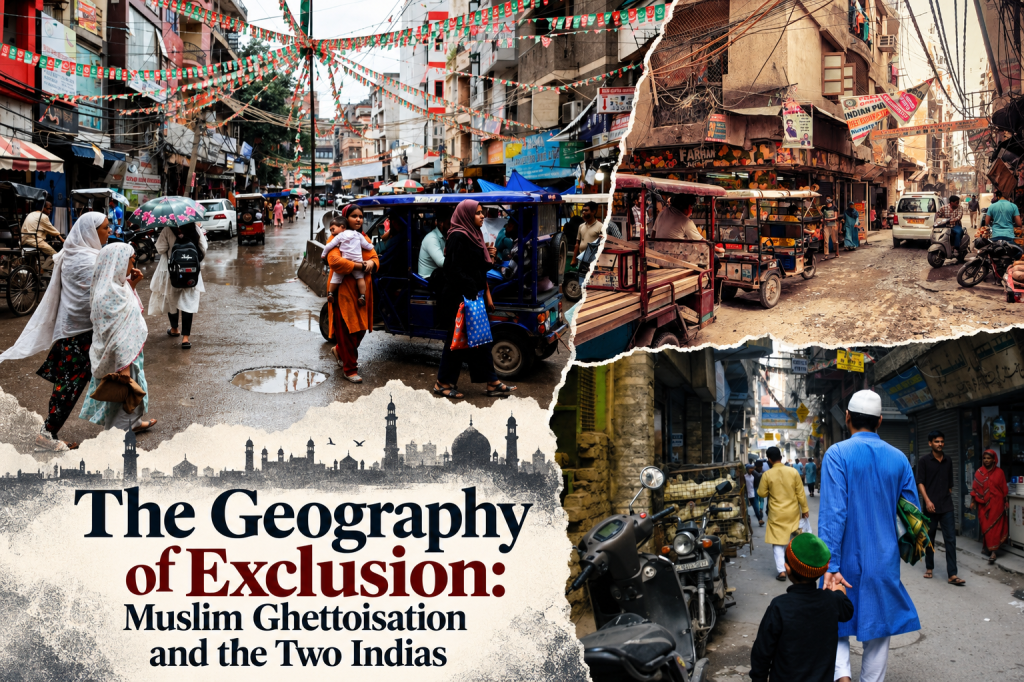
There are neighbourhoods in India whose religious identity announces itself before one encounters a mosque, hears the call to prayer, or notices the beards and skullcaps of their inhabitants. The broken roads, overflowing drains, heaps of uncollected rubbish, tangled electricity wires, overcrowded houses and conspicuous absence of civic amenities often tell you that you are entering a predominantly Muslim locality. What ought to be an indictment of municipal administration has gradually become an accepted feature of the Indian urban landscape. Poverty, neglect and religious identity have become so closely associated in the public imagination that the condition of a neighbourhood is frequently mistaken for a characteristic of the community inhabiting it.
This is not to suggest that every Muslim locality is impoverished, or that civic neglect is confined to Muslims. There are affluent Muslim neighbourhoods, just as there are appallingly neglected Hindu and Dalit settlements. Yet the geographical concentration of Muslims in poorly serviced urban spaces, their difficulties in securing accommodation elsewhere, and the suspicion with which their neighbourhoods are regarded point towards a particular form of exclusion, one in which religious prejudice, economic inequality and administrative indifference reinforce one another.
Reading Rakhshanda Jalil’s deeply personal essay, “Living in Jamia, Coping with Ghettoisation”, reproduced in her collection But You Don’t Look Like a Muslim (HarperCollins, 2019), which she shared once again recently on social media, I was struck by how closely her experiences corresponded with what I have observed elsewhere. Jalil writes of her move from the relatively privileged surroundings of Gulmohar Park in South Delhi to the neighbourhood adjoining Jamia Millia Islamia. What she initially imagined would be a simple change of residence became an encounter with an entirely different social reality.
The most revealing incident concerns her young daughter’s birthday party. Children who had happily attended celebrations at their previous home suddenly found themselves unable to visit the new one. Their parents were reluctant to venture into the Jamia neighbourhood, notwithstanding Jalil’s offers to provide directions or arrange transport. When subsequent birthday celebrations were organised at a McDonald’s elsewhere, the reluctance disappeared. The problem, clearly, was not distance. It was the address.
Jalil recounts similar experiences with landlords who declined to rent accommodation to Muslims, often invoking the familiar preference for “vegetarian tenants”, as though a biryani recipe might somehow contaminate the property deed. Delivery services, dry cleaners and other businesses serving neighbouring affluent colonies refused to cross an invisible boundary into Jamia Nagar. Even more disturbing was the contrast in civic amenities between adjoining localities. One side of the road enjoyed the benefits of organised urban living; the other was left to negotiate inadequate infrastructure and administrative neglect. Her essay is particularly valuable because it demonstrates that ghettoisation is not necessarily the consequence of a community’s desire to live separately. Frequently, it is the outcome of a society’s unwillingness to allow that community to live anywhere else.
What Jalil describes is by no means peculiar to Jamia Nagar, Batla House, Zakir Nagar or Abul Fazal Enclave. It is a phenomenon encountered across large parts of India, and even beyond the towns and cities of the Hindi-speaking belt. Indeed, it has roots extending well into the twentieth century, although the forms of exclusion have changed over time.
I am reminded of an experience in Kolkata several decades ago, probably when Jyoti Basu was still alive. I had gone there to participate in a seminar. At the conclusion of the programme, I requested my hosts to arrange for me to be dropped at a particular street in the Park Circus area. One of the organisers, a gentleman belonging to the city’s educated bhadralok milieu and sympathetic to its long-established communist culture, kindly offered to take me in his car.
As we approached Park Circus, the surroundings began to change. The streets appeared increasingly congested, the environment less orderly, and the visible presence of men wearing beards and skullcaps became more pronounced. The neighbourhood, as it were, began to announce its religious identity.
My companion grew visibly uncomfortable. Finally, he turned towards me and asked, with unmistakable nervousness, “Is it safe for you to go there?”
The question has stayed with me all these years.
Here was a member of Kolkata’s educated, ostensibly progressive middle class, someone shaped by a political environment that had for decades proclaimed its commitment to secularism, class solidarity and opposition to communalism. Yet the sight of a predominantly Muslim neighbourhood was sufficient to produce anxiety. The area had become, in his imagination, a place of possible danger. What made the incident particularly revealing was that his apprehension was not based on anything that had happened to us. We had encountered no hostility, no disturbance, no threatening situation. The anxiety arose entirely from the neighbourhood’s appearance and the identity of its inhabitants. The beards and skullcaps were not evidence of danger. They were merely signs through which a deeply embedded social prejudice found expression.
I have often wondered whether my companion would have experienced the same unease had we been entering a similarly congested Hindu neighbourhood. Perhaps he would have complained about the roads, the traffic or the filth. But would he have questioned my safety merely because of the religious appearance of its residents? The distinction is important. A neglected Muslim neighbourhood is not merely perceived as poor. It is often perceived as dangerous. Its poverty becomes a sign of backwardness, its congestion a sign of disorder, and its religious identity an explanation for both.
And this was Kolkata, the city of the bhadralok, of intellectual debate, progressive literature, trade unionism and a powerful communist movement. If such anxieties could survive within that social and political environment, one can imagine how deeply they had penetrated societies where communal divisions were more openly articulated.
There was another encounter, perhaps more than a decade or so ago, which revealed a different but equally disturbing dimension of the same prejudice. I was travelling from Delhi to Hyderabad by the Rajdhani Express, in an AC two-tier compartment. Seated near me was a young woman who appeared well educated, affluent and thoroughly at ease with the world around her. We struck up a conversation. Speaking fluent English, she told me that she worked for a multinational company in Delhi, had recently visited the United Kingdom, and was now travelling to Hyderabad for the first time.
The conversation proceeded pleasantly until she discovered that I was a Muslim and taught history at Aligarh Muslim University. Her tone changed almost immediately. Looking at me with an expression of genuine surprise, she exclaimed, “But you don’t look like a Muslim!”
I was momentarily taken aback. What, I wondered, was a Muslim supposed to look like? Perhaps she expected me to sport a beard, wear a skullcap, have surma in my eyes and dress in the manner in which Muslims have so often been stereotypically portrayed in popular Hindi cinema, presumably with a permanently villainous expression and a background score to match. Apparently, my appearance, my manner of speaking and my professional identity did not correspond to the image of a Muslim she carried in her mind.
After a brief silence came another question, equally revealing: “In Aligarh, do you teach in Urdu?”
Imagine a young, educated, English-speaking professional, employed by a multinational corporation in Delhi, widely travelled and familiar with life in Britain, yet knowing so little about a university situated barely two or three hours from the national capital! That Aligarh Muslim University is a modern institution of higher education, where English is widely employed as a medium of instruction, seemed to be entirely outside her understanding. For her, the word “Muslim” apparently suggested a particular appearance, a particular language and, by implication, a world quite separate from the modern professional environment she herself inhabited.
What struck me was not merely her ignorance – ignorance can be corrected through information. More troubling was the confidence with which she carried these assumptions, without apparently recognising that they were prejudices. Her education, professional success and exposure to the wider world had done little to challenge the stereotypes she had absorbed.
In many ways, she reflected a mentality that extends well beyond any single individual. Within significant sections of India’s majority community, Muslims continue to be imagined through a narrow collection of visual and cultural stereotypes. Their identity is reduced to beards, skullcaps, Urdu, religious observances and supposed cultural separateness. A Muslim who does not conform to this image becomes an object of surprise, almost an exception requiring explanation.
This is precisely what makes the title of Rakhshanda Jalil’s book, But You Don’t Look Like a Muslim, so telling. The seemingly innocuous remark contains an entire history of stereotyping. It assumes that Muslims possess a recognisable and uniform appearance, that their religious identity must necessarily dictate their language, dress and cultural habits, and that those who do not conform are somehow unusual.
The young woman on the train and my bhadralok companion in Kolkata belonged to different social worlds, but their reactions sprang from a similar conditioning. One associated a Muslim neighbourhood with danger; the other associated Muslim identity with a predetermined appearance and linguistic culture. Neither seemed conscious of the assumptions underlying their responses. Indeed, the two encounters illuminate different dimensions of the same phenomenon. The Kolkata incident revealed the geography of prejudice; the Rajdhani encounter revealed its psychology. In one case, the Muslim was imagined as belonging to a threatening space; in the other, he was expected to conform to a fixed cultural stereotype. Both involved an inability to recognise Muslims as ordinary, diverse participants in India’s shared social and intellectual life.
And herein lies a larger problem. Ghettoisation is not merely the physical concentration of a community within particular neighbourhoods. It also exists in the minds of those who regard that community as fundamentally different from themselves. The walls separating communities are constructed as much through inherited prejudices, cultural representations and everyday conversations as through discriminatory housing markets and unequal civic development.
In the towns of Uttar Pradesh, Bihar, Madhya Pradesh, Rajasthan and elsewhere, the spatial separation of Muslims has long been visible. In many places, older Muslim residential quarters grew around mosques, markets, shrines, artisanal occupations and networks of kinship. Their origins cannot always be explained through discrimination. Medieval and early modern Indian towns frequently developed around occupational, caste, religious and familial clusters. The mohalla was an important unit of urban social organisation.
But there is a fundamental difference between a historically evolved neighbourhood and a modern ghetto. The former may represent social proximity, occupational association or cultural preference. The latter increasingly reflects restricted choices, unequal opportunities and the fear of exclusion or violence. A neighbourhood becomes a ghetto not simply because members of one community live together, but because the wider society erects barriers around them, both visible and invisible.
The communal violence accompanying Partition in 1947 profoundly altered the social geography of many north Indian towns. Subsequent riots, including those in Jabalpur, Ahmedabad, Moradabad, Meerut, Bhagalpur and other cities, contributed to new anxieties about residential security. In some places, families moved towards areas where members of their own community were concentrated, believing that numerical strength offered some protection against communal attacks. Such movements were not always voluntary in any meaningful sense. When a family abandons a mixed neighbourhood because it fears violence, or because its neighbours no longer regard it with trust, the resulting segregation cannot reasonably be described as a free choice.
The process has continued into the twenty-first century. The violence in Gujarat in 2002, for instance, accelerated the concentration of Muslims in particular residential areas of Ahmedabad. Juhapura became emblematic of a larger phenomenon: the growth of substantial Muslim settlements whose residents included professionals, traders, teachers and prosperous families, but who nevertheless encountered the disadvantages associated with a segregated urban space.
The existence of well-to-do households within such localities should not obscure the larger problem. Economic success does not necessarily secure freedom of residence. A Muslim professional may possess the means to purchase a house in an affluent mixed neighbourhood and still find that no one is willing to sell or rent to him. The vocabulary employed to justify such exclusion is often deceptively innocuous. Landlords prefer vegetarians. Housing societies speak of maintaining their cultural character. Property dealers invoke the preferences of other residents. Sometimes the refusal is blunt; more often it is conveyed through evasions, suddenly unavailable flats or conditions introduced after the applicant’s name becomes known. In this manner, discrimination is practised without necessarily being acknowledged. Politeness, it turns out, has always been an excellent disguise for prejudice.
The consequences extend far beyond housing. Once a neighbourhood acquires a communal identity, commercial institutions may hesitate to invest there, banks may regard it as undesirable, private schools may become inaccessible, and municipal services may remain inadequate. The very conditions produced by exclusion are then used to justify further exclusion. A vicious circle develops. Muslims are discouraged from settling in mixed neighbourhoods; they concentrate in areas where accommodation remains available; those areas become overcrowded; public investment fails to keep pace; and the resulting deterioration reinforces the prejudice that Muslim localities are inherently disorderly or backward. The inhabitants are blamed for the circumstances into which they have been pushed.
This process was recognised by the Sachar Committee, appointed to examine the social, economic and educational condition of India’s Muslims. Its report, submitted in 2006, documented serious disadvantages in education, employment, access to credit and urban infrastructure. It also drew attention to the residential insecurity of Muslims and the relationship between their concentration in particular localities and inadequate public facilities. The implications are disturbing. If two neighbourhoods of comparable economic standing receive different levels of public attention, poverty alone cannot explain the disparity. We must also examine the priorities of the institutions responsible for distributing civic resources.
There is, moreover, a political dimension to this neglect. Municipal administrations respond not only to need but also to influence, visibility and pressure. Areas inhabited by politically influential citizens are often better placed to demand services. Poorly organised or politically marginalised neighbourhoods may find their complaints repeatedly ignored. In Muslim localities, this disadvantage can be aggravated by communal prejudice and the tendency of political parties to regard their residents primarily as electoral constituencies rather than citizens entitled to equal services.
One should also recognise that the responsibility does not rest with any single political party. The conditions described by Jalil, and those I witnessed in Kolkata, developed long before the present phase of Indian politics. Congress governments, regional parties, Left administrations and other political formations have all presided, at different times and in different places, over unequal urban development. Secular declarations have not always translated into equitable civic administration.
Yet the political developments of the past decade have introduced an additional anxiety. Where Muslims were once frequently treated as a neglected minority, they are now also increasingly subjected to public suspicion. Campaigns around religious identity, disputes over places of worship, communal rhetoric and the selective use of demolition drives have deepened insecurities in several parts of the country. In such an atmosphere, residential concentration may become not merely a matter of convenience or social preference but a strategy for survival.
It is important, however, not to confuse the condition of a locality with the character of its inhabitants. Muslim neighbourhoods are not homogeneous spaces. They contain differences of class, occupation, education, sect, caste and political outlook. The prosperous trader, the university professor, the artisan, the daily-wage labourer and the unemployed young man may share the same neighbourhood while inhabiting very different social worlds. Nor should one romanticise life within these settlements. Community solidarity can provide security, mutual assistance and cultural continuity, but it cannot substitute for functioning institutions. A community may establish its own schools, clinics, charitable organisations and welfare associations, yet it cannot reasonably be expected to provide everything that the modern state is constitutionally obliged to ensure.
The problem is not that Muslims live together. The problem arises when living together becomes the only realistic option, and when the resulting concentration is used to justify their exclusion from the wider city.
Urban scholars have drawn attention to precisely these distinctions. Raphael Susewind, in his study Muslims in Indian Cities: Degrees of Segregation and the Elusive Ghetto (2017), demonstrated that residential concentration alone does not necessarily constitute a ghetto. What matters equally are the histories of insecurity, restrictions on residential choice, and the ways in which people perceive and experience their urban surroundings. Such research helps explain why the phenomenon is both historical and contemporary. Its roots lie partly in older patterns of urban settlement, but its persistence and intensification reflect modern structures of discrimination.
There is another consequence of this separation that deserves attention. When people inhabit increasingly segregated spaces, they gradually lose opportunities for ordinary social interaction. The shared neighbourhood, the neighbourhood school, the marketplace and the everyday encounters through which communities once came to know one another begin to disappear. Ignorance then takes the place of familiarity. A locality becomes known not through the people who inhabit it but through rumours, newspaper headlines, political speeches and occasional sensational incidents. Popular cinema and television have frequently reinforced these impressions by reducing Muslims to a limited repertoire of appearances, accents, occupations and religious practices. The Muslim neighbourhood becomes a place to be feared rather than a part of the city to be understood.
This brings me back to my two encounters, separated by years and circumstances but connected by the same underlying prejudice. In Kolkata, a communist-minded bhadralok was apprehensive about entering a Muslim neighbourhood. On the Rajdhani Express, an educated, internationally travelled young professional was astonished that a Muslim university teacher did not resemble the stereotype she had inherited. Neither incident involved overt aggression. Neither person necessarily considered himself or herself communal. Yet both revealed how deeply the idea of the Muslim as the unfamiliar, the different, and sometimes the threatening, had penetrated everyday consciousness.
That is perhaps what makes such prejudices particularly difficult to confront. They are not always expressed through hatred. Sometimes they appear as curiosity, surprise, nervousness or seemingly innocent questions. But beneath them lies an assumption that Muslims constitute a separate category of Indians whose appearance, language, neighbourhoods and way of life must necessarily differ from those of the majority.
Jalil’s essay exposes precisely this invisible geography. Her move from Gulmohar Park to Jamia Nagar did not change her education, cultural outlook, professional standing or her family’s aspirations. Yet her new address altered the way others perceived her. It affected who would visit her home, which services would reach her doorstep and how her neighbourhood was situated within the city’s social hierarchy.
What she experienced in Delhi, I recognised in Kolkata and aboard a train travelling towards Hyderabad. And what these experiences reveal can be encountered, with regional variations, across much of urban India.
The tragedy is that these divisions have become so familiar that they seldom provoke outrage. We have learnt to accept that certain localities will have broken roads, inadequate sanitation, poor schools and unreliable public services. We have even learnt to identify the religious composition of neighbourhoods through these signs of neglect. But there is nothing natural or inevitable about this geography. It has been shaped by history, political decisions, discriminatory housing practices, unequal public investment and, above all, the failure to regard every citizen as equally entitled to the city.
What is particularly telling is how little has changed in Jamia Nagar itself, despite the passage of years and the arrival of the Delhi Metro. The neighbourhood is now well connected to the rest of the capital, a fact that would suggest, on paper at least, that the old isolation should have diminished. Yet the perception persists. Auto-rickshaw drivers and taxi operators still hesitate to pick up or drop passengers there, as though crossing an invisible border into another country, one that requires a separate visa and perhaps a change of currency. Many amenities routinely available elsewhere in Delhi remain denied to the residents of the area. The metro may have shortened the distance, but it has not altered the distance in people’s minds. If anything, the only visible transformation is that people now flock to the area for its excellent variety of non-vegetarian food, because nothing unites Indians quite like a good kebab, even if the same Indians would rather not live next door to the people serving it.
The answer cannot simply be to improve roads and drains within Muslim neighbourhoods, although that is urgently necessary. It must also involve dismantling the barriers that prevent Muslims from living elsewhere, ensuring fair access to housing and credit, strengthening public institutions, and restoring the possibility of genuinely shared urban spaces. Equally important is the need to confront the stereotypes perpetuated through education, popular culture, political discourse and everyday social interactions.
For what use is the physical integration of a city if its inhabitants remain mentally segregated? A metro line may connect Jamia Nagar to the rest of Delhi, but it cannot by itself persuade a landlord to rent his flat to a Muslim family, or convince an educated professional that a Muslim need not wear a skullcap or speak Urdu. Such changes require something more fundamental: a willingness to recognise fellow citizens without first imprisoning them within inherited religious categories.
A secular society cannot be judged merely by the assurances contained in its Constitution or the declarations of its political leaders. It must also be judged by the everyday geography of its cities, by who can live where, who receives public services, who feels secure, and whose neighbourhoods are regarded as belonging to the city.
Until those questions are confronted, the invisible boundary described by Rakhshanda Jalil will remain firmly in place.
And perhaps the most damning indictment of our urban civilisation is this: in a country that constitutionally promises equality to all its citizens, one can still often recognise a Muslim neighbourhood not by its mosque, but by the neglect surrounding it. And even when a Muslim steps outside that neighbourhood, he may discover that the ghetto continues to exist in the minds of those he encounters – waiting for him at the metro station, or a house which will not be rented to him.
Note:
This essay draws upon:
• Rakhshanda Jalil’s “Living in Jamia, Coping with Ghettoisation”, reproduced in But You Don’t Look Like a Muslim (HarperCollins, 2019),
• Susewind, R., “Muslims in Indian cities: Degrees of segregation and the elusive ghetto.” Environment and Planning A: Economy and Space, 49(6), 2017, pp. 1286–1307 which is a work on Muslim residential segregation in Indian cities.
• Report of the High Level Committee on the Social, Economic and Educational Status of the Muslim Community of India, chaired by Justice Rajindar Sachar, submitted on 17 November 2006, and tabled in Parliament on 30 November 2006.
• Personal Recollections


