Syed Ali Nadeem Rezavi
The history of the English East India Company in India is generally written backwards, beginning with its eventual political ascendancy in the eighteenth century and tracing its origins to the modest commercial establishments of the seventeenth. Such an approach frequently creates the impression that European domination was inevitable, that the Company’s superior maritime technology and military organisation had already assured its eventual triumph over the Indian powers. Yet the historical record presents a considerably more complex picture. In the closing decades of the seventeenth century, when the English East India Company attempted to challenge Mughal authority through armed force, it suffered a humiliating defeat and was compelled to seek the forgiveness of Emperor Aurangzeb Alamgir.
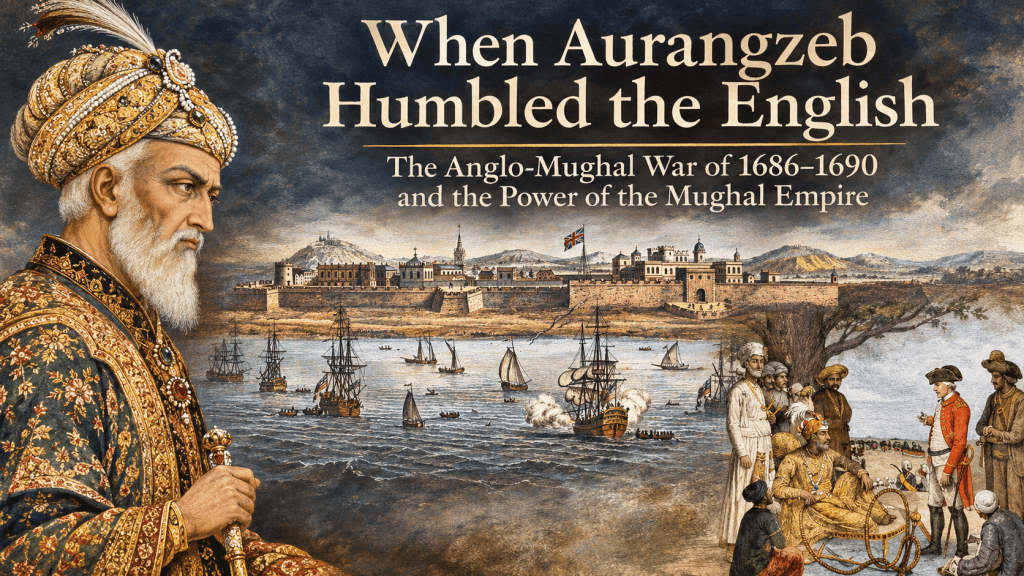
The Anglo-Mughal War of 1686–1690, sometimes called Child’s War after Sir Josiah Child, one of the Company’s principal directors, deserves greater attention than it has generally received in popular historical writing. It was not merely an isolated military confrontation between a European commercial corporation and an Indian empire. It was a contest over political sovereignty, commercial privileges and the limits of European intervention in the Indian Ocean world. Its outcome demonstrated the formidable resources of the Mughal state and the ability of Aurangzeb to assert imperial authority even while his armies were engaged in extensive campaigns elsewhere.
The episode also provides an opportunity to reconsider Aurangzeb himself. Few rulers in Indian history have been subjected to such sharply contrasting representations. In contemporary political discourse, he is frequently reduced to a caricature: an intolerant, narrow-minded and destructive ruler whose religious convictions supposedly overwhelmed his political judgement. Such representations tell us more about the selective appropriation of history in the present than about the complexities of seventeenth-century Mughal governance. Aurangzeb was undoubtedly a deeply religious sovereign, and some of his policies, particularly the reimposition of the jizya in 1679 and certain measures concerning temples, remain legitimate subjects of historical criticism and debate. Yet to allow these issues alone to define a reign extending over nearly half a century is to disregard the extraordinary political, administrative and military responsibilities that he discharged.
Aurangzeb was one of the most powerful sovereigns of his age. He governed an empire of immense territorial extent, commanded enormous military resources, supervised a sophisticated administrative establishment and remained personally involved in the conduct of government to an unusual degree. His reign witnessed the conquest of Bijapur and Golconda, the further expansion of Mughal authority in the Deccan and the continued integration of distant regions into imperial political and fiscal structures. His long correspondence, preserved in collections such as the Ruqʿāt-i Alamgīrī and the Kalimat-i Tayyibāt, reveals a ruler deeply concerned with appointments, revenue administration, military affairs, justice and the conduct of his officials.
This does not mean that his policies were invariably successful. His prolonged Deccan campaigns imposed enormous pressures upon the empire, and the expansion of Mughal authority created administrative and financial problems that became increasingly apparent towards the end of his reign. Nevertheless, political difficulties and controversial decisions should not obscure his considerable abilities as an administrator, commander and statesman. He was a ruler with a clearly articulated conception of sovereignty, political responsibility and imperial order. The defeat of the English East India Company offers a particularly revealing illustration of these qualities.
The Mughal Empire and the English commercial presence
When the English East India Company received its charter from Queen Elizabeth I on 31 December 1600, the Mughal Empire was already firmly established as one of the great powers of the early modern world. Under Akbar, its territorial authority and administrative institutions had undergone substantial consolidation. During the reigns of Jahangir and Shah Jahan, the empire continued to exercise considerable influence over the commercial and political life of the subcontinent.
European merchants entering Indian waters encountered neither an economically stagnant society nor a political vacuum. They entered a densely interconnected commercial world in which Indian merchants, bankers, brokers and shipowners played dominant roles. Gujarat, Bengal and the Coromandel Coast were major centres of textile production and maritime commerce, while cities such as Surat, Ahmadabad, Agra, Lahore, Patna and Dhaka were linked through extensive networks of trade and credit.
The English Company initially operated within this established system. Its commercial activities depended upon permissions granted by Mughal authorities, negotiations with provincial governors and arrangements with Indian merchants. The English factory at Surat and the subsequent expansion of Company establishments in Bengal were made possible not through military conquest but through commercial diplomacy.
Sir Thomas Roe’s embassy to Jahangir’s court between 1615 and 1619 illustrates the nature of these relationships. Roe sought trading privileges from a sovereign whose court possessed political resources and ceremonial authority far exceeding anything that the English Company could command in India. The English were petitioners seeking imperial favour, not representatives of a superior power dictating terms.
By the middle of the seventeenth century, the Company had established itself at several important commercial centres. Madras developed around Fort St George, while Bombay, acquired by the English Crown from Portugal in 1661 and transferred to the Company in 1668, provided a potentially valuable maritime base. Bengal, with its extensive production of cotton textiles, silk and saltpetre, became increasingly important to English commercial interests.
Yet the Company remained dependent upon Indian political authority. Its factories were not sovereign enclaves in the modern sense, and its commercial privileges could be challenged or withdrawn by the governments under whose jurisdiction it operated.
The significance of this dependence becomes clearer when viewed against the scale of Aurangzeb’s empire. By the 1680s, the Mughal state commanded resources vastly exceeding those of the Company. Its armies, revenue administration and political institutions extended across much of the subcontinent. Its authority was exercised through an elaborate hierarchy of mansabdars, provincial governors, revenue officials, military commanders and local intermediaries.
Aurangzeb’s empire was certainly not free from political tensions, but it remained a formidable imperial structure. The English Company was only one among several foreign commercial organisations seeking access to its markets.
Aurangzeb as sovereign, administrator and commander
To appreciate the significance of the Anglo-Mughal War, it is necessary to understand the character of Aurangzeb’s rule.
Aurangzeb had acquired extensive administrative and military experience long before his accession in 1658. As a prince, he served as governor of the Deccan, Gujarat and Multan, and participated in important military campaigns. His experiences in the Deccan were particularly significant, acquainting him with the complexities of regional politics, military logistics, revenue administration and relations with powerful local elites.
His accession followed a bitter war of succession, in which he demonstrated considerable strategic ability. His victories over the forces supporting Dara Shukoh, particularly at Dharmat and Samugarh in 1658, were not accidental achievements. They reflected his capacity to organise military resources, cultivate political alliances and exploit the weaknesses of his opponents.
Once established on the throne, Aurangzeb maintained close supervision over the machinery of government. His correspondence reveals a sovereign attentive to administrative detail and frequently dissatisfied with negligence, corruption or the failure of officials to discharge their responsibilities. He was not merely a ceremonial monarch presiding over an inherited system. He was actively involved in its operation.
The extensive documentary material relating to his reign, including the Maʾāsir-i ʿĀlamgīrī of Saqi Mustaʿid Khan, the Muntakhab al-Lubāb of Khafi Khan and the collections of imperial correspondence, allows us to examine both the ideals and the practical limitations of his kingship. These sources must, of course, be read critically. Court chronicles often sought to legitimise imperial actions, while later narratives sometimes reflected the political concerns of their own times.
Aurangzeb’s military achievements were substantial. The incorporation of Bijapur in 1686 and Golconda in 1687 brought two powerful Deccan sultanates under Mughal authority. These conquests required prolonged planning, enormous logistical arrangements and the coordination of substantial military forces. At the same time, the emperor’s determination to extend Mughal authority throughout the Deccan created problems of overextension. The continuing resistance of the Marathas, the difficulties of maintaining garrisons and the strain upon imperial finances complicated his achievements.
A serious historical assessment must acknowledge both sides of this record. Aurangzeb was an exceptionally capable ruler, but his political objectives sometimes exceeded the administrative and military capacities of the empire. His achievements and failures belonged to the same ambitious conception of imperial sovereignty.
What is particularly striking is that the Anglo-Mughal confrontation unfolded precisely when Aurangzeb was engaged in some of his most demanding campaigns in the Deccan. The emperor was not personally leading troops against the English. Rather, the conflict demonstrated the ability of the Mughal political system to mobilise provincial authorities, military commanders and regional allies in defence of imperial interests. It is in this institutional capacity, as much as in individual military victories, that the strength of Aurangzeb’s government becomes apparent.
The Company’s challenge to Mughal sovereignty
During the 1680s, the English East India Company’s leadership began to pursue a more assertive policy towards Indian rulers. Sir Josiah Child, an influential director of the Company in London, believed that its commercial interests required stronger military protection and greater political autonomy. The Company’s officials complained of customs duties, restrictions upon trade and the conduct of Mughal provincial authorities. Disputes over commercial privileges were not unusual, but the Company’s directors increasingly concluded that armed force could secure concessions more effectively than negotiation.
Their ambitions extended beyond the protection of trade. They envisaged fortified settlements, independent revenues and a degree of jurisdiction that would reduce their dependence upon Indian governments. As Philip J. Stern has demonstrated in The Company-State: Corporate Sovereignty and the Early Modern Foundations of the British Empire in India (2011), the East India Company was already developing political ambitions that went beyond its identity as a trading corporation. It sought to exercise forms of sovereignty within its settlements while continuing to operate in territories governed by powerful Asian states. The difficulty was that these ambitions collided directly with Mughal conceptions of political authority.
For Aurangzeb, the issue was not simply whether English merchants should pay a particular customs duty. The larger question was whether a foreign commercial organisation, whose privileges ultimately depended upon imperial permission, could employ military force against Mughal territories and subjects.
The Company’s directors believed that their naval power would provide a decisive advantage. By attacking ports, interrupting shipping and threatening maritime commerce, they hoped to compel the Mughal authorities to accept their demands. This strategy revealed a serious misunderstanding of the political and economic foundations of Mughal power. The empire was not dependent upon English trade for its survival. Nor was its military strength confined to coastal establishments vulnerable to naval bombardment. Its resources were overwhelmingly territorial, supported by an extensive agrarian revenue system and a network of inland commercial centres. The Company’s ships could inflict damage upon coastal commerce, but they could not easily translate that capacity into political control over the vast territories of the Mughal Empire.
The war in Bengal
The conflict began in Bengal in 1686, when the Company attempted to enforce its demands through military action. An English naval expedition under Admiral Henry Nicholson arrived in the Bay of Bengal with instructions to secure a more favourable position for the Company’s trade. The English also contemplated establishing a fortified base at Chittagong, whose strategic importance had already been demonstrated by its conquest from Arakan by Mughal forces in 1666. Bengal was governed by Shaista Khan, Aurangzeb’s maternal uncle and one of the most experienced administrators of the empire. His long tenure as governor had been associated with the consolidation of Mughal authority and the expansion of commerce.
Hostilities broke out at Hugli in October 1686. English forces attacked Mughal positions, while Company vessels bombarded the settlement. The confrontation quickly escalated beyond a dispute over commercial privileges. The English, however, were unable to maintain their position. Job Charnock, the Company’s senior representative in Bengal, withdrew from Hugli and eventually moved towards Sutanuti. Further attempts to establish a secure base led the English to Hijli, where their troops suffered heavily from disease, shortages and Mughal military pressure.
The English had underestimated the ability of the provincial administration to mobilise troops and sustain resistance. Their naval artillery could damage settlements, but it could not provide the territorial control necessary for a lasting military victory. The projected conquest of Chittagong also failed. The subsequent expedition under Captain William Heath achieved little, and the Company was eventually compelled to withdraw its principal forces from Bengal. The outcome was a serious setback. Far from compelling the Mughal authorities to grant additional privileges, the English had jeopardised their existing commercial position.
The Bengal campaign is particularly instructive because it reveals the effectiveness of provincial government under Aurangzeb. The emperor did not need to abandon his campaigns in the Deccan to deal personally with the English. The administrative and military institutions of the empire possessed sufficient resources to confront the challenge. As David Veevers has argued in The Origins of the British Empire in Asia, 1600–1750 (2020), the conflict must be understood within the complex political relationships that connected Company servants with Mughal officials. The Company’s attempt to renegotiate these relationships through military coercion failed because it misunderstood the balance of power within which it operated.
The western coast and the siege of Bombay
While the Company’s position deteriorated in Bengal, hostilities spread to the western coast. Surat was one of the principal ports of the Mughal Empire, linking Indian commerce with the Red Sea, the Persian Gulf and the wider Indian Ocean. It was also a major centre for pilgrims travelling to Mecca. Under Sir John Child, the Company’s leading official in western India, English vessels began intercepting and seizing ships associated with Mughal commerce. Such actions struck directly at imperial authority. They threatened the interests of merchants, shipowners and pilgrims, and disrupted maritime networks that were important to the Mughal economy.
Aurangzeb’s government responded by taking action against the Company’s establishments and personnel. English commercial activities at Surat were severely restricted, while the Mughal authorities sought to bring the Company to submission.
The decisive confrontation occurred at Bombay. In February 1689, Sidi Yakut Khan, a commander associated with the Siddis of Janjira, launched an attack upon the island. The Siddis were an established maritime and military power on the western coast, and their relationship with the Mughal state provided an important element in the imperial response to the English. The participation of Sidi Yakut’s forces illustrates the wider political networks through which Mughal authority could be exercised. The emperor’s power did not depend exclusively upon armies commanded directly from the imperial court. It also operated through alliances, subordinate authorities and regional military establishments.
The siege of Bombay continued into 1690. Sidi Yakut’s troops occupied substantial parts of the island and confined the English to their principal fortified positions. The Company’s garrison suffered from shortages of provisions, disease, desertions and the progressive weakening of its defences. The contemporary diary of James Hilton, reproduced in Margaret R. Hunt and Philip J. Stern’s The English East India Company at the Height of Mughal Expansion: A Soldier’s Diary of the 1689 Siege of Bombay with Related Documents (2015), provides valuable evidence of the conditions experienced by the besieged troops. Hilton’s testimony is particularly important because it reveals the conflict from within the Company’s military establishment. It records not the confident advance of a technologically superior European power but the anxieties of soldiers struggling to survive a prolonged siege.
Margaret Hunt, in her article ‘The 1689 Mughal Siege of East India Company Bombay: Crisis and Historical Erasure’ (History Workshop Journal, 84, 2017, pp. 149–169), has demonstrated how the siege exposed weaknesses in the Company’s military organisation and challenged the loyalty of its soldiers. The English were not defeated in a single spectacular engagement. Their failure resulted from sustained military pressure, the loss of territory, inadequate supplies and the inability to maintain an effective defensive position. By 1690, the Company’s situation had become untenable. The siege demonstrated that European naval resources, however formidable, did not automatically confer superiority in the military and political conditions of seventeenth-century India.
Aurangzeb’s victory and the Company’s submission
The cumulative effects of the campaigns in Bengal and western India forced the English East India Company to abandon its attempt to secure concessions through military coercion. Its commercial activities had been disrupted, its establishments threatened and its principal western Indian settlement subjected to a prolonged siege. The Company was compelled to seek a negotiated settlement with the Mughal emperor.
The surviving documentary evidence is revealing. Among the British Library’s India Office Records is a petition associated with Sir John Child and addressed to Aurangzeb in February 1689. It provides direct evidence of the Company’s attempts to restore relations with the imperial government. The settlement reached in 1690 required the Company to acknowledge Mughal authority, make restitution and pay an indemnity generally recorded as 150,000 rupees. Aurangzeb also demanded the removal of Sir John Child, whom the Mughal authorities regarded as responsible for the Company’s hostile conduct. Child died in Bombay in early 1690 before the settlement had been fully implemented.
An imperial farmān issued in February 1690 permitted the restoration of relations under specified conditions. Sidi Yakut’s forces subsequently withdrew from Bombay in June. The result was an unmistakable political defeat for the English. The Company had begun the confrontation believing that armed force would compel the Mughal emperor to grant concessions. It ended by accepting the conditions imposed by the imperial government.
Aurangzeb’s handling of the conflict deserves attention. He neither ignored the challenge nor allowed it to divert him permanently from his larger political objectives. The Mughal response employed provincial military resources, commercial restrictions, maritime allies and diplomatic pressure. Once the Company had submitted, the emperor permitted it to resume trade. This decision should not be mistaken for weakness. It reflected an understanding of the relationship between political authority and commercial prosperity. The Mughal state benefited from overseas commerce. European merchants purchased Indian manufactures, brought bullion into the country and participated in commercial networks that generated revenue for merchants and governments alike.
Aurangzeb had little reason to destroy a potentially useful trading organisation once it had acknowledged imperial sovereignty. His objective was not the elimination of English commerce but the restoration of political authority. In this respect, the settlement reveals a ruler capable of combining military firmness with political pragmatism.
Aurangzeb beyond the contemporary caricature
The significance of the Anglo-Mughal War extends beyond the history of the East India Company. It offers a useful corrective to the increasingly simplified representations of Aurangzeb in contemporary public discourse. The emperor’s reign has become a convenient arena for modern political controversies, with complex historical developments frequently reduced to a struggle between religious communities. Aurangzeb is often represented as though his entire political existence can be explained through religious hostility. Such interpretations ignore the actual functioning of the Mughal state.
Aurangzeb ruled over a population of enormous religious, linguistic and regional diversity. His administration depended upon the cooperation of nobles, zamindars, merchants, soldiers and officials belonging to different social and religious backgrounds. Hindu nobles continued to occupy important positions within the imperial mansabdari establishment, even as relations with particular Rajput houses and other political groups became strained. His government operated through institutions inherited from earlier Mughal rulers, though these institutions underwent modifications in response to changing political circumstances.
The emperor’s personal religious convictions undoubtedly influenced his understanding of kingship. Yet his policies cannot be reduced to theology alone. Political expediency, fiscal considerations, military requirements, dynastic interests and the maintenance of imperial sovereignty were equally important elements in his decisions. The work of historians such as M. Athar Ali, particularly The Mughal Nobility under Aurangzeb (1966), remains fundamental to understanding the composition and functioning of the ruling elite. Satish Chandra’s studies of Mughal politics and the Deccan, together with John F. Richards’s The Mughal Empire (1993), demonstrate the need to examine Aurangzeb within the broader institutional and political history of the empire.
A historically responsible assessment must recognise his contradictions. He was capable of administrative diligence and political pragmatism, but also of decisions that intensified conflict and imposed heavy burdens upon the imperial system. His military achievements were considerable, but the prolonged Deccan campaigns exposed the limits of Mughal expansion. These complexities do not diminish his historical importance. They make him a more substantial figure than the caricatures that dominate much contemporary discussion.
The Anglo-Mughal War is especially revealing because it brings into focus a dimension of Aurangzeb’s reign that is frequently neglected: his ability to defend the political and economic interests of the empire against an aggressive foreign commercial organisation. At a time when European maritime companies were extending their influence across the Indian Ocean, the Mughal government successfully resisted an attempt to impose commercial demands through armed force. The emperor understood that the privileges granted to foreign merchants could not be allowed to develop into an independent claim to political sovereignty. His response was therefore consistent with the wider objectives of Mughal kingship: the preservation of imperial authority, the protection of revenue and commerce, and the maintenance of political order.
The historical irony: from submission to supremacy
Perhaps the most striking aspect of the episode is the contrast between the Company’s position in 1690 and its subsequent political ascendancy. Following the restoration of relations, Job Charnock returned to Sutanuti in August 1690. The settlement subsequently developed into the nucleus of Calcutta. The Company’s recovery in Bengal depended upon renewed negotiations with Mughal officials and the reconstruction of commercial relationships. Its acquisition of zamindari rights over Sutanuti, Kalikata and Govindapur in 1698 took place within the existing Mughal political and revenue framework. The Company did not emerge from Child’s War as an independent territorial power. It survived because it was permitted to resume commercial activities under Mughal authority.
The situation changed considerably during the eighteenth century. Following Aurangzeb’s death in 1707, the Mughal Empire experienced prolonged succession struggles, increasing provincial autonomy and difficulties in maintaining effective central control. The rise of powerful regional states transformed the political landscape of the subcontinent. The English East India Company gradually expanded its military resources and developed increasingly influential relationships with Indian merchants, financiers and political elites. Its victory at Plassey in 1757 depended not merely upon European military organisation but also upon the political circumstances prevailing in Bengal, including divisions within the nawab’s establishment and the Company’s alliances with influential Indian interests.
The contrast is instructive. In 1690, the Company was unable to withstand the pressure exerted by Aurangzeb’s government and its regional allies. In 1757, it was able to exploit divisions within a regional political order that had developed in the aftermath of the weakening of central Mughal authority. The transformation cannot be explained by an assumption of inherent European superiority. It was the outcome of changing political institutions, commercial networks, military resources and alliances. Indeed, the Company’s later success should not obscure the fact that, at the end of the seventeenth century, the Mughal Empire remained one of the most formidable political powers in the world.
Conclusion
The Anglo-Mughal War of 1686–1690 provides an important perspective on both the history of European expansion in India and the character of Aurangzeb’s reign. The English East India Company attempted to employ military force to secure commercial and political concessions from the Mughal Empire. Its strategy rested upon confidence in maritime superiority and an underestimation of the resources available to the Mughal state. The result was a decisive failure.
In Bengal, the Company was unable to establish a secure territorial position. On the western coast, its interference with maritime commerce provoked imperial retaliation. At Bombay, its garrison was subjected to a prolonged siege that exposed serious weaknesses in its military organisation. The Company was ultimately compelled to seek Aurangzeb’s forgiveness and accept the conditions imposed by his government.
The emperor’s response revealed the strengths of the Mughal political system. Provincial governors, military commanders and regional allies were mobilised to defend imperial interests, while the final settlement combined punishment with the restoration of commercial relations. Aurangzeb emerges from this episode not as the one-dimensional figure of contemporary political polemics but as a powerful and purposeful sovereign, deeply concerned with the authority of the state and capable of employing military and diplomatic resources to defend it.
His reign was marked by contradictions, and his policies must remain open to critical historical examination. Yet it would be equally unhistorical to deny his administrative abilities, military experience, political determination and extraordinary capacity for sustained engagement with the affairs of government. The defeat of the English East India Company was not his greatest military achievement. Compared with the conquest of Bijapur and Golconda, the confrontation involved relatively limited forces. Its significance lay elsewhere: it demonstrated that a European commercial organisation could not yet challenge Mughal sovereignty with impunity.
The Company that would eventually establish British political supremacy in India had once been compelled to acknowledge the authority of an Indian emperor. That emperor was Aurangzeb Alamgir. The episode reminds us that history should not be written backwards from the eventual triumph of colonialism, just as the reign of Aurangzeb should not be interpreted through the prejudices and political requirements of the present. Both demand an examination of contemporary evidence, institutional structures and historical circumstances.
Aurangzeb was neither the flawless sovereign of apologetic tradition nor the monstrous caricature of modern political propaganda. He was one of the most consequential rulers of early modern India, a formidable administrator and commander whose political ambitions, achievements and failures profoundly shaped the history of the subcontinent. The humiliation of the English East India Company in 1690 remains a revealing testimony to the power of the empire over which he presided.
Select references
Ali, M. Athar, The Mughal Nobility under Aurangzeb, Bombay, 1966.
Chandra, Satish, Parties and Politics at the Mughal Court, 1707–1740, Aligarh, 1959.
Hamilton, Alexander, A New Account of the East Indies, 2 vols, Edinburgh, 1727.
Hunt, Margaret R., ‘The 1689 Mughal Siege of East India Company Bombay: Crisis and Historical Erasure’, History Workshop Journal, vol. 84, 2017, pp. 149–169.
Hunt, Margaret R., and Philip J. Stern (eds), The English East India Company at the Height of Mughal Expansion: A Soldier’s Diary of the 1689 Siege of Bombay with Related Documents, Boston, 2015.
Khafi Khan, Muntakhab al-Lubāb, Persian chronicle of the Mughal period.
Richards, John F., The Mughal Empire, The New Cambridge History of India, I.5, Cambridge, 1993.
Saqi Mustaʿid Khan, Maʾāsir-i ʿĀlamgīrī, translated by Jadunath Sarkar, Calcutta, 1947.
Sarkar, Jadunath, House of Shivaji, and Bengal in the Reign of Aurangzib, 1658–1707.
Stern, Philip J., The Company-State: Corporate Sovereignty and the Early Modern Foundations of the British Empire in India, Oxford, 2011.
Veevers, David, The Origins of the British Empire in Asia, 1600–1750, Cambridge, 2020.
Archival source: British Library, India Office Records, IOR/E/3/47, fol. 226, additions to the petition of Sir John Child addressed to Aurangzeb, February 1689.


