Syed Ali Nadeem Rezavi
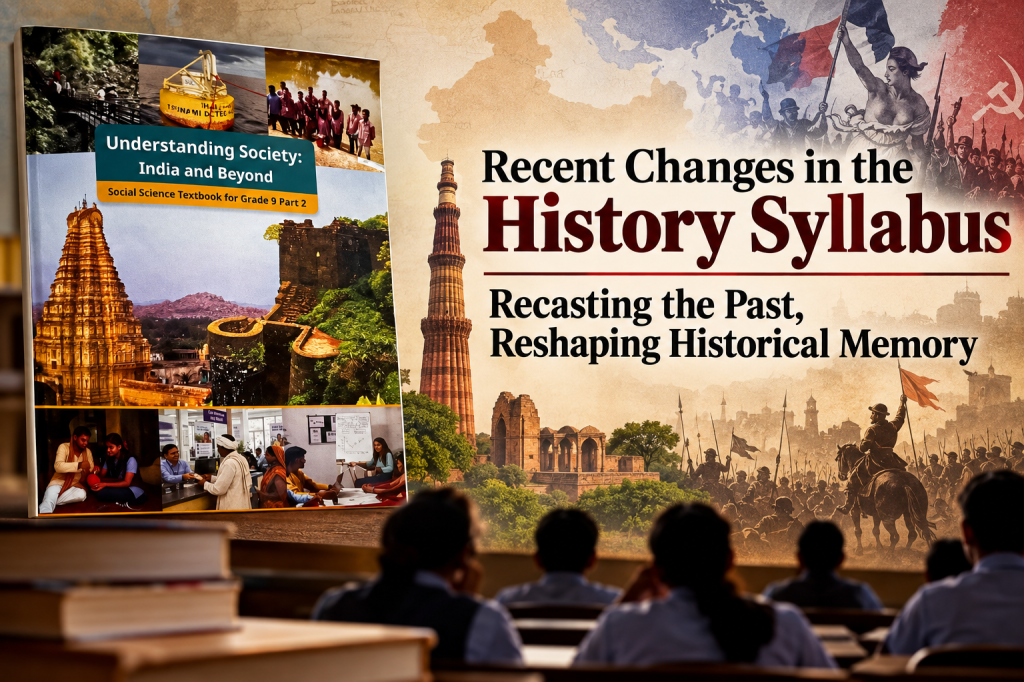
The latest changes in the Class IX Social Science textbook, reported by The Indian Express in its Delhi edition of 30 September 2026, have drawn attention to substantial alterations in the organisation and emphasis of the history syllabus. The new textbook, Understanding Society: India and Beyond, Part 2, describes seven hundred years of medieval Indian history from 1000 to 1700 AD as a period of resistance and resilience, a time when Indian society not only defended itself from external threats but also preserved its traditions. It replaces four older textbooks, including India and The Contemporary World, and introduces a new concentration upon medieval and early modern India, foreign invasions, regional resistance, Sikh struggles against Mughal authority, and the resistance of Jats, Rajputs, Ahoms and others. At the same time, subjects which earlier occupied an important place at this stage, particularly the French and Russian Revolutions, have been relocated to Part 1 of the new textbook, released in June, which deals with themes such as socialism, the rise of Nazism, and democratic politics. A qualification is necessary at the very outset. What follows is a preliminary response to what has been reported, considered alongside the changes already introduced in textbooks for the preceding classes. A detailed analysis must await a careful reading of the complete new Class IX textbook, including its text, illustrations, extracts, maps, exercises and questions.
This caution is particularly necessary because a textbook communicates its historical argument not merely through explicit statements. Selection itself is interpretation. What is placed at the beginning of a chapter, what is repeatedly emphasised, which events are juxtaposed, which illustrations are selected, what questions are asked and what subjects quietly recede from view can collectively produce an interpretation more powerful than any single sentence. What has been reported deserves attention because the new Class IX textbook does not stand alone. When read alongside the manner in which medieval India was introduced in the revised textbooks of the preceding class, a discernible pattern begins to emerge.
The issue is not whether NCERT should revise its textbooks. It certainly should. Historical knowledge changes, new research appears, and regions and communities neglected by older narratives need to be recovered. The real questions are what is being removed, what is being introduced, how the new material is being framed, and what conception of India’s past is gradually being placed before schoolchildren. The NCERT chief, Dinesh Saklani, writes in the foreword that social science learning at this stage is expected to cultivate analytical and discursive abilities, encourage critical inquiry, and promote intercultural understanding. These are admirable aims, but the framing of the content must be examined against them.
To understand the significance of the latest Class IX changes, we need to remember what had already happened a year earlier. In 2025, NCERT released its new Class VIII Social Science textbook, Exploring Society: India and Beyond. The treatment of medieval Indian history began with Chapter 2, significantly entitled “Reshaping India’s Political Map”. This was not some incidental discussion buried in the textbook. It was the point at which the Class VIII child was introduced to the medieval period and therefore helped establish the conceptual framework through which the centuries that followed were to be understood. The opening of the chapter is particularly revealing. Carrying an aerial photograph of the Qutb Minar complex, it confronts the pupil with three “Big Questions”. The first asks how foreign invasions and new dynasties reshaped India’s political boundaries. The second asks how Indian society responded to invasions and how India’s economy adapted during periods of political instability. The third turns towards the impact upon ordinary people. Before the pupil had learnt anything substantial about the Delhi Sultanate or the complicated political, economic and social transformations of these centuries, the categories through which the period was to be understood had already been supplied.
The introductory narrative goes considerably further. It describes the early eleventh century as beginning a new era in India’s journey, characterised by invasions from beyond the Hindu Kush, and says that many of the Turkic and Afghan invaders were attracted not only by India’s riches and territorial ambitions but also by a desire to spread their versions of religion, if necessary through force. The medieval period thus begins not principally with historical transformation, but with intrusion. This is precisely why the changes now being reported in the Class IX textbook cannot be examined as an isolated curricular experiment. A preceding textbook, introduced in 2025, prepared the conceptual ground. The Class VIII pupil was introduced to medieval India through the language of foreign invasion and Indian response; a year later the Class IX pupil encounters an expanded narrative structured around resistance and resilience, with the new textbook explicitly shifting away from the themes of cooperation and composite culture that were central to Indian historiography for over fifty years.
The formulation asking how Indian society responded to invasions deserves interrogation. Who precisely constituted this single Indian society supposedly standing on one side while invaders stood on the other? Political India during the eleventh, twelfth and thirteenth centuries was divided amongst numerous kingdoms and ruling lineages. Rajputs fought other Rajputs. Indian rulers resisted incoming powers on some occasions, negotiated with them on others, and sometimes allied with them against other Indian rulers. Political loyalties were structured around dynasties, clans, kingdoms, localities and material interests rather than around a modern national consciousness dividing Indians from foreigners. To project the modern nation backwards into the medieval centuries is therefore deeply problematic.
This is not merely a terminological objection. Once Indian society and foreign invaders have been established as the two principal categories, they can easily acquire religious identities. The foreign invader increasingly becomes Muslim; those resisting him become indigenous and therefore implicitly Hindu. A geographical distinction can imperceptibly be transformed into a communal one. The new textbook reinforces this framing by describing the period as one accompanied by religious discrimination and social distress, and by presenting acts of resistance as the defining feature of the era. It devotes sections to the resistance of the Ahoms, the Marathas and the Sikhs, and it invokes the worship of goddesses such as Kali, Durga and Bhavani as a long-standing tradition that kings and princes invoked as protectors in times of conflict. It cites the example of Annamraja, ruler of Bastar, who is believed to have received his sword from Manikyadevi, and Kumara Kampana of Vijayanagara, who was believed to have used a goddess-given sword against the Sultanate forces at Madurai. Shivaji is also traditionally believed to have obtained a sword from goddess Tulja Bhavani. These are legitimate cultural and historical traditions, but their placement within a narrative of resistance against foreign forces subtly frames the entire period as a religiously charged civilisational conflict.
Another implication of associating foreign invasion with political instability is the creation of an unstated contrast between an earlier age of indigenous stability and a later period of disruption. Pre-Sultanate India was hardly an uninterrupted political idyll. The Palas, Pratiharas and Rashtrakutas fought prolonged wars. The Cholas undertook extensive military campaigns. Regional kingdoms continuously competed for territory, resources and sovereignty. Rajput houses fought one another. Warfare, conquest, tribute and the displacement of ruling dynasties were normal features of pre-modern state formation. Political violence did not enter India with Islam, nor did territorial ambition, heavy taxation, the destruction of enemies’ political symbols or the appropriation of conquered resources. This does not diminish the violence accompanying the Turkish conquests. It merely places that violence where historians must place it, within the comparative history of pre-modern political power.
This is not merely a terminological objection. Once Indian society and foreign invaders have been established as the two principal categories, they can easily acquire religious identities. The foreign invader increasingly becomes Muslim; those resisting him become indigenous and therefore implicitly Hindu. A geographical distinction can imperceptibly be transformed into a communal one. The new textbook reinforces this framing by describing the period as one accompanied by religious discrimination and social distress, and by presenting acts of resistance as the defining feature of the era. It invokes the worship of goddesses such as Kali, Durga and Bhavani as a long-standing tradition that kings and princes invoked as protectors in times of conflict, explicitly asserting that these goddesses supplied divine swords to be wielded against the invading forces. It cites the example of Annamraja, ruler of Bastar, who is believed to have received his sword from Manikyadevi, and Kumara Kampana of Vijayanagara, who was believed to have used a goddess-given sword against the Sultanate forces at Madurai. Shivaji is also traditionally believed to have obtained a sword from goddess Tulja Bhavani. These are legitimate cultural and historical traditions, but their placement within a narrative of resistance against foreign forces subtly frames the entire period as a religiously charged civilisational conflict.
The choice of the Qutb complex as the visual introduction to the Class VIII chapter is itself instructive. It is entirely appropriate as a monument through which to approach the establishment of the Delhi Sultanate. But what questions should a historian ask of it? The Quwwat-ul-Islam mosque provides evidence for the reuse of materials from demolished temples, and that evidence should be discussed openly. Temple destruction cannot be removed from history because it makes us uncomfortable. The new textbook refers to multiple instances of temple destruction and the construction of mosques on these sites, including the reconstruction of the Kashi Vishwanath temple by Todarmal and Man Singh, its destruction later by Aurangzeb, and its subsequent reconstruction by Ahilyabai Holkar. These are important historical facts. But the same monument opens an entirely different range of historical questions. Who were the craftsmen who constructed it? Why were the earliest arches corbelled rather than truly arcuate? How did trabeate Indian traditions interact with architectural forms introduced by new patrons? How was Arabic calligraphy incorporated into an architectural environment created largely through Indian craftsmanship? How did construction techniques change, and how did the Sultanate gradually develop an architectural vocabulary different both from Central Asian traditions and from those it encountered in northern India? The Qutb complex embodies conquest, appropriation, reuse, adaptation and architectural creativity simultaneously. A good history textbook should enable a child to see all these layers. The important question is not whether temple destruction should be mentioned. It certainly should. The question is whether temple destruction and religious conflict become the principal lenses through which an entire historical period is viewed.
This brings us to an important point. A historical narrative does not need to invent facts in order to distort the past. Distortion can operate through selection, accumulation, repetition, juxtaposition and omission. Mahmud of Ghazni attacked temples. Muhammad Ghuri was a conqueror. Sultanate armies could be enormously destructive. Guru Arjan was executed during Jahangir’s reign. Guru Tegh Bahadur was executed under Aurangzeb. Jats rebelled against Mughal authority because of economic hardships and Aurangzeb’s religious practices. Sikhs developed traditions of armed resistance. Rajputs, Marathas and Ahoms fought Mughal armies. All are legitimate subjects of history. The new textbook does acknowledge the cooperative relationships of the Kachwahas of Amber with the Mughals, noting that the latter had a strong incentive to collaborate with the Rajputs, and it devotes a section to Mewar and Maharana Pratap’s resistance to Akbar. But place these episodes repeatedly beside one another, describe protagonists predominantly through religious identities, foreground foreign invasion, follow it with Indian resistance, emphasise temple destruction and religious persecution, and allow political accommodation, economic transformation and cultural interaction progressively to recede, and an entirely different narrative emerges. Every individual brick may be genuine. It is the structure constructed from those bricks that the historian must examine.
The category of foreignness itself demands interrogation. Babur undoubtedly entered India as a Central Asian conqueror. But how long does that description remain historically meaningful? Humayun spent his political career struggling for possession of an Indian empire. Akbar was born at Umarkot. Jahangir, Shah Jahan and Aurangzeb were born and brought up in the subcontinent. Some of them were born to Hindu women. The empire they ruled depended upon Indian agricultural resources and an increasingly diverse nobility containing Rajputs, Indian Muslims, Afghans, Marathas and numerous other groups alongside Iranian and Central Asian immigrants in equal measure. Its revenues came overwhelmingly from Indian agriculture. Its cities were Indian cities. Its soldiers, officials, peasants, artisans and merchants overwhelmingly belonged to the subcontinent. At what point, therefore, does conquest become state formation? That is an excellent historical question. Simply continuing to describe succeeding generations through the language of foreignness avoids answering it. Nor does the political society of the period conform to a Hindu-Muslim binary. Rajputs fought Rajputs. Muslim dynasties fought other Muslim dynasties. Vijayanagara fought the Deccan Sultanates but also entered alliances with them. Rajput rulers rebelled against Mughal emperors and served them. Maratha chiefs served the Deccan Sultanates and the Mughals as well as fought them. Rajputs fought against the Marathas and Marathas invaded Rajput territories. Mughal armies contained large numbers of non-Muslim commanders and soldiers, while forces opposing them could contain Muslims. Medieval India stubbornly refuses to behave according to the communal categories subsequently imposed upon it.
It is against this background that the reported new Class IX chapter on resistance and resilience acquires particular significance. There is nothing inherently objectionable about such a theme. Resistance is an important part of history. So is resilience. Regional political formations have too often been overshadowed by Delhi-centred narratives, and any serious revision of Indian history should give the Ahoms, Jats, Rajputs, Sikhs, Marathas and southern kingdoms their proper place. The new textbook devotes a section to the Ahom kingdom of Assam, underlining that it maintained its political independence for almost six centuries and successfully defended its territories from the Mughals, making specific mention of the Battle of Saraighat where the Ahom commander Lachit Borphukan defeated a Mughal fleet. It also includes a section on the resistance of Vijayanagara, underlining that resistance to foreign invasions was not confined to northern India, and it moves to the Marathas and their idea of Swarajya, explaining it as the idea of an independent, self-governing territory free from external control. The question is how these histories are organised. The sequence across the new textbooks is striking. Foreign invasion leads to Indian response and political instability, followed subsequently by invasion, persecution, resistance and resilience. The danger is that what ought to be one dimension of medieval history begins to become its governing narrative.
Sikh history illustrates this difficulty well. The new Class IX textbook reportedly devotes considerable attention to Mughal relations with the Sikh Gurus and uses particularly strong language concerning Mughal brutality, mentioning the martyrdom of Sikh gurus and the rigid religious and discriminatory practices of the Mughals. Guru Arjan, Guru Hargobind and Guru Tegh Bahadur appear within a narrative connecting Mughal pressure with the subsequent development of organised Sikh resistance. There is absolutely no reason why these subjects should not be taught. Guru Arjan’s execution is fundamental to Sikh history. Jahangir’s own memoir provides important evidence concerning his attitude towards the Guru. Guru Hargobind’s miri-piri, the Akal Takht, Guru Tegh Bahadur’s execution, Guru Gobind Singh and ultimately the Khalsa are indispensable to understanding the development of Sikh political identity. But explanation requires context. The growth of Sikh authority needs also to be situated within Punjab’s agrarian society, Mughal sovereignty, local politics, the expanding following of the Gurus, imperial anxieties concerning autonomous centres of authority, succession disputes and changing relations between the Sikh community and the state. To describe violence is history. To make violence self-explanatory is not.
The same difficulty arises with the category of resistance. Resistance is not automatically a national struggle. Historians must ask who resisted whom, and why. Jat rebellions cannot adequately be explained merely as Hindu resistance to a Muslim emperor. Revenue demands, zamindari rights, agrarian structures, local power and imperial authority all mattered. Religion could matter too, but its importance has to be demonstrated in particular contexts rather than assumed as the universal explanation. Likewise, Rajput conflicts could involve succession, territorial claims, honour, imperial service or relations between particular ruling houses and the Mughal sovereign. Maratha expansion involved regional politics, military entrepreneurship, revenue rights and state formation alongside religious idioms. A seventeenth-century zamindar refusing imperial revenue demands was not necessarily fighting a war of Indian national liberation. To transform every conflict between a Hindu chief and a Muslim sovereign into indigenous resistance is to place nineteenth and twentieth century nationalism inside societies which did not possess it in that form.
The greatest cost of organising medieval history predominantly around invasion and resistance is what the child may cease to see. Where is the iqta? How did the mansab-jagir system function? What was the relationship between jagirdars, zamindars and peasants? Why did cultivation expand? Why did towns grow? Why did the Mughal economy become so extensively monetised? Why did European merchants desperately seek Indian textiles? Where are Surat, Agra, Lahore, Burhanpur, Patna and Dhaka? Where are merchants, artisans, peasants, bankers and revenue officials? Where is the Indian Ocean? Where are Persian, Sanskrit and the developing regional languages? Where are translation movements, painting, music, legal culture and technological transmission? The new textbook does mention Bhakti and Sufi traditions, noting that Bhakti is credited with providing devotees non-material forms of worship when temple construction got restricted or temples could be destroyed, and that Chaitanya Mahaprabhu led a public sankirtan in Bengal against restrictions imposed by a Qazi on devotional practices. Sufism, while being seen as a comparatively liberal dimension of Islam, is also credited with contributing to its spread. These are valuable inclusions, but they sit within a framework that prioritises religious conflict and resistance over the broader social, economic and cultural transformations that shaped medieval India.
None of this should be mistaken for an argument against giving greater prominence to regional histories. Quite the contrary. The Ahoms have long deserved greater attention. So have the political histories of the Northeast, the Deccan and southern India. Women rulers who were reduced to passing references in older narratives deserve serious treatment. Sikh history deserves considerably greater depth. So do the Jats, Rajputs, Marathas and numerous regional political formations. The old Delhi-centred narrative of Indian history undoubtedly requires correction. But the problem is not inclusion. It is instrumentalisation. The Ahoms do not require the Mughals to become caricatures in order for Lachit Borphukan to matter. Sikh history does not require the entire Mughal period to be reduced to religious persecution. Regionalising Indian history is a necessary historiographical correction. Communalising it is not.
This brings us to the other major aspect of the reported Class IX restructuring: the changed position of the French and Russian Revolutions. The new textbook replaces four older textbooks, and Part 1, released in June, dealt with themes like the French Revolution, socialism in Europe, the Russian Revolution, the rise of Nazism and democratic politics. If material has merely been shifted to another part or class, that should be clearly acknowledged. But the larger pedagogical question remains. Why should an Indian child learn about the French Revolution? Not because France deserves some privileged place in Indian education, but because the Revolution transformed the political vocabulary of the modern world. Liberty, equality, citizenship, popular sovereignty, republicanism, constitutionalism and rights acquired meanings during the revolutionary age that travelled far beyond France. Indian nationalism itself did not develop inside a sealed civilisational container. Indian intellectuals and political activists engaged with liberalism, nationalism, republicanism and socialism. Concepts travelled, were translated, contested and transformed. The French Revolution is therefore not merely French history. It forms part of the intellectual history of modern India.
The same is true of 1917. Whatever one’s judgement of Bolshevism or the subsequent Soviet experiment, the Russian Revolution was one of the defining events of the twentieth century. It transformed global discussions concerning capitalism, socialism, labour, land redistribution, imperialism, colonial liberation and economic planning. Its consequences for India were substantial. How does one eventually understand the emergence of the Communist movement in India, trade unionism, peasant organisations, socialist currents within Indian nationalism, Jawaharlal Nehru’s intellectual development, the Congress Socialist Party or Bhagat Singh’s movement towards socialist thought without understanding something of the world created by 1917? Reducing the place of these histories does not simply mean teaching less Europe. It potentially deprives Indian students of some of the conceptual equipment required to understand modern India itself. A genuinely India-centred history does not require an India-isolated history.
The present changes also follow earlier NCERT revisions and rationalisation exercises which produced controversies over the reduction or deletion of material relating to the Delhi Sultanate and Mughals as well as politically sensitive modern subjects. This background matters because the character of the rewriting now appears to be changing. At one stage, much criticism centred upon the apparent disappearance of the Mughals. The present development may prove more consequential because medieval India can return, but in a different form. The Sultanate need not disappear if it is principally approached through invasion. The Mughals need not disappear if they repeatedly appear through persecution and resistance. The new textbook devotes one page to the period of the Delhi Sultanate, mentioning acts of resistance by local kings, while the Mughal period is somewhat more elaborate but focuses on resistance rather than cooperation with the Mughals. Medieval India may occupy many pages while its social, institutional and economic history occupies progressively less conceptual space. The relevant question is therefore no longer simply how many pages the Mughals have received. It is what kind of Mughals, and what kind of medieval India, the child is being taught to imagine.
This is where the possible social consequences become particularly serious. There is an enormous difference between saying that Aurangzeb ordered a particular act and constructing a narrative which encourages the reader to understand that Muslims did this to Hindus. The first is a historical proposition capable of investigation through evidence. The second transforms the action of a seventeenth-century ruler into a transhistorical relationship between two modern religious communities. A ruler who professed Islam is not interchangeable with all Muslims. A Hindu who suffered under his government does not automatically represent every Hindu living centuries later. Yet if medieval history is repeatedly presented as Muslim aggression followed by Hindu or Sikh resistance, children can gradually learn to identify themselves with historical protagonists according to present-day religious identities. A Hindu pupil may begin to see the victim of a sixteenth-century conquest as us. A Muslim pupil may consequently find the conqueror classified as them. Neither child bears responsibility for those events. Modern Indian Muslims bear no responsibility for Mahmud of Ghazni, just as modern Indian Hindus bear no responsibility for acts of violence committed by pre-modern Hindu rulers. History should liberate citizens from hereditary guilt and hereditary grievance, not manufacture them.
This is ultimately the distinction between history and communal memory. Memory asks what they did to us. History asks what happened, why it happened, what evidence survives, who produced that evidence, what political, economic and social structures were involved, how contemporaries understood the event, and what changed afterwards. The distinction is fundamental. A temple destroyed five hundred years ago is an important historical fact deserving investigation. The historian asks who destroyed it, why, in what circumstances, whether religion, wealth, political sovereignty or several motives were involved, what contemporary evidence survives, and what subsequently happened at the site. Communal memory does something different. It transforms that historical event into an injury personally inherited by someone living today. Once that happens, historical distance collapses. Historical distance is one of the greatest gifts the discipline of history can give a society.
This does not mean sanitising medieval India. There is an opposite error which must equally be resisted. Medieval India should not be romanticised as an uninterrupted paradise of syncretism and composite culture. There was violence. There was religious persecution. Temples were destroyed. Political enemies were brutally punished. Cities were devastated. Peasants were exploited. States extracted substantial agricultural surpluses. Sectarian conflict existed. Religious identity could influence political action. All this should be taught. But so should accommodation, alliance, migration, economic integration, artistic borrowing and cultural interaction. The choice is not between concealing atrocities and making atrocities the organising principle of medieval history. Good history does neither.
The most important issue, therefore, is not any single sentence in any single textbook. It is the cumulative historical imagination being created across successive school years. In the Class VIII textbook introduced in 2025, the child encounters medieval India through foreign invasion, Indian response and political instability. In the reported Class IX restructuring of 2026, the same pupil encounters persecution, resistance and resilience. Meanwhile, the relative position of histories through which children encounter revolution, equality, citizenship, socialism and transformations of the modern state is altered. The cumulative effect can privilege civilisation over society, religious community over class and political interest, invasion over state formation, resistance over negotiation, and historical grievance over explanation. That would represent a profound transformation in the teaching of history.
There is absolutely no need to choose between Indian history and world history. Teach Naiki Devi, Rudrama Devi and Rani Abbakka. Teach the Ahoms properly and give the Northeast the space it has long deserved. Teach Rajput political formations in all their diversity. Teach Sikh history in considerably greater depth. Teach the Jats and Marathas. Teach Vijayanagara and the Deccan Sultanates. Teach women, peasants, artisans, merchants, Dalits, tribal communities and pastoral societies. But alongside them teach the French Revolution, industrialisation, capitalism, the Russian Revolution, imperialism, nationalism and fascism. Teach Mahmud of Ghazni’s raids and temple destruction. But teach the iqta too. Teach Guru Arjan’s execution. But also teach the transformation of Punjab. Teach Aurangzeb’s temple destructions where the evidence establishes them. But also explain Rajput mansabdars, Maratha nobles, zamindars, revenue administration and the circumstances under which temples could be patronised, protected, appropriated or destroyed. Teach the Quwwat-ul-Islam mosque and its reused temple material. But also ask children to examine the craftsmen who constructed it, its architectural techniques and the process through which different building traditions encountered one another. Above all, whenever the word resistance occurs, encourage pupils to ask the historian’s indispensable questions. Resistance to whom? By whom? For what reason? In defence of what interests? Those questions transform memory into history.
The debate over the latest NCERT textbooks is therefore not fundamentally about whether Akbar receives twenty pages or ten, whether the Ahoms receive additional space, or even whether a particular European revolution is taught in Class IX or Class X. It concerns something much larger. What do we believe history education is for? If history is intended primarily to produce pride, almost every society can manufacture a past filled with heroes and victories. If it is intended to produce grievance, every civilisation can assemble an equally impressive catalogue of injuries. Neither exercise requires much historical training. The more difficult task is to teach young people that the past was populated by human beings whose identities, loyalties and assumptions were often very different from our own, that states could be brutal without representing entire religious communities, that victims and perpetrators cannot simply be divided retrospectively according to the religious categories of modern India, that cultural interaction can coexist with political violence, and that societies are transformed as profoundly by agriculture, commerce, technology, migration and ideas as by battles.
India particularly needs such history because its past belongs to everyone. No Indian Muslim should be made to carry Aurangzeb upon his shoulders. No Indian Hindu should be encouraged to inherit personally the wounds of every Hindu who suffered under a medieval ruler. Neither community can monopolise the achievements of those who happened to profess its faith. The Qutb complex, the forts of Rajasthan, the monuments of the Mughals, the temples of Vijayanagara, the gurdwaras of Punjab, Sanskrit intellectual traditions, Persian historiography, Bhakti literature, Sufi poetry, Hindavi literary culture and the commercial worlds of Surat and Masulipatnam are not exhibits in separate communal museums. Together they constitute the enormously complicated historical inheritance of the Indian subcontinent.
This is why the changes beginning with the Class VIII textbook released in 2025 and apparently continuing into the new Class IX curriculum of 2026 deserve close scrutiny. The danger lies less in any isolated factual statement than in the architecture of the narrative. If invasion, foreignness, religious atrocity and resistance become the principal categories through which the medieval centuries are introduced, pupils can be led towards a predetermined interpretation before acquiring the historical knowledge necessary to evaluate it. A definitive judgement on the new Class IX textbook should await a careful reading of the book itself. We need to establish precisely what has been removed, what has merely been shifted elsewhere, what has been added, how older themes have been rewritten, what qualifications accompany contentious claims, and what exercises pupils are being asked to undertake. The reports appearing at the end of September provide important indications, but they cannot substitute for that textual examination. What they reveal nevertheless matters because the direction is already visible in the Class VIII textbook of 2025.
A history textbook should not tell a Hindu child whom to resent. It should not make a Muslim child feel obliged to defend a medieval emperor. It should not transform Sikhs, Jats, Rajputs, Marathas, Ahoms or any other historical community into pieces upon a contemporary ideological chessboard. It should teach children to ask questions. Who wrote this source? Why? What evidence supports the claim? Was religion the principal cause, one amongst several causes, or the language through which another conflict was expressed? Why did enemies become allies? Why did allies become enemies? Why did institutions survive changes of dynasty? Why did cultures borrow from one another even while rulers fought? Those are historical questions.
A history syllabus worthy of India must therefore resist two temptations equally. The romanticisation of the medieval past and its communalisation. The first conceals conflict. The second makes conflict the whole story. Medieval India was neither an idyll of uninterrupted harmony nor seven centuries of Hindu-Muslim warfare. It was a changing world of conquest and accommodation, exploitation and prosperity, mobility and hierarchy, religious contestation and intellectual exchange, political violence and extraordinary cultural creativity. Our children deserve to encounter that world in all its contradictions. For once the past is rearranged principally to establish who were the historical victims and who were the historical villains, history ceases to enlarge the mind. It begins instead to distribute inherited grievances amongst living communities. That is not the recovery of India’s past. It is the fragmentation of its historical memory, and potentially of the society that inherits it.


