Syed Ali Nadeem Rezavi
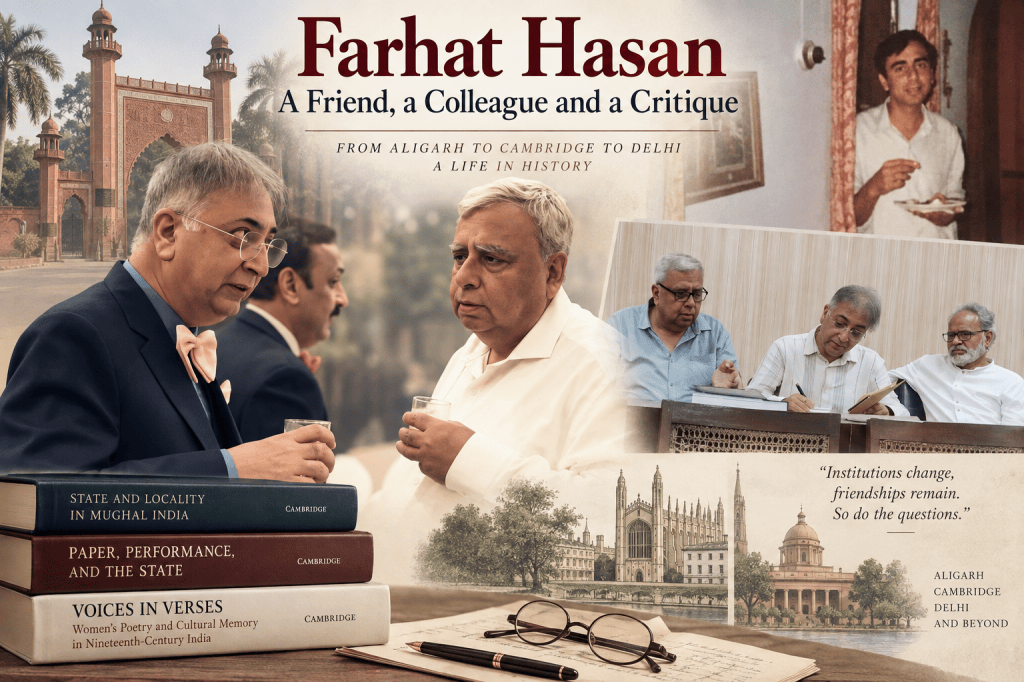
On 30th September 2026 Professor Farhat Hasan retires from the Department of History, University of Delhi, and retirement notices being what they are, they will doubtless reduce an entire academic life to a tidy succession of appointments, publications and honours. In Farhat’s case, at least for me, that would hardly suffice, since our association goes back much further than our professional careers. We grew up in the same Aligarh world, passed through the same Department of History, entered teaching on precisely the same day, and then followed scholarly trajectories that frequently ran parallel, sometimes intersected, and at other times diverged rather sharply, so that a tribute to Farhat cannot be merely an assessment of a historian but is inevitably also a recollection of a friend and colleague with whom I have shared almost an entire academic lifetime.
I was senior to Farhat in school, though after completing our schooling both of us eventually entered the Department of History at Aligarh Muslim University, which was then at the height of what came to be called the Aligarh School of History. Irfan Habib, M. Athar Ali, Iqtidar Alam Khan, Shireen Moosvi and others had created an intellectual environment in which history was expected to rest upon evidence, rigorous source criticism and an understanding of social and economic structures, and one could agree or disagree with particular interpretations, but one could hardly remain untouched by the intellectual discipline of the place.
Our personal backgrounds also contained curious parallels, since Farhat’s family, like mine, was settled in Aligarh, and our fathers were both associated with the University. My father was a theologian and was in charge of the Manuscripts Section of the Maulana Azad Library, while Farhat’s father, Professor Ishrat Hasan Enver, taught Philosophy and was deeply immersed in the Sufi tradition, and the Hasan household possessed something of that older Aligarh cosmopolitanism which did not find religion and culture arranged in mutually exclusive compartments. Their house near Amir Nishan, behind Kothi Rani Dulhan, was called Prem Nishān, and I still remember visiting it and seeing, hanging on a wall of the drawing room, a picture of Shri Krishna, which is a small memory perhaps, but memories such as these sometimes tell us more about an age than formal descriptions can. A Muslim Professor of Philosophy, deeply influenced by Sufism, living in a house called Prem Nishān with an image of Sri Krishna upon its wall did not appear to us particularly extraordinary, and it belonged to the cultural landscape of the Aligarh in which we had grown up.
Then came the curious coincidence which permanently linked our professional careers, for in February 1989 Farhat and I were appointed temporary lecturers in the Department of History on the same day, and we entered the profession together. Our subsequent administrative fortunes were not quite identical, since Farhat was confirmed before me while I had to wait another year and was eventually confirmed after completing three years as a temporary lecturer, and such differences appeared immensely important when one was young, though seen from the other end of a career extending over more than three and a half decades, they seem little more than milestones beside a very long road.
Farhat’s intellectual formation at Aligarh was closely connected with Professor Irfan Habib and Shireen Moosvi. It was under the later under whose supervision he completed his MPhil, and he subsequently went to the University of Cambridge for further research, where his doctoral work, supervised by Gordon Johnson, eventually became a study of state and local power relations in the towns of Gujarat, particularly Surat and Cambay, with his Cambridge PhD being completed in 1997. The Cambridge experience was important, but it did not simply replace his Aligarh training, and rather it added another historiographical vocabulary to it, which becomes apparent if one looks at Farhat’s early publications. His article on “Conflict and Cooperation in Anglo-Mughal Trade Relations during the Reign of Aurangzeb”, published in the Journal of the Economic and Social History of the Orient in 1991, already questioned overly simple pictures of Mughal-European relations, while his essay “Indigenous Cooperation and the Birth of a Colonial City: Calcutta, c. 1698–1750”, published in Modern Asian Studies in 1992, similarly drew attention to indigenous agency in processes too easily described simply as European expansion, and his 1993 article, “The Mughal Fiscal System in Surat and the English East India Company”, again used Company records not merely to reconstruct European activities but to illuminate Mughal institutions and commercial taxation. These were significant indications of the direction his scholarship was taking, and the Mughal state would remain central to Farhat’s work, but increasingly he would refuse to see it only from the imperial centre.
The full significance of this approach became visible with the publication of State and Locality in Mughal India: Power Relations in Western India, c. 1572–1730 by Cambridge University Press in 2004, and it remains one of Farhat’s most important contributions to Mughal historiography. The book consciously shifted the historian’s gaze away from the imperial court and towards the locality, and instead of asking only how the Mughal state imposed authority upon society, Farhat asked how imperial sovereignty actually operated when it encountered merchants, local officials, landed groups, families, urban communities and other networks of power, so that the state, in his formulation, was not simply an institutional machine standing above society but was continually being constituted through negotiation with society. It was after this book that I increasingly came to regard Farhat as occupying an interesting position between two historiographical traditions, since he had been trained at Aligarh and the imprint of Aligarh remained unmistakable in his respect for documentation, Persian sources, fiscal structures and the material foundations of power, yet Cambridge had exposed him to a different set of questions about locality, negotiation, political process and the relationship between state and society. For a while, therefore, Farhat appeared to a number of us almost as a bridge between Aligarh and Cambridge, not merely importing the so-called Cambridge School into Mughal studies nor simply reproducing the established propositions of the Aligarh School, but attempting to use what he considered valuable in both, and indeed State and Locality explicitly engaged the Aligarh model of the Mughal state while questioning what Farhat regarded as its excessively centralised conception of authority, with his emphasis increasingly upon the state as a process rather than merely a structure. This was also what made the book important, for whether one accepted all its criticisms of earlier Mughal historiography or not, it compelled historians to look again at the relationship between the imperial system and local society, and the book attracted considerable international attention and was shortlisted by the International Convention of Asian Scholars for its humanities book prize, besides being reviewed in major historical journals, including the American Historical Review and the Journal of the Royal Asiatic Society.
But scholarship was only one part of Farhat’s Aligarh career, since between 1989 and 2000 he taught as Lecturer in the Centre of Advanced Study, Department of History, and from 2000 to 2007 as Reader, and during these years he became involved in several institutional responsibilities beyond the Department. He was associated with the Indira Gandhi National Open University Study Centre on the AMU campus, and in 2006–07 he served as Member-in-Charge of the Public Relations Office of the University. One institutional association deserves particular remembrance, for when Professor Shireen Moosvi became Director of the Centre for Women’s Studies, she set about developing a Centre which had for long remained comparatively static under its previous in-charge, Professor Zakia Siddiqui, and Farhat joined her as Deputy Director, so that his association with the Centre, formally recorded from 2005 onwards, became an important part of that formative phase. It was not merely an administrative appointment, since the Centre expanded its academic activities, seminars, research and intellectual visibility, and Farhat made a substantial contribution to this process, and in retrospect the association also seems to anticipate an important direction that his own scholarship would later take towards gender, cultural memory and women’s literary voices. In 2006 he was a Visiting Fellow at the Maison des Sciences de l’Homme in Paris, and in 2007 he left Aligarh after being selected Professor of Medieval and Early Modern South Asian History at the University of Delhi, thus ending nearly two decades of his professional life in the Department where he had first been trained and where both of us had begun teaching together in February 1989.
Delhi opened another phase in his intellectual career, and the questions raised in State and Locality gradually widened as Farhat moved from locality and political authority towards communication, legal culture, property, literacy, performance and the public sphere, with his work increasingly asking how ordinary people experienced the state, how they used its institutions and how the apparently impersonal structures of law and government were transformed when they entered the social world. His essay “Towards a Theory of Social Communication in Pre-colonial India”, presented to the Indian History Congress, already pointed towards this shift, while other writings ranged considerably more widely across madrasas and modernity, Muslim liberal reform movements, globalisation and postmodernism, religion and the Revolt of 1857, and forms of civility and publicness in pre-British India, and his work on 1857, for example, drew attention to the religious language of rebellion without reducing the uprising simply to religion, so that his scholarship was gradually moving from the institutional history of the state towards the cultural practices through which authority was understood, negotiated and contested. His interest in legal culture proved particularly productive, and in “Property and Social Relations in Mughal India: Litigations and Disputes at the Qazi’s Court in Urban Localities, 17th–18th Centuries”, published in the Journal of the Economic and Social History of the Orient in 2018, Farhat questioned the tendency to understand property simply as an economic commodity, arguing instead that property was embedded within relationships of family, caste, honour and community, so that documents consequently did not speak independently of the social world in which they were produced, writing coexisted with oral and performative practices, and litigation itself became a field in which social relations were continually negotiated.
This long intellectual journey culminated in his second major monograph, Paper, Performance, and the State: Social Change and Political Culture in Mughal India, published by Cambridge University Press in 2021, and if State and Locality had moved the study of Mughal authority from the centre to the locality, Paper, Performance, and the State went further by attempting to recover the state in activity. Farhat examined property disputes, qazi’s courts, petitions, legal pluralism, literacy, oral traditions and the public sphere, and the Mughal Empire appears here as what he calls a vast regime of paper, but paper did not eliminate performance or oral culture, since the written, oral and performative constantly interacted. The book’s most interesting intervention lies perhaps in Farhat’s insistence upon a socially embedded state, for authority did not merely descend from emperor to official and from official to subject, as subjects themselves used petitions, complaints, documents and courts to negotiate with authority, and markets, coffee houses, courts and other spaces became arenas in which perceptions of the state were produced, while the concept of a “performative public sphere” allowed him to explore forms of political communication outside the institutional categories inherited from European historical experience. In 2022, as Sectional President of the Indian History Congress, he brought together many of these concerns in his address, “Social Change and Imperial Sovereignty in Micro-Spaces: Exploring the Mughal State Formation from Below”, and the title itself captures the distance travelled since the older debates about whether the Mughal Empire was a centralised or decentralised state, since Farhat’s concern had become the micro-space, the locality, the ordinary transaction and the small arena in which sovereignty actually acquired social meaning.
His scholarship, however, has not remained confined to the Mughal state, and his most recent major work marks another important widening of his intellectual interests, for Voices in Verses: Women’s Poetry and Cultural Memory in Nineteenth-Century India, published by Cambridge University Press in 2024, enters the world of nineteenth-century women’s Urdu poetry. Drawing especially upon neglected tazkira-i zanāna, or biographical compendia of women poets, Farhat challenges the assumption that the Urdu literary public sphere was overwhelmingly male, and he reconstructs the presence of women from very different social locations, including elite households, bazaars and kothas, besides examining their participation in the making of literary culture. There is, in fact, an interesting continuity between this apparently very different book and his earlier scholarship, since the historian who once moved from the imperial court to the locality now moves from canonical male literary culture towards voices at its margins, and the scholar interested in paper, performance and communication turns towards poetry, memory and emotion, so that Voices in Verses is therefore not quite the departure it might initially seem but continues Farhat’s persistent attempt to discover historical agency in spaces where conventional narratives have often failed to look. There is also something of Aligarh in this book which deserves notice, for Farhat himself has acknowledged the Urdu literary environment in which he grew up, recalling figures such as Ale Ahmad Suroor, Waheed Akhtar, Khalil-ur-Rahman Azmi, Qazi Abdus Sattar and Shahryar, as well as the influence of his own family, and the world of Prem Nishān, one might say, was never entirely left behind, since his journey through Cambridge, Mughal Gujarat, qazi’s courts, public spheres and the University of Delhi eventually returned him, by another route, to the Urdu literary culture of the world in which he had grown up. Farhat’s academic interests have continued to expand, and since August 2022 he has been a Partner Investigator in the Australian Research Council Discovery Project, “Pursuing Public Health in the Pre-Industrial World, 1100–1800”, whose principal investigator is Professor Guy Geltner of Monash University, while his teaching at Delhi has similarly ranged beyond conventional Mughal political history to Ottoman history, gender relations in the Persianate world, Indo-Persian source reading, legal history and questions of early modernity, so that his intellectual movement has consequently been from political and fiscal history towards social, legal, cultural and gender history without completely abandoning the questions about power with which he began.
And yet there is another Farhat Hasan whom I have known, and it would be dishonest to suppress him in a retirement tribute. The Farhat who left Aligarh intellectually was not quite the Farhat who had entered it, nor should he have been, since historians are not required to remain disciples of the institutions in which they were trained, and indeed a school of history that cannot produce its own critics has failed as an intellectual tradition. Farhat increasingly became a critic of what is described as the Aligarh School, and some of his criticisms are explicit in his writings, particularly his objections to what he considers its excessive emphasis upon centralisation, institutions and the fiscal foundations of the Mughal state, and here our perspectives have sometimes differed. I continue to regard the fundamental contributions of the Aligarh historians, particularly their reconstruction of the agrarian system, mansab-jagir structure, revenue administration, social classes and material foundations of Mughal power, as indispensable, while Farhat has increasingly been interested in precisely those areas which the older structural history was less equipped to illuminate, namely locality, negotiation, micro-spaces, legal pluralism, communication, performativity and the public sphere. The difference is not insignificant, yet it need not always be understood as an either-or proposition, and indeed Farhat’s best work demonstrates why it should not be, since one cannot understand negotiation without knowing the structures within which negotiation occurred, but neither can one assume that structures operated everywhere precisely as they were prescribed at the imperial centre. Institutions matter, but so do the people who inhabited them, revenue records reveal one reality while petitions, court papers, poetry and public performance may reveal another, and the historian requires both. That, to my mind, remains Farhat’s most interesting historiographical position, for he may today be more readily recognised as a critic of Aligarh than as its representative, but the Aligarh training remains embedded in the very scholarship through which he criticises it, and the insistence upon evidence, the mastery of Persian material, the seriousness with which the Mughal state is treated, and the refusal to substitute attractive theory for archival labour are all part of an intellectual inheritance that cannot easily be discarded, since Cambridge widened his questions but did not erase Aligarh. Perhaps that is why I still prefer to think of Farhat not simply as a historian who moved from one school to another, but as someone who, at his most productive, stood between traditions and compelled them to speak to each other.
There is finally the personal dimension, for academic careers have their agreements and disagreements, their friendships and silences, their collaborations and contests, and those of us who entered the profession together in the late 1980s have now begun to leave it. I retired from the University in June 2026, and three months later, Farhat reaches the same formal boundary at Delhi, so that suddenly February 1989 seems both very distant and strangely close. We were young temporary lecturers then, uncertain of what lay ahead, and we had no way of knowing that one of us would spend his career largely at Aligarh and the other would eventually move to Delhi, that books would be written, institutions administered, controversies encountered and historiographical positions revised, or that nearly thirty-eight years later we would find ourselves looking back upon careers that began on exactly the same day.
When I think of Farhat, therefore, I do not think first of Cambridge or Delhi, or even of State and Locality, but I remember Aligarh. I remember two young historians entering the same Department in February 1989, and beyond that I remember an older Aligarh, the Aligarh of our fathers, of teachers, libraries, manuscripts, philosophy, poetry and long conversations, and I remember Prem Nishān behind Kothi Rani Dulhan and that image of Krishna hanging quietly upon its wall. Much has changed since then, for Aligarh has changed, universities have changed, the discipline of History has changed, and we too have changed with it.
Farhat Hasan leaves formal university service with three substantial monographs and a wide body of essays behind him, and from State and Locality in Mughal India through Paper, Performance, and the State to Voices in Verses, one can trace a remarkable widening of historical vision from state to society, from institutions to interactions, from imperial sovereignty to micro-spaces, from fiscal documents to legal performances, and eventually from the predominantly male archive to women’s voices, poetry and cultural memory. Retirement, of course, is an administrative category, and it need not be an intellectual one, for a historian it can provide precisely what university administration so frequently denies us, namely time to read, think and write. And so, as Farhat retires, I wish my old schoolmate, fellow Alig, colleague, friend, fellow traveller and, yes, sometimes intellectual opponent many more years of scholarship, since we began together as temporary lecturers in February 1989 and our paths subsequently diverged, crossed and diverged again, but perhaps that is precisely what makes an academic friendship worth remembering. A friend need not always agree, a colleague need not always follow the same road, and a critique, when it grows out of a shared intellectual world, remains in its own curious way a part of that world, and Farhat Hasan’s career has been all three.
A very happy and fruitful post-retirement life to him!


