Syed Ali Nadeem Rezavi
Mahatma Gandhi remains profoundly significant in today’s India, not as a remote statue or a textbook ideal but as a living challenge to the ways we practise politics, education and social life, since his insistence that means matter as much as ends, that communal harmony is a necessity rather than a favour, and that the poorest citizen is the true test of freedom still speaks directly to a nation wrestling with inequality, sectarian tension and the temptations of easy conformity. His ideas of non-violence, truth, Swadeshi, dignity of labour and sacrifice may be quoted often, yet their real value lies in whether we are willing to live them when they become inconvenient. As we commemorate his birth anniversary, I have decided to focus on what he said and did during his visits to Aligarh, especially his address to the students of the Muhammadan Anglo-Oriental College on 12 October 1920, because that occasion captures both the courage of his appeal and the difficult work of unity he placed before the young.
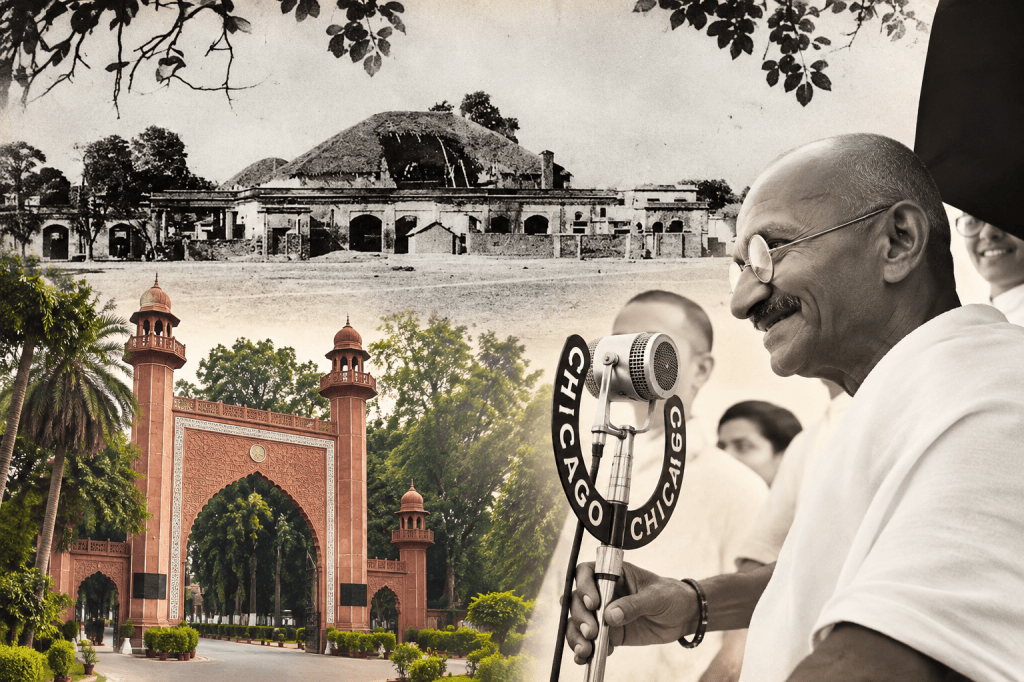
The relationship between Mahatma Gandhi and Aligarh, especially the campus of the Muhammadan Anglo-Oriental College that became Aligarh Muslim University, remains one of the most instructive episodes in the story of India’s freedom struggle. On 12 October 1920, Gandhi visited Aligarh and was awarded honorary membership of the Students’ Union of the institution, which had only recently been upgraded as Aligarh Muslim University by an Act of Legislation passed in September, with its formal inauguration scheduled for the coming December. A function was held in the Union within the College premises, where students interacted with the Mahatma and then listened as he spoke with characteristic directness against colonialism and the British yoke that had to be thrown out. That day transformed a campus gathering into a lesson in citizenship, sacrifice and unity, and its echoes are still worth hearing on his birth anniversary.
Gandhi did not flatter his young audience or appeal to their career prospects; he asked them to examine the moral cost of the loyalty they were expected to profess. He said, “How can you adhere to that institution where you have to pay allegiance to the Union Jack, be it for a moment, and where you have to state, to an august visitor like the Governor or some high officer, that you are loyal to the Empire though in fact you are not?” These words were not merely a criticism of one college or one government; they were a challenge to every institution that demanded outward obedience while inwardly denying freedom. Their relevance even today is uncomfortable, for while the flags and offices may have changed, the pressure to conform, to flatter power and to trade conscience for position has not disappeared. The nature of our masters and handlers may have altered, but the Gandhian question remains: can true education flourish where the mind is asked to bow before authority?
From this challenge, Gandhi moved to the deeper wound that colonial rule had inflicted upon Hindu-Muslim relations. He reminded the students that “the heart of the Muslim brethren have, therefore, been pained,” and he linked that pain to the government’s actions in the Punjab after the passing of the Rowlatt Act, which had convinced both Hindus and Muslims that it was impossible to get justice from that government. He exposed the strategy of division with plain words: “They made us, Hindus and Muslims, to quarrel among ourselves. They used to speak very ill of Hindus before Muslims and Muslims before Hindus.” Then came the warning that remains central to his thought: “If Islam is in danger today, Hinduism is also in danger, for if it is Islam’s turn today, it will be ours tomorrow.” This was not a plea for one community to protect another out of charity; it was a recognition that injustice, once tolerated against one, soon becomes licensed against all. Gandhi also pointed out that both communities had decided that fighting with the sword would only lose their money, their precious lives and leave them unsaved still more, since they did not possess guns and ammunition in such quantities and had received no such training from the government. The logic was stark, and it led him to the remedy of non-cooperation.
The speech then turned to education itself, and here Gandhi was at his most radical. He declared, “We are taught the lessons of slavery in the Aligarh College. We should boycott this slavish education. This is my first lesson.” He went on to say, “When thirty crore of men combine and organise with a view not to have this Government in their midst, it would be impossible for the government to remain in India,” and from that confidence he urged, “we should boycott Government Educational Institutions.” He did not stop at a single institution, for he asked students to boycott government educational institutions generally, just as the Non-Cooperation Movement had been in existence for a few months and had not yet been fully embraced by all. He called upon lawyers to give up practising, saying, “We will become mendicants. We will beg. We will subsist on rice and pulses. We will accept bare bread but will take our liberty also with. It is then alone we can be counted among the human beings. No one who is not free can engage himself in devotion of God.” He rejected titles as “badges of slavery” and wanted them returned; he did not want a single soldier or labourer sent into the government’s army; and he insisted that the people were not going to enter their legislative councils. For Gandhi, “Non-Cooperation is nothing more than sacrifice,” and it was inseparable from the Swadeshi Movement, since India had to pay seven crore of rupees for cloth. His formula was clear: “Non-Cooperation with one means Cooperation with others. Unless we have mutual regard for each other we can not become united or Organised.”
What makes the Aligarh visit so moving is that his words did not remain in the air. The students were divided, and the loyalist trustees were deeply uncomfortable, but the nationalist fervour could not be contained. On the following day, the students boycotted their classes, and in a meeting at the Union (Sidon’s) Club a young Zakir Husain declared that he would forgo his scholarship, a sacrifice that gave flesh and blood to Gandhi’s call. Mohammad Ali, addressing a gathering at the Aligarh (Lytton) Library, is said to have wept as he recited a verse, and the students began to demand another college where they could study free from government influence. That impulse contributed to the founding of a National Muslim University, with Maulana Mohammad Ali as its Principal, which later evolved into Jamia Millia Islamia. Gandhi returned to Aligarh in August 1921, arriving from Bombay with Maulana Syed Subani and Maulana Mohamed Ali, and the journey became a procession of enthusiasm as crowds greeted him with cries of “Mahatma Gandhi ki-jai” and showered flowers upon his compartment. At Agra Cantonment he spoke on Hindu-Muslim unity and urged the people to take to Khadi, and in Aligarh he visited the National Muslim University (Jamia Milia) and addressed meetings of women and the public. In 1929 he came again to propagate the Swadeshi Movement, staying once more at Nishat Kothi (now where stands Aligarh Public School), and his relationship with the institution deepened to the point that the Aligarh Muslim University Students’ Union, founded in 1920, conferred its first lifetime membership on him.
Gandhi’s respect for Aligarh was not one-sided, for he regarded Sir Syed Ahmad Khan as a “Prophet of education” and acknowledged him as one of the architects of modern India who foresaw the need for Indians to acquire proficiency in English and modern sciences. Handwritten letters from the Mahatma to student leaders such as Abdul Majid Khwaja and Abdul Bari are preserved in the Maulana Azad Library, tangible relics of a living relationship rather than a distant memory. The Khilafat and Non-Cooperation movements provided the immediate context for his visits, but the deeper significance lay in his attempt to construct a shared political community in which Hindus, Muslims and Sikhs could act together as communities without surrendering their distinct identities. The outcome was complex, for Khilafat propaganda sometimes heightened a separate Muslim consciousness rather than dissolving it, and the colonial policy of divide and rule continued to bear poisoned fruit. Yet the sincerity of Gandhi’s effort is not diminished by the difficulty of the task, and Aligarh remains a crucial arena where he experimented with mass mobilisation and inter-communal dialogue.
As we commemorate the birth anniversary of Mahatma Gandhi, the memory of his 1920 speech at the Students’ Union in Aligarh should disturb as much as it inspires. He asked students to refuse slavish education, to surrender titles and privileges, to accept bare bread with liberty, and to recognise that non-cooperation with an unjust system means cooperation with one another. In a time when divisions are amplified and loyalties are often demanded without conscience, the Gandhian legacy in Aligarh invites us to rediscover dialogue, non-violence and the courage to place the poorest and most marginalised at the centre of patriotism. The Mahatma’s birthday is therefore not only an occasion for garlands and speeches; it is a call to renew the unity and harmony he pursued, and to ask whether we, like those students in 1920, are ready to become fakirs for the service of the motherland.
Ishwar Allah tero nām
Sab ko sanmati de Bhagwān


