Syed Ali Nadeem Rezavi
By the time the events narrated in the previous instalment of this series (uploaded a few weeks ago) had run their course, I had learnt something about my academic career. Whenever an opportunity arose to leave Aligarh, I would seriously consider it, seek advice, sometimes apply, occasionally prepare myself to go, and then somehow remain exactly where I was. Perhaps it was indecision. Perhaps attachment. Or perhaps, as I have preferred to call it throughout these reminiscences, it was a call I had not yet learned to recognise properly. I thought destiny was summoning me elsewhere, but all along it was telling me to stay.
The world around me was also changing. Slowly and gradually, most of the teachers before whom we had once sat as students retired. Some passed away. The giants who had dominated the corridors of the Department when I entered it as a young student were disappearing from everyday life. We, who had once been the youngsters, were becoming the seniors, although our official designations did not always keep pace with either our age or our grey hair. We waited for promotions. And we waited.
Aligarh had developed a peculiar philosophy regarding Selection Committees. Other universities appeared to regard them as a routine administrative necessity. At Aligarh they sometimes resembled astronomical events, discussed frequently, predicted confidently, but actually witnessed only after very long intervals.
While waiting for one such celestial occurrence, my telephone rang one evening. I was at home watching television when the caller introduced himself as speaking from Kolkata. He informed me that the Pro Vice Chancellor of Calcutta University wanted to speak to me. That was sufficient to make me sit upright. I was told that a certain Professor, whose name I shall deliberately not reveal, had recommended me for appointment as Professor. Could I come to Kolkata with my original documents by a specified date and join? Literally, I was swept off my feet. A Professorship had arrived over the telephone while I was watching television. After waiting endlessly for Aligarh to hold a Selection Committee, here was Calcutta University asking when I could arrive with my certificates.
I somehow composed myself and requested a day or two to think. The following morning I went, as I had done so many times before at crucial moments in my life, to Professor Irfan Habib. “Sir, what should I do?” He smiled. “Is there something to think? Go and join.” That appeared to settle the matter. Except that it did not. The following day I telephoned Kolkata and politely declined. The gentleman at the other end was astonished. “Do you even realise that this is an opportunity of a lifetime?” “Yes, Sir,” I replied. “I do.”
I then tried to explain why I was refusing an opportunity of a lifetime. There were two reasons. The first was Aligarh’s libraries. By then my research had become so dependent upon Persian sources, manuscripts, rotographs, microfilms, rare books and old journals that I had come to appreciate the extraordinary resources available around me. If I required a particular source, there was a very good chance that it was somewhere in Aligarh. I did not have to travel from city to city hunting for material. The second reason was even more difficult to reproduce elsewhere. At Aligarh there was a living encyclopaedia called Irfan Habib. One could sit with him over an ordinary cup of tea, mention a subject one was thinking about, and within minutes receive a list of sources, references, problems and possible approaches. Sometimes one emerged from such a conversation wondering whether the proposed paper had not already been written in his head. Libraries could perhaps be assembled elsewhere. An Irfan Habib could not. I knew that neither advantage would be available to me in quite the same way in Kolkata. So I stayed. Once again, some friends thought I was being foolish. By then I had considerable experience in being told this.
A few years passed and the wait for further promotion at Aligarh seemed endless. Then Delhi University advertised a Professorship. This time I decided that I would not repeat my old habit of refusing opportunities before they had even had the opportunity to refuse me. Our senior and a fellow student of Professor Habib, Professor Jafri, was then the Chair of the Department. I rushed to apply and prepared seriously for the interview. There were, however, excellent candidates. Almost at the last moment, another candidate applied from the United States. He was very good and was eventually appointed. I had gone into the Selection Committee fully prepared and also sufficiently aware of the competition to understand the result. Academic life should teach one, among other things, that not every unsuccessful interview is an injustice. Sometimes someone else is simply the stronger candidate. I returned to Aligarh. Destiny had once again stamped my passport: DEPARTURE DENIED.
Then came JNU. There was a certain symmetry in this because JNU had already appeared much earlier in my story. As a young academic I had applied there and then, at the last moment, failed to muster the courage to appear for the interview. Decades later, JNU returned for a second attempt. The person then holding charge of the Department encouraged me to apply. Indeed, when I read the required qualifications, I could almost have imagined that someone had prepared them after looking at my CV. They suited my academic profile remarkably well. I applied. Then came the interview. And once again I did not go. There was no great ideological reason. There was no administrative obstacle. No one prevented me. I simply could not bring myself to leave Aligarh. Everyone told me I was foolish. They may well have been right. But by then Aligarh was no longer merely the university which paid my salary. Its libraries contained my intellectual memories. Its corridors carried the voices of my teachers. Its classrooms contained generations of my students. Even its quarrels had become familiar. One may spend years complaining about an institution and still discover, when an opportunity to leave actually arrives, that complaining about home and leaving home are two entirely different things. So JNU came and went for the second time. I remained.
Meanwhile, destiny found another way of promoting me without actually making me Professor. A University Grants Commission Visiting Committee came to evaluate the Centre of Advanced Study in History. I had not applied for any administrative position. In fact, during the Committee’s visit I had argued with some of its members. Apparently the argument did me no harm. On the basis of my CV, the Committee recommended my name for a leading role in the Centre. There was, however, a technical difficulty. I was still a Reader and not a Professor, and therefore, I was informed, they could not recommend me as Coordinator. An ingenious solution was discovered. I would be Deputy Coordinator. Thus, perhaps for the first and last time in its history, the Centre of Advanced Study in History at Aligarh acquired a Deputy Coordinator. Academic bureaucracy is capable of remarkable creativity when sufficiently provoked. I continued to be associated with the Centre through its later years. Eventually, in March 2023, with the completion of its eighth cycle, the Centre of Advanced Study in History came to an end.
Long before that, however, the great Aligarh Selection Committee finally materialised. By then I was counted among the senior most Readers in the Faculty. Years had passed since I had become eligible for promotion. When posts were finally advertised, I applied both for a general Professorship and for Professor under the Centre of Advanced Study, for which I was qualified. The Selection Committee met. I performed well. Indeed, the Vice Chancellor, Lieutenant General Zameeruddin Shah, personally congratulated me and told me that mine had been the best performance. The Selection Committee recommended me as Professor under CAS with effect from 2008, the date of my eligibility. After all those years, the wait appeared to be over. I should by then have known better than to assume that destiny had finished with the script.
Months passed before the results were announced. One day we were conducting a viva voce examination when a clerk entered carrying the selection orders. Names were announced. Mine was not among them. For a few moments I could not understand what had happened. I had appeared before the Committee. I had been recommended. The Vice Chancellor himself had congratulated me and told me that mine had been the best performance. Yet I had not been appointed.
Eventually an explanation emerged. I was told that since I did not possess a PhD when I had originally been appointed Reader, I was somehow not eligible. I protested that the advertisement under which I had been appointed Reader had specifically required either a PhD or qualifications equivalent to a PhD. At that time a PhD was not an absolute requirement. I had been selected and appointed according to the rules then in force. My protestations fell on deaf ears. Thus began my confrontation with Lieutenant General Shah.
Our relations deteriorated further when the University administration turned its attention towards the Aligarh Historians Society. When an attempt was made to “investigate” the Society and restrain it from functioning from the Department of History, my patience finally deserted me. I wrote an angry Facebook post questioning the wisdom of a Vice Chancellor who, in my view, had dared to cast aspersions upon a man through whom the University was known across the academic world. Yes, it was a post which, under ordinary circumstances, I probably should not have written. Anger is an excellent source of energy but a poor editor. My frustration had been building for months. In every meeting the Vice Chancellor had assured me that my performance had been excellent. Yet when the appointment was finally to be made, I believed that he had yielded to a lobby determined to block it, even though the rules, as I understood them, did not prevent my appointment.
My detractors could hardly believe their luck. For years they had perhaps been waiting for me to provide them with ammunition. I had now supplied it myself. A copy of my Facebook post began travelling through the University. I learnt much later that one lady from the Department itself was actually deputed to carry a copy to the Pro Vice Chancellor. Many of these details were revealed to me, with considerable irony, by the former Vice Chancellor and Pro Vice Chancellor themselves after their tenures had ended. I was summoned. I was asked to apologise. I refused. Flatly.
The matter then reached the Executive Council. There, a person who had been my senior at school, and who would eventually succeed General Shah as Vice Chancellor, delivered an argument of such extraordinary constitutional ingenuity that it deserves preservation. I had criticised the Vice Chancellor. The Vice Chancellor was a retired officer of the Indian Army. Therefore I had criticised a retired officer of the Indian Army. That meant I had criticised the Indian Army. To criticise the Indian Army was to criticise the country. Therefore I was anti national. I assure the reader that I am not making this up. I still retain an audio recording of the speech. A member of the Executive Council recorded it during the meeting, forwarded it to a friend, and it eventually reached me. Today that person occupies a significant position in the University. Even more remarkably, my suspension order contains almost the same charge. I have preserved that document carefully. Some people collect medals. I collect administrative absurdities.
There is another document in this unusual archive. Lieutenant Colonel Shrikant Purohit, who had been arrested in connection with the 2008 Malegaon blast case, somehow learnt about my suspension. From jail he wrote to Lieutenant General Shah suggesting that instead of suspending me, he should have called me and settled the matter “over a couple of drinks”. He sent me a copy of the letter. I still remember the day the envelope arrived. We stared at it in considerable puzzlement. It carried endorsements from jail authorities and government officials and looked as though it had passed through half the administrative machinery of the Republic before reaching my house. Whatever else may be said about my suspension, it certainly enriched my personal archive.
The suspension lasted six long months. What followed, however, was something I had never anticipated. Academics across the country spoke out. Professor Romila Thapar and numerous scholars, colleagues and friends condemned what they regarded as the high handedness of the action. Teachers’ associations at universities whose names I had scarcely heard issued statements in my support. Newspapers reported the controversy. Members of civil society also spoke out. Until then I had been known largely within my professional circle, among historians, colleagues and students. The Vice Chancellor solved that problem rather efficiently. Suddenly people across the country knew who I was.
One newspaper account particularly disturbed me. The Indian Express carried a column by Seema Chishti which, as I read it, substantially repeated the Vice Chancellor’s allegations against me. Among these was the claim that I habitually spoke disparagingly of former Vice Chancellors, from Dr Zakir Husain to Hamid Ansari. Those who knew me on campus would have found the allegation rather strange. I had always regarded these men with respect. What troubled me even more was that neither the newspaper nor the journalist had contacted me before publishing the allegations. On Professor Habib’s advice I wrote to both the journalist and the editor giving my side of the matter. I waited for a reply. By then I was an Aligarh academic of many years’ standing. Waiting was one of my strongest professional skills. No acknowledgement came. Nor, needless to say, did an apology.
Eventually, after six months and considerable intervention by friends within and outside the University, my suspension was revoked. Then, towards the end of 2016, the weather began to brighten again. Academic life has peculiar seasons. People who oppose you today may become your supporters tomorrow, while those whom you confidently regard as permanent allies can sometimes demonstrate that permanence is a highly overrated concept. The most remarkable change concerned the very person who had signed my suspension order. By the end of 2016, he had emerged as one of my strongest supporters. Before leaving office, he saw to it that I was given charge of the Department as its Chairman and also that of Coordinator of the Centre of Advanced Study in History. After everything that had happened, there was a delicious irony in this transformation. The administration under which I had been suspended now entrusted me with two of the Department’s most important academic responsibilities. There were, naturally, certain last minute manoeuvres by some friends who were not particularly delighted by this turn of events. Universities are supposed to be institutions devoted to the pursuit of knowledge, but they are also exceptionally good laboratories for the study of human nature. I had spent much of my career studying factions within the Mughal nobility. By this stage I sometimes wondered whether I really needed Persian chronicles for the purpose. A departmental corridor could provide remarkably similar source material. Despite these machinations, I finally received what was my due.
But destiny had reserved an even better joke for me. The man who, as a member of the Executive Council, had delivered that fiery argument linking my criticism of the Vice Chancellor to criticism of the Indian Army and ultimately to anti nationalism was Professor Tariq Mansur. In the years that followed, Professor Tariq Mansur became one of my principal sources of support during my entire tenure at the helm of the Department. Life has a sense of humour which no memoirist can hope to improve upon.
I have always believed that one should remember assistance as carefully as one remembers opposition. It would therefore be unfair to tell the story of my suspension without recording what happened afterwards. The person who had once spoken fiercely against me later supported me as Chairman. The person who had signed my suspension order later helped ensure that I became Chairman and Coordinator. And the Archaeology Section that had been closed was opened again. Perhaps this was reconciliation. Perhaps it was simply the strange rhythm of university life. Or perhaps all of us had grown older and discovered that yesterday’s battles need not determine tomorrow’s relationships. Whatever the explanation, I learnt another useful lesson. In academic life, never write the final footnote about anyone too early.
A few months into my Chairmanship, I received a call from the VC around 7:00 am. “Have morning tea with me at my residence”. I rushed and by 8:00 am he took me in his car to Musa Dakri Museum. “I want to give its charge to you”. There were some from the Museology who were desperate to take the charge themselves. He asked them to come to his office and asked me to sit in the car. I obeyed but as we reached the Library Gate, and I asked him to drop me there, he stopped the car and said “I am getting the order typed in your name”. I requested him not to do so, but get the order typed in the name of the Chairman Department of History. He listened to me intently and asked are you sure? And by afternoon the gentleman holding the charge was removed and me, as Chairman and Coordinator of CAS Department of History also became the Coordinator of Musa Dakri Museum.
When I became Chairman, one matter particularly close to my heart was the revival of the Archaeology Section. Historical archaeology had been part of my academic life almost from the beginning. My work at Fathpur Sikri had grown out of my conviction that historians of medieval India needed to interrogate buildings, landscapes, archaeological remains and material culture alongside chronicles and documents. The Archaeology Section, however, had been closed during Lieutenant General Shah’s tenure. Its revival was therefore particularly important to me. It could not have been achieved by the Chairman alone. Professor Tariq Mansur extended his support and the Section was revived. Something which had been shut down, was brought back to life. His assistance did not stop there. During my tenure we were able to organise an International Seminar on Sir Syed Ahmad Khan and a Symposium on Medieval Archaeology. Both required institutional support, resources and administrative cooperation, and Professor Mansur helped us obtain them.
There was another irony. My suspension itself turned out to have been something of a boon in disguise. For one thing, it provided me with something university teaching rarely gives an active teacher: time. For six months I had no classes and few routine departmental responsibilities. I returned to books I had been intending to read for years. I caught up with scholarship that the demands of teaching, research and administration had forced me to postpone. The University had unintentionally granted me a rather unusual sabbatical. Then came the financial surprise. The salary withheld during the suspension was eventually restored. Not a penny was lost. The accumulated amount proved remarkably useful. It helped towards buying a new car, jewellery for the family and meeting various other expenses. Thus General Shah’s punishment ultimately left me better read, better known and, temporarily at least, with more money in the bank. I remain grateful to him for all three. There is a certain pleasure in discovering that a punishment has failed so comprehensively in its intended purpose.
There are two events which happened during my tenure as the Chairman of the Department: one, my attempt to propose a Chair of Modern Indian History named after Late Mushirul Hasan who had then recently expired due to an accident, and an attempt to get the Board of Studies pass a resolution recommending the position of Professor Emeritus for Professor Shireen Moosvi who had contributed so much for Medieval Indian History and the Department which she had served. Both attempts came to a naught due to a coterie amongst our Faculty. In the first case, the coterie alleged that Mushirul Hasan had harmed JMI, was rabidly “anti-Left” and opposed Irfan Habib! These allegations coming from those who were rabid Left haters was actually quite thing! And then they alleged that as and he “were related”, I was trying to create a Chair in his name! In the second case too, the same persons opposed my move and alleged that I had “vested interests” to propose such a move! What was more interesting was that an old retired professor too expressed his grudge: if at all anyone else was to be elevated as Professor Emeritus after Irfan Habib, why did I not consider his name? It was a good question as he too had done a lot of work!
The years continued to pass. Almost imperceptibly, I had moved from being one of the youngest members of the Department to being among its senior academics. Students now came to me with the sort of questions with which I had once gone to my teachers. Younger colleagues sought advice. Administrative files arrived in quantities which occasionally made me wonder whether becoming senior was really the reward we had imagined it to be. But there was satisfaction too. I had seen the Department change across generations. I had taught students who themselves became teachers. I had watched research interests expand and new approaches enter the discipline. I had been able, during my own tenure at the helm of the Department, to contribute to its academic activities and to revive an Archaeology Section which had particular personal significance for me.
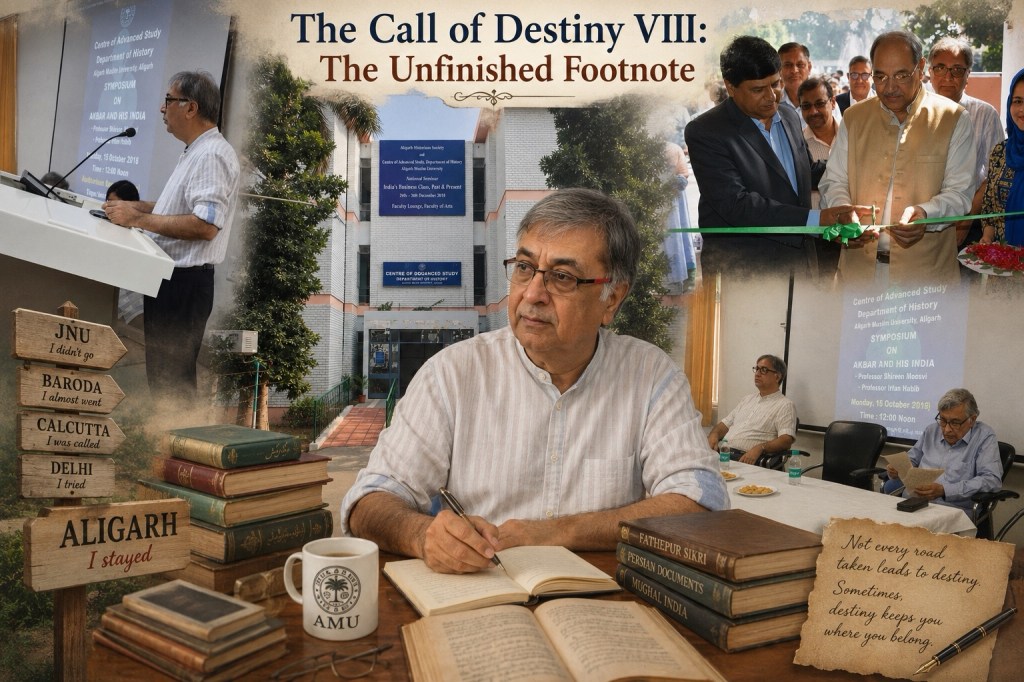
Eventually the journey reached its formal end. When I retired from active service after decades at Aligarh, I was certainly not the same man who had entered the University as an uncertain young researcher. I remembered the young scholar who had once been so embarrassed after delivering a dud speech that he had shaved off his beard. I remembered the research student who had no idea where life was leading him. I remembered Union School, Minto Circle and the brakeless bicycle at Women’s College. And then I remembered all the universities I had almost joined. JNU had called me once when I was young. I did not go. Baroda selected me as Reader. I prepared to leave, bought household goods and almost shifted there. I stayed. Calcutta University virtually offered me a Professorship over the telephone. I declined. Delhi University interviewed me. Someone better was appointed. JNU called again. I applied and once again did not appear. If one looked only at these episodes, my career might appear to be a catalogue of missed opportunities.
I see them differently. Each was a road that might have produced another life. Had I taken the JNU position, had I moved to Baroda, had I accepted Calcutta, or had Delhi selected me, my academic journey would undoubtedly have been different. Perhaps it would have been better. Perhaps worse. History does not provide control experiments. What I do know is what staying gave me. It gave me access to extraordinary libraries and collections. It allowed me to remain within an intellectual environment created by some of the finest historians of medieval India. Above all, it allowed me to remain close to teachers such as Irfan Habib, whose advice over a cup of tea could sometimes save weeks of wandering through the wrong sources. It gave me generations of students. It gave me colleagues, friends, opponents and, occasionally, people who managed to occupy all three categories at different moments. It gave me battles I would rather not have fought, but also the satisfaction of having survived them.
Aligarh frustrated me, promoted me, delayed me, suspended me, restored me, made me Chairman, and occasionally drove me nearly mad. But it also made me. That, perhaps, is why I could never quite leave. The young man who had once wondered whether he would ever secure a permanent job had eventually spent an entire professional lifetime in the same institution. The teachers before whom he had once nervously presented his work were gone or retired. The student had become the teacher, the Lecturer had become the Professor, and eventually the Professor had reached the end of his formal service.
Through all those twists and turns, one thing had remained remarkably constant. Whenever another road opened before me, something kept pulling me back towards Aligarh. For years I thought I was repeatedly refusing destiny’s call, battling against the current of my own career, forever saying no to what the universe seemed to be offering. Looking back, I realise that I had misunderstood the summons entirely. I had been listening for a voice that would carry me away, when all along a quieter, more persistent voice had been speaking from the very ground beneath my feet. I had mistaken departure for destiny and arrival for accident. The truth was far simpler and far more profound.
Destiny had never really been calling me away. It had been telling me, all along, to stay. And so I did. I stayed through the frustrations and the promotions, through the suspensions and the restorations, through the battles that I would rather not have fought and the satisfactions that made every struggle worthwhile.
Now that my formal service to the Department has ended, I find myself contemplating what comes next. The official designation of Professor may have been retired, the administrative files no longer arrive on my desk, and the classroom no longer summons me at appointed hours. But the call, I have come to understand, was never really about a job or a position. It was about something far more enduring. It was about a place that had shaped me so completely that even if destiny were to carry me to the farthest corner of the earth, it would find that it could not take Aligarh out of me. The students I have taught, the colleagues I have worked alongside, the corridors I have walked for decades, and the spirit of this institution that has become woven into the very fabric of my being, these will remain close to my calling for as long as I live.
In academic life, I have often reminded myself, never write the final footnote about anyone too early. Perhaps the same holds true for one’s relationship with an institution. My formal service may be over, but the story remains unfinished. The footnote has not yet been written. There will always be students to guide, scholarship to pursue, and memories to cherish. The Department of History at Aligarh will always be home, not because I never left, but because even if I do, a part of me will forever remain within its walls. The call I had mistaken for departure was never really asking me to go. It was asking me to belong, to commit, to become inseparable from the place that had made me what I am. And that, I now understand, was the only destiny that mattered.


