Syed Ali Nadeem Rezavi
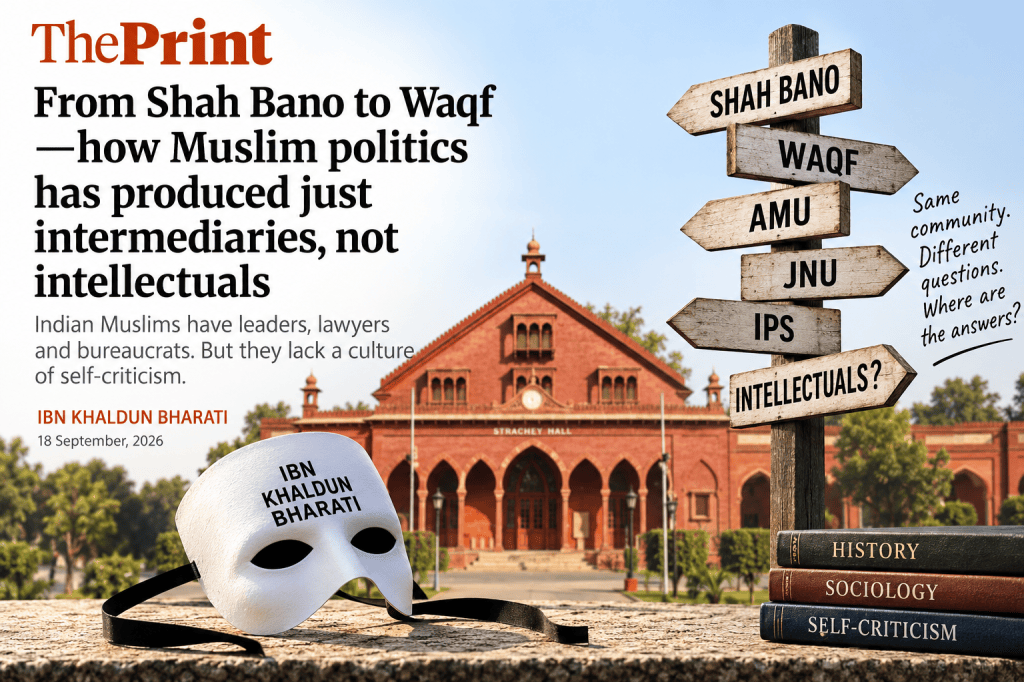
There are articles with which one disagrees, articles which irritate but nevertheless compel one to think, and then there are articles whose propositions are so enormous and whose evidence is so slender that one is left wondering how exactly the author managed to travel from one to the other. The recent piece published in ThePrint, “From Shah Bano to Waqf: How Muslim politics has produced just intermediaries, not intellectuals”, belongs, unfortunately, to the last category. Its author writes under the imposing name “Ibn Khaldun Bharati”, and the choice itself has a certain charm. The original Ibn Khaldun was one of the most formidable historical minds of the medieval world, a thinker who attempted to understand societies through power, institutions, economic circumstances, social solidarities and historical change. His Indian namesake appears to have devised a considerably simpler method: take approximately twenty crore Indian Muslims, remove their differences of class, caste, language, region, politics, gender, education and intellectual formation, stir thoroughly, and what finally emerges is what the author himself calls an “undifferentiated lump of thoughtlessness”. It is sociology made wonderfully economical, since one no longer requires fieldwork, archives, statistics or even troublesome human diversity.
The article begins with the claim that “most Indian Muslims” like to brandish their backwardness and use it to indict India. The Sachar Committee Report naturally enters the argument because its findings documented serious socio-economic disadvantages affecting sections of the Muslim population, but our author performs an interesting manoeuvre. Having invoked the question of Muslim backwardness, he announces that he does not intend to decide whether it is “real or mythical”. Surely, however, that is precisely the question which has to be answered before proceeding further. The Sachar Committee Report of 2006 was not a work of fiction. It was a government-appointed committee under Justice Rajinder Sachar, and its findings were unambiguous: the Muslim community was lagging behind other religious groups of India in most development indicators, relatively poor, more illiterate, and facing deep deficiencies and deprivation. By and large, Muslims ranked somewhat above Scheduled Castes and Scheduled Tribes but below Hindu Other Backward Classes, other minorities and Hindu general castes in all indicators considered. The Committee stressed the need for formulation of appropriate programmes to address the educational and economic backwardness of the community. One may dispute the Sachar Committee’s methodology, categories, statistics or conclusions, and there is nothing sacred about a government committee report, but intellectual criticism requires identifying what is wrong with the evidence and demonstrating why. The Government itself described the Sachar exercise as an attempt to establish the social, economic and educational status of India’s Muslim community, and subsequent official reporting recorded decisions on the overwhelming majority of its recommendations. Instead, the Sachar Report is rhetorically converted into something resembling the official version of a Muslim catalogue of grievances. Evidence has not been refuted; it has merely been renamed.
Having avoided the empirical question of backwardness, “Ibn Khaldun Bharati” arrives at his real discovery. The actual problem of Indian Muslims, he tells us, is “intellectual backwardness”, since India has millions of Muslims but somehow they have failed to produce an intellectual class. He is aware, of course, that Muslim historians, economists, scientists, lawyers, journalists, writers, academics and public figures exist in rather inconvenient numbers, so another ingenious device becomes necessary. Possessing intellect, he tells us, does not necessarily make somebody an intellectual, and Gramsci and Edward Said are summoned to lend theoretical dignity to the exercise. Very well, let us accept the test. What, then, are we to do with Maulana Abul Kalam Azad? What do we do with Zakir Husain, Mohammad Mujeeb, K. M. Ashraf, Mohammad Habib, Nurul Hasan, Irfan Habib, Mushirul Hasan and Asghar Ali Engineer? These are only a few obvious names, and they did not constitute an ideological regiment. Some were Marxists, others liberals; some were devout believers, others secular in intellectual orientation; some engaged deeply with Islamic thought, others with nationalism, class, history, communalism, education, gender or constitutionalism. They disagreed with each other, sometimes fundamentally, which is precisely what intellectuals normally do. Asghar Ali Engineer alone creates considerable difficulties for the thesis, since he criticised communalism, patriarchal interpretations of religion and authoritarian structures within his own community, supported reform on questions of Muslim personal law and repeatedly confronted religious conservatism. His intellectual and activist career, which earned him the Right Livelihood Award in 2004, therefore fits rather awkwardly into the picture of a Muslim society incapable of producing internal criticism. Indeed, the broader history of Muslim enlightened thought in South Asia, as scholars such as Ayesha Jalal have documented, includes figures from Mirza Ghalib and Sayyid Ahmad Khan to Muhammad Iqbal and Fazlur Rahman, alongside lesser-known intellectuals such as Nazir Ahmad and Sadequain, all of whom engaged seriously with questions of faith, selfhood, history and time. One may dislike their conclusions, but one cannot make their existence disappear.
There is a simple way around this difficulty, however, and our author seems to have discovered it. Define an intellectual in such a manner that anyone whose conclusions differ from one’s own ceases to qualify, then having emptied the room, announce triumphantly that nobody is inside. Syed Shahabuddin receives especially rough treatment, as the former diplomat, parliamentarian and editor of Muslim India is transformed into almost the archetypal Muslim intermediary. His politics surrounding Shah Bano, the Babri Masjid dispute and other questions certainly deserves critical examination, and I would myself disagree with several positions taken by Shahabuddin, but disagreement cannot substitute for historical representation. Here was a man who left the Indian Foreign Service, entered parliamentary politics, edited a journal for years and wrote extensively on minority rights, constitutional questions, foreign affairs and Indian Muslim politics. He was, by many accounts, a practitioner of left-of-centre politics who proudly called himself a socialist, even as his stance on Shah Bano and Babri Masjid led some to compare him to Muhammad Ali Jinnah. One may reject his conclusions, but it requires a remarkably elastic definition of “intellectual” to make intellectual engagement itself disappear merely because one dislikes the politics that accompanied it.
The treatment of Shah Bano is equally revealing. There was unquestionably a deeply conservative mobilisation against the Supreme Court judgement of 1985, and it deserves criticism, while Muslim intellectuals and women’s voices themselves criticised it, but Shah Bano was not a simple morality play in which a single Muslim leadership confronted an enlightened state. The controversy involved competing interpretations of personal law, Muslim organisations, reformist voices, women’s groups, Congress electoral calculations and the changing politics of communal mobilisation. The Supreme Court judgement itself concerned the applicability of Section 125 of the Code of Criminal Procedure to a divorced Muslim woman unable to maintain herself. The case involved a civil court ordering M. A. Khan to pay his divorced wife Shah Bano monthly support, a decision that was upheld by the Supreme Court but which evoked extensive conservative Muslim protest and led to legislation meant to limit alimony among Muslims. History requires recovering those complications, while polemic has the easier task of removing them.
Then come Gramsci and Said. Gramsci’s “organic intellectual” arose from a sophisticated discussion of class, hegemony and the organisation of consent, not a certificate to be awarded by an examiner to those whose politics met with his approval. Edward Said is an even stranger recruit to this enterprise, since Said’s conception of the intellectual emphasised independence from power, received orthodoxies and collective simplifications. Yet he is invoked in an article whose principal achievement is precisely the reduction of an extraordinarily heterogeneous population into a collective personality. Indian Muslims, we are told, do not possess the normal ideological spectrum of Left, Right and centre, and their divisions are apparently merely sectarian: Sunni, Shia, Deobandi, Barelvi, Wahhabi, Tablighi and so forth. Eventually Muslim society is compared with a “unicellular organism”. One hardly knows whether the appropriate response should come from a historian or a biologist.
Where are Muslim communists to be placed in this organism? Where are Muslim socialists, Congressmen, liberals, conservatives, feminists, Islamic modernists, secular academics, traditional ulema, reformist ulema, supporters of the BJP and its Muslim opponents? What happens to Pasmanda politics, a movement that has contested the hegemonic Muslim-minority discourse since the 1990s and comprises Dalit, Backward and Adivasi Muslims who constitute about 85 per cent of Indian Muslims? What happens to the enormous regional differences separating Kerala, Bengal, Kashmir, Assam, Uttar Pradesh, Gujarat, Maharashtra, Tamil Nadu and the Deccan? Does a Malayalam-speaking Muslim businessman in Kozhikode inhabit precisely the same political consciousness as an Urdu-speaking artisan in Uttar Pradesh, a Bohra trader in Gujarat and a Muslim communist in Kerala? Apparently they do, since twenty crore people become intellectually unicellular because allowing them to remain humanly complicated would ruin a perfectly good theory.
The historical method becomes still more adventurous when contemporary Muslim political behaviour is connected with the “tribal origins and military expansion” of Islam. At this point fourteen centuries of history disappear with enviable efficiency. The Umayyads and Abbasids pass silently away, Persia and Central Asia vanish, the Ottomans and Safavids are excused attendance, and Sufism, jurisprudence, philosophy, regional cultures, colonialism, capitalism, print, nationalism and modern education are no longer required. In India itself, more than a millennium of political change, social mobility, regional differentiation, caste formation, linguistic transformation and cultural interaction can apparently be bypassed. We begin in seventh-century Arabia and arrive directly in twenty-first-century India, a journey even Air India cannot manage non-stop. This is not longue durée history but historical essentialism. The historian normally asks how societies change, while the essentialist assumes that somewhere beneath all inconvenient historical change lies an eternal cultural substance waiting to explain everything.
The category of Ashrāf is treated in much the same manner. It is a historically meaningful social category and certainly deserves serious investigation, but in the article it becomes almost a hereditary political instinct travelling effortlessly across centuries. The old Muslim ruling class supposedly reinvents itself repeatedly, turning its class interests into the interests of the entire Muslim community. A genuine class analysis would ask who constituted this class at different historical moments, what its economic basis was, how colonialism altered it, how regional variations operated, how new professional classes emerged and how its relationship with other Muslim social groups changed. Here, however, Ashrāf becomes something of a magic word: say it three times and the whole of modern Muslim politics appears. The same fascination is visible in the author’s earlier writings on Aligarh Muslim University, where he has described AMU as “Allah Miyan’s University”, presented it as a “Succession State of the Mughal empire” and elsewhere called it the “last citadel of the Muslim political power”. These are remarkable descriptions of a modern central university, but they become even more interesting once one knows something about the gentleman writing under the name “Ibn Khaldun Bharati”. For the man behind this pseudonym is himself a graduate of Aligarh Muslim University, so the road to this devastating diagnosis of Aligarh passed through Aligarh itself. After graduating from AMU, he proceeded to Jawaharlal Nehru University, that famous “den of Leftists” of contemporary political folklore, and from JNU he entered government service and became an officer of the Indian Police Service. AMU, JNU and the IPS: it is, one must admit, quite a journey.
There is nothing objectionable in any part of it, since AMU and JNU are distinguished universities, whatever criticisms one may make of either, and service in the IPS is an honourable career. The relevance of the biography lies elsewhere. Someone who repeatedly interprets the intellectual failures of institutions and communities cannot reasonably expect his own intellectual formation to be treated as occurring in a vacuum. If AMU is really the intellectual wasteland suggested by these writings, what did it do to him? Who were his teachers, what did he read there, which debates did he encounter and which habits of thought did he acquire? The Aligarh Movement, after all, was founded by Sir Sayyid Ahmad Khan as a radical model for Muslim education in nineteenth-century India, embracing Western secular learning and the English language despite severe criticism, and its object was to make Muslims progressive. Did the University contribute nothing to the formation of the graduate who subsequently went to JNU and eventually emerged as “Ibn Khaldun Bharati”? JNU makes the story still more delightful. Here is a Muslim graduate of AMU who moves to one of India’s most intensely argumentative universities, enters an elite government service, and later announces that Indian Muslims somehow lack ideological diversity and an intellectual class. His own biography rather inconveniently demonstrates movement between precisely the intellectual worlds whose complexity his argument tries to erase, yet the biography disappears behind the magnificent curtain of “Ibn Khaldun Bharati”.
The use of a pseudonym is publicly acknowledged by the publications which have carried his work. An earlier publication explained that employer rules prevented him from publishing under his real name, while ThePrint has stated that its editors know the writer’s identity and allow the pseudonym, noting that they only permit pseudonyms when they know the writer well. There may therefore have been perfectly understandable professional reasons for the original concealment, but that does not make the resulting asymmetry any less interesting. Syed Shahabuddin has a name. Rajiv Gandhi has a name. Muslim organisations have names. AMU has a name. The ulema have names. The alleged intermediaries have names. Everybody standing in the dock has a name, while only the judge is wearing a mask. This brings us to perhaps the funniest contradiction in an article about “intermediaries”. The author reserves particular disdain for former bureaucrats who seek to become spokesmen or intellectual leaders of Muslims, yet the person writing this diagnosis is himself a government servant, an IPS officer, writing for a major national platform and explaining Indian Muslims to a wider readership. He tells readers what Muslims think, why they behave as they do, which grievances are genuine and which are manufactured, which leaders are legitimate and which are intermediaries, what AMU really represents, what Muslim Personal Law signifies, what Waqf politics means and even what psychological residue of early Islam supposedly remains buried in contemporary Muslim consciousness. What exactly is an intermediary supposed to do that is missing here? One is tempted to ask a rather simple question: who is mediating whom to whom?
The discussion of maslahat provides another example of the article’s method. A complex concept with a substantial history in Islamic jurisprudence is acknowledged as capable of meaning something like strategic prudence or consideration of welfare, only then to be rendered in “unadorned language” as makkāri, deceit. A complicated legal and ethical category thus undergoes an astonishing linguistic transformation, as centuries of jurisprudence enter the machine at one end and makkāri comes out at the other. This is not philology but a conjuring trick. The argument concerning AMU’s minority character suffers from the same tendency. One may support or oppose particular interpretations of AMU’s minority status, but it is not an imaginary controversy manufactured by an Ashrāf cabal. It involves Article 30 of the Constitution, parliamentary legislation, amendments to the AMU Act and a substantial history of constitutional litigation. The Supreme Court has grappled with the question of whether Article 30(1) applies to an institution established before the commencement of the Constitution, and a seven-judge Constitution Bench has deliberated on whether AMU fulfils the parameters of a minority institution under Article 30. To disagree with one interpretation is perfectly legitimate, while to treat the very existence of the dispute as proof of elite manipulation is another matter altogether.
The most disturbing passages come when Muslim society is described as possessing something resembling an army mentality in which departure from collective opinion becomes treason and religious dissent becomes apostasy, potentially exposing the dissenter to death. Again the question that a historian instinctively asks is embarrassingly simple: which Muslims, which country, which region, which class, which organisation, which school of thought, which historical period and which evidence? Once twenty crore people have already been converted into a “unicellular organism”, such tiresome questions cease to matter, and “The Muslim” has replaced Muslims. The tragedy is that underneath all this rhetoric lies a subject that genuinely deserves serious discussion. Muslim political leadership certainly deserves criticism, Muslim institutions require criticism, Waqf administration requires transparency and scrutiny, and here the author could have found genuine common ground with Muslim reformers. The lack of transparency in Waqf management, leading to corruption and misuse of funds, has been a longstanding problem that Muslim reformers themselves have acknowledged, and recent reform proposals have introduced digital portals to record Waqf properties, mandatory financial audits and stricter penalties for irregularities. Muslim Personal Law should be debated, patriarchal interpretations deserve challenge, the disproportionate public prominence sometimes accorded to clerics requires examination, self-appointed spokesmen claiming to represent millions of people should be questioned, and educational and economic problems require far more attention than symbolic controversies. There is nothing anti-Muslim in saying any of this, and Muslims themselves have been saying it for generations.
Indeed, that is precisely why the thesis of intellectual barrenness collapses. Modern South Asian Muslim history is saturated with arguments among Muslims about modernity, theology, nationalism, education, women, law, socialism, capitalism, Pakistan, secularism, communalism and democracy. Deoband argued with Aligarh, Aligarh argued within itself, Shibli differed from Sir Syed, Azad confronted the Muslim League, Muslim communists attacked Muslim communalism, Muslim feminists challenged patriarchy, Asghar Ali Engineer challenged both communalism and religious authoritarianism, and Muslim historians have disagreed with one another about almost every significant question in Indian history. Muslim women have themselves deployed everyday ideas of ethics and bodily practices to challenge inequality in Muslim family law, constructing a just community based upon the ethical ideals of the Quran and rights guaranteed by the Indian Constitution. One may dislike their conclusions, but one cannot make their existence disappear. There is also something wonderfully circular about the author’s complaint that Left-liberal Hindus have functioned as “attorneys” for Indian Muslims and prevented Muslims from speaking for themselves. This could have led to a serious discussion about representation and access to public platforms. Instead, having complained that others speak for Muslims, “Ibn Khaldun Bharati” spends the remainder of his article telling us what Indian Muslims really think. Apparently they cultivate victimhood, lack ideological diversity, have failed to secularise, lack civil society, remain intellectually shaped by tribal origins, behave collectively like soldiers and are manipulated by Ashrāf intermediaries. At last the Muslim has been allowed to speak, and, remarkably, all twenty crore of them speak through Ibn Khaldun Bharati.
There is a personal dimension to my amusement at all this. This is not my first encounter with the gentleman behind the pseudonym. On an earlier occasion he had written something of a similar order and I responded, raising particular historical questions and challenging his assumptions and evidence. His memorable response was not to answer the questions; he discovered that I had used AI, and that apparently settled the matter. How could I have responded so quickly and in such detail to what he had written? What he forgot was that as some are expert in baton wielding and witch-hunting, I have a decades old experience of wielding a pen! Whether I had used a fountain pen, a typewriter, Microsoft Word, Google, a research assistant or artificial intelligence somehow became more important than whether the arguments I had made were correct. It was a magnificent intellectual manoeuvre: when unable or unwilling to answer the petition, investigate the stationery on which it was written. Months have passed, and I am still waiting for the answers. Perhaps he has been busy, perhaps the original Ibn Khaldun had to be consulted, and perhaps somewhere in an undiscovered manuscript of the Muqaddimah there survives a chapter entitled “On the Proper Response to an Opponent Suspected of Using Artificial Intelligence”. Scholarship requires patience, and I am therefore prepared to wait a little longer.
But the same problem now arises again. Did the Sachar Committee document socio-economic disadvantages or did it not? If its conclusions are wrong, which conclusions are wrong and why? Where do Azad, Mohammad Habib, K. M. Ashraf, Zakir Husain, Nurul Hasan, Irfan Habib, Mushirul Hasan and Asghar Ali Engineer fit into the alleged absence of Muslim intellectuals? How does one describe a population containing communists, liberals, conservatives, feminists, secularists, Islamists and supporters of virtually every major Indian political formation as a “unicellular organism”? What historical mechanism takes us from the tribal society of seventh-century Arabia to an Indian Muslim citizen in 2026 while fourteen centuries conveniently disappear? How exactly does maslahat become makkāri? And if AMU is really a Mughal “Succession State”, what are we to make of the fact that the gentleman making this discovery graduated from it? These are questions of evidence and argument, and “He used AI” is not an answer to any of them. If AI has produced a false quotation, identify it. If a historical fact is wrong, correct it. If Sachar has been misread, demonstrate where. If Shah Bano has been misunderstood, produce the judgement. If my understanding of Ashrāf, maslahat or Aligarh is historically defective, show me the evidence. I would be perfectly happy to be corrected, since that, after all, is what scholarly disagreement means.
But there is another fascinating sociological phenomenon surrounding “Ibn Khaldun Bharati”, and it deserves recording for the benefit of future historians. He has friends. They are a remarkable fraternity, possessing what appears to be a highly developed capacity for seasonal hibernation. For weeks, sometimes months, one hears nothing from them. Universities may decline, historical claims may be distorted, scholarship may suffer and public discourse may descend into absurdity without noticeably interrupting their repose. Then somebody criticises Ibn Khaldun Bharati, and suddenly the forest awakens. One remembers Facebook, another discovers the share button, a third arrives to question the critic’s motives, a fourth becomes deeply concerned about tone, and a fifth, previously indifferent to the historical issue, develops an urgent interest in artificial intelligence. The original questions remain unanswered, but an impressive amount of activity takes place around them, and one almost expects a bugle. Then the danger passes and tranquillity returns, as the defenders withdraw gently into their caves, burrows and other suitable places of intellectual hibernation. Their public presence once again acquires the peaceful stillness of an archaeological mound, until the next article appears, or, more accurately, until somebody questions it. Then spring returns.
This is particularly entertaining in the context of an article lamenting the absence of an intellectual class among Indian Muslims. Apparently such a class exists after all, and its principal intellectual activity merely consists of sharing Ibn Khaldun Bharati and rushing to his defence whenever awkward questions arise. Here, at last, the pseudonym becomes genuinely useful. The original Ibn Khaldun possessed an excellent concept for precisely this sort of group solidarity: ʿasabiyyah. Groups cohere, protect their members, rally around authority and mobilise when challenged. Perhaps our modern Ibn Khaldun has finally provided us with an authentically Khaldunian phenomenon worthy of investigation, not the supposed tribal mentality of twenty crore Indian Muslims but his own little circle of ʿasabiyyah. So when this response circulates, I have one modest request for Ibn Khaldun Bharati and his periodically awakening friends. Please do not begin by asking whether I used AI. Let us save everybody some time and assume that I did. Assume, if it makes the discussion more enjoyable, that ChatGPT sat beside me, fetched the books, supplied the tea, checked the references and occasionally whispered Gramsci into my ear. Now answer the questions.
The real Ibn Khaldun taught his readers to examine societies through structures, interests, solidarities, power and historical change, and he was interested in explanation rather than denunciation. His modern Indian namesake instead gives us tribal origins, an eternal Ashrāf, maslahat transformed into makkāri, a “unicellular” Muslim society and twenty crore people somehow incapable of producing intellectuals. There is something almost autobiographical about the resulting paradox. A man graduates from AMU, proceeds to JNU, enters the IPS and eventually writes behind the name of one of history’s greatest social thinkers to explain that Indian Muslim politics produces former bureaucrats who become intermediaries instead of intellectuals. Sometimes a polemic possesses such perfect internal symmetry that a critic should hesitate before disturbing it. Perhaps the intellectuals whom Ibn Khaldun Bharati seeks were there all along, arguing, disagreeing, teaching, writing, reforming, criticising orthodoxy and criticising one another. Perhaps the difficulty lies not in their absence but in the peculiar spectacles through which he has chosen to search for them. As for me, I remain where I was several months ago, waiting for an answer to the earlier questions, and these new questions can now join the queue. When the hibernating friends next awaken, they too are welcome to answer them. Whether the questions were typed by a human finger, dictated into a telephone, written with a fountain pen or polished with AI will not alter the evidence one little bit, since the answer to an argument remains an argument. Perhaps “Ibn Khaldun Bharati”, having diagnosed the desperate need of Indian Muslims for genuine intellectuals rather than intermediaries, might set an example. He could begin by answering one.
Appendix: A Partial Inventory of the Barren
The question of who constitutes a living intellectual from Aligarh Muslim University is one that “Ibn Khaldun Bharati” might find inconvenient, since the answer rather undermines his thesis of a community-wide intellectual barrenness. The university has produced and sustained a remarkable range of scholars, writers, critics and public thinkers whose work continues to shape debates far beyond Aligarh, and this is nowhere more true than in history, the sciences, medicine and engineering, where the charge of intellectual vacancy becomes not merely unkind but demonstrably false.
Alongside Irfan Habib, who turned ninety-five in August 2026 and remains Professor Emeritus of History, still visiting his chamber at the department two or three times a week to meet colleagues and research students, the university sustains historians whose contributions are foundational. Professor Ishtiyaq Ahmad Zilli taught history at Aligarh Muslim University from 1978 to 2004, specialising in historiography, Muslim religious thought and medieval Indian history, particularly the Delhi Sultanate, before becoming director and secretary of the Darul Musannefin Shibli Academy in Azamgarh, a premier research institute for oriental studies in South Asia; he is the author of The Mughal State and Culture 1556-1598: Selected Letters and Documents from Munshaat-I-Namakin and remains a founding president of the Institute of Qur’anic Studies in Aligarh. Shireen Moosvi had been teaching at the Centre of Advanced Study in History since 1970 and today is a leading member of what is now known as the Aligarh school of historians, combining critical rigour with evolving visions of history; her statistical study of the Mughal empire’s economy in 1595, based on the Ain-i Akbari, remains a landmark of empirical research, and she has published widely on Mughal India and the economic history of colonial times, including People, Taxation, and Trade in Mughal India. Professor Iqtidar Alam Khan retired as Professor of History from Aligarh Muslim University in 1994 and served as President of the Indian History Congress in 1997; his political biographies of early Mughal nobles such as Mirza Kamran and Mun‘im Khan have served as founding pillars for Mughal prosopography, and his later works on India’s polity in the age of Akbar and on gunpowder and firearms in medieval India remain indispensable to the field. He is credited to have streamlined a new field of study, the field of Medieval Archaeology. He was one of the first to use modern scientific methods like satellite imagery in History. Professor Farhat Hasan is an alumnus of Aligarh Muslim University who went on to Cambridge, returned to teach at the Centre of Advanced Study in History at AMU, and now serves as Professor of Medieval and Early Modern South Asian History at the University of Delhi, where he has written on state and locality in Mughal India and was asked to write on Mughal history for NCERT textbooks in 2008. Najaf Haider graduated from Aligarh Muslim University and obtained his doctorate from the University of Oxford, subsequently teaching medieval Asian history at the University of Delhi before moving to Jawaharlal Nehru University, where he is now Professor at the Centre for Historical Studies working on the history of money, banking and credit in Mughal India. And Professor Muzaffar Alam, who was trained at Jamia Millia Islamia, Aligarh Muslim University and Jawaharlal Nehru University, obtained his doctorate in history in 1977 and went on to become the George V. Bobrinskoy Professor in South Asian Languages and Civilizations at the University of Chicago, with landmark works on the crisis of empire in Mughal north India and the making of Indo-Persian culture.
In the sciences, medicine and engineering, the charge of intellectual vacancy becomes not merely unkind but demonstrably false. Mohammad Akram, Professor in the Department of Radiation Oncology at Jawaharlal Nehru Medical College, is a distinguished oncologist and researcher whose work focuses on the interface between the human microbiome and cancer, and who is a core member of the Cancer Nanomedicine Consortium at AMU. Professor Syed Moied Ahmed, former Chairman of the Department of Anaesthesiology and In-Charge of the ICU at JNMCH for two decades, is a Commonwealth Fellow who has authored over a hundred and fourteen papers, established the PDCC programme in Critical Care Medicine at AMU, and developed a resuscitation course that has been incorporated into CBSE school textbooks. Lalit Mohan Bariar, who served as Professor and Chairman of the Department of Plastic Surgery at JNMCH, dedicated his career to burns management, maxillofacial trauma and reconstructive microsurgery, mentored generations of surgeons, and published extensively on immunological responses in burn injuries and innovative reconstructive techniques. In the basic sciences, Professor Qudsia Tahseen is Professor of Zoology, a Fellow of the National Academy of Sciences and a recognised authority on nematology whose work has been supported by the Indian National Science Academy. M. Masroor A. Khan, Professor of Botany, has published widely on plant physiology and essential oil-bearing plants, while Professor Shamsul Hayat is known internationally for his research on brassinosteroids, salicylic acid and plant stress responses. In physics, M. Sajjad Athar is a Professor whose work on neutrino physics and nuclear reactions has been presented at international workshops, and Shri Krishna Singh is a Full Professor working on neutrino physics, quark models and electroweak interactions. There are non-Muslims too, but I will name only one or two: B. P. Singh, Professor and Chairperson of the Physics Department, and R. Prasad, Emeritus Professor and former Dean of the Faculty of Science, represent the departmental leadership that “Ibn Khaldun Bharati” would presumably classify as evidence of intellectual vacancy.
In chemistry, Farukh Arjmand is a Full Professor whose work on antitumour polymer therapeutics and clinical developments in polymer chemistry has been published in peer-reviewed journals, and Anees Ahmad is Professor of Industrial Chemistry, a product of AMU’s own academic pipeline who has been publishing and teaching in the department since 1987. Zeba N. Siddiqui, Professor of Organic Chemistry, works on green chemistry, heterogeneous catalysis and synthetic organic chemistry, while Dr Inamuddin, Assistant Professor in the Department of Applied Chemistry at Zakir Husain College of Engineering and Technology, has an extensive publication record in analytical and materials chemistry. In engineering, Mohd Hasan has been Professor in the Department of Electronics Engineering since 2005, holds a PhD from the University of Edinburgh and has published a hundred and seventy-eight refereed papers on low-power architectures and multicarrier systems. Salman Hameed is Professor in the Department of Electrical Engineering, a Gold Medallist and recipient of the QIP Research Fellowship from IIT Roorkee, whose research spans power systems, artificial intelligence applications, fuzzy logic controllers and nanotechnology in solar PV cells. Dr Md. Rehan Sadique, Assistant Professor in the Department of Civil Engineering, has published over sixty Scopus-indexed papers on finite element analysis, multi-hazard protection of structures and underground construction, and has led sponsored research projects funded by the UGC and the DST-RSF scheme. Dr Tabish Alam, a Senior Scientist at CSIR-Central Building Research Institute who earned his B.Tech in Mechanical Engineering from AMU, was listed among the top two per cent of scientists globally by Stanford University in 2024 and serves on the editorial board of Scientific Reports. Faisal Talib is Professor in the Department of Mechanical Engineering, with over eighty publications in industrial engineering and total quality management, and Dr Sidra Khanam is an Assistant Professor in the same faculty whose work has been indexed in Scopus and Google Scholar.
The point is not that every one of these figures is beyond criticism, or that their politics are uniformly agreeable, or that the university has no problems worth discussing. The point is that they exist, they research and teach and publish and mentor, and they do so from within the very institution that “Ibn Khaldun Bharati” has described as a Mughal succession state and a citadel of intermediaries. The pattern is difficult to ignore, since Aligarh trained them, Delhi University and JNU housed them, and the wider scholarly world read them. If AMU is really the intellectual wasteland that “Ibn Khaldun Bharati” describes, one wonders why its alumni keep turning up in the history departments of the country’s most competitive universities, publishing books that the rest of the field is obliged to cite, and why its scientists continue to win grants, publish in international journals and appear on lists of the world’s most cited researchers. A thesis of intellectual barrenness requires, at the very least, an explanation of how so many of the barren are still publishing in journals that the rest of the world happens to read.


