Syed Ali Nadeem Rezavi
Jayanta Sengupta’s recent essay in The Telegraph, “History Lessons“, (Published 14.09.26, 07:42 AM) reflects upon the passing of a remarkable generation of historians from Bengal. His five chosen figures, Ranajit Guha, Tapan Raychaudhuri, Ashin Das Gupta, Sabyasachi Bhattacharya and Sumit Sarkar, certainly constitute an extraordinary intellectual constellation. Sengupta himself makes it clear that his selection is personal rather than exhaustive. Indeed, no list of five, ten or perhaps even twenty names could adequately represent the richness of historical scholarship that Bengal produced during the second half of the twentieth century.
The names Sengupta has chosen are, as he acknowledges, a personal selection rather than a comprehensive roll call, and any such list inevitably leaves out scholars whose contributions have been equally foundational. We might think, for instance, of the late Professor Amales Tripathi, whose chronicling of the national movement remains indispensable to students of modern India, or the late Professor B.N. Mukherjee, who opened up hitherto uncharted territory in Kushana studies. The nonagenarian Professor Binay Bhushan Chaudhuri, still living in Calcutta, redefined the agrarian history and the history of the adivasis of eastern India in the late precolonial and colonial periods. The late Professor Rajatkanta Ray showed us new avenues in the interpretation of modern India’s social, political and economic history, while the late Professor B.D. Chattopadhyaya established, with enduring scholarship, the beauty and complexity of early medieval India. And the late Professor Amiya Kumar Bagchi, an archetypal economic historian, widened our understanding of colonialism in British-ruled India. To remember one generation is not to forget the others who shaped the discipline
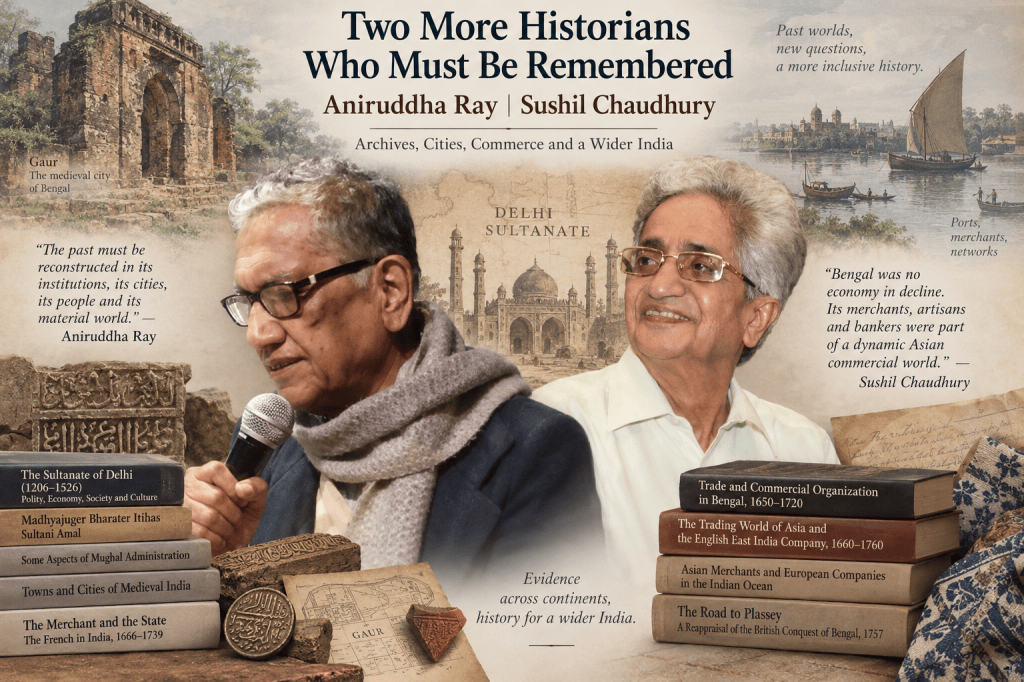
There are, however, two historians whom students of medieval and early modern India in particular would immediately wish to bring into this conversation: Professor Aniruddha Ray and Professor Sushil Chaudhury. They deserve to be considered together for more than the accident of being contemporaries. Both were associated with the Department of Islamic History and Culture at the University of Calcutta. Both devoted much of their scholarly lives to the centuries between the Delhi Sultanate and the beginnings of British colonial domination. Both recognised the extraordinary value of European archival records for writing Indian history. Both saw Bengal not as an isolated regional unit but as part of much wider networks of commerce, politics and cultural interaction.
There was yet another institution which connected them, namely the Indian History Congress. For historians of their generation the Congress was not simply an annual conference at which one occasionally presented a paper. It constituted one of the principal institutions of the historical profession in India. Both Ray and Chaudhury contributed to its proceedings, participated in its institutional life and eventually received its highest distinction through election to its General Presidency. Yet they were by no means historians of the same kind.
Aniruddha Ray possessed an unusually wide field of vision. The Delhi Sultanate and its administrative institutions, Mughal administration, medieval Bengal, urbanisation, archaeology, technology, European travellers, merchants, maritime commerce and the French East India Company all came within his range. Sushil Chaudhury was more consistently an economic historian, although his interests eventually extended deeply into politics and society. His great subjects were Bengal’s commercial economy, its merchants and bankers, the European companies, Asian trading networks and the circumstances surrounding the British conquest of Bengal. Read together, their scholarship reconstructs something often obscured by the retrospective shadow of British rule: the extraordinary vitality of the political, economic and urban world of eastern India before colonialism.
Aniruddha Ray belonged to a generation for whom serious historical research meant, among other things, the acquisition of languages and the willingness to move between different categories of evidence. Born in Calcutta in 1936, he studied at Presidency College and went to the Sorbonne in 1964, returning with his doctorate in 1967. The following year he joined the Department of Islamic History and Culture at Calcutta University, where he taught until his retirement in 2001. His years in France gave him access to French archives comparatively neglected by Indian historians. But it would be misleading to identify Ray simply as a historian of the French in India. His scholarly interests stretched backwards to the Delhi Sultanate and forward into the eighteenth century, and geographically from Delhi to Bengal and from the Indian interior to the maritime world. What held this apparently disparate scholarship together was his determination to understand historical institutions in their social and material settings.
One important dimension of Aniruddha Ray’s scholarship which deserves much greater recognition is his contribution to the history of the Delhi Sultanate and its administrative structure. For generations the history of the Sultanate had frequently been organised around dynastic succession: the Mamluks or so-called Slave dynasty, the Khaljis, Tughluqs, Sayyids and Lodis. Political history consequently tended to become the history of rulers, wars, rebellions and dynastic change. Ray did not discard political history. But he insisted that the Sultanate had to be understood as a functioning historical system. His work therefore directed attention towards the nature of Sultanate rule, its ideology of kingship, central administrative departments, revenue and land arrangements, urbanisation, commerce, technology, architecture, social formations and religious movements.
This represented an important methodological shift. The question was no longer simply what Alauddin Khalji or Muhammad bin Tughluq did. It was also what kinds of institutions made government possible, how the State mobilised resources, how land and revenue were organised, how political authority interacted with society, and what material and technological structures sustained the Sultanate. Two of Ray’s important books need to be recalled in this connection: his Bengali work Madhyajuger Bharater Itihas: Sultani Amal and, above all, his major English synthesis The Sultanate of Delhi (1206–1526): Polity, Economy, Society and Culture. The latter is especially revealing of his mature approach. Its first part reconstructs the political and dynastic history from the Ghurian conquest through the Lodi dynasty. But the second half deliberately changes the angle of vision. Here Ray examines the structure and ideology of Sultanate rule, departments of government and land relations, followed by trade and shipping, urbanisation, architecture and sculpture, science and technology, social life and religious movements. Thus the Delhi Sultanate emerges not merely as a succession of Muslim dynasties ruling from Delhi but as a complex political and social formation. That was also Ray’s answer to the old colonial representation of medieval India as a “dark age”. Political conflict could not constitute the totality of a civilisation. One had to reconstruct its institutions, cities, commerce, technologies, architecture, social relationships and intellectual life before making judgements about its historical character.
Another field in which Aniruddha Ray made a substantial contribution was administrative history. This was not a subsidiary interest arising out of his later work on the Delhi Sultanate. As early as 1984 he published Some Aspects of Mughal Administration, a work which became familiar to generations of students of medieval Indian history. Conceived in a form useful to students while at the same time engaging seriously with the problems of Mughal government, its chapters began with “The Mughal Concept of Sovereignty” and “The King and the Business of State”, before moving through the central and provincial administrative machinery, the mansab and jagir systems, revenue administration, officials, the nobility and related institutions. Administration, in his treatment, was therefore not simply a vocabulary of wazirs, diwans, bakshis, mansabdars, jagirdars and faujdars. The larger question was how the Mughal State actually worked.
This concern with the functioning of the medieval State eventually found an important counterpart in his study of the Delhi Sultanate. His The Sultanate of Delhi (1206–1526): Polity, Economy, Society and Culture, published in 2019, extended this institutional approach backwards. It was consciously written as more than another dynastic narrative. Its second part began specifically with “Structure of Sultanate Rule: Nature, Ideology, Departments, Land”, before proceeding to commerce, urbanisation, architecture, technology, society and religion. There is thus an important continuity in Ray’s scholarship which deserves greater emphasis. He was a historian of administration before he became so prominently identified with cities, French commerce and the archaeology of Gaur. His work on Mughal administration and his later synthesis of the Delhi Sultanate belong to the same intellectual endeavour: an attempt to move beyond chronicles of rulers and battles towards an understanding of the institutions through which medieval Indian States exercised authority and interacted with society.
This also helps us understand the extraordinary breadth of his later scholarship. Ray could move from the imperial secretariat to the marketplace, from the mansab and jagir to merchants and shipping, and ultimately from written administrative records to the physical landscape of Gaur. These were not disconnected interests. They represented different ways of answering a common historical question: how did the political, economic and urban structures of medieval and early modern India actually function?
And yet Ray was never content to remain inside the secretariat. He moved from institutions to merchants, from revenue to cities, from political authority to technology and, most strikingly, from written documents to the archaeological landscape. That movement is nowhere more visible than in his work on Gaur.
If Ray’s work on the Delhi Sultanate demonstrates his concern with political institutions, his engagement with Gaur, the great medieval capital of Bengal, reveals another and perhaps less widely appreciated dimension of his historical method. Here Ray did not simply read chronicles describing a vanished capital. He went to the site. Gaur was one of the greatest cities of medieval eastern India. For a considerable period it served as the political centre of the independent Bengal Sultanate and remained an important centre into the sixteenth century. Yet the historian attempting to understand Gaur confronts a peculiar problem. The city survives not as a continuously inhabited urban organism but substantially as an enormous archaeological landscape. Mosques, gateways, tombs and other monumental remains are visible. But the monumental architecture represents only part of the historical city.
Where did ordinary people live? Where were the markets? How extensive were the habitation zones? How were different parts of the city connected? What can pottery, bricks, tiles, inscriptions, coins and surface remains tell us that political chronicles cannot? And how did the changing riverine environment affect the growth and eventual decline of the city? These questions demanded a different kind of historical investigation. Ray became deeply involved in the exploration and archaeological survey of Gaur. The work was collaborative and interdisciplinary. Historians and archaeologists examined the surviving urban landscape, conducted reconnaissance and sector-wise exploration, recorded surface material and attempted to relate archaeological evidence to textual sources. The objective was not simply to catalogue monuments. It was to recover the city.
That distinction is fundamental. A monument can be studied as an individual architectural object. A city requires the historian to understand spatial relationships: habitation, roads, markets, water systems, fortifications, religious structures, industrial activity, environmental setting and the relationship between monumental and non-monumental spaces. The Gaur project therefore sought evidence of settlement patterns and material culture across the larger walled city. Pottery scatters, glazed tiles, bricks, inscriptions, coins and other archaeological remains could indicate areas of occupation that had disappeared completely above ground. The archaeological survey thus provided evidence for the lived city that neither the great mosques nor the chronicles could adequately recover. For Ray this was an extension, rather than a rejection, of textual history. The written record and the archaeological record had to interrogate one another.
The intellectual outcome of this collaborative enterprise was especially visible in the 2012 special issue of Pratna Samiksha: A Journal of Archaeology, devoted entirely to Gaur: The Medieval City of Bengal, c. 1450–1565. The significance of that volume deserves emphasis. It was not a conventional collection of essays on the political history of the Bengal Sultanate. It was an attempt to reconstruct a medieval city by bringing together history, archaeology, environmental evidence, settlement studies, epigraphy, numismatics and the scientific examination of building materials. Ray’s intellectual presence ran through the volume. He provided an overview of the archaeology of medieval Bengal, reconstructed the dynastic framework of Gaur, examined its economic formation and contributed directly to the analysis of the city itself. Other contributors examined Gaur’s historiography, its pre-medieval background, environment and settlement pattern, newly discovered inscriptions and coins, glazed tiles and the technology of glazed bricks from Gaur and Pandua. This was precisely the kind of interdisciplinary history towards which Ray’s scholarship had increasingly moved. The city could no longer be reconstructed solely from the Persian chronicle. Nor could archaeology be reduced to the description of monuments. The two had to meet.
The importance of the Gaur project becomes clearer when placed alongside Ray’s wider work on Indian urbanisation. He was interested in why cities emerged, what sustained them and why they declined. Political patronage obviously mattered. A capital attracted officials, soldiers, artisans, religious establishments, merchants and service groups. But political command alone could not explain the life of a major city. Gaur required an economic hinterland. It required supplies of food and raw materials. It participated in networks of trade. It possessed craft production. It depended upon waterways. Its physical expansion was conditioned by the peculiar riverine environment of Bengal. Thus the rise and decline of Gaur could not be understood merely by saying that one dynasty replaced another or that a capital was transferred elsewhere. The environment itself had a history. Rivers shifted their channels. Routes of communication changed. Areas that were commercially advantageous in one period could become difficult to sustain in another. This sensitivity to the interaction between politics, economy, environment and urban space was one of Ray’s most valuable contributions to medieval urban history.
Gaur also needs to be seen within Ray’s larger engagement with urban history, culminating in Towns and Cities of Medieval India. His canvas there was remarkably wide: Delhi, Agra, Fatehpur Sikri, Shahjahanabad and Lahore appeared alongside Surat, Goa, Calicut, Cochin, Golconda, Bijapur, Burhanpur, Patna and the cities and ports of Bengal. Ray challenged, implicitly and sometimes explicitly, the old image of pre-colonial India as overwhelmingly rural and of its cities as artificial creations of royal courts. The medieval Indian city was not simply where the Sultan or emperor happened to reside. Cities were centres of manufacture, commerce, administration, pilgrimage and cultural production. Artisans, merchants, bankers, officials, soldiers, religious specialists and labourers produced an urban life extending beyond the court. The work at Gaur gave this larger argument an archaeological foundation. It demonstrated that the historian of the medieval city must sometimes leave the archive and walk across the abandoned city itself.
Another Aniruddha Ray emerges when we turn towards European commerce. His monumental The Merchant and the State: The French in India, 1666–1739 was perhaps the fullest expression of his engagement with French archival material. But the larger subject was not simply the French East India Company. It was the relationship between commerce and political authority in early modern India. European merchants could not simply arrive, establish factories and conduct commerce on whatever terms they wished. They required permissions, concessions and protection. They depended upon Indian merchants, brokers, financiers, artisans and suppliers. Commerce was not external to politics. Nor was the State omnipotent. Merchants possessed resources, information and networks that rulers required. Commercial communities crossed political frontiers. Credit connected distant markets. Ray consequently helped recover a seventeenth-century India in which Europeans were participants rather than masters. We know that Plassey occurred in 1757. The people of seventeenth-century India did not. That distinction is essential to Ray’s historical world.
This brings us back to Jayanta Sengupta’s essay and particularly to Ashin Das Gupta. Das Gupta transformed our understanding of Indian Ocean commerce by placing merchants, ports, Asian commercial communities and networks of trust at the centre of the story. Ray and Chaudhury occupied adjoining historical territories. Ray’s French merchants moved through this Asian commercial world. Chaudhury’s Bengali, Armenian, Dutch and English merchants inhabited it. Das Gupta’s Indian Ocean connected their histories. But Ray added another dimension. He could move from a French commercial document to the administrative structure of the Delhi Sultanate, and from there to the archaeological surface of an abandoned medieval capital at Gaur. That extraordinary range should form an essential part of our assessment of him. He was a historian of texts who understood the value of objects. He was an administrative historian who became an urban historian. He was a historian of Bengal who understood that Bengal belonged to an Indian Ocean world. And he was a historian of European commerce who never allowed Europeans automatically to become the protagonists of Indian history.
If Aniruddha Ray’s great strength was the breadth of the worlds he explored, Sushil Chaudhury’s achievement lay particularly in the depth with which he reconstructed Bengal’s commercial economy. His scholarly career extended for more than half a century. His Trade and Commercial Organization in Bengal, 1650–1720, published in 1975, already announced many of the questions that would occupy him throughout his life. What made Chaudhury’s scholarship particularly important was the archive upon which it rested. He did not depend exclusively upon the records of the English East India Company. He made extensive use of Dutch records preserved at The Hague. This changed the perspective. Read only through English records, the English Company can easily become the protagonist of Bengal’s commercial history long before it actually possessed political supremacy. Dutch evidence made such assumptions much harder to sustain. The economy of Bengal was larger than any European company.
This became one of Chaudhury’s most important historiographical interventions. Colonial historiography had frequently represented eighteenth-century Bengal as a society already moving towards economic and political collapse before Plassey. Such a picture served an obvious explanatory purpose. If Bengal was already disintegrating, British conquest could appear as the consequence of indigenous decline. Chaudhury challenged this interpretation. His research into companies, merchants, commodities, textile production, prices, credit and commercial organisation led towards a very different conclusion: mid-eighteenth-century Bengal remained one of the richest and most commercially dynamic regions of the contemporary world. Its textiles commanded international markets. Its merchants possessed capital and commercial expertise. Its banking networks were sophisticated. Indian and Asian merchants remained important participants in inland and overseas commerce. The British did not conquer a commercial wasteland. They acquired control over one of the great manufacturing and commercial regions of early modern Eurasia.
Chaudhury also challenged the assumption that European companies progressively displaced indigenous merchants from long-distance trade. Indian, Armenian and other Asian merchants remained formidable commercial actors. They possessed advantages Europeans could not easily reproduce: local knowledge, access to credit, relationships with producers and political authorities, and commercial networks extending across regions and seas. Chaudhury’s work on Armenian merchants was particularly valuable because the Armenians cannot easily be fitted into histories organised around modern national boundaries. Their presence reminds us that early modern commerce cannot be reduced to a binary encounter between “India” and “Europe”. The Bay of Bengal was not a boundary separating India from the outside world. It was one of the great highways connecting them.
Chaudhury’s interest in commerce naturally took him towards bankers and financiers, especially the Jagat Seths. The great banking house of eighteenth-century Bengal stood at the intersection of commerce, credit and politics. Rulers required credit. Revenue had to be transmitted. Merchants needed bills of exchange. European companies required advances. Financial history consequently became political history. This brought Chaudhury directly to the problem of Plassey. He resisted explanations that treated British conquest as the inevitable consequence of a decaying indigenous order. Siraj-ud-Daulah, Mir Jafar, the Jagat Seths, the English East India Company and other political and commercial interests had to be reconstructed within the specific conjuncture of 1757. Plassey was not the inevitable triumph of modernity over medievalism. It was a contingent political event produced by military power, commercial interests, financial networks, court politics and betrayal.
There was another arena in which the scholarly lives of these two historians converged, namely the Indian History Congress. Both were associated with it over decades. For historians of their generation the annual Congress was not simply an occasion for ceremonial speeches. Research was brought before a national community of historians. Arguments were challenged. New evidence was presented. Young scholars encountered established historians. Sectional Presidential Addresses reviewed entire areas of scholarship, while the annual Proceedings created a cumulative record of the development of Indian historiography. Aniruddha Ray occupied several positions in the Congress before being elected General President in 2011. This was recognition of an unusually wide-ranging scholarly career: Sultanate administration, Mughal institutions, Bengal, urbanisation, technology, archaeology, merchants, maritime trade and European companies. His relationship with the Congress is particularly appropriate because his scholarship itself resisted narrow compartments. A paper on medieval Bengal could become an intervention in the national debate on urbanisation. A study of administration could raise larger questions about the nature of the medieval State. Archaeological exploration at Gaur could contribute to discussions about Indian urban history as a whole.
Sushil Chaudhury likewise had a long relationship with the Congress. He served as President of the Medieval India Section and contributed repeatedly to its Proceedings on Bengal’s commerce, shipping and the transition towards British political power. Eventually he too was elected General President, for the 79th session. He died in January 2019 before he could preside over the session. But he had already completed his General Presidential Address, “Overland Trade vis-à-vis Overseas Commerce: Which Enjoyed Primacy? Early Modern Era.” It was read posthumously when the Congress met at Bhopal. There was something extraordinarily appropriate about that final address. A historian who had spent his life reconstructing merchants, markets, shipping, credit and commercial networks ended his scholarly journey by returning to one of the fundamental questions of early modern economic history: the relationship between inland and overseas commerce.
Perhaps we should therefore speak cautiously of another strand within the celebrated historical tradition of Bengal. It was not the Subaltern Studies tradition associated with Ranajit Guha. It was not primarily the history of nationalism associated with Sumit Sarkar. Nor was it identical with the intellectual and economic history represented by Tapan Raychaudhuri. It was a historically grounded reconstruction of the institutional and material world of medieval and early modern India: States and administrative systems, merchants and bankers, cities and ports, ships and textiles, monuments and pottery, European companies and Asian commercial networks. Ashin Das Gupta was one of its greatest practitioners. Aniruddha Ray and Sushil Chaudhury unquestionably belong within that larger constellation.
All three shared another quality increasingly worth remembering. They took evidence seriously. They learnt languages because the sources demanded them. They entered archives because assertions had to be tested against documents. And, in Ray’s case at Gaur, when the written archive could take the historian only so far, he went out into the field with archaeologists and other historians to examine what remained upon and beneath the ground. That is an important expansion of what we mean by the historian’s craft. The archive is not always a room filled with paper. Sometimes the archive is an abandoned city. A scatter of pottery can be evidence. A change in brick technology can be evidence. A coin, an inscription, the alignment of a ruined wall, the location of a water body and the changing course of a river can all become historical documents when the right questions are asked of them. The Gaur project embodied precisely this understanding.
This brings us finally to the larger concern of Jayanta Sengupta’s essay. The importance of the generation he remembers does not lie simply in the fact that its members wrote famous books. It lies in a particular conception of what being a historian required. One had to learn languages. One had to enter archives. One had to read documents produced by people whose assumptions were radically different from one’s own. One had to submit one’s findings to criticism by other historians. And sometimes one had to leave the library altogether, walk across the remains of an abandoned medieval city, examine its walls, pottery, coins, inscriptions and landscape, and ask whether the material evidence confirmed what the texts appeared to say.
Aniruddha Ray and Sushil Chaudhury belonged emphatically to that scholarly culture. Ray moved between the Delhi Sultanate and Mughal administration, between Persian India and French archives, between Bengal’s commercial networks and the ruins of Gaur. Chaudhury followed Bengal’s merchants and textiles through Indian, English and Dutch records and reconstructed an economy whose vitality could not easily be reconciled with inherited assumptions about eighteenth-century decline. And both brought their scholarship repeatedly to the Indian History Congress, the institution that provided Indian historians with perhaps their most important national forum for presentation, criticism and debate.
Neither historian needed to make the past resemble the present. They attempted instead to recover a world whose inhabitants did not yet know what was going to happen to them. The merchants of seventeenth-century Bengal did not know that Plassey was coming. The Sultanate official did not imagine the Mughal Empire that would succeed his political world. The inhabitants of Gaur could not foresee that their magnificent capital would one day become an archaeological landscape. The French and Dutch companies did not know that their English competitor would eventually become a territorial sovereign. The historian does know. The historian’s responsibility is nevertheless to resist allowing that knowledge to predetermine the story. That is what the best historical scholarship does.
And that is why, when we remember the remarkable constellation of historians Bengal gave to modern India, Aniruddha Ray and Sushil Chaudhury deserve places of their own. Their long association with the Indian History Congress adds another dimension to their legacy. They were not simply authors of books read within specialised fields. They were participants in, and ultimately leaders of, a national community of historians committed to the patient reconstruction of India’s past. In remembering them, therefore, we remember not merely two outstanding Bengali historians. We remember a particular culture of doing history: archival and archaeological, multilingual and interdisciplinary, argumentative yet collegial, and always grounded in evidence.

 ASHA: Blast From The Past