Syed Ali Nadeem Rezavi
A recent lecture in Pakistan reportedly dismissed Sir Syed Ahmad Khan’s edition of Abu’l Fazl’s Āʾīn-i Akbarī as virtually worthless. A brief mention of it was made in a social media post. This judgement, if actually made during the course of the lecture, is historically unfair and methodologically questionable. Although the full lecture is to be heard before a comment is made on it, yet a pioneering nineteenth-century scholarly undertaking cannot be assessed solely by the conventions of a modern critical edition, and to do so is to commit the kind of anachronism historians normally warn their students against. Here, instead of the lecture, I will confine myself to assess the endeavours of Saiyid Ahmad Khan.
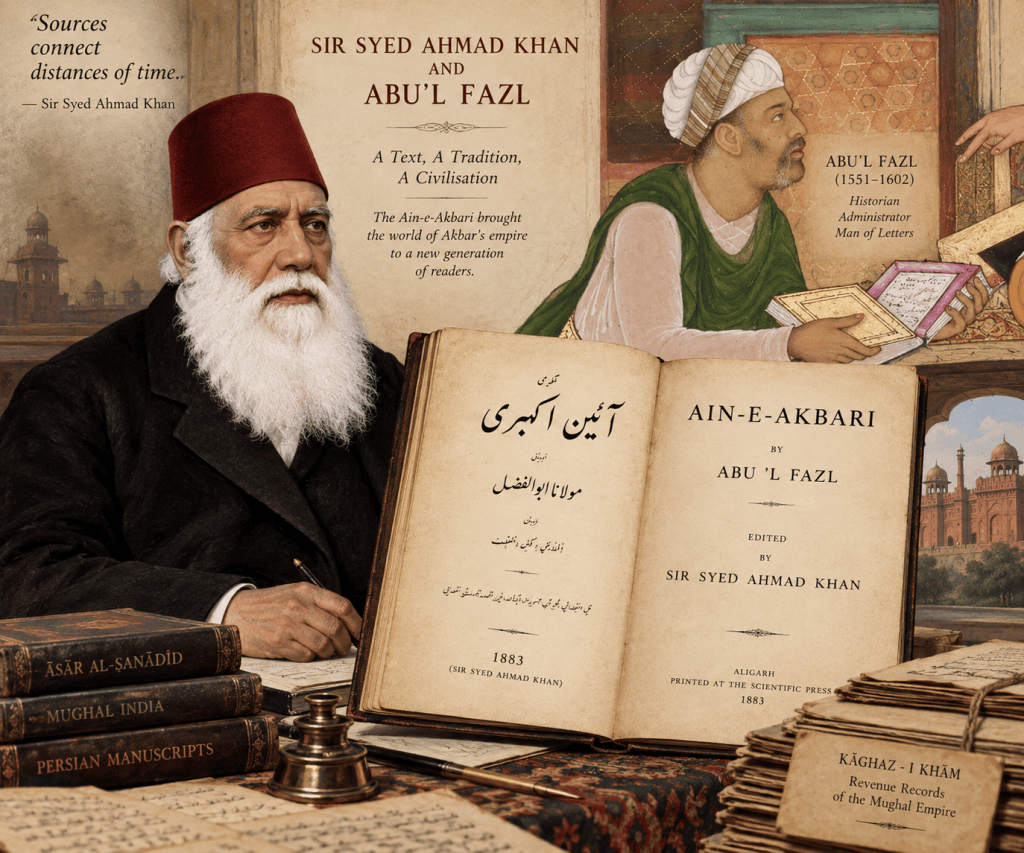
Before Sir Syed (as he is popularly known) became primarily associated with Muslim educational and social reform, he was deeply engaged with the monuments, inscriptions, documents and Persian historical literature of Mughal India. His Āsār al-Ṣanādīd belongs to this antiquarian world, and his work on the Āʾīn emerged from the same intellectual milieu. Abu’l Fazl’s text presented formidable editorial problems. Its administrative regulations, numerical tables, revenue statistics, geographical information and technical vocabulary made accurate transmission unusually difficult. Copyists could easily corrupt figures, names and technical expressions, while tables were especially vulnerable to displacement and error. Sir Syed published his edition in 1855, making the work far more accessible at a time when manuscripts remained scattered in private and institutional collections and modern Persian textual criticism in India was still developing. Printing such a large and technically difficult work widened its circulation and helped transform an elite manuscript tradition into a historical source that scholars could cite, compare and examine systematically.
The judgement must nevertheless become more qualified. Sir Syed’s edition cannot be treated as a critical edition in the modern philological sense. A modern editor would identify and describe all manuscripts used, establish their dates and relationships, record significant variants in an apparatus and explain editorial interventions. Sir Syed provided no such transparent textual apparatus. This matters greatly in the case of the Āʾīn. When manuscripts disagree over a literary sentence the consequences may be limited, but when they disagree over the assessed revenue of a sarkār, the number of cavalry attached to a mansab, a price or a statistical total, a single scribal error can materially change the historian’s conclusion. The printed page can therefore create an illusion of certainty. Sir Syed transformed a fluid manuscript tradition into a fixed printed text, but the fixing of the text did not necessarily resolve all the textual uncertainties lying behind it.
It would, however, be unfair to conclude that Sir Syed simply reproduced an available manuscript mechanically. His undertaking involved substantial scholarship. He was deeply familiar with Persian, Mughal institutions and the physical remains of Mughal India, and his antiquarian interests gave him an unusual sensitivity to historical terminology, places, buildings and institutions. Sir Syed belonged to a generation standing at the intersection of two traditions. Behind him lay the Persianate world of the munshi, the maulavi, the calligrapher and the manuscript collector; before him was emerging the modern world of printed texts, archaeology, epigraphy and institutional historical research. His edition of the Āʾīn belongs precisely to that transitional moment, and it is best described as more than a reproduction of a manuscript but less than a critical recension in the modern philological sense.
The limitations of his edition become clearer when placed beside the subsequent scholarship associated with Henry Blochmann. Blochmann represented a further stage in the critical study of the Āʾīn. His English translation of the first volume, published in the Bibliotheca Indica series in 1873, together with his extensive notes, transformed the study of Abu’l Fazl for European and subsequently Indian historians. Yet we should be wary of constructing a crude progression in which a supposedly traditional Sir Syed was simply superseded by scientific European scholarship. Blochmann himself worked within an Indo-Persian scholarly environment upon which European Orientalism depended heavily. Manuscripts had to be located, read and compared; difficult Persian expressions had to be understood; administrative terminology required explanation; names and places had to be identified. Indian maulavis, munshis, copyists and manuscript owners formed an indispensable part of this intellectual infrastructure. Sir Syed therefore belongs within the genealogy of modern Āʾīn scholarship rather than outside it.
There is also a fascinating intellectual episode associated with the edition. Sir Syed asked Mirza Ghalib to write a taqrīẓ, the conventional laudatory notice, for his edition. Ghalib did something quite different. His Persian poem effectively questioned the value of expending so much scholarly labour upon recovering Akbar’s administrative world when the British had created a radically different order based upon new forms of knowledge, science and technology. He wrote that Sir Syed had done something like freeing a servant who was already free, and urged him to look at the Sahibs of England and the laws and rules they had made. The episode is sometimes treated merely as an amusing encounter between two great nineteenth-century figures. It was considerably more significant. Ghalib was confronting Sir Syed with a question that would soon dominate his own intellectual life: what should knowledge of the past be for? The Sir Syed who edited the Āʾīn was deeply immersed in recovering Indo-Muslim civilisation; the later Sir Syed increasingly turned towards education, science and engagement with modern European knowledge. Ghalib’s refusal to provide uncomplicated praise thus seems almost to anticipate Sir Syed’s subsequent intellectual transformation.
From the standpoint of the historian, however, Ghalib was wrong in one important respect. The value of editing the Āʾīn cannot be measured by whether Akbar’s institutions could be resurrected in nineteenth-century India. Sir Syed was preserving the documentary foundations through which an entire historical civilisation could subsequently be reconstructed. The great twentieth-century scholarship on Mughal administration and economy, from W. H. Moreland and Jadunath Sarkar to M. Athar Ali, Satish Chandra and Irfan Habib, asked questions Sir Syed had not asked and subjected the evidence to forms of criticism he had not developed. Yet those historians inhabited, in part, a scholarly landscape that nineteenth-century editors such as Sir Syed had helped to create. There is therefore a certain irony in dismissing his edition from the vantage point of a mature modern historiographical tradition.
We can now return to the methodological problem of Abu’l Fazl himself. It has become customary to describe him as an imperial historian, and the description is correct, but it can become misleading when allowed to do too much explanatory work. Abu’l Fazl was unquestionably an ideologue of Akbar’s sovereignty, and his presentation of Akbar and the ordering of the empire must be read within that political and intellectual context. But it does not follow that the factual and statistical material contained in the Āʾīn was invented by Abu’l Fazl in order to glorify the emperor. Much of it rested upon the actual records of the Mughal administration. Abu’l Fazl had access to the documentation maintained by the imperial revenue establishment, including the kāghaz-i khām, the working papers or primary revenue records made available to him through the clerks of the revenue department. The figures incorporated into the Āʾīn were therefore not simply literary representations of an ideal empire. They were derived from the bureaucratic documentation through which that empire assessed, recorded and collected its revenues.
This distinction is fundamental. A figure may represent assessment rather than actual collection, and the historian must establish which it represents. The historian must distinguish between at least three separate stages in the history of the evidence. First, what did the Mughal revenue record originally contain? Second, how did Abu’l Fazl select, organise and reproduce that information in the Āʾīn? Third, how accurately was Abu’l Fazl’s text subsequently transmitted through manuscripts and eventually reproduced by editors such as Sir Syed? Confusing these stages produces unnecessary scepticism. Indeed, one of the remarkable features of the Āʾīn is precisely the conjunction of ideology and bureaucracy. Abu’l Fazl’s imperial vision was not constructed in opposition to administrative information; in significant measure, it was constructed through the organisation of administrative information. The enumeration of revenues, resources, officials, horses, crops, prices and territories was itself part of the representation of an ordered imperial polity. The statistics are therefore simultaneously bureaucratic evidence and components of an imperial discourse.
Sir Syed’s edition should neither be canonised nor dismissed. As textual criticism, it has been superseded. Its manuscript base and editorial principles are insufficiently explicit by present standards; it lacks the critical apparatus we would now expect; and individual readings, particularly numerical and tabular ones, should where necessary be checked against manuscript evidence and later editorial work. As nineteenth-century scholarship, however, it was a considerable achievement. Sir Syed recognised the extraordinary historical importance of Abu’l Fazl, undertook the difficult labour of bringing a vast and technically complicated Persian work into print and helped transform an elite manuscript tradition into a historical source accessible to a much larger scholarly community. As an intellectual event, it is more interesting still, capturing Sir Syed at a transitional moment between the recovery of Indo-Muslim civilisation and the later turn towards educational and social reform.
To ask why Sir Syed did not produce the sort of critical apparatus expected of a modern editor is legitimate. To judge the entire scholarly value of his undertaking by his failure to meet standards that had yet to become established is another matter. Sir Syed’s Āʾīn-i Akbarī is not the last word on Abu’l Fazl. It was one of the important early words in the modern scholarly recovery of Abu’l Fazl. Textually superseded does not mean historically insignificant. Editorial imperfection does not amount to scholarly incompetence. Sir Syed’s edition remains a landmark in the history of Indian historical scholarship: pioneering in its own time, limited when measured against subsequent advances, but indispensable for understanding how the modern study of the Mughal Empire itself came into being.


