Syed Ali Nadeem Rezavi
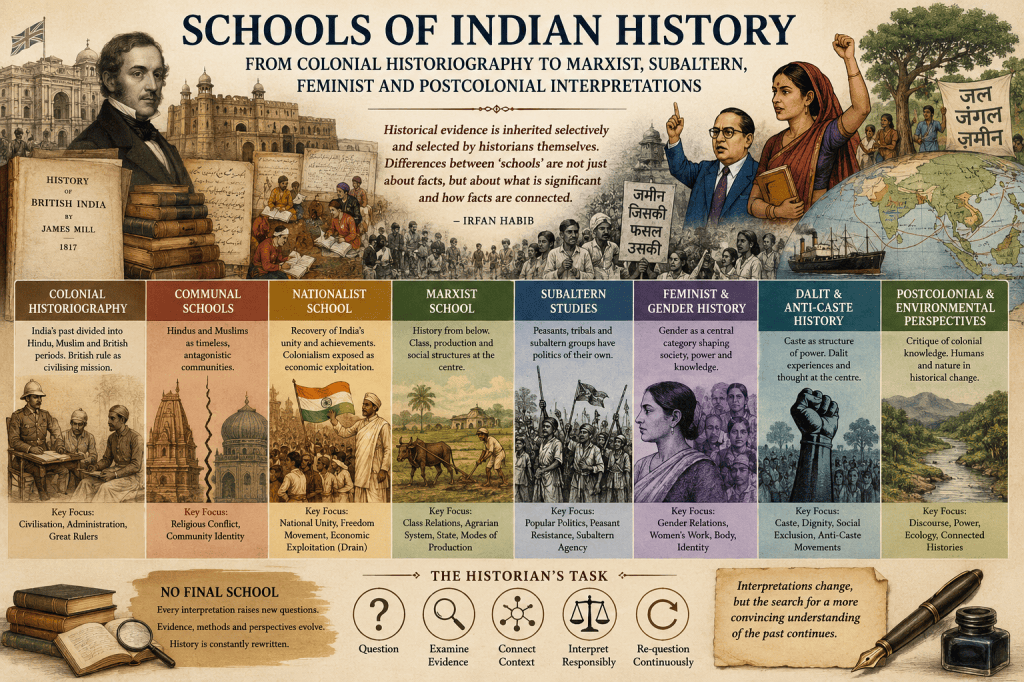
There is a certain paradox in speaking of “schools” of Indian history. Historians do not ordinarily enrol themselves in schools in quite the manner that the term suggests. D. D. Kosambi, R. S. Sharma and Irfan Habib were all Marxist historians, yet they did not interpret every historical problem in precisely the same way. R. C. Majumdar was a nationalist in one sense, conservative in another, and could adopt positions on medieval India that brought him remarkably close to explicitly communal interpretations. Ranajit Guha began within a broadly Marxist intellectual universe, yet the Subaltern Studies project that he inaugurated eventually moved considerably beyond Marxism. Some of the most influential historians writing today could not easily be accommodated within any single historiographical school.
Yet the idea of schools remains useful because Indian history has never consisted simply of the accumulation of facts. Historians have repeatedly disagreed about the meaning of the same facts. Was British rule fundamentally an agency of modernisation or a structure of colonial exploitation? Was medieval India essentially an age of Hindu-Muslim conflict, or did political and economic divisions cut across religious identities? Was nationalism principally the achievement of an educated middle-class leadership, or did peasants, workers, tribal communities and other subordinated groups possess political histories of their own? Was early Indian society organised primarily through religion and caste ideology, or must caste itself be understood in relation to production, labour and social power?
Behind each of these questions lies another: what makes one interpretation of history more convincing than another?
This was the problem with which Irfan Habib began his Interpreting Indian History, originally delivered as the Zakir Husain Memorial Lectures in 1985. Historical evidence, he argued, cannot resemble the evidence produced in a laboratory. The past cannot be experimentally repeated. Sources are produced by people with their own prejudices and interests, while the survival of evidence is itself accidental and unequal. The historian then performs another act of selection by deciding which surviving facts matter. Objectivity therefore cannot mean the absence of interpretation. A historian who refuses consciously to interpret merely reproduces, often unknowingly, somebody else’s interpretation.
Habib consequently insisted that the rewriting of history is not necessarily evidence of the failure of the discipline. On the contrary, the past must continually be reconsidered as new evidence becomes available, new questions are asked and changes in the present enable historians to recognise processes that earlier generations could not see. Historical interpretation requires, in his formulation, repeated exploration of evidence and the continuous re-questioning of inherited assumptions.
This provides a useful way of understanding the successive schools of Indian historiography. Each arose partly because an earlier interpretation appeared inadequate. Each enlarged the historical field by asking questions that its predecessors had neglected. Yet each also developed assumptions and exclusions of its own.
The Colonial Construction of Indian History
Modern academic Indian historiography developed under colonial rule, and this fact profoundly influenced its earliest organising categories.
James Mill’s History of British India (1817) famously divided India’s past into Hindu, Muslim and British periods. Mill himself had never visited India, but his periodisation proved extraordinarily durable. Ancient India became identified with Hindu civilisation, the centuries of the Sultanates and Mughals with Muslim rule, and British conquest with the beginning of a supposedly rational and progressive order.
This was not innocent chronology. It contained a theory of historical development.
India before British rule was represented as stagnant, despotic, irrational and divided by religion. British rule could therefore be presented not merely as conquest but as historical deliverance. The colonial state supplied law, rational administration, private property, modern education and ultimately political unity to a civilisation supposedly incapable of generating these things itself.
The Orientalists did not always share this contempt. William Jones and other eighteenth-century Orientalists expressed considerable admiration for Sanskrit literature and ancient Indian civilisation. But admiration for India’s antiquity could coexist remarkably easily with assumptions about its subsequent decline. Indeed, the celebration of a glorious ancient India sometimes strengthened the argument that contemporary India had degenerated from its former greatness.
The interpretation became particularly consequential in medieval history. H. M. Elliot announced in 1844 that he intended to extract from Persian chronicles evidence of forced conversions, confiscations, murders and massacres. As Habib pointed out, Elliot’s purpose was explicitly political: to contrast the alleged oppression of earlier Muslim rulers with British government and thereby weaken Indian criticism of colonial rule.
Colonial historiography thus did something whose consequences long survived colonialism. It converted religious identities into the principal actors of Indian history.
Instead of states, ruling classes, peasants, merchants, zamindars, artisans, castes and regional communities interacting within changing political circumstances, there emerged two apparently permanent historical subjects: Hindus and Muslims.
The Communal Schools: Two Narratives, One Historical Structure
From this colonial interpretation emerged what Habib called the two communal schools of Indian history.
Their political sympathies were opposite, but their historical architecture was remarkably similar.
The Hindu communal interpretation regarded medieval India essentially as a period of Muslim domination over Hindus. The Muslim communal interpretation celebrated much the same political order as Muslim achievement and increasingly imagined Indian Muslims as a historically continuous political community.
Habib’s comparison between R. C. Majumdar and I. H. Qureshi is particularly revealing. Majumdar’s account treated Hindus as a subject population under Muslim governments; Qureshi interpreted Muslim political history as a prolonged struggle against Hindu encroachment. Their heroes and villains differed, but both assumed precisely what required demonstration: that Hindus and Muslims existed through the medieval centuries as internally coherent and politically antagonistic communities.
This was history read backwards from nineteenth- and twentieth-century communal politics.
The difficulty is not that religious conflict did not occur. Temples were destroyed; rebellions could acquire religious language; rulers patronised particular religious institutions; discrimination existed. The historiographical question is whether religion provides the principal explanatory structure for medieval Indian history.
Once administrative documents, revenue records, commercial evidence, inscriptions, regional literature and the social composition of ruling elites are examined, the picture becomes considerably more complicated. Muslim rulers fought Muslim rulers; Rajputs served Mughal emperors against other Rajputs; Marathas fought Marathas; zamindars resisted revenue demands irrespective of the religion of the revenue collector; merchants formed networks that crossed religious boundaries; and political alliances repeatedly violated any simple Hindu-Muslim division.
The communal interpretation therefore suffers from precisely the problem against which historians constantly have to guard: it transforms modern political identities into timeless historical communities.
Its continued attraction nevertheless demonstrates that historiographical schools do not necessarily disappear when academically challenged. They may survive, and sometimes become politically more influential outside professional historical scholarship than within it.
The Nationalist School
Nationalist historiography emerged partly as a reply to colonial denigration.
If imperial historians argued that Indians were incapable of political unity, nationalists searched for evidence of unity. If British writers described Indian civilisation as stagnant, nationalists emphasised its intellectual, economic and cultural achievements. If colonialism presented itself as benevolent modernisation, Indian economic nationalists demonstrated its material costs.
Dadabhai Naoroji’s theory of the drain, R. C. Dutt’s economic history and later studies of deindustrialisation transformed the understanding of British rule. Colonialism could now be studied not merely through administrative reforms and governors-general but through transfers of wealth, taxation, handicraft decline and impoverishment.
Habib regarded this economic critique as one of nationalism’s enduring achievements. He insisted that the drain of wealth was not merely nationalist rhetoric but a proposition requiring serious economic investigation, and argued that colonial economic history could not simply dismiss the cumulative consequences of a sustained transfer of resources from India to Britain.
Nationalist historiography also generated a different understanding of medieval India. Tara Chand’s Influence of Islam on Indian Culture and Mohammad Habib’s work challenged communal assumptions and stressed interaction rather than perpetual religious antagonism. Tara Chand emphasised the composite character of Indian civilisation, while Mohammad Habib subjected figures such as Mahmud of Ghazni to historical rather than communal evaluation.
The Allahabad historians, including R. P. Tripathi and others, carried this approach into detailed institutional history. Their importance lay in demonstrating from sources that the medieval state could not simply be equated with a religious community.
Yet nationalism created problems of its own. In answering colonial assertions that India lacked unity, historians sometimes searched for an Indian nation too far back into the past. Political integration under Ashoka, Akbar or the Mughals could too readily become an anticipation of modern nationalism. The legitimate attempt to recover cultural interaction could occasionally romanticise “composite culture” and underplay conflict, hierarchy and inequality.
Nationalist historiography corrected colonialism, but nationalism itself could become an anachronism when projected into periods before the emergence of modern national consciousness.
Marxism and the Transformation of the Historical Question
The most important methodological transformation in twentieth-century Indian historiography came with Marxist history.
Its significance cannot be reduced to the application of a prefabricated sequence of slavery, feudalism and capitalism. Habib himself explicitly rejected such mechanical Marxism and observed that Marx had been badly served by followers who attempted to impose a rigid universal sequence of social formations.
The more important contribution was a change in the object of historical enquiry.
Kings remained important, but historians increasingly asked what happened beneath the court. How was the agricultural surplus extracted? Who owned or controlled land? What was the relationship between peasant and zamindar? How were artisans organised? What happened to commerce and urbanisation? What was the relationship between technology and production? How did caste interact with the division of labour? What social interests sustained states?
D. D. Kosambi was crucial to this transformation. He combined texts, archaeology, numismatics, anthropology and field observation in attempting to reconstruct social formations rather than dynastic sequences. R. S. Sharma developed the debate over Indian feudalism, land grants and changing relations of production. Romila Thapar transformed the study of early India by treating political institutions, lineage, state formation and ideology historically rather than accepting textual categories as transparent descriptions of society.
For medieval India, Mohammad Habib had already moved towards a social interpretation, but the work of Irfan Habib, Satish Chandra, M. Athar Ali, Nurul Hasan, Tapan Raychaudhuri and others created an especially powerful tradition of economic, social and institutional history.
The so-called Aligarh School became particularly associated with Mughal history. The mansab, jagir, zamindar, revenue system, agrarian production, ruling class, merchant, artisan and peasant replaced the emperor alone as the central subjects of historical enquiry. Athar Ali’s reconstruction of the Mughal nobility demonstrated its changing ethnic and social composition. Satish Chandra connected political crisis with the jagirdari system and agrarian relations. Irfan Habib’s Agrarian System of Mughal India reconstructed the relationship between state, zamindar and peasant through an extraordinary range of Persian sources.
This scholarship also fundamentally weakened communal interpretations of the Mughal Empire. Once the ruling class was examined empirically, the notion of a monolithic Muslim state confronting a Hindu population became difficult to sustain.
The great contribution of Marxist historiography was therefore not simply “class struggle”. It was the insistence that social structures have histories.
Its weakness appeared when economic explanation hardened into economic reductionism. Culture, gender, religion, language, emotion and political imagination could not always be explained adequately as reflections of material relations. The best Marxist historians recognised this; less sophisticated applications sometimes did not.
The Cambridge School and the Attack on Nationalism
During the 1960s and 1970s another interpretation emerged, associated especially with Cambridge historians such as Anil Seal, John Gallagher, Gordon Johnson and their associates.
Where nationalist historians saw an anti-colonial movement and Marxists analysed the class basis of nationalism, the Cambridge School concentrated upon political competition, patronage, local networks and elite interests.
Anil Seal’s The Emergence of Indian Nationalism became its emblematic work. Political leaders who spoke the language of nationalism could, from this perspective, also be understood as members of local, caste and regional networks competing for influence and access to the colonial state.
This was a useful corrective to heroic nationalist history. Political leaders were not disembodied embodiments of the nation. They possessed careers, patrons, rivals, caste affiliations and material interests.
But explanation could easily become reduction.
Habib’s criticism was that the Cambridge School’s problem lay less in the facts it uncovered than in the setting into which it placed them. Seal’s emphasis upon competition among elites diminished both the reality of colonial exploitation and the ideological transformation by which individuals could transcend, however incompletely, local loyalties. The nationalist critique of colonial economic policy, elaborated in works such as Bipan Chandra’s Rise and Growth of Economic Nationalism in India, could not simply be reduced to competition for offices and patronage.
The larger question was whether nationalism was merely what nationalist politicians did, or whether ideas themselves could become historical forces.
Subaltern Studies: History from Below
The next major challenge came from within the Left.
Beginning with the first volume of Subaltern Studies edited by Ranajit Guha in 1982, historians including Shahid Amin, David Hardiman, Gyanendra Pandey, Gautam Bhadra, Dipesh Chakrabarty and others argued that Indian historiography remained overwhelmingly elitist.
Colonial history attributed political change to British administrators. Nationalist history attributed it to nationalist leaders. Even Marxist history, Subaltern historians argued, could sometimes reduce peasants to social classes whose political consciousness was interpreted through structures formulated by intellectuals.
What about the peasants themselves?
Guha proposed an autonomous domain of subaltern politics. Peasant rebellion possessed its own vocabulary, symbols, rumours, memories and conceptions of authority. Popular politics did not simply reproduce elite nationalism in diluted form.
Habib welcomed the attempt to recover workers, peasants and tribal peoples but disputed the strong claim of autonomous subaltern consciousness. He argued that peasant politics could not be isolated from ideas circulating through wider society and pointed out that Marxist historians had already recognised both spontaneous peasant resistance and tensions between popular movements and nationalist leadership. His deeper objection was that elite and subaltern politics interacted: peasant movements changed nationalism, but nationalism also changed peasant consciousness.
That disagreement remains important.
But Subaltern Studies itself changed. What began partly as radical social history increasingly encountered anthropology, literary theory, Edward Said, Michel Foucault and post-structuralism. Dipesh Chakrabarty has himself described this movement from a project related to Marxist “history from below” towards a wider postcolonial critique of historical knowledge.
The question was no longer simply: where are the peasants in history?
It became: whose categories make historical knowledge possible?
Postcolonial History and the Critique of Europe
This transition produced another influential historiographical formation.
Dipesh Chakrabarty’s Provincializing Europe crystallised the problem. Categories such as capitalism, modernity, citizenship, secularism and historical progress emerged from particular European experiences but acquired apparently universal authority. How could Indian history be written without making Europe the implicit standard against which every other society appeared early, late, incomplete or deficient?
This critique produced important insights. Colonialism was not merely political domination or economic extraction; it also created categories of knowledge. Census classifications, ethnography, law, caste enumeration, linguistic categories and notions of religious community did not simply describe Indian society. In certain circumstances they helped reshape it.
The influence of Bernard Cohn, Edward Said and later postcolonial scholarship encouraged historians to interrogate the archive itself. A colonial document was no longer merely a source containing information. Its classifications, vocabulary and silences themselves became historical evidence.
Yet postcolonial history produced its own danger. If discourse becomes overwhelmingly powerful, material structures can disappear. Peasants still paid revenue; workers still received wages; famines killed real people; forests were physically appropriated; wealth actually moved between colony and metropolis. The archive may construct categories, but it does not construct everything that happened outside it.
The strongest subsequent scholarship has therefore tended to combine rather than choose between material and discursive history.
A significant recent intervention is Benjamin Zachariah’s After the Last Post: The Lives of Indian Historiography (2023), which addresses the politics of historical production in India while warning against the pitfalls of postcolonial consciousness itself. Zachariah interrogates how history-writing and history-reading have functioned in public debates, often through processes of memorialisation that serve collective identities. His work exemplifies a growing tendency to treat postcolonial theory not as a final settlement but as another set of assumptions requiring historical scrutiny.
Feminist and Gender History
Another transformation was taking place at roughly the same time.
Women had certainly appeared in older histories, but usually when they became queens, reformers, nationalist leaders or exceptional personalities. Feminist historiography asked a more fundamental question: what happens if gender itself becomes a category of historical analysis?
The work of historians such as Uma Chakravarti, Kumkum Sangari, Sudesh Vaid, Tanika Sarkar, Geraldine Forbes, Gail Minault, Lata Mani and others transformed the field. Recasting Women, edited by Sangari and Vaid, was especially influential in demonstrating that gender could not simply be added to an already completed political or social history. Gender relations helped constitute caste, community, labour, property and nationalism.
The field has subsequently moved beyond the recovery of “women” towards the histories of gender and sexuality. As Charu Gupta has emphasised, neither “woman” nor gender can be treated as a homogeneous or biologically self-explanatory category; both have to be located within changing structures of caste, class, sexuality and power.
This was not simply the creation of another special field called women’s history. It altered the questions asked of Indian history as a whole.
Recent scholarship continues to extend these insights. Janaki Nair’s Women and Colonial Law: A Feminist Social History (2025) introduces students to key colonial moments that have shaped women’s legal status up to the present day, tracking shifts and changes that have occurred over the last thirty years. Lata Singh and Shashank Shekhar Sinha’s edited volume Gender in Modern India: History, Culture, Marginality (2024) brings together pioneering research on themes including social reforms, caste, Adivasis, patriarchy, colonialism, capitalism, political economy, labour, masculinity, sexuality, health and migration. The volume examines the gender question through a multilayered and multi-dimensional frame in which interdisciplinarity and intersectionality play an important role, using case studies from diverse geographies and community locations.
Dalit History and the Challenge to the Older Schools
Perhaps the most important extension of this critique has come from Dalit historiography.
Subaltern history had promised history from below, but “the subaltern” could itself become an abstraction. Caste was not merely another example of subordination. Dalit historians and scholars of anti-caste movements increasingly insisted that caste possessed its own structures of power and historical memory.
The writings of B. R. Ambedkar, Jyotirao Phule and other anti-caste intellectuals consequently came to be read not merely as sources for political history but as works of historical interpretation themselves.
More recent Dalit Studies has explicitly challenged the old colonialism-versus-nationalism binary. Ramnarayan Rawat and K. Satyanarayana’s Dalit Studies, for example, places humiliation, dignity and spatial exclusion at the centre of historical enquiry and asks how Dalit intellectuals themselves conceptualised emancipation.
This intervention has in turn been criticised from within. Shailaja Paik has shown that Dalit history could reproduce a male-centred account of Dalit experience. Dalit women’s history requires the simultaneous examination of caste, class, gender and sexuality rather than treating any one of them as sufficient. Paik’s The Vulgarity of Caste: Dalits, Sexuality, and Humanity in Modern India (2022) offers the first social and intellectual history of Dalit performance of Tamasha, examining how Dalit performers negotiated violence and stigma while struggling to claim human dignity. Drawing on ethnographies, films and untapped archival materials, Paik demonstrates how choices that communities make about culture speak to much larger questions about inclusion, inequality and the structures of caste violence. Her work builds on and departs from Ambedkar-centred historiography by examining the ordinary and everyday in Dalit lives. The development continues: recent scholarship explicitly treats Dalit women not merely as objects whose experiences historians recover but as producers of historical and theoretical knowledge in their own right.
Here the idea of separate historiographical “schools” begins to break down. Feminist, Dalit, labour and subaltern histories intersect without becoming identical.
Environmental History and New Historical Subjects
Another field scarcely visible when Habib delivered his lectures in 1985 has since become substantial: environmental history.
Forests, rivers, animals, climate, irrigation, disease and ecological change were once treated largely as background scenery against which human history occurred. Environmental historians instead asked how relations between human societies and nature changed historically.
Madhav Gadgil and Ramachandra Guha’s This Fissured Land, Guha’s The Unquiet Woods, and subsequent work by many scholars connected forest policy, colonialism, communities, resource use and resistance. Environmental history in South Asia has since expanded far beyond colonial forestry to encompass water, animals, climate, disease, urban environments and the ecological history of pre-colonial societies. Michael Fisher describes successive waves in a field that has moved from the study of resistance to state-backed exploitation towards much broader investigations of changing relationships among human beings, other species and the material environment.
Ramachandra Guha’s Speaking with Nature: The Origins of Indian Environmentalism (2024) represents a major recent contribution, challenging the orthodox assumption that countries like India are “too poor to be green” and revealing a virtually unknown prehistory of environmental thought set far outside Europe or America. Guha identifies ten remarkable individuals who wrote with deep insight about environmental abuse from within an Indian context, long before Rachel Carson’s Silent Spring, and posits the idea of “livelihood environmentalism” in contrast to the “full-stomach environmentalism” of the affluent world.
This development again illustrates Habib’s central insight. Historical significance changes when the historian changes the question.
A forest that appears in an imperial archive as “waste”, in a revenue document as taxable land and in a nationalist history as territory may appear in environmental history as an ecosystem, a livelihood and a contested political resource simultaneously.
Global and Connected Histories
A further transformation has been the turn towards global and connected histories. Sanjay Subrahmanyam’s concept of “connected histories”, first advanced in 1997, has been accepted, contested and modified by many since. His Across the Green Sea: Histories from the Western Indian Ocean, 1440-1640 (2024) exemplifies this approach, scanning the intricate links between trade, politics and cultural exchange across the western Indian Ocean. Subrahmanyam supplements the heavy reliance on early Portuguese texts to recover a history with a far greater variety of actors and interests, written from a diversity of perspectives. This scholarship places India within movements of people, commodities, technologies, texts and ideas across the Indian Ocean, Central Asia and Eurasia, challenging the nation-state as the natural container of historical enquiry.
New Directions: Masculinity and Gender
One of the most significant developments in recent Indian historiography has been the emergence of masculinity as a distinct field of historical enquiry. The earliest writings on masculinity in the context of India were within the discipline of history, and works on modern history effectively demonstrated that masculinity and femininity were important nodes for the organisation of power in the colonial context. Mrinalini Sinha’s Colonial Masculinity: The ‘Manly Englishman’ and the ‘Effeminate Bengali’ in the Late Nineteenth Century (1995) was pioneering in this regard. Sinha argued that the emerging dynamics between colonial and nationalist politics in the 1880s and 1890s in India is best captured in the logic of colonial masculinity. The figures of the “manly Englishman” and the “effeminate Bengali” were constituted in relation to colonial Indian society as well as to aspects of late nineteenth-century British society, including the emergence of the “New Woman”, the remaking of the working class and the anti-feminist backlash of the 1880s and 1890s. Sinha traced the impact of colonial masculinity through four specific controversies: the “white mutiny” against the Ilbert Bill in 1883, the official response to the Native Volunteer movement in 1885, the recommendations of the Public Service Commission of 1886, and the Indian opposition to the Age of Consent Bill in 1891.
The historiography of colonial India has thus played a significant role in early studies of masculinities, taking interest in understanding the dynamic of Indian nationalism and the gender discourse in India. As one scholar put it, the question of “what is involved in writing a history of masculinity” finds important contributions from the historiography of colonial India.
In nineteenth-century Bengal, the recovery of lost manhood became a dominant aspect of the Hindu nationalist project, with the single aim of metamorphosing the effeminate Hindu Bengali into a virile citizen. Bankim Chandra Chatterjee’s essays challenged longstanding Victorian gender binaries and participated in broader historiographical debates on the construction of colonial masculinity and virility in Anglophone discourses. This concern with masculinity was not confined to Bengal. In early twentieth-century North India, masculinity became a site of power, hierarchy and resistance, articulated through Hindi vernacular print. Charu Gupta’s recent work on “Performing Masculinities” (2025) examines three key narratives: upper-caste Hindu masculinity in the shuddhi and sangathan movements, ascetic celibacy in the writings of Satyadev Parivrajak, and representations of Dalit manhood. While dominant Hindu masculinities reinforced caste and gender norms, Dalit men redefined manhood as a mode of assertion and dignity. The study highlights masculinity’s dual role as both a hegemonic tool and a medium for subaltern dissent and egalitarian aspirations.
The intersection of masculinity with caste has become an increasingly important area of enquiry. Dalit masculinity has largely been studied as a footnote to two larger conversations: Brahmanical patriarchy and hegemonic masculinity. Yet the Dalit male body disturbs the idea of masculinity in colonial India in ways that have not always been readily recognised. The physical violence enacted upon Dalit men, their simultaneous hypersexualisation and debasement, and the weaponisation of the masculine imperative itself by Brahmanical patriarchy have all emerged as subjects of sustained investigation.
Recent scholarship has also explored masculinity in relation to militarisation and conflict. In Kashmir, Amya Agarwal’s Contesting Masculinities and Women’s Agency in Kashmir (2022) unearths a “mosaic of masculinities”, showing how different forms of masculinity coexist and conflict within a securitised and militarised environment, complicating the narrative of a singular, dominant masculinity. In Assam, Uddipana Goswami’s Gendering Peace in Violent Peripheries (2022) highlights the role of “hegemonic masculinity”, where hypermasculine ideals tied to ethnic identity and militarisation exacerbate ongoing violence and suppress alternative forms of agency. Both works explore how militarisation, ethnic fragmentation and state violence construct and reinforce patriarchal power through the performance of masculinities. The study of masculinities in conflict zones has been further extended by research on civilian men in India’s “disturbed areas”, which argues that amid the extreme and violent forms of masculinities of military and militant groups, civilian men reconfigure a new form of masculinity: “lesser” but more humanistic.
The domestic sphere has also emerged as a crucial site for the study of masculinity. Gyanendra Pandey’s Men at Home: Imagining Liberation in Colonial and Postcolonial India (2025) offers a detailed exploration of men’s comportment and conduct in the home and the implications of their ambiguous commitment to this critical part of their lives. Pandey draws on autobiographies, memoirs, fiction and ethnographies to situate Indian men firmly in the domestic world, underlining their dependence on the family and home. He investigates how men negotiate marriage, intimacy and conjugality, and focuses on the effects of the humiliating and constant assertion of gender, caste and class power in familial interactions. As much as it is a book about masculinity and conjugality, it is also a book about Indian modernity, nationalism and society as seen from the location of men in the home.
Popular culture, particularly Bollywood, has become another important arena for the study of masculinity. The image of the “angry young man” of the 1970s and 1980s gave way to the “creative young man” of subsequent decades, which in turn led to the “metrosexual male”. The image of the muscular hero gained prominence around the 1990s, when socialist goals were replaced by economic liberalisation. Interpretations of manhood have unfolded within a middle-class cultural milieu shaped by assertive self-confidence fuelled by liberalisation and the prominence of Hindutva politics. The desire for muscular masculinity, intertwined with nationalism during the colonial era, is now being re-enacted in contemporary India with neoliberal influence.
The relationship between masculinity and Hindu nationalism has been the subject of sustained enquiry. Prem Kumar Vijayan’s Gender and Hindu Nationalism: Understanding Masculine Hegemony (2019) argues that Hindu nationalist thought and predilections emerge out of and in turn feed pre-existing gendered tendencies, specifically Brahmanical masculine hegemony. The image of an aggressive male warrior is central to certain versions of Hindu nationalism, embedded within a political narrative that declares its affinity for ideas of resolute masculinity. This has been described as “Hindu muscular nationalism”, fusing the concept of a Hindu India with armed masculinity.
Queer and non-normative masculinities have also begun to receive historical attention. The study of “female masculinity” in India embodies what has been described as a double failure: that of a racialised, postcolonial subjectivity perpetually one step outside of modernity, and that of queer masculinity seen only as a failed copy of dominant, Hindu nationalist masculinity. Queer masculinity in Indian cinema has never been only about identity but about how men learn to live within, and sometimes disrupt, the script of masculinity imposed on them.
The International Center for Research on Women (ICRW) and Nirantar conducted a comprehensive literature review on men, masculinities and feminist theorisation in 2024, bringing together theoretical, historical and programmatic insights to examine how masculinities are constructed and contested in India. The review traces the evolution of masculinity studies globally and contextualises them within India’s complex socio-political and historical realities, ranging from colonial legacies and caste hierarchies to nationalism, religion and sexual identities. It calls for a deeper, feminist-rooted understanding of masculinity as a social, intersectional and power-laden construct.
From Schools to Multiple Histories
Indian historiography today is therefore considerably more plural than the historiographical world Habib surveyed four decades ago.
The old schools have not vanished. Marxist history continues to produce important work on class, labour, agrarian relations and political economy. Subaltern history has permanently altered the treatment of popular politics. Feminist history has made gender indispensable. Dalit and Adivasi scholarship has challenged the social location from which historical knowledge itself is produced. Environmental history has enlarged the very category of historical agency. Postcolonial scholarship has made historians more suspicious of apparently neutral categories. Global and connected histories have increasingly placed India within wider frameworks. The study of masculinity has added yet another dimension, demonstrating that gender is not merely a matter of women’s history but a structuring principle of power, hierarchy and resistance across the entire historical record.
Nor has the older historiography simply been superseded. Many questions raised by Kosambi, Sharma, Athar Ali, Satish Chandra or Habib remain unresolved. The debate over Indian feudalism, for example, may no longer be conducted in precisely the language of the 1960s and 1970s, but the underlying questions about land rights, political decentralisation, urbanisation, monetisation and agrarian surplus remain historical problems. Habib himself warned against treating a universal sequence of social formations mechanically and insisted instead upon comparison of economic relationships across periods.
The same applies to Mughal history. The Aligarh School’s reconstruction of institutions and material structures has not been rendered obsolete by newer cultural history. Scholarship on Persianate culture, gender, literary production, courtly knowledge, regionality and connected histories has enlarged the picture. It need not require abandoning what we know about the mansabdari system, revenue extraction, agrarian relations or the composition of the nobility. The more productive question is how these dimensions interacted.
This may be the most important historiographical development of recent decades. The strongest historical scholarship increasingly occurs between schools rather than within them.
A historian may employ quantitative evidence without being an economic determinist, analyse discourse without denying material reality, recover subaltern agency without assuming complete autonomy, investigate religion without accepting communal categories, write gender history while simultaneously examining caste and class, and study masculinity without losing sight of femininity or queer subjectivities.
The Return of an Older Problem
There is, however, another reason why the history of historiographical schools matters today.
Interpretations that professional historical research had substantially challenged have returned with considerable force in public culture. The colonial division of India’s past into Hindu, Muslim and British epochs survives in altered form. Medieval history is again frequently reduced to a ledger of temples destroyed and rulers classified according to religion. Historical individuals are recruited into contemporary political identities that would have been incomprehensible to them.
The irony is considerable. A history presented as a recovery of an indigenous Indian past can reproduce one of the most enduring intellectual constructions of colonial historiography: the assumption that religion supplies the fundamental division of Indian history.
Recent controversies over school textbooks illustrate the stakes. The NCERT’s revised history curriculum for 2025-26 has reduced entire chapters on the Delhi Sultanate and the Mughal dynasty to passing references, effectively erasing centuries of cultural, political and architectural contribution. Critics have charged that this promotes a narrow, majoritarian political narrative. The new textbooks have also been accused of applying different standards of “truth-telling” to Hindu and Muslim rulers alike. As one commentator put it, the sophisticated productions of three generations of post-Independence historians have been thrust into the dubious category of being dishonest. The old colonial division of Indian history into Hindu, Muslim and British periods, which professional historians had largely displaced through re-periodisations such as “Early India” and “Early Modern”, has returned in altered form.
This does not mean that historians should construct a comforting past in response. The answer to communal history cannot be nationalist mythology. Evidence of conflict cannot be suppressed in the name of composite culture any more than evidence of collaboration can be suppressed in the name of religious conflict.
The historian’s obligation is harder.
New Directions: Beyond Established Binaries
Recent scholarship has also begun to challenge some of the foundational binaries that have structured Indian historiography. Shonaleeka Kaul’s Bharata Before the British and Other Essays: Towards a New Indology (2024) argues that colonial prisms have been widely used to view the country, and that Indian literary sources have been viewed through a lens that the West used to see non-western societies as the Other. Kaul breaks with much of the extant academic commonsense by seeking to tease out new ways of sourcing the Indian past. She argues that myths are “communitarian mechanisms by which societies make sense of themselves and their world”, and that scientific historiography that ignored myths in the search for scientific past truths became an “agent of Empire” in India. Her work calls for an approach where myths are reclaimed as “modes of territorial becoming and belonging” rather than dismissed as ahistorical.
Kaul’s project, which she terms a “New Indology”, might focus less on oppositional binaries such as colonial versus native or Western versus Indic, and more on evolving integrative models that foreground shared intellectual inheritances. This represents a significant departure from the postcolonial critique that has dominated Indian historiography for the past three decades, suggesting that the discipline may be entering a phase in which the very frameworks of opposition are themselves subjected to historical scrutiny.
There Is No Final School
Perhaps, then, we should ultimately abandon the expectation that one school will defeat all the others and produce the definitive history of India.
Historiography advances differently.
Colonial historians assembled enormous bodies of information while embedding them within imperial assumptions. Nationalist historians exposed colonial prejudice and discovered the economic critique of empire, but sometimes projected the nation backwards. Marxists transformed dynastic history into social history but could occasionally privilege structure at the expense of culture and consciousness. Cambridge historians exposed patronage and local political networks but frequently diminished ideology and colonial exploitation. Subaltern historians recovered forms of popular politics neglected by elite history but sometimes exaggerated their autonomy. Postcolonial historians exposed the power embedded in historical categories but could allow discourse to overwhelm material relationships. Feminist historians demonstrated that gender structured apparently gender-neutral institutions. Dalit historians revealed that caste could not simply be dissolved into class or an undifferentiated category of subalternity. Environmental historians showed that the human world itself cannot be understood independently of the material and ecological worlds within which it exists. Historians of masculinity have shown that power is gendered in ways that affect everyone, not only women.
Each intervention has therefore altered what historians are capable of seeing.
That returns us to Irfan Habib’s starting point. The historian cannot escape selection and interpretation. Pretending otherwise merely conceals the assumptions through which selection has already occurred. The real defence against arbitrary history lies not in abandoning interpretation but in making interpretation answerable to evidence.
Habib concluded that an authentic historical interpretation demands repeated exploration of evidence and a continuous re-questioning of previous assumptions. That proposition has aged remarkably well.
The history of Indian historiography demonstrates precisely why.
Schools of history are necessary because inherited explanations have to be challenged. But no school should become a faith. The moment an interpretation becomes immune to inconvenient evidence, it ceases to function as historical explanation and begins to become ideology.
The historian’s task is therefore neither to possess the past nor to defend it. It is to interrogate it. And because every generation asks questions that earlier generations could not ask, Indian history will continue to be rewritten.
That is not a weakness of History.
It is the condition of its vitality.
Reading List
General Surveys and Historiography
Habib, Irfan. Interpreting Indian History. Shillong: North-Eastern Hill University Publications, 1988. The Zakir Husain Memorial Lectures, offering a lucid and rigorous defence of historical method and materialist interpretation.
Chakrabarty, Dipesh. Provincializing Europe: Postcolonial Thought and Historical Difference. Princeton: Princeton University Press, 2000. A foundational text arguing that European categories of historical thought cannot claim universal validity in non-Western contexts.
Zachariah, Benjamin. After the Last Post: The Lives of Indian Historiography. Oxford: Oxford University Press, 2023. An interrogation of how history-writing and history-reading have functioned in public debates in India.
Kaul, Shonaleeka. Bharata Before the British and Other Essays: Towards a New Indology. Delhi: Vitasta Publishing, 2024. An argument for reclaiming myth and indigenous categories as sources of historical understanding.
Colonial and Nationalist Historiography
Mill, James. The History of British India. London: Baldwin, Cradock, and Joy, 1817. The seminal colonial text that established the Hindu-Muslim-British periodisation of Indian history.
Naoroji, Dadabhai. Poverty and Un-British Rule in India. London: Swan Sonnenschein, 1901. The foundational economic critique of colonial rule, introducing the theory of the drain of wealth.
Chandra, Bipan. The Rise and Growth of Economic Nationalism in India: Economic Policies of Indian National Leadership, 1880-1905. New Delhi: People’s Publishing House, 1966. A detailed examination of the economic critique developed by Indian nationalists.
Tara Chand. Influence of Islam on Indian Culture. Allahabad: The Indian Press, 1936. A nationalist intervention challenging communal interpretations and emphasising cultural interaction.
Marxist and Social History
Kosambi, D. D. An Introduction to the Study of Indian History. Bombay: Popular Book Depot, 1956. The foundational text of Marxist historiography in India.
Habib, Irfan. The Agrarian System of Mughal India, 1556-1707. Bombay: Asia Publishing House, 1963. A magisterial reconstruction of Mughal agrarian relations; revised edition New Delhi: Oxford University Press, 1999.
Sharma, R. S. Indian Feudalism, c. 300-1200. Calcutta: University of Calcutta, 1965. The classic formulation of the Indian feudalism thesis.
Thapar, Romila. From Lineage to State: Social Formations in the Mid-First Millennium B.C. in the Ganga Valley. Bombay: Oxford University Press, 1984. A transformed approach to early Indian history.
Chandra, Satish. Parties and Politics at the Mughal Court, 1707-1740. Aligarh: Department of History, Aligarh Muslim University, 1959. A landmark study connecting political crisis to agrarian and jagirdari relations.
Subaltern Studies
Guha, Ranajit, ed. Subaltern Studies I: Writings on South Asian History and Society. Delhi: Oxford University Press, 1982. The inaugural volume of the Subaltern Studies project.
Guha, Ranajit. Elementary Aspects of Peasant Insurgency in Colonial India. Delhi: Oxford University Press, 1983. A seminal work recovering the political consciousness of peasant rebels.
Pandey, Gyanendra. The Construction of Communalism in Colonial North India. Delhi: Oxford University Press, 1990. An influential demonstration of how communal identities were historically constructed.
Amin, Shahid. Event, Metaphor, Memory: Chauri Chaura, 1922-1992. Berkeley: University of California Press, 1995. An exploration of how a single event was remembered and interpreted.
Feminist and Gender History
Sangari, Kumkum and Sudesh Vaid, eds. Recasting Women: Essays in Indian Colonial History. New Brunswick: Rutgers University Press, 1990. A field-defining collection.
Sinha, Mrinalini. Colonial Masculinity: The ‘Manly Englishman’ and the ‘Effeminate Bengali’ in the Late Nineteenth Century. Manchester: Manchester University Press, 1995. The pioneering work on masculinity in colonial India.
Chakravarti, Uma. Gendering Caste Through a Feminist Lens. Calcutta: Stree, 2003. A sustained analysis of the intersection of caste and gender.
Gupta, Charu. “Performing Masculinities: Hindu Reform, Ascetic Celibacy, and Dalit Manhood in Colonial North India.” Studies in People’s History 12, no. 2 (2025): 215-34. An examination of how masculinities were constructed and contested in early twentieth-century North India.
Pandey, Gyanendra. Men at Home: Imagining Liberation in Colonial and Postcolonial India. New Delhi: Orient BlackSwan, 2025. An exploration of men’s comportment and conduct in the domestic sphere.
Singh, Lata and Shashank Shekhar Sinha, eds. Gender in Modern India: History, Culture, Marginality. Oxford: Oxford University Press, 2024. An intersectional collection.
Nair, Janaki. Women and Colonial Law: A Feminist Social History. Cambridge: Cambridge University Press, 2025. A comprehensive introduction to colonial moments shaping women’s legal status.
Dalit and Anti-Caste Historiography
Rawat, Ramnarayan and K. Satyanarayana, eds. Dalit Studies. Durham: Duke University Press, 2016. A collection placing humiliation, dignity and spatial exclusion at the centre of historical enquiry.
Paik, Shailaja. The Vulgarity of Caste: Dalits, Sexuality, and Humanity in Modern India. Stanford: Stanford University Press, 2022. An examination of Dalit performance of Tamasha, analysing caste, gender and sexuality.
Ambedkar, B. R. Annihilation of Caste. Bombay: 1936. The classic anti-caste text.
Environmental History
Gadgil, Madhav and Ramachandra Guha. This Fissured Land: An Ecological History of India. Delhi: Oxford University Press, 1992. A foundational text of Indian environmental history.
Guha, Ramachandra. The Unquiet Woods: Ecological Change and Peasant Resistance in the Himalaya. Berkeley: University of California Press, 1989. A classic study connecting environmental change to popular resistance.
Guha, Ramachandra. Speaking with Nature: The Origins of Indian Environmentalism. New Haven: Yale University Press, 2024. A recovery of pre-modern Indian environmental thought.
Global and Connected Histories
Subrahmanyam, Sanjay. Across the Green Sea: Histories from the Western Indian Ocean, 1440-1640. Ranikhet: Permanent Black, 2024. A connected history of the western Indian Ocean.
Recent Contributions on Masculinity and Conflict
Agarwal, Amya. Contesting Masculinities and Women’s Agency in Kashmir. Lanham: Rowman & Littlefield, 2022. An exploration of masculinities in a securitised environment.
Goswami, Uddipana. Gendering Peace in Violent Peripheries: Marginality, Masculinity, and Feminist Agency. London: Routledge, 2022. An examination of hegemonic masculinity in conflict zones.
Vijayan, Prem Kumar. Gender and Hindu Nationalism: Understanding Masculine Hegemony. New York: Routledge, 2019. An argument that Hindu nationalist thought emerges from masculine hegemony.
Other Significant Works
Cohn, Bernard. Colonialism and Its Forms of Knowledge: The British in India. Princeton: Princeton University Press, 1996. A foundational examination of how colonial knowledge reshaped Indian society.
Trautmann, Thomas. Languages and Nations: The Dravidian Proof in Colonial Madras. Berkeley: University of California Press, 2006. A study of how linguistic and racial categories were constructed.
Dirks, Nicholas. Castes of Mind: Colonialism and the Making of Modern India. Princeton: Princeton University Press, 2001. A demonstration of how colonial ethnography reshaped caste.
Fisher, Michael. An Environmental History of India: From Earliest Times to the Twenty-First Century. Cambridge: Cambridge University Press, 2018. A comprehensive survey of South Asian environmental history.


