Syed Ali Nadeem Rezavi
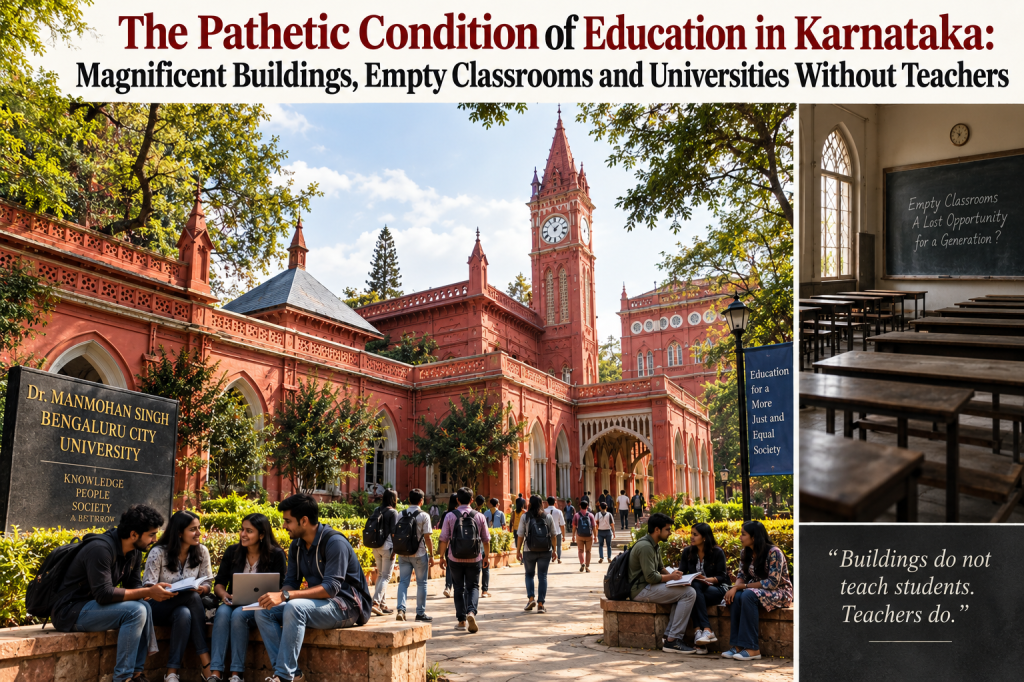
I recently visited Dr Manmohan Singh Bengaluru City University and, at first sight, there is much to impress. One is dazzled by the magnificent heritage structures of the old Central College campus, reminders of Bangalore’s distinguished educational past. Alongside them stand flashing new multi-storeyed buildings housing departments and faculties, proclaiming expansion and confidence. The physical appearance suggests an institution on the move.
But walk away from the Vice-Chancellor’s office and well-maintained grounds, and another university reveals itself. Most of the corridors I passed through were strangely empty. So were many of the classrooms. Although I was told that it was the first day of the session, which universally remains crowded and bubbling with anticipation. There was little of the noise and movement one normally associates with a functioning campus. Even some students sitting in classrooms appeared listless. One should be cautious about drawing conclusions from a single visit – universities have busy days and quiet days – but the emptiness stayed with me.
Then I saw the statistics, something which the VC had spurted out without my comprehending. And suddenly, when confronted with it, what I had witnessed acquired a context. The entire university has only nine permanent teachers. Not nine professors. Not nine teachers in a particular faculty. Nine permanent teachers in the whole university. Against 161 sanctioned permanent teaching posts, only nine are occupied. There are 152 vacancies, meaning more than 94 per cent of the sanctioned permanent teaching establishment does not exist in practice. The university survives academically because it employs 217 guest lecturers. Its administrative position is almost equally astonishing: against 123 sanctioned permanent non-teaching posts, only six are occupied, with 143 outsourced workers keeping the institution functioning (Bangalore Mirror).
How does one run a university with nine permanent teachers? The answer is that one does not, at least not in the conventional sense. One creates an alternative arrangement where a tiny permanent establishment is surrounded by a much larger body of temporary teachers and outsourced employees who somehow keep classes, examinations and administration going.
I initially thought I had encountered an extreme and perhaps exceptional case. I was wrong. The figures for Karnataka as a whole are even more disturbing because they reveal that Bengaluru City University is not an isolated institutional failure. It is an extreme manifestation of a crisis that has spread through the state’s entire public university system. According to the latest figures placed before the Karnataka legislature, the state’s 32 public universities have 4,483 sanctioned permanent teaching posts. Only 1,477 are filled. No fewer than 3,006 are vacant. In other words, approximately 67 per cent of Karnataka’s sanctioned university teaching positions are empty. To keep the system functioning, universities employ around 3,434 guest lecturers – more than twice as many as permanent university teachers (Bangalore Mirror). The non-teaching establishment is in still worse condition. Of 8,989 sanctioned posts, only 2,604 are filled, with 6,385 vacant. Universities compensate by employing more than 4,000 contractual and outsourced workers (The Times of India).
These figures should cause alarm in any society that takes higher education seriously. Nor can the problem be dismissed as the teething difficulty of recently established universities. Bangalore University, one of the state’s principal institutions, has only 113 permanent teachers against 365 sanctioned positions – 252 vacancies – with 250 guest lecturers engaged to keep teaching going. On the administrative side, 838 of 1,176 sanctioned posts are vacant. The University of Mysore has more than 400 teaching vacancies, while Karnatak University, Dharwad, has nearly 400 (Bangalore Mirror).
At the other end of the spectrum are universities whose situation sounds almost surreal. Recent government data show institutions such as Maharani Cluster University and Nrupathunga University functioning without a single permanent teacher against large sanctioned establishments. In June 2026, Higher Education Department data indicated that eleven public universities in Karnataka had no permanent teacher at all (Deccan Herald). We have consequently arrived at the extraordinary phenomenon of the university without university teachers.
There are Vice-Chancellors and Registrars. There are university statutes, academic councils and syndicates. There are departments, examinations, degrees, convocations, websites, conferences and impressive buildings. Yet the people without whom a university cannot meaningfully exist – its permanent community of teachers and scholars – are steadily disappearing. In their place stands the ubiquitous guest lecturer. The terminology itself conceals the nature of the transformation. A guest is someone who comes temporarily. But when a person teaches the regular syllabus year after year, and when thousands of such people collectively perform much of the routine teaching of the state’s universities, they are hardly guests. They have become the academic workforce of the university without being granted the security, status or institutional role of university teachers. The latest figures make this unmistakable: Karnataka’s public universities have approximately 1,477 permanent teachers and 3,434 guest lecturers. In at least thirteen universities, the number of guest lecturers recently exceeded the entire sanctioned permanent faculty strength (Deccan Herald).
This has consequences far beyond salaries and employment conditions. A university teacher is not simply someone hired to deliver sixteen hours of lectures. Universities require people who build departments over decades, supervise research, train younger scholars, develop libraries and laboratories, revise curricula, organise seminars, undertake fieldwork, participate in academic bodies and acquire an enduring intellectual investment in their institutions. A temporary lecturer may be every bit as intelligent, qualified and committed as a permanent professor. Indeed, many of Karnataka’s guest teachers possess doctorates and have taught for years. Malini, an ad hoc teacher whom I met appeared articulate and enthusiastic. The problem lies not with them but with the conditions under which they are employed. One cannot expect people who are uncertain of employment from one academic year to the next to carry the same long-term institutional responsibilities as a permanent academic community. This is not flexibility. It is casualisation. And the handful of permanent? One of the 9 permanent staff whom we met was reluctant on every count. Why should they tax themselves? They already have the best of the world. Enough on our plate!
How did one of India’s educationally most advanced states reach this point? The easy answer would be to blame the present Congress government. That would be historically unfair. The crisis is much older. In 2023, before the present government had time to create it, reports were already describing vacancy rates of 75 to 90 per cent in some Karnataka universities. The University of Mysore then had 407 of 460 sanctioned teaching positions vacant, while Karnatak University had 386 vacancies out of 600. Several recently established universities had no permanent academic staff. Indeed, the guest-faculty problem had become acute under the previous BJP government. In January 2022, around 14,000 guest lecturers protested over their conditions. By early 2023 it was being reported that guest teachers constituted more than 70 per cent of the faculty in government first-grade colleges and state universities (The New Indian Express).
The proliferation of new universities compounded the problem. Seven new universities were created under the previous BJP government, ostensibly to expand access to higher education. Yet several were created without adequate land, buildings, finance or permanent personnel. The present government has itself acknowledged that some of these institutions are still operating from borrowed or rented premises and largely through guest and outsourced staff (Bangalore Mirror). So the present Congress government inherited a deeply damaged system when it came to power in May 2023. But inheritance cannot remain an explanation indefinitely.
The Congress has now governed Karnataka for more than three years, first under Siddaramaiah and, since June 2026, under D. K. Shivakumar. The legitimate question is therefore no longer whether the Congress created the crisis – it plainly did not – but whether it has acted with sufficient urgency to reverse it. The answer is mixed, but hardly reassuring. There were signs of concern almost immediately. In October 2023, Siddaramaiah instructed the Higher Education Department to fill 3,321 backlog posts and other vacancies, particularly in the Kalyana Karnataka region. His government also proceeded with recruitment initiated earlier for government first-grade colleges. By 2026 Siddaramaiah could point to 1,016 assistant professors appointed during 2024–25 in government first-grade colleges and to a process for filling 2,000 posts across government colleges, engineering colleges and polytechnics (The New Indian Express). These are real measures and should not be ignored.
The 2026 budget went further. The government announced that 1,000 teaching posts in public universities would be filled in phases after rationalisation, while permission had been accorded for filling 2,000 teaching posts in government first-grade colleges, engineering colleges, polytechnics and the University Visvesvaraya College of Engineering (The Tribune). By August 2026, the government stated in the Legislative Council that registrars of all 32 public universities had been asked to identify essential vacancies and submit workload-based proposals, to be examined department by department and subject by subject before recruitment proceeds (Bangalore Mirror). So it would be wrong to say that nothing has been done.
But it would be equally misleading to suggest that Karnataka has begun seriously repairing its universities. Three years after the Congress returned to power, 3,006 sanctioned permanent university teaching positions remain vacant. The government is now speaking of filling 1,000 of them in phases. Even if every one of those appointments is actually made, more than 2,000 existing vacancies would remain, and retirements will continue.
There is also something troubling in the language in which the problem has sometimes been discussed. At a Vice-Chancellors’ conference in February 2026, Siddaramaiah acknowledged that irregular recruitment over two decades had left 60 to 70 per cent of teaching posts vacant. But when Vice-Chancellors complained about shortages, he also asked why guest lecturers could not be regarded as part of the workforce and drew a comparison with visiting professors at leading universities internationally (The Times of India). The comparison is difficult to sustain. A visiting professor at Oxford, Harvard or any other major university supplements a large permanent academic establishment. The visitor brings additional expertise to an institution whose departments already possess professors, associate professors and lecturers. A guest lecturer who substitutes for a permanent teacher because the state has left a sanctioned position vacant for ten years performs an entirely different function. One represents academic enrichment. The other represents institutional substitution. Confusing the two risks turning an emergency measure into a philosophy of university governance.
There is also a curious contradiction between the enthusiasm for new educational initiatives and the reluctance to provide the permanent human infrastructure required to sustain existing institutions. Karnataka speaks of artificial intelligence, Centres of Excellence, skill development, innovation hubs and collaboration with industry. These may all be worthwhile. The government has announced a ₹2,500 crore higher-education transformation programme with Asian Development Bank support and ambitious plans for new technology and research initiatives (The Times of India). Yet the basic question remains unanswered: who will teach the students? A university cannot be transformed digitally if it has no professors. Artificial intelligence cannot supervise a doctoral thesis in history, conduct archaeological fieldwork, run a chemistry laboratory, teach a difficult philosophical text or build a school of scholarship over a generation. Technology can assist teachers. It cannot substitute for an academic community.
The problem is therefore larger than Congress or BJP. The present crisis has developed over nearly two decades and through governments of different political colours. Former university administrators themselves describe it as the consequence of a long policy drift in which governments have been reluctant to assume the continuing financial liability involved in permanent appointments. Salaries and pensions cost money. Guest lecturers and outsourced employees are cheaper (Deccan Herald). There lies perhaps the real explanation. What Karnataka is experiencing is not simply a recruitment failure. It is the gradual transformation of the conception of public education. Governments continue to want universities, but appear increasingly reluctant to pay the full cost of maintaining them as universities.
A building is a capital expenditure and produces something visible. A new block can be inaugurated, photographed and named. A new university can be announced in a budget speech. A Centre of Excellence can be launched with banners and publicity. Permanent teachers are different. They represent a commitment extending over decades. The temptation is therefore obvious: build the institution, appoint the senior administration, hire temporary teachers and keep the machinery moving. The institution survives statistically. Students are enrolled. Classes appear on timetables. Examinations are conducted. Degrees are awarded. Convocations take place. Government reports can therefore record that a university exists and that so many thousands of young people are receiving higher education. But education cannot ultimately be measured by the number of students registered or degrees distributed.
This brings me back to those empty corridors I encountered in Bangalore. Perhaps what disturbed me was not simply their physical emptiness. It was the possibility that they symbolised something larger. The buildings were there. The classrooms were there. The departments were there. The students were there. What was disappearing was the permanent academic community that gives all these things meaning.
And the crisis extends below the university. Karnataka has also been confronting enormous vacancies in its school system. In 2026 the government approved recruitment of 15,000 school teachers, an important measure, but this has to be set against more than 50,000 vacancies in primary schools and nearly 10,000 in high schools (Bangalore Mirror). Again, the problem did not originate with the present government. Again, the present government has taken steps. And again, the scale of the response remains smaller than the accumulated deficit.
It would therefore be unfair to turn Karnataka’s educational crisis into a simple indictment of one party. The BJP government created new universities without providing many of them with adequate permanent establishments. Earlier governments had already allowed recruitment to stagnate. The Congress inherited this system in 2023 and has initiated recruitment in colleges and schools and now promises phased university recruitment. But governments must ultimately be judged not merely by whether they are less responsible for creating a problem than their predecessors, but by whether they solve it.
After more than three years of Congress rule and two Chief Ministers, Karnataka’s universities still have roughly two-thirds of their sanctioned permanent teaching posts vacant. Eleven public universities were reported as recently as June 2026 to have no permanent teachers whatsoever. Thousands of guest lecturers remain indispensable to the daily survival of the university system (Deccan Herald). That makes it difficult to avoid the conclusion that education remains somewhere on the back burner, irrespective of the political colour of the government in power.
Every political party speaks reverentially of education. Every government celebrates innovation, skill development and the knowledge economy. Politicians compete to establish universities and colleges in their constituencies. But the less glamorous business of maintaining libraries, filling laboratories, recruiting teachers and building durable academic departments receives much less attention. The tragedy is particularly striking in Karnataka because this is not a poor state without intellectual resources. Bengaluru is one of the great technological centres of Asia. Karnataka possesses some of India’s finest scientific and research institutions. The University of Mysore, Bangalore University and Karnatak University have distinguished intellectual histories. The state has produced scholars, scientists, writers and teachers of international standing. It possesses the resources and the intellectual tradition to create one of India’s finest public educational systems.
Instead, we have reached a point where a university with 161 sanctioned teaching posts can function with nine permanent teachers, while others can apparently function with none. There is something profoundly wrong when such figures cease to shock us. The immediate requirement is not another committee or another declaration of intent. Karnataka needs a transparent, academically rigorous and time-bound programme for filling permanent teaching and non-teaching vacancies. Guest lecturers who have kept these institutions alive must be treated with dignity and properly remunerated, but temporary employment cannot remain the permanent solution to permanent academic requirements. Nor should universities continue proliferating until the state demonstrates that it can adequately staff those it already possesses.
Above all, we need to recover an elementary truth that seems to have been lost amid the vocabulary of rankings, skills, innovation, employability and artificial intelligence. Education requires teachers. Magnificent heritage buildings can remind us of a great educational past. Glittering new multi-storeyed blocks can promise an impressive future. But between the heritage building and the glass-and-concrete tower stands the classroom. If the classroom has no teacher, both the past and the promised future become meaningless.
That was perhaps the most unsettling impression I carried away from Bangalore. The crisis of Karnataka’s education is not that it lacks impressive institutions on paper. It is that behind increasingly impressive façades, the human foundations of those institutions are being allowed to disappear. It also explains to me why the VC of Dr Manmohan Singh Bangaluru Central University was so reluctant to go ahead with the organising of the forthcoming session of the IHC which he had initially promised.
Source of Information
· Bangalore Mirror: 25 August 2026 edition. Article: “Staff Shortages Cripple Bengaluru’s Public Universities: Nearly 82% Teaching Posts Vacant”.
· The Times of India: 21 February 2026 edition. Article: “Align recruitment with AI, Siddaramaiah advises universities”.
· Deccan Herald:
· 1 January 2025 edition. Article: “10 public universities in Karnataka do not have any permanent teaching or non-teaching staff”.
· 21 June 2026 edition. Article: “Guest faculty keep public varsities breathing in Karnataka”.
· 4 April 2026 edition. Article: “Faculty Shortage: Karnataka Relies on Guest Lecturers”.
· 6 March 2026 edition. Article: “Karnataka Budget 2026| Student unions, new courses: What it means for higher education”.
· The New Indian Express: 15 January 2022 edition. Article: “Despite hike in honorarium, guest lecturers to continue protest”
· The Tribune: 6 March 2026 edition. Article: “Karnataka Budget 2026” (referenced indirectly via Deccan Herald’s coverage of the budget).


