Syed Ali Nadeem Rezavi
The expression “reliable source” is frequently used in historical writing, but it is also frequently misunderstood. A reliable source is not simply an old source, an official source, a famous source, or even a source written by someone who witnessed the events being described. Nor does reliability mean that everything contained in a particular text must be accepted as true. In professional historical practice, reliability is established through a process of source criticism: the historian asks who produced the evidence, when it was produced, for what purpose, for whom, under what circumstances, from what information, and whether its claims can be tested against other independent evidence. This distinction is fundamental because historians do not have direct access to the past. The Delhi Sultanate and the Mughal Empire no longer exist as observable realities. What survives are their traces: manuscripts, chronicles, administrative documents, royal orders, revenue records, inscriptions, coins, buildings, paintings, objects, letters, literary compositions and descriptions written by travellers. The historian reconstructs the past by interrogating these surviving traces.
A source is therefore not reliable merely because it says something confidently. Indeed, some of the most valuable historical sources are deeply partisan. Ziya al-Din Barani’s Tarikh-i Firuz Shahi, Abu’l Fazl’s Akbarnama, Badauni’s Muntakhab al-Tawarikh and Bhimsen’s Nuskha-i Dilkusha were written by authors with very different intellectual commitments, political positions and personal experiences. None should be treated as a neutral recording instrument. Yet all are indispensable historical sources precisely because the historian can investigate the circumstances in which they were produced and compare their testimony with other evidence. The question that should be asked, therefore, is not simply “Is this source reliable?” but “Reliable for what?” A court chronicle may be unreliable about the number of soldiers in an enemy army but extremely valuable for understanding the political ideology of the court. A royal inscription exaggerating a ruler’s victory may tell us little about the actual scale of that victory but much about how kingship wished to represent itself. A European traveller may misunderstand an Indian social practice while nevertheless recording valuable observations about prices, roads, urban life or commercial activity. Reliability belongs not automatically to the source as a whole but to particular claims made by that source and to the questions historians ask of it.
This is why corroboration lies at the heart of historical method. If a chronicler describes a famine, the historian may compare the account with other chronicles, revenue documents, letters, price information and evidence of demographic or agrarian disturbance. If a text claims that an emperor destroyed or constructed a particular building, the historian should examine inscriptions, architectural remains, contemporary administrative records and independent narrative sources. Historical knowledge becomes stronger when evidence produced independently and for different purposes converges upon the same conclusion.
Primary and Secondary Sources
The distinction between primary and secondary sources follows from this understanding of evidence. A primary source is evidence originating from, or directly connected with, the historical period, institution, event or process being investigated. A farman issued by Shah Jahan is a primary source for Mughal government. An inscription placed upon a mosque during the reign of Sikandar Lodi is a primary source for the circumstances of its construction. A revenue document from Aurangzeb’s reign is primary evidence for seventeenth-century administration. A coin of Muhammad bin Tughluq is primary evidence for his monetary system and his claims to sovereignty. Primary does not, however, mean true. Abu’l Fazl was a contemporary of Akbar, but this does not mean that everything in the Akbarnama must be accepted literally. Badauni was also Akbar’s contemporary, yet his hostility towards many of Akbar’s religious and intellectual experiments shaped his account. The historian cannot resolve the disagreement merely by declaring one “reliable” and the other “unreliable”. Their accounts must be placed within their respective intellectual and political contexts and tested against other evidence.
A secondary source, by contrast, is a later scholarly reconstruction or interpretation based upon primary sources and usually upon previous historical scholarship as well. Modern works by historians such as Mohammad Habib, K. A. Nizami, Satish Chandra, Iqtidar Alam Khan, M. Athar Ali, Irfan Habib, Shireen Moosvi, Simon Digby, Muzaffar Alam or Catherine Asher are secondary sources for the Sultanate and Mughal periods. They do not become primary sources merely because they are authoritative works of history. The distinction nevertheless depends partly upon the question being asked. A twentieth-century historian’s book is a secondary source for the Mughal Empire, but the same book becomes a primary source if one is studying the development of Mughal historiography in twentieth-century India. “Primary” and “secondary” describe the relationship of evidence to a historical question; they are not permanent qualities inherent in a document.
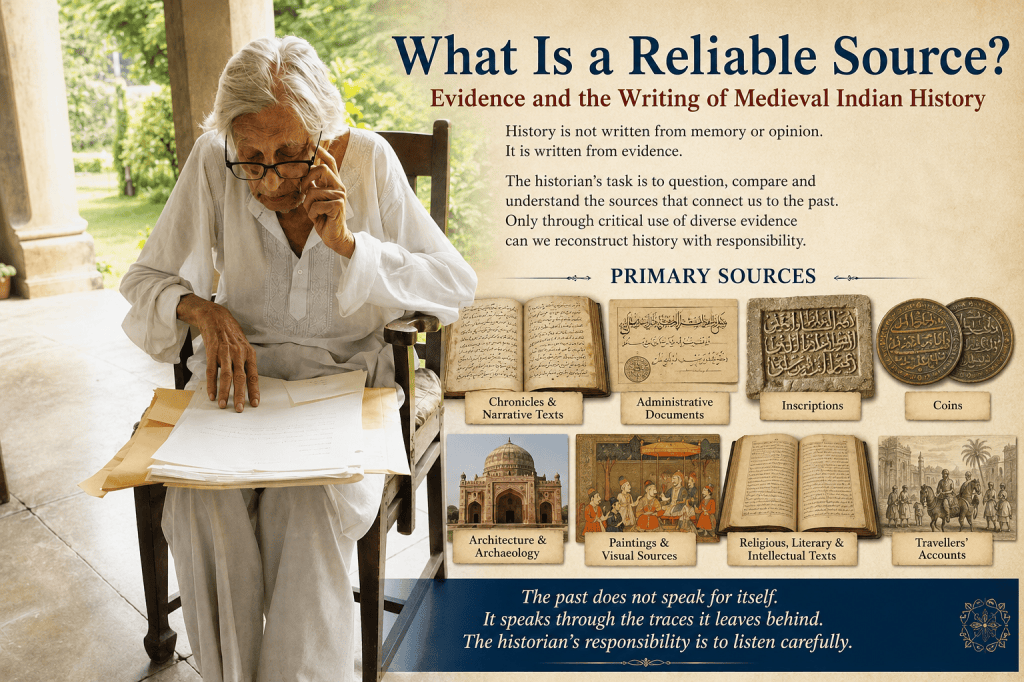
Nor should primary sources automatically be regarded as superior to secondary sources. A contemporary witness may possess very limited information, whereas a modern historian can compare hundreds of documents scattered across different archives and languages. Primary sources supply the evidence from which historical reconstruction begins; secondary scholarship subjects that evidence to criticism, comparison and interpretation. For the history of the Delhi Sultanate and Mughal India, the range of primary evidence is exceptionally rich and can broadly be organised into several overlapping categories.
Narrative and Chronicle Literature
The most familiar primary sources are chronicles and narrative histories, especially those written in Persian, the principal language of administration and high literary culture under much of the Sultanate and Mughal periods. For the Sultanate, works such as Minhaj-i Siraj Juzjani’s Tabaqat-i Nasiri, Amir Khusrau’s historical compositions, Ziya al-Din Barani’s Tarikh-i Firuz Shahi, Shams-i Siraj Afif’s work of the same title, and Isami’s Futuh al-Salatin provide indispensable evidence. They record political events, court conflicts, campaigns, rebellions, appointments, ideas of sovereignty and relations among rulers and elites. But these texts must never be treated as newspapers from the Middle Ages. Barani was not simply describing the Sultanate: he possessed definite ideas about monarchy, social hierarchy, religion and political order. His Fatawa-i Jahandari makes his normative political concerns especially clear. Amir Khusrau wrote within structures of courtly patronage. Afif looked back upon Firuz Shah Tughluq from a particular political and emotional context. The historian must therefore distinguish between description, prescription, literary convention and political argument.
Mughal narrative sources are even more extensive. Babur’s Baburnama, Gulbadan Begum’s Humayun Nama, Abu’l Fazl’s Akbarnama, Badauni’s Muntakhab al-Tawarikh, Jahangir’s Tuzuk-i Jahangiri, Abdul Hamid Lahori’s Padshahnama, Muhammad Kazim’s Alamgirnama, Saqi Musta’id Khan’s Ma’asir-i Alamgiri and numerous regional and biographical works provide different windows upon the empire. Their disagreements are themselves historically significant. Abu’l Fazl and Badauni, for example, were observing substantially the same court but understood Akbar’s policies through radically different intellectual frameworks. Their disagreement is not an inconvenience that the historian must eliminate; it is evidence for the contested intellectual world of Akbar’s reign.
Administrative and Documentary Sources
A second and in many respects even more important category consists of administrative documents. These include farmans, nishans, parwanas, sanads, dastaks, arzdashts, waqfnamas, revenue documents, appointment orders, grants, petitions, deeds of sale and other records produced through the activities of government and society. Such documents allow historians to move beyond the spectacular world of emperors, battles and court politics. They reveal how authority actually operated: how land was assigned, revenue collected, officials appointed, religious establishments supported, merchants regulated, property transferred and disputes negotiated. The Mughal administrative system generated an especially rich documentary culture. Records connected with mansabs, jagirs, madad-i ma’ash grants, zamindars, revenue assessment and provincial administration permit historians to reconstruct the institutional structure of the empire. The Ain-i Akbari, although part of Abu’l Fazl’s larger literary enterprise, occupies a distinctive position because it systematically records information concerning administration, revenue, prices, salaries, military organisation, provinces, social groups and imperial institutions. Here again caution is necessary. An administrative regulation tells us what the state ordered; it does not necessarily tell us what actually happened. A farman prohibiting a practice is evidence that the prohibition existed, not proof that the practice immediately disappeared. Norm and implementation must be distinguished.
Epigraphic and Numismatic Evidence
A third category is inscriptions, which survive on mosques, tombs, forts, gateways, stepwells, bridges, temples, sarais and other structures, as well as on individual objects. Inscriptions may supply dates, names of patrons, architects, officials or builders, religious formulae, royal titles and information concerning construction and repair. They can sometimes correct literary chronicles or establish facts not mentioned in narrative sources. Epigraphy is particularly important because inscriptions frequently survive in situ. Their physical relationship to a building can help establish chronology and patronage. But inscriptions too are rhetorical objects. A royal inscription was often designed to proclaim legitimacy, piety or conquest. Its claims therefore require the same critical scrutiny as those of a chronicle.
Coins constitute another major category of primary evidence. Sultanate and Mughal coins reveal much more than monetary history. Their metals, weights, denominations, mint places, dates, inscriptions and calligraphy provide evidence for political authority, territorial control, economic change and concepts of sovereignty. A ruler’s coinage was itself an assertion of power. The appearance of a ruler’s name at a particular mint may help establish political control over a region. Changes in weight standards or metallic composition can illuminate monetary policy and economic conditions. Muhammad bin Tughluq’s experiments with currency, Sher Shah’s monetary reforms and the elaborate coinage of Akbar and his successors cannot adequately be studied from chronicles alone. Coins have an additional methodological value: they may contradict narrative traditions. When textual and numismatic evidence disagree, the disagreement forces the historian to reconsider the chronology or political claims preserved in literary accounts.
Architecture, Archaeology and Material Culture
Buildings and archaeological remains constitute primary sources in their own right. Architecture is not merely an illustration placed beside textual history; it is historical evidence. The Qutb complex, Tughluqabad, Firuz Shah Kotla, the Lodi tombs, Fathpur Sikri, Agra Fort, the Taj Mahal, Shahjahanabad, provincial forts, mosques, temples, tombs, gardens, bridges, sarais and ordinary domestic structures contain information that no chronicle can fully provide. Plans, construction techniques, masonry, reused architectural material, water systems, spatial organisation, alterations and building sequences can reveal patterns of technology, patronage, labour, ritual practice and social organisation. Archaeological excavation and architectural survey may establish that a structure underwent several phases even when literary sources attribute it simply to a single ruler. Material evidence is especially important because textual sources disproportionately represent literate elites. Pottery, tools, domestic architecture, settlement remains, craft debris and ordinary objects can provide access to aspects of everyday life largely absent from court chronicles.
Literary, Religious and Intellectual Texts
Another large body of primary evidence consists of texts that were not written as histories. Poetry, Sufi malfuzat, tazkiras, theological works, legal compilations, religious polemics, philosophical writings and vernacular literature can all serve as historical sources. Works such as Amir Hasan Sijzi’s Fawa’id al-Fu’ad, recording the conversations of Shaikh Nizamuddin Auliya, reveal dimensions of Sultanate society that political chronicles barely notice. Sufi literature can illuminate urban life, charity, social relationships, religious practice and interactions across social boundaries. Similarly, the Fatawa-i Alamgiri is primarily a compilation of Hanafi jurisprudence rather than a narrative history of Aurangzeb’s reign. It therefore cannot simply be read as a description of how law actually operated throughout Mughal India. Yet it is indispensable for studying Islamic jurisprudential culture, legal reasoning and the intellectual environment in which Mughal legal institutions functioned. Vernacular works in Sanskrit, Hindi, Braj, Bengali, Marathi, Punjabi, Rajasthani and other languages further broaden the historian’s field of vision. They allow the history of medieval India to escape the artificial assumption that Persian court literature alone represents the period.
Biographies, Memoirs, Letters and Foreign Accounts
Memoirs and autobiographical writings provide another particularly revealing category. Babur and Jahangir wrote about themselves in ways unusual within the larger tradition of Persianate court historiography. Gulbadan Begum’s Humayun Nama provides perspectives upon the Mughal household and the experiences of imperial women that cannot be recovered from official chronicles alone. Collections of letters and correspondence can be even more revealing because they bring historians closer to the everyday operation of politics and administration. Letters between rulers, nobles, officials, scholars, merchants and religious figures illuminate patronage, political negotiation, personal networks and administrative practice. Yet personal testimony requires caution. Memory is selective, autobiography is self-fashioning, and letters are written for particular recipients. Their apparent intimacy does not make them automatically truthful.
The accounts of foreign visitors form another major body of evidence. For the Sultanate period, Ibn Battuta’s Rihla provides an extraordinary description of Muhammad bin Tughluq’s India. For the Mughal period, travellers and merchants such as François Bernier, Jean-Baptiste Tavernier, Niccolao Manucci, Peter Mundy, Thomas Roe and numerous Portuguese, Dutch and English observers provide accounts of court life, commerce, cities, roads, manufacturing, agriculture, customs and social practices. These sources are invaluable partly because outsiders noticed things that indigenous court historians took for granted. But foreignness does not produce objectivity. Travellers arrived with their own cultural assumptions and often possessed limited knowledge of Indian languages and institutions. Bernier’s interpretation of Mughal landholding, for example, profoundly influenced later European representations of India, but historians have demonstrated that his understanding of property and agrarian relations was shaped partly by European political debates and comparisons with France. The traveller’s account must therefore be read both as evidence about India and as evidence about the observer.
Visual and Regional Sources
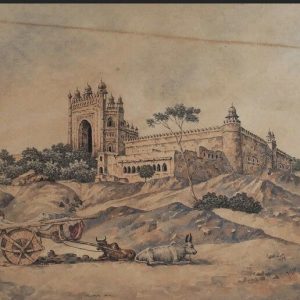
Mughal India provides another remarkable category of evidence: paintings, illustrated manuscripts, maps, drawings and other visual representations. Mughal miniature painting can illuminate court ceremony, clothing, weapons, technologies, animals, buildings, gardens, occupations and material objects. Portraiture can help reconstruct the visual culture of nobility and sovereignty. Illustrated manuscripts demonstrate the relationship between literature, artistic patronage and imperial ideology. Yet paintings cannot simply be treated as photographs. They obey artistic conventions and were often carefully constructed representations of authority. An imperial audience scene shows not simply what a court looked like but how hierarchy and kingship were intended to be visualised.
Finally, the history of the Sultanate and Mughal periods cannot be reconstructed solely from sources produced at Delhi, Agra or Lahore. Regional archives and local traditions are indispensable. Rajasthani records, Marathi documents, Sikh sources, Jain writings, regional Persian chronicles, temple records, merchant papers, genealogies, inscriptions and local revenue documents reveal negotiations between imperial power and regional society. They are particularly important for studying zamindars, merchants, bankers, local elites, religious institutions and social groups whose activities may scarcely appear in imperial chronicles. This widening of the evidentiary field has profoundly changed the writing of medieval Indian history. Once historians move beyond dynastic chronicles, the Sultanate and Mughal periods cease to appear merely as sequences of rulers and wars. They emerge instead as complex histories of states, agrarian systems, cities, markets, technologies, religious communities, intellectual networks, families, artisans, merchants, peasants and everyday social relationships.
From Sources to History
The central methodological lesson is therefore that no category of evidence is inherently self-sufficient. Chronicles, documents, inscriptions, coins, architecture, archaeology, literature, paintings and travellers’ accounts answer different kinds of historical questions. The strongest historical reconstruction usually emerges from their combination. Suppose a historian wishes to reconstruct the reign of Akbar. Abu’l Fazl provides one perspective; Badauni another. Jesuit writings provide yet another. The Ain-i Akbari supplies administrative and statistical information. Farmans reveal particular acts of government. Coins illuminate sovereignty and monetary policy. Inscriptions establish patronage and chronology. Surviving buildings at Fathpur Sikri and elsewhere provide architectural and archaeological evidence. Paintings reveal the visual construction of the court. Regional documents show how imperial authority interacted with local societies. No single one of these is “the truth”. Historical knowledge emerges through their critical confrontation with one another.
This also explains why the historian must resist two opposite errors. The first is credulity: believing a source merely because it is contemporary. The second is arbitrary scepticism: rejecting evidence simply because it is inconvenient or because every source possesses some form of bias. Bias does not make a source useless. Indeed, bias itself is historical evidence. If Barani disliked certain social groups, the historian must not simply discard Barani; one must ask why he disliked them and what his hostility reveals about the political and social assumptions of his world. If Abu’l Fazl idealised Akbar’s sovereignty, that idealisation itself becomes evidence for the political theory being constructed around the Mughal emperor.
The historian’s task consequently resembles neither that of a believer nor that of a prosecutor. It is an act of disciplined interrogation. Who produced this evidence? When? Why? For whom? What did the author or maker know? What did they wish others to believe? What could they not have known? What have they omitted? Can their claims be corroborated? Does material evidence support them? Do independent sources disagree? Only after these questions have been asked can the historian decide how much weight a particular piece of evidence deserves. A reliable source, then, is not necessarily an unbiased source, because completely unbiased historical sources scarcely exist. It is a source whose provenance can be established, whose circumstances of production can be investigated, whose claims can be critically tested and whose evidentiary value can be assessed in relation to a particular historical question.
That understanding is especially important for the history of the Delhi Sultanate and Mughal India. The period has left an exceptionally diverse archive, extending from royal chronicles and imperial farmans to coins, inscriptions, buildings, paintings, legal texts, Sufi conversations, travellers’ accounts and archaeological remains. To privilege one category while ignoring the others produces a distorted history. The historian therefore does not merely collect sources. The historian interrogates them, compares them, contextualises them and makes them speak to one another. It is through this critical conversation among different forms of surviving evidence that the fragments of the past are transformed into history.


