Syed Ali Nadeem Rezavi
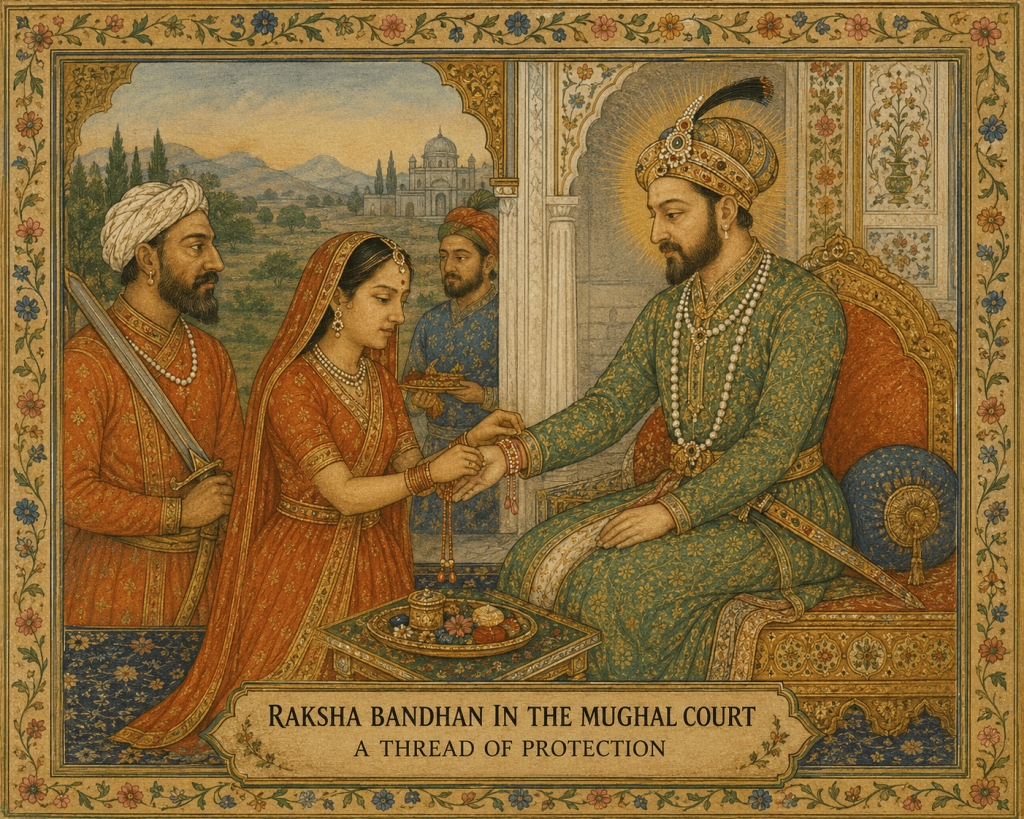
Among the Hindu festivals and ritual practices encountered by the Mughal emperors in India, Raksha Bandhan occupies a particularly interesting place. It is tempting to view the festival entirely through its modern form, in which a sister ties a rakhi around her brother’s wrist and the ceremony affirms a relationship of affection and protection between them. The evidence from the sixteenth and seventeenth centuries, however, points towards a considerably wider range of meanings. The rakhi was certainly connected with protection, but the person tying it did not necessarily have to be a sister, nor did the recipient have to be a brother. Brahmins tied protective threads upon patrons and rulers, and the ceremony could express blessing, auspiciousness, protection and reciprocal obligation. It was principally in this wider sense that Raksha Bandhan found a place within the ceremonial world of the Mughal court.
This distinction is important because the history of Raksha Bandhan under the Mughals has often become entangled with the celebrated story of Rani Karnavati of Mewar sending a rakhi to the emperor Humayun and appealing to him for protection against Bahadur Shah of Gujarat. The story has acquired enormous popularity and has frequently been presented as one of the earliest examples of Hindu-Muslim fraternity under the Mughals. Unfortunately, contemporary evidence for the episode is extremely uncertain. There is, however, no need to depend upon this attractive but problematic story to establish a Mughal connection with Raksha Bandhan. The evidence from the reigns of Akbar and Jahangir is both contemporary and much more revealing. Abu’l Fazl knew of the festival and described its place within Hindu ritual life, while Jahangir himself recorded the practice of tying rakhis upon Akbar and described his own participation in the ceremony. The documented history is consequently more interesting than the legend.
The Sanskrit expression rakṣā-bandhana itself provides a useful point of departure. Literally a ‘bond of protection’, it belongs to an older body of ritual practices in which a consecrated thread, cord or amulet was tied to the body as a means of invoking protection and auspiciousness. Such practices were by no means restricted to relations between brothers and sisters. The full moon of Shravana, which usually falls in July or August, possessed particular ritual importance for Brahmins and was associated with Shravani, Upakarma and the renewal or performance of Brahmanical rites. One element within this ritual world was the tying of a protective thread upon another person, including a patron or ruler.
This older meaning helps explain what otherwise appears rather curious in the Mughal sources. Brahmins could approach a Muslim emperor and tie a rakhi around his wrist without either party imagining that they were thereby establishing a literal relationship of brother and sister. The Brahmin offered an auspicious and protective object; the ruler accepted the blessing and, through gifts and patronage, acknowledged the social relationship that the ceremony represented. Protection in this context could operate in both directions. The ritual specialist offered sacred protection to the ruler, while the ruler provided material and political protection to those who acknowledged his authority. Raksha Bandhan therefore possessed a symbolic vocabulary particularly well suited to kingship.
The Festival in Mughal Records
Abu’l Fazl’s Āʾīn-i Akbarī is particularly useful for recovering this older character of the festival. His discussion of Hindu beliefs, calendars and practices was part of a much larger intellectual enterprise through which the Mughal court attempted to understand the society over which it ruled. In discussing the full moon of Shravana, Abu’l Fazl refers to the practice of fastening the raksha-bandhan upon the right wrist of important persons. The thread could be made of silk, and among people of wealth and status the object could assume a more elaborate form. What Abu’l Fazl describes is therefore recognisably connected with the modern rakhi, but its social meaning was broader. The emphasis falls upon the protective thread and the relationship between Brahmin and patron rather than exclusively upon sibling affection.
It was under Akbar that this practice became incorporated into the ceremonial life of the Mughal court. This should not be regarded as an isolated eccentricity on the emperor’s part. Akbar’s reign witnessed a profound enlargement of the cultural vocabulary of Mughal sovereignty. The dynasty had entered India with a Timurid political inheritance and a court culture strongly shaped by Persianate traditions, but the empire that Akbar created could not remain culturally detached from the society over which it ruled. Rajputs and other Hindu groups entered the Mughal nobility in increasing numbers, while Indian languages, customs, festivals, intellectual traditions and forms of ritual gradually became familiar at court. The political integration of India was accompanied, though never completely or uniformly, by processes of cultural accommodation.
Akbar’s engagement with Hindu festivals has to be understood within this setting. Holi, Diwali, Dussehra and other Indian celebrations became known at the Mughal court, just as Indian astrology, calendrical practices, modes of dress and forms of ceremonial entered imperial life. Participation did not necessarily imply acceptance of the theological foundations of a particular festival. A ruler might acknowledge a religious or cultural practice because it possessed political, social or ceremonial meanings that extended beyond doctrine. Akbar’s willingness to participate in such practices was closely related to the changing conception of sovereignty articulated most systematically by Abu’l Fazl. The emperor was increasingly represented as the ruler of all his subjects rather than as the political representative of one religious community alone.
The principle of ṣulḥ-i kul, usually translated as ‘universal peace’ or ‘peace with all’, supplied an intellectual framework for this conception of government. It did not require the disappearance of religious differences. On the contrary, those differences continued to exist and were frequently quite pronounced. What it attempted to establish was the political superiority of justice and imperial loyalty over sectarian affiliation. Within such a conception of kingship, the emperor could receive a Hindu ritual object without becoming Hindu, just as a Hindu noble could serve a Muslim sovereign without necessarily abandoning his own religious and social world. The Mughal court became one of the spaces in which these identities met, negotiated and occasionally borrowed from one another.
The Evidence from Jahangir
Our most striking evidence for the rakhi at Akbar’s court comes, interestingly enough, from Jahangir. In the Tuzuk-i Jahangiri, Jahangir recalled that during his father’s reign Hindu nobles and other important persons had taken to presenting and tying rakhis upon the emperor. As frequently happened when a relatively simple custom entered the intensely competitive ceremonial environment of the Mughal court, the offerings became increasingly magnificent. The rakhis could incorporate precious stones, pearls and other valuable materials. What had begun as a protective thread was thus transformed into an object of imperial display.
Akbar appears eventually to have become uncomfortable with this extravagance. His objection, however, was not necessarily to the ceremony itself. Jahangir’s account distinguishes between the increasingly costly rakhis offered by wealthy men and the simpler cotton or silk threads traditionally tied by Brahmins. Akbar curtailed the former while permitting the latter. The distinction is revealing because it suggests that the emperor recognised a difference between an established Indian custom and the competitive display of wealth that had grown around it at court. He was willing to accept the protective thread, but apparently saw little reason why it should become another occasion for nobles to demonstrate their wealth through jewels and precious objects.
Jahangir continued the practice in his own reign. His memoirs record an occasion in 1613 when he permitted Hindu nobles and leading men to fasten rakhis upon his arms and allowed Brahmins to tie their traditional cotton and silk threads. The passage is particularly valuable because it removes the subject from the realm of later anecdote. Here we have a Mughal emperor himself describing his participation in a ceremony that he understood to be associated with Hindu custom. He neither disguises its origins nor appears embarrassed by his participation in it. At the same time, there is no suggestion that he had adopted the religious beliefs of those performing the ceremony. The rakhi could enter Mughal imperial culture precisely because its meanings were capable of extending beyond a narrowly defined confessional boundary.
The role of Hindu nobles in this process deserves particular emphasis. By Jahangir’s reign, Rajputs occupied an established position within the Mughal ruling class. Their incorporation had not required them to erase their cultural identities. They retained dynastic traditions, marriage networks, religious affiliations and connections with their ancestral territories while simultaneously participating in the political and ceremonial life of the Mughal Empire. Court culture consequently could not remain exclusively Central Asian or Persianate. It became increasingly Indian without ceasing to be Mughal. The presence of the rakhi upon the emperor’s wrist is one small but revealing manifestation of this transformation.
Beyond Binary Categories
The ceremony also demonstrates why the cultural history of the Mughal period cannot satisfactorily be understood through a simple opposition between ‘Hindu’ and ‘Muslim’. Such categories were obviously important, and religious differences were real. They could generate argument, conflict and exclusion. Yet the existence of boundaries did not prevent people from crossing them in particular contexts. Political service, patronage, music, literature, architecture, language, food, clothing and ceremonial all created spaces in which cultural practices circulated between communities. The interesting historical question is therefore not whether Mughal India was either completely ‘syncretic’ or permanently divided, but how particular practices travelled, what meanings they acquired in new settings, and where the limits of such accommodation lay.
Raksha Bandhan provides an especially good example because the ritual itself was concerned with the creation of a relationship. The thread established a bond, but that bond was capable of several interpretations. It might convey a Brahmin’s blessing to his patron, express the loyalty of a noble to his sovereign, invoke protection, or become part of an exchange of gifts and honours. In later social practice the brother-sister relationship became particularly prominent, but the Mughal evidence reminds us that the semantic world of the rakhi was once considerably wider.
This brings us back to the famous story of Humayun and Rani Karnavati. According to the familiar narrative, Karnavati, the widowed queen of Mewar, sent a rakhi to Humayun when Chittor was threatened by Bahadur Shah of Gujarat. Humayun accepted her as his sister and attempted to come to her assistance. The story has acquired such currency that it is frequently repeated as established fact. Yet it is not securely supported by contemporary Mughal or Rajput evidence, and its development owes much to later traditions concerning Rajasthan. The political events surrounding Bahadur Shah’s attack on Chittor and Humayun’s subsequent intervention in Gujarat certainly occurred, but the rakhi episode cannot be placed on the same evidentiary footing as Jahangir’s description of the ceremony.
Historical caution in this instance does not diminish the larger story of cultural interaction. It strengthens it. The temptation to retain the Karnavati episode arises partly because it appears to provide such an attractive symbol of Hindu-Muslim fraternity. Yet the actual historical evidence is richer. We do not need to imagine a Rajput queen sending a rakhi to Humayun when we possess the testimony of Jahangir that Hindu nobles tied rakhis upon Akbar and subsequently upon Jahangir himself. The latter evidence tells us not about an exceptional gesture during a political crisis, but about a practice sufficiently familiar to have become part of the ceremonial experience of two successive Mughal emperors.
The Later Mughal Period
For the reigns of Shah Jahan and Aurangzeb the evidence is less explicit, and caution is again necessary. It would be misleading to assume that every practice associated with Akbar and Jahangir continued unchanged throughout the seventeenth century. Mughal court ceremonial evolved considerably from one reign to another. Shah Jahan developed his own highly formalised language of imperial sovereignty, while Aurangzeb altered or discontinued a number of practices that he considered inconsistent with his conception of kingship and religion. The absence of equally vivid imperial references to Raksha Bandhan in their reigns should therefore not be filled by conjecture.
At the same time, imperial participation and social observance must not be confused. A Hindu festival did not cease to be celebrated in Mughal India merely because the reigning emperor chose not to participate in it personally. The empire contained millions of Hindu subjects, as well as Rajput rulers, zamindars, merchants, officials and soldiers whose religious and social calendars continued to structure their lives. Festivals belonged to society before they belonged to the court. The remarkable feature of the Akbar and Jahangir evidence is therefore not that Raksha Bandhan existed under Muslim rule, which is hardly surprising, but that the ceremony travelled from Hindu ritual life into the highest ceremonial space of the Mughal Empire.
Nor should this be romanticised into an uncomplicated story of communal harmony. Mughal society contained tensions, inequalities and conflicts, just as it contained accommodation and exchange. The significance of the rakhi lies precisely in the fact that cultural interaction did not require religious identities to disappear. A Brahmin tying a protective thread upon Akbar’s wrist remained a Brahmin, while Akbar remained the Muslim-born descendant of Timur and Chinggis Khan who ruled through a political culture deeply indebted to Persian and Islamic traditions. Yet the two could participate in a ceremony whose meanings both could understand. Cultural accommodation worked not because differences ceased to matter, but because people sometimes found languages through which those differences could be negotiated.
A Thread Through Time
Raksha Bandhan therefore offers a useful corrective to the tendency to write Mughal history exclusively through battles, dynastic politics and administrative institutions. Empires are also sustained through gestures, symbols and ceremonies. The Mughal state had to make its sovereignty intelligible to the many communities that inhabited India, and Akbar in particular proved remarkably receptive to political languages that had not originated within the Timurid or Islamic traditions of his ancestors. The incorporation of Rajputs into the nobility, the translation of Sanskrit texts into Persian, participation in Indian festivals and the development of ṣulḥ-i kul were different aspects of this broader attempt to construct an imperial order capable of embracing diversity without demanding cultural uniformity.
Seen from this perspective, the rakhi tied upon the Mughal emperor’s wrist was a small object carrying a surprisingly large historical meaning. Its thread connected an ancient idea of ritual protection with the political language of patronage and sovereignty. In the hands of Brahmins it could confer blessing; in the hands of Hindu nobles it could express attachment to the sovereign; within the spectacular world of the Mughal court it could even become an object embellished with pearls and precious stones. Akbar accepted the older ceremony while attempting to restrain its ostentation, and Jahangir consciously continued the practice.
The history of Raksha Bandhan in Mughal India is therefore more interesting than the familiar legend of Humayun and Karnavati. It reveals something of the manner in which the Mughal Empire became Indian, not by surrendering every element of its earlier inheritance, nor by dissolving religious distinctions, but through a prolonged process of encounter and accommodation. Hindu and Muslim, Persianate and Indic practices could remain recognisably distinct while nevertheless entering a shared political and cultural world. Few objects illustrate that process more simply or more eloquently than the protective thread tied around the wrist of the emperor.
Sources and Further Reading
Primary Sources
· Abu’l Fazl. Āʾīn-i Akbarī. Translated by H. Blochmann and H.S. Jarrett. Calcutta: Asiatic Society of Bengal, 1867–1877. The most important contemporary account of Akbar’s administration, including his discussion of Hindu festivals, calendars and ritual practices. Of particular relevance is the section dealing with the month of Shravana and Brahmanical observances.
· Abu’l Fazl. Akbarnāma. Translated by H. Beveridge. Calcutta: Asiatic Society of Bengal, 1897–1921. The official chronicle of Akbar’s reign, providing the broader political and ideological context for his evolving conception of sovereignty and his engagement with non-Islamic religious and ceremonial practices.
· Jahangir. Tuzuk-i Jahangiri or Jahangirnama. Translated by A. Rogers and edited by H. Beveridge. London: Royal Asiatic Society, 1909–1914. Jahangir’s memoirs are the most valuable source for the rakhi ceremony itself, containing his recollection of the practice under Akbar and his own description of continuing it during his reign.
· ʿAbd al-Qadir Badauni. Muntakhab-ut-Tawārīkh. Translated by W.H. Lowe. Calcutta: Asiatic Society of Bengal, 1884–1925. An important contemporary source offering a frequently hostile perspective on Akbar’s engagement with non-Islamic religious and ceremonial practices, valuable as a counterpoint to Abu’l Fazl’s more sympathetic accounts.
Secondary Sources
· Ali, M. Athar. The Mughal Nobility under Aurangzeb. Bombay: Asia Publishing House, 1966; revised edition, New Delhi: Oxford University Press, 1997. An essential study of the composition and character of the Mughal ruling class, including the place of Rajputs and other Hindu groups within imperial service.
· Ali, M. Athar. Mughal India: Studies in Polity, Ideas, Society and Culture. New Delhi: Oxford University Press, 2006. A collection of essays exploring Mughal political culture, including analyses of cultural accommodation and the ideological foundations of imperial rule.
· Chandra, Satish. Mughal Religious Policies, the Rajputs and the Deccan. New Delhi: Vikas Publishing House, 1993. Examines the relationship between Mughal religious policies and the incorporation of Rajput elites into the imperial system.
· Flores, Jorge. The Mughal Empire at War: Babur, Akbar and the Indian Military Revolution, 1500–1605. London: Routledge, 2018. Provides context for the political and military environment in which Mughal cultural policies developed.
· Habib, Irfan. The Agrarian System of Mughal India, 1556–1707. Bombay: Asia Publishing House, 1963; revised edition, New Delhi: Oxford University Press, 1999. The foundational study of Mughal agrarian society, essential for understanding the social and economic context within which Hindu festivals and practices were observed.
· Kinra, Rajeev. Writing Self, Writing Empire: Chandar Bhan Brahman and the Cultural World of the Indo-Persian State Secretary. Berkeley: University of California Press, 2015. Explores the intellectual and cultural world of Mughal India through the life and works of a Hindu secretary at the Mughal court, illuminating the intersection of Hindu and Persianate traditions.
· Koch, Ebba. Mughal Art and Imperial Ideology: Collected Essays. New Delhi: Oxford University Press, 2001. Addresses the visual and material dimensions of Mughal sovereignty, including the ceremonial use of objects.
· Lefèvre, Corinne. Pouvoir impérial et élites dans l’Inde moghole: Les Sayyids de Barha (1556–1748). Paris: Éditions de l’EHESS, 2020. Translated into English, Consolidating Empire, Power and Elites in Jahangir’s India. Permanent Black, 2022. Provides detailed analysis of court dynamics and ceremonial politics.
· Mukhia, Harbans. The Mughals of India. Malden, MA: Blackwell Publishing, 2004. A comprehensive introduction to Mughal history that emphasises the processes of cultural interaction and the formation of an imperial society.
· Richards, John F. The Mughal Empire. Cambridge: Cambridge University Press, 1993. The standard political history of the Mughal Empire, providing essential background for understanding the context of Akbar’s and Jahangir’s ceremonial practices.
· Sangari, Kumkum. The Politics of the Possible: Essays on Gender, History, Narratives, Colonial English. New Delhi: Tulika, 1999. Offers insights into the interplay between textual traditions and social practices.
· Sharma, Sunil. Mughal Arcadia: Persian Literature in an Indian Court. Cambridge, MA: Harvard University Press, 2017. Examines the Persian literary culture of the Mughal court and its relationship to Indian cultural traditions.
· Subrahmanyam, Sanjay. Mughals and Franks: Explorations in Connected History. New Delhi: Oxford University Press, 2005. Contains essays that contextualise Mughal cultural and political practices within broader early modern global connections.
· Suvorova, Anna. Muslim Saints of South Asia: The Eleventh to Fifteenth Centuries. London: Routledge, 2004. Provides background on Sufi traditions that mediated between Islamic and Indic religious cultures.
· Truschke, Audrey. Culture of Encounters: Sanskrit at the Mughal Court. New York: Columbia University Press, 2016. An illuminating study of Sanskrit intellectual traditions at the Mughal court, demonstrating the depth of cultural exchange between Hindu learned traditions and Mughal patronage networks.
· Wink, André. Al-Hind: The Making of the Indo-Islamic World. 3 volumes. Leiden: Brill, 1990–2004. A sweeping examination of the interaction between Islamic and Indian civilisations that provides crucial background for understanding cultural accommodation under the Mughals.


