Syed Ali Nadeem Rezavi
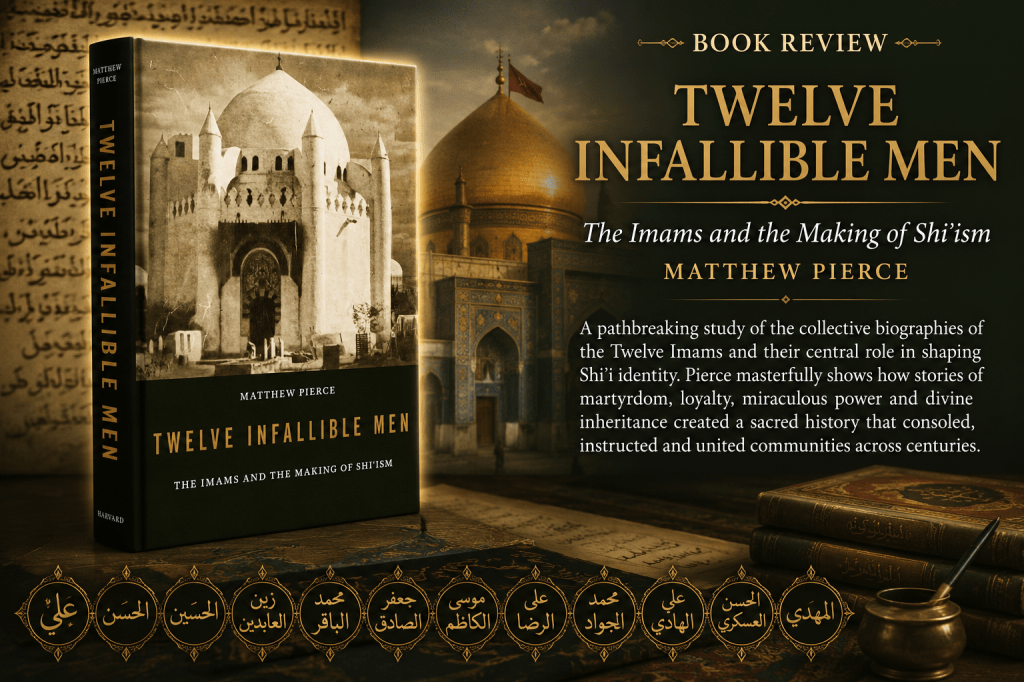
Matthew Pierce, Twelve Infallible Men: The Imams and the Making of Shiʿism. Cambridge, Massachusetts and London: Harvard University Press, 2016. ix + 257 pp. ISBN 978-0-674-73707-5.
Matthew Pierce’s Twelve Infallible Men is an ambitious and methodologically innovative study of the collective biographies of the Twelve Imams. Rather than reconstructing their historical lives or tracing the development of imamate doctrine, Pierce examines how medieval Twelver Shiʿi communities narrated the lives, sufferings and deaths of their sacred leaders, and how these narratives forged a distinct religious identity.
Pierce treats these biographies as acts of communal memory rather than repositories of historical fact. Their importance, he argues, does not depend entirely on whether every event can be verified. What matters is that successive generations found these accounts meaningful and authoritative. Through preservation, repetition and reorganisation, the stories created a shared sacred past and gave the community a vocabulary for understanding suffering, loyalty, authority and salvation.
The book draws principally on five Arabic collective biographies composed between the tenth and twelfth centuries, including works attributed to al-Masʿūdī, al-Shaykh al-Mufīd and al-Ṭabrisī. The author identifies these as forming a recognisable literary genre organised around the sequential lives of the Twelve Imams. This is one of the book’s key contributions: these texts have rarely been examined together as a corpus with its own narrative conventions, emotional logic and communal function. Pierce shifts attention from isolated traditions to the overall architecture of the biographies.
The opening chapter situates the literature within the late Abbasid period, cautioning against projecting modern Sunni-Shiʿi divisions backwards. In that fluid environment, collective biographies helped define the Twelve Imams as a closed sequence of divinely appointed guides. The end of the Lesser Occultation posed a profound problem: the Imam was alive yet inaccessible. The biographies responded by organising the past into a coherent sacred history, retrospectively establishing the unity of the Twelve and transforming their lives into a complete age of guidance.
The thematic chapters examine martyrdom, betrayal, bodies and birth narratives. Pierce shows how the biographies extended the paradigm of suffering from Imam Husain to encompass the entire line of Imams. Their deaths became variations on a story of truth rejected by worldly power. Poisoning proved an especially effective narrative device, preserving the Imam’s innocence while identifying political authority as treacherous.
The chapter on loyalty demonstrates how betrayal functions as an organising principle. The Imams are betrayed by rulers, relatives and followers, establishing moral boundaries. Readers are invited to locate themselves within the narrative: would they have recognised the Imam and remained loyal? The past becomes a continuing test of conscience.
The most innovative chapter examines vulnerability and masculine ideals. Drawing on gender studies, it shows that the Imams were presented not as disembodied abstractions but as physically beautiful, disciplined and powerful, yet vulnerable to imprisonment and poison. Their capacity to endure suffering without surrendering moral control became a high expression of sacred manhood. The inclusion of Fāṭima al-Zahrāʾ broadens the discussion, though she sometimes appears chiefly in relation to the male Imams.
The final thematic chapter examines birth narratives, which place the Imams within a cosmic genealogy extending from Adam to Muḥammad. The transmission of light through purified loins transforms genealogy into cosmology. These narratives also solved problems of recognition: in a world of rival claimants, miraculous births and precocious knowledge distinguished the true Imam.
Pierce’s theoretical framework draws from social and cultural memory studies, particularly the work of Maurice Halbwachs and Jan Assmann. This allows him to ask why communities preserved certain stories and how narrative produced belonging. However, the near suspension of historicity is occasionally problematic. Medieval authors often rested a narrative’s persuasive force precisely on the claim that it reported actual events through reliable chains of transmission. A more sustained engagement with isnād analysis might have added an important dimension.
There is also a danger in importing models from Christian hagiography too readily. Pierce is aware of this and offers caveats, but the theoretical literature sometimes shapes the reading more strongly than internal Shiʿi categories such as naṣṣ, ʿiṣma and walāya. A closer integration of these concepts would have rooted the study more firmly in the theological universe of the texts.
The chronological claims also deserve qualification. He argues that collective biographies shaped Twelver identity from the tenth century onwards, yet he occasionally extends his conclusions to “the tenth century to today”. The later transmission of these narratives through Persian, Urdu and Turkish literary cultures receives little attention. The transformation of written biography into ritual performance, popular print and vernacular poetry is acknowledged but not systematically traced. A fuller account would need to follow these stories beyond Arabic scholarly literature.
Despite these reservations, the book is a significant contribution. The author successfully directs attention towards narrative as a constitutive force in religious history. Twelver Shiʿism was not produced by doctrine and political conflict alone. It was also made through stories: stories of poisoned bodies, miraculous knowledge, abandoned leaders and faithful companions. These stories taught believers how to remember and, through remembrance, how to recognise themselves.
The prose is clear and accessible. The organisation into thematic chapters creates a coherent argument, though the selection of individual Imams as case studies sometimes gives the impression that themes belong more exclusively to particular figures than the sources warrant. The appendices are useful, and the bibliography makes the volume valuable for specialists and advanced students.
Ultimately, Twelve Infallible Men is an original and illuminating work. It encourages historians to read sacred narratives neither as straightforward chronicles nor as fanciful accretions, but as texts that actively shaped communities. Pierce has opened an important field of enquiry and demonstrated that the making of Shiʿism took place as much through the disciplined remembrance of the Imams as through formal theology, law or political allegiance.


