Syed Ali Nadeem Rezavi
Today’s edition of The Hindu carries an excellent lead editorial column written by Congress Parliamentary Party Chairperson Sonia Gandhi, titled “An Education System’s Collapse, Young India’s Trauma.” In the piece, she delivers a blistering critique of the government’s handling of the ongoing student protests, accusing it of responding to young people’s demands for accountability and education reform with “cowardice and wanton cruelty” rather than constructive dialogue. She argues that the protests sweeping the country are not isolated outbursts but the inevitable consequence of years of policy failures, institutional neglect, and a steady retreat from public investment in education. Her words echo what thousands of students and teachers have been saying for years: that Indian education is in the throes of a deep and dangerous crisis. What follows below is an attempt to examine the full dimensions of that crisis, from the hollowing out of universities to the erosion of critical thought, and to understand why the promise of the National Education Policy has given way to such profound disillusionment.
A Promise Unfulfilled
When the National Education Policy was announced in 2020, it was greeted with considerable optimism. It promised nothing less than a transformation of Indian education: universities would become multidisciplinary, students would enjoy greater flexibility, research would flourish, Indian institutions would compete with the world’s best, and education would finally prepare young people for the challenges of the twenty-first century. It was a vision that few could object to. Every teacher wants universities that are more open, more creative and more responsive to changing times.
The true test of any educational policy, however, lies not in the language of the document but in its consequences. Several years after the NEP began to be implemented, it is becoming increasingly difficult to ignore the widening gap between promise and reality. Across the country, universities are grappling with shrinking resources, vacant teaching positions, weakened research, collapsing specialised courses, growing bureaucratic control and an increasing intrusion of ideology into the classroom. Institutions that once took decades to build are slowly being hollowed out. What is unfolding is not simply another round of educational reform but a profound change in the very idea of what a university is meant to be.
The Shrinking Purpose of Higher Education
Universities have never existed merely to prepare people for jobs. Their purpose has always been larger. They create new knowledge through research, transmit it through teaching, preserve the intellectual inheritance of civilisation and train citizens to think independently. Employment is undoubtedly one outcome of higher education, but it has never been its only purpose. Increasingly, however, education is being discussed almost entirely in the language of skills, employability, entrepreneurship and measurable outcomes. These are important objectives, but they cannot become the sole measure of educational success. Once universities begin to see themselves primarily as training centres for the labour market, something fundamental is lost.
It is often the humanities that suffer first. History, philosophy, literature, archaeology, sociology, Persian, Arabic, Sanskrit and other classical and modern disciplines find themselves under pressure because they cannot easily demonstrate immediate economic value. Yet these are precisely the subjects that teach societies to understand themselves. They preserve memory, explain social change, encourage ethical reflection and cultivate critical judgement. A country that neglects these disciplines weakens not only its universities but also its understanding of its own civilisation. The contraction of social science research funding and the erosion of full-time faculty positions have reduced many departments to mere teaching centres, stripped of their capacity for deep inquiry.
Flexibility or Fragility?
The much-celebrated flexibility introduced through multiple entry and exit options illustrates this contradiction. It is presented as empowering students by allowing them to leave with certificates or diplomas after one, two or three years. In theory, flexibility appears attractive. In practice, however, students rarely leave higher education because they desire flexibility. They leave because their families cannot afford the fees, because they must seek employment, or because social circumstances make it impossible for them to continue. Providing a certificate at the point of departure does not remove these obstacles. Instead, it risks normalising early exit. The students most likely to leave are also those who are already disadvantaged. Rather than reducing inequality, the system may well reinforce it.
The Tyranny of Paperwork
Alongside these structural changes has come a remarkable expansion of bureaucracy. Teachers increasingly find themselves spending more time filling forms, uploading information to digital portals, preparing accreditation reports and satisfying administrative requirements than reading, researching or teaching. Universities appear to believe that excellence can be measured through endless documentation. Yet scholarship does not flourish through paperwork. Research requires uninterrupted time, functioning libraries, archives, laboratories where necessary, and above all the freedom to think. Teaching requires preparation, discussion and reflection. None of these can be reduced to numerical indicators or administrative compliance. The proposed Viksit Bharat Shiksha Adhishthan Bill, intended to replace the UGC, has raised further concerns over centralisation and the uncertain future of grant disbursement to state universities.
A Research Culture in Crisis
The condition of research reflects this larger malaise. Vacancies remain unfilled for years. Young scholars move from one contractual appointment to another with little hope of permanent academic careers. Libraries struggle to acquire books and journals. Funding becomes uncertain. Scholars are encouraged to publish rapidly because quantity has become easier to measure than quality. Citation counts replace intellectual contribution. Rankings replace scholarship. Universities begin to chase metrics rather than ideas. India’s investment in research and development has stagnated at around 0.6 to 0.7 per cent of GDP, well below the global average and far behind emerging economies.
The Vanishing Disciplines
Perhaps nowhere is the crisis more visible than in the steady disappearance of specialised courses and centres of advanced study. Over generations, Indian universities built internationally respected expertise in fields such as manuscript studies, palaeography, epigraphy, numismatics, historical linguistics, archaeology, textual criticism and archival science. These disciplines cannot be learnt through a few interdisciplinary modules. They require years of rigorous training under experienced scholars. Yet many such programmes have either disappeared altogether or have been absorbed into broad multidisciplinary structures that sacrifice depth for administrative convenience.
Interdisciplinarity is valuable only when it rests upon strong disciplinary foundations. A historian must first learn history before engaging with sociology or anthropology. An archaeologist cannot work without mastering archaeological method. A scholar editing medieval Persian or Sanskrit texts requires years of linguistic training. Ironically, while official rhetoric repeatedly invokes India’s ancient and glorious civilisation, the very disciplines needed to recover and understand that civilisation are being steadily weakened.
When History Becomes Mythology
Equally disturbing is the gradual erosion of the distinction between history and mythology. Every civilisation possesses myths. They are central to cultural identity and deserve to be studied with seriousness and respect. Historians have always treated mythology as an important source for understanding belief, memory and social imagination. The difficulty begins when myth is presented as historical fact and historical method itself is portrayed as an obstacle to national pride. Textbook revisions that reduce focus on the Mughals and introduce a more glorified portrayal of certain dynasties have prompted concerns over ideological influence.
History is not a collection of comforting stories. It is a disciplined enquiry based upon evidence, chronology, source criticism and reasoned interpretation. It often produces conclusions that are complex and occasionally uncomfortable. That is precisely why it matters. Myth serves a different purpose. It expresses moral values, symbolic truths and collective memory. Confusing the two ultimately impoverishes both.
Increasingly, students encounter simplified narratives in which the past is divided neatly between heroes and villains. Centuries of social interaction, cultural exchange and intellectual dialogue are compressed into stories of permanent conflict. Nuance disappears. Evidence becomes secondary to ideology. The purpose of history quietly shifts from understanding the past to legitimising the politics of the present.
Ideology Over Inquiry
This transformation is reinforced by the growing influence of educational networks associated with the Rashtriya Swayamsevak Sangh and its affiliated organisations. Like any social organisation, they have every right to establish schools and educational institutions. The concern is not their existence but the replacement of scholarly method with ideological certainty. When education encourages predetermined conclusions rather than open enquiry, classrooms cease to be places where minds are formed and become places where opinions are manufactured.
The consequences extend well beyond the study of history. The greatest purpose of education is not to provide answers but to teach students how to ask questions. Critical thinking develops only when young people encounter conflicting evidence, weigh competing arguments and learn to defend their conclusions through reason. If questioning itself begins to appear undesirable, curiosity slowly gives way to conformity. Students may leave university with degrees, but without the intellectual confidence to challenge received wisdom.
The Danger of Manufactured Minds
This is perhaps the gravest danger confronting Indian education today. A society that teaches its young what to think instead of how to think gradually weakens its own future. Scientific discovery depends upon scepticism. Historical research depends upon doubt. Democracy depends upon informed citizens capable of questioning authority. None of these can survive if education becomes an instrument for producing obedience rather than understanding.
There is another irony that deserves attention. India’s own intellectual traditions were built upon debate. The philosophical dialogues of the Upanishads, the rigorous arguments of Buddhist scholars, the traditions of Sanskrit learning, the disputations of medieval madrasas and the vibrant exchanges that took place in the courts of rulers across the subcontinent all testify to a civilisation that valued disagreement as a means of arriving at deeper understanding. To discourage questioning today is therefore not a defence of Indian civilisation. It is a departure from one of its oldest and richest traditions.
What Universities Truly Need
At the heart of this crisis lies a more fundamental problem. Universities flourish only when they enjoy intellectual autonomy and sustained public investment. Neither can be replaced by policy announcements. Libraries require books. Laboratories require equipment. Archives require conservation. Students require scholarships. Teachers require secure careers. Research requires time. None of these can be created through bureaucratic restructuring alone. The NEP’s own ambition of raising public education spending to six per cent of GDP remains unrealised, with actual expenditure staying around 2.9 per cent.
The Student Protests: A Symptom of Collapse
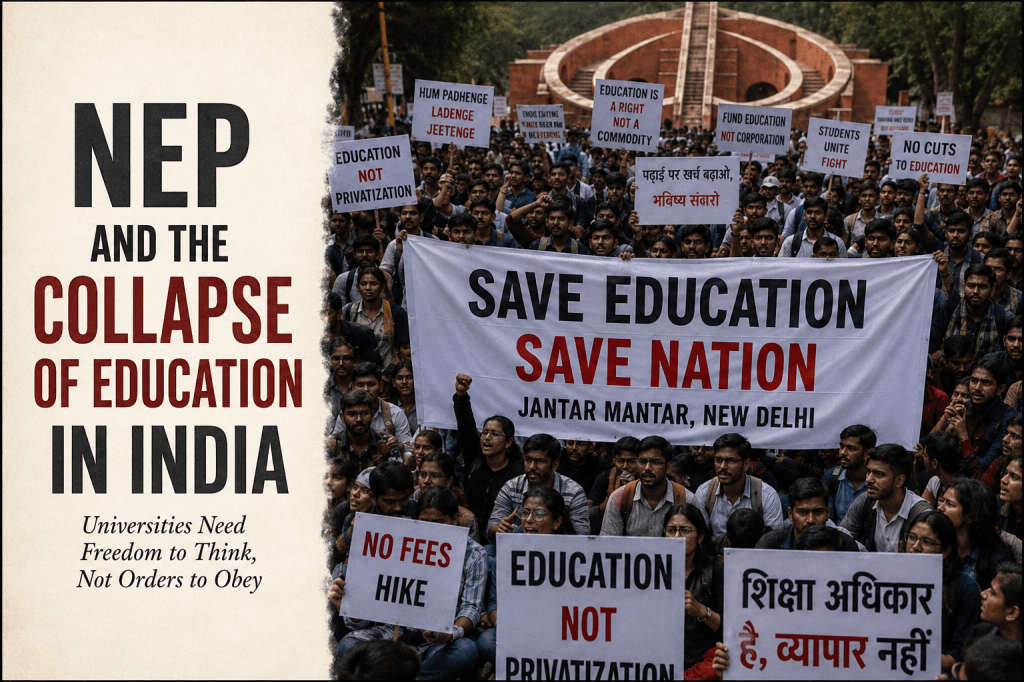
The recent student protests at Jantar Mantar, which spread to cities across the country, are not isolated events. They are a direct consequence of this collapse. Students are not just angry about paper leaks. They are protesting a system that has failed them at every level. When the Delhi University administration issued advisories warning students to stay away from lawful protests, it only confirmed what many already believed: that institutions of learning have ceased to be spaces of intellectual freedom and have become instruments of control. The protests in Himachal Pradesh and Hyderabad, where students demanded the scrapping of the NEP and the resignation of the Education Minister, reflect a deep-seated frustration with an education system that promises flexibility but delivers precarity. This movement is not just about examinations. It is a refusal to accept an education that manufactures obedience rather than cultivates critical thought.
A Nation’s Future at Stake
The debate over the NEP is therefore about much more than curriculum design or administrative reform. It is about the future character of Indian society. If universities become places where specialised knowledge disappears, where history gives way to mythology, where ideology replaces scholarship and where conformity is valued above curiosity, the damage will not be confined to campuses. It will shape the quality of public life itself.
Nations are ultimately judged not by the number of policies they announce but by the quality of minds they produce. India does not need an education system that manufactures agreement. It needs one that cultivates informed scepticism, intellectual honesty and the courage to question. Those are the qualities that have sustained every great civilisation. They are also the qualities without which no democracy can long endure.


