Syed Ali Nadeem Rezavi
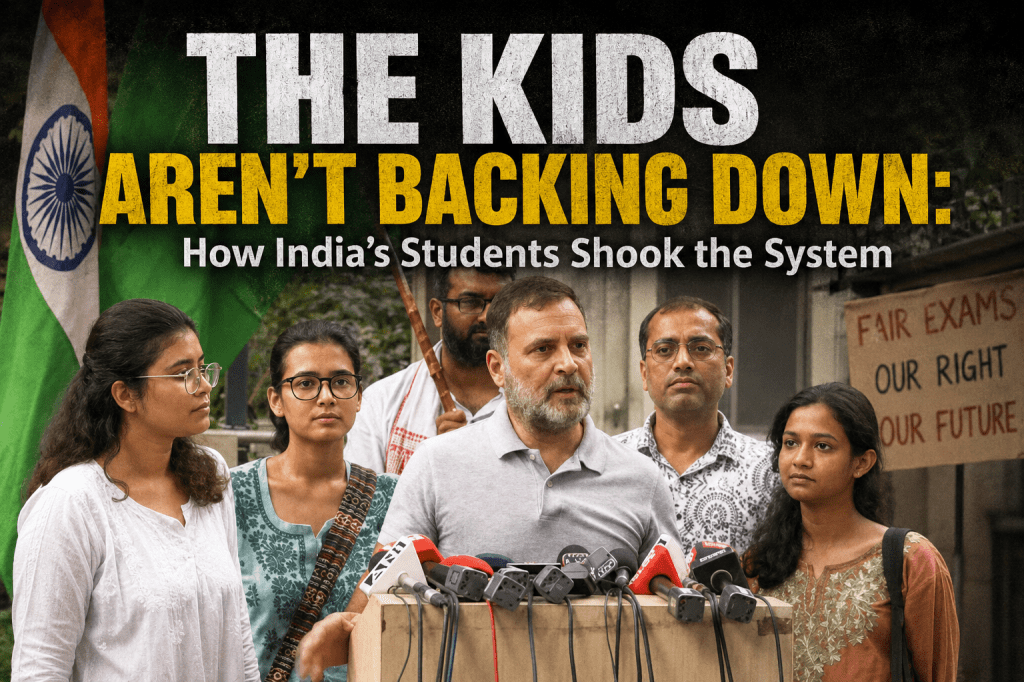
Let’s be honest about what just happened. Dharmendra Pradhan’s resignation as Education Minister wasn’t some gracious political gesture. It was a surrender. A government that had spent years brushing aside student grievances finally found itself cornered by the very people it had ignored. And that is what makes this moment historic. Not the fall of one minister, but the rise of thousands of young Indians who refused to be treated as statistics.
This was never really about the Cockroach Janata Party. The CJP provided a name and a structure, sure. But the heart and sinew of this movement belonged to the students who flooded the streets, who slept on pavements, who travelled for days on crowded trains just to add their voice to the chorus. They were not symbols. They were not props. They were the real deal.
The anger that propelled them was entirely justified. Leaked papers. Botched exams. A system so riddled with incompetence that merit became a joke. Young people who had studied for years, who had sacrificed sleep and sanity, who had pinned their entire futures on fair assessment – they were being cheated. And not quietly. Not politely. They were done with being patient. They were done with being fobbed off by bureaucrats and ministers who had never known what it felt like to have their dreams hinge on a single mark sheet.
So they gathered. First in small clusters, then in growing crowds, and finally in a roar that could not be ignored. They organised through WhatsApp, Instagram, Telegram – the very platforms that establishment politicians dismiss as frivolous. They built networks that transcended cities, states, and languages. They turned a scattered cry of frustration into a unified, unstoppable demand for accountability.
And here is the part that really rattled the powers that be: they did it with discipline. No riots. No vandalism. Just a quiet, stubborn refusal to go away. That discipline was their superpower. It stripped the government of every excuse. They couldn’t be painted as goondas. They couldn’t be dismissed as anti-nationals. They were just students – angry, articulate, and absolutely right.
Now let’s address the elephant in the room. There were whispers from the very beginning – and not just from cynics – that the CJP, along with figures like Wangchuk and Dipke, might have been playing a different game altogether. Some suspected they wanted to act as a cushion for the government. The theory went like this: give the students a platform, let them blow off steam, absorb the criticism, take the heat out of the protests, and then quietly negotiate a face-saving exit for the minister. In other words, provide a release valve so the real pressure never reached the boiler.
We don’t know the truth of that thinking. Maybe it was fair. Maybe it was paranoia. Maybe the CJP and its prominent faces genuinely believed in the cause. But here is what we do know: whatever cushion they might have intended to create, the students blew right through it.
The young participants were not interested in being managed. They were not interested in backroom deals that would let the government off the hook. They were not there to be a photo opportunity or a talking shop. They kept the pressure on. They refused to be pacified by vague promises. They refused to disperse when asked. They kept the streets alive, the conversation loud, and the government uncomfortable.
And that is where the real story lies. The students became the Achilles heel of this government. Think about that for a moment. The farmers, with all their numbers and moral authority, could not bring this administration to its knees. They marched, they sat, they endured brutal police action, and still the government held firm. Political parties, with all their resources and machinery, could not land a decisive blow. They debated, they criticised, they formed alliances, and still the government remained unshaken.
But the students did what none of them could. They exposed the Modi government. Not through grand politics. Not through media campaigns. Simply by being young, stubborn, and utterly unwilling to be ignored. They laid bare the government’s vulnerability. They showed that beneath all the bluster and bravado, this administration is far more fragile than it pretends to be.
What the farmers could not achieve, what the opposition could not achieve, the students achieved with nothing more than their voices, their feet, and their refusal to back down. They did not have deep pockets. They did not have political backing. They had only their conviction that they deserved better. And that was enough.
Now let’s talk about what made these young protesters genuinely dangerous to the political establishment. Not dangerous in a violent sense, but dangerous in a way that keeps politicians awake at night. They refused to play the communal game. In an era when every election, every policy, every media debate is coloured by religion and region, these students looked at one another and saw equals. They sat together, ate together, marched together, regardless of whether they worshipped in a temple, a mosque, a church, or nowhere at all.
That was the real subversion. They tore up the divisive script that has become so comfortable for our ruling class. They reminded everyone that a student is first a student – not a Hindu voter, not a Muslim voter, not a pawn in someone else’s identity war. They reasserted a shared citizenship that has been under systematic assault for years. And they did it without grand speeches or ideological posturing. They simply lived it.
The government’s response was telling. First, they tried to ignore the protests. Then they tried to dismiss them as political mischief. Then they tried to divide the protesters along familiar communal lines. Nothing worked. Every attempt to fracture the movement backfired spectacularly because the students had already chosen solidarity over division. They had already decided that their common future mattered more than the ancient hatreds that politicians love to stoke.
So Pradhan fell. And good riddance. But this was never just about one man. It was about the government being forced to acknowledge that it is not invincible. That even a ruling party with a massive parliamentary majority cannot trample on young people with impunity. That when thousands of determined citizens refuse to look away, even the mightiest administration must blink.
What happens now? The formal protests have ended. The tents at Jantar Mantar have been folded. But anyone who thinks this is over is dangerously naive. Movements don’t evaporate just because organisers declare victory. They leave behind something far more enduring: a generation that has learned its own strength.
These students now know how to organise. They know how to communicate. They know how to sustain pressure. They know how to make themselves heard in a political system that was designed to ignore them. That knowledge cannot be unlearned. It will seep into every future campaign – unemployment, university autonomy, environmental justice, you name it. The establishment has sown the wind, and it will reap the whirlwind.
And here is the uncomfortable truth for those in power: the students are not going away. They are not returning to their dormitories to quietly finish their degrees and become obedient professionals. They have tasted collective action. They have seen their own power reflected in the panic of a government that scrambled to respond. They know now that democracy is not a spectator sport. It is a muscle that must be exercised, and they have just done a very heavy workout.
The communal agenda that has dominated Indian politics for the past decade looked resilient. It looked unshakeable. But these young protesters exposed its greatest weakness: it cannot survive genuine human connection. When students of different faiths stand shoulder to shoulder, when they share food and water and hope, the walls that politicians have spent years building start to crumble. That is not a threat the government can legislate away. That is not a problem they can solve with a reshuffle.
So let us call this what it is. The kids have just served notice. They have shown that they are no longer content to be passive recipients of policies made in distant corridors. They have shown that they are willing to take risks, endure hardship, and stand up for what is right. And they have shown that they are not interested in the tired, toxic politics of division.
The resignation of one minister is a beginning, not an end. The real battle lies ahead – over jobs, over education, over the very soul of this country. And if the government thinks it can return to business as usual, it has another think coming. The students have arrived. They have found their voice. And they are not backing down.
What the farmers could not do, what the politicians could not do, they have done. They have exposed the Modi government. They have made it susceptible. They have shown that the emperor has no clothes. And what follows next – well, that is entirely up to them.
Not today. Not tomorrow. Not ever. Yesterday it was Jantar Mantar, today it is Patna, and tomorrow…. Who knows? The entire nation!


