Syed Ali Nadeem Rezavi
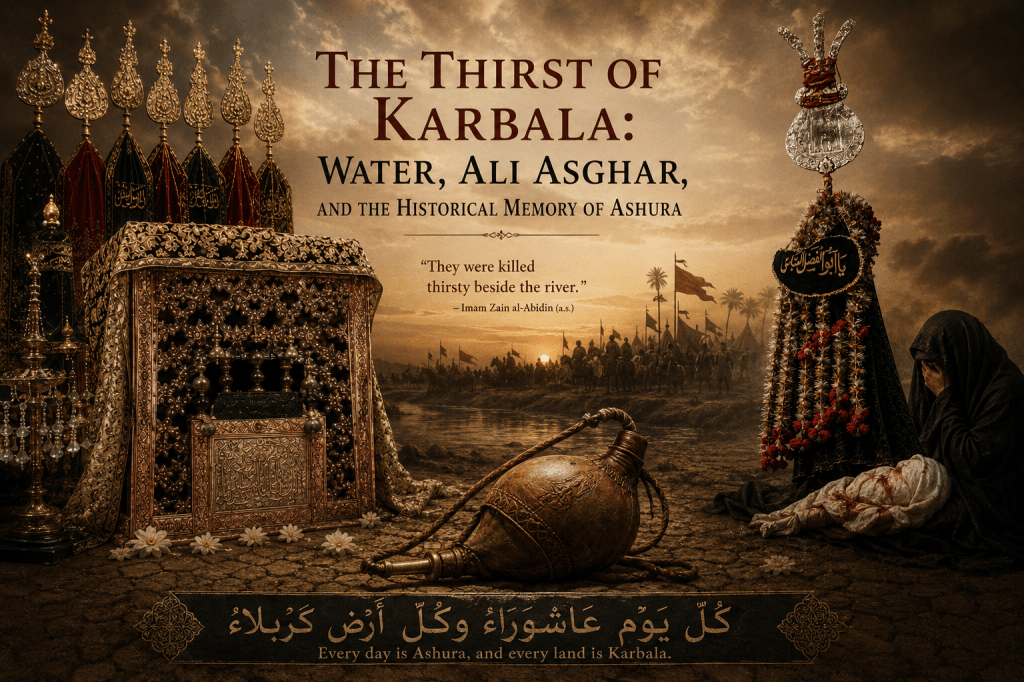
فرات بہہ رہی تھی مگر ظلم کی حد تھی
قطرہ نہ ملا پیاس بجھانے کو حسینؑ کو
“The Euphrates flowed, yet tyranny knew no bounds;
Not a single drop was given to quench Husain’s thirst.”
. Firaq Gorakhpuri
Among the many episodes that constitute the tragedy of Karbala, two have exercised an unparalleled influence upon the historical memory of Ashura: the thirst suffered by Imam Husain, his family, and his companions, and the martyrdom of his infant son, Ali Asghar. These are not merely emotional episodes added by later generations to intensify mourning. Rather, they lie at the heart of the Karbala narrative itself. They reveal the extent of the suffering endured by the Prophet’s family and expose the moral degradation of those who stood against them. Indeed, if the thirst of Karbala and the martyrdom of Ali Asghar are removed from the narrative, much of what makes Karbala a unique and universal tragedy is fundamentally altered.
The confrontation at Karbala was never simply a military encounter. History is filled with battles, rebellions, and political struggles. Karbala acquired its enduring significance because it combined resistance to tyranny with the suffering of the innocent. The image of thirsty children crying beside a flowing river and the image of an infant struck by an arrow while in his father’s arms transformed the events of Muharram 61 AH into a moral drama that continues to resonate across centuries and cultures.
The historical sources agree that after Imam Husain and his small band of followers were encamped at Karbala, the forces of ʿUbayd Allah ibn Ziyad gradually tightened their control over access to the Euphrates. The river flowed close to the camp, yet access to its waters was denied. Abu Mikhnaf’s account, preserved by al-Tabari, together with later works such as al-Mufid’s al-Irshad, consistently indicate that the Umayyad forces sought to weaken Husain’s position through a blockade of water.
The significance of this blockade cannot be overstated. Water in the desert is not merely a commodity. It is life itself. To deny water to women and children was regarded even by many contemporaries as an act of extraordinary cruelty. As the days passed, thirst spread throughout the camp. The cries of the children became increasingly desperate. Their repeated plea, al-atash, al-atash – ‘thirst, thirst’ – echoed through the tents and entered the collective memory of generations of mourners.
The companions of Husain bore this suffering with remarkable fortitude. Their heroism consisted not merely in facing the enemy but in doing so while weakened by thirst and exhaustion. They fought with parched throats, knowing that relief was unlikely to come. Their struggle was therefore both physical and moral.
Among the most moving episodes associated with this suffering is that of Ali Akbar, the young son of Imam Husain. After fighting courageously, he is said to have returned to his father and complained of the severity of thirst. In the devotional literature of Ashura, this moment has been immortalised by the image of Ali Akbar observing the condition of Husain himself and remarking that his father’s tongue had become as dry as a thorn. Whether one accepts every detail of these later narrations or not, they reflect a historical memory deeply rooted in the experience of thirst.
The suffering of the camp reached its most dramatic expression in the mission undertaken by Abu al-Fadl al-Abbas. Abbas occupies a unique place in the memory of Karbala because he embodied loyalty, courage, and self-sacrifice. His greatest achievement was not the defeat of enemies but his determination to bring water to the thirsty children.
Responding to their cries, Abbas broke through the enemy lines and reached the Euphrates. Tradition remembers that although he himself was desperately thirsty, he refused to drink before the children of Husain had received water. Filling a water-skin, he began the journey back to the camp. Realising the importance of his mission, the enemy concentrated its attack upon him. His right arm was severed. He continued carrying the water-skin with his left hand. Then his left arm was cut off as well. The water-skin was pierced, and the precious water spilled onto the sands of Karbala. Moments later Abbas himself fell, mortally wounded.
The significance of this episode rests entirely upon the reality of thirst. Abbas’s sacrifice would be incomprehensible if water had been readily available within the camp. His martyrdom became a symbol of the desperate struggle to secure life-giving water for the vulnerable members of Husain’s household.
If Abbas represents the tragedy of thirst, Ali Asghar represents the tragedy of innocence.
The six-month-old child was incapable of understanding the conflict unfolding around him. According to the widely accepted account preserved in both historical and devotional traditions, Imam Husain brought the infant before the opposing army and appealed to their humanity. If they regarded Husain as their enemy, surely the child was blameless. Let him at least be given water.
The response was an arrow.
The infant was struck by a three pronged arrow (tīr e seh shoba) fired by Harmala ibn Kahil and died in the arms of his father. In the devotional memory of Shi’i Islam, the image is made even more poignant because the arrow is said to have pierced the child’s dry throat.
The symbolism is unmistakable. The thirsty infant was not given water. He was given death.
It is these twin realities – thirst and innocence violated – that give Karbala much of its moral force. They transform the conflict from a political confrontation into a universal indictment of tyranny and injustice.
For this reason, twentieth-century attempts to reinterpret these events generated considerable controversy. Among the most distinguished Shi’i scholars of South Asia was Allama Saiyid Ali Naqi Naqqan. Renowned for his scholarship and intellectual rigour, he frequently sought to distinguish between historical fact and devotional embellishment. Discussions attributed to him regarding the thirst of Karbala and the martyrdom of Ali Asghar became the subject of debate among later scholars.
Saiyid Ali Naqi, in his book Shahīd-e Insaniat, which he drafted in the early 1950s, wrote that water was available in the camp of Husain. Before going out for the ultimate battle, he performed wuzu (ablutions). Unfortunately, he did not cite any evidence or sources for this view.
One of the principal responses came from Saiyid Sibtul Hasan in his work Izhar-e Haqiqat (‘Manifestation of the Truth’), where he examined and criticised interpretations that, in his view, diminished the established understanding of the suffering endured at Karbala. His argument was rooted not only in historical reports but also in Islamic jurisprudence, ethics, and the testimony preserved through the Ahl al-Bayt.
According to Sibtul Hasan, the expression qaht-e ab (‘water deprivation’) did not require the absolute absence of every drop of water. Rather, it referred to a condition in which access to sufficient water for survival had been denied. The historical memory of Karbala, he argued, consistently portrays the camp as suffering from severe thirst caused by the blockade imposed by the Umayyad forces.
Drawing upon principles of Islamic law, Sibtul Hasan further argued that when human life is endangered by thirst, the preservation of life takes precedence over ritual purification. In such circumstances, tayammum replaces wuzu and ghusl. Therefore, any interpretation suggesting the availability of water for ritual purposes while children remained thirsty would raise serious ethical and legal difficulties.
In one of his articles published in a journal, Saiyid Ali Naqi made his second bizarre claim: that the massacre of the infant Ali Asghar was an ‘inadvertent accident’, a hādisa. The arrow of Harmala was meant for Husain, but unintentionally struck Ali Asghar.
With regard to Ali Asghar, Sibtul Hasan maintained that the traditional account of the infant’s martyrdom occupies a central place in the remembrance of Ashura because it illustrates the suffering of the most innocent victim of the conflict. The significance of the episode lies not merely in the death of a child but in the moral message conveyed by the event as preserved in Shi’i historical and devotional literature.
He also pointed to the recollections attributed to Imam Zain al-Abidin and Lady Zainab, whose speeches and lamentations repeatedly emphasise the thirst endured by the family of the Prophet. For Sibtul Hasan, these testimonies formed an essential part of the transmitted memory of Karbala and could not easily be set aside.
In the face of rising criticisms and condemnations, Naqqan ultimately verbally explained that he was actually citing another author.
The debate therefore extended beyond questions of historical detail. It concerned the interpretation of Karbala itself and the meaning attached to its most enduring symbols.
If the thirst of the camp is minimised, the sacrifice of Abbas loses much of its significance.
If the death of Ali Asghar is transformed into an accident, one of the most powerful symbols of innocence martyred by tyranny disappears.
If both are weakened, Karbala risks becoming little more than another political conflict in early Islamic history.
Yet Karbala has never been remembered as an ordinary battle.
It is remembered because thirsty children cried for water beside a flowing river.
It is remembered because Abbas gave his life attempting to bring them relief.
It is remembered because a father carried an infant before an army and asked not for power or victory, but simply for water.
And it is remembered because the answer to that plea was an arrow.
For fourteen centuries the cry of al-atash and the image of Ali Asghar have remained at the centre of Ashura’s historical memory. They remind humanity that the greatest tragedies are not measured merely by the deaths of heroes but by the suffering inflicted upon the innocent. It is for this reason that the thirst of Karbala and the martyrdom of Ali Asghar continue to define the moral and emotional landscape of Ashura, ensuring that Karbala remains not simply an event of the past but an enduring symbol of resistance to injustice and oppression.
Selected References
Abu Mikhnaf, Maqtal al-Husain (preserved in al-Tabari).
Al-Mufid, Kitab al-Irshad.
Al-Tabari, Tarikh al-Rusul wa’l-Muluk.
Mahmoud M. Ayoub, Redemptive Suffering in Islam (1978).
Peter J. Chelkowski (ed.), Ta’ziyeh: Ritual and Drama in Iran (1979).
Syed Akbar Hyder, Reliving Karbala: Martyrdom in South Asian Memory (2006).
Moojan Momen, An Introduction to Shi’i Islam (1985).
David Pinault, Horse of Karbala: Muslim Devotional Life in India (2001).
Vernon James Schubel, Religious Performance in Contemporary Islam (1993).
Saiyid Ali Naqi Naqqan, Mujahida-i Karbala.
Saiyid Ali Naqi Naqqan, Shahīd-e Insaniat.
Saiyid Sibtul Hasan, Izhar-e Haqiqat.


