Syed Ali Nadeem Rezavi
Let us start with the second part of the series which I have started on Karbala. By now you must have understood that it is directed towards the uninitiated and those who have forgotten as to what Karbala stands for or contributed. Today I will deal with Karbala and our National Movement.
The influence of Imam Husain and the tragedy of Karbala upon the Indian freedom movement has often been acknowledged in popular memory, but less frequently examined through authenticated historical sources. In recent decades, numerous quotations have circulated on social media and in public speeches attributing statements to Mahatma Gandhi, Jawaharlal Nehru, and other national leaders regarding Imam Husain. While many of these sentiments are consistent with the views of those leaders, historians must distinguish between popular attributions and verifiable documentary evidence.
This essay therefore relies, as far as possible, on authenticated statements found in primary sources such as The Collected Works of Mahatma Gandhi, the writings and speeches of Maulana Abul Kalam Azad, contemporary nationalist newspapers, the speeches of the Ali brothers, the poetry of Sarojini Naidu, Muhammad Iqbal, and Hasrat Mohani, and the wider literary traditions of Urdu and Indian nationalist discourse. Where a quotation is widely circulated but cannot be firmly traced to a reliable source, it is either omitted or identified as an unverified attribution. Such caution is particularly important when writing about figures who have become subjects of national memory and public reverence.
The story of Karbala occupies a unique place in world history. In 680 CE, Imam Husain ibn Ali, the grandson of the Prophet Muhammad, refused to recognise the authority of the Umayyad ruler Yazid, whom he regarded as morally and politically illegitimate. Accompanied by members of his family and a small group of followers, Husain journeyed towards Kufa but was intercepted on the plain of Karbala. There, after being denied access to water and surrounded by a vastly superior force, he and his companions were martyred.
The significance of Karbala lies not in military victory but in moral triumph. Husain’s refusal to submit to injustice transformed him into an enduring symbol of conscience, sacrifice, and resistance. Across centuries and continents, oppressed peoples have found inspiration in his example. In colonial India, where millions struggled against foreign domination, the memory of Karbala acquired particular resonance.
The Indian encounter with Karbala had deep historical roots. Muharram commemorations had become an integral part of South Asian culture. As scholars such as Athar Abbas Rizvi, Saiyid Sibtul Hasan, David Pinault, Vernon Schubel, Justin Jones, Syed Akbar Hyder, and others have demonstrated, Muharram in India often transcended sectarian and communal boundaries. Hindus, Muslims, Sikhs, and others participated in processions, sponsored tazias, and attended majalis. Karbala thus entered the shared cultural vocabulary of the subcontinent. Indeed, this very tradition of Muharram Tazia processions, with their powerful visual evocation of sacrifice and resistance, directly inspired the introduction of the Ganesh festival in Maharashtra by Bal Gangadhar Tilak and his associates. Gokhale and other nationalist leaders recognised that the public processions associated with Muharram provided an effective model for mobilising popular sentiment and fostering communal solidarity in the cause of national awakening.
Equally important was the contribution of Urdu literature. The marsiyas of Mir Anis and Mirza Dabeer transformed Karbala into a vivid moral drama. Their works emphasised courage, loyalty, sacrifice, and steadfastness in the face of overwhelming odds. Long before the emergence of organised nationalism, these poets had already familiarised generations of Indians with the ethical lessons of Karbala.
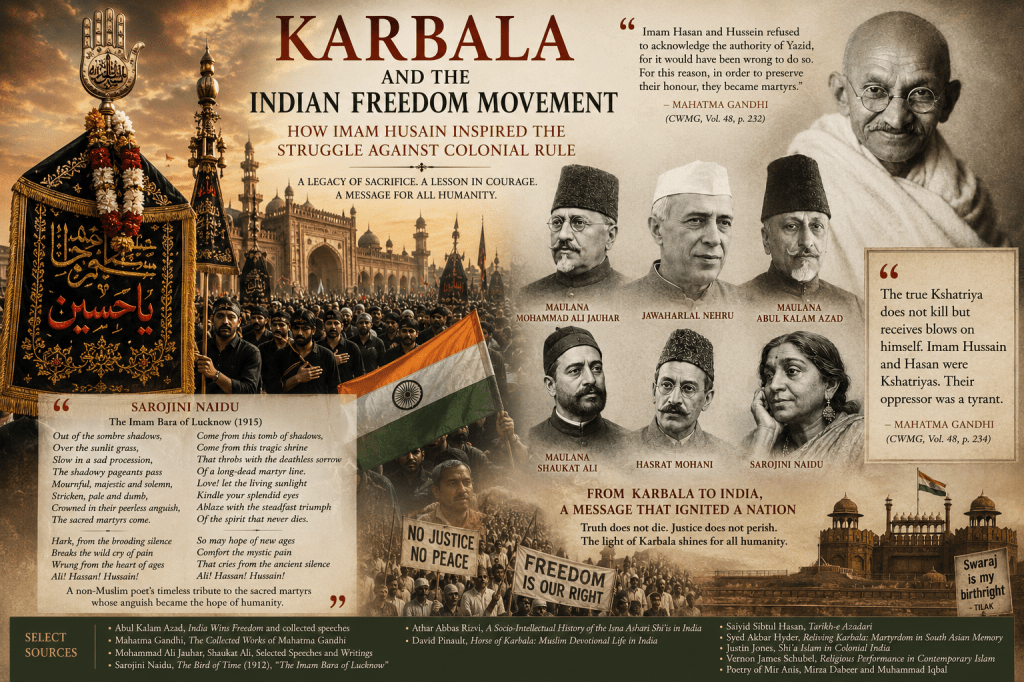
Among the most remarkable literary responses to Karbala by a non-Muslim Indian nationalist was Sarojini Naidu’s poem The Imam Bara of Lucknow, written in 1915. Witnessing a Muharram procession in Lucknow, Naidu was deeply moved by the spectacle of collective mourning and the enduring memory of Husain. She described the mourners emerging from the shadows of the Imambara into the sunlight:
“Out of the sombre shadows,
Over the sunlit grass,
Slow in a sad procession,
The shadowy pageants pass;
Mournful, majestic and solemn,
Stricken, pale and dumb,
Crowned in their peerless anguish,
The sacred martyrs come.”
The image is powerful. The mourners, dressed in black and moving beneath the blazing sun, appear transformed into the martyrs themselves. Their grief is profound, yet they remain majestic. Naidu’s description of Husain and his companions as “sacred martyrs” and their suffering as “peerless anguish” constitutes one of the finest tributes paid by a non-Muslim poet to Karbala. She further wrote:
“Hark, from the brooding silence
Breaks the wild cry of pain
Wrung from the heart of ages,
Ali! Hassan! Hussain!”
For Naidu, Karbala was not merely a historical tragedy. It was a wound carried by humanity itself. The cries of “Ali! Hassan! Hussain!” represented the sorrow of civilisations remembering the suffering of truth at the hands of oppression.
The poem reaches its philosophical climax when Naidu reflects upon the permanence of Husain’s message:
“Love! let the living sunlight
Kindle your splendid eyes
Ablaze with the steadfast triumph
Of the spirit that never dies.”
Here lies the essence of Karbala. Husain’s victory was not military but moral. Yazid possessed armies, wealth, and political authority. Yet it is Husain who remains the symbol of justice and courage, while the empire of his adversary survives only as a historical memory. Naidu recognised that Karbala represented the triumph of principle over power. Her final appeal was equally profound:
“So may hope of new ages
Comfort the mystic pain
That cries from the ancient silence,
Ali! Hassan! Hussain!”
She described Karbala as a “mystic pain”, not simply because a noble man had been killed, but because truth itself had suffered. Yet she also believed that future generations would continue Husain’s struggle and that one day justice would prevail over tyranny. In this respect, her interpretation closely anticipated the manner in which Indian nationalists would later draw inspiration from Karbala during the struggle against colonial rule.
Following the Revolt of 1857, the language of Karbala increasingly appeared in discussions of political oppression and resistance. The suffering experienced by Indians under colonial rule was often expressed through imagery drawn from Muharram traditions. The martyrdom of Husain became a metaphor through which many could understand their own historical condition.
The political significance of Karbala became particularly evident during the Khilafat and Non-Cooperation movements. Leaders such as Maulana Mohammad Ali Jauhar and Maulana Shaukat Ali repeatedly invoked Imam Husain as an example of resistance to illegitimate authority. Their speeches drew parallels between the struggle against colonial domination and Husain’s refusal to compromise with tyranny. Mohammad Ali Jauhar’s own political life reflected these ideals. His famous declaration, “I would prefer to die in a foreign land rather than return to a slave country,” expressed the same spirit of honour and defiance that many associated with Karbala. Although the statement does not mention Husain directly, the intellectual and emotional influence of Karbala upon Jauhar’s political thought is unmistakable.
Among the leaders of the freedom movement, Mahatma Gandhi occupies a special place in discussions of Karbala. Numerous quotations are popularly attributed to Gandhi, including the often repeated claim that he “learnt from Husain how to achieve victory while being oppressed.” Despite its popularity, historians have not been able to locate this statement in Gandhi’s authenticated writings. It should therefore be treated with caution.
What can be stated with certainty is that Gandhi held Imam Husain in profound regard. His collected writings contain several explicit references to Hasan and Husain. In one passage Gandhi observed:
“Imam Hasan and Hussein refused to acknowledge the authority of Yazid, for it would have been wrong to do so. For this reason, in order to preserve their honour, they became martyrs.”
Elsewhere he wrote:
“When called upon to surrender, they refused. They knew at the time that this would mean death for them. If they were to submit to injustice, they would disgrace their manhood and betray their religion.”
In another striking passage he remarked:
“The true Kshatriya does not kill but receives blows on himself. Imam Hussain and Hasan were Kshatriyas. Their oppressor was a tyrant.”
These authenticated statements reveal Gandhi’s effort to present Husain as a universal moral exemplar rather than as a figure confined to one religious tradition. By describing Hasan and Husain as ideal Kshatriyas, Gandhi translated the ethical message of Karbala into a language that could be appreciated by all Indians.
The parallels between Karbala and Gandhi’s doctrine of satyagraha are striking. Both emphasised moral courage over physical force, sacrifice over submission, and fidelity to truth over worldly success. Gandhi repeatedly argued that true victory belongs not to those who wield power but to those who remain faithful to their principles. This understanding closely mirrors the traditional interpretation of Husain’s martyrdom.
Maulana Abul Kalam Azad likewise drew inspiration from Karbala. Throughout his speeches and writings, Azad emphasised that Husain consciously chose the path of sacrifice in order to preserve truth and justice. For Azad, Karbala demonstrated that the survival of moral principles often depends upon individuals willing to place conscience above personal safety.
Jawaharlal Nehru, though writing from a secular nationalist perspective, also recognised the broader significance of Karbala. Nehru’s vision of India rested upon the idea of a shared civilisational heritage in which figures from different religious traditions belonged to the collective memory of the nation. In this framework, Imam Husain represented not merely an Islamic hero but a universal symbol of resistance against oppression.
The revolutionary poet Hasrat Mohani found in Karbala a model for uncompromising political action. One of the earliest advocates of complete independence, Mohani regarded resistance to injustice as a moral obligation. The spirit of Karbala permeated both his poetry and his politics.
The influence of Karbala upon Indian nationalism can also be seen in the works of Muhammad Iqbal. Although Iqbal’s political thought evolved over time, his poetry consistently celebrated Husain as a symbol of spiritual freedom and moral resistance. His famous verse:
Mūsā-o-Fir’aun, Shabbīr-o-Yazīd
Zindagī hai jang in mukhtalif tāqatōn ke darmiyān
(موسیٰ و فرعون، شبیر و یزید
زندگی ہے جنگ ان مختلف طاقتوں کے درمیان)
translated as “Musa and Pharaoh, Shabbir and Yazid; life is the struggle between these opposing forces,” transformed Karbala into a universal metaphor for the eternal conflict between justice and tyranny.
Likewise, his description of Husain as:
Imām-e ‘Āshiqān, Peshwā-ye Āzādgān
(امام عاشقان، پیشوائے آزادگان)
or “The leader of lovers and the guide of the free,” helped establish Husain as a symbol of liberty for modern generations.
One of the most remarkable features of Karbala’s role in the freedom movement was its ability to transcend communal boundaries. Muharram processions across India often attracted participation from multiple religious communities. Many Hindus regarded Husain as a martyr for justice. In numerous towns and villages, local traditions evolved in which Karbala became part of a shared cultural inheritance rather than the exclusive possession of any one community. The inspiration drawn from these processions by Gokhale and Tilak for the Ganesh festival stands as a testament to the creative appropriation of Karbala’s cultural forms for broader nationalist purposes.
This broader appeal explains why references to Karbala frequently appeared in nationalist speeches, newspapers, public meetings, and literary works. The imprisoned activist, the student facing repression, the peasant resisting exploitation, and the political leader confronting colonial authority could all identify with the example of Husain’s steadfastness in the face of overwhelming power.
The Indian freedom movement drew strength from many intellectual and moral traditions. The Bhagavad Gita, the teachings of the Buddha, the example of Guru Gobind Singh, the message of the Sufi saints, and the memory of Karbala all contributed to its ethical foundations. Among these influences, however, Karbala occupied a unique place because it offered a powerful example of resistance without compromise, sacrifice without expectation of reward, and courage without hope of worldly victory.
The enduring relevance of Imam Husain to the Indian freedom movement lay in the universal values that his life embodied. His stand at Karbala demonstrated that truth is not determined by numbers, that justice does not depend upon power, and that moral courage can outlive armies and empires. For generations of Indians struggling against colonial rule, this lesson provided inspiration and hope.
The British Empire eventually disappeared from the subcontinent. The memory of Husain did not. That fact alone illustrates the central message of Karbala. Power may triumph temporarily, but principles endure. It was this enduring lesson that inspired many of India’s freedom fighters and ensured that the name of Imam Husain remained a beacon of resistance, dignity, and justice in the long struggle for independence.
Select Sources
Abul Kalam Azad, India Wins Freedom and collected speeches.
Athar Abbas Rizvi, A Socio-Intellectual History of the Isna Ashari Shi’is in India.
David Pinault, Horse of Karbala: Muslim Devotional Life in India.
Mahatma Gandhi, The Collected Works of Mahatma Gandhi (relevant references to Imam Hasan and Imam Husain).
Sarojini Naidu, The Bird of Time (1912; later editions), especially “The Imam Bara of Lucknow.”
Saiyid Sibtul Hasan, Tarikh-e Azadari.
Syed Akbar Hyder, Reliving Karbala: Martyrdom in South Asian Memory.
Justin Jones, Shi’a Islam in Colonial India.
Vernon James Schubel, Religious Performance in Contemporary Islam: Shi’i Devotional Rituals in South Asia.
Selected speeches and writings of Mohammad Ali Jauhar, Shaukat Ali, and Hasrat Mohani.
Poetry of Mir Anis, Mirza Dabeer, and Muhammad Iqbal.


