Syed Ali Nadeem Rezavi
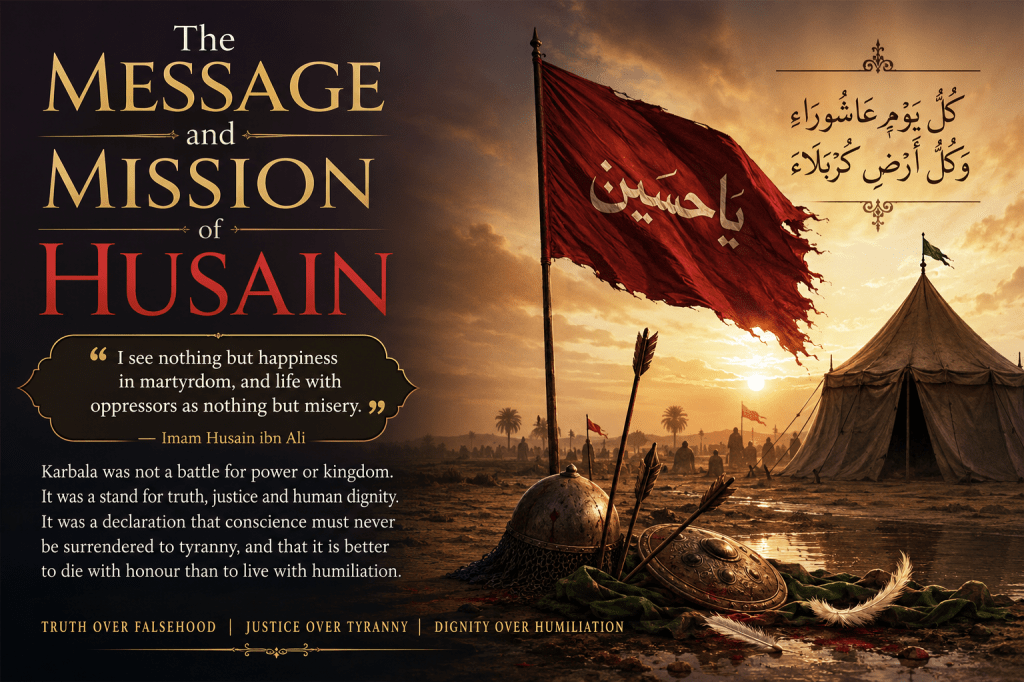
“I see nothing but happiness in martyrdom, and life with oppressors as nothing but misery.”
— Imam Husain ibn Ali
Since the commencement of Muharram this year, we have reflected upon many dimensions of the tragedy of Karbala. We have written about the companions of Imam Husain, the women and children who shared his suffering, the role of Zainab in preserving the memory of Ashura, the universal brotherhood represented in his camp, the educational role of Muharram, and the enduring influence of Karbala on literature, culture, and political thought. In truth, the message of Imam Husain is embedded in all these themes. Each aspect of Karbala is but a window through which one glimpses a larger moral vision.
Before proceeding in the coming days to examine other dimensions of Muharram and the legacy of the Ahl al-Bayt, it is useful to pause and ask a fundamental question: What was the message and mission of Husain himself? Why does his name continue to move hearts and inspire consciences more than thirteen centuries after his martyrdom? Why is it that a small band of men, women, and children who perished on a remote desert plain continue to command the admiration of millions across the world?
The answer lies in the fact that Karbala was never merely a historical event. It was a moral revolution. It was a declaration that truth must be upheld even when defeat appears certain, that conscience must never be surrendered to power, and that human dignity is worth more than life itself. The struggle of Imam Husain was not for a throne, a kingdom, or worldly authority. It was a struggle to preserve the ethical and spiritual foundations of Islam and, in doing so, to provide a timeless example for all humanity.
To understand Husain’s mission, one must appreciate the circumstances in which he lived. He was the beloved grandson of the Prophet Muhammad, the son of Imam Ali and Fatima al-Zahra, and a member of the Prophet’s household, whose virtues were repeatedly extolled by the Prophet himself. Husain grew up witnessing Islam not merely as a system of rituals but as a moral order founded upon justice, compassion, accountability, and service to humanity.
When Mu’awiya died in 680 CE and his son Yazid assumed power, Husain was confronted with a momentous choice. Yazid demanded allegiance from the leading figures of the Muslim community. To many, this may have appeared a routine political matter. To Husain, however, it was a question of moral legitimacy. He believed that acquiescence would amount to endorsing a system that had reduced the caliphate from a moral trust into hereditary kingship. To remain silent would be to betray the values for which his grandfather and father had struggled. Husain therefore refused to submit. Yet his refusal was not motivated by political ambition. Had power been his objective, he could have reached an accommodation with the ruling regime and enjoyed wealth, comfort, and influence. Instead, he consciously chose a path that he knew would lead to suffering and death.
His own words explain his purpose: “I did not rise out of arrogance, pride, corruption, or oppression. I rose only to seek reform in the community of my grandfather. I desire to enjoin what is right and forbid what is wrong.”
These words constitute the manifesto of Karbala. Husain did not rise to conquer territory. He rose to restore moral consciousness. He understood that religion without justice becomes hollow, and that faith divorced from ethical responsibility loses its meaning. His mission was therefore one of reform, accountability, and the awakening of conscience. This emphasis on conscience is perhaps the most enduring aspect of Husain’s message. Karbala teaches that every individual possesses the freedom and responsibility to distinguish right from wrong. Throughout the tragedy, the central issue was not tribal affiliation, political loyalty, or military strength. The real question was whether one would stand with truth or with power.
The companions of Husain embody this principle. Many of them were not related to him by blood. Some came from tribes that had no historical association with the Prophet’s family. Others had once been sympathetic to opposing political camps. Yet when confronted with the choice between justice and expediency, they chose justice. Among them was Zuhair ibn Qayn, who had initially avoided meeting Husain but ultimately became one of his most devoted supporters. There was Jawn (John), the elderly freed African companion who insisted on fighting alongside Husain despite being released from any obligation to do so. There were former slaves, tribal chiefs, young men in the prime of life, and elderly companions approaching the end of their days. Karbala brought together people of different backgrounds and social positions in a common commitment to truth.
This diversity reveals an important dimension of Husain’s mission. Karbala was not an Arab struggle, nor a family dispute within Quraysh. It was a universal movement. In the camp of Husain stood Arabs and non-Arabs, free men and former slaves, nobles and commoners. The movement represented humanity in miniature. Its message was addressed not to one tribe or one community but to all people. Equally significant was the role of the youth. Ali Akbar, Qasim ibn Hasan, Aun and Muhammad, and many other young participants demonstrated extraordinary courage. They remind us that moral greatness is not determined by age. Karbala teaches that the young are capable of profound ethical insight and immense sacrifice when guided by noble ideals.
The presence of children deepens this lesson. Sakina, Ruqayya, and the infant Ali Asghar stand among the most poignant figures of Karbala. Their suffering transformed the tragedy from a political conflict into a universal human drama. The image of an infant struck by an arrow while seeking water has moved generations because it exposes the cruelty of oppression in its starkest form. Yet the message of Husain is not confined to those who stood with him. Karbala also compels us to reflect upon those who failed him. Many people in Kufa knew that Husain represented justice. They had invited him to come. They had pledged their support. Yet when confronted with threats and intimidation, most abandoned him. This is one of the most uncomfortable but important lessons of Karbala. Tyranny survives not only because of tyrants but because ordinary people choose silence. The tragedy teaches that neutrality in moments of moral crisis is itself a choice. The people of Kufa did not kill Husain with their swords alone. Many helped create the conditions for his martyrdom through fear, hesitation, and inaction. Karbala therefore speaks not only about the crimes of oppressors but also about the responsibilities of bystanders. Every generation must ask itself whether it resembles the small group that stood with Husain or the much larger crowd that remained silent.
The mission of Husain cannot be understood without acknowledging the extraordinary role of the women of Karbala. If Husain gave the movement its blood, Zainab gave it its voice. Following the massacre, it was Zainab who assumed leadership of the survivors. She comforted the bereaved, protected the children, and confronted the victorious authorities. Her speeches in Kufa and Damascus rank among the most powerful acts of resistance in history. Standing as a captive before the rulers responsible for her family’s suffering, she refused to be intimidated. Instead, she transformed captivity into a platform for truth. The survival of Karbala’s message owes as much to Zainab as to those who fell on the battlefield. Without her courage and eloquence, the tragedy might have been reduced to a forgotten military episode. Through her words and actions, it became an enduring moral narrative. The role of the women and children also reminds us that Karbala was not solely a battlefield encounter. It was a struggle involving entire families. The sacrifices of Sakina, Rubab, Umm Kulthum, Fizza, and countless others demonstrate that resistance to oppression is not confined to warriors. The moral courage shown by the women of Karbala was no less significant than the physical courage displayed by its martyrs.
At its deepest level, Husain’s mission was a defence of human dignity. His famous refusal to accept humiliation has inspired people far beyond the Muslim world. Mahatma Gandhi saw in Husain’s sacrifice a model for resisting injustice. Jawaharlal Nehru described him as a symbol of courage and steadfastness. Muhammad Ali Jinnah admired his moral example. The historian Thomas Carlyle regarded Karbala as proof that true victory belongs not to those who possess armies but to those who possess conviction. Such admiration arises because the message of Husain transcends religious boundaries. One need not be Muslim to appreciate the principles for which he stood. Truthfulness, justice, courage, sacrifice, and resistance to oppression are values recognised by all civilisations.
This universality explains why Karbala has inspired such a vast literary and cultural tradition. In the Persian-speaking world, it gave rise to devotional poetry, passion plays, and historical narratives. In South Asia, poets such as Anees and Dabeer transformed Karbala into one of the greatest traditions of Urdu literature. Modern writers, including progressive poets and intellectuals, continue to invoke Husain as a symbol of resistance against tyranny and injustice. Indeed, every Muharram reminds us that Karbala is not merely remembered; it is relived. The majlis, the nauha, the marsiya, the procession, the distribution of food and water, and the gathering of communities all serve to renew the values for which Husain stood. Muharram functions as a living school that educates minds, shapes consciences, and transmits ethical ideals from one generation to the next.
Ultimately, the mission of Husain was to preserve the moral essence of religion. He demonstrated that faith is not measured by outward displays of piety alone but by one’s willingness to stand for justice when doing so carries a cost. He showed that numbers do not determine truth, that power does not confer legitimacy, and that sacrifice in the cause of righteousness can prove more enduring than the victories of kings. This is why Husain remains alive in human memory while the empires that opposed him have largely faded into history. The battlefield of Karbala lasted only a few hours. Its moral impact has endured for more than thirteen centuries. For this reason, Allama Ali Naqi Naqqan aptly described him as Shahid-e-Insaniyat, the Martyr of Humanity. Husain belongs not merely to one sect, one nation, or one historical period. He belongs to every age in which people confront injustice, every society in which conscience struggles against power, and every individual who seeks to live with dignity rather than submission.
The enduring message of Husain can therefore be summarised in a simple but profound proposition: there are values more precious than life itself. Truth, justice, honour, and conscience are among them. When these values are threatened, silence becomes complicity and resistance becomes duty. That was the mission of Husain at Karbala. That remains the message of Husain today. And that is why his name continues to illuminate hearts and consciences across the world, generation after generation.


