Syed Ali Nadeem Rezavi
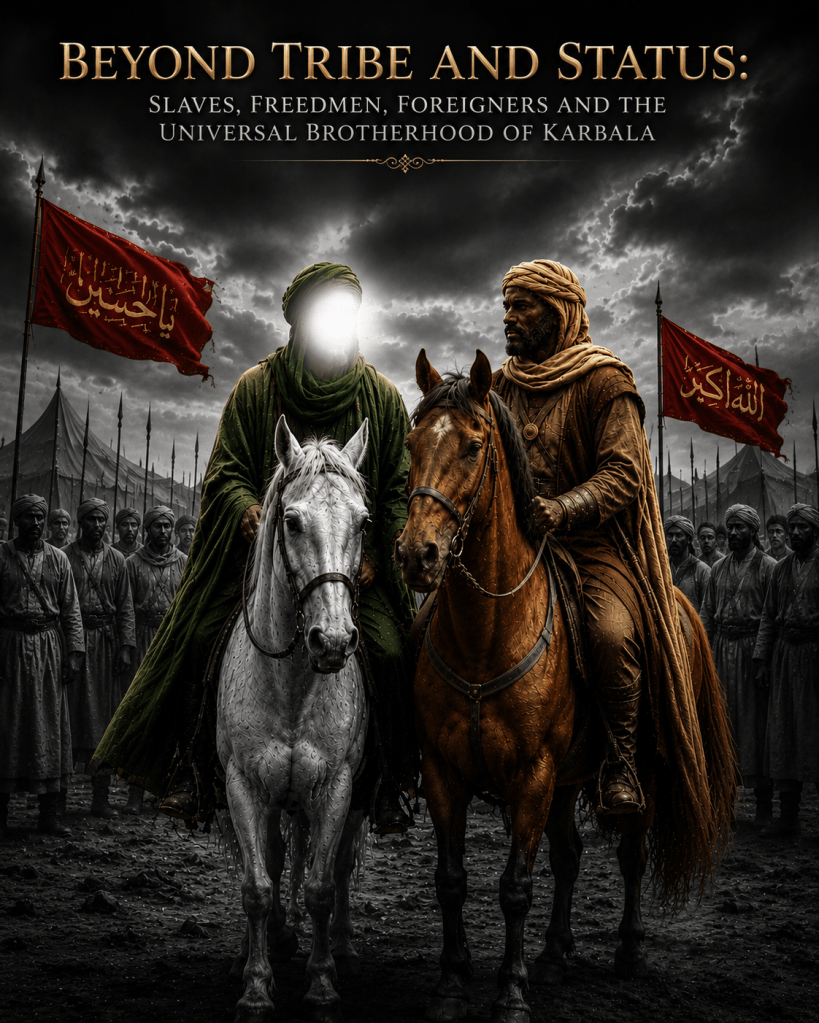
When Karbala is recalled, the popular imagination tends to fix upon the members of the Prophet’s family. The names of Husain, Abbas, Ali Akbar, Qasim, Sakina, Zainab and Ali Asghar naturally dominate the narrative. Yet to regard Karbala solely as a tragedy of the Prophet’s household is to overlook one of its most profound dimensions. Karbala was not merely a family calamity; it was a gathering of humanity in miniature. Arabs and non-Arabs, nobles and commoners, former slaves and tribal chiefs, old men and children, blacks and whites, men and women – even those who had once held differing political loyalties – stood together in defence of a single moral principle.
The battlefield of Karbala represented the ideal Islamic community as envisioned by the Prophet Muhammad. Social distinctions disappeared before the demands of conscience. The camp of Husain was defined not by race, tribe, wealth or ancestry, but by the choice to stand with truth. As Wilferd Madelung observes in The Succession to Muhammad, the confrontation at Karbala was fundamentally about the nature of legitimate authority in Islam, and those who rallied to Husain did so out of conviction rather than tribal allegiance.
This diversity becomes even more remarkable when one examines the backgrounds of those who accompanied Imam Husain. Among them were descendants of the Prophet, veterans of the early Islamic conquests, former supporters of Caliph Uthman, Persians, Turks, Africans, freed slaves, servants and even Christians. Husain M. Jafri, in The Origins and Early Development of Shi’a Islam, emphasises that the supporters of Husain represented a cross-section of early Islamic society, bound together by opposition to what they perceived as the usurpation of rightful authority. Karbala thus emerged as a universal movement whose message transcended every social and ethnic boundary.
Among the most celebrated martyrs was Jawn ibn Huwayy, the former slave of Abuzar al-Ghifari. The earliest historical sources provide only a brief mention of his presence. In al-Tabari’s Tarikh al-Rusul wa al-Muluk, which preserves the account of Abu Mikhnaf, we find the simple notation that “Huwayy” – a former slave of Abuzar – fell alongside Husain. Similarly, in Shaykh al-Mufid’s Kitab al-Irshad, the figure appears as “Juwayn”, listed among the martyrs without elaboration. By the time of the later maqtal literature, however, his story had grown considerably. Ibn Shahrashub, in Manaqib Al Abi Talib, records a poem attributed to Jawn and a famous dialogue with Imam Husain in which the Imam offers to release him from his oath of allegiance, only for Jawn to refuse. The elderly Abyssinian declared that he could not enjoy the blessings of the Ahl al-Bayt in times of peace and abandon them in times of hardship. He fought until he was martyred. In the memory of Karbala, the former slave attained a rank equal to princes and nobles.
Nor was Jawn alone. The lists of martyrs preserved in the maqtal literature mention numerous freedmen and servants. Aslam al-Turki, a Turkish freedman attached to Husain’s household, fought and died at Karbala. Qarib, a servant of Imam Husain, and Munjih, a servant associated with Imam Hasan, likewise gave their lives. Harith ibn Nabhan, the son of a servant of Hamza ibn Abd al-Muttalib, also fell among the martyrs. Their presence demonstrates that Karbala was not an aristocratic cause; it was a movement in which those occupying the lowest positions in society found themselves standing shoulder to shoulder with the descendants of the Prophet. The Maqatil al-Talibiyyin of Abu al-Faraj al-Isfahani preserves numerous such names, underscoring the social diversity of Husain’s companions.
The role of servants and slaves becomes still more striking in the narratives preserved in later maqtal and majlis traditions. These accounts may not always be recoverable from the earliest chronicles, but they reveal how Muslim memory understood the ethical significance of Karbala. As Mahmoud Ayoub demonstrates in Redemptive Suffering in Islam, the Karbala narrative evolved over time to emphasise themes of sacrificial loyalty and moral redemption, with even the humblest figures emerging as exemplars of virtue.
One such account concerns Habib ibn Mazahir, the aged companion of Imam Husain. When news of Husain’s isolation reached Kufa, Habib sought ways to evade Umayyad surveillance. According to later traditions preserved in Persian and Indo-Muslim maqtal works, it was his servant who urged him not to delay and reminded him of his duty towards the grandson of the Prophet. The social hierarchy of master and slave was momentarily reversed; the servant became the voice of conscience.
A similar episode is associated with Hurr ibn Yazid al-Riyahi. Hurr’s own transformation remains one of the most powerful moments in Islamic history. Having initially blocked Husain’s route, he ultimately abandoned worldly rank and military command to join the Imam. Later traditions relate that one of Hurr’s servants requested permission to fight alongside his master. Inspired by Hurr’s example, he too chose martyrdom over survival.
Equally moving is the account connected with Zuhair ibn Qayn. Zuhair had not always been counted among the supporters of Ali. Many traditions describe him as having sympathies with the camp known as the Shi’at Uthman – those who continued to identify strongly with the cause of Caliph Uthman. Yet when confronted with the moral challenge of Karbala, Zuhair underwent a profound transformation and became one of Husain’s most loyal defenders. As Ali Rahnema observes in his studies on Karbala memory, the narrative deliberately includes figures like Zuhair to illustrate that the appeal of Husain’s cause extended beyond partisan boundaries.
After his martyrdom, later narratives tell us, his widow sent a servant carrying a shroud to cover his body. Reaching the battlefield, the servant saw not only the body of Zuhair but also the unburied bodies of Husain, Abbas, Ali Akbar, Qasim and the other martyrs. Overcome with emotion, he returned without using the shroud. How, he reportedly asked, could he cover his master while the grandson of the Prophet remained exposed beneath the sun? Whether preserved as history or as sacred memory, the episode captures the spirit of Karbala, where personal loyalties dissolved before devotion to Husain.
The diversity of Husain’s companions extended beyond slaves and servants. Karbala also included men whose tribal, political and ethnic backgrounds differed widely. Zuhair himself demonstrates that support for Husain was not confined to those already identified with the partisans of Ali; individuals who had previously occupied different positions within the political conflicts of the early Muslim community also found themselves drawn to his cause.
Likewise, the presence of non-Arabs is significant. Men of Persian, Turkish and African origin appear throughout the lists of Karbala’s martyrs, as documented in sources such as Ibsar al-Ayn fi Ansar al-Husayn by Shaykh Muhammad Samawi, which meticulously catalogues the companions of the Imam. Their participation illustrates the cosmopolitan character of the early Islamic world. Karbala was not an Arab tribal struggle; it was a struggle over principles that resonated across ethnic boundaries.
The Christian presence in the wider Karbala tradition further reinforces this point. The stories of Christian monks, hermits and sympathisers who recognised the sanctity of Husain – whether historical or devotional – reflect a conviction deeply embedded in Muslim memory: that the truth represented by Husain could be recognised even by those outside the Muslim community. Karbala became a moral event whose significance transcended confessional boundaries.
Among the most remarkable figures connected with the women of Karbala is Fizza, the devoted servant of Fatima al-Zahra. Although often overshadowed by the towering personality of Zainab, Fizza occupies an important place in Shi’i memory. She had long served the household of Ali and Fatima and remained deeply attached to the family. While the earliest sources, such as al-Tabari and al-Mufid, focus primarily on the male martyrs and the orations of Zainab, the later maqtal and majlis traditions – particularly in Persian and Indo-Muslim devotional literature – expand considerably upon Fizza’s role.
Later traditions place her among those who endured the suffering of Karbala and the subsequent captivity. Her role did not end on the battlefield. Like Zainab, she emerged as one of the voices of resistance during the captivity of the Ahl al-Bayt. Accounts preserved in devotional literature describe her speaking boldly in the courts of Kufa and Damascus and defending the dignity of the Prophet’s family.
One particularly striking tradition recounts that while in captivity she encountered members of her own Abyssinian community. They offered assistance and protection. Yet Fizza refused to separate her fate from that of the Prophet’s household. She would not accept freedom for herself while the daughters and granddaughters of the Prophet remained prisoners. Her loyalty was not to tribe, race or ethnicity; it was to the cause of Husain and the family of Muhammad.
In this respect Fizza’s example parallels that of Zainab herself. Just as Zainab transformed captivity into a platform for resistance, Fizza transformed servitude into a form of moral leadership. Her speeches, her refusal to abandon the captives, and her steadfastness in the face of humiliation ensured that she became one of the lesser-known but deeply significant heroines of the Karbala narrative.
What emerges from all these accounts is a vision of Karbala fundamentally different from the simplistic notion of a conflict between two Arab clans. Karbala was not merely a confrontation between Banu Hashim and Banu Umayya; it was a gathering of humanity around a moral choice. Those who stood with Husain came from different races, tribes, social classes and political backgrounds. Some were descendants of the Prophet, some were former slaves, some were non-Arabs, and some had previously followed different political loyalties. Yet all were united by a shared recognition of truth.
The enduring power of Karbala lies precisely in this universality. Every section of society found representation in Husain’s camp. The noble and the humble, the free and the enslaved, the Arab and the non-Arab, the man and the woman, the elder and the child – all participated in the same struggle.
For this reason Karbala continues to inspire people across cultures and centuries. It demonstrates that dignity is not inherited through birth, wealth or status. The greatest heroes of Karbala were not necessarily those of the highest rank. Some were slaves, some were servants, some were strangers, some were women. Yet all attained greatness because they chose principle over power.
Karbala thus remains a timeless lesson that human worth is determined not by who one is, but by the choices one makes when confronted with injustice. On the plains of Karbala, the descendants of the Prophet stood beside former slaves, and together they created one of history’s most enduring testimonies to equality, loyalty and moral courage.
Bibliography
Primary Sources
Abu Mikhnaf (d. 774). Maqtal al-Husayn (preserved in al-Tabari).
Abu al-Faraj al-Isfahani (d. 967). Maqatil al-Talibiyyin. Beirut: Dar al-Ma’rifah.
Al-Mufid, Shaykh (d. 1022). Kitab al-Irshad. Translated by I.K.A. Howard. London: Muhammadi Trust, 1981.
Al-Samawi, Shaykh Muhammad (d. c. 1920). Ibsar al-Ayn fi Ansar al-Husayn. Najaf: al-Matba’ah al-Haydariyyah.
Al-Tabari (d. 923). Tarikh al-Rusul wa al-Muluk. Edited by M.J. de Goeje. Leiden: Brill, 1879-1901.
Ibn Shahrashub (d. 1192). Manaqib Al Abi Talib. Qum: Intisharat-i Allamah.
Ibn Tawus, Sayyid (d. 1266). al-Luhuf ‘ala Qatla al-Tufuf. Beirut: Dar al-Mahajjah al-Bayda’.
Modern Studies
Ayoub, Mahmoud. Redemptive Suffering in Islam: A Study of the Devotional Aspects of Ashura in Twelver Shi’ism. The Hague: Mouton, 1978.
Crone, Patricia. Roman, Provincial and Islamic Law: The Origins of the Islamic Patronate. Cambridge: Cambridge University Press, 1987.
Inloes, Amina. ‘Racial “Othering” in Shi’i Sacred History: Jawn ibn Huwayy the “African Slave”, and the Ethnicities of the Twelve Imams’. Journal of Shi’a Islamic Studies, vol. 10, no. 2, 2017.
Jafri, S. Husain M. The Origins and Early Development of Shi’a Islam. London: Longman, 1979.
Madelung, Wilferd. The Succession to Muhammad: A Study of the Early Caliphate. Cambridge: Cambridge University Press, 1997.
Rahnema, Ali. ‘Karbala and the Memory of the Martyrs’. In The Routledge Handbook of Shi’a Islam, edited by Robert Gleave. London: Routledge, forthcoming.


