Syed Ali Nadeem Rezavi
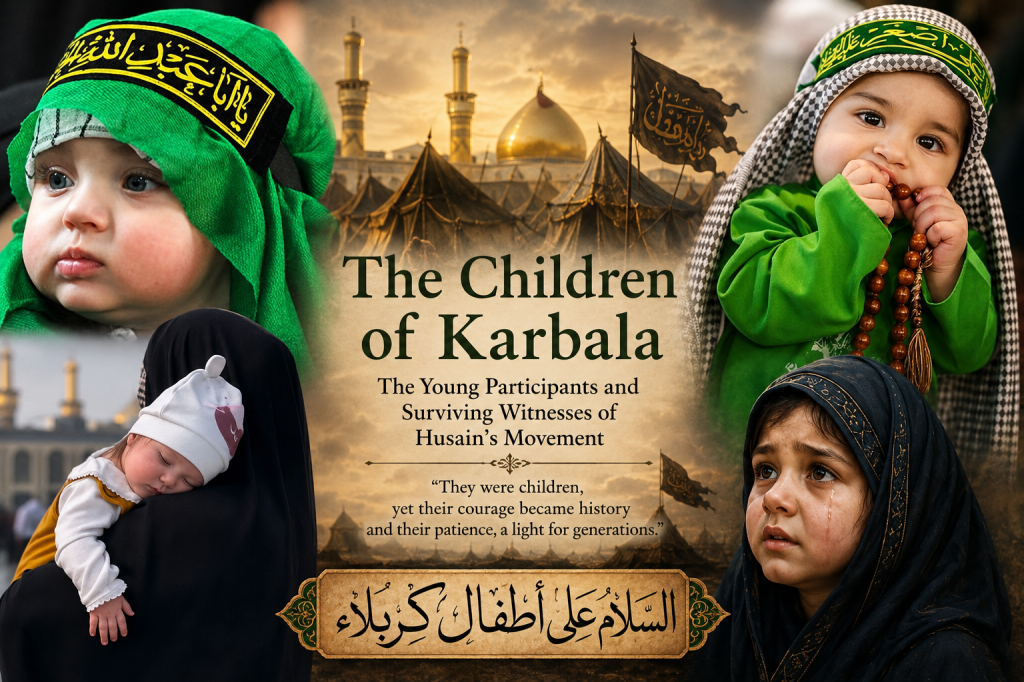
The tragedy of Karbala is indelibly marked by the memory of its adult protagonists: Imam Husain ibn Ali, his half-brother Abbas, his son Ali Akbar, and his sister Zainab, alongside the loyal companions who fell beside them on the plains of Karbala in 61 AH (680 CE). Yet the conflict’s profound impact extended far beyond these well-known figures, enveloping the youngest members of Husain’s household and retinue. Children were not merely passive observers; they were integral to the narrative, their experiences ranging from active, albeit tragic, participation on the battlefield to the profound suffering of hunger, thirst, bereavement, captivity, and displacement. Among them was an infant whose death would evolve into one of the most poignant and powerful symbols within Islamic commemorative traditions, particularly in Shi’i piety. Collectively, their stories illuminate how the events at Karbala affected multiple generations of the Prophet’s family, embedding a legacy of sacrifice and resilience that transcends age.
The children associated with Karbala occupy a singular and enduring place in Islamic historical memory. Their narratives, preserved and transmitted through a rich tapestry of early chronicles, biographical dictionaries, maqtal (martyrdom) literature, and later devotional poetry and rituals, are consistently interpreted as exemplars of courage, unwavering loyalty, profound faith, and steadfast perseverance. Over the centuries, these youthful experiences have been imbued with profound symbolic meaning, coming to represent the broader themes of righteous sacrifice, moral commitment in the face of overwhelming tyranny, and the forging of communal identity through shared remembrance.
Sources and the Construction of Historical Memory
Before examining the individual stories, it is essential to consider the historiographical landscape through which their memory has been mediated. Our knowledge of the children of Karbala derives from a layered corpus of sources. The foundational account is that of Abu Mikhnaf (d. 774 CE), whose Maqtal al-Husain was composed relatively soon after the events. Although the original text is no longer extant independently, substantial portions were meticulously preserved by the renowned historian al-Tabari (d. 923 CE) in his monumental Tarikh al-Rusul wa al-Muluk. Valuable corroborating information is also found in al-Baladhuri’s (d. 892 CE) Ansab al-Ashraf and in the comprehensive histories of Ibn Athir (d. 1233 CE) and other medieval scholars. Later compilations, such as al-Khwarizmi’s (d. 1172 CE) Maqtal al-Husain and Ibn Tawus’s (d. 1266 CE) al-Luhuf fi Qatla al-Tufuf, preserve a wealth of traditions concerning the younger victims and the surviving children of the Prophet’s household, often elaborating on the emotional and devotional dimensions of the tragedy.
Modern scholarship has approached these sources with a critical eye, seeking to distinguish between the earlier, more restrained historical reports and the later, often more elaborate, devotional elaborations. Scholars such as Wilferd Madelung, S. H. M. Jafri, Moojan Momen, and Kamran Scot Aghaie have carefully examined the transmission chains and the socio-political contexts in which these narratives were cultivated. While they acknowledge that certain details, particularly those of a highly miraculous or emotive nature, appear more prominently in later commemorative traditions, the consensus remains that the available evidence robustly indicates that children were indeed present at Karbala, that several were killed during or in immediate connection with the battle, and that the survivors played a crucial, albeit often understated, role in preserving and transmitting the memory of the event.
With this historical and literary background in mind, the children of Karbala can be thoughtfully considered through three interconnected thematic lenses: the young battlefield casualties, the infant and child victims of the conflict’s violence, and the surviving witnesses whose subsequent experiences shaped the enduring remembrance of the tragedy.
The Young Battlefield Martyrs
Among the most celebrated of these young participants is Qasim ibn Hasan, the son of Imam Hasan and the nephew of Imam Husain. Orphaned years before Karbala, Qasim was raised under the guardianship of his uncle, Husain, who became a paternal figure to him. According to traditional accounts, after witnessing the successive deaths of numerous companions and relatives on the fateful day of Ashura, the youthful Qasim repeatedly importuned his uncle for permission to enter the battlefield. In a widely transmitted tradition preserved in Karbala literature, Husain, moved by the boy’s earnestness, asked him how he regarded death. Qasim is said to have replied with a poignant metaphor, declaring that death in the path of truth was sweeter than honey. While historians exercise due caution regarding the precise historical reliability of such dialogue, the narrative has become a cornerstone of later representations of Qasim’s character, epitomising youthful devotion and an unflinching commitment to principle. Traditional accounts state that permission was eventually granted and that Qasim fought valiantly before being overwhelmed and martyred. His death remains one of the most frequently and poignantly commemorated episodes in Karbala narratives, often serving as a powerful representation of dedication to a just cause, irrespective of age.
Another son of Imam Hasan whose memory is indelibly etched in Karbala traditions is Abdullah ibn Hasan. Unlike Qasim, Abdullah is generally described as a young child who had remained in the camp with the women and other non-combatants. According to the sources, as the battle reached its violent crescendo and Husain stood largely isolated, wounded, and exhausted, Abdullah, upon witnessing his uncle’s peril, ran from the tents in a desperate act of familial loyalty. Traditional reports relate that when a soldier moved to strike Husain, the young Abdullah rushed forward to shield him. In these accounts, his arm was severed by a blow, and he was subsequently killed, falling beside his uncle. The episode is commonly presented as a profound example of spontaneous loyalty and familial devotion, a child’s instinctive love overcoming the terror of the battlefield, though details concerning his age and the exact circumstances of his death vary across different sources.
The youthful casualties also included Aun and Muhammad, the sons of Zainab bint Ali and Abdullah ibn Ja’far. Through their mother, they were direct descendants of Ali and Fatima and great-grandsons of the Prophet Muhammad. Their presence at Karbala vividly illustrates the extent to which members of the Prophet’s extended family were enmeshed in the events surrounding Husain’s movement. According to traditional accounts, the two brothers, after witnessing the martyrdom of their relatives and companions, requested permission to fight. These reports state that they entered the battle and were subsequently killed, defending their uncle. Their deaths have often been interpreted as reflecting the participation of multiple generations of the Banu Hashim in the conflict, and they feature prominently in discussions of Zainab’s anguished but resilient role in Karbala.
The descendants of Aqil ibn Abi Talib, Husain’s cousin, likewise suffered grievous losses. Among them was Muhammad ibn Abi Sa’id ibn Aqil, a young boy whose death is reported to have occurred amid the chaotic turmoil following Husain’s martyrdom. Historical traditions describe him emerging from the tents, perhaps in a state of confusion or seeking his family, and being mercilessly killed by opposing soldiers who showed no distinction between combatant and non-combatant. Although the details of this account vary, it is frequently cited as stark evidence of the vulnerability of the innocent and the indiscriminate nature of the violence meted out during the aftermath of the battle.
Closely associated with the tragedy are Muhammad and Ibrahim, the sons of Muslim ibn Aqil. Muslim, Husain’s cousin and his representative in Kufa, had been betrayed and executed in that city before the events at Karbala, after losing the local support that had initially invited Husain to Iraq. According to long-established traditions, his young sons, having been left behind or subsequently captured, later fell into captivity and were eventually martyred. While many of the more elaborate details of their story derive from later maqtal literature, the narrative became an influential and heart-rending symbol of innocence, persecution, and steadfastness in the face of overwhelming adversity. These accounts collectively demonstrate that the events of Karbala involved not only experienced adult combatants but also a significant number of younger individuals, whose stories became an inextricable part of the broader historical and moral record.
Infant and Child Victims of the Tragedy
Among the children associated with Karbala, Ali Asghar, also reverently known as Abdullah al-Radhi (the ‘Pleasing Infant’), occupies a uniquely prominent and emotive place in later tradition. He is universally identified as the infant son of Imam Husain and is commonly described as being approximately six months old at the time of Ashura. In the harrowing accounts, the severe thirst that afflicted those in Husain’s camp is emphasised, as access to the Euphrates had been restricted by Yazid’s forces for several days. Many narrations relate that Husain, cradling the parched infant in his arms, walked to the frontline and, exposing the baby to the opposing army, made a desperate appeal for water on the child’s behalf. According to the traditional narrative, rather than receiving succour, the innocent infant was instead struck by a three-pronged arrow, which pierced his neck, and he died in his father’s arms. The death of Ali Asghar became one of the most searing and significant episodes in the memory of Karbala. In later religious and literary traditions, it evolved into a powerful symbol of the suffering of the most innocent and vulnerable during the conflict, playing a central role in shaping the moral and emotional dimensions of Karbala commemoration and invoking profound empathy for the plight of Husain and his family. The deaths of children such as Ali Asghar and Muhammad ibn Abi Sa’id ibn Aqil powerfully underscore the extent to which the violence associated with Karbala affected both combatants and non-combatants, leaving no segment of the household untouched.
The Surviving Witnesses of Karbala
If Ali Asghar became a symbol of innocent victimhood in later tradition, Sakina bint Husain (also known as Ruqayya) came to represent endurance, survival, and the profound emotional toll of the tragedy. She was one of the young daughters of Imam Husain and was present during the events of Karbala. Traditional accounts describe her witnessing the deaths of her father and relatives and enduring the immense hardships that followed the battle, including the harrowing journey of captivity. Following the death of her father, Sakina was among those taken captive and paraded through Kufa and Damascus. Her experiences, particularly her poignant suffering and grief, occupy a prominent place in later devotional literature and ritual lamentation. One widely circulated, albeit historically debated, tradition recounts that while imprisoned in a cell in Damascus, she awoke crying for her father. According to this narrative, when Husain’s severed head was brought before her, she died of grief. Although historians have questioned the origins and precise historical reliability of this heart-rending account, it has nevertheless become an influential and indelible element of Karbala remembrance, encapsulating the tragedy of a child’s loss.
Alongside Sakina were other young girls of the Prophet’s household, including Fatima bint Husain and the many daughters of Husain’s brothers and cousins. Their individual stories receive less attention in many of the historical chronicles than those of the battlefield casualties; yet they remain critically important for understanding the full scope of the aftermath of Karbala. Traditional accounts describe them witnessing the burning of their tents, the looting of their possessions, and the profound hardships of captivity, while mourning the loss of their close relatives. Through their reported experiences and recollections, later generations preserved essential aspects of the Karbala narrative. Yet another survivor was Muhammad al-Bāqir, the infant son of Zainul Abedīn, who was later to emerge as the fifth Imām. He is said to have been around 5 years of age when Karbala took place.
The role of these surviving children after Ashura is often less emphasised than that of adult figures like Zainab. Nevertheless, they formed a vital part of the captive group that accompanied Zainab and Imam Ali ibn Husain Zainul Abedīn (the sole adult male survivor from Husain’s immediate family) during their journey to the courts of Kufa and Damascus. Their presence starkly highlighted the far-reaching consequences of the conflict for the Prophet’s family and contributed significantly to the profound emotional and political impact of the speeches attributed to Zainab and Zainul Abedīn in those cities. In this vital sense, the surviving children were not merely passive victims but important witnesses within the historical memory of Karbala. While those who died became central figures in narratives of ultimate sacrifice, it was the survivors who helped preserve and transmit the event’s legacy, ensuring that the tragedy was not forgotten.
Legacy and Enduring Lessons
The children associated with Karbala continue to occupy a place of profound importance in Islamic memory precisely because their stories have been interpreted as embodying a diverse and compelling range of ethical and religious values. In later tradition, Qasim ibn Hasan is often associated with conviction and courage; Abdullah ibn Hasan with spontaneous loyalty; Aun and Muhammad with commitment to principle; Muhammad and Ibrahim with perseverance; Ali Asghar with innocent suffering; and Sakina and Al-Båqir, with patience, resilience, and grief. The surviving daughters of the Prophet’s household are frequently remembered for their crucial, albeit often unheralded, role in preserving and transmitting the memory of the tragedy through oral accounts. Taken together, these narratives suggest that significance within historical and religious traditions is not necessarily linked to age, physical strength, or political authority. Although many of these figures died in childhood, their stories have remained remarkably prominent in communal remembrance for over thirteen centuries.
More than thirteen hundred years after the tragedy of Karbala, the children associated with Imam Husain continue to occupy a notable and deeply resonant place in Islamic historical and devotional traditions. They are remembered as both victims and, in some cases, active participants in a broader narrative concerning moral commitment, justice, and the imperative of remembrance. Through early historical accounts, ritual commemorations such as the Rauza-Khwani and Ta’ziya performances, and a vast body of literary and poetic representations, their diverse experiences continue to shape the interpretative lens through which the events of Karbala are understood and internalised across generations, serving as an enduring testament to the human cost of that fateful day and the timeless values it champions.
Select Bibliography
Primary Sources:
· Abu Mikhnaf (d. 774 CE). Maqtal al-Husain. Preserved in al-Tabari’s Tarikh.
· Al-Tabari, Muhammad ibn Jarir (d. 923 CE). Tarikh al-Rusul wa al-Muluk. Translated as The History of al-Ṭabarī, Vol. XIX: The Caliphate of Yazīd b. Mu‘āwiyah, translated by I. K. A. Howard. Albany: State University of New York Press, 1990.
· Al-Baladhuri, Ahmad ibn Yahya (d. 892 CE). Ansab al-Ashraf.
· Al-Khwarizmi, Muwaffaq ibn Ahmad (d. 1172 CE). Maqtal al-Husain.
· Ibn Tawus, Ali ibn Musa (d. 1266 CE). Al-Luhuf fi Qatla al-Tufuf. Translated as The Tragedy of Karbala by A. H. Qureshi. Qum: Ansariyan Publications, n.d.
· Ibn Athir, Ali ibn Muhammad (d. 1233 CE). Al-Kamil fi al-Tarikh.
Secondary Sources: (Selected)
· Aghaie, Kamran Scot, ed. The Women of Karbala: Ritual Performance and Symbolic Discourses in Modern Shi‘i Islam. Austin: University of Texas Press, 2005.
· Hyder, Syed Akbar. Reliving Karbala: Martyrdom in South Asian Memory. Oxford: Oxford University Press, 2006.
· Jafri, S. H. M. The Origins and Early Development of Shi‘a Islam. London: Longman, 1979; repr., Qum: Ansariyan Publications, 2000.
· Madelung, Wilferd. The Succession to Muhammad: A Study of the Early Caliphate. Cambridge: Cambridge University Press, 1997.
· Momen, Moojan. An Introduction to Shi‘i Islam: The History and Doctrines of Twelver Shi‘ism. New Haven: Yale University Press, 1985.
· Pinault, David. The Shiites: Ritual and Popular Piety in a Muslim Community. London: I. B. Tauris, 1992.
· Vaglieri, L. Veccia. “al-Ḥusayn b. ‘Alī b. Abī Ṭālib.” In Encyclopaedia of Islam, Second Edition, edited by P. Bearman, Th. Bianquis, C. E. Bosworth, E. van Donzel, and W. P. Heinrichs. Leiden: Brill, 1960-2007.


