Syed Ali Nadeem Rezavi
These days many people opine: what is the need to waste time in attending or organising a majlis? It’s a useless waste of time, energy and resources. Why keep hearing the same nonsense again and again? This essay, on the other hand, tries to argue contrarily, that majālis of Muharram are actually a great way of a learning process: in fact the months of mourning are in fact a period when the University of the Ahlulbayt, the Living University of Muharram, functions and provides us a cheap and easy way to educate ourselves. It is the madrasa of the Ahlulbayt where you gain much.
Let us start by asking two questions: one, what is a majlis? It is an assembly or congregation, in our case, a congregation to mourn the martyrdom of Imām Husain, the grandson of the Prophet at the hands of Yazid and his cohorts. It is a combination of elegy recitations, marsiya and nauha, and an oration. They can be held any time of the year, but specially so during Muharram and Safar, running into the first week of Rabiul Awwal. The second question is: “What is a madrasa?” Is it only a place which imparts religious education or is it much more? In its conventional sense, it is a place of learning, an institution where knowledge is transmitted through structured lessons, where teachers guide students through established curricula, and where the pursuit of understanding is undertaken with seriousness and purpose.
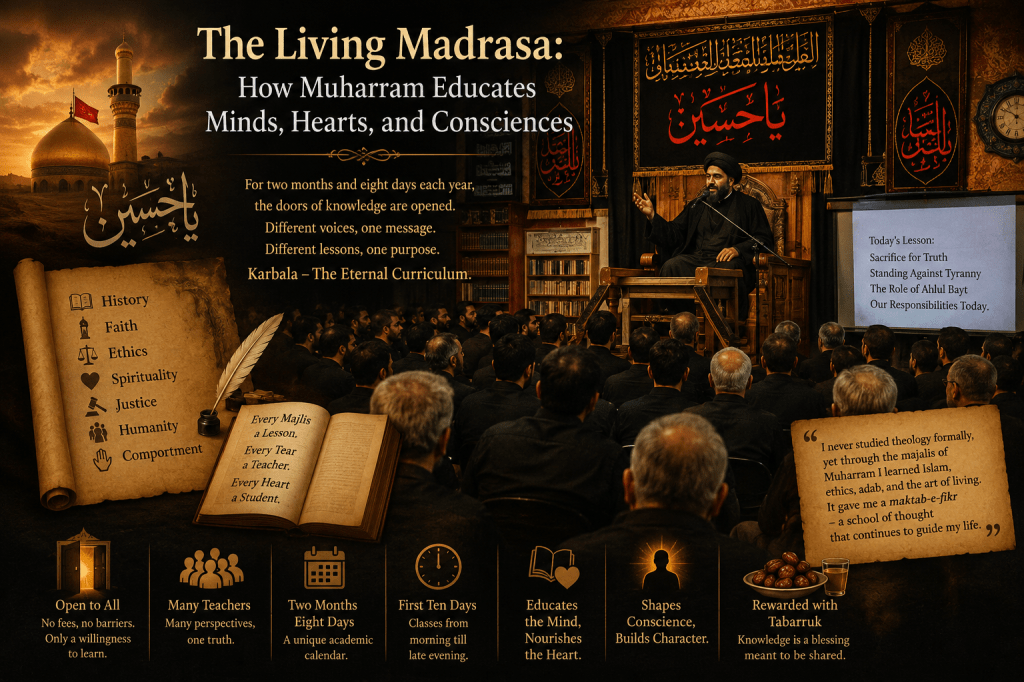
Muharram gatherings, the majalis, are another kind of madrasa, one that has educated millions for more than thirteen centuries without ever constructing a single building, without charging a single fee, and without issuing a single diploma. It operates not within lecture halls but within homes, community centres, mosques, and public spaces. Here people assemble and are taught by various experts, called Zākir. These teachers are scholars, historians, ethicists, storytellers and even professionals, who offer their knowledge freely. Its students are ordinary people who come not to earn credentials but to understand, to reflect, and to grow. Its curriculum is not a fixed syllabus but a living narrative, revolving around the story of Karbala, which reveals new meanings with each retelling. This is the Living Madrasa that this essay seeks to explore.
Most people associate Muharram with mourning, remembrance, and commemoration. While this is certainly true, it is only part of the picture. Muharram is actually a vast educational enterprise, a monumental madrasa whose classrooms extend across continents and whose curriculum has remained relevant through changing ages and societies. Every year, this remarkable institution, as stated, opens its doors for two months and eight days. During this period, people gather in homes, Imāmbādas, mosques, community centres, and even public spaces to attend majālis, gatherings of mourning and remembrance. These assemblies are often viewed simply as religious rituals, but in reality they function as dynamic classrooms where knowledge is imparted, ideas are debated, history is preserved, and moral values are cultivated. This aspect has been recognised and commented over throughout the world. The Islamic Center at New York University recognising this educational dimension, observed that Muharram majalis programmes offer “in-depth religious education, intensive courses and a lecture series that brings in the brightest minds from the Shia community,” functioning as a unique space “for learning, connection, and spiritual growth” (Islamic Center at New York University, 2024). The Imam Ali Foundation in London similarly emphasises that Muharram is not merely an emotional occasion but “a pivotal opportunity to revive religious awareness, renew allegiance to the path of the Ahl al-Bayt, and foster the development of a mission-driven individual who takes Imam Husain as a role model and exemplar” (Imam Ali Foundation, 2026). Contemporary scholarship has increasingly recognised the educational dimension embedded within such religious practices, identifying how these traditions serve as informal mechanisms for transmitting moral and spiritual values. Syed Akbar Hyder’s Reliving Karbala (2006) examines how the Karbala narrative is “appropriated and lived in the contexts and memories of South Asian Muslims and non-Muslims at different times,” demonstrating how various interpretive strategies shape social milieus and contribute to education across communities (Hyder, 2006, p. 10).
The resemblance between Muharram and a formal educational institution is not metaphorical but striking. In any madrasa or university, students are taught by different teachers who approach the same subject from diverse perspectives. A historian may explain political developments, a philosopher may explore ethical implications, and a literary scholar may examine cultural expressions. In academic institutions multiple approaches and perspectives are discussed and inculcated. Together, they provide a comprehensive understanding of a subject. The same process occurs during Muharram. In my childhood and teenage I remember listening to a known surgeon, a philosopher and a theologian in a single day: and the learning was incredible! The same subject but different approaches becomes the mantra.
Throughout the commemorative period, and particularly during the first ten days, different scholars and speakers address audiences on a wide range of themes connected with Karbala. One speaker may discuss the political conditions of the Umayyad period; another may focus on the personality and mission of Imam Husain; a third may examine the role of Abbas ibn Ali; yet another may analyse the contribution of Lady Zainab in preserving and disseminating the message of Karbala. A fourth may talk of principles of physics or even the basics of chemistry! Some focus on theology, others on history, literature, ethics, philosophy, spirituality, or contemporary social concerns. Each lecture adds a new dimension and deepens understanding, training the mind to approach complex questions from multiple angles.
In many communities, the first ten days of Muharram resemble an intensive academic programme. Majālis (plural of majlis) begin early in the morning and continue until late in the evening. Historical accounts indicate that in the early nineteenth century in Awadh, notables held mourning sessions twice daily during the first ten days, with the evening sessions being the best attended. It is not uncommon for participants to attend several gatherings in a single day, moving from one majlis to another much as students move between lecture halls during a conference or seminar. The process is cumulative: each session contributes something new, and by the end of the ten days the participant has engaged with a rich and multifaceted body of knowledge. The first ten days thus form the core curriculum, while the remaining period, up to the fortieth day (Arba’īn), serves as an extended session for deeper reflection and consolidation of the lessons learned. This pedagogical structure, with its sequenced progression from foundational narratives to advanced ethical and theological reflection, mirrors the curriculum design of traditional madrasas where students advance through progressively deeper levels of study.
What makes this educational experience unique is that its central subject is not merely a text, it is humanity itself explained through an event. Karbala functions as a living text that is read, interpreted, and revisited every year. Like all great texts, it reveals new meanings with each reading. A child listening to the story may be inspired by acts of courage and sacrifice, thus beginning the education of the heart through emotional engagement with virtue. A young person may reflect upon questions of loyalty and integrity, engaging the conscience in moral reasoning. An adult may recognise lessons concerning justice, responsibility, and moral choice, exercising the mind in political and ethical analysis. An elderly listener may discover profound insights about patience, faith, and human dignity, deepening the spiritual cultivation of the heart. The event itself remains unchanged, yet every generation finds new meanings within it, and each listener at each stage of life discovers lessons appropriate to their own spiritual and intellectual development. As Hyder (2006, p. 11) notes, “the interpretive and commemorative strategies that undergird Muharram rituals require agency on the part of individuals and communities, whether they act as storytellers, as listeners, or both.”
This emphasis on education and the pursuit of knowledge is deeply rooted in the foundational sources of Islam. The Qur’an repeatedly stresses the importance of learning, reflection, and understanding. The very first revelation to the Prophet Muhammad began with the command, “Iqra” (Read or Recite) (Qur’an 96:1-5), and the sacred text is replete with verses that urge believers to ponder the signs of God, to seek knowledge, and to recognise that those who possess knowledge are elevated in rank: “Allah will raise those who have believed among you and those who were given knowledge, by degrees” (Qur’an 58:11). The Qur’an also instructs: “And it is not for the believers to go forth [to battle] all at once. For there should separate from every division of them a group [remaining] to obtain understanding in the religion and to warn their people when they return to them that they might be cautious” (Qur’an 9:122). Likewise, the teachings of the Prophet Muhammad consistently encouraged the acquisition of knowledge, declaring it an obligation upon every Muslim, male and female. He famously stated: “Seeking knowledge is a duty upon every Muslim” (Ibn Majah, Sunan, Book of the Sunnah), and he prayed for the increase of knowledge, saying: “O God, benefit me with what You have taught me, and teach me what will benefit me, and increase me in knowledge” (Tirmidhi, Sunan, Book of Supplications). Mu’adh ibn Jabal narrated that the Prophet said: “Seeking knowledge for the sake of Allah results in fearing Allah, it is a form of worship, discussing it is an act of glorifying Allah, and being busy in its search is a form of Jihad” (Abu Nu’aym, Hilyat al-Awliya). This prophetic tradition laid the foundation for an educational ethos that would later manifest itself in various institutional forms, including the very madrasas that have shaped Islamic civilisation for centuries.
Perhaps the first formal school to systematically impart education to children and others was established during the Khilafat of Imam Ali ibn Abi Talib. Recognising the critical need for structured learning, Imam Ali organised educational circles in Kufa, where initially the girls were taught, and later, male children were also included. This pioneering institution was remarkable not only for its inclusivity but also for its comprehensive curriculum, which encompassed Qur’anic exegesis, prophetic traditions, jurisprudence, and ethics. Scholarship on the educational principles of Imam Ali has examined his systematic approach to moral and intellectual development. Research drawing on Nahj al-Balaghah, Ghurar al-Hekam, and other Shiite narrative sources has identified that from Imam Ali’s perspective, the sources of knowledge include “revelation and inspiration, reason, the heart, Fitrah, verses of nature, verses of the soul, and history,” while the instruments for acquiring knowledge include “contemplation in the Holy Qur’an, wisdom, sense, discovery and intuition, and taking lessons from the lives of the Ahl al-Bayt” (Rezayat & Rezayat, 2020, p. 15). This epistemological framework, encompassing reason, revelation, and experiential insight, anticipates the holistic education that Muharram continues to provide, engaging the mind through rational inquiry, the heart through spiritual reflection, and the conscience through moral discernment. Studies have also examined Imam Ali’s emphasis on human social responsibilities, noting that from his viewpoint, “human being is naturally a social creature and in order to live in society, they must be in contact with society,” with education playing a crucial role in realising such social responsibilities (Rezvan Khah, Salehi & Sajadi, 2020, p. 8).
It was in this very school that Habib ibn Mazahir, who would later become one of the most distinguished figures of Karbala, received his initial education. His life story, when heard by a child attending a majlis, leaves a deep moral and practical impact. According to historical sources, Habib ibn Mazahir was a companion of Imams Ali, al-Hasan, and al-Husain, and was a member of the Banu Asad tribe. He had helped Ali ibn Abi Talib in the Battle of the Camel, the Battle of Siffin, and the Battle of Nahrawan. He was also Imam Husain’s childhood friend. He studied under the direct guidance of Imam Ali and other prominent companions, excelling in his studies to such an extent that he himself became a well-known teacher in Kufa, specialising in Qur’anic sciences and jurisprudence. His life exemplifies the ideal that education in this tradition is not an end in itself but a preparation for ethical action, where the mind informs the conscience, and the conscience moves the heart to sacrifice for justice. His example introduces the listener to the fact that education has had its importance even from the very early days of Islam.
When Imam Husain, on his journey to Karbala, found himself surrounded by Yazid’s army, he wrote a letter to Habib informing him of the situation and asking him to come to his aid. Ibn A’tham in his Al-Futuh records the events of Muharram 6th, 61 AH, noting that Habib ibn Mazahir said to Imam Husain: “A part of the Bani-Asad clan lives near here; allow me to go to them and ask them to come to your aid” (Ibn A’tham, Al-Futuh, Vol. 5, pp. 91-92; Khwarizmi, Maqtal al-Husayn, Vol. 1, pp. 243-244). Traditional narratives recount that Habib received the letter while having breakfast with his wife and young son. Upon reading it, “he kissed it and tears began to flow from his eyes. His wife asked him what was wrong. Habib said: ‘I have received a letter from my master, Husain. He has asked me to join him in Kerbala. Yazid’s soldiers have surrounded him and are after his life'” (Hujjat, 2009). Habib’s wife urged him to go, saying: “Habib! Your childhood friend has called you. Your master needs your help. What are you waiting for? Go Habib, before it is too late!” Habib managed to escape Kufa with his slave, who also insisted on joining the mission, saying: “Master! You are not being fair. I have served you faithfully for years. Now, I have a chance to serve the son of Bibi Fatemah, and you are asking me to go. Why are you denying me a place in Heaven?” (Hujjat, 2009). This episode reveals how the education of the heart, love for the Prophet’s family and attachment to justice, had so thoroughly permeated Habib’s household that even his wife and servant were moved to prioritise conscience over personal safety.
When Imam Husain wrote to him, he addressed him with the epithet “Mard e Faqīh” (scholar of law), recognising his profound learning and wisdom. This title was not merely honorific; it acknowledged Habib’s deep understanding of the religious and legal dimensions of the mission he was being called to support. Also important to note is that Husain was not beckoning a warrior, but a scholar.
Traditional narratives recount that Imam Husain received Habib with great affection in Karbala, and Bibi Zainab sent her greetings to him, a gesture that moved Habib to tears, reflecting his deep devotion and the honour he felt. Upon hearing that Bibi Zainab had sent greetings to him, “he screamed out in grief and anger. He threw his turban down on to the ground. He slapped his face. Tears rolled down his cheeks as he spoke: ‘What a sad day! What has happened to the household of Bibi Fatemah? The princess! Grand-daughter of the Holy prophet, the daughter of Ali and Fatemah is sending her greetings to an ordinary person like me! Yazid! You beast, you tyrant! What have you done to the household of Bibi Fatemah?'” (Hujjat, 2009). In this moment, the intellectual formation of Habib’s mind as a Faqīh, the spiritual cultivation of his heart expressed through tears and devotion, and the moral development of his conscience manifested in grief and righteous anger all converge, demonstrating precisely the three-dimensional education that Muharram seeks to cultivate.
By responding to Imam Husain’s call, Habib ibn Mazahir embodied the ideal that true knowledge must translate into moral action, that the scholar’s place is not in the ivory tower but on the frontlines of justice. On the day of Ashura, Habib sought permission to go to the battlefield. Imam Husain initially urged him to stay, saying: “Habib, my childhood friend. Stay with me. You give comfort to me, my friend” (Hujjat, 2009). But Habib persisted, and eventually Imam Husain gave his permission. Habib ibn Mazahir rode into the battlefield and fought bravely but was finally overpowered. As he fell to the ground, an enemy soldier cut off his head, the first head to be cut off among the martyrs of Karbala (Hujjat, 2009; Ansab al-Ashraf, Vol. 3, p. 388). His head was tied to a horse and dragged across the land of Karbala. Later, in Syria, his young son Qasim followed the horse carrying his father’s head and asked to bury it, to which the severed head seemed to say: “My son Qasim, you are thinking of burying my head. What about the head of Husain on that spearhead?” (Hujjat, 2009). Habib thus gave his life at the age of seventy-five in the Battle of Karbala, and his grave lies near the shrine of Imam Husain. His life and death offer a powerful pedagogical lesson: the mind’s learning finds its fulfilment in the heart’s devotion, and the heart’s devotion finds its ultimate expression in the conscience’s willingness to sacrifice for truth. This is the education that Muharram imparts, not abstract theory but lived reality, not passive reception but active transformation.
The educational significance of this process is perhaps best understood through lived experience. I never formally studied theology in a madrasa or seminary; my academic training belonged to an entirely different discipline. Yet from childhood onwards, by attending the majālis of Muharram year after year, I acquired much of my understanding of Islam, its history, ethics, philosophy, and moral teachings. It was in these gatherings that I first encountered discussions on justice and oppression, truth and falsehood, sacrifice and responsibility, faith and reason, morality and human dignity. Through the majlis, I came to understand not only what Islam teaches but also how a human being ought to conduct himself in society. The majlis thus served as my madrasa, not a building with classrooms and fees, but a living tradition transmitted through narrative and community. I learnt that one should not bow to unjust or cruel. One has to take a principled stand, whatever the consequences. It taught me Yazid is not to be feared, but faced with conviction.
The majlis taught far more than theology. It imparted adab, the comprehensive Islamic concept of cultured behaviour and refined manners. It taught manners, civility, humility, compassion, self-restraint, respect for others, and responsibility towards society. Through the examples of the Prophet’s family and their companions, one learned how to face adversity with dignity, how to disagree without hatred, how to defend principles without arrogance, and how to remain steadfast without becoming intolerant. In many ways, the majlis became a classroom for learning the art of living itself, cultivating the heart through the example of those who embodied virtue, and educating the conscience through narratives that demanded moral reflection.
What is true in my own case is true for countless others. Across South Asia and throughout the wider Shi’i world, generations of men and women who have never attended formal theological institutions possess a substantial understanding of Islamic history, Qur’anic teachings, ethical principles, and religious practices. Their knowledge was acquired not through formal examinations or degrees but through decades of listening, reflecting, questioning, and participating in the educational culture of Muharram. Research on similar traditions has found that such practices operate as effective informal educational platforms, where participants internalise values through active engagement, and faith-based values are reinforced alongside social-moral values fostering compassion and dignity (Umayah, Abidin & Kusumawati, 2022). The majlis thus performs a remarkable function: it democratises knowledge and makes it accessible to ordinary people, bypassing the barriers of literacy, class, and institutional affiliation. It is a madrasa without entrance examinations, without tuition fees, and without graduation requirements, yet its alumni carry its lessons in their hearts for a lifetime.
In this sense, Muharram provided me with what may best be described as a maktab-e fikr, a school of thought and a framework through which to understand religion, society, and life itself. The lessons learned there extended beyond ritual and devotion. They shaped intellectual outlooks, moral sensibilities, and social attitudes. They offered a lens through which to evaluate power, justice, authority, and human conduct. Unlike formal educational systems that often compartmentalise knowledge, the maktab-e fikr of Muharram presents an integrated worldview, connecting the metaphysical with the ethical, the historical with the contemporary, and the personal with the social. It educates the mind through rigorous historical and theological inquiry, the heart through emotional engagement with the suffering and sacrifice of the Prophet’s family, and the conscience through the persistent moral questions that the narrative of Karbala raises.
There is another aspect of this institution that deserves attention. Modern education is often expensive: schools charge fees, universities demand substantial investments, seminars require registration, and specialised training programmes can be beyond the reach of ordinary people. The Madrasa of Muharram functions according to an entirely different economic model. Its only requirement is time and commitment. The student invests nothing except a willingness to attend, listen, reflect, and learn. He pays neither admission fees, nor tuition fees. Nor are there any kind of hidden charges. In this sense, it embodies the prophetic tradition that knowledge should be accessible to all, regardless of economic means.
Indeed, one might say that it is perhaps the only educational institution where the student is rewarded for attending every class. After the lecture concludes, participants are often offered tabarruk, blessed food or items. This may take the form of meals, sweets, fruit, tea, sharbat (sweet drinks), or sometimes even useful household items and other material gifts distributed in memory of the martyrs of Karbala (Grist, 1995; Pinault, 1999). Historical sources confirm that as early as the 1820s, after the Persian reading in the mourning sessions, there would be an intermission during which servants handed around sweetened rose water to the gathering of mourners (JRI Cole). Thus the student departs not only intellectually enriched and spiritually nourished, but often carrying a tangible token of blessing as well. This practice embodies the generosity that is itself a lesson in adab, teaching that knowledge is a gift to be shared, not a commodity to be hoarded.
There is a deeper significance to this practice. In most educational systems, knowledge is treated as a commodity to be purchased. In the culture of Muharram, knowledge is viewed as a blessing to be shared. The organisers seek no profit; the speakers generally address gatherings as a service to the community; and the listeners are welcomed as honoured guests rather than paying customers. The tabarruk symbolises this ethos of generosity. It is a reminder that learning, remembrance, and service are acts of devotion rather than commercial transactions. This also mirrors the prophetic tradition where the acquisition of knowledge was never meant to be a financial burden; rather, the Prophet and his household encouraged the free circulation of knowledge as a communal obligation and a spiritual merit. In this way, the Madrasa of Muharram preserves and perpetuates the prophetic educational ideal.
Looking back upon decades of attending majālis, one realises that the return on this modest investment of time has been extraordinary. For a few hours spent each day in Muharram gatherings, generations have acquired a knowledge of Islamic history, ethics, theology, literature, and human conduct that many formal educational institutions would struggle to impart. They have received not merely information but a worldview; not merely lessons but a maktab-e fikr. And at the end of each class, they have often gone home carrying tabarruk in their hands and the lessons of Karbala in their hearts. The education of the mind has been complemented by the cultivation of the heart, and both have been directed by a conscience formed through years of moral reflection.
This process resembles the methods employed in the great centres of learning that have existed throughout history. The ancient academies encouraged students to reflect upon questions of truth, justice, and virtue; medieval universities sought to combine knowledge with moral formation; and great Islamic madrasas aimed not merely to produce learned individuals but wise human beings. Muharram shares this broader understanding of education: its objective is not simply to convey information but to transform character. It is a madrasa that educates the whole person, mind, heart, and conscience, and measures its success not by examination results but by the quality of lives lived in accordance with truth and justice.
The majlis is therefore much more than a lecture. It is a forum for reflection and self-examination. Beneath every narration lies a series of profound questions: What should an individual do when confronted by tyranny? Is power more important than principle? Can truth be compromised for personal gain? What responsibilities do human beings owe to society and to their own conscience? These questions are as relevant today as they were in seventh-century Iraq. The story of Karbala provides a framework through which successive generations continue to engage with them. As Hyder (2006, p. 11) observes, “an engagement with the story of Karbala is a process through which one is simultaneously involved in shaping one’s identity in the world.” In this sense, the educational process of Muharram is not merely about acquiring information but about forming individuals who can navigate the moral complexities of their time. It is the education of the conscience, preparing individuals to recognise injustice and respond with courage.
Ultimately, the purpose of education is not merely to produce informed individuals but to cultivate wisdom and character. This is precisely what Muharram seeks to achieve. It teaches that knowledge without conscience is incomplete and that learning must lead to ethical action. The lessons of Karbala are not intended to remain confined to the majlis; they are meant to shape everyday conduct and influence the choices individuals make throughout their lives. In this way, Muharram serves as a perpetual guardian of the prophetic tradition of seeking knowledge, and it reaffirms the Qur’anic vision of an educated, conscious, and morally responsible community. The mind is informed so that the heart may be moved, and the heart is moved so that the conscience may act; this is the threefold education that the Living Madrasa of Muharram has imparted for over thirteen centuries.
For more than thirteen centuries, this extraordinary madrasa has continued its work. Every year, for two months and eight days, its classrooms reopen. During the first ten days, lectures begin in the morning and continue until late in the evening. The teachers may change, the audiences may change, and societies may change, but the central lesson remains constant. Through the remembrance of Karbala, Muharram continues to educate minds, refine hearts, preserve historical memory, and nurture a commitment to truth and justice. It remains one of humanity’s most remarkable educational institutions, a madrasa without walls whose graduates are measured not by the certificates they receive but by the values they embody. Its fees are paid only in time, its rewards begin immediately, and its ultimate degree is the cultivation of an informed mind, a compassionate heart, and a conscientious life.
Those who attend its sessions with an open heart and a seeking mind discover that the this madrasa offers an education that no formal institution can replicate, an education that does not end with graduation but continues to shape the soul long after the final majlis has concluded, echoing through the choices one makes, the principles one defends, and the legacy one leaves behind. It is, in the truest sense, an education for eternity, one that transforms mere listeners into bearers of a living tradition, and turns the remembrance of a tragedy into the foundation of a life of meaning, purpose, and unwavering commitment to justice. In a world that often separates knowledge from virtue, intellect from compassion, and learning from conscience, the this school insists that these cannot be divided, for the mind that learns without the heart is cold, the heart that feels without the conscience is unmoored, and the conscience that acts without knowledge is blind. Muharram brings them together, educating the whole human being for a life of truth, justice, and compassion. And in doing so, it fulfils the deepest purpose of all true education: to make us not merely more knowledgeable, but more fully human.
Bibliography
Primary Sources
- The Qur’an. (Verses cited: 9:122; 58:11; 96:1-5).
- Ibn Majah, Sunan, Book of the Sunnah. (Tradition: “Seeking knowledge is a duty upon every Muslim”).
- Tirmidhi, Sunan, Book of Supplications. (Tradition: “O God, benefit me with what You have taught me…”).
- Abu Nu’aym, Hilyat al-Awliya. (Tradition of Mu’adh ibn Jabal on seeking knowledge).
- Ibn A’tham, Al-Futuh, Vol. 5, pp. 91-92. (Account of Habib ibn Mazahir in Karbala).
- Khwarizmi, Maqtal al-Husayn, Vol. 1, pp. 243-244. (Account of Habib ibn Mazahir’s actions).
- Ansab al-Ashraf, Vol. 3, p. 388. (Biographical information on Habib ibn Mazahir).
- Nahj al-Balaghah. (Collection of sermons, letters, and sayings of Imam Ali).
- Ghurar al-Hekam. (Collection of sayings of Imam Ali).
Secondary Sources
- Hujjat, Stanmore. (2009). “Habib ibn Mazahir.” Traditional narrative account of Habib’s life, escape from Kufa, arrival in Karbala, and martyrdom. Available at: https://hujjat.org/habib-ibn-mazahir/.
- Hyder, Syed Akbar. (2006). Reliving Karbala: Martyrdom in South Asian Memory. New York: Oxford University Press.
- Imam Ali Foundation, London. (2026). “General Recommendations for Leaders and Staff of Islamic Centers and Institutions on the Occasion of Muharram 1447 AH.” Guidance document recognising Muharram’s role in education and religious awareness.
- Islamic Center at New York University. (2024). “ICNYU Shia Chaplaincy & Muharram Majlis Campaign.” Description of Muharram programmes and educational initiatives.
- Pinault, David. The Shiites, 2nd ed. Princeton: Markus Wiener Publishers, 2011.
- Rezayat, Ghulam Hussein & Rezayat, Fatemeh. (2020). “Epistemology from Imam Ali’s Point of View with Emphasis on Educational Implications.” Research in Islamic Education Issues 28, no. 46, pp. 5–30.
- Rezvan Khah, Salman; Salehi, Akbar; Sajadi, Seyed Morteza. (2020). “Human Social Responsibilities from the Perspective of Imam Ali, with Emphasis on Nahj al-Balaghah and the Role of Education in Their Realization.” Islam and Social Studies 8, no. 1 (2020): 5–36.
- Juan RI Cole. Roots of North Indian Shiism in Iran and Iraq: Religion and State in Awadh, 1722–1859. Berkeley: University of California Press, 1988Historical accounts of Muharram mourning sessions in Awadh during the early nineteenth century.
- Umayah, Rina Dewi; Abidin, Ahmad Zainal; Kusumawati, Ita Rahmania. (2022). “Basmalah as a Protection for Bala’: The Tradition of Writing Basmalah Every 1 Muharram at Islamic Boarding Schools Al-Mahrusiyah Lirboyo Kediri.” Jurnal At-Tibyan 7, no. 2 (2022)..
- Hollister, John Norman. The Shi’a of India. Reprint edition. New Delhi: Oriental Books Reprint Corporation (distributed by Munshiram Manoharlal), 1979.
- S Athar Abbas Rizvi, A Socio-Intellectual History of the Isna Ashari Shi’is in India, Canberra, 1986 (2 volumes)
- Vernon James Schubel, Religious Performance in Contemporary Islam: Shi’i Devotional Rituals in South Asia.
Schubel explicitly analyses the majlis as a mechanism through which religious knowledge, historical memory, and communal values are transmitted across generations. He shows how listeners learn theology, history, ethics, and social norms through participation in Muharram rituals rather than through formal religious schooling. His work comes very close to viewing the majlis as a pedagogical institution. - T. P. A. Cooper, “‘Live has an atmosphere of its own’: Azadari, ethical atmospheres and mediation in Shi’i Muslim London”, Journal of the Royal Anthropological Institute (2022). Cooper examines the majlis as a space of ethical formation where listeners learn how to feel, think, and behave as moral subjects.
- Michael Fischer and Mehdi Abedi,
Debating Muslims: Cultural Dialogues in Postmodernity and Tradition.
Their discussions of Shi’i discourse emphasise the majlis as a setting where knowledge is collectively produced and transmitted.


