Syed Ali Nadeem Rezavi
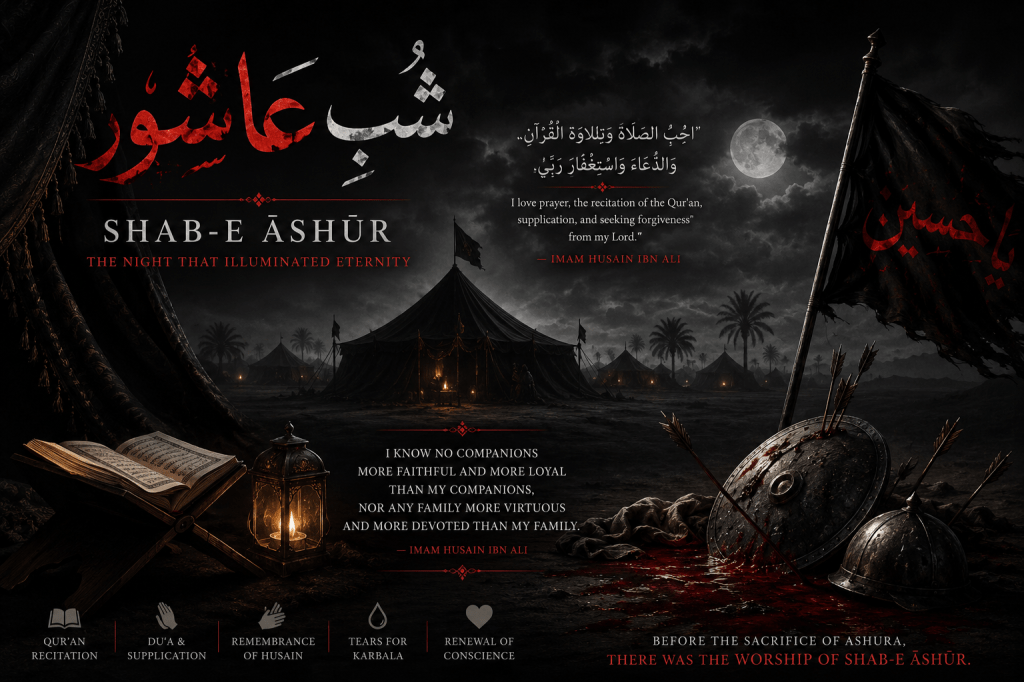
“I love prayer, the recitation of the Qur’an, supplication, and seeking forgiveness from my Lord.”
— Imam Husain ibn Ali (as)¹
The first nine days of Muharram have permitted us to journey through numerous dimensions of Imam Husain’s movement. We have reflected upon the Prophet’s Household, the companions, the women of Karbala, the children, the universal brotherhood that transcended tribe and race, the thirst of the camp, the message of Husain, and the enduring influence of Karbala upon India and the wider world. Yet all these themes converge in one extraordinary night. Shab-e Āshūr, the night preceding the tenth of Muharram, represents the moment in which every strand of the Karbala narrative coalesces before history changes forever.
If the Day of Ashura represents the outward struggle between truth and tyranny, then Shab-e Āshūr reveals the spiritual foundations upon which that struggle rested. It was not a night of military strategy or political negotiation. It was a night of worship, introspection, farewell, and absolute trust in God. Before the swords were unsheathed, and before the blood of the martyrs was shed, there was prayer. Before sacrifice came surrender to the Divine.²
The Request for Respite
As evening descended upon Karbala on the ninth of Muharram in the year 61 AH (680 CE), the forces of Yazid, commanded by Umar ibn Sa’d, prepared to launch their assault. Imam Husain sent his brother Abbas to request that the battle be postponed until the following morning. The reason he gave has been preserved by the earliest authorities, including Abu Mikhnaf, al-Tabari, al-Baladhuri, Dinawari, and Shaykh al-Mufid.³
He declared:
“I love prayer, the recitation of the Qur’an, supplication, and seeking forgiveness from my Lord.”⁴
Few statements better summarise the purpose of Husain’s movement. Had Karbala been a struggle for political authority, the final night would have been devoted entirely to military preparations. Instead, Husain desired to stand before his Lord. His revolution was therefore born from worship before it was expressed through sacrifice.⁵
The Camp of Worship
The chronicles describe the camp of Husain throughout that night as echoing with the recitation of the Qur’an, invocations, and prayers. The sounds rising from the tents resembled the continuous humming of bees.⁶ Men who knew they would not survive the following day did not spend the night lamenting death. They spent it preparing to meet God.⁷
The scene is one of the most remarkable in all religious history. Death had become certain, yet fear had disappeared. The serenity of Husain’s camp stood in sharp contrast to the anxiety of the vastly larger army surrounding it. Karbala teaches that courage is not the absence of danger but the presence of certainty born of faith.⁸
The Gathering and the Offer of Freedom
Perhaps the most moving episode of Shab-e Āshūr occurred when Imam Husain gathered his companions and family. Having praised God, he informed them that the enemy desired only his own life. Under the cover of darkness, anyone who wished to depart was entirely free to do so. According to many reports, he ordered the lamps extinguished so that no one would feel embarrassed to leave.⁹
History has rarely witnessed such moral freedom. Husain neither compelled nor emotionally manipulated anyone into remaining with him. He demanded no oath of allegiance. Every individual was left to follow the dictates of conscience.¹⁰
It was then that one of the greatest testimonies to loyalty in human history unfolded.
The Companions’ Response
Muslim ibn Awsaja declared that he would never abandon the grandson of the Prophet.¹¹
Habib ibn Muzahir renewed his pledge with complete serenity.¹²
Zuhayr ibn al-Qayn, who only days earlier had hesitated even to meet Husain, declared that even if he were killed, burnt, restored to life, and killed repeatedly, he would never forsake him.¹³
Abbas ibn Ali reaffirmed that life without Husain possessed no meaning.¹⁴
It was on this same night that Imam Husain uttered the famous tribute which has echoed through the centuries:
“I know no companions more faithful and more loyal than my companions, nor any family more virtuous and more devoted than my family.”¹⁵
No commander has ever paid a greater tribute to those who stood beside him.¹⁶
The Women of Karbala
The women of the Prophet’s household likewise spent the night preparing for an unimaginable future. Zainab bint Ali, Umm Kulthum, Rubab, Layla, Sukayna, and the other women knew that dawn would change everything. Yet nowhere do the sources portray panic or despair. Instead, they reveal extraordinary composure sustained by faith.¹⁷
It was during this night that Imam Husain prepared his sister Zainab for the immense responsibility that awaited her. The battlefield would end on Ashura, but Karbala itself would survive only because Zainab would carry its message into Kufa and Damascus. The sermons she would deliver after the massacre transformed military defeat into moral victory. Without Zainab, the sacrifice of Ashura might have remained confined to the plains of Karbala. Through her courage, it became the conscience of history.¹⁸
The Preservation of the Imamate
Shab-e Āshūr was also the night during which the future of the Imamate was secured. Imam Ali Zain al-Abidin, weakened by illness and therefore unable to participate in the battle, received from his father the sacred trust of the Prophet’s household. Shi’i tradition relates that the Prophet’s arms, books, and other emblems of spiritual authority were entrusted to him.¹⁹ While the following day would witness the martyrdom of Husain, it would not extinguish the light of Divine guidance. The chain of the Imamate would continue through Imam Sajjad, ensuring that the spiritual legacy of Karbala remained alive.²⁰
The Children
No account of this sacred night is complete without recalling the children.
Ali Akbar awaited the dawn with complete submission.²¹
Qasim ibn Hasan anticipated the opportunity to fulfil his pledge. It was on this night that he opened the of his father and read his request: be my sacrifice on my brother.²²
Aun and Muhammad, the sons of Zainab, rested beside their mother and requesting her to allow them to sacrifice their lives on their uncle.²³
Little Sakina remained close to her father.²⁴
The six-month-old Ali Asghar slept peacefully, unaware that history would remember him as the youngest martyr of Karbala.²⁵
Poetry and Historical Memory
The emotional memory of these final hours has been preserved not only in chronicles but also in the devotional literature of Islam. Among the most moving Urdu nauhas is one which imagines Lady Rubab, affectionately remembered as Bano, cradling Ali Asghar in her arms on the eve of Ashura:
Kahtīn thīn Bāno Shab-e Āshūr, Asghar so raho,
Raat bhar kī zindagī hai, aao dilbar so raho.
“Bano would say on the Night of Ashura: Asghar, go to sleep. Only one night’s life remains. Come, my beloved, sleep.”²⁶
The succeeding verses become progressively more poignant. She embraces him tightly because tomorrow her lap will be empty. Today he sleeps in his mother’s arms; tomorrow he will rest beneath the sands of Karbala. She knows that the dust of Karbala will become his cradle.²⁷
Whether these precise words were ever uttered is beside the point. The nauha does not claim to be documentary history. It belongs to the realm of historical memory. Chronicles establish what occurred. Poetry enables successive generations to feel what those events meant. The historian and the poet therefore perform complementary tasks. One preserves the facts; the other preserves the tears.²⁸
The Meaning of Freedom
Shab-e Āshūr also offers one of the clearest lessons about the meaning of human freedom. Every individual who remained with Husain did so voluntarily. There was no promise of victory, no expectation of survival, and no worldly reward. Their choice sprang entirely from conscience.²⁹
For this reason, Karbala continues to resonate far beyond confessional boundaries. It demonstrates that moral greatness lies not in the certainty of success but in the willingness to uphold truth when success appears impossible.³⁰
Contemporary Observance
This explains why Shab-e Āshūr remains a living institution throughout the Muslim world. In Iraq, Iran, India, Pakistan, Lebanon, and countless other lands, believers remain awake throughout the night. They recite the Qur’an, listen to majālis, remember the martyrs, recite Ziyārat-e Āshūr, offer supplications and elegies, and spend the hours in reflection.³¹ Their purpose is not merely to commemorate a historical anniversary but to accompany Husain spiritually during the final night of his earthly life. Every generation seeks to spend, in its own humble way, the night that Husain spent in prayer.³²
Contemporary Relevance
For contemporary society, Shab-e Āshūr remains profoundly relevant. It teaches that resistance to injustice must be rooted in moral discipline. Political courage without spirituality easily becomes vengeance; spirituality without concern for justice becomes escapism. Husain united both. His worship gave meaning to his struggle, and his struggle gave practical expression to his worship.³³
Conclusion
As dawn finally approached, every farewell had been spoken. Every prayer had been offered. Every soul had surrendered itself to God. The battle had not yet begun, but its outcome had already been determined in the hearts of those who stood with Husain.
Shab-e Āshūr teaches that history is not changed only on battlefields. It is first transformed in the silence of prayer, in the freedom of conscience, in the embrace of a mother bidding farewell to her child, in the loyalty of companions who refuse to abandon their leader, and in the certainty of a family that places God’s pleasure above life itself.³⁴ Every event of the following day was born during the preceding night. The courage of Abbas, the sacrifice of Ali Akbar, the martyrdom of Ali Asghar, the steadfastness of Zainab, the survival of Imam Zain al-Abidin, and ultimately the immortality of Husain’s message all emerged from the spiritual preparations of Shab-e Āshūr.³⁵
It is therefore not merely the night before Ashura. It is the night in which eternity quietly descended upon Karbala. When dawn broke on the tenth of Muharram, the battle had not yet begun, but victory had already been won. The swords of the Umayyads could conquer bodies, but during the long hours of Shab-e Āshūr they had already lost the struggle for the human soul. That is why, after nearly fourteen centuries, believers still keep vigil on this blessed night. They know that before there was the sacrifice of Ashura, there was the worship of Shab-e Āshūr, and before there was the triumph of martyrdom, there was the triumph of faith.³⁶
References
- This statement is recorded in multiple early sources, including al-Tabari, Tarikh al-Rusul wa al-Muluk, vol. 5, p. 419; and al-Baladhuri, Ansab al-Ashraf, vol. 3, p. 182.
- M. Ayoub, Redemptive Suffering in Islam: A Study of the Devotional Aspects of Ashura in Twelver Shi’ism (The Hague: Mouton Publishers, 1978), p. 98.
- Abu Mikhnaf, Maqtal al-Husain, ed. and trans. I.K.A. Howard as The History of al-Tabari: The Caliphate of Yazid (Albany: State University of New York Press, 1990), vol. 19, p. 154; al-Tabari, Tarikh, vol. 5, p. 420; al-Baladhuri, Ansab, vol. 3, p. 183; al-Dinawari, al-Akhbar al-Tiwal (Cairo: Dar Ihya al-Kutub al-Arabiyya, 1960), p. 259; Shaykh al-Mufid, Kitab al-Irshad, trans. I.K.A. Howard (London: Muhammadi Trust, 1981), p. 322.
- Al-Tabari, Tarikh, vol. 5, p. 420; al-Mufid, al-Irshad, p. 322.
- S.H.M. Jafri, The Origins and Early Development of Shi’a Islam (London: Longman, 1979), p. 200.
- Al-Tabari, Tarikh, vol. 5, p. 421; al-Mufid, al-Irshad, p. 324.
- Ayoub, Redemptive Suffering, p. 102.
- T. al-Shibli, Karbala and the Imam’s Message (Qum: Ansariyan Publications, 2005), p. 87.
- Al-Tabari, Tarikh, vol. 5, p. 421; al-Baladhuri, Ansab, vol. 3, p. 184.
- Jafri, Origins and Early Development, p. 202.
- Al-Mufid, al-Irshad, p. 325.
- Abu Mikhnaf, Maqtal, trans. Howard, p. 156.
- Ibid., p. 157.
- Ibid., p. 158.
- Al-Tabari, Tarikh, vol. 5, p. 421; al-Mufid, al-Irshad, p. 325.
- Jafri, Origins and Early Development, p. 203.
- L. Takim, The Heirs of the Prophet: Charisma and Religious Authority in Shi’ite Islam (Albany: State University of New York Press, 2006), p. 78.
- Ayoub, Redemptive Suffering, p. 115; also see Z. Ali, The Role of Zainab in the Karbala Narrative (London: Islamic College, 2010), p. 45.
- Al-Mufid, al-Irshad, p. 326; H. Modarressi, Crisis and Consolidation in the Formative Period of Shi’ite Islam (Princeton: Darwin Press, 1993), p. 28.
- Jafri, Origins and Early Development, p. 205.
- Al-Mufid, al-Irshad, p. 328.
- Ibid., p. 329.
- Takim, Heirs of the Prophet, p. 80.
- Ayoub, Redemptive Suffering, p. 110.
- Al-Tabari, Tarikh, vol. 5, p. 430.
- This nauha appears in the South Asian marsiya tradition; for discussion, see S.A. Hyder, Reliving Karbala: Martyrdom in South Asian Memory (New York: Oxford University Press, 2006), p. 92.
- Hyder, Reliving Karbala, p. 94.
- See M. Fischer, Iran: From Religious Dispute to Revolution (Cambridge: Harvard University Press, 1980), pp. 120-125, on the relationship between historical chronicle and poetic memory in Shi’i tradition.
- Shibli, Karbala and the Imam’s Message, p. 92.
- Ayoub, Redemptive Suffering, p. 210.
- See N. Keddie, Iran: Religion, Politics and Society (London: Frank Cass, 1980), p. 45; also Hyder, Reliving Karbala, p. 112.
- Fischer, Iran, p. 128.
- Jafri, Origins and Early Development, p. 206; also see Ayoub, Redemptive Suffering, p. 198.
- Takim, Heirs of the Prophet, p. 84.
- Modarressi, Crisis and Consolidation, p. 32.
- Ayoub, Redemptive Suffering, p. 212; Shibli, Karbala and the Imam’s Message, p. 98.


