Syed Ali Nadeem Rezavi
Author’s Note
The observations presented in this essay draw upon the work of a number of distinguished scholars who have explored the history of Muharram, Karbala, and the traditions of the Ahl al-Bayt in the Indian subcontinent. Among the most important of these are Professor Athar Abbas Rizvi’s pioneering study Intellectual Ithna’asharis of India and Allama Saiyid Sibtul Hasan’s monumental Tarikh-e-Azadari, as well as his Hindu Qaum aur Azadari. The discussion also incorporates insights derived from several of my own research papers presented over the years at national and international conferences dealing with Muharram, Shi’ism, the history of the Ahl al-Bayt, and the cultural interactions between Islam and the Indian subcontinent.
As this article is intended for the general reader and those unfamiliar with the subject, detailed references have been omitted in favour of a more accessible narrative. Readers interested in pursuing the subject further may consult the works mentioned above and the growing body of scholarship devoted to Muharram and the history of the Ahl al-Bayt in South Asia.
••••••••••••••••••••••••••••••••••••••••••••••••••••••••••
The Crescent Over India
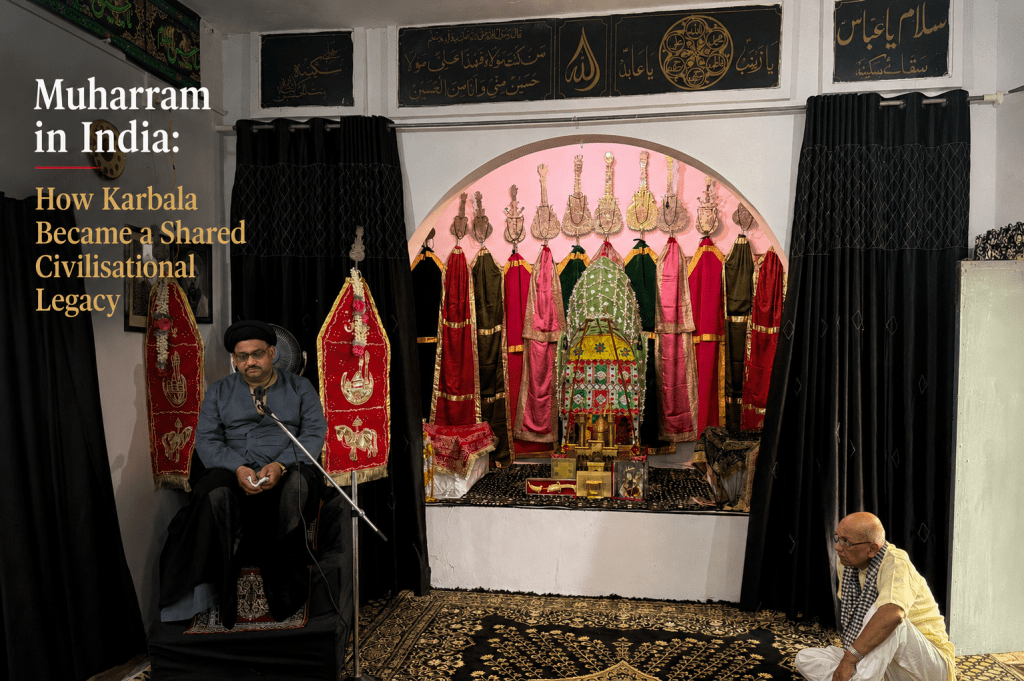
As the crescent of Muharram appears over India and a new Islamic year begins, millions once again turn their thoughts towards Karbala. Across the country, from Kashmir to Kerala, from Gujarat to Bengal, gatherings are held in memory of Imam Husain ibn Ali, the grandson of the Prophet Muhammad, who was martyred on the plains of Karbala in 680 CE. Majlis assemblies are organised, elegies are recited, alams are raised, and processions move through streets that have witnessed these commemorations for centuries.
Yet for the Indian subcontinent, Muharram is not merely the remembrance of a tragedy that occurred in distant Iraq. It is also the story of a profound historical relationship between India and the memory of Karbala. Over more than thirteen centuries, the tragedy of Imam Husain became woven into the cultural, emotional, literary, and spiritual life of South Asia in a manner unparalleled anywhere else in the world.
The commemoration of Muharram in India represents one of the most remarkable examples of how a historical event from the early Islamic period was transplanted, adapted, and transformed within a non-Arab cultural milieu. What began as a specific remembrance of a particular tragedy evolved into a shared civilisational legacy that transcended religious, linguistic, and regional boundaries. The story of Husain ceased to be merely a narrative of Islamic history and became instead a universal moral parable, accessible to all who valued justice, truth, and resistance against oppression.
India in the Imagination of Early Islam
One of the most intriguing traditions associated with Karbala concerns Imam Husain himself. According to accounts preserved within the historical memory of the followers of the Ahl al-Bayt, when the forces of Yazid blocked his movement and demanded submission, Imam Husain expressed a desire to leave the territories under Umayyad control and proceed towards Hindustan. Whether one accepts this account literally or regards it as a later memory, the reference itself is revealing. It suggests that India was already known to the family of the Prophet as a land beyond the reach of Umayyad authority, a place associated with refuge and possibility.
The mention of Hindustan was not accidental. Long before the rise of Islam, India and Arabia had been connected through trade and maritime networks. Indian merchants regularly sailed to Arabian ports, while Arab traders frequented the western coast of India. Indian textiles, spices, perfumes, medicines, and luxury goods were familiar in Arabia. Traditions preserve references to Indian products that were known and appreciated during the Prophet’s lifetime. Merchant communities from the Indian coast had established themselves in various parts of the Arab world, and commercial caravans moved regularly between the two regions. By the seventh century, India occupied a recognised place in the geographical and cultural imagination of Arabia.
Indian traditions preserve memories of even closer connections with the earliest period of Islam. The well-known story of Cheraman Perumal, the ruler of Kerala who is said to have travelled to Arabia and embraced Islam during the lifetime of the Prophet, continues to occupy an important place in the historical memory of the Malabar coast. The mosque associated with his name at Kodungallur remains a symbol of these early links.
Likewise, South Indian traditions remember figures such as Thameemul Ansari, whose shrine is located near Chennai, and Syed Ukkashah Oliyullah of Portonovo in Tamil Nadu, who is believed to have been among those who witnessed the signs of prophethood on Muhammad’s person. Whether every detail of these traditions can be historically verified is less important than the fact that they reflect a deeply rooted belief that India was connected to Islam from its earliest days.
The Zutts and Early Support for the Ahl al-Bayt
The relationship between India and Karbala became even more significant after the martyrdom of Imam Husain. In the years following the tragedy, support for the Ahl al-Bayt emerged in many regions of the Islamic world. According to traditions preserved in South Asia, some of the earliest responses in favour of Imam Husain and against Yazid came from Indian communities living in West Asia.
Arabic sources refer to groups known as the Zutts (Jat), generally understood to have been communities of Indian origin, many of whom are associated with Jat groups from the north-western regions of the subcontinent. These Zutts had settled in Iraq, Syria, and other parts of the Middle East through trade, migration, and military service. According to traditions preserved in Muharram literature and historical memory, when the surviving members of the Prophet’s family, led by Hazrat Zainab and Imam Zain al-Abidin, were being taken captive towards Damascus after Karbala, contingents of Zutts attempted to assist them. Some accounts also speak of Brahmin groups joining these efforts. Many are said to have been killed by the forces of Yazid before they could succeed.
Whether every detail of these accounts can be independently verified is a matter for historians to examine, but their survival across centuries is itself significant. They reveal that generations of Indians remembered themselves as having stood with the family of the Prophet in one of the darkest moments of Islamic history.
This memory of solidarity with the oppressed, of choosing the side of justice even at great personal risk, became a foundational element of the Indian Muharram tradition. It established a template that would be repeated across centuries: Indians, regardless of their own religious affiliations, finding in the tragedy of Karbala a cause worthy of their sympathy and support.
The Husaini Brahmins: A Living Legacy
This memory survives most visibly in the remarkable tradition of the Husaini Brahmins. Found particularly in Punjab, Kashmir, and parts of northern India, these communities have long maintained that their ancestors fought and died in support of Imam Husain and his family. Though they remain Hindu by faith, they regard Husain with extraordinary reverence and affection. Their traditions speak of sacrifice, loyalty, and devotion to the cause of Karbala. Whether approached through the lens of history, anthropology, or cultural memory, the Husaini Brahmins represent one of the most remarkable examples of Karbala’s ability to transcend religious boundaries and become a universal symbol of righteousness.
The Husaini Brahmins have preserved their own distinctive rituals and narratives. They participate in Muharram processions, recite elegies in their own languages, and maintain family traditions that connect them to the events of Karbala. Their continued presence in the Muharram landscape of India challenges any simplistic understanding of the commemorations as exclusively Muslim. They demonstrate instead that the memory of Husain belongs to all who identify with his cause.
India as a Sanctuary for the Prophet’s Family
The Indian connection with the Ahl al-Bayt did not end with Karbala. During the Umayyad and Abbasid periods, members of the Prophet’s family and their supporters frequently faced persecution. Many sought refuge in distant lands beyond the direct reach of imperial authority. South Asia emerged as one of the most important destinations for these migrants.
Traditions preserved in Sindh remember Raja Dahir as among the earliest rulers to extend protection to refugees connected with the family of the Prophet. Whether all such traditions can be reconstructed in precise historical detail, they nevertheless reflect a long-standing memory that India became a sanctuary for those associated with the Ahl al-Bayt during periods of political persecution.
Over the centuries, descendants of the Prophet settled across different regions of the subcontinent. Their presence left an enduring imprint upon the religious and cultural landscape of South Asia. One important reminder of these early migrations survives at Samana in present-day Patiala district of Punjab. There, local tradition associates an ancient shrine with an Imamzada believed to have been a son of Imam Ali al-Rida, or Imam Raza, who migrated to India to escape political persecution. Whatever the precise details of his journey, the shrine stands as a powerful symbol of the historic links that connected India with the family of the Prophet. Similar traditions and shrines can be found across Sindh, Punjab, Awadh, Bengal, Kashmir, and the Deccan, demonstrating how India became not only a land that remembered Karbala but also a land that sheltered those who carried its memory.
The presence of these shrines across the subcontinent created a sacred geography of Karbala in India. They became centres of pilgrimage, sites where the memory of the Ahl al-Bayt was preserved and transmitted. They also became points of contact between Muslim and non-Muslim communities, as many of these shrines attracted devotees from diverse religious backgrounds.
The Transformation of Muharram in India
It was through these centuries of interaction that Muharram acquired its uniquely Indian character. The remembrance of Karbala gradually absorbed local artistic, literary, and cultural forms without ever losing its essential message. Indeed, it may be argued that nowhere outside Iraq and Iran did Muharram develop such a rich and diverse cultural expression as it did in South Asia.
This transformation occurred at multiple levels. In the realm of material culture, new forms of commemorative objects emerged. In the realm of literature, new poetic genres were developed. In the realm of ritual, new practices were incorporated. In each case, the result was not a dilution of the Karbala message but its enrichment through engagement with Indian cultural traditions.
The Emergence of the Tazia: A Crucial Distinction
The most visible example of this process was the emergence of the tazia, and here it is essential to make a critical historical distinction that has often been overlooked. The eminent scholar Allama Saiyid Sibtul Hasan, in his monumental Tarikh-e-Azadari, was the first to point out that the tazia was introduced to India by Amir Timur (Tamerlane) following his invasion in 1398 CE. According to this tradition, Timur brought with him a sacred relic—an actual wooden tazia or representation associated with the Ahl al-Bayt, which he introduced into the subcontinent. This relic was a physical object of veneration, connected directly to the family of the Prophet and their memory.
However—and this is where the scholarly contribution of Allama Sibtul Hasan becomes especially significant—what Timur introduced was a relic, a sacred artefact brought from West Asia. The tazia as it subsequently developed and became known across India was something entirely different. It was not a relic brought from elsewhere but a direct import from the local indigenous cultural tradition of India.
The Indian tazia, constructed from bamboo, paper, wood, metal, and other locally available materials, drew its forms and structures not from West Asian prototypes but from the ceremonial and processional traditions that had long existed in the subcontinent. Its towering, multi-tiered structures bore a striking resemblance to the great rathas (chariots) of eastern India, the temple processional cars that had been part of Hindu religious practice for centuries. Its construction techniques, its ornamental styles, and its processional use all reflected indigenous artistic and ritual traditions.
This distinction is crucial for understanding the true nature of Muharram in India. The relic brought by Timur remained a sacred object, but it was the indigenous adaptation—the Indian tazia—that became the central symbol of Muharram across the subcontinent. The local artisans who built these tazias were not replicating West Asian forms; they were drawing upon their own cultural traditions, their own inherited skills, and their own aesthetic sensibilities to create something that was simultaneously a symbol of Karbala and an expression of Indian civilisation.
In many regions, the forms these tazias assumed reflected indigenous artistic traditions with remarkable fidelity. Some resembled ceremonial chariots associated with local religious practices. Certain tazias consciously echoed the architectural forms of the great rathas of eastern India. The magnificent tazias of Lucknow, the elaborate structures of Bengal, the distinctive forms of the Deccan, each reflected local artistic traditions while serving the universal purpose of commemorating Imam Husain.
This adaptation did not weaken the message of Karbala. Rather, it enabled that message to be expressed through a cultural language familiar to Indian society. The tazia became a bridge between worlds, a symbol that could be embraced by Muslims for its connection to Karbala and by non-Muslims for its resonance with their own cultural traditions. It was through this indigenous form that Muharram truly became an Indian tradition, rooted not in foreign importation but in local creativity and cultural synthesis.
Allama Sibtul Hasan’s insight thus illuminates a fundamental truth about the Indian Muharram tradition: it was not merely transplanted from elsewhere but was actively transformed and recreated within the subcontinent. The tazia, as it developed in India, was a product of Indian civilisation, a testament to the ability of the Karbala message to find new expression through local forms. Its forms, its materials, its construction techniques, and its processional use all spoke of India even as its purpose remained the remembrance of Husain.
The Spread of the Tazia Tradition
From its early development, the tazia tradition spread across the subcontinent, acquiring distinctive regional characteristics. In Awadh, particularly in Lucknow, tazias became extraordinarily elaborate, with exquisite craftsmanship and intricate detailing. In Bengal, they often incorporated local materials and motifs. In the Deccan, they reflected the artistic traditions of the region. In Gujarat and Rajasthan, they were influenced by local architectural styles. In South India, particularly in Tamil Nadu and Karnataka, they developed their own distinctive forms and associated rituals.
The artisans who constructed these tazias came from diverse communities. Muslim artisans worked alongside Hindu craftsmen. The skills required were often hereditary, passed down through generations within families. In many cases, Hindu families maintained the hereditary responsibility for constructing tazias, a tradition that continued even when the surrounding context changed. These artisans did not see themselves as merely building structures; they understood themselves as serving the memory of Karbala through their craft.
The tazia became a central feature of Muharram observances across the subcontinent. Its construction involved collaboration across communities. Its procession through the streets became a public spectacle that engaged entire neighbourhoods. Its final immersion or burial symbolised the martyrdom of Husain and the tragedy of Karbala, providing a tangible focus for the emotional and spiritual engagement of the devotees.
The Literary Traditions of Muharram
Alongside the material culture of the tazia, the great literary traditions of Muharram developed in conversation with local cultural forms. The marsiyas of Mir Anees and Mirza Dabeer transformed the events of Karbala into one of the greatest achievements of Urdu literature. Through their poetry, generations learned not merely the history of Karbala but also its ethical and emotional significance. Their works became part of the cultural heritage of South Asia, read and appreciated by Muslims and non-Muslims alike.
Similar developments occurred in Bengali, Punjabi, Sindhi, Kashmiri, and Dakani literary traditions. The seventeenth-century Bengali poet Saiyad Sultan, for example, demonstrated how Islamic sacred history could be expressed through Bengali literary forms, illustrating the broader process through which Islam and local cultures interacted and enriched one another.
The literary traditions of Muharram served multiple functions. They preserved the historical memory of Karbala. They provided emotional and spiritual sustenance to the devotees. They educated new generations about the moral lessons of Husain’s sacrifice. And they created a shared literary heritage that united diverse communities.
The Development of Ritual Practices
Alongside the material and literary dimensions of Muharram, distinctive ritual practices developed in India. The majlis assemblies became forums for the transmission of the Karbala narrative and its moral lessons. The alam processions became public expressions of solidarity with the Ahl al-Bayt. The recitation of elegies became a means of emotional engagement with the tragedy.
These ritual practices incorporated elements from Indian cultural traditions. The use of local musical forms, the integration of indigenous performative styles, and the participation of diverse communities all contributed to the distinctive character of Muharram in India. The result was a tradition that was simultaneously Islamic and Indian, neither diluted in its commitment to the Karbala message nor detached from its South Asian context.
The Synthesis of Traditions
The development of the tazia tradition exemplifies the broader pattern of synthesis that characterised Muharram in India. The Karbala message was preserved and transmitted, but it was expressed through forms that were deeply rooted in Indian civilisation. The result was not a foreign tradition transplanted unchanged but an indigenous tradition that carried within it the memory of Karbala.
This synthesis was possible because of the universal appeal of the Karbala message. The values for which Imam Husain stood, justice, truth, resistance against oppression, and the willingness to sacrifice for principle, were values that resonated with Indian ethical traditions. The cultural forms through which these values were expressed were already familiar and accessible. The result was a tradition that could be embraced by people across religious boundaries.
Muharram Beyond Muslim Communities
Perhaps the most remarkable aspect of Muharram in India was its ability to transcend communal boundaries. Across large parts of the subcontinent, Muharram was never solely a Muslim observance. Hindus, Sikhs, tribal communities, artisans, peasants, nobles, and rulers all found ways of associating themselves with the commemoration of Imam Husain.
The Taziyadari by Non-Muslims
One of the most captivating traditions related to this wider participation is the taziyadari (commemorations of Karbala) by non-Muslim communities. This tradition reflects the deep resonance of the Karbala narrative across religious boundaries. Non-Muslims did not merely observe Muharram from a distance; they actively participated in its rituals, sponsored its processions, and incorporated its messages into their own cultural frameworks.
Rajput Participation
Among the most notable non-Muslim patrons of Muharram were the Rajputs. Rajputs, despite being Hindu, were notable patrons and participants in the commemorations. The Rajput rulers of Jaisalmer, for instance, commissioned the construction of the Tazia Tower within the Badal Palace complex in the late nineteenth century. This five-story tower, built by Muslim artisans for their Hindu rulers, stands as a magnificent architectural symbol of shared heritage and communal harmony. It represents a remarkable example of how the memory of Karbala could find expression through the patronage of non-Muslim rulers.
The Rajput connection with Muharram extended beyond Jaisalmer. In various Rajput states, rulers participated in Muharram processions, sponsored the construction of tazias and alams, and provided support for the commemorations. This patronage reflected not merely political calculation but also genuine reverence for the figure of Imam Husain and the values he represented.
Maratha Participation
Similarly, Maratha households, including the Scindias of Gwalior and the Holkars of Indore, were known to conduct and patronise Muharram processions, demonstrating their reverence for the legacy of Imam Husain. The Scindia family of Gwalior, in particular, maintained a long tradition of participation in Muharram. Their involvement reflected the broader pattern of Maratha engagement with Islamic cultural traditions, a pattern that included patronage of religious institutions, participation in festivals, and integration of diverse cultural elements.
The Maratha connection with Muharram represented a continuation of the inclusive traditions of the Deccan sultanates and a reflection of the composite culture that had developed in the region. It demonstrated that reverence for Husain was not confined to any single community but was shared across religious boundaries.
Beyond Royal Patronage
The participation of non-Muslims in Muharram extended beyond royal patronage. In villages and towns across the subcontinent, Hindu communities participated in the commemorations. In many regions, families that were not Muslim maintained hereditary responsibilities connected with Muharram observances.
This is particularly evident in many parts of Karnataka, where even today, in villages with no Muslim population, Hindu communities come together to build an Ashura Khana and observe Muharram with great devotion. They construct tazias, participate in processions, and maintain traditions that have been passed down through generations. This continued observance reflects the deep roots that Muharram has established in the cultural fabric of India.
Sikh and Tribal Participation
Sikh communities have also participated in Muharram commemorations, particularly in Punjab and other northern regions. The values of resistance against oppression and martyrdom for justice resonated with the Sikh tradition. Similarly, tribal communities in various parts of India incorporated Muharram rituals into their own traditions, adapting them to local cultural frameworks.
In each case, the participation of non-Muslim communities was not merely an act of passive observation but of active engagement and integration. These communities did not simply watch Muharram processions; they built tazias, recited elegies, maintained traditions, and transmitted the memory of Karbala to their own generations.
Cultural Exchange and Mutual Enrichment
Few commemorative traditions in Indian history have facilitated cultural interaction on such a scale. Through Muharram, Islamic ideals found expression through Indian cultural forms, while Indian society absorbed and reinterpreted the ethical message of Karbala. The result was not cultural confusion but cultural enrichment. The story of Husain became part of the moral imagination of communities far removed from the original events of seventh-century Iraq.
The Role of Artisans and Craftsmen
One of the most important aspects of this cultural exchange was the role of artisans and craftsmen. The construction of tazias, alams, and other Muharram objects required the skills of artisans from diverse communities. Hindu artisans built tazias for Muslim patrons. Muslim artisans worked alongside Hindu craftsmen in the production of commemorative objects. This collaboration created bonds of interdependence and mutual respect.
The artistic traditions of Muharram thus became a site of cultural synthesis. The forms, motifs, and techniques employed in Muharram objects reflected a fusion of Islamic and Indian aesthetics. This fusion was not the result of conscious syncretism but of practical collaboration and shared artistic traditions.
The Role of Literature and Performance
The literary and performative traditions of Muharram also facilitated cultural exchange. The elegies of Muharram were recited not only in Urdu and Persian but also in Bengali, Punjabi, Sindhi, Kashmiri, and other regional languages. These recitations were attended by diverse audiences. The moral messages of Husain’s sacrifice were communicated to communities who might otherwise have had little contact with Islamic traditions.
The performative aspects of Muharram also contributed to cultural interaction. The processions, the majlis assemblies, and the various rituals of Muharram were public events that engaged entire communities. They became occasions for social interaction, cultural exchange, and the reinforcement of shared values.
The Ethical Dimension
At its core, the appeal of Karbala across religious boundaries was ethical. Imam Husain’s stand against tyranny, his willingness to sacrifice everything for justice, and his refusal to submit to illegitimate authority resonated with communities far beyond the Islamic tradition. These values were universal in their appeal, and they found echoes in the moral traditions of diverse Indian communities.
The ethical message of Karbala was communicated through the narratives, elegies, and rituals of Muharram. It was reinforced through the participation of non-Muslim communities and the integration of Karbala into their own moral frameworks. The result was that Husain’s sacrifice became a shared moral reference point, a story that could be invoked across religious boundaries to articulate principles of justice and resistance.
Muharram and the Composite Culture of India
In many respects, Muharram became one of the greatest ambassadors of cultural exchange in South Asian history. It helped create Muslims who were deeply attached to the teachings of Islam while remaining firmly rooted in the civilisation of India. At the same time, it introduced countless non-Muslims to the universal values embodied by Imam Husain: courage in the face of oppression, loyalty in times of adversity, and the willingness to sacrifice everything for truth and justice.
The Integration of Local Traditions
The integration of local traditions into Muharram observances was not a recent development but a process that had been unfolding for centuries. From the earliest days of Islam in India, the remembrance of Karbala was expressed through local cultural forms. This integration was facilitated by the fact that the Ahl al-Bayt tradition emphasised certain values that were already present in Indian ethical traditions: devotion to truth, resistance to injustice, and sacrifice for principle.
The integration of local traditions enriched Muharram without diluting its core message. The values of Karbala were communicated through forms that were familiar and accessible to Indian audiences. The result was that Muharram became simultaneously Islamic and Indian, transcending the binary that modern discourse often imposes on religious and cultural identity.
The Role of Sufism
The Sufi tradition in India played a particularly important role in the spread of Muharram beyond Muslim communities. Sufi orders emphasised devotion to the Ahl al-Bayt and incorporated the remembrance of Karbala into their spiritual practices. The Sufi emphasis on love, devotion, and the inner dimensions of faith resonated with Indian spiritual traditions and facilitated the integration of Muharram into the broader religious landscape.
Sufi shrines became centres of Muharram observance in many regions. The devotional poetry of Sufi saints contributed to the literary traditions of Muharram. The Sufi emphasis on the ethical and spiritual dimensions of Karbala communicated its message to diverse audiences.
The Role of Syncretic Traditions
The participation of non-Muslim communities in Muharram reflected the broader pattern of syncretic traditions in Indian history. Across the subcontinent, communities had long engaged in shared religious observances, developed syncretic rituals, and maintained traditions that transcended religious boundaries. Muharram was one of the most prominent examples of this pattern.
This syncretic tradition was not the result of theological confusion but of practical coexistence and mutual respect. Communities that participated in Muharram did not abandon their own religious identities; rather, they found in Muharram a way of expressing values that were already important to them. The result was a tradition that was enriched by the contributions of diverse communities.
The British Period and Beyond
The pattern of Muharram observance continued during the British period, though it was also affected by colonial policies and changing social conditions. The British administration sometimes attempted to regulate Muharram processions and to manage the interactions between different communities. The introduction of modern technologies, new modes of communication, and changing social structures influenced the character of Muharram observances.
In some regions, the British period saw a decline in non-Muslim participation in Muharram, as colonial policies and the emergence of communalism created new divisions. However, in other regions, the traditions of shared observance continued. The legacy of centuries of cultural interaction was not easily erased.
Survivals in the Modern Period
Even today, traces of this shared heritage survive in various parts of India. In places such as Gwalior and Baroda, Muharram processions long enjoyed the patronage of Hindu ruling houses. While the political context has changed, some of these traditions continue.
In villages across South India, particularly in Karnataka and Tamil Nadu, non-Muslim communities maintain Muharram traditions that have been passed down through generations. These communities build tazias, participate in processions, and preserve the memory of Karbala. Their continued observance reflects the deep roots that Muharram has established in Indian culture.
In many regions, Hindu families maintain hereditary responsibilities connected with Muharram. These families continue to perform their traditional roles, even when the larger context of communal relations has changed. Their commitment to these responsibilities reflects the enduring significance of Muharram in Indian culture.
The Challenge of Communalism
The emergence of communalism in the modern period has challenged the traditions of shared observance. In some regions, the participation of non-Muslims in Muharram has declined. In others, Muharram has become more exclusively identified with Muslim communities.
However, the traditions of shared observance have not disappeared entirely. In many parts of India, non-Muslim communities continue to participate in Muharram, maintaining connections that have been established over centuries. The persistence of these traditions reflects the resilience of India’s composite culture and the enduring appeal of the Karbala message.
Lessons for Our Own Age
The history of Muharram in India offers an important lesson for our own age. The devotees of the Ahl al-Bayt who embraced local languages, customs, artistic traditions, and cultural forms never believed that doing so weakened their faith. On the contrary, they understood that cultures are enriched through dialogue and interaction. Their devotion to Husain did not make them less Indian, and their attachment to Indian civilisation did not make them less Muslim.
The Universality of the Karbala Message
The history of Muharram in India demonstrates that the message of Karbala is universal in its appeal. The values for which Imam Husain stood, justice, truth, resistance against oppression, and the willingness to sacrifice for principle, are values that can be embraced by people of all faiths and none.
This universality has been recognised across centuries and across communities. Non-Muslims who have participated in Muharram have not done so despite their religious identities but because of their own commitment to these universal values. They have found in the memory of Karbala a way of expressing principles that were already important to them.
The Possibility of Cultural Synthesis
The history of Muharram in India also demonstrates the possibility of cultural synthesis. It shows that religious traditions can interact with local cultures without losing their essential character. It shows that devotion to a particular religious figure or tradition can be expressed through diverse cultural forms. And it shows that cultural synthesis can produce rich and creative traditions that transcend any single religious or cultural framework.
This is a lesson of great importance for our own age, when questions of religious and cultural identity are often framed in terms of exclusion and conflict. The history of Muharram in India suggests an alternative: a model of cultural synthesis in which religious devotion and cultural identity are not in tension but in dialogue.
The Tazia as Symbol of Synthesis
The tazia, in particular, embodies this synthesis. Its form is Indian, its purpose is remembrance of Karbala. It represents the creative engagement of Indian civilisation with the message of Imam Husain, an engagement that produced something new and distinctive. The tazia is not a foreign object but an Indian object that carries a universal message. It is a testament to the ability of Indian culture to absorb, transform, and enrich traditions from elsewhere.
The Resilience of Shared Traditions
Finally, the history of Muharram in India testifies to the resilience of shared traditions. Despite the challenges of communalism, colonialism, and modernisation, many of the traditions of shared Muharram observance have survived. They have been preserved by communities that have maintained their connections to Karbala across generations.
This resilience suggests that the traditions of shared observance are not mere relics of the past but living traditions that continue to have meaning in the present. They represent a resource for building bridges across communities, for fostering mutual understanding, and for affirming the values that unite us.
Karbala on the Banks of the Ganga
As Muharram begins once again, the memory of Karbala reminds us that the struggle between truth and falsehood, justice and tyranny, conscience and power, is never confined to one place or one time. In India, that message acquired a uniquely rich and inclusive expression. Through centuries of migration, refuge, memory, literature, ritual, and shared participation, Karbala became part of the civilisational heritage of the subcontinent.
To remember Muharram in India is therefore not merely to mourn the martyrs of Karbala. It is also to remember a remarkable historical encounter between the message of Imam Husain and the civilisation of India. It is to remember how a tragedy that occurred on the banks of the Euphrates came to find one of its most enduring homes on the banks of the Ganga, the Yamuna, the Godavari, the Krishna, and the Kaveri. It is to recognise that this land did not dilute the message of Husain. Rather, it embraced it, enriched it, and carried it forward across generations.
The Continuing Relevance of Karbala
The continuing relevance of Karbala in India is not merely a matter of historical interest. It is also a matter of contemporary significance. In a world marked by conflict, injustice, and oppression, the message of Husain remains as urgent as ever. His stand against tyranny, his refusal to submit to unjust authority, and his willingness to sacrifice everything for principle continue to inspire people across the world.
In India, this message has been expressed through distinctive cultural forms. The tazias, elegies, processions, and rituals of Muharram have carried the memory of Karbala across centuries and across communities. They have made the message of Husain accessible to people of diverse backgrounds and have integrated it into the cultural fabric of the subcontinent.
The Future of Muharram in India
The future of Muharram in India will depend on the continued vitality of these traditions. It will depend on the willingness of communities to maintain their connections to Karbala and to pass them on to future generations. It will depend on the recognition that the message of Husain is not a relic of the past but a living tradition with continuing relevance.
There are reasons for optimism. The resilience of Muharram traditions across centuries suggests that they will continue to endure. The participation of diverse communities in Muharram suggests that the tradition remains a source of shared meaning and value. And the continuing appeal of the Karbala message suggests that it will continue to resonate with people across religious and cultural boundaries.
A Shared Civilisational Heritage
That is why, more than thirteen centuries after Karbala, millions across the Indian subcontinent continue to bow their heads before the memory of the Prophet’s grandson. They do so because the message of Husain belongs not to one community alone, but to all who cherish justice, dignity, compassion, and freedom.
The story of Karbala in India is a story of how a historical tragedy became a shared civilisational heritage. It is a story of how a memory was preserved, transmitted, and transformed across centuries and across communities. It is a story of how a message of justice and resistance found expression in diverse cultural forms. And it is a story that continues to unfold, as new generations discover the meaning of Karbala and make it their own.
In the final analysis, the history of Muharram in India is a testament to the power of memory, the resilience of tradition, and the universality of the values for which Imam Husain stood. It is a reminder that the struggle for justice and truth is never confined to any single time or place. And it is an invitation to all who cherish these values to join in the remembrance of Karbala, to carry forward its message, and to ensure that the legacy of Husain continues to inspire generations to come.
A Note on Sources
This essay has drawn upon the work of numerous scholars who have explored the history of Muharram, the traditions of the Ahl al-Bayt, and the cultural interactions between Islam and the Indian subcontinent. The following works have been particularly influential in shaping the understanding presented here:
• Rizvi, Athar Abbas. Intellectual Ithna’asharis of India. This pioneering study explores the development of Twelver Shi’i thought and practice in India, including the history of Muharram observances.
• Hasan, Saiyid Sibtul. Tarikh-e-Azadari. This monumental work provides a comprehensive history of the development of Muharram commemoration traditions in South Asia. Allama Sibtul Hasan’s insight regarding the distinction between Timur’s relic and the indigenous Indian tazia has been particularly influential in shaping the understanding presented here.
• Hasan, Saiyid Sibtul Hasan, Hindu Qaum Aur Azadari. It provides the details of how the non-Muslims in India commemorated Muharram.
• Schimmel, Annemarie. Pain and Grace: A Study of Two Mystical Writers of Eighteenth-Century Muslim India. This work explores the literary and devotional traditions associated with the Ahl al-Bayt in India.
• Pinault, David. The Shiites: Ritual and Popular Piety in a Muslim Community. This study provides insights into Shi’i devotional practices, including Muharram observances.
• Rezavi, S Ali Nadeem, ‘The State, Shias and Shiism in India’, Studies in People’s History, vol 4, no.1 2017
• Rezavi, S Ali Nadeem, ‘The Shia Muslims’, Religious Movements and Institutions in Medieval India, Ed JS Grewal
• Various conference proceedings and research papers presented at national and international conferences on Muharram, Shi’ism, the history of the Ahl al-Bayt, and cultural interactions between Islam and the Indian subcontinent.
Readers interested in pursuing the subject further are encouraged to consult these works and the growing body of scholarship devoted to Muharram and the history of the Ahl al-Bayt in South Asia.


