Syed Ali Nadeem Rezavi
Among the many events that have shaped the moral and political imagination of humanity, few possess the enduring power of Karbala. More than thirteen centuries have passed since the martyrdom of Imam Husain ibn Ali on the plains of Karbala, yet the tragedy continues to evoke reflection, grief, admiration, and inspiration across cultures and generations. Karbala was not merely a battle fought between a small group of supporters and a powerful state. Nor was it simply a dispute over political succession. It was, above all, a test of conscience. It compelled individuals to choose between truth and power, justice and expediency, moral conviction and worldly advantage. The foundational sources for this historical narrative include the classical works of al-Tabari’s Tarikh al-rusul wa-l-muluk, Ibn al-Athir’s al-Kamil fi al-tarikh, and Ibn Kathir’s Kitab al-bidaya wa-l-nihaya. As Aaron M. Hagler demonstrates in The Echoes of Fitna, the desire to reframe the meaning of Karbala is central to these historians’ narrative construction, and even small changes to contextual expository moments fundamentally change their meaning.
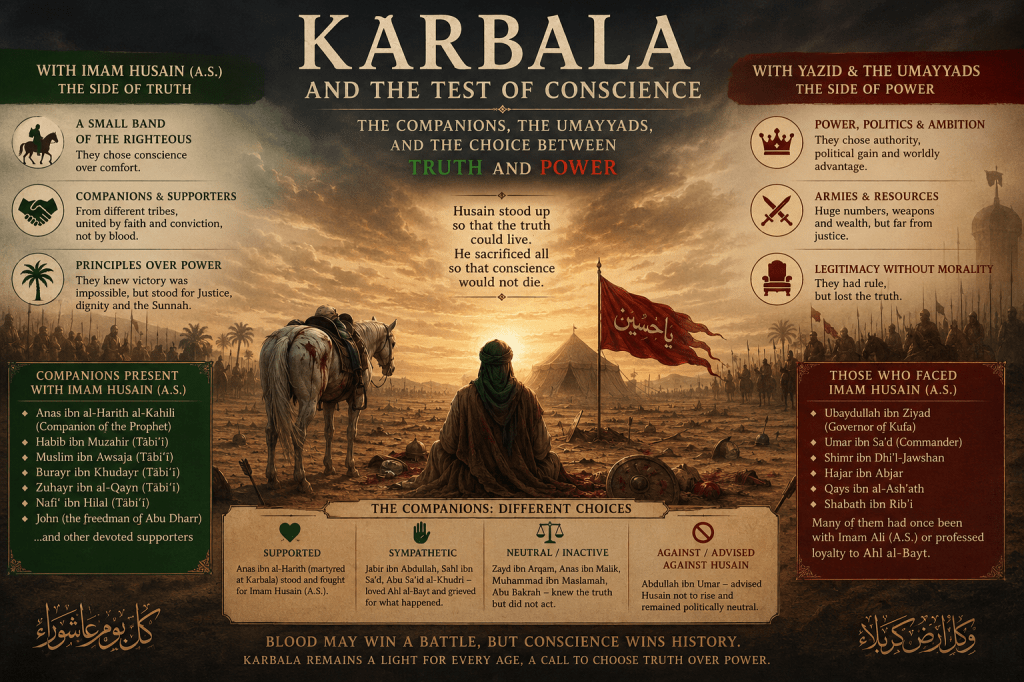
What makes Karbala especially significant is that it occurred within living memory of the Prophet Muhammad. Many of the participants and observers belonged to a generation that had seen the Prophet, heard his sermons, fought beside him, and transmitted his teachings. The distance between Karbala and the Prophet’s own lifetime was remarkably short. Yet when Imam Husain refused to recognise the authority of Yazid ibn Mu’awiya and challenged the transformation of the caliphate into hereditary monarchy, the Muslim community found itself deeply divided. Some stood with Husain. Some sympathised with him but remained inactive. Some advocated neutrality. Others aligned themselves with the ruling establishment. In this sense, Karbala became not only Husain’s trial but the trial of an entire generation.
To understand the deeper background of Karbala, one must first examine the internal dynamics of the Quraysh, the tribe from which both Husain and Yazid emerged. The Quraysh were not a monolithic entity. They were divided into several clans, among the most prominent being the Banu Hashim and the Banu Umayya. Before Islam, these clans competed for prestige, influence, and leadership within Meccan society. The Banu Hashim enjoyed distinction through their association with the Ka’ba and the services they provided to pilgrims. The Banu Umayya, meanwhile, emerged as one of the wealthiest and most politically influential branches of the tribe.
When the Prophet Muhammad proclaimed his message, some of the strongest opposition came from leading figures of the Banu Umayya, including Abu Sufyan ibn Harb. Yet the conquest of Mecca transformed these relationships. Former opponents embraced Islam and were incorporated into the new community. The Prophet consciously sought reconciliation and transcended old tribal antagonisms. For a brief period, it appeared that the rivalries of pre-Islamic Arabia had been overcome by a broader moral and religious vision.
However, questions surrounding authority and leadership after the Prophet’s death gradually reopened tensions that had never entirely disappeared. During the caliphates of Abu Bakr and Umar, these tensions remained largely contained. Under Uthman, himself a member of the Banu Umayya, Umayyad influence expanded throughout the rapidly growing empire. The assassination of Uthman and the subsequent conflict between Imam Ali and Mu’awiya brought these underlying divisions into the open.
Yet it would be mistaken to interpret these struggles solely as tribal rivalries. Ali’s supporters included numerous non-Hashimites, while many of Mu’awiya’s supporters had no particular attachment to the Banu Umayya. The issues increasingly revolved around questions of justice, governance, authority, and the nature of the Islamic state. By the time Husain confronted Yazid, the conflict had acquired a significance that transcended clan loyalties.
One of the most striking aspects of the tragedy of Karbala is that it unfolded within living memory of the Prophet Muhammad. A number of his Companions (Sahaba) were still alive in 61 AH / 680 CE when Imam Husain confronted the Umayyad ruler Yazid ibn Mu’awiya. Yet their responses to the crisis varied considerably.
Contrary to popular assumptions, very few Companions were physically present either in Husain’s camp or in the army opposing him. Most of the principal actors at Karbala belonged to the next generation, the Tabi’un. Among the Companions who are traditionally remembered as having joined Imam Husain and embraced martyrdom was Anas ibn al-Harith al-Kahili. Others, such as Jabir ibn Abdullah al-Ansari, Sahl ibn Sa’d al-Sa’idi, and Abu Sa’id al-Khudri, are remembered for their devotion to the Ahl al-Bayt, though age and circumstance prevented their participation.
A number of distinguished Companions, including Abdullah ibn Umar, Abdullah ibn Abbas, Anas ibn Malik, and Zayd ibn Arqam, did not join Husain. Their reasons varied. Some believed that rebellion would lead only to further bloodshed, while others adopted a position of political neutrality. Significantly, there is little evidence that major surviving Companions actively fought against Imam Husain at Karbala. The men who commanded and carried out the military campaign against him, such as Ubaydullah ibn Ziyad, Umar ibn Sa’d, Shimr ibn Dhi’l-Jawshan, and others, largely belonged to a younger generation.
Before examining those who actively fought against Imam Husain, it is essential to establish a fundamental principle for evaluating the status of the Companions. The Golden Principle is that only those Companions are honourable and beloved who remain firmly attached to and loyal to the Saqlain, the Quran and the Itrat Ahlulbayt (peace be upon them), who continue to follow them, and who remain on the path of love for the near kin (mawaddat fil Qurba).
With this principle in mind, we turn to the historical evidence of those Companions who were present in the army of Umar ibn Sa’d at Karbala. The following individuals are recorded as having been present in the opposing forces:
- Abd al-Rahman bin Abi Sabratul Ju’fi (Yazeed bin Malik al-Jufi)
This individual was a Companion, as was his father. Both were from the people of Kufa. His son was named Khusaima. (Al-Isaba, Volume 4, page 260, number 5141). On the day of Ashura, this Companion was a general over the forces of the tribes of Mazhaj and Asad in the army of Umar ibn Sa’d. (Tarikh al-Tabari, Volume 5, page 422; Al-Kamil fi al-Tarikh, Volume 3, page 168).
- Khalid bin Urfutah
This person was a leader of one of the armies within the forces of Umar ibn Sa’d at Karbala. (Al-Tabaqat al-Kabeer, Volume 5, page 273, number 932; Al-Isaba, Ibn Hajar, Volume 2, pages 209-210, number 2187). It is noteworthy that Khalid ibn ‘Urfutah had been told by the Prophet Muhammad: “O Khalid, after me, events, trials, and divergence will occur. So if you can be the servant of Allah who is killed, and not the one killing, then do so.” This prophetic advice, which counselled him to be the one killed rather than the killer in times of tribulation, stands in stark contrast to his actual participation in the army that killed the grandson of the Prophet.
- Amr bin Hajjaj Zubaidi
This Companion was the officer over the force that Umar ibn Sa’d had stationed on the banks of the River Euphrates. (Al-Isaba, Volume 4, page 510, number 5823). He was also recorded as having spoken extremely harshly to Imam Husain on the day of Ashura. (Tarikh al-Tabari, Volume 5, page 412; Ansab al-Ashraf, Volume 3, page 390). Historical sources also confirm that on the 7th of Muharram, 61 AH, Umar ibn Sa’d stationed a force of 500 soldiers led by Amr bin Hajjaj on the banks of the River Euphrates, to deprive the Prophet’s Household of water.
- Hijaar bin Abjar
This Companion was present in the army of Umar ibn Sa’d at Karbala. Imam Husain addressed him in one of his sermons on the day of Ashura and asked him: “Did you not write to me in a letter, along with Shabath ibn Rib’i, Qays ibn al-Ash’ath, and Yazid ibn Harith?” (Al-Isaba, Ibn Hajar, Volume 2, page 143, number 1960). Hajjar b. Abjar was among the commanders of Umar b. Sa’d’s army and was one of those who wrote to Imam Hussain on behalf of the Kufians, inviting him to Kufa. However, after Ubayd Allah b. Ziyad took over Kufa, he turned against Imam Hussain and forced people to scatter away from Muslim b. Aqil.
- Masrooq bin Waa’el al-Hazrami
His statement is recorded as follows: “I was in the front line of the horsemen who came towards Husain. I said in my heart that I should remain in the front line of the horsemen, so that perhaps I might obtain the head of Husain, and through this means gain status and position in the court of Ubaydullah…” (Al-Isti’ab, Ibn Abd al-Birr, Volume 4, page 1472, number 2549; Tarikh al-Tabari, Volume 5, page 431).
The historical importance of these differing responses lies in the fact that Karbala became a test of conscience for the entire community. Proximity to the Prophet did not produce a single political position. Some supported Husain, some sympathised with him, some counselled caution, and others accommodated themselves to Umayyad rule. Karbala thus reminds us that neither companionship with the Prophet, nor noble lineage, nor past achievements exempted anyone from the moral choices that history demanded. Individuals were ultimately judged not by who they were, but by the decisions they made when confronted with the conflict between truth and power.
One of the most striking aspects of the tragedy of Karbala is that it unfolded within living memory of the Prophet Muhammad. A number of his Companions (Sahaba) were still alive in 61 AH / 680 CE when Imam Husain confronted the Umayyad ruler Yazid ibn Mu’awiya. Yet their responses to the crisis varied considerably.
Contrary to popular assumptions, very few Companions were physically present either in Husain’s camp or in the army opposing him. Most of the principal actors at Karbala belonged to the next generation, the Tabi’un. Among the Companions who are traditionally remembered as having joined Imam Husain and embraced martyrdom was Anas ibn al-Harith al-Kahili. Others, such as Jabir ibn Abdullah al-Ansari, Sahl ibn Sa’d al-Sa’idi, and Abu Sa’id al-Khudri, are remembered for their devotion to the Ahl al-Bayt, though age and circumstance prevented their participation.
A number of distinguished Companions, including Abdullah ibn Umar, Abdullah ibn Abbas, Anas ibn Malik, and Zayd ibn Arqam, did not join Husain. Their reasons varied. Some believed that rebellion would lead only to further bloodshed, while others adopted a position of political neutrality. Significantly, there is little evidence that major surviving Companions actively fought against Imam Husain at Karbala. The men who commanded and carried out the military campaign against him, such as Ubaydullah ibn Ziyad, Umar ibn Sa’d, Shimr ibn Dhi’l-Jawshan, and others, largely belonged to a younger generation.
The historical importance of these differing responses lies in the fact that Karbala became a test of conscience for the entire community. Proximity to the Prophet did not produce a single political position. Some supported Husain, some sympathised with him, some counselled caution, and others accommodated themselves to Umayyad rule. Karbala thus reminds us that neither companionship with the Prophet, nor noble lineage, nor past achievements exempted anyone from the moral choices that history demanded. Individuals were ultimately judged not by who they were, but by the decisions they made when confronted with the conflict between truth and power.
Indeed, one of the most remarkable features of Karbala is that the men who died with Husain were not united by tribal affiliation. They came from different backgrounds, regions, and social classes. What united them was not blood but conviction. As Torsten Hylén explores in The Karbala Story and Early Shi’ite Identity, the story developed into a paradigmatic myth in formative Shi’ism, representing the eternal struggle between truth and falsehood. The conceptual framework of this clash, with ‘Yazidiyat‘ representing power as truth and ‘Hussainiyat‘ representing truth as power, has been developed by scholars such as Murtaza Mutahhari and articulated in the writings of contemporary thinkers including Dr Muhammad Tahir-ul-Qadri.
The First Group: Those Who Wholeheartedly Sided with Husain
Among the Companions of the Prophet who are recorded as having fought and died with Husain was Anas ibn al-Harith al-Kahili. According to later traditions, he had heard the Prophet speak of Husain’s future martyrdom. When that moment arrived, Anas did not remain a passive observer. Despite his advanced age, he joined Husain and embraced martyrdom. His choice symbolised the continuity between the Prophet’s generation and the stand taken by his grandson.
Abd al-Rahman ibn Abd Rabb al-Ansari was another Companion who had witnessed the event of Ghadir Khumm and transmitted the hadith about Ali’s succession. He accompanied Husain from Mecca and was martyred at Karbala, demonstrating that his commitment to the Prophet’s family was not merely verbal but was sealed with his life.
Sa’id ibn Abd Allah al-Hanafi delivered several crucial letters to Husain from the people of Kufa. On the night before Ashura, he famously declared that he would never abandon Husain. On the day of battle, he shielded the Imam with his own body while Husain was praying, receiving numerous arrows before being martyred. His sacrifice exemplifies the highest form of loyalty.
Habib ibn Muzahir al-Asadi was a 70-year-old Companion who had been close to the Prophet and Imam Ali. He was known for his unwavering loyalty and was among the first to be martyred at Karbala. His advanced age did not deter him from fulfilling what he understood to be his moral obligation.
Most of Husain’s supporters, however, belonged to the generation after the Companions. Among them were Muslim ibn Awsaja, Burayr ibn Khudayr, Nafi’ ibn Hilal, and Zuhayr ibn al-Qayn. These men understood perfectly well that Husain’s small band could not achieve military victory. Yet they chose to remain. Their loyalty was not based upon calculations of success. It was rooted in a conviction that certain principles are worth defending regardless of consequences.
The story of Zuhayr ibn al-Qayn is particularly revealing. Initially reluctant to become involved in the conflict, he encountered Husain during the journey to Iraq. Historical accounts relate that Zuhayr’s caravan had sought to avoid the Imam, but circumstances obliged them to halt at the same location. When Husain’s messenger summoned him, Zuhayr’s companions were so troubled that they put down their food. It was his wife, Lady Dulham bint Amr, who reminded him: “The son of the Holy Prophet of Allah has sent someone to you and called you; are you not prepared to go to him?” Following a private conversation with the Imam, Zuhayr underwent a profound transformation. He divorced his wife so that she might be free to remarry after his inevitable martyrdom. The man who had sought to avoid the struggle became one of Husain’s most devoted defenders, smiling as he intercepted arrows meant for the Imam and receiving them in his chest until he fell dead on the battlefield. His life demonstrates that conscience can awaken even at the last moment, and that true conviction often requires a complete reorientation of one’s priorities.
Burayr ibn Khudayr al-Hamdani was a very old, pious Companion of Imam Ali who was known for his deep devotion. He begged Husain for permission to be martyred, eager to meet the Prophet on the Day of Judgement. His enthusiasm for sacrifice illustrates how these men viewed martyrdom not as a tragedy but as the ultimate honour.
The camp of Husain also included John, the freed servant of Abu Dharr al-Ghifari. Elderly, of African origin, and possessing every excuse to withdraw, he nevertheless insisted upon fighting beside the Imam. His presence testified to the universal character of Husain’s cause. Karbala brought together Arabs and non-Arabs, nobles and freedmen, scholars and warriors, all united by a commitment to justice.
One of the most remarkable transformations at Karbala was that of Hurr ibn Yazid al-Riyahi. Unlike Zuhayr, Hurr had already belonged to the opposing army. He had joined Yazid’s forces not out of hatred for Husain but out of a soldier’s duty to execute the orders of his superiors. Yet on the night before Ashura, Hurr was restless. He could hear the children in Husain’s camp crying from thirst. His conscience whispered to him: “What have you done Hurr? Why did you put the son of Fatimah in this position? Will Allah ever forgive?” This career soldier could not sleep the whole night. Within him there was a struggle between his duty as a soldier and his Islamic conscience. When he finally crossed over to Husain’s camp, the Imam forgave him immediately, declaring that his grandfather, the Prophet, also forgave him. Hurr had travelled from the side of the strong, the well-fed, and the many, to the side of a few hungry and thirsty men who would certainly perish in the burning sands. He became the first martyr of the battle, making his choice at the final moment. His transformation demonstrates that human beings possess the freedom to choose their path at any moment, and that God’s mercy is not far for those who seek it.
This is further evidenced by figures such as Sa’d ibn al-Harth al-Ansari, who, despite initially being part of the Kharijite movement that had opposed Ali, was moved by the cries of Husain’s family to switch his allegiance and fight alongside the Imam until he too was martyred. Such stories underscore that the call of truth transcends prior sectarian or political affiliations.
The Second Group: Those Who Remained “Neutral”
Yet if Karbala honours those who stood with Husain, it also compels us to examine those who did not. This second group consisted of Companions who expressed sympathy for the Prophet’s family but ultimately chose political quietism and inaction. They were often motivated by a fear of civil war (fitna) or a belief that staying passive was the safer religious option.
Among the surviving Companions of the Prophet was Jabir ibn Abdullah al-Ansari. By 61 AH he was blind and advanced in age. Unable to participate physically, he nevertheless remained devoted to the Ahl al-Bayt and is remembered as among the earliest visitors to Husain’s grave after the tragedy. His conduct reflected sympathy and reverence, even if circumstances prevented active participation.
Similarly, Sahl ibn Sa’d al-Sa’idi and Abu Sa’id al-Khudri expressed affection for the Prophet’s family and discomfort with the treatment they received. Yet they too remained outside the conflict itself.
More complex are the cases of Zayd ibn Arqam and Anas ibn Malik. Both were distinguished Companions. Both had transmitted traditions concerning the virtues of Hasan and Husain. Yet neither joined Husain. Zayd ibn Arqam is reported to have protested when Husain’s severed head was displayed before Ubaydullah ibn Ziyad. He recognised the enormity of what had occurred. Yet recognition came after the event. When Husain required support, Zayd had remained absent.
Anas ibn Malik presents a similarly difficult case. One of the Prophet’s closest attendants and among the greatest transmitters of hadith, he survived well into the Umayyad era. Yet he neither joined Husain nor openly challenged the regime. Whether this reflected caution, age, political withdrawal, or other considerations remains debated. What is clear is that closeness to the Prophet did not automatically determine one’s response to Karbala.
Perhaps the most influential surviving Companion who declined to support Husain was Abdullah ibn Umar. The son of the second Caliph Umar ibn al-Khattab, he enjoyed enormous prestige within the Muslim community. Yet Ibn Umar believed that civil conflict represented a greater danger than even an unjust ruler. He therefore refused to support Husain’s course and counselled restraint. At the same time, he did not actively participate in Yazid’s cause. His position was one of neutrality and political quietism.
Abdullah ibn Abbas, another prominent Companion, tried to dissuade Husain from going to Kufa, fearing he would be betrayed. He accepted the reality of Yazid’s rule to avoid further bloodshed among the Muslim community. Abd al-Rahman ibn Abi Bakr, the son of the first Caliph Abu Bakr, also opted to accept Yazid’s reign to prevent a repeat of the divisions that had cost many Muslim lives in previous conflicts.
Other Companions, including Muhammad ibn Maslamah and Abu Bakrah, adopted similar attitudes. They preferred disengagement from civil conflict and feared the consequences of renewed bloodshed. Their choices reflected a particular understanding of religious duty, one that prioritised stability over resistance.
The Third Group: Those Who Sided with the Umayyad Power
It is important to recognise, however, that very few prominent Companions actively fought for Yazid. The principal figures responsible for the tragedy belonged not to the Prophet’s generation but to a younger political elite that had emerged under the Umayyads. This third group consisted of individuals who actively participated in the killing of Husain. Many of them had previously professed support for the family of the Prophet, but they chose to side with the state for political or personal advancement.
Among them were Ubaydullah ibn Ziyad, the governor of Kufa who was directly responsible for orchestrating the massacre. He sent the army and gave the order to prevent Husain from accessing water. Umar ibn Sa’d was the commander of the Yazidi army that confronted Husain at Karbala. Shimr ibn Dhi’l-Jawshan was the ruthless figure who is most infamous for slitting Husain’s throat. Also among them were Hajar ibn Abjar, Qays ibn al-Ash’ath, and Shabath ibn Rib’i. Several of these men had once been associated with Imam Ali or had previously professed sympathy for the Ahl al-Bayt. Yet when confronted with a choice between principle and power, they sided with the state.
The story of Umar ibn Sa’d is especially revealing. The son of the famous Companion Sa’d ibn Abi Waqqas, he was fully aware of Husain’s stature. Historical reports suggest that he hesitated before accepting command against the Imam. Yet the promise of office and political advancement ultimately outweighed his reservations. His tragedy lies not in ignorance but in choosing ambition over conscience. He knew the right path, yet he chose the one that promised worldly gain.
Similarly, Shimr ibn Dhi’l-Jawshan had once fought in Ali’s army. Yet he became one of Husain’s most ruthless enemies. His transformation demonstrates that proximity to truth does not guarantee permanence in it. Human beings continually define themselves through their choices.
Shibth ibn Rib’i led a contingent of four thousand men in the Umayyad army that besieged Husain. Muhammad ibn al-Ash’ath was another leader of a contingent in the Umayyad army and one of the tribal chiefs who pressured their men to abandon Husain’s cousin, Muslim ibn Aqil, in Kufa. These men had all been given the opportunity to stand for justice, yet they chose to stand with power.
The Contrast Between the Right Path and Opportunism
This brings us to the most profound lesson of Karbala. Neither lineage nor proximity to greatness provides immunity from moral failure. Both Husain and Yazid belonged to Quraysh. Both descended from respected lineages. Both inherited the legacy of a community transformed by Islam. Yet history remembers them in radically different ways because of the choices they made.
The same principle applies more broadly. Abu Lahab was the Prophet’s uncle, yet the Qur’an condemned him. Salman al-Farisi was unrelated to the Prophet by blood, yet achieved immense spiritual distinction. Bilal ibn Rabah, born into slavery, occupies a place of honour that many aristocrats never attained. Karbala reaffirmed through history what revelation had already established through principle: human worth is determined not by ancestry but by action.
As Shaykh-ul-Islam Dr Muhammad Tahir-ul-Qadri has articulated, the epoch of Karbala is fundamentally a clash between two philosophies. One segment holds that power is truth and should be supported. The other maintains that truth is power and should be wholly embraced. Considering power as right is ‘Yazidiyat‘, whereas truth as power is ‘Hussainiyat‘. This distinction lies at the heart of the tragedy. Yazid laid the foundation of a system marked by oppression, coercion, dictatorship, corruption, and absolute sway over power. Imam Husain raised the banner of truth against this system of cruelty and oppression. The clash was not between two princes seeking power but between the forces of truth and falsehood, humanity and barbarism, justice and oppression.
The stark contrast between these groups, those who sacrificed everything for truth, those who remained silent for stability, and those who murdered for ambition, is the core of the moral lesson of Karbala. It shows that the true test of conscience lies not in one’s lineage or past declarations, but in the final choice made when principle and power are in direct opposition. History remembers the first group as heroes, the second as cautionary examples of complicity through inaction, and the third as symbols of how worldly ambition can corrupt the soul.
The later history of Islam reinforced this lesson. The Abbasids overthrew the Umayyads while claiming legitimacy through their own relationship to the Prophet’s family. Yet many Abbasid rulers persecuted descendants of Ali and suppressed opposition with equal severity. Their conduct demonstrated once again that genealogy alone possesses no moral significance. The descendants of Hashim and Umayya alike produced figures of virtue and figures of ambition. History judges them not by their clan but by their conduct.
This is why Karbala continues to resonate across centuries and cultures. It is not merely a Shi’i memory or a Muslim memory. It is a universal moral drama. It asks questions that every generation must confront. What should one do when faced with injustice? Is sympathy sufficient, or does truth require action? Does the pursuit of stability justify silence? Can power be accepted when it compromises principle?
The men who stood with Husain answered these questions through sacrifice. Those who remained neutral answered them through caution. Those who sided with the Umayyads answered them through obedience, ambition, or political calculation. History remembers all of them accordingly.
In the final analysis, Karbala was not simply the martyrdom of Imam Husain. It was the revelation of character. It exposed the strengths and weaknesses of an entire generation. It demonstrated that the true division within society is not between tribes, clans, or families, but between those who choose principle and those who choose power. The tragedy served as a profound test of conscience for the early Muslim community, and its moral clarity resonates through the centuries. It affirms a fundamental truth found in many spiritual traditions: that human worth is determined not by ancestry but by action, not by proximity to greatness but by the integrity of one’s choices.
That is why Karbala remains alive. Every age produces its own forms of injustice, its own pressures to conform, its own temptations of power and privilege. The question that confronted the Companions, the Tabi’un, the Umayyads, and the supporters of Husain continues to confront humanity today. When truth and power stand opposed to one another, on which side will we stand? The side of truth may not offer worldly success, but it alone offers moral coherence and historical vindication. To side with truth, even when it is not the path of least resistance, is to uphold a principle that is the bedrock of any just and dignified society. The enduring greatness of Husain lies not simply in who he was, but in what he chose. The enduring tragedy of many of his opponents lies not in who they were, but in what they chose. And therein lies the eternal lesson of Karbala, a lesson that calls upon us not to be passive observers of history, but active participants in the timeless struggle for justice.
A Final Observation: The Impossibility of a Uniform View of the Companions
Beyond its moral and spiritual dimensions, the tragedy of Karbala in AH 61 carries profound implications for how we understand the earliest generation of Muslims. The events of that fateful day conclusively demonstrate that the Companions of the Prophet Muhammad cannot be treated as a uniform group of revered and upright individuals. The diversity of responses to Husain’s stand, ranging from martyrdom alongside him, to passive neutrality, to active participation in his killing, shatters any simplistic notion that all Companions were uniformly righteous, infallible, or beyond moral reproach.
This is not a conclusion derived from sectarian bias but from the objective testimony of history itself. The classical sources that preserve the names and actions of the Companions reveal a community that was, like all human communities, composed of individuals with varying degrees of moral courage, political ambition, personal conviction, and spiritual insight. The fact that some Companions died defending Husain, while others stood by in silence, and still others or their sons actively contributed to his martyrdom, demonstrates that the category of ‘Companion’ was never a guarantee of moral or spiritual infallibility.
The Qur’an itself anticipates this reality. It repeatedly distinguishes between those who believe and do righteous deeds and those who fall into error, regardless of their outward affiliation or proximity to the Prophet. The Prophet Muhammad himself warned that not all who accompanied him would be saved, declaring that some would be turned away from the Pool of Kawthar on the Day of Judgement, and he would be told: “You do not know what they innovated after you.” This prophetic warning, preserved in canonical hadith collections including Sahih al-Bukhari and Sahih Muslim, establishes the principle that Companionship with the Prophet, while a great honour, does not confer automatic immunity from error or guarantee salvation.
Karbala brings this abstract principle into stark historical reality. The contrast between Anas ibn al-Harith, who died for Husain, and Umar ibn Sa’d, who commanded the army against him, could not be more striking. Both were Companions or sons of Companions. Both inherited the same prophetic legacy. Yet their choices could not have been more different. Similarly, the neutrality of Abdullah ibn Umar, however sincerely motivated by a fear of fitna, stands in sharp relief against the active sacrifice of Habib ibn Muzahir. These are not marginal figures but some of the most prominent individuals of their generation.
This historical reality has significant theological and historiographical implications. It demands that we approach the study of the Companions with nuance, critical analysis, and moral discernment, rather than with an uncritical reverence that flattens all distinctions. It compels us to evaluate individuals based on their actions and choices, not merely on their status or proximity to the Prophet. It reminds us that moral authority is earned through righteous conduct, not inherited through association.
The tragedy of Karbala thus serves as a powerful corrective to any tendency towards blind veneration. It calls upon Muslims and historians alike to recognise that the early Islamic community was a complex tapestry of virtue and vice, courage and cowardice, principle and opportunism. It invites us to judge individuals not by their labels but by their deeds, not by their claims but by their sacrifices. In doing so, it aligns with the Qur’anic injunction: “And whoever does an atom’s weight of good will see it, and whoever does an atom’s weight of evil will see it” (Qur’an 99:7-8).
Ultimately, Karbala teaches us that truth is not determined by numbers, status, or lineage, but by the integrity of one’s conscience and the courage of one’s convictions. It reminds us that history judges us not by the company we keep but by the choices we make. And it compels us to acknowledge that even among those closest to the Prophet, there were those who rose to the highest stations of honour and those who fell to the deepest depths of moral failure. This is the sobering lesson of Karbala, and it is one that no honest student of history can afford to ignore.
—————————————————————-
Sources and References
This essay is based upon a close reading of both primary historical sources and modern scholarly analyses.
Primary Historical Sources:
· Al-Tabari, Tarikh al-rusul wa-l-muluk (History of the Prophets and Kings)
· Ibn al-Athir, al-Kamil fi al-tarikh (The Complete History)
· Ibn Kathir, Kitab al-bidaya wa-l-nihaya (The Beginning and the End)
· Al-Baladhuri, Ansab al-ashraf (Genealogies of the Nobles)
· Ibn Abd al-Birr, Al-Isti’ab fi ma’rifat al-ashab (Comprehensive Knowledge of the Companions)
· Ibn Hajar al-Asqalani, Al-Isaba fi tamyiz al-sahaba (The Injury in Distinguishing the Companions)
· Ibn Sa’d, Al-Tabaqat al-Kabeer (The Major Classes)
Secondary Scholarship:
· Hagler, Aaron M. The Echoes of Fitna: Developing Historiographical Interpretations of the Battle of Karbala. This work demonstrates how the desire to reframe the meaning of Karbala is central to historians’ narrative construction.
· Hylén, Torsten. The Karbala Story and Early Shi’ite Identity. This explores how the story developed into a paradigmatic myth in formative Shi’ism.
· Mutahhari, Murtaza. The Martyrdom of Imam Husain and the Lessons of Karbala. This provides the conceptual framework for understanding the clash between ‘Yazidiyat’ and ‘Hussainiyat’.
· Tahir-ul-Qadri, Dr Muhammad. The Philosophy of Karbala. This articulates the distinction between power as truth and truth as power.
· Jafri, S.H.M. The Origins and Early Development of Shi’a Islam. This provides essential historical context for understanding the political and theological divisions of the early Islamic community.
· Madelung, Wilferd. The Succession to Muhammad: A Study of the Early Caliphate. This offers a comprehensive analysis of the political dynamics that led to the events of Karbala.
Encyclopaedic and Biographical Sources:
· Encyclopaedia Britannica entries on the Battle of Karbala, Yazid I, Ubaydullah ibn Ziyad, and Umar ibn Sa’d provide authoritative overviews of key figures and political dynamics.
· Biographical details of key figures, including the companions and opponents of Husain, are drawn from detailed accounts in both classical historiography and modern analyses, including the biographical dictionaries of Ibn Sa’d and Ibn Hajar al-Asqalani.
Hadith Sources:
· References to the traditions concerning the virtues of Hasan and Husain, transmitted by Companions such as Zayd ibn Arqam and Anas ibn Malik, are drawn from the canonical collections of Sunni and Shi’i hadith, including Sahih al-Bukhari, Sahih Muslim, and the compilations of al-Tirmidhi and Ibn Majah.
· The prophetic warning regarding the fate of some Companions at the Pool of Kawthar is recorded in Sahih al-Bukhari and Sahih Muslim. The hadith of Khalid ibn ‘Urfutah is recorded in Musnad Ahmad.


