Syed Ali Nadeem Rezavi
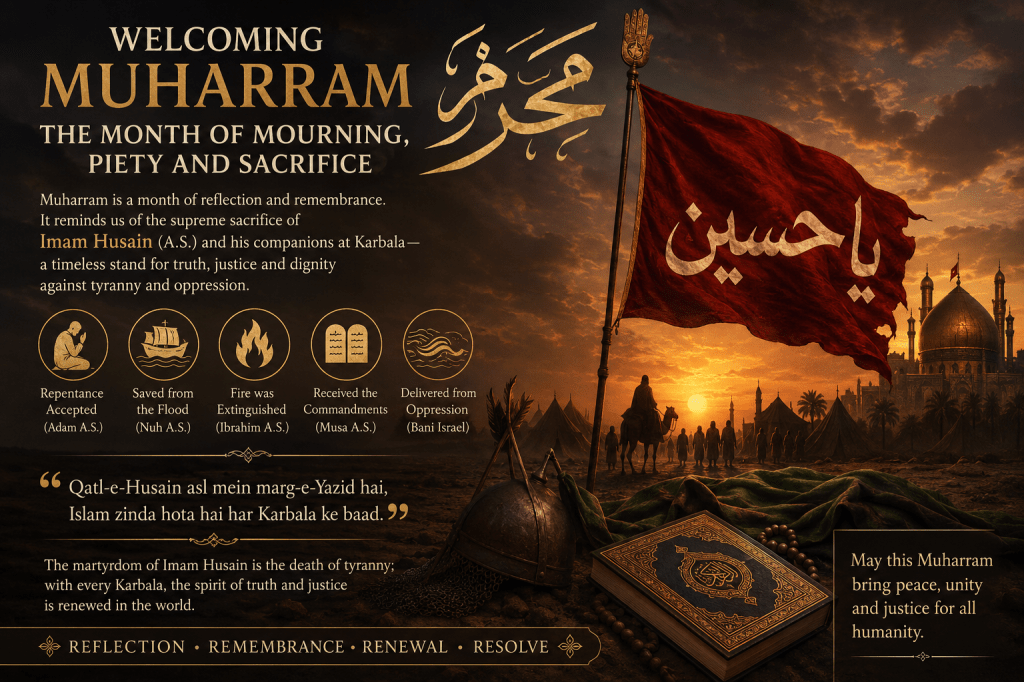
With the setting of the old moon and the appearance of the new, the month of Muharram once again enters our lives. For Muslims across the world, it is not merely the beginning of a new Islamic year. It is a month laden with memory, reflection, devotion, and profound historical significance. It is a month that invites believers to look inward, to examine their conscience, and to renew their commitment to truth, justice, and righteousness.
Muharram is one of the four sacred months mentioned in the Qur’an, months that have been sanctified by God and during which wrongdoing and bloodshed are especially condemned. The very word Muharram, as already mentioned in an earlier blog, is derived from the root haram, conveying the meanings of sanctity, respect, and prohibition. It is a month that is both sacred and inviolable, a period during which humanity is reminded of the value of peace and the sanctity of life.
The Qur’an refers to these sacred months in Surah al-Tawbah (9:36), where God declares that there are twelve months in the divine reckoning, of which four are sacred. According to the Prophet Muhammad, these four months are Dhul Qa’dah, Dhul Hijjah, Muharram, and Rajab. Dhul Qa’dah and Dhul Hijjah precede Muharram and are closely associated with the rites of Hajj, while Rajab, occurring midway through the year, has long been regarded as a month of reverence and devotion. In pre-Islamic Arabia, warfare was traditionally suspended during these months to ensure safe travel and pilgrimage, and Islam reaffirmed their sanctity while emphasising their spiritual significance. Muslims are therefore encouraged to increase acts of worship, charity, repentance, and self-discipline during these blessed periods, while being especially mindful to avoid injustice and wrongdoing.
The tenth day of this month of Muharram, known as Ashura, occupies a special place in the religious memory of Muslims. Sunni traditions associate this day with a number of momentous events in sacred history. It is said to be the day on which the repentance of Prophet Adam was accepted, the day on which Prophet Nuh and his companions were saved from the Flood, the day on which the fire prepared by Nimrod was rendered cool and harmless for Prophet Ibrahim, and the day on which Prophet Musa received divine commandments. It is also associated with the deliverance of the Children of Israel from Pharaoh’s oppression, the restoration of Prophet Ayyub’s health, the reunion of Prophet Yusuf with his father Ya’qub, the deliverance of Prophet Yunus from the belly of the fish, the forgiveness of Prophet Dawud, the restoration of Prophet Sulayman’s kingdom, and the raising of Prophet Isa to heaven.
Yet for millions of Muslims, particularly those devoted to the memory of the Prophet’s family, the tenth of Muharram is remembered above all as the day on which Imam Husain ibn Ali, the beloved grandson of Prophet Muhammad, was martyred on the plains of Karbala in 680 CE. The first ten days of Muharram are therefore not days of celebration but days of mourning, remembrance, and spiritual reflection.
The tragedy of Karbala occupies a unique place in human history. It was not merely a political confrontation nor simply a battle for temporal power. It was a moral struggle between principle and expediency, justice and tyranny, truth and falsehood. Yazid, who had assumed the leadership of the Muslim polity through hereditary succession and political influence, sought the allegiance of Imam Husain in order to legitimise his rule. Husain refused. He could not endorse a system that, in his view, violated the ethical and spiritual foundations established by his grandfather, the Prophet Muhammad.
In refusing submission, Imam Husain knowingly chose a path that would lead to suffering and death. Yet he understood that silence in the face of injustice would amount to complicity. His stand transformed what might otherwise have been a forgotten political dispute into one of the most enduring symbols of resistance against oppression in human history.
The immediate impact of Karbala was profound. The brutal killing of the Prophet’s grandson, along with members of his family and loyal companions, shocked the Muslim world. It compelled people to question the legitimacy of a regime that could perpetrate such an act. The martyrdom of Husain awakened a moral consciousness that had become dormant under political expediency and fear. His sacrifice exposed the true nature of tyranny and reminded believers that faith demands moral courage.
The long-term consequences of Karbala have been even more far-reaching. Across centuries and continents, the memory of Imam Husain has inspired countless struggles for justice and human dignity. His message transcended the boundaries of religion, ethnicity, and nationality.
Karbala became a universal symbol of the eternal struggle between oppression and freedom. The celebrated verse captures this truth with remarkable eloquence:
Qatl-e-Husain asl mein marg-e-Yazid hai,
Islam zinda hota hai har Karbala ke baad.
The martyrdom of Husain becomes, in reality, the death of tyranny itself, for every Karbala renews humanity’s commitment to truth and justice.
But then, to those who are the Shi’a, the Friends of Ali, Karbala is unique: it can be emulated but never duplicated. Thus Karbala is a unique singular event.
What makes Imam Husain’s sacrifice particularly remarkable is the foresight and wisdom with which he approached his mission. He chose not to remain in Mecca, despite the sanctity and security it offered, because he did not wish bloodshed to occur within the sacred precincts. Nor did he wish his death to pass unnoticed as an isolated assassination. By proceeding towards Iraq, the very centre of Yazid’s power, he ensured that the confrontation would reveal the true nature of the regime and would be remembered by history.
Equally significant was the composition of his small caravan. Husain did not seek military strength. His companions came from different tribes, regions, and social backgrounds. Among them were elderly veterans, freed slaves, devoted followers, and even those newly joined to his cause. They represented the diversity of the Muslim community itself. Their presence demonstrated that Karbala was not a tribal conflict or a struggle for political power. It was a defence of moral principles.
Perhaps the most remarkable aspect of Husain’s planning was his decision to take with him the women and children of his household. Their survival ensured that the story of Karbala could never be buried. After the massacre, it was his sister, Sayyida Zainab, who emerged as the voice of the revolution. Through her courageous speeches in Kufa and Damascus, she exposed the injustice of Yazid’s regime and preserved the message for future generations. If Husain’s blood laid the foundation of the movement, Zainab’s eloquence ensured its permanence in history.
Professor Syed Jafar Raza Bilgirami described Imam Husain’s achievement as the reconstruction of a system of life. According to him, Karbala represented the triumph of reason over greed, conscience over appetite, and justice over brute force. Husain demonstrated that true civilisation rests not upon power but upon ethical restraint and moral responsibility. In doing so, he offered humanity a timeless code of conduct.
It is therefore not surprising that scholars, historians, and thinkers from diverse backgrounds have been moved by the tragedy of Karbala. We have seen that whether it is Edward Gibbon, Thomas Carlyle, E. G. Browne, Charles Dickens, or Muhammad Iqbal, they, and many more have recognised in Husain’s sacrifice a universal lesson in courage, conviction, and moral integrity. Karbala continues to evoke sympathy, admiration, and inspiration because it speaks to fundamental human values that transcend religious boundaries.
As Muharram begins once again, Muslims gather in mosques, imambaras, and homes to remember these events. Majalis are held, elegies are recited, and the stories of Karbala are narrated anew. These gatherings are not merely commemorations of a distant past. They are opportunities to renew one’s commitment to justice, compassion, and truthfulness. They remind believers that faith is not simply a matter of ritual but also of moral responsibility.
Muharram thus arrives as a month of mourning, but also as a month of spiritual awakening. It teaches that truth may suffer but can never be defeated; that numbers do not determine righteousness; and that the courage of a small group of principled individuals can transform the course of history.
As we welcome this sacred month, may we reflect deeply upon the lessons of Karbala. May the memory of Imam Husain inspire us to oppose injustice wherever it appears, to uphold human dignity, and to remain steadfast in the pursuit of truth. May this Muharram become a source of peace, reconciliation, and moral renewal for all humanity.
Amen.


