Syed Ali Nadeem Rezavi
In recent years, the figure of the Mughal emperor Akbar has become a battleground in contemporary debates over Indian history. A growing body of popular writing and commentary, particularly from proponents of Hindutva historiography, seeks to portray the Mughal period as one of unrelieved religious oppression and cultural alienation. In this narrative, Akbar appears either as a cynical politician whose gestures of tolerance masked imperial ambitions, or as a lone exception whose policies supposedly confirm the alleged intolerance of all other Muslim rulers. More recently, commentators such as Vikram Sampath have revived arguments questioning the depth and sincerity of Akbar’s inclusivism. Drawing on a long tradition of skeptical scholarship, Sampath and others suggest that Akbar’s policies were primarily instruments of political expediency rather than expressions of a broader vision of governance, a perspective that has gained considerable traction in public discourse, particularly following his interviews on platforms like NDTV.
Such interpretations, however, tend to flatten a far more complex historical reality. No serious historian would deny that Akbar was an empire builder or that his policies were shaped by political calculations. Yet the same may be said of virtually every successful ruler in history. The question is not whether Akbar’s policies were political, but what kind of politics they embodied. A careful examination of the evidence suggests that Akbar consciously sought to construct a polity that transcended narrow sectarian identities, and that his vision represented one of the most remarkable experiments in inclusive governance in the early modern world.
The Mahzar of 1579: An Assertion of State Authority
The clearest indication of this vision is the famous Mahzar of 1579. Often misunderstood as a declaration of personal infallibility or a step toward founding a new religion, the document was actually a more nuanced political intervention. The Mahzar, a legal attestation signed by leading Muslim scholars, did not proclaim Akbar a prophet. Rather, it acknowledged him as an Imam-i ‘Adil (Just Ruler) and granted him the authority to choose between competing juridical opinions when leading scholars disagreed. As the scholar F. W. Buckler argued in a classic reinterpretation, the document was a diplomatic victory that allowed Akbar to rise above the squabbling factions of the ulama.
The context is crucial. Akbar was confronting a situation in which rival groups of religious scholars frequently advanced contradictory and self-serving interpretations of Islamic law. The Mahzar was therefore an attempt to subordinate sectarian legal disputes to the ultimate authority of the state. In effect, Akbar was asserting that political sovereignty should not be held hostage by clerical rivalries.
The Ibadat Khana: A Forum for Intellectual Engagement
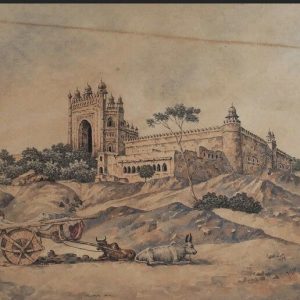
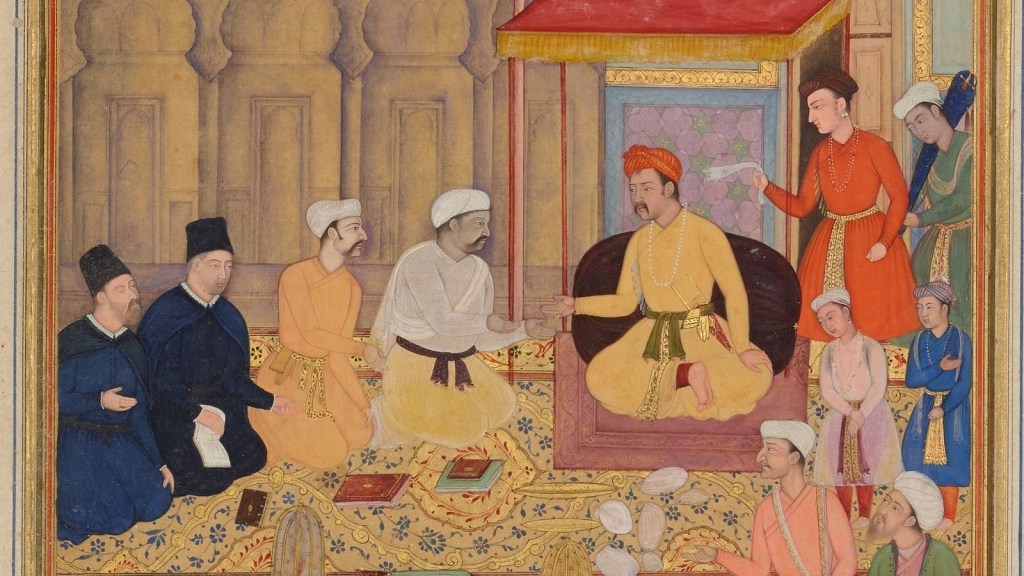
The institutional expression of this approach was the Ibadat Khana, or House of Worship, at Fathpur Sikri. Established initially as a venue for discussions among Muslim scholars, it soon expanded to include representatives of a remarkable range of traditions. Sunni and Shia scholars debated alongside Sufis, Jains, Brahmins, Zoroastrians, and even Jesuit priests from Portuguese Goa. The Jesuits were received with courtesy and were encouraged to present Christian doctrines before the emperor. Akbar’s objective was not theological conversion but intellectual engagement. He believed that truth could not emerge from dogmatic isolation.
As I have shown in my own work on the Ibadat Khana, these disputations were not mere courtly entertainment. They were part of a deliberate project to elevate reason (‘aql) over blind adherence to tradition (taqlid). The Ibadat Khana was designed as a space where competing claims to truth could be tested through dialogue rather than asserted through authority.
A Social Contract for the Sixteenth Century
What made Akbar’s vision truly radical was the theory of kingship that he and his official chronicler Abu’l Fazl articulated. At a time when rulers across the world claimed divine right or inherited privilege, Akbar and Abu’l Fazl advanced a theory of governance based on the social contract. In this framework, the ruler’s authority was not a gift from God nor a license for tyranny. Rather, the ruler existed to safeguard the people. Kingship was a trust, a responsibility, and its legitimacy derived from the protection and welfare of all subjects, regardless of their faith. This was not merely philosophical abstraction. It translated into concrete policies: the abolition of punitive taxes on non-Muslims, the protection of temples and churches, and the incorporation of diverse elites into the highest levels of imperial administration.
The Divine Light That Falls on Everyone
Underpinning this political theory was a profound metaphysical vision drawn from the Ishraqi or Illuminationist tradition. Akbar invoked the concept of Farr-e Izadi, the divine light or royal radiance. But unlike exclusivist interpretations of divine favour, Akbar understood this light as something that falls upon and illuminates everyone and everything without discrimination. It did not distinguish between Muslim and Hindu, between noble and commoner, between Persian and Rajput. The divine light shone equally on all creation. The emperor, as the recipient of this light, was therefore bound to reflect its universality. His justice, his protection, and his patronage could not be selective. They had to extend to every being touched by the same divine radiance.
This was the philosophical heart of sulh-i kul, or universal peace. The doctrine argued that the state should transcend sectarian divisions and treat all subjects with equal concern. Contrary to some modern caricatures, sulh-i kul was not merely a slogan. As the work of M. Athar Ali, Irfan Habib, Shireen Moosvi, B. L. Bhadani, and Savitri Chandra has consistently shown, it shaped recruitment to the nobility, administrative practice, and imperial ideology. The cosmopolitan nobility that emerged under Akbar had no parallel in the early modern world. Rajputs, Indian Muslims, Persians, Central Asians, Afghans, and members of other communities participated in a remarkably inclusive ruling class.
A World at War Over Religion: Akbar’s Radical Alternative
The significance of these ideas becomes even clearer when we place them in global context. The sixteenth century was an age of intense religious conflict across much of the known world. In Europe, the Reformation and Counter-Reformation had unleashed waves of bloody violence. Catholics and Protestants burned each other at the stake. The French Wars of Religion, the Spanish Inquisition, and the Dutch Revolt were all fought over competing visions of Christian truth. Meanwhile, the Safavid Empire in Persia had made Shia Islam its official state religion, often persecuting its Sunni minorities. The Ottoman Empire, for all its administrative sophistication, waged relentless war against Shia Safavids and regularly enforced Sunni orthodoxy within its domains.
At the very moment when much of Eurasia was tearing itself apart over sectarian differences, Akbar was moving in the opposite direction. He did not merely tolerate other faiths; he actively invited them into his court. He did not enforce a single orthodoxy; he created a platform for multiple voices. No other major ruler of the sixteenth century routinely convened public discussions among representatives of so many religious traditions. While European monarchs were burning heretics, the Mughal emperor was sponsoring comparative religious dialogue. While Safavid shahs and Ottoman sultans enforced sectarian uniformity, Akbar articulated a vision in which political community could transcend differences of faith. The contrast is not merely striking; it is historically unprecedented.
Jizya, Pilgrimage Tax, and the Abolition of Discrimination
Akbar’s practical policies reflected the same outlook. He abolished the pilgrimage tax in 1563 and the jizya in 1564. These measures removed fiscal disabilities that disproportionately affected non-Muslims and signalled that imperial subjects were to be treated primarily as members of the political community rather than as adherents of particular faiths. Recent controversies over textbook revisions have brought these policies back into public debate, with some commentators questioning the timing and motivations behind the abolition. Critics often dismiss these actions as political expedients designed to win support from Hindu elites, particularly the powerful Rajput clans. Yet such criticism overlooks an obvious point: rulers reveal their priorities through the policies they choose to pursue. Akbar could easily have maintained these taxes, as many contemporary rulers elsewhere maintained discriminatory burdens on religious minorities. Instead, he chose to abolish them.
Akbar as Vishnu: The Brahminical Embrace
The depth of Akbar’s acceptance among his non-Muslim subjects is perhaps best captured in research by B. L. Bhadani, who has demonstrated that Akbar was hailed as an avatar of Vishnu by Brahmins of his time. This was not a fanciful exaggeration or a mere diplomatic courtesy. It reflected a genuine perception that Akbar’s rule embodied righteous governance (dharma) in a way that transcended his own religious identity. Contemporary accounts describe how Brahmins would gather below Akbar’s jharokha, or viewing balcony, to catch a glimpse of his face before breaking their fast. This ritual, which echoes the darshan (sacred viewing) traditionally associated with Hindu deities, suggests that for many of his subjects, Akbar was not merely a tolerant ruler but a sacred figure in his own right.
Such evidence is difficult to reconcile with portrayals of Akbar as a cynic or a tactician. Brahmins were not known for bestowing divine status upon rulers who merely calculated political advantage. Their embrace of Akbar as Vishnu’s avatar indicates that his policies of inclusion were experienced as genuine and transformative by those they were meant to benefit.
Acknowledging the Critics: Political Pragmatism or Genuine Vision?
It is important to take the critics’ arguments seriously. Vikram Sampath and others are correct to point out that Akbar was not a secularist in the modern sense. He remained a Muslim monarch, and his policies were certainly aimed at consolidating his empire. Furthermore, the Mahzar can be read as a power play against the orthodox ulama who challenged his authority. Some historians also note that while Akbar promoted interfaith dialogue, the debates at the Ibadat Khana were eventually discontinued in 1582, possibly because they led to greater bitterness rather than understanding.
Yet to reduce Akbar’s policies to mere political opportunism misses the larger historical point. Successful states are always built through political calculation. The question is whether those calculations promote exclusion or inclusion. Akbar’s genius lay in recognising that a subcontinent as diverse as India could not be governed through sectarian domination. Stability required accommodation; legitimacy required inclusion. The fact that he maintained these policies for decades, and that they were largely continued by his successors Jahangir and Shah Jahan, suggests they were more than fleeting tactics. They represented a genuine governing philosophy. Even his great-grandson Aurangzeb, who reversed many of these policies by reinstating the jizya, struggled to govern an empire that had been built on the foundation of Akbar’s inclusive model. This is not to excuse Aurangzeb’s policies, but to acknowledge that Akbar’s framework was a deliberate choice, not an inevitable feature of Muslim rule.
Inclusion Versus Exclusion: A Lesson for Our Time
Unlike what is happening in many parts of the world today, where the politics of exclusion has gained disturbing currency, Akbar believed in inclusion. He believed that a ruler’s legitimacy derived from the protection of all people, not just those of his own faith. He believed that divine light illuminated everyone equally, without discrimination. He believed that a stable and just polity required space for many voices, many traditions, and many ways of life. These were not merely political calculations. They were convictions, tested and sustained over a long reign, and they left an indelible mark on the subcontinent’s political imagination.
The contrast with contemporary politics could not be starker. Today, we see the rise of governments and movements that thrive on identifying enemies, on drawing lines of exclusion, on declaring certain communities unwelcome. Akbar’s model offers a powerful alternative. It reminds us that inclusion is not weakness, that diversity is not a threat, and that the most durable political communities are those built on the recognition of shared humanity rather than on the enforcement of narrow loyalties.
The Enduring Legacy
This does not mean that Akbar was a modern secular democrat. He was an early modern emperor whose authority remained deeply personal and monarchical. Nor does it mean that all conflicts disappeared under his rule. Yet historical understanding requires us to judge figures within their own context. By the standards of the sixteenth century, where religious persecution was the norm across much of the globe from Europe to Safavid Persia to the Ottoman Empire, Akbar’s policies represented an extraordinary departure from prevailing models of confessional governance.
Indeed, the most enduring legacy of Akbar may not be his military conquests or administrative reforms, but the political imagination he bequeathed to the subcontinent. At a time when much of the world was torn apart by religious conflict, he articulated a vision in which political community could transcend differences of faith. The Mahzar, the Ibadat Khana, the abolition of discriminatory taxes, the patronage of temples and churches, the social contract theory of kingship, the Ishraqi philosophy of divine light illuminating all beings, and the doctrine of sulh-i kul were all manifestations of this larger project.
Modern attempts to portray Akbar as either a tyrant disguised as a liberal or a ruler whose inclusiveness was merely tactical reveal more about contemporary ideological anxieties than about the sixteenth century. Serious historical scholarship, from M. Athar Ali, Irfan Habib, Shireen Moosvi, B. L. Bhadani, and Savitri Chandra to my own work on the Ibadat Khana, has consistently demonstrated the complexity of Mughal governance. The evidence does not support the image of an empire organised around religious persecution. Rather, it reveals a state that, especially under Akbar, sought to reconcile diversity with imperial authority.
In an age increasingly tempted by exclusionary visions of the past and the present, Akbar’s experiment remains historically significant precisely because it points in the opposite direction. His reign reminds us that one of the most powerful states in pre-modern India was built not upon religious uniformity but upon the recognition that a durable political order required space for many faiths, communities, and ways of life. He chose inclusion over exclusion, light over darkness, and peace over perpetual conflict. That lesson, perhaps, is what makes Akbar so controversial and so profoundly relevant today.


