Syed Ali Nadeem Rezavi
The conventional narrative of Mughal Emperor Akbar’s sulh-i-kul (universal tolerance) and his employment of Hindu Rajputs, bureaucrats, and intellectuals often overshadows a longer, less celebrated history of non-Muslim participation in India’s medieval state apparatus. Long before Akbar’s Mansabdars, the Sultans of Delhi, particularly the Khaljis (1290–1320) and Tughluqs (1320–1414), had already inducted Hindus, Jains, and other indigenous communities into the highest echelons of fiscal, military, architectural, and administrative governance. Thakkura Pheru, a Shrimal Jain who served as mint master and treasurer under Alauddin Khalji and later under Ghiyath al-Din Tughluq, was not an anomaly but a symbol of a structural reality: the Sultanate could not function without Hindu officers. From Pheru’s mint to the Hindu revenue clerks who staffed the Diwan-i-Wizarat, from the village muqaddams who collected taxes to the Rajput zamindars who consolidated power under Tughluq patronage, and finally to Hemu, the Hindu Wazir who led an Afghan army to capture Delhi in 1556, the evidence is overwhelming. Hindus were the Sultan’s officers, his mint masters, his architects, and his kingmakers. This essay traces that long arc of Hindu service from 1290 to 1556, demonstrating that the Delhi Sultanate was, in its everyday functioning, a deeply collaborative enterprise between Muslim rulers and Hindu subjects, a partnership that redefined medieval Indian polity long before Akbar formalized it.
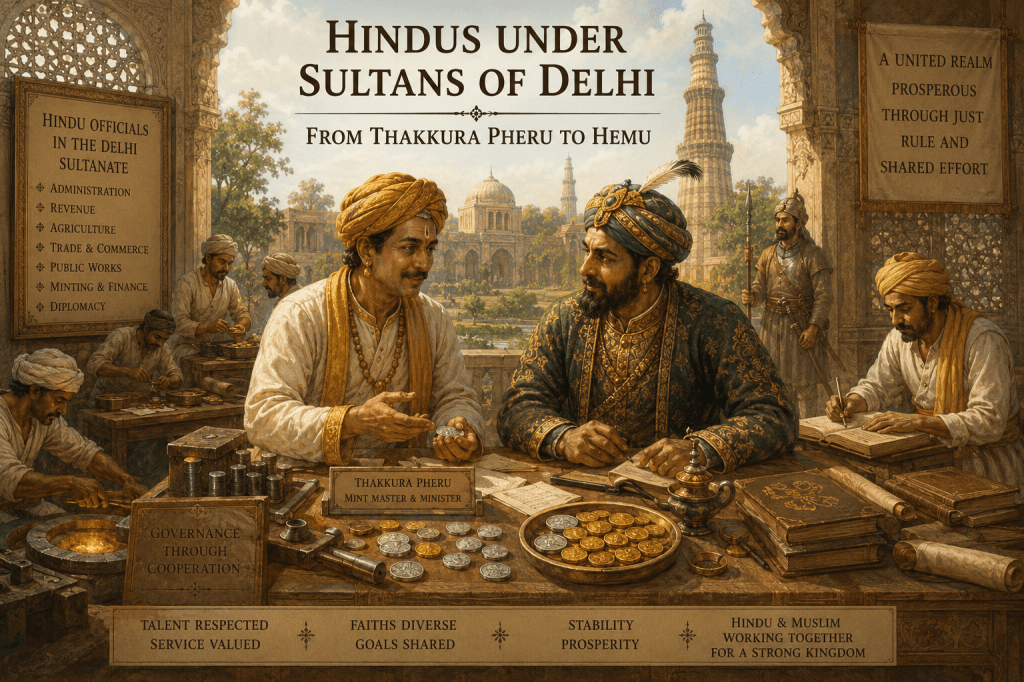
Thakkura Pheru’s career is a testament to the Khalji state’s reliance on non-Muslim technical knowledge. Appointed as daroga-i-dar al-sikka (superintendent of the mint) and diwan-i amanat (treasurer), he oversaw Alauddin’s revolutionary market controls and currency reforms. Pheru was not a token employee; he was a polymath who wrote treatises on coins (Dravyaparikṣa), gems, metallurgy, architecture (Vastusara), and mathematics. His writings, composed in Apabhraṃśa, the vernacular of northern India, not Persian, provide an insider’s account of the Sultanate’s economy. Modern scholars like Sreeramula Rajeswara Sarma have argued that Pheru’s detailed descriptions of 260 coin types, their alloys, and their exchange rates could only have come from someone trusted with the Sultan’s treasury. That a Jain layman could hold such a sensitive position under a ruler often caricatured as a bigot, Alauddin Khalji, reveals a sharp divide between ideology and governance. For Alauddin, fiscal solvency trumped religious purity.
Pheru thus symbolizes a broader truth: the induction of Hindus and Jains into elite state service began in earnest in the late thirteenth and early fourteenth centuries, much before Akbar. Under the Khaljis, non-Muslims served as revenue accountants, mint masters, market superintendents, and even military commanders. This was not born of any enlightened secularism but of administrative necessity. The Delhi Sultanate, like all pre-modern states, lacked a literate, numerate Muslim population capable of managing a complex agrarian and monetary system. The indigenous scribal and commercial castes, including Kayasthas, Jains, and Agrawals, possessed the accounting skills, local knowledge, and trust networks that the state desperately needed.
The Fiscal Apparatus: Indigenous Tax Collectors as State Instruments
Nowhere was this dependence more pronounced than in the revenue department, the very sinews of the Sultanate’s power. The Wazir’s office, the Diwan-i-Wizarat, was staffed at its lower levels by indigenous clerks known as Amils, Karkuns, and Mutasarrifs, all essentially revenue clerks and accountants who maintained the detailed records of agricultural production, land tenure, and tax collection. These men, drawn from the local literate castes, were the ones who actually implemented the Sultan’s fiscal policies on the ground.
The interface between the state and the cultivator, however, was managed by a tier of hereditary rural intermediaries who had deep roots in Indian society. These included the Muqaddams (village headmen), Khuts (smaller landlords), and Chaudhuris (chiefs over groups of villages). The earliest known reference to the muqaddami system dates from the first decades of the 13th century, when Hasan Nizami wrote of a delegation of muqaddams offering gifts to Sultan Qutb ud-Din Aibak. These intermediaries were tasked with the actual collection of revenue from the peasantry (raiyat), for which they received either 2.5 percent as remuneration or rent-free land of equivalent value.
Under Alauddin Khalji, these rural elites faced severe repression. The Sultan, in his drive to maximize revenue and crush any potential rebellion, abolished their traditional privileges. As one contemporary account records, revenue officers would “string together twenty Hindu notables and enforce payment by blows.” The Sultan’s specific measures against his Hindu subjects included taxing them up to half the produce of their land, imposing duties on milch cattle, and forbidding them from keeping horses, carrying arms, or wearing fine clothes. The intent was clear: to reduce the indigenous rural elite to a state of impotence.
Yet this suppression proved temporary. The state simply could not function without these intermediaries. Alauddin’s death saw a swift reversal. Under Ghiyasuddin Tughluq and Feroz Tughluq, these rural headmen and landlords were granted further concessions. It was during the Tughluq period that these intermediaries, khuts, muqaddams, and chaudhuris, came to be collectively referred to as Zamindars, a term that would gain immense prominence under the Mughals. With the state’s patronage, these local strongmen began consolidating their power over ever larger territories.
From Petty Intermediaries to Rajput Zamindars
This brings us to the most significant social transformation of the period: the rise of the Rajputs as a ruling class. Like many other historians, Richard M. Eaton, in his magisterial India in the Persianate Age, identifies the 14th to 16th centuries as the crucial period for the emergence of a consolidated ‘Rajput’ identity. The process is described as “Emerging Identities: the Idea of ‘Rajput’,” implying that this was not an ancient, static category but a dynamic formation driven by political opportunity.
The Sultanate’s revenue policies inadvertently created the conditions for this rise. By recognizing and dealing with local muqaddams and khuts as the legitimate tax-collecting authorities, the state granted them de facto political power. These men “were prosperous enough to ride on costly Arabi and Iraqi horses, wear fine clothes, and behave like members of the upper classes.” Over time, through service to the state, first as tax collectors, then as local magistrates (Shiqdars) responsible for law and order, and finally as military commanders, these petty intermediaries transformed into landed gentry.
By the 16th century, on the eve of Mughal rule, many of these zamindars had successfully reinvented themselves as Rajputs, a warrior caste identity that claimed Kshatriya status. This was not simply a return to an ancient order but a new synthesis. The very term ‘Rajput’ (from rajaputra, meaning ‘son of a king’) became an aspirational identity for local strongmen who had consolidated their hold over land and resources thanks to centuries of service within the Sultanate’s fiscal-military apparatus. The Tughluq policy of employing non-Turkish, indigenous elements, including the very men Barani sneered at as “low-born,” had created a new, powerful class of rural elites.
Thakkura Pheru’s Architectural Legacy: Disseminating the Arcuate in India
Beyond his fiscal and literary contributions, Thakkura Pheru played a critical but underappreciated role in one of the most transformative technological transfers in Indian history: the dissemination of arcuate architecture (true arches, vaults, and domes) from the Persian-Islamic world into Indian building traditions. His 1315 CE treatise Vastusara (Essence of Architecture), composed in Apabhraṃśa, is among the earliest Indian texts to systematically describe the construction of arched structures and domed buildings. Written by a Jain layman serving a Muslim sultan, the work stands as a remarkable document of cross-cultural knowledge exchange mediated by an indigenous intellectual.
Prior to the Delhi Sultanate, Indian architecture was overwhelmingly trabeate (post-and-lintel), relying on horizontal beams supported by columns. This system could not easily span large spaces without massive stone beams, which were difficult to source and prone to cracking. The arcuate system, by contrast, used voussoirs (wedge-shaped stones) that locked together under compression, allowing for wider spans, greater height, and more durable openings. The true arch and the dome transformed what was architecturally possible, yet this technology was not simply imposed by Persian architects on a resistant India. It was studied, codified, and transmitted by indigenous scholars like Pheru.
In a chapter entitled Vastusara, in his book Gaṇitasārakaumudī, Pheru describes the construction of the kaman (arch, derived from Persian kaman meaning bow) and the gumbad (dome, from Persian gunbad). He explains the geometry of arch construction, the cutting of wedge-shaped stones, the use of scaffolding, and the calculation of thrust lines. Most remarkably, he writes in Apabhraṃśa, making this knowledge accessible to Indian masons, carpenters, and builders who did not read Persian. Modern architectural historians argue that Pheru’s text served as a bridge, translating Persianate building techniques into Indian vernacular technical language. Without such intermediaries, the arcuate system might have remained a foreign import confined to royal mosques and palaces. Instead, through texts like Vastusara, these techniques percolated downward and outward.
The consequences were profound and visible. Over the 14th and 15th centuries, Indian cities underwent a quiet architectural revolution. The skyline, once dominated by flat-roofed trabeate structures with modest shikhara towers, began to sprout domes and arches. Sultanate capitals like Delhi, Jaunpur, and Gulbarga acquired new profiles: the Alai Darwaza (1311) with its first true dome in India, the massive tomb of Ghiyath al-Din Tughluq, and later the arched halls of Mandu and the domed pavilions of provincial sultanates. But this revolution was not limited to Muslim patrons. Jain and Hindu builders, armed with the knowledge disseminated by Pheru and others, began incorporating arches and domes into their own temples, palaces, and stepwells. The 15th-century Jain temples of Rajasthan show experimentation with domical ceilings that blend trabeate and arcuate principles. The Mughals would later perfect this synthesis, but the foundational moment came in these earlier decades when indigenous intellectuals like Pheru translated Persianate technology into Indian practice.
Thus, Thakkura Pheru’s Vastusara is not merely a technical manual. It is evidence of a deeper process: the absorption of Islamic architectural knowledge into Indian traditions through the agency of a Hindu-Jain intellectual working within the Sultanate. The arched gateway and the dome became symbols not of conquest but of synthesis. By the 16th century, the arcuate style had become thoroughly Indianized, a shared architectural language across religious communities. Pheru, the Sultan’s Hindu officer who wrote on arches, stands at the origin of this new skyline, a skyline that still defines the urban imagination of north India.
The Culmination: Hemu and the Challenge to Mughal Rule
The long arc of Hindu state service that began with Thakkura Pheru under Alauddin Khalji reached its logical and dramatic culmination in the 16th century with the figure of Hemu, also known as Hem Chandra Vikramaditya. Hemu was not a zamindar who rose from village headmanship, but he represented the same trajectory of indigenous talent finding its fullest expression within a pre-Mughal, and then anti-Mughal, state structure. He began his career as a bania (grocer) in the town of Rewari, but his exceptional organizational and military abilities soon brought him to the attention of Sher Shah Suri and his successor Islam Shah, rulers of the Suri interregnum that briefly displaced the Mughals. Within the Suri administration, Hemu rose to become the Wazir (chief minister) and the de facto military commander, responsible for revenue administration, intelligence, and the suppression of rebellions across northern India.
When Humayun died in 1556, the Mughal throne in Delhi was nominally held by the young and inexperienced Akbar, who was then in Punjab. Hemu, serving as the chief minister and general to the Afghan ruler Muhammad Adil Shah (a successor of the Suris and a figure belonging to the old Lodi Afghan network), saw an opportunity to permanently expel the Mughals from India. He assembled a massive army of Afghans and Rajputs and marched on Delhi. In a swift campaign, he captured Agra and then Delhi, defeating the Mughal governor Tardi Beg Khan. On October 6, 1556, Hemu entered the Mughal capital and proclaimed himself Raja Vikramaditya at Purana Qila, performing a coronation that deliberately invoked Hindu kingship. The architectural setting of his coronation is itself significant: Purana Qila, with its massive arched gateways and domed structures, embodied the very synthesis that Pheru had helped enable. A Hindu king was crowned beneath the arches and domes that a Jain scholar had taught India to build.
Only the accidental turning of the tide at the Second Battle of Panipat (November 5, 1556), where Hemu was struck by an arrow and fell unconscious at a moment of certain victory, saved the Mughal enterprise. Akbar’s biographer Abul Fazl, in the Akbarnama, records that the Mughal soldiers brought the unconscious Hemu before the young Akbar, but that Akbar, following the counsel of his regent Bairam Khan, beheaded him. The incident is telling: it shows that even as Akbar would later embrace non-Muslim service, his early regime understood that a figure like Hemu, a Hindu who had risen through pre-Mughal state structures to challenge Mughal sovereignty itself, had to be eliminated.
Conclusion: Hindu Officers and the Redefinition of the Sultanate Polity
The evidence presented across this essay, from Thakkura Pheru to Hemu, compels a fundamental rethinking of the Delhi Sultanate as a polity. Far from being an exclusively Muslim, Turkic-dominated enterprise that excluded Hindus from power, the Sultanate was from its very inception dependent on Hindu participation at multiple levels of governance: fiscal, military, administrative, architectural, and intellectual. This participation was not marginal or symbolic but structural and indispensable.
At the highest levels, Hindus and Jains like Thakkura Pheru held positions of immense trust, controlling the mint and treasury of the most powerful state in northern India. At the intermediate level, Hindu Kayasthas and Agrawals staffed the entire revenue bureaucracy, without which the Sultan’s writ could not have extended beyond the capital. At the local level, Hindu muqaddams, khuts, and chaudhuris formed the bedrock of revenue extraction, acting as the essential bridge between the state and the peasantry. Through sustained service and state patronage, these petty intermediaries transformed themselves into Rajput zamindars, a class that would dominate the subcontinent’s politics for centuries. At the military level, Hindu commanders and Rajput contingents fought alongside Turkic and Afghan forces, a trend that became more pronounced under the Tughluqs and reached its apogee with Hemu leading an entire army to claim the throne of Delhi. And at the intellectual level, figures like Pheru did more than merely serve; they actively translated and transmitted new knowledge, ensuring that technologies like the arcuate arch and dome became part of India’s own architectural vocabulary, giving rise to a new Indo-Islamic skyline that remains the signature of north Indian cities to this day.
This extensive Hindu participation in Sultanate polity was driven not by ideology but by necessity. The Sultanate was a conquest state ruling over an overwhelmingly non-Muslim population. It simply did not possess enough Muslim manpower, let alone literate and numerate personnel, to administer its vast territories or build its monumental structures. It was therefore forced to co-opt the existing indigenous elites, service castes, and technical intellectuals who possessed the local knowledge, accounting skills, building expertise, and social legitimacy that the state required. Over time, this co-optation transformed both the state and Hindu society. The state became more Indianized, with Persianate forms accommodating indigenous practices. Concurrently, Hindu rural elites, through sustained interaction with Sultanate institutions, consolidated their power and reinvented themselves as Rajput zamindars. Meanwhile, Hindu and Jain builders internalized the arch and the dome, producing a hybrid architecture that transcended religious boundaries.
What makes this history particularly significant is that it took place in an era often portrayed by both colonial and nationalist historians as one of perpetual Hindu-Muslim conflict. The reality, as revealed by the careers of men like Thakkura Pheru, the countless anonymous Hindu revenue clerks, the rising Rajput zamindars, the builders who erected arched temples and domed stepwells, and finally Hemu, was far more complex. Hindus were not merely subjects of the Sultanate; they were the Sultan’s officers, his revenue collectors, his mint masters, his transmitters of new architectural knowledge, and occasionally his would-be kings. The orthodoxy represented by Ziauddin Barani, who railed against the employment of Hindus and “low-born” men as a degradation of Islamic polity, was a voice of aristocratic resistance to a pragmatic, inclusive state-building process that was already well underway. Barani’s lament is valuable precisely because it confirms what he sought to deny: that Hindus had become indispensable to the Sultanate’s machinery of power.
Thus, the presence of Hindu officers in the Sultanate’s service was not a precursor to Akbar’s policies or an exception to an otherwise exclusionary rule. It was a foundational, continuous, and transformative feature of medieval Indian statecraft from the late thirteenth century onward. Thakkura Pheru, the Jain mint master who wrote on arches and domes, and Hemu, the grocer who became Wazir and then Raja Vikramaditya, stand at opposite ends of this long arc. Between them lie two centuries of Hindu participation that redefined the polity of medieval India. The Mughals under Akbar perfected and formalized this collaboration, but they did not invent it. The groundwork was laid by the Khaljis and Tughluqs, who, out of sheer administrative compulsion, opened the doors of state to indigenous India and could never close them again. That opened door let in not only people but ideas, transforming the very stones and skylines of Indian cities for centuries to come. The Sultan’s Hindu officers were not traitors to their identity nor exceptions to a norm. They were the norm themselves, the silent, steady, and essential partners in the making of medieval India.


