Syed Ali Nadeem Rezavi
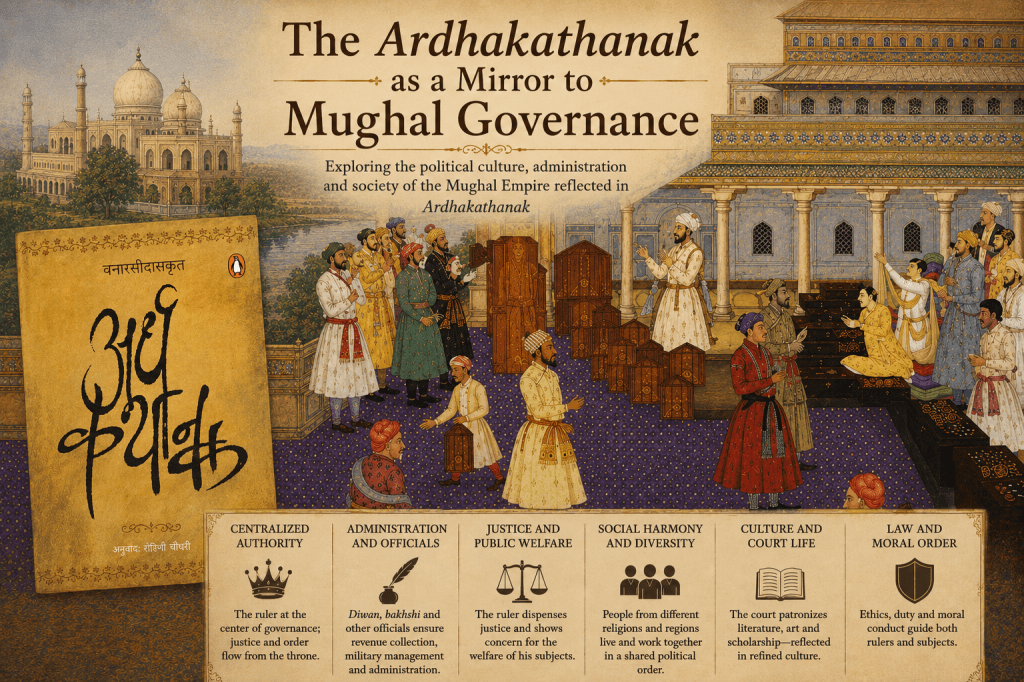
Banarasidas, a Shrimal Jain merchant who lived from 1586 to 1643, could not have known that his modest poetic autobiography would one day serve as a crucial corrective to some of the most persistent myths about Mughal India. Written in Braj Bhasha in 1641 and aptly titled Ardhakathanak or Half a Tale, this work stands as the first autobiography by a commoner in an Indian language. While official chronicles like the Akbarnama or the Padshahnama narrate history from the ramparts of the Red Fort, Banarasidas offers a view from the bazaar, the caravanserai, and the merchant household. As India completes over five centuries since the establishment of the Mughal dynasty, a concerted effort has been made in certain political discourses to discredit the Mughals as uniquely communal rulers who systematically suppressed Hindus. A dispassionate reading of the Ardhakathanak does not support this monolithic charge. Instead, it reveals a far more complex premodern society where state subject relations were defined more by the whims of local bureaucracy, economic interests, and personal loyalties than by religious bigotry. The truth of the Mughals, as experienced by a middle class merchant who dealt with them daily, resists the simplistic binaries of contemporary culture wars.
The Mechanics of Fear: A Society at the Mercy of Succession
The most vivid testimony Banarasidas provides is not about persecution but about the terrifying fragility of political order. When Emperor Akbar died in 1605, the merchant records a society that did not erupt in communal violence but rather collapsed into a state of paralysed anarchy. He writes, ghar ghar dar dar kiye kapaat, hatavaanee nahin baithe haat, which translates to at all houses, doors were kept closed; merchants stopped sitting at the shops. The wealthy buried their finery and account books underground, donned coarse blankets to disguise their status, and armed themselves. Banarasidas records the scene with unforgettable precision: The rich hurriedly buried their jewels and costly attire underground; many of them quickly dumped their wealth and their ready capital in carriages and rushed to safe, secluded places. Every householder began stocking his home with weapons and arms. The rich disguised themselves in coarse blankets so that, in his words, you could not recognize the status of a person, the rich and poor looked alike.
Such was the shock of losing the emperor that Banarasidas himself fainted, falling and cutting his head open on the stone floor, which turned red with his blood. He recounts, I was sitting up a flight of stairs in my house when I heard the dreadful news, which came as a sharp and sudden blow. It made me shake with violent, uncontrollable agitation. I reeled, and, losing my balance, fell down the stairs in a faint. This description is remarkable because it complicates the narrative of Akbar as merely a secular ruler or, conversely, a destroyer of Hindu places of worship. For this Jain merchant, Akbar’s death created a vacuum that threatened the very existence of the commercial class. It was not the emperor’s religion that mattered but his role as the guarantor of a predictable order. Interestingly, when Jahangir died years later, Banarasidas mentions it in a matter of fact manner without emotion. The people, bereft of their emperor, felt orphaned and helpless at Akbar’s passing, but Jahangir’s death passed with little recorded grief. This distinction suggests that the people’s loyalty was not religious but personal and conditional, based on perceived stability.
Interactions with the Bureaucracy: The Predatory Local and the Distant King
Contrary to the theory that the Mughal state was a monolithic theocratic machine oppressing non Muslims, the Ardhakathanak reveals a fractured bureaucracy. Banarasidas distinguishes constantly between the distant, often unknowable Emperor and the local officials who actually touched his life. The most damning incident involves Nawab Qilij Khan, the governor of Jaunpur. Without regard for religious affiliation, the governor arrested all the jewellers in the city, many of whom were Hindus and Jains, and demanded an extortionate sum. When the merchants could not pay, he ordered them lined up and flogged. The next morning, the jewellers held a collective meeting and decided to flee the city, taking their wealth elsewhere. They only returned months later when the governor had left for Agra.
Here, Banarasidas does not frame this as a Muslim ruler persecuting Hindus. He frames it as a classic premodern problem of local predation. The merchant’s solution was not religious resistance but mobility and financial resilience. Similarly, when Prince Salim, the future Jahangir, rebelled near Jaunpur, the city was turned into a fortress. The governor barricaded the city, stockpiled food, and prepared for a siege, leaving the merchants caught in the crossfire. In this world, the average subject feared the nawab or the faujdar more than the padshah, and they judged their rulers by their capacity to restrain local tyranny, not by their faith.
The merchant also reveals his own pragmatic proximity to power. He helped a Mughal noble read Jain texts in Sanskrit, demonstrating a cultural and intellectual permeability that defies communal stereotypes. At different times, he was a friend of the Nawab of Jaunpur, Chin Qilich Khan, and at other times, he was persecuted by him. He reportedly played chess with Emperor Shah Jahan, a fact that, while perhaps apocryphal, suggests the fluid social interactions possible in the Mughal court where merit and personality, not just religion, determined access. The state was not a monolith of benevolence. It was a hierarchy of predators, and the commoner’s goal was to survive the ones closest to the ground while hoping for the distant protection of the one at the top.
Economic Interdependence Over Religious Conflict
Banarasidas’s account highlights a robust economic ecosystem where trust was commercial and communitarian, not religious. He details a sophisticated system of hundis or promissory notes that allowed cashless transfer of wealth across the empire. He speaks of strict business ethics, the necessity of detecting counterfeit coins, and the importance of family networks. When he first arrived in Agra, a strange and intimidating city, he did not seek out co religionists for charity. He recalled his brother in law, Bandidas, proving that one could always rely on relatives.
Furthermore, the text reveals that the Mughal bureaucracy was not exclusively Muslim. Banarasidas’s father served in the revenue administration under a diwan who was a fellow Shrimal Jain named Rai Dhana, who in turn served under a Pathan governor of Bengal. This intermixing of elites across religious lines suggests an empire that functioned on the basis of shared class interests and administrative pragmatism rather than a rigid Hindu Muslim binary. The same state that arrested jewellers employed Jain financiers to manage its treasuries. This nuance is lost in the modern polemical discourse that seeks to flatten every Mughal action into a communal algorithm.
The Merchant’s Inner World and the Pull of Ordinary Life
Banarasidas does not only write about the state. He writes about the intimate pressures of his own life, revealing a man caught between the expectations of his caste and the longings of his heart. His family expected him to be a trader. He wanted to be a scholar and a poet. The elders admonished him with a line that speaks across centuries to anyone who has ever chosen art over commerce: Too much learning behoves a Brahman or a bhat, a bard. A merchant’s son has to sit in the bazar.
He was, by his own admission, not a very good businessman. He made bad decisions, incurred losses, and at one desperate point had to be bailed out by his wife, who gave him twenty coins from her dowry. His honesty about his failings is what makes him so modern. He also writes frankly about his youthful passions, contracting syphilis as a teenager, and his later turn towards religious realisation. In a line that reveals his introspective ambition for the entire project, he writes, All that I have heard, and seen with my own eyes, let me tell of those matters in my own words. This was a radical act. He was not writing for a patron. He was writing for posterity, for all who may read my story or listen to it or recite it to others. In a literary culture dominated by royal chronicles and religious hagiography, Banarasidas chose to make the ordinary extraordinary.
Revisiting History to Combat Contemporary Myths
The completion of over five centuries since the Mughals established their rule in Hindustan has unfortunately coincided with a wave of historical revisionism. There is a concerted effort to portray the Mughal period as a dark age of Hindu subjugation, ignoring the lived reality evidenced by sources like the Ardhakathanak. Banarasidas, a Jain who wore the sacred thread and practiced strict vegetarianism, did not live in constant fear of state sponsored conversion or temple destruction. He lived in fear of tax collectors, uncertain succession, and dishonest business partners. He worried about his health, his business losses, and his family’s disappointment in his literary pursuits.
When the state officials confiscated his money or when he lost precious jewels due to mice chewing through his pyjama strings, he recorded these as domestic and economic tragedies, not theological persecutions. The real story of the Mughal era, as seen through this half tale, is one of remarkable resilience of the merchant class, a syncretic culture where a Jain could help a Muslim noble with Sanskrit texts, and a political system that was deeply flawed and often predatory, but which was primarily driven by the logic of revenue extraction and power consolidation, not religious genocide. As scholar Aniket Tathagata Chhetry has noted, the text articulates the liminal spaces which merchants occupied in the premodern world, where they occupied a dual position of being both predator and predated upon.
Conclusion
The Ardhakathanak is more than a historical artifact. It is a political intervention from four centuries ago. It proves that the people of Hindustan had a sophisticated, critical, and non communal view of their rulers. They respected those who provided stability and criticized those who were corrupt, regardless of the ruler’s faith. When Banarasidas fainted at the news of Akbar’s death, he was not mourning a co religionist. He was mourning the guarantor of a world he understood. When he fled from a tyrannical governor, he was not fleeing a Muslim. He was fleeing a bad administrator. When his elders told him to stop studying and sit in the bazaar, they were not speaking as Hindus or Jains. They were speaking as merchants. This is the granular, messy, human reality that political polemic cannot accommodate.
By recovering voices like Banarasidas, we do not whitewash Mughal cruelty where it existed, but we do insist on complexity. We insist on the truth that the average Jain or Hindu merchant navigating the bazaars of Agra and Jaunpur had more in common with the average Muslim peasant or trader, who also suffered under a tyrannical faujdar or rejoiced at a stable harvest, than with the court historiography that pits them against each other. In an age where history is weaponised to divide, the candid voice of a merchant from 1641 reminds us that the past, like the present, was far too messy for the neat cages of communal identity. The Ardhakathanak stands as a quiet but definitive refutation of the claim that the Mughal period was nothing but a dark age of Hindu subjugation. It is the voice of a common man who lived through the reigns of Akbar, Jahangir, and Shah Jahan, and that voice tells us that the truth of the Mughals is not as told by court historians or modern ideologues, but as lived by a man who simply wanted to tell his own story. That story, a half tale of a full life, remains one of the most valuable historical documents we possess.


