Syed Ali Nadeem Rezavi
I write at a moment of profound political anxiety. In a state that was, until a week ago, constitutionally secular, committed to equal respect for all religions and the impartiality of the state in matters of faith, a newly appointed leader has declared that if he becomes Chief Minister, his government will be concerned only with the welfare of the single religious community to which he belongs. This statement, however hyperbolic or tactical, represents a fundamental rupture: it abandons the very idea of a common civic space in favour of majoritarian exclusivism. It is against this backdrop that the question of why one should remember the Mughals acquires an urgency far beyond the academic. For the Mughals, at their best, built precisely the opposite vision: a state that not only tolerated but actively engaged with, learned from, and sacralized the multiple religious communities under its dominion. To remember the Mughals is to recall that a plural, inclusive, and syncretic polity is not a Western colonial import but a homegrown achievement, one that was realised in South Asia centuries before modern secularism was theorised in Europe. And to forget the Mughals, as the new rhetoric of exclusive majoritarianism demands, is to willfully amputate the very civilisational memory that made the idea of a secular, composite India possible in the first place.
The Heirs to Ashoka’s Unfinished Project
Ashoka’s Mauryan Empire represented the first great continental unification, binding disparate cultures under a non-sectarian imperial ideology articulated through the Dhamma. Yet within half a century of Ashoka’s death, this unity dissolved into regional fragmentation that would last for nearly two millennia. The Mughals achieved what no post-Ashokan power had managed. From Akbar’s accession in 1556 to Aurangzeb’s death in 1707, a span of 150 years, the empire controlled or dominated nearly every corner of the subcontinent. This consolidation was qualitatively different from mere military conquest. The Mughals integrated conquered territories through a standardized mansabdari bureaucracy, a uniform revenue system (Todar Mal’s zabt), a common court language (Persianized Hindavi), and a single currency. A merchant in Surat and a peasant in Bengal operated under the same legal and fiscal framework, an achievement not seen since Ashoka’s edicts, and one that would later provide the administrative skeleton for the British Raj and the territorial imagination of modern India, Pakistan, and Bangladesh.
The Inclusive Society: Sulh-i-Kul and the Architecture of Coexistence
Political consolidation alone does not guarantee lasting memory; brutal empires are often remembered only to be cursed. What distinguishes the Mughals, particularly under Akbar and his immediate successors, is their deliberate, institutionalized project of inter-religious understanding. Akbar’s Sulh-i-kul (absolute peace or universal tolerance) was an ambitious, proactive engagement with religious pluralism. He dismantled the jizya (poll tax on non-Muslims) in 1564, removed pilgrimage taxes, and appointed Hindus to the highest military and civilian ranks. Man Singh I, Todar Mal, and Birbal became pillars of the empire. The Ibadat Khana (House of Worship) at Fathpur Sikri hosted not only Muslim theologians but Hindus, Jains, Buddhists, Zoroastrians, Christians, and even atheists. Jains influenced Akbar to ban animal slaughter during certain holy days; Jesuit portraits influenced Mughal miniature painting; and Hindu epics like the Mahabharata and Ramayana were translated into Persian (Razmnama), making them accessible to Persian-reading elites. The result was a composite culture, Ganga-Jamuni tehzeeb, where Hindustani classical music evolved under mixed patronage, where Urdu emerged from the fusion of Persian and Khari Boli, and where festivals like Holi were celebrated in Mughal courts while Muharram processions received Hindu participation.
Akbar’s Humility Before Hindu Wisdom
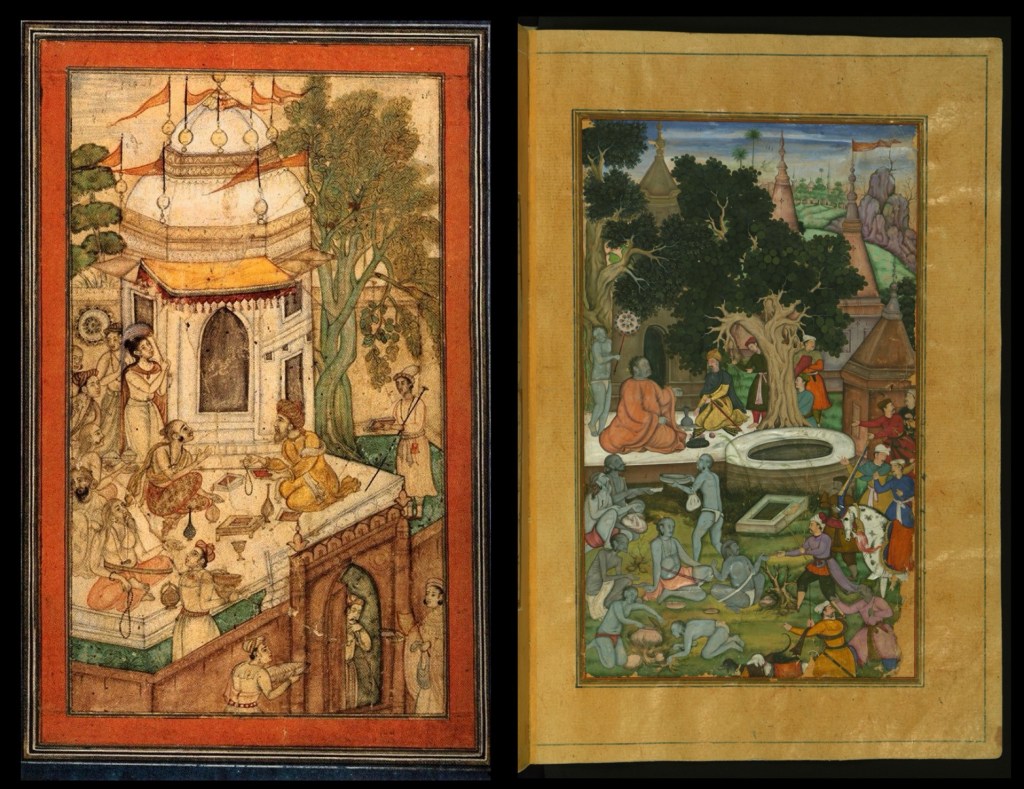
The depth of Akbar’s engagement with Hindu thought is best illustrated not through grand court debates alone but through intimate, symbolic acts of respect. Akbar regularly invited Hindu scholars, yogis, and mendicants to his court, treating them not as conquered subjects but as sources of spiritual wisdom. One striking episode involves a mendicant named Debi. Rather than summoning Debi as a supplicant, Akbar had a cot raised to the level of the jharokha (the imperial balcony from which the emperor appeared to his subjects), the highest symbol of royal elevation. Debi was made to sit on that raised cot, at the same level as the emperor, for a nightly discussion. This was not theater; it was a public declaration that a wandering Hindu holy man possessed a truth worthy of the emperor’s equal. Such acts of symbolic equality, raising a mendicant to the jharokha, transformed the very grammar of Mughal kingship, embedding into the imperial ethos the idea that wisdom transcends religious boundaries.
Jahangir’s Journey to the Cave: Vedantic Engagement
If Akbar brought saints to his court, his son Jahangir did something even more remarkable: he went to them. Jahangir’s Tuzuk-i-Jahangiri (Memoirs) records his deep curiosity about Vedantic philosophy and his personal encounters with Hindu ascetics. The most famous of these is his meeting with Jadrup Gosain (also known as Chitrup Gosain), an Upanishadic sage who lived in a cave near Ujjain. Jahangir did not summon Jadrup to the imperial camp; instead, the emperor, accompanied only by a few attendants, traveled to the cave, dismounted from his horse, and entered the humble dwelling of the ascetic. There, the ruler of Hindustan sat at the feet of a naked mendicant and discussed the nature of the soul, the illusion of the material world, and the unity of all existence, the core tenets of Advaita Vedanta. Jahangir records in his memoirs that he was profoundly moved by Jadrup’s wisdom and thereafter maintained a respectful correspondence with him. This was not mere political expediency; it was a genuine philosophical courtship. In an age when European monarchs were burning heretics, a Muslim emperor was crawling into a Hindu ascetic’s cave to learn about the Upanishads. This act alone, the emperor going to the saint, helped create an India where spiritual authority could be recognized regardless of religious label, a legacy that remains visible in the syncretic veneration of saints across communities today.
Shah Jahan’s Theological Elevation of Temple Worship
The tradition of inclusive respect continued under Shah Jahan, often remembered primarily for the Taj Mahal. Yet his farmāns (imperial decrees) reveal a ruler who went beyond mere grants to temples, which were plentiful under Akbar, Jahangir, and Shah Jahan, to a theological redefinition of Hindu worship itself. In one remarkable farmān, Shah Jahan declared that the ringing of the temple bell and the prayers offered before the deity in a Hindu temple constituted parastish-e-ilahi, literally “worship of God,” and declared such acts to be equivalent to prayers offered in a mosque. This was not tolerance; it was theological recognition. The Mughal emperor, as the defender of Islam in India, was asserting that the Hindu deity, worshipped with bells and offerings, was the same God worshipped by Muslims in their mosques. This statement, emerging from the imperial chancery, effectively sacralized the Hindu temple as a legitimate space of divine worship under Islamic sovereignty. Such a declaration would have been unthinkable in any contemporary European or West Asian court. It helped create a civilizational ethos in which multiple paths to the divine could be legally and theologically recognized, an ethos that, however frayed, remains central to the Indian constitutional promise of equal respect for all religions.
Dara Shukoh and the Upanishads: A Philosophical Bridge
The Mughal commitment to mutual understanding reached its philosophical zenith under Dara Shukoh, the Sufi-leaning crown prince of Shah Jahan. Between 1656 and 1657, Dara completed the Sirr-i-Akbar (The Great Secret), a Persian translation of fifty Upanishads. In his introduction, he made a stunning claim: the Upanishads were the Kitab al-maknun (the hidden book) referred to in the Qur’an, and the Qur’an and the Upanishads were twin explications of the same monotheistic truth. This was not mere academic curiosity; it was a radical act of theological synthesis. Had Dara succeeded Aurangzeb instead of being executed, South Asian intellectual history might have taken a dramatically different turn. But even in failure, his translation proved monumentally consequential. The Sirr-i-Akbar was acquired by French scholar Anquetil Duperron in the 1760s, who translated it into Latin (1801-1802). That Latin version reached the German philosopher Arthur Schopenhauer, who called the Upanishads “the most profitable and elevating reading… possible in the world.” Thus, a Mughal prince’s heretical curiosity introduced Vedantic philosophy to German idealism and, through it, to global thought. But for Dara’s attempt to draw parallels between Hinduism and Islam and his daring elevation of the Upanishads as heavenly books, the world might have remained ignorant of these foundational texts for centuries longer.
Akbar’s Rationalism and the Secularisation of Education
Akbar’s religious curiosity was undergirded by a deeper commitment: the primacy of reason (aql) over blind imitation (taqlid). In the Ibadat Khana debates, Akbar famously declared, “The pursuit of reason and the rejection of taqlid… are the foundation of my faith.” This rationalism had direct pedagogical consequences. Akbar reformed the imperial madrasa curriculum to include, alongside traditional religious sciences, mathematics, astronomy, medicine, geography, agriculture, logic, and philology. He patronized illustrated scientific manuscripts, including translations of Euclid’s Elements and the (a Sanskrit astronomy text). This was not a “Muslim” or “Hindu” education; it was a secular, empirical education designed to produce competent administrators, not dogmatists. This tradition, shattered by the orthodox reaction under Aurangzeb and then systematically erased by British colonial education, which privileged English letters over Indic sciences, is the hidden prehistory of South Asian rationalism. The modern Indian scientist, the skeptical intellectual, the believer in evidence over scripture: all owe an unacknowledged debt to Akbar’s insistence that reason must sit in judgment over revelation.
The Mughal School of Painting and the Birth of Humanism
The Mughal School of painting, forged in Akbar’s karkhanas (workshops) by Persian, Hindu, and Jain artists, introduced a radical humanism into South Asian visual culture. Prior Indic painting was largely hieratic or narrative, focused on deities, prophets, or flat iconographic conventions. Mughal painting, by contrast, delighted in the ordinary: a partridge preening, a gardener tying his turban, a cat toying with a mouse, a courtier sneezing during an audience. The naturalism was unprecedented, with birds identifiable to species, foliage studied from life, and portraits capturing individual physiognomy (warts, wrinkles, and all). This was an art of observation, not prescription. It reflected the same rational, secular gaze that Akbar brought to religion: the world could be known through careful looking, without divine mediation. The masterpieces, the Baburnama illustrations, the Akbarnama battle scenes, the Tuti-nama animal fables, constitute a visual archive of the everyday, a celebration of human activity as worthy of artistic attention as any god or prophet. This humanist turn directly influenced later Company painting, Raja Ravi Varma’s realism, and even early Bollywood aesthetics. To forget Mughal painting is to forget that South Asian art once escaped the temple and the shrine to look, with clear eyes, at the world of men and women.
Secularising the Art of Building Construction
The Mughal contribution to architecture is often reduced to the Taj Mahal, a tomb, and therefore a religious structure. But this misses a deeper revolution: the Mughals secularized monumental construction itself. Prior to the Mughals, large-scale stone building in India was overwhelmingly religious: temples, stupas, mosques, monasteries. Royal palaces were often perishable or integrated into temple complexes. The Mughals pioneered the garden-tomb as a typology that was simultaneously memorial, botanic, hydraulic, and recreational, neither exclusively sacred nor profane. They perfected the pietra dura (hard stone inlay) technique for geometric and floral motifs that carried no inherent religious symbolism. They built serais (roadside inns), baolis (stepwells), karkhanas (manufactories), bridges, and entire planned cities (Fatehpur Sikri, Shahjahanabad) with monumental gateways, markets (chandni chowks), and public baths (hammams). The red sandstone and white marble vocabulary they developed, including archways, chhatris (pavilions), and jharokhas (overhanging balconies), became a secular architectural language, adopted by Rajput courts, Sikh gurudwaras, British colonial bungalows, and even modern Indian parliament buildings. When a contemporary Indian sees a municipal building with a large arched window or a garden city with water channels, he or she is seeing the ghost of Mughal secular construction. The art of building, in South Asia, owes to the Mughals the idea that architecture can be magnificent without being divine.
The Necessary Inheritance Against the Present
One should remember the Mughals precisely because they offer a living, homegrown counter-model to the exclusivist majoritarianism that a newly appointed leader, in a state secular until a week ago, now threatens to institutionalize. When a Chief Minister declares that his government will concern itself only with the welfare of his own religious community, he repudiates the very logic that allowed the Mughals to rule for three centuries over a subcontinent of immense diversity. The Mughals did not merely tolerate Hindus, Jains, Sikhs, Christians, and Zoroastrians; they raised mendicants to the jharokha, traveled to caves to learn Vedanta, declared temple bells to be the worship of God, translated Upanishads into Persian, reformed education to include reason and science, humanized painting, and secularized architecture. They helped create an India where, for centuries, a Muslim emperor could sit at the feet of a Hindu ascetic, and where a royal decree could declare that the ringing of a temple bell reaches the same divine ear as the call to prayer from a mosque.
To remember the Mughals is to remember that secularism and pluralism are not Western impositions but indigenous achievements. To forget them, or to reduce them to caricatures of foreign despots, is to willfully blind ourselves to the very civilisatory memory that made the idea of a composite, inclusive India possible. That memory is not nostalgia; it is a weapon. It is the historical evidence that exclusive majoritarianism is a choice, not an inevitability, and a disastrous choice at that, one that unravels the syncretic fabric woven over centuries by emperors who understood that power without humility, governance without inclusivity, and sovereignty without curiosity are ultimately brittle and self-defeating. The Mughals, in their finest hours, shaped what we are today. In an era when that inheritance is under direct assault, to remember them is an act of intellectual resistance and political hope. It is to insist that another India is not only possible but has already existed, and can exist again.


