Lalkot to Siri: The Delhi Before Tughluqs

The area around the Qutb complex, known as Lalkot, is the earliest defense work in Delhi created by Anangpal II, who is also credited to have brought the Iron Pillar of Chandragupta II, which now stands in the Quwwat ul Islam.
The massive walls and bastions of the Lal Kot enclose the Qutb complex, the Anangtal and some other mounds. It is pierced by a number of gates.


According to Cunningham (I, p. 151), its date of construction is between 1052-60. He reaches this conclusion on the basis of the Mehrauli Iron Pillar Inscription:

Samvat Dhilli / Dhihali 1109 Ang Pal Bahi”, i.e., “ In Samvat 1109 [1052 AD], Ang [Anang] Pāl peopled Dhilli”.

Buddha Rashmi Mani (1997), the archaeologist who took up some excavation work there and wrote a book on Delhi, read it as follows:

Samvat Kinllī 1109 Aṅgapāla bādi [Anangpal tightened the nail [iron pillar] in Samvat 1109]

Then we have two manuscripts, obtained from Garhwal and Kumaun regions which mention that Anangpal II built the fort in Samvat 1117 / AD 1060.

Perhaps taken together, one may gather that construction was started in 1052 AD, and completed in 1060 AD, eight years later.

The term Dhillika first appears in the Bijhli rock inscription found in district Udaipur, Rajasthan which was issued by the Chahamana (Chauhan) ruler Someshwar in VS 1226 / 1169-70 (Epigraphica Indica, XXVI, 1941-42, no. 9, pp. 84-112).

Iron Pillar in the courtyard of Qubbatul Islām Mosque, Delhi

According to Meera Dass and R. Balasubramaniam (2004) the iron pillar was originally erected at Udayagiri in Madhya Pradesh. And as per the inscription cited above, it was relocated to Delhi by Anangpal. Later when the Turks built the city, it was either Aibek or Iltutmish who had it fixed within the congregation mosque.


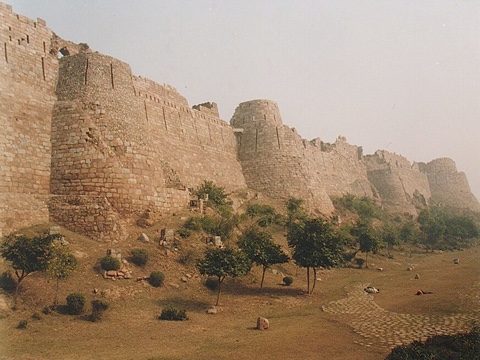
The circumference of the ramparts is nearly 3.6 Km with varying thickness ranging between 3-9 m. The ramparts are surrounded with a ditch and the height of the ramparts is nearly 20m at some places. At intervals are semi-circular bastions.


Later on around 12th Century, Vigraharaja IV, the Chauhan (Chahamana) ruler of Sakambhari captured the Dhillika of the Tomaras. His grandson, Rai Pithora (Prithvi Raj III) extended this Lal Kot by throwing up massive ramparts around it. This enlarged city came to be known as Qila Rai Pithora, which was captured by Aibek in 1193.

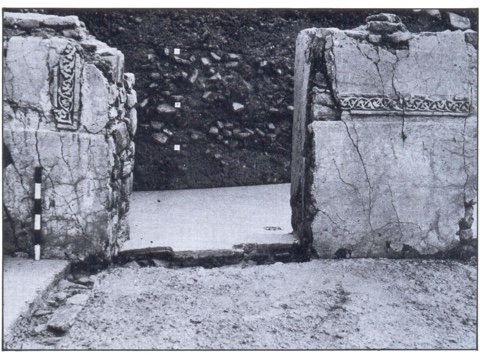
Ramparts of Lalkot

In the 12th Century, the Tomar Rajputs were overthrown by the Chauhans of Ajmer who built the Qila-i Rai Pithora (Prithvi Raj III) with massive stone ramparts to defend it from the Turks. For this period, we have the bardic poem, Prithviraj Rāso composed by Chānd Bardai, which mentions that the fort here was in fact built by Prithviraj Chauhan [Prithviraj III].

Chand Bardai, is supposed to be Prithviraj’s court poet, who accompanied the king in all his battles. Chand Bardai, whose traditional occupation was to compose poems and ballads in praise of their patrons, based this ballad loosely on historical incidents. These balladeers were poets and scribes who accompanied the armies of their patrons and encouraged and exhorted the warriors to bravery in battle by reciting the great deeds of their illustrious clan forebears.
Over time, the Prithviraj Raso has been embellished with the interpolations and additions of many other authors. Only a small portion of the existing texts is likely to have been part of the original text. Several versions of the Prithivraj Raso are available, but scholars agree that a small 1300 stanza manuscript in Bikaner is closest to the original text. The longest available version is the Udaipur manuscript, which is an epic comprising of 16,306 stanzas. The language of the texts available today largely appears to be post-15th century.


The ramparts of this fort were pierced with 13gates, three of which open into the future city of Jahanpanah. The Badaun Gate towards the east is the most elaborate and well-known of these 13 gates. And if we believe Ibn Batuta, this was probably the main gate through which the city could be entered. And by the time Delhi was captured by Aibek, it already possessed 27 Hindu and Jain temples.
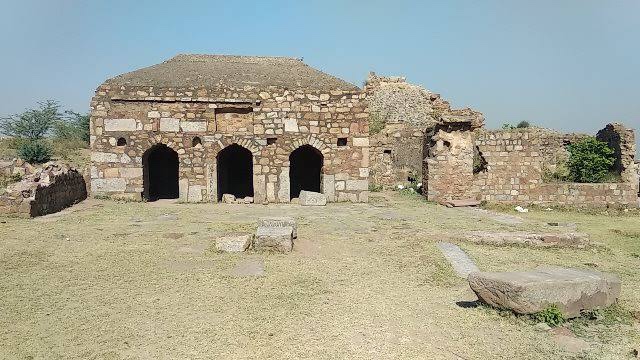
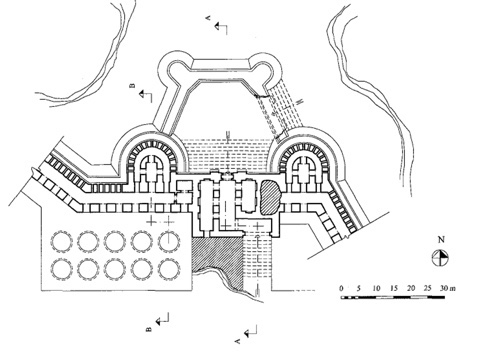
Dhillika under the Chauhans was but a provincial outpost. Excavations conducted in the area suggest that the Lal Kot was divided into two parts – the original western section, and a later eastern division. Y. D. Sharma, through his excavations brought to light structural remains of a Gate, ‘the Bhind Gate’ of the original Lal Kot.


Excavations have also proved that the extension of the Lal Kot towards the east was the area in which the Turkish Sultans and the Khaljis built their structures. Palaces like Kushak-i La’l (Ruby Palace) and the Kushak-i Sabz (Green Palace) were towards this side. J.D. Beglar had noticed large quantities of green enamelled tiles with Arabic inscriptions and ornaments, as well as corner and portions of a floor of a well plastered structure at the back of the Qubbat ul Islam Mosque. This tallies with the information given by Minhaj us Siraj, who tells us that the mosque stood outside the Lal Kot. Firishta also gives us the same type of information. While discussing the details of Haji Maula’s conspiracy, which was subdued by Malik Hamid, the foster-brother of Alauddin Khalji, Minhaj tells us that Hamid entered the Old City through the Ghazni Gate and crossed through Bhind Gate where he killed Haji Maula. Then he went to Kushak-i La’l and slew another rebel. Firishta, at another place tells us that after the retreat of Mongol invaders, Qutlugh Khan and Targhai Khan, Alauddin constructed a palace and directed the citadel of Old Delhi (Lal Kot) to be pulled down and built anew.


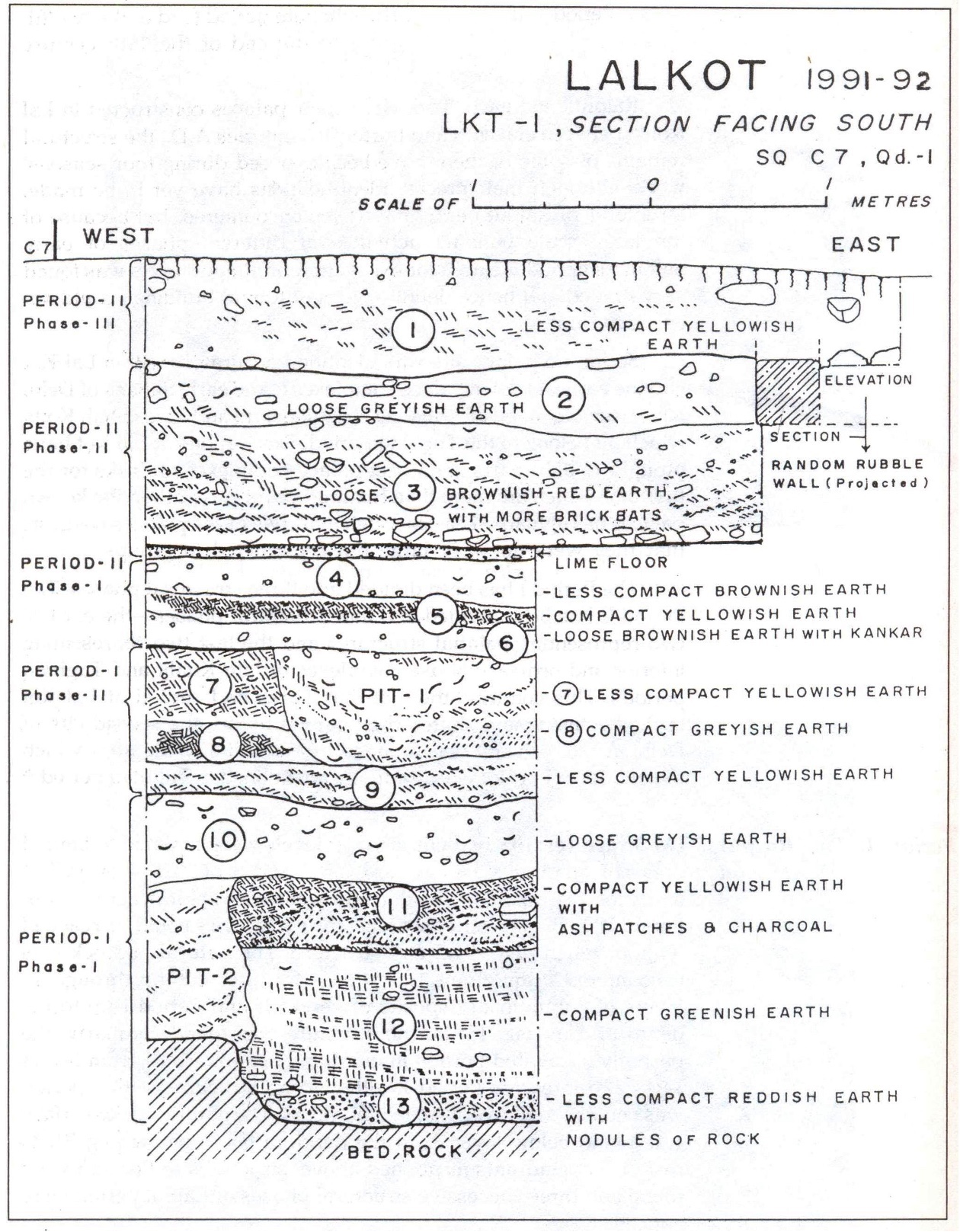
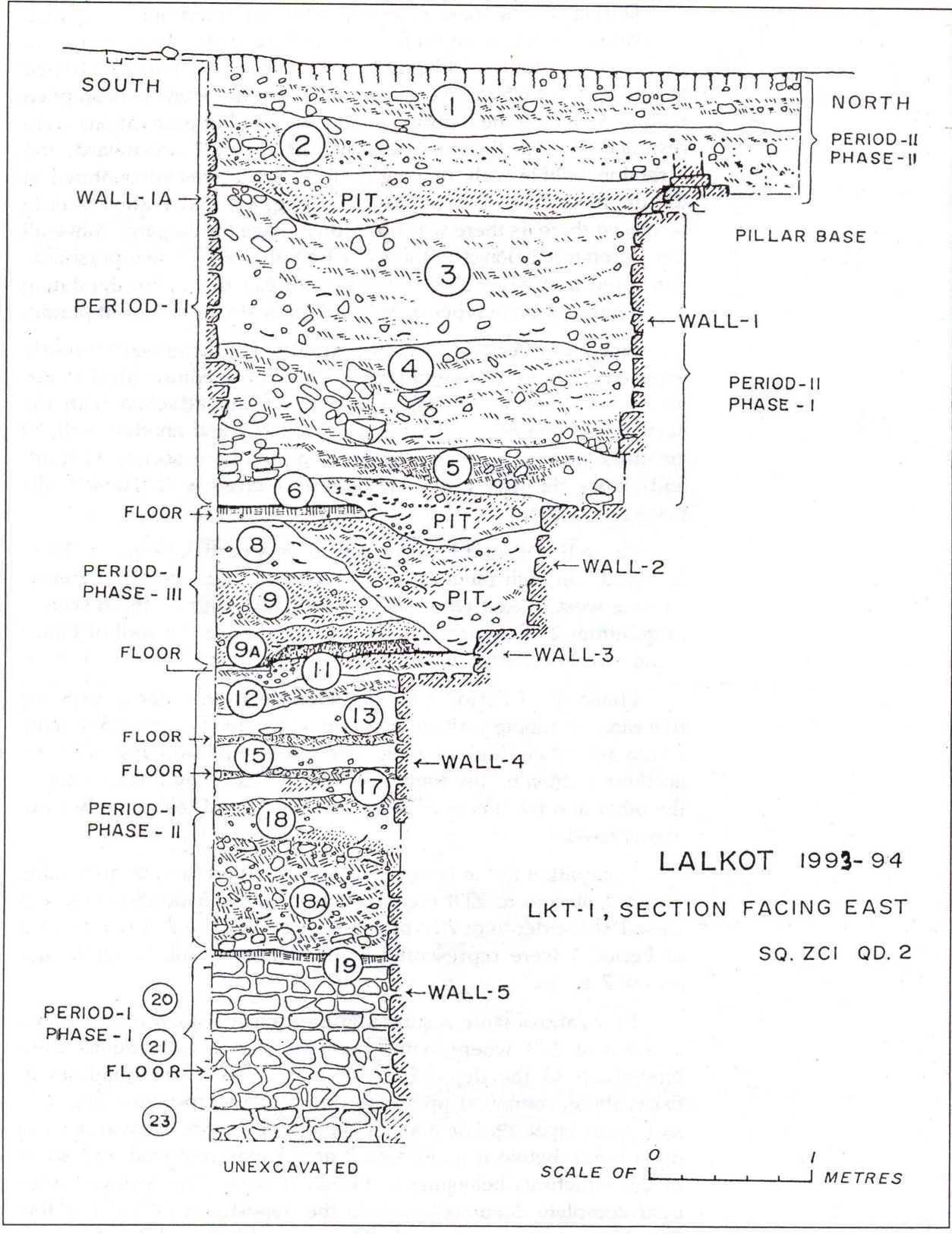
Excavations were then undertaken at Lal Kot area under the charge of B.R. Mani between 1991-92 and 1994-95. These revealed a sequence of two cultural periods:
Period I – Rajput Period (middle of 11th C to the end of 12th C)
Period II – Early Sultanate (end of 12th Cent to end of 14th C)


Period I was found divided into three structural phases all of which were generally represented by mud floors and rubble walls with medium sized stones set in mud mortar. In Phase III were encountered two floors of red murram and mud.


In this Period I one thus encounters either mud floors or mud floors mixed with lime finish. Two plastered drains were also noticed. At one spot remains of ochre painting were found over mud plaster on a wall. Ceramic industry included red ware, both plain and decorated. Black slipped grey ware were also encountered.


The Period II (Early Sultanate) is represented by four structural phases. Rooms with water cisterns and drains lined with lime plaster, Lime plastered water tanks and lime floors are encountered. In the succeeding phases, the drainage is covered with stone chips and fresh lime floor. ‘Rajput Style’ pillar bases, probably supporting wooden canopy are also found.
Another notable feature of this period is the use of brick-masonry for the construction of the water cistern, tank, small alcoves and the upper parts of the random rubble wall. All the structures have fine or decorated lime plaster, white in colour in which the decorated parts were probably painted with red colour. The structures were provided with fine lime floors. The ceilings were also probably provided with decorated lime plaster. The fragments of lime plaster of ceilings, decorated with undercut designs of flower were recovered from the debris.


The pottery of this Period II is also quite distinct. Glazed ware, both of sandy friable as also of ordinary terracotta core was profusely used. Foreign ceramics was another notable feature: (a) Chinese celadon ware; (b) fine quality of thin, monochrome & polychrome glazed ware; (c) some sherds of Chinese porcelain. Red ware and Grey ware are also encountered.


Shift Towards Yamuna and a ‘New City’:


It appears that the Dihli-i Kuhna (the Lal Kot / Qila Rai Pithora / Dhillika), the Old Delhi, along with the Hisar-i Nau (the New Fort) – the eastern extension of the Lal Kot – had a natural problem: the problem of water supply. It was situated 18 Km from the river. Dry wells have been excavated outside the Badaun Gate of Lalkot.

To rectify this issue, Sultan Iltutmish built the hauz-i Shamsi (Tabaqat-i Nasiri). Barani mentions that when in 1260’s the Meo’s rebelled, they obstructed the water-carriers and slave girls from filling water from the hauz-i sultani. From the Futuhat-i Firuzshahi we come to know that the channels feeding this tank also dired up as they were ‘dammed’ by ‘dishonest people’. Firuz Shah had to endeavour to get it back in working order.

According to Ibn Batuta, it was 2 mil long and one mil broad. However if you take its dimensions today, they are 200 metres by 125 metres. It is situated approximately 3 Km north of the Qutb complex. Probably, the difference is in the understanding of the term mil, which was definitely much shorter than the English mile. This tank fed with rain-water drained from the higher catchment areas on the ridge, was thus not enough to meet the requirements of the town.


Thus we find a gradual shifting of the city towards Yamuna. First a suburb, Ghiyaspur (during the reign of Ghiyasuddin Balban) developed. It was established near the khanqah of Nizamuddin Auliya. The distance between Ghiyaspur and the Dihli-i Kuhna was around 7 miles as the crow flies.


Between this settlement of Balban and the Yamuna, Balban’s successor Muizzuddin Kaiqubad, according to Zia Barani, built a walled palace (qasr), which was known as Kilokhari. According to Shaikh Nasiruddin (Khairul Majalis), it was half a kuroh (less than a mile) from Ghiyaspur. The palace was towards the river and between the two, Jalauddin Khalji is said to have laid out a garden. The Shahr-i Nau (the New City) developed during this reign around this palace.


According to Barani, the Sultan ordered the nobles and other great men to build their mansions and other large edifices in this area. Large markets were also established. And all this was surrounded with a great stone fortification. Its suburbs included areas around Indarpat and a place known as ‘Bakula’ where Mongols were settled – these areas were also known as Mughulpuri.


It was in 1952 that Olaf Prufer excavated Kilokhari {Report on the Trial Excavations carried out at Khilokhri, Delhi, 1952}
These excavations were conducted near the village Jogabai at a mound 100 × 100 m, having a height of 6 metres. They revealed two phases of structural activity at the site:


a. Pre-Tughluq: in which generally constructions of brick masonry are encountered; and


b. Tughluq: where we find constructions which are of stone masonry


From the excavations it also becomes apparent that the area was abandoned due to some invasion: thick ashy deposits mixed with unburied skeletal remains.
Glazed ware along with red ware, black slipped grey ware as well as ‘foreign ceramics in the form of Chinese pottery is also encountered.


Both Barani and Isami (Futuh us Salatin) inform us of ferocious Mongol invasions of Qutlugh Khwaja and Targhi Beg on Delhi.[ And then of course, the invasion ans sack of Delhi by the forces of Timur at the end of the Tughluq reign.] Thus Alauddin Khalji was forced to revert back to the rocky zone once again. To quote Barani:


The terror of the Mongols became all pervasive. Mughal horsemen began to come up to the Chabutara-i Subhani and the villages of Mori and Hadhi, and the banks of the hauz-i Sultani – after the disaster of Targhi’s invasion – which was a great disaster – Sultan Alauddin woke up from his sleep of negligence and gave up the projects of taking away the army on campaigns and reducing forts (in India). He now built his palace (kushak) in Siri and began to reside at Siri; he designated Siri his capital (darul khilafah) and made it well populated. He also built up the fort of Old Delhi.
Siri was in fact a plain wasteland (sahra) situated to the northeast of Shahr-i Kuhna.

Yazdi in his Zafarnama gives this directional information. Initially this settlement at Siri was called Lashkar or Lashkargah, army encampment or cantonment in contrast to the area around the Qutb which continued to be called the Shahr. Around 1317 AD, Nizamuddin Auliya in one of his recordings in Fawaid ul Fawad (Amir Ahmad Sijzi) comments on the distance between the Shahr and the Lashkar. A few years earlier, in 1314, Amir Ahmad Sijzi had a house built at Lashkar and used to pray in the Jama Masjid of Kilokhari. It was only around 1318 that Lashkargah (Siri) came to be nomenclated as Darul Khilafah, a fact which is corroborated by Ibn Batuta and Zia Barani.


The area of Siri was first identified by Cunningham who identified it with a vast area enclosed by raised mounds of earth near the village Shahpur Jat. The enclosed area is roughly 1.7 sq kilometres and aligns with what Yazdi described of Siri: it was a circular walled enclosure (sura). The main city however continued to be the area of the Qutb where Alauddin kept up his architectural projects: it was still the shahr, while Siri and Kilokhari were the Darul Khilafa and the shahr-i nau. The grand cloth market of Alauddin Khalji was located within the precincts of the Badaun Gate in the direction of Kushak-i Sabz. According to Barani it was known as Sara-i Adl. The grain market, the mandi, was situated near another gate of the city, the Mandvi Darwaza.


Further works to retain water were undertaken. The hauz-i sultani of Iltutmish was redug and resilted. Another tank, the hauz-i Alai or the hauz-i khas, about 2 miles north of the Qutb was dug. According to Carr Stephen it was square with each side measuring some 600 metres and a total space of 70 acres. Yazdi calls it as daryacha (a small sea) which would be filled during the rainy season and took care of the annual needs of the city inhabitants. The catchment area of this tank was the area now occupied by the IIT and the JNU where some of the channels are still visible.


Excavations at Siri were under taken by Raghbir Singh in 1976-77. They revealed the traces of the fortification walls built of undressed rubble laid in lime mortar. It was oval in plan with bastions at regular intervals. It further revealed single culture occupational deposit datable to early 14th Century

• Syed Ali Nadeem Rezavi

Sources For Akbar’s Reign

Abul Fazl presenting Volume One of Akbarnāma to Akbar


The study of the sources of Akbar’s reign is a topic which has to be tackled in three parts, viz.
• A general Survey of the sources: the broad categories
• Abul Fazl’s approach to the study of history; his world out-look with special reference to Ain-i Akbari
• Basic structure of Badauni and his Muntakhab ut Tawarikh; his world out-look and also the general bias that we find in his historical writings.

General Survey:


The sources are mainly written in Persian language and their total number is very large for this period. It is possible to place the sources we have for the Akbar’s reign under different categories, keeping in mind the world out-look and political loyalties of the authors, their cultural predilections, their social status and also keeping in mind the themes with which their work is primarily concerned.


If we try to work out the characterization of our sources, both primary and some later sources giving primary information of this period, we may get the following seven categories:

1. Official Histories

2. Semi-Official Histories

3. Histories written by theologians (ulema)

4. Insha collections

5. Regional histories

6. Biographical Dictionaries

7. Later sources and histories

There were other sources also – for example the Jesuit Portuguese Fathers writing letters and reports to their superiors in Goa and Lisbon – comprising very interesting sources of information. We also have Traveller’s Accounts, for example that of Finch, who came during the reign of Akbar, or the Ottomon traveller Sidi Ali Reis, whose ship wrecked and he came to Delhi on the eve of Akbar’s accession. The accounts which he left behind for just before and after Akbar’s accession are the only accounts of these political and eventful days.


We also have a very large number of inscriptions and coins of Akbar’s time. Then we have quite a considerable number of original documents of Akbar’s reign which add much to our knowledge on the period under consideration.

Akbarnāma & Tarīkh i Alfi:

Let us start with the Official Histories.
Amongst the official histories we have Akbarnama compiled between 1593-94 – 1597: The last portion of the volume III was completed sometime in 1597. Another important source of this category is the Tarikh-i Alfi compiled in 1582 and completed in 1588.
Then we have the Takmila-i Akbarnama. It is in a way a continuation of the Akbarnama after 1597. But it is an account which is in a different style and a different approach. This was written as a concluding part after the assassination of Abul Fazl in 1602 by Faizi Sirhindi. It covers a period from 1602 to 1604.
Official histories are important as they project the official version of the contemporary events as well as of past developments which naturally tend to be in conformity with the cultural predilections or leanings of the monarch under whose perusal such works are produced. They are actually in the nature of justification of many of the measures taken by a particular ruler.


Therefore it is indeed very useful that in Akbar’s reign we have two official histories written at different times – one is from an early stage during his reign and the other was completed at the end of his reign when he had adopted his policies for which his reign is distinguished. A comparison of the interpretations of the same events in the two works enables us to ascertain as to what the main stages were through which his main outlook was passing through and how they were being perceived. For some events and policies we have one interpretation in the Tarikh-i Alfi, while another is given in the Akbarnama which was completed 10 – 15 years after the former.


Tarikh-i Alfi, as its name indicates, was conceived by Akbar as a comprehensive history of the first millennium of the Islamic era. It was undertaken towards the close of the millennium and the idea was that in this book the account which began from the dawn of Islam would be brought till the end of 1000 years. The task of compiling this work was entrusted to a team of historians consisting of Mulla Ahmad Thattavi, Asaf Khan and Abdul Qadir Badauni.


The book was planned as the history of the world in which the political developments in the then known world were to be put under individual chapters. But the era used here is not exactly the ‘Islamic’ era. In fact Akbar altered the Islamic era by calculating it not from the hijrat i.e., 622 AD but by calculating it from the date of Rihlat, i.e., Prophet’s demise in 632 AD. The justification that Akbar gave for this change was that, as Abul Fazl says, it is not proper to start the Islamic era from an episode which actually represented the temporary success of forces of evil. Its better to start it from the date of the Prophet’s demise which is a more momentous date. Therefore the years under which individual chapters were organized were rihlat years and not hijrat years.


The chapter would open with developments at the Mughal court of a particular year; it would then abruptly switch to an account of events on the Ottoman empire of the same year before recounting the events that took place in the Safavid court, the Uzbeks and then back to the Deccan for the same year. This was quite an arbitrary approach which squeezed in varied information in one single chapter. Thus this is a narrative of dis-connected events and happenings in different parts of the world.

In fact we do have at our disposal one interesting work providing an insight in the manner in which this book was compiled. This is a work preserved in the Khuda Bakhsh Library at Patna known as Tarikh-i Khandan-i Taimuria. The only copy of this work that has survived contains paintings in large numbers by some of the well-known painters of Akbar’s court which is testimony to the fact that it is a manuscript which was completed at Akbar’s court. Like Tarikh-i Alfi in this book also the account is divided into chapters that commence with rihlat years. But this is only an account of the political history of the Timurids from the time of Timur to that of Akbar in 1576. If one compares the account of the history in this book with the passages on Timurid history in the yearly account in the Tarikh-i Alfi, one will find that this account is exactly the same as given there. This goes to indicate that perhaps Tarikh-i Alfi was initially compiled by its team of authors as separate histories each of which was divided on an yearly basis. And then these accounts were put together to create and constitute a large account represented by Alfi.


Badauni tells us that the Timurid account was compiled mainly by Ghiyasuddin Asaf Khan. Thus we can say that the Khuda Bakhsh manuscript was authored by Ghiyasuddin Asaf Khan.


So far as the nature of this source is concerned, this source included some facts omitted in the Akbarnāma. In this official history written in 1582, some information later suppressed in official history is re-produced without any inhibition. This would naturally indicate that by this time Akbar had not yet arrived at a state of mind to suppress some developments of the earlier period that did not present some people close to him in a favourable light.


For example, in Tarikh-i Alfi it is mentioned that at the time of Tardi Beg’s execution in October-November 1556 Bairam Khan had succeeded in securing the co-operation of Akbar’s favourite wet-nurse Maham Anaga through bribery. This fact is missing in the Akbarnama. According to Akbarnama she was against Bairam Khan from the very beginning and organized Bairam’s downfall in 1560.
This indicates the manner in which a tailored history was prepared by Akbar; and which facts Akbar was subsequently trying to hide.
Another similar discrepancy between the two accounts regards the capture of Hemu. In the Akbarnama Abul Fazl devotes a long passage to the famous episode of Hemu’s capture at the Battlefield and his execution at the hands of Bairam Khan after Panipat. Abul Fazl says that when Hemu was brought before Akbar in a wounded state, Akbar refused to raise his own hand towards him and attributes a full speech to the effect that it is not right to attack a man injured. This was to shift the blame on Bairam Khan. Abul Fazl was trying to build a particular image of Akbar which shows him generaus and farsighted.


But in the Tarikh-i Alfi the episode is narrated in total frankness: the speech attributed to Akbar is not quoted here. It is possible that Akbar invented it to Abul Fazl who incorporated it. But what is important to note is that till 1582, Akbar did not had it included and that it is not reproduced in the account written in 1582.


Thus a reading of both the accounts helps us understand how the political image of Akbar and his history was being tailored.
Similarly in the Akbarnama Abul Fazl makes an explicit statement that Akbar had abolished jizya and the Pilgrimage tax in 1562-64. Abul Fazl goes out of his way to explain the significance of this on Akbar’s Rajput Policy. Jizya was not justified and Abul Fazl denounces earlier rulers for imposing it. Now, he says, relief was provided to the non-Muslims.


But then, these two measures are not mentioned in the 1582 text! It is not to suggest that Abul Fazl invented them; perhaps these orders were there but were not enforced in a regular manner and even Akbar did not give much importance to them. He did not regard them as great achievement. But in the subsequent history, attempt was made to give an impression that they were the starting point of Akbar’s religious policy. When subsequently the principles of sulh-i kul were evolved, they were mentioned with great fanfare!


Apart from all this, certain sections of Tarikh-i Alfi relating to Babur and Humayun are important as they were copied by later Mughal histories of Babur and Humayun’s reign.

Semi-Official Histories:

So far as these are concerned, they are histories written by persons in imperial service or one of those who was a noble at Akbar’s court at the time when he wrote his account. These accounts were written by these persons in their individual capacity and not on the order of the king. They were generally written on their own initiative. But at the same time as they identified themselves with the Mughal state and were involved in its working, they tended to give an imperial bias which does not reflect changing situations and policies at the court. Their information tends to justify the role of the authors or that of their immediate superiors and employers.


In this connection one can list the following:
a) Nafais-ul Ma’asir, Alaud Daulah Qazwini (c. 1575)
b) Tarikh-i Akbari, Haji ‘Arif Qandhari (1580’s)
c) Tazkira-i Humayun wa Akbar, Bayazid Bayat (1590)
d) Tabaqat-i Akbari, Nizamuddin Ahmad Bakhshi (1594)
e) Risala-i Asad Beg, Asad Beg (1604)

One thing that is common to all of them is that the authors of these histories were in the service of the Mughal state in one or the other capacity. Some were minor or important nobles. Nizamuddin Ahmad was an imperial bakhshi of the central government. Similarly Alauddaulah Qazwini was the son of a distinguished Persian scholar Khwaja Abdul Latif Qazwini who came in 1555 and had acted as Akbar’s ataliq during the last one year of Humayun’s reign.


But then, Bayazid Bayat was a petty officer who could reach to the position of 200 sawars towards the end of his career as a mansabdar. However, he was close to the royal family and had access to them as a close servant. At the time of writing his account, he was not a regular noble.


Same was the condition of Arif Qandhari who was in the service of Bairam Khan. Later he served Muzaffar Khan. At the time of writing he was still in the service of the same noble.
So far as the Nafais ul Ma’asir is concerned, it comprised two sections, one is the political history of the Mughal rule in Hindustan from the time of Babur’s conquest in 1526 to 1575 – the conquest of Bengal.


The second part comprises of biographical notices of poets etc which are not found anywhere else. Much information contained in the III volume of Badauni on the biographies the contemporaries is drawn from Nafais-ul Ma’asir.


Tazkira-i Humayun wa Akbar is more a memoir than a regular history. A great significance of this account is that Bayazid’s account of Akbar is focussed mainly on developments taking place in different provinces where Bayazid was staying and posted at different points of time.


In fact Bayazid joined the service of Munim Khan Khan-i Khanan in 1555 and stayed with him at Kabul down to 1560. For this crucial period, Bayazid’s account helps us to understand how the Mughal nobles placed at a long distance to the court were reacting to the tussle that was going on at the court between the regent Bairam Khan and his opponents.
Subsequently Bayazid was made the in-charge of Munim Khan Khan-i Khanan’s jagir at Hisar Firuza where he remained between 1560 and 1567. Again during this period his account is the only account helping us to understand what repercussions’ were created in a provincial town due to the events taking place at the court. For example, when in 1562 Mirza Sharafuddin revolted against Akbar he escaped towards Hisar Firuza and much fighting took place between him and the royal officers in the vicinity of this town where Bayazid was stationed. So there is an account of the manner in which military operations against Sharafuddin were organized.
Subsequently Bayazid stayed with Munim Khan at Jaunpur from 1567 to 1573. Again we find the developments and repercussions at Jaunpur to the eventsat the court as well as preparations at Jaunpur for further expansion towards Bihar & Bengal known to us only as a result of Bayazid’s account at this provincial headquarters.


Bayazid’s account is presented from the Imperial point of view: thus it is a tailored account.


Same is true for Risala-i Asad Beg as it covers a period for which no other history is present. He served Abul Fazl for a number of years and was in his party when Abul Fazl was assassinated. After that in 1602 he was sent by Akbar as his envoy to the Deccan from where he returned sometime before 1604. His Risala contains a detailed account of his activity in the Deccan and the journey to Agra and the presents he brought with him to the court. First mention of tobacco in medieval sources occurs in his Risala and he displayed how it was smoked.


Histories Written by Ulema:


General Nature: These histories represent the reactions and assessments of the Muslim religious elite, the social category which was known in the medieval period as ashraf living on madad-i ma’ash or suyurghal grants (revenue free grants for charitable purposes). It is therefore understandable that in these histories the authors seem to be particularly sensitive about Akbar’s measures relating to the management of suyurghal grants and also Akbar’s policies which in any other manner effected the position of the orthodox people. For this reason these sources represent a very important evidence that relates to the religious policy of the Mughal state under Akbar.


The second important feature of these accounts is that all of them suffer from a religious bias and an attempt is made by these authors to interpret political history on doctrinal lines – i.e. their own understanding of the shariat. But at the same time it is also true that in spite of this doctrinal approach, individual interpretations of different authors of this category are at variance with each other as a rule. Therefore it is of great interest for a student of political history that how a particular measure of Akbar is variously assessed by historians and chroniclers, all of whom are writing from an Islamic orthodox point of view.


For example, on the one hand we have Mulla Abdul Qadir Badauni who denounces Akbar as well as most of his close associates as heretics. He also denounces policies and measures of Akbar as aimed at destroying Islamic religion as such.


But on the other hand we have persons like Shaikh Abdul Haq Muhaddith in Tarikh-i Haqqi or his son Nurul Haq Dehlavi in Zubdat ul Tawarikh, wherein we find in spite of an attempt (of ulema) to long for an Islamic age, they have no such harsh assessment as is made by Badauni.


There are a number of important works in this category to be remembered, viz.


Muntakhab ut Tawarikh by Abdul Qadir Badauni completed by him sometime in 1595
Akbarnama compiled by Ilahadad Faizi Sirhindi in 1601
Tarikh-i Haqqi by Abdul Haq in 1605
Zubdat ut Tawarikh by Nurul Haq in 1605
All these are the works compiled by the ulema of Akbar’s period.


Insha Collections:


So far as insha collections are concerned, their number is very large. Here we will mention only the important collections.


Insha Collections are works in which specimen copies of different kinds of documents, including letters written by people belonging to different categories are collected together. These collections were compiled with the aim of presenting collections of the model documents that could serve as instructions to people who sought training as administrators and munshis. Actually when people would write these ‘manuals’, they would take out original letters and copy. So documents which survived, were original documents selected as model documents.


They provide a variety of evidence on political and social history: And are as valuable as information coming from any other contemporary sources.


Insha-i Abul Fazl is available in a number of editions. Abul Fazl’s writings were regarded for long as models of prose writing. They were used in Persian madrasas for purposes of instruction of students. So a number of editions of Abul Fazl’s writings under different titles are available. In these are included letters written on Akbar’s behalf to contemporary rulers of the Deccan, Abdullah Khan Uzbek and the rulers of the Safavid Empire. Some of the letters are written by Abul Fazl on behalf of Akbar and addressed to individual nobles.


Ruqqat-i Abul Fath Gilani published from Lahore is important as it dates back to 1580-81. It is one of the earliest collections left behind by one of Akbar’s noble.
In this collection are included a large number of letters written by Abul Fath Gilani to his contemporaries in which he has made references to the current developments particularly developments taking place in Bihar and Bengal where a revolt by some nobles was going on in 1580-81.


Then we have the Maktubat-i Imam Rabbani – a collection of letters written by the famous Naqshbandi sufi, Shaikh Ahmad Sirhindi, who is also sometimes remembered as the Mujaddid-i Alf-i Sāni – the Lawgiver of the Second Millenium. His Radd-i Rawafiz indicates him as a man of intolerant views of Sunni Muslims, especially the Isna ‘Ashari Shias. Naturally he was greatly provoked by the liberal religious policy followed by Akbar.
In this collection, compiled during the reign of Jahangir, there are available a number of letters that were written by him to some of the leading nobles of Akbar’s court: i.e., Shaikh Farid, Abdur Rahim Khan-i Khanan, Mirza Aziz Koka etc, in which he had pleaded with them that they should use their influence to have Akbar’s policy of separating religion from state be reversed. Shaikh Ahmad wanted this because according to him, it caused, and was causing, great harm to Islam in India.
This collection is very important for the study of Akbar’s Religious Policy that Akbar pursued towards the close of his reign and more particularly for the reaction of the Sunni orthodoxy against Akbar’s policies during this time.


Then we have Munsha’āt-i Namakīn by Abul Qasim Namakin, who was a noble in Akbar’s service and who was stationed for a considerable period in Sind and the Salt Range area of the Punjab. It was during his tenure as the jagirdar in the Salt Range area that he gave a present to Akbar made of salty rock, and as a reward for this, Akbar gave him the title ‘Namakin’, i.e., ‘salty’.


This work was completed sometime between 1595-99. It is in fact a very large collection of official letters and documents which were collected by Abul Qasim during his long tenure as a mansabdar. In this we have separate sets of documents relating to different units of administration: revenue administration, the department of sadarat, fathnamas, etc. In fact the information supplied by these documents is so overwhelming that when it was edited by Prof. I.A. Zilli, it became apparent that unless the administrative history of Akbar’s reign is re-written in the light of these documents, the study would remain incomplete. These documents give a new dimension on the administrative history of Akbar’s reign. They also furnish information on the political aspects of the reign as well.


There is given in this collection a document known as Fathnama-i Chittor, a copy of declaration that Akbar had issued after his victory over the Sisodias at Chittor in 1568. Thus it lays down his policy towards the Rajputs and the drastic measures that he had taken against the Rajputs on this occasion. It talks about establishing Islam in the territories inhabited by non-Muslims. Akbar says that since the beginning of his reign till now, he has waged warfare against kafirs. He takes pride in the fact that he was responsible for the destruction of a large number of townships inhabited by the kafirs. He massacred a lot of kafirs and converted quite a few of them. This is in sharp contrast to Akbar’s policy projected by Abul Fazl in 1597. Akbarnama describes Akbar’s victory in Chittor, but all the religious bias in this original document is missing. Thus this document helps us to understand Akbar’s attitude at this time towards the Rajputs and his role at Chittor in 1568 itself, and how it is different from his own image he is seeking to project in the official history written subsequently. Thus we can say that definite change has taken place in his personal religious approach as well as his attitude towards the Hindus and the Rajputs.


Regional Histories:


They are available mainly for the history of Gujarat, Sind, Deccan and Kashmir. These histories, as it is seen, are histories focussed on political and administrative developments taking place in different regions from the time these regions were controlled by independent kingdoms down to the end of Akbar’s reign when these regions were integrated into a new imperial system which evolved under Akbar. Therefore, these sources are very important in so far as they highlight the circumstances that led to the annexation of the individual regions to the Mughal Empire and also highlight the settlements that were made in these regions after the conquest which accounted for the diverse administrative forms that are sometimes discernible in the different Mughal subahs.


The important histories of this category are as follows:


Tarikh-i Gujarat compiled by Abu Turab Wali sometime before 1597 and which covers the history of the Gujarat region from 1526, i.e., from the coming of Bahadur Shah to the throne, down to the final suppression of the revolt of the Gujarat nobles against Akbar in 1584. So this book covers a very important period of the history of the struggle between the Mughal Imperial Authority and the local ruling dynasty of Gujarat which finally culminated in the absorption of Gujarat in the Mughal Empire.


Tarikh-i Ma’sumi or Tarikh-i Sindh written by Masum Bhakkari in 1606-07. This is a local history of Sindh giving account of the Arghun ruling dynasty of Sindh from very early time down to the time of annexation of Sindh to the Mughal Empire under Akbar. Masum Bhakkari at the time of writing was serving as a minor mansabdar of the Mughal Empire who belonged to an old family of Sindh nobility.


Tarikh-i Farishta. This is important from the point of view that it is a general history which is a near contemporary source for us. We are concerned here only with that part of it in which histories of various regional kingdoms including those of Gujarat, Malwa, Sindh, Kashmir, Bengal and Bahmani kingdoms are given from beginning of the 15th Century down to the annexation of some of these to the Mughal Empire under Akbar. It was only the Bahmani kingdom which stayed out of the Mughal Empire.


Then we have Mirat-i Sikandari by Sikandar bin Manjhu, compiled in 1611; the Baharistan-i Shahi of Kashmir compiled in 1614; the Mirat-i Ahmadi, another history of Gujarat compiled by Ali Muhammad Khan in 1761.


All these are later works but focus on the period when these territories were annexed.


Tazkiras:


They are biographical notices of the Ulema and the Mashaikh, and occasionally, of poets. Then we have a number of instances of tazkiras covering the biographies of the people in the fighting profession or holding positions as nobles. For example, the second part of Nafais ul Ma’asir compiled by Ala ud Daulah Qazwini in 1575, which is a tazkira of the nobles under the garb of the tazkira of poets.
Amongst the tazkiras of ulema and mashaikh which also contain biographical notices of nobles may be included:


Muzakkar-i Ahbab (1562) containing biographical notices on a number of persons serving in the Mughal Empire under Akbar, compiled at Samarqand. Incidentally it contains biographies of some of those who migrated to Hindustan in 1562 or after, and a number of poets, scholars and other persons and groups of intelligentsia who are not known otherwise.


Akhbar ul Akhyar compiled by Abdul Haq Muhaddis Dehlavi contains biographical notices of ulema and mashaikh.
• Another such tazkira is ‘Arafat ul ‘Ashiqin written by Taqi Auhadi.


Then we have the Zakhirat al Khawanin written by Shaikh Farid Bhakkari in 1652-53. It is important as it is entirely a biography of nobles who were serving Akbar. We get access to detailed information about Akbar’s nobility which we get nowhere else. It was however written much later.


Ma’asir ul Umara was compiled in 1742-47 by Shahnawaz Khan. This also contains original information. However, it had a particular bias – its author was a staunch Shia, while Farid Bhakkari was a staunch Sunni. Thus both these works had their own particular bias. However, Shahnawaz Khan borrowed extensively from the earlier work.


Tazkirat ul Umara was compiled in 1728 by Kewal Ram. This is important because, even for the earlier period, information about the non-Muslim nobles is quite detailed which is not found in other tazkiras.


Other Later Sources:


Source like Tarikh-i Farishta was compiled in the Deccdan in 1606-07. It provides information not only about the Mughal Empire, but also about the Delhi Sultans of earlier centuries as well, which is not found in earlier sources. Its introduction quotes a large number of sources not available now to us. So, much information is derived from authentic contemporary sources to which we now have no access. Lastly, Farishta is the first account where an attempt is made to interpret early history of the 16th Century and Mughal Empire, in terms of the controversies, for example, the Shia-Sunni controversy, and the differences being the basic reason for the rise of factional struggle during the regency.


Ma’asir-i Rahimi was written by ‘Abdul Baqi Nahawandi sometime in 1614-16. This deals with Abdur Rahim Khan-i Khanan – it is a sort of an apology for the role played by Bairam Khan and Abdur Rahim himself earlier. So it is in bias, and favour of, two nobles who served Akbar in high positions.


Iqbalnama-i Jahangiri compiled in 1620 is very important because it is an attempt made in the reign of Jahangir to elaborate the political history in such a way that it can be used as auseful guide and help to interpret the verbose statements made by Abul Fazl in the Akbarnama. It also adds information in addition to that of Abul Fazl.


Even the Tuzuk-i Jahangiri when referring about the last few years of Akbar’s reign, provides us information. It also contains an assessment of Akbar’s policies and measures.

Lastly we have the Dabistan-i Mazahib compiled sometimes towards the mid-17th Century by an anonymous author, most probably a Zoroastrian (Parsi). This book is conceived as an encyclopaedia of different religions practiced in Hindustan and for the study of the political and institutional history of Akbar’s reign: It covers what is described by the author as the so-called Din-i Ilahi, the concept of religious tolerance introduced by Akbar. It also gives a detailed summary of discussions which had taken place in the Ibadatkhana in 1575. Resume of discussions reproduce mainly relate to those acrimonious exchanges which took place between Sunni Ulema and the Jesuits, between Shi’i and Sunni ulema and also with the Hindus. It seems that this section is based on some authentic record of discussions. This is borne out by the great resemblance between it and that of the summary of the discussions given by Badauni in volume II of his Muntakhab.

• Syed Ali Nadeem Rezavi

Akbar’s Revenue Administration

The revenue administration of the Mughal Empire under Akbar can be understood on the basis of the evidence mainly furnished by Abul Fazl in the Ain-i Akbari and the Akbarnama. The important documents reproduced by Abul Fazl have a bearing on this aspect are: (1) The ain dealing with the Sher Shahi rai; (2) the ain-i nuazdehsala; and (3) Ain-i dahsala (1580); all in the Ain-i Akbari. And then (4) Todar Mal’s report of the 27th RY (1582) and (5) Fathullah Shirazi’s report of the 30th RY (1585) given in the Akbarnama.

Akbar’s administration achieved a remarkable degree of standardization of the land-revenue system over a fairly large region. The region where it effectively functioned, comprised the larger portion of Northern India, the territory extending from the Salt Range to the river Son and contained within eight subas. The standard mode of revenue assessment followed here was known as zabt, which signified assessment of revenue by the application of standard rates, fixed in cash, to the area under each crop.

The rates annually fixed from the 6th to the 24th RY are recorded in the Ain in a set of tables entitled Ain-i Nauzdehsala (The Ain of 19 Years). In these tables the dasturs (cash rates) are given province wise, in single rates or pairs (lowest & highest). From the 6th to the 9th RY the crops are given a single rate throughout each province: in many cases same rate prevails in all eight provinces. From this one would infer that uniform productivity as well as uniform prices had been assumed. From 10th RY a change occurs: the rates are are much lower than those during the previous 3 years; and for most crops 2 rates, the max & min, are entered (excepte in suba Lahore & Malwa). The rates now vary from province to province.

The rates from the 15th (& in some cases 14th) to the 24th RY on which the final cash rates are supposedly based, were still lower than the rates of the previous years. The variation from province to province is quite pronounced.

The figure in this ain-i nauzdehsala are generally given in dams with complex fractions expressed in jitals (1d=25j): thus based on a very close calculation.

Under the heading Ain-i Dahsala, Abul Fazl sets out in detail the cash rates (dasturul ‘amal) in force in the eight provinces at the time the Ain was written (c. 1595). From this it appears that the crops were not normally rated uniformly within a province, but the province was divided into circles comprising groups of parganas, each circle having a separate schedule containing single cash rates for individual crops. The Ain provides separately for each province lists of parganas constituting the various dastur circles within the province. Usually these did not cross the boundaries of a sarkar. In a few cases these circles comprise groups of parganas drawn from more than one sarkar.

Akbar’s land-revenue reforms rested on the new system introduced by Todarmal which became popular by the name of Todarmal’s bandobast. The three main features of the bandobast or system were: (a) Survey and measurement of land, (b) Classification of land on the basis of its productivity and (c) The assessment of land-revenue.

The Mughal revenue system, evolved through experiments that continued till 1585. In the beginning, he adopted Sher Shah’s system in which the cultivated area was measured and a central schedule was drawn up fixing the dues of peasant’s crop wise on the basis of the productivity of the land.

From Abul Fazl’s formula for the calculation of the revenue rates on the basis of Sher Shah’s rai, it has been assumed (Moreland) that Akbar’s dasurs too were designed to represent one-third of the yield per bigha, and that the rates so fixed in kind were commuted not cash at prices prevailing in the rural localities.

Prices were lower in rural areas which were far away from the urban centres and the cultivators found it difficult to pay in cash at the official rate.

According to Moosvi, there is no plain direct statement to this effect by AF. Further according to Moosvi that there was a difference of atleast 10% between rural and urban prices and that if one makes allowance for that, we would have to assume that the dasturs represented about half of the average produce. It is then quite probable that one-half and not one-third was set as the share of produce for formulating the dasturs. Further, as the rai of Shershah was also inflated, and it had to be scaled down. One is therefore tempted to conclude that Akbar’s administration in framing its dasturs flatly laid claim to one-half of the total produce.

In the tenth year of his (Akbar’s) reign, prices of crops prevailing in dif­ferent regions were substituted for the uniform schedule and the emperor reverted to a system of annual assessment.

In 1573, the annual assessment was given up and karoris were appointed all over North India to collect a crore of dams as revenue and to check the facts and figures supplied by the qanungos regarding the actual produce, state of cultivation, local prices etc.

These karoris were also known as amiIs or amalguzars. On the basis of the above facts and figures, a new system was developed in 1580 called the dahsala system. This system was an improved version of the zabti system which was the standard system of revenue assessment during the greater part of the Mughal empire. The credit for developing this system goes to Todarmal who became the head of the wizarat or revenue ministry.

During the reign of Akbar and his successors four main systems of revenue assessment were prevalent: (a) zabti or dahsala system; (b) batai, ghallabakshi or bhaoli; (c) kankut and (d) nasaq.

As stated earlier the dahsala was an improvement on the zabti system. For the purpose of assessment the land was classified in Akbar’s reign in four categories: polaj (land which was cultivated every year and never left fallow);parauti (land which had to be left fallow for a time to enable it to recover fertility); chachar (land which had to be left fallow for three or four years); and banjar (land which remained uncultivated for five years or more) Polaj and parauti lands were classified into three categories-good, middling and bad-and the average produce per bigha of these three categories was taken as the normal produce of a bigha. Parauti land, when cultivated, paid the same revenue as polaj land.

The chachar and banjar lands were charged a concessional rate which was progressively increased to full or polaj rate (i.e. one- third of the produce) by the fifth or the eighth year. Under the dahsala system an attempt was made to work out the revenue rates. The state demand was given in maunds but for the conversion of the state demand from kind to cash, a separate schedule of cash revenue rates (dasturu’l amals) for various crops was fixed.

For a period of the past ten years, 1570-71 to 1579-80, information on yields, prices, and area cultivated was collected for each locality. On the basis of the average prices of different crops in each locality over the past ten years the state demand was fixed in rupees per bigha.

Each revenue circle had a separate schedule of cash revenue rates (dasturu’l amal) for various crops. Thus the peasant was required to pay on the basis of local produce as well as local prices. The dahsala was neither a ten-year nor a permanent settlement, and the state had the right to modify it.

Since this system was associated with Raja Todarmal, it is also known as Todarmal’s bandobust or settlement. This system prevailed from Lahore to Allahabad and in the provinces of Malwa and Gujarat. A major exten­sion of it occurred in the later years of Shah Jahan’s reign, when it was introduced in the Deccan by Murshid Quli Khan.

This system greatly simplified the process of assessment. The cash rates (dasturu’lamals) were not fixed by a “rule of thumb”, but were based on enquiries into the yields and prices of each crop in different localities.

(b) Batai, ghalla-bakhshi or bhaoli. This was a very old system which continued during the Mughal period. This was a simple method of crop- sharing in which the produce was arranged into heaps and divided into three shares, one of which was taken by the state. Under this system the peasant had the choice to pay in cash or kind, but in the case of cash crops the state demand was mostly in cash.

(c) Kankut. This system was already in use in the fourteenth century. Under this method, in­stead of actually dividing the grain (kan), an es­timate {kut) was made on the basis of an actual inspection on the spot.

One-third of the estimated produce was fixed as the state demand. In simple terms, it was a rough estimate of produce on the basis of actual inspection and past experience.

(d) Nasaq. This was widely prevalent in the Mughal Empire, particularly in Bengal. In this system a rough calculation was made on the basis of the past revenue receipts of the peasants. It required no actual measurement, but the area was ascertained from the records.

The zabti system was the standard system, but other methods of assessment were prevalent in different parts of the empire. In the subahs of Ajmer, Kashmir and southern Sind, crop-sharing and in Bengal nasaq were prevalent. There was, however, a contradiction in the Mughal revenue system.

Although the assessment was made by the state of the individual cultivator, the collection of revenue was made through intermediaries like zamindars, talluqdars, muqaddams, patils etc.

Reading List:

1. Akbar’s Land-Revenue System as Described in the “Ain-i-Akbari”

W. H. Moreland and A. Yusuf Ali

The Journal of the Royal Asiatic Society of Great Britain and Ireland
(Jan., 1918), pp. 1-42


2. Moreland, Agrarian System of Moslem India, pp. 82-92


3. R.P Tripathi, some Aspects of Muslim Administration, 308-38


4. Irfan Habib, Agrarian System


5. Shireen Moosvi, The Economy of the Mughal Empire, c. 1595 A Statistical Study

• Syed Ali Nadeem Rezavi

Humayun and the Afghans

A special situation arose as a result of the concentration of a large number of Afghan chiefs having a tendency of moving towards the east after being evicted by the Mughals from their erstwhile iqtas or after having fallen out with the Mughals.

As a result, by 1530 or 1531, there had come to exist in the eastern parts of Bihar three major Afghan factions:

  1. The Nauhani chiefs, holding a major part of Bihar as their iqta since the time of Ibrahim Lodi.
  2. Secondly, were the Afghan chiefs of the Sur clan, together controlling a number of parganas in the region located between Ganges and Son.

Both were rivals of each other.

  1. Third were those Afghan chiefs like Shaikh Bayazid, Shaikh Bibban and Maruf Farmuli and his sons who had converged on Bihar as fugitives after being expelled from their iqtas. They had come with considerable funds and contingents and thus can be called as ‘Afghan emigres’.

Then there was another factor: The role played by the ruler of Bengal who felt threatened not only by the expansion of the Mughal territory but also by the presence of Afghan chiefs and troops in the vicinity of his kingdom.

From 1528 onwards, the King of Bengal was trying to

  1. Playing one Afghan faction against the others;
  2. Put joint Afghan pressure on the Mughals.

At Kharid, the Afghans fought jointly with Bengal. Then, with the accession of Humayun, an attempt by some Afghan groups was made to occupy Jaunpur territory with the help of Bengalis.

Gulbadan Bano Begum says that within six months of Humayun’s coming to the throne, sheikh Bibban coming from Gaur invaded Jaunpur territory. Humayun had to proceed and repulse him.

But then in other sources, eg., Tazkirat ul Waqi’at of Jauhar it is mentioned that sometime after Humayun’s accession, Shaikh Bibban, Shaikh Bayazid and Mahmud Lodi entered the eastern wing of the empire somewhere near Awadh and created serious disturbances. These sources, including Jauhar Aftabchi, inform that Humayun met them in the vicinity of Awadh, at a place known as Dadra or Daura and in the battle the emperor defeated the Afghan army.

The question which arises is whether this episode of Dadra is the same as the one narrated by Gulbadan, or were they two different battles? Some points tend to suggest they were two different battles:

  1. Gulbadan specifically says that the Afghan army came from Bengal; In the other story, there is no mention of this fact.
  2. In the case of Gulbadan, mention of Mahmud Lodi is absent. In the other sources it is clear that at Dadra / Daura, the Afghan army was commanded by Mahmud Lodi himself.

Then there is the problem of the timing of the battles. Gulbadan’s battle took place within six months of Humayun’s accession.

Abbas Khan Sarwani, who describes the Battle of Dadra in his Tarikh-i Sher Shahi, goes on to suggest that the Battle of Dadra took place not earlier than 1533.

According to him, Mahmud Lodi promised to Sher Shah that after defeating Humayun, ‘I shall bestow all Bengal to you’. This shows that this battle took place after the Battle of Surajgarh. Prof. Qanungo says that the Battle of Surajgarh took place in 1529. But we have evidence that the Battle of Surajgarh did not take place before 1532, as it took place after the death of Nusrat Shah. And Nusrat Shah was alive down to the mid-1532.

Thus the battle between Afghans and Humayun described by Gulbadan, and the battle described by Jauhar, Abbas Khan and others were not the same.

What we find is that the Bengalis were creating diversion for the Mughals by encouraging Afghan chiefs to undertake expeditions against the Mughals.

Thus we can say that the situation in Bihar was fluid. All groups, irrespective of mutual tussles, had a tendency to unite against the Mughals.

In fact the outcome of the Battle of Dadra from the Mughal point of view was mixed: As a result of the Afghan defeat in this battle, one powerful faction was eliminatd from the scene. But then, the defeat of Bayazid, Farmuli, etc., led by Mahmud Lodi in the long run proved to be a boon for Sher Shah and a bane for the Mughals.

After this development, Sher Khan was the only leading Afghan left who could hope to mobilize Afghans before him. And this tended to make the Afghan position very strong – as under one command, the Afghans were a force not so easy to tackle.

Thus the Mughal victory at the battle of Dadra created a problem for Humayun in the shape of Sher Khan.

• Syed Ali Nadeem Rezavi

Humayun and Mirza Kamran

Mirza Kamran submits to Humayun. Akbarnama, artist Manohar, 1602-3, fol. 129r, British Library. Or.12988

Kamran was the younger brother through a wife of Babur who was of Mongol origin. Humayun’s mother had a Central Asian background. From their prince-hood days, relations between them were far from cordial. One may refer to the dispute that arose over Kabul in 1528. In that year, while Kamran was stationed at Qandahar, Humayun was made in charge for the wilayat of Kabul which was under Kamran’s charge. This demand was contested by Mirza Kamran and the dispute became acute. According to Babur, on account of the role of the members of the royal haram, in 1528, a tense situation was created at Kabul. Babur took Kabul in khalisa and compensated Kamran with the sarkar of Wilayat.

After his accession, Humayun seems to have wanted to exclude Kamran from Punjab altogether. Therefore, while transferring Kabul to Kamran’s charge, Humayun took away the sarkar of Multan from him. This naturally provoked Kamran as Multan was a much richer sarkar as compared to Kabul: This change meant a financial loss to him. Perhaps Humayun was also conscious that by taking away Multan, he was giving him a pretext for adopting a hostile attitude.

Thus we find that side by side with bringing this change, Humayun also wrote a letter to Kamran. The text of this letter is given only by Khawr Shah bin Qibad al-Husaini [the text has been translated by S.K. Veda in PIHC, in 1960’s].

In this letter in a very vague manner, Humayun held out prospects of increasing Kamran’s assignments at a later date. In fact, he asks Mirza Kamran: “Remove the veil of secrecy from desires”.

A later source, compiled in 18th C (Muntakhab ul Lubab) gives a curious information: Humayun also decided to add a few Afghan places to Kamran’s charge. If we accept this, then Humayun tried to ensure that Kamran had no foothold in the Punjab but keep him in good humour and persuad him to remain with two wilayats, Qandahar and Kabul. Humayun did not want to give him foot-hold to the east of Khaibar. And when he discovered that Kamran would not be happy, he wrote the letter reproduced by Khawr Shah.

Kamran was not prepared to accept the deal and soon descended into Punjab and occupied Lahore by force. He brought under his rule the whole territory of Punjab up to the river Sutlej.

Humayun had to acquiesce in this act with a show of grace. He pretended to being happy of occupation of Punjab and added some new territories and allowed him to rule.

This attitude of Humayun can be explained due to serious difficulties on the eastern front and his nobility. Humayun was trying to suppress the revolts of Muhammad Zaman Mirza and Bengal and Bihar.

The establishment of Kamran’s control over Punjab created a situation in which there were two centres of authority within the Mughal Empire: Agra with Humayun and Lahore with Mirza Kamran. This had quite serious consequences:

1) In times of emergency and crisis, it hampered the mobilization of resources of the Empire to face military threats. In 1530, after the Battle of Chausa, when Humayun tried to offer a battle at Qannauj to Sher Shah, he found a large chunk of forces of Kamran not available.

2) This situation also created a bad example for the other Mughal princes. If Kamran could be accepted as the de facto ruler of a territory, then Mirza Askari and Mirza Hindal could also think of getting established in other territories. Now no scruples for them were left.

In 1536-37, when Humayun left Askari in Gujarat, Askari was tempted to declare himself as the king of Gujarat. He was in fact advised by some of his lieutenants to do so.

Similarly in 1538-39, when Humayun was trapped in Bengal due to the collapse of the Mughal military control over the Eastern part of the Empire, Mirza Hindal was persuaded by some of the nobles to declare himself as a rival king at Agra. Again, if we believe Abu’l Fazl and Gulbadan, some of these nobles are reported to have threatened that if Hindal refused their advice, they would go over to Punjab under Kamran.

3) Then this assignment of dual centres at Agra & Lahore also contributed in further undermining the allegiance of the nobility towards Humayun: As in this situation, any noble, feeling aggrieved, had a choice of going over to Kamran.

In 1539, when a large number of senior nobles deserted Humayun at Bengal, and declared that they could not serve under Humayun as he had failed completely, they would rather serve Hindal, if he proclaimed himself, or go over to Kamran in Punjab.

• Syed Ali Nadeem Rezavi

Humayun and His Nobility

So far as the problem of the nobility is concerned, one important development took place during the last one year of Babur’s reign. This development was apparently the withdrawal of almost the entire set of the Indian nobles (i.e., the Afghans & the Shaikhzadas) from the Mughal service, which naturally once again created a situation in which the Timurid ruler in Hindustan had to administer Hindustan with the help of Turani nobles exclusively, i.e., those who came with Babur from Kabul including Khurasan etc.

This is suggested by two kinds of evidence from Humayun’s reign: One are those which go to positively indicate that many shaikhzadas & Afghan nobles were now in rebellion against Humayun. The whole Nauhani clan controlling Bihar, Shaikh Bibban & Shaikh Bayazid, who had earlier joined Babur’s service were in rebellion. Most probably, a majority of these nobles had left in the last year of Babur’s reign, a period when we have no detailed contemporary account.

This is also borne out partly by the negative evidence to the effect that most of these Afghans and Shaikhzadas mentioned by Babur holding wajh are not mentioned in the accounts of this period.

Putting together both these positive and negative evidences, it appears that most of the Afghan and shaikhzada nobles had withdrawn. Net result was that the Mughal ruler had again become dependent on Turanis who had their own limitations. They had no roots in the Indian society. Secondly, they had great pretensions about their privileges and perquisites. They were very sensitive of these: some privileges, as we have earlier seen, were underlined by the influence of the Mongol traditions in the working of the Timurid polity.

Babur was able to tackle them and use them effectively in Hindustan. Most of the Turani nobles who came to Hindustan with Babur were devoted to his person and had served him in very difficult conditions. Further, as a result of the successful leadership of Babur, they had great faith in his person.

Then, they had been raised to high positions by Babur himself. Out of the senior nobles, whom Babur inherited from Umar Shaikh Mirza, most had been eliminated by a variety of reasons. By the time Babur had established himself at Kabul, the majority were those raised to high positions and office by Babur himself. Babur himself observes that before setting out for Hindustan in 1525, he had given enmass promotions to his troopers and petty officers (yikitlars & ichikis) so that he was able to overcome the problem of paucity of high nobles (begs) in his party. Thus they were Babur’s creatures and thus remained loyal to him when certain measures of Babur (like 30 % reduction of wajh) hurt them.

Under Humayun some nobles did not show the same kind of loyalty as shown to Babur. Humayun found it difficult to control, manage or discipline them. In addition, this problem was further complicated on account of Humayun’s extreme unpopularity with an influential section of the Turani nobility.

That Humayun wa unpopular, is borne out by the evidence we have regarding the so-called Mir Khalifa’s Conspiracy. The evidence to this conspiracy is provided by Nizamuddin Bakhshi who says that his father Mohd.Muqim Harvi, who was in Babur’s service as a diwan-i buyutat, told him that when Babur was lying critically ill, his wakil, Mir Khalifa, decided to put up Babur’s son-in-law Mahdi Khwaja as the possible successor. But one day, while Mahdi Khwaja was talking in a menacing manner about Mir Khalifa in private, it was heard by Muqim Harvi, who reported it to the wakil. Thereupon Mir Khalifa changed his view and withdrawing support from Mahdi Khwaja, invited Humayun and assured him of support in succession.

This narration of Nizamuddin Bakhshi on the authority of his father is a centre of controversy amongst modern historians.

Important point is that at one point of time, just before his coming to the throne, Humayun was not looked upon with favour by a section of senior nobility represented by Mir Khalifa.

This story is borne out by Abu’l Fazl in an oblique manner in his Akbarnama.

Another indication of this lack of support between Humayun and an influential group of Turani officers, was a revolt of Muhammad Zaman Mirza which took place according to Tarikh-i Ilchi-i Nizam Shah preserved in Persia. The author, Khawr Shah bin Qibad al-Husaini, was an ambassador of Bahmani Kingdom to the Safavid court sometime before 1565-70.

In this work, it is pointedly mentioned that Muhammad Zaman Mirza revolted just after Humayun’s accession. This is at variance with time given in other sources where mention is made to this incident in 1533-34. But a much earlier source mentions it as the first important event after Humayun’s accession.

Thus the clans of Mirzas were also alienated from Humayun and they revolted. This development assumes significance if seen in the background of total support which Turani nobility gave to Babur.

This is the first case of the revolt of Turanis against the Mughal emperor. This again, is an indication of a change in the attitude towards Humayun.

This should be before us when we say that Humayun had no complete command and thus complicated his position with his nobility as such.

To begin with, this was the nature of the problems with nobility.

Probably it was as a result of this that Humayun initiated a number of steps to re-organise his nobility. These measures, as mentioned by Khwand Amīr would be discussed separately elsewhere. Possibly these administrative steps were not sufficient to solve the issues, but to escalate the ensuing conditions further.

If the post-1535 period is any indication, this type of re-organization further complicated the situation by provoking the nobles further. It further widened the cleavage between him and the senior nobles whose privileges he was trying to curtail.

We find that as the military pressure against Humayun increased, the tendency on the part of the Turani nobles to defy his authority, to disown him and to think in terms of setting up his brothers against him went on steadily increasing. This process became quite manifest from 1536 onwards.

In 1536, or the close of 1535, we come across an incident of gross indiscipline and disobedience by a considerable number of officers in Gujarat. In fact at Champaner, when Humayun camped, 400 Mughal (petty) officers deserted him and proceeded towards Ahmadnagar. They were pursued and arrested. All of them were put to death in a most savage manner.

Humayun’s perturbed mind can be seen from the fact that the very next day of execution, he also put to death the imam of the royal camp on the charge that the imam had recited in the evening prayers a verse from the Holy Quran in which a general disapproval of cruelty to servants and sub-ordinates is conveyed.

This indicates anxiety of Humayun on this development as desertion had taken place while on march to Gujarat. It is also an indication of the great cleavage between Humayun and his nobility. Before, under Babur, nobles would stand like rock even in the most difficult situations. Now even minor officers were defying Humayun in a difficult situation.

Next year in 1536, one of the senior nobles in Gujarat, Ghazanfar Koka deserted. He was a Turani. He deserted with 300 horsemen and joined Bahadurshah in his counter-offensive against the Mughals.

One further matter took place the same year at Champaner. When Bahadurshah had evicted the Mughal officers from the coastal region, the Mughal officers greatly panicked and all of them led by Mirza Askari came to Champaner. There Mirza Askari was adviced by some of his trusted nobles that he should declare himself an independent king of Gujarat. Argument was that the Mughal hold over Gujarat could be maintained only if Askari declared as king otherwise the local chiefs would not be reconciled and they would rally around Bahadurshah. Humayun at this time was at Malwa.

There was a tussle between Tardi Beg and Mirza Askari. Tardi Beg was guarding the fort and the treasury. Askari asked for it on pretext of organizing an army. Tardi Beg was ready and finally Askari and Yadgar Mirza proceeded to Agra without working for Humayun. General suspicion was that Askari would be declared as the rival king and fore-stall Humayun’s coming back.

Thus with the increase in military pressure, Humayun’s complications with the nobility was increasing. This alienation came to a point of no return during the Bengal campaign. It was this crisis with nobility which resulted in Humayun’s defeat against Sher Khan. At Chausa in 1539 and then at Qannauj in 1540 Humayun was routed due to his bad relations with his nobles.

We find that when Humayun was still in Bengal, some of his highly placed nobles whom he had stationed for guarding the route connecting Gaur with Agra deserted Humayun at a very critical juncture. They were according to Abul Fazl, Khusrau Beg Kokaltash, Haji Muhammad Koki, Zahid Beg and Mirza Nazar. They came to Koil which was in Zahid Beg’s jagir. From here they sent a message to Mirza Hindal who at that time was at Alwar:

“Henceforth we do not serve the king, if you, as you have already proposed, will have the khutba read in your name, we will enter your service and render you faithful allegiance; otherwise we shall go to Mirza Kamran where happiness and a welcome are awaiting for us.”

Then we also know about the behaviour of nobles at Agra and Delhi during Humayun’s absence. Both Gulbadan and Mirza Haider Dughlat inform that it was because of the pressure of nobles present at Agra and Delhi that Kamran did not proceed to Chausa to rescue Humayun. They thought that if the king returns in victory, he would take them to task, otherwise he woud deal with them leniently.

This shows the loss of confidence and faith in Humayun by a large section of noble’s community. Nobility had reached a point by 1539 that when Humayun offered the governorship of Bengal to Zahid Beg, he contemptuously turned down the offer and retorted back in the presence of other nobles that: “Couldn’t you find a better place to get me killed”. After making this impolite reply, he deserted Humayun and went to Loil.

If this is taken along with another independent piece of evidence, the picture becomes clearer.

Masum Bhakkari in his Tarikh-i Sind  says two of Shah Husain Arghun’s emissaries, whom he had sent to Bengal (Gaur) to congratulate Humayun for his success, started from Humayun’s camp for Sind on the eve of Humayun’s decision to withdraw from there. The report which these two brought of the condition in the Mughal camp testify that almost the entire nobility was in a rebellious mood and the king had lost all control over the army. They predicted that Humayun would soon meet catastrophe.

Thus this independent source also points in the same direction that the nobles were completely alienated from Humayun.

These evidences put together also indicate that the measures of Humayun as given in Khwandmir’s account remained un-accounted and that by 1535 the position reached a point of no return. 

Now the question arises: why this crisis of Humayun accentuated in such a dramatic manner during this period?

One fact was the failure of the scheme he worked out. This utopian scheme further added to the confusion due to loss of trust between nobles and the king.

Then Humayun’s own erratic behaviour in post-1538 period was also responsible for the loss of confidence in his leadership on the part of the nobles. During this time we find on the one hand Humayun insisted upon divine origin of his power or Jalwa-i Quds: shutting himself for months with no social meetings with nobles.

On the other hand he was gradually very lenient with the nobles and was not taking any stern action or measure for disciplining them. The episode in Gujarat is an exception. This is borne out by the fact that none of the high nobles who rebelled by 1535, as well as those who deserted him in Bengal or Agra, or who behaved in an insolent manner like Zahid Beg at Gaur, were given any punishment. They would be pardoned and restored. This lenient attitude was in contrast to the high claims he made. This was a contradiction which convinced the nobles that Humayun would not provide a right leadership.

Ther is also evidence to suggest that in 1535-40 Humayun had developed a psychic problem. For example, he claimed that his defeat at Chausa was the result of Divine intervention on Sher Shah’s side: “I saw myself horsemen wearing green garments descending from the sky and joining Sher Shah’s forces.”

Again, his behaviour during his 6 – 7 months that separated the battle of Chausa from that of Kannauj was erratic. He was not able to devote himself to mobilize forces. During this time he resorted to gimmicks which were censored by Kamran & others. One was placing on throne Nizam Saqqa, the water carrier for three days. Kamran protested these frivolous orders. He said this is the time of war.

So this erratic behaviour was an important factor for the complete loss of faith among the nobles. That is why in the final battle at Kannauj, the issue was decided in favour of the Afghans not due to the inherent weakness of the Mughals but as a direct result of the dis-integration of the Mughal army organization which had become totally demoralized due to the absence of any rapport between the emperor and his nobles.

A few passages of the account of the Battle of Kannauj, given by Mirza Haider Dughlat in Tarikh-i Rashidi, show that the Mughal defeat was not a military defeat, but a collapse of the organization.

Referring to the behaviour of the nobles at Kannauj, Dughlat writes:

“Now (at Kannauj) having colluded with Sher Khan, he (Muhammad Zaman Mirza) deserted. A new way was thus opened. Every body began to desert and most surprising point of it was that many of those who deserted did not go over to Sher Khan ans so could expect no favour from him.

An excited feeling ran through the army and the cry was ‘Let us go and rest in our homes’. A number of Kamrani auxiliaries also abandoned the king and fled to Lahore.

Between me and the river (Ganges) there was a force of 27 Amirs, all of whom carried the tugh (banner). In this position also, were the other components of the left wing, and they must be judged by the others. On the day of the Battle, when Sher Khan, having formed his divisions marched out, of all these 27 tugh not one was to be seen, for the great nobles had hidden them, in the apprehension that the enemy might advance upon them. The soldiership of the Amirs may be conceived from this exhibition of courage.

Before the enemy had discharged an arrow the whole army had scattered and defeated. I had estimated the Chaghtais as numbering 40,000 men excluding the camp followers and workmen. They fled before 10,000 men and Sher Shah gained a victory while the Chaghtai were defeated in this battlefield where not a man, either friend or foe, was wounded; not a gun was fired and the chariots were useless.”

These passages more than support the contention that this was not a defeat but the disintegration of the Timurid nobility due to a deepening crisis in 1542.

In 1541 Kamran proclaimed himself a rival king. This led to a radical shift in the situation. Henceforth there existed a state of civil war between Humayun and Kamran for possession of the Timurid territories especially in the Kabul, Qandahar and Badakhshan region. This civil war came to an end only with Mirza Kamran’s defeat and blinding in 1553. the Mughal nobility tried to use this situation for extending its own area of privileges by playing up one brother against the other. They were repeatedly changing sides throughout this time which actually was the basic factor behind the prolongation of the civil war for such a long time.

In 1541 the nobles rallied around Kamran which reduced Humayun to the desparate position of a wanderer in the Sind region and later a fugitive at Shah Tahmasp’s court.

But the same nobles, once they joined Kamran, started conspiring against him also. One additional factor making impossible to keep the nobles contended was the paucity of resources in this region, which were not sufficient for keeping all the nobles in service employed gainfully and paid properly for the services. This was additional to the high claims to privileges and benefits which these nobles had from early period. It was also in addition to the fact that they had become habitual conspirators. That is why we find that when Humayun returned in 1545 to Kabul, they deserted Kamran and joined Humayun. But they deserted Humayun again in 1547 and again tried to bolster Kamran’s position by joining him. Once again they revolted in 1550. This was possible for them because of the situation created by Kamran as a rival king. 

Before 1540 Kamran had no claim of being a rival of Humayun. He ruled before as a semi-independent ruler. He would also mention Humayun as Sultan-i Azam and Khaqaz-i muazzam. He refused to do so only after 1541. Coins issued now did not include Humayun’s name, but his own name had titles of khaqan and sultan.

Relations after Humayun’s Return from Iran

After his return from Persia, from 1545, he did not resort to the gimmicks as before. Now jalwa-i quds is not referred to nor his insistence of nobles standing at a long distance from him. Now he organized festivities and mixed with nobles on a social plain.

Gulbadan says that on the occasion of Akbar’s circumcision in 1545, Humayun organized a wrestling bout where he wrestled with Imam Quli Quchi who was one of his nobles. This was un-imaginable in 1540!

He came in drinking parties and played cards in sharp contrast to the early period. But he had also become very exacting on his demands upon the nobles. He dealt with, particularly the Abbysinian nobles who were comparatively prominent, in a most stern manner. During this period Humayun had the tendency to punish these nobles severely even on slightest suspicion of disaffection. During this period he was also responsible for executing a large number of senior nobles. He made the beginning in this regard with a prince of royal blood – Mirza Yadgar Nasir who was put to death in 1546 on the suspicion that he was planning to cross over to Kamran. Similarly 14 other highly placed nobles were also put to death. Amongst them were Qarachar Beg, Dindar Beg, Haji Muhammad Khoki and his brother Shah Muhammad Khoki. They were punished for crimes committed not only in the present time but also those committed before 1540. Thus a mention was also made of disloyalties which they had committed before 1540.

Most interesting case is that of Haji Mohd Khoki who had instigated Kamran to proclaim, rebelled in Gujarat, but remained with Humayun after 1541 and had accompanied him to Persia. In 1551 when Haji Muhammad was suspected of having links with Kamran, he was arrested from his charge of Ghazni and personally interrogated by Humayun. During his interrogation, Haji Mohd argued of being loyal and the charge being false. To this Humayun replied that alright, I want to take final decision on this but I would ask one known enemy to prepare a list of insubordination to me, while you prepare a list of distinctive services you did to the emperor. If the lsit of crimes is larger than your list, you would be put to death. Eventually the crimes were more than the services and he was put to death. His brother was also executed.

Jauhar Aftabchi says that at one occasion, Humayun was on the march, he came across a water channel near Qipchak:

“His Majesty drove his horse into the channel, but nonr of the troops accompanying him followed his example. All the troops remained on the bank of that rivulet. HM said to them ‘Ill-mannered ones [ay be tamizan] at one occasion Shah Ismail had dropped his handkerchief from the top of the hill. His ten thousand Qurchi’s jumped after that handkerchief and then got themselves killed. On the other hand, not even one soldier amongst you thought it fit to go along with his king. With this sort of troops how can things improve?”

Thus we find that Humayun tried to impose the model way rigorously. He meant business this time. This changed mood of Humayun and the model relationship was a very important new factor which accounted for the elimination of high placed nobles between 1549-51.

His struggle with Kamran was by proxy a struggle with his nobility. In the course of this struggle, senior nobles gradually were eliminated from the scene – some were executed by Humayun, some by Kamran, others fell to natural death, while some became casualties in the civil war. Net result was that the entire senior group was eliminated from the scene. Those who remained were devoted to him. In fact only two survived Humayun – Bairam Khan and Tardi Beg. Tardi Beg had also eclipsed between 1547-53 and regained again in the last one year of Humayun’s reign (1554).

In place of this group, Humayun promoted a new group of younger officers to the top-most positions. They were mainly Turanis promoted from the ranks of petty nobles. A number of Iranis were also recruited in the nobility during his stay in Persia. In fact we can give a whole list of such officers: Munim Khan Chaghtai, Khwaja Jalaluddin Beg, a Khurasani, Ali Quli and Bahadur, the two Uzbeks recruited in Persia. Husain Quli sultan of Persia in 1545 and then a number of new Turani names not mentioned earlier or who were petty officers, e.g., Balku Beg, Haider Muhammad Khan etc.

Thus now in his new nobility:

1) Some were Iranis

2) Majority were Turanis who hade been raised by Humayun from low ranks to high during this period.

This set of nobles was a composite set of very young nobles who remained throughout loyal to him.

It was with the help of this new section that after his return from Persia, Humayun was able to crush Kamran and the senior nobles conspiring for him.

These nobles had an entirely different outlook in the sense that being Humayun’s own creation, they were loyal to him.

Another important aspect is that as a result of their experiences during the period of Humayun’s exile & civil war, they had come to the conclusion that their own interest would be served only if the Mughal Empire was re-established on a firm footing. Humayun had tried to get Balkh, but had failed.

If they had to survive as a group, they had no option but to help Humayun. This is fully borne out by the manner in which these nobles behaved.

We know that when in 1553 Humayun decided to invade Kashmir, these loyal nobles went to him en mass and pleaded that he should not allow the Mughal resources to be wasted in expeditions like that. They insisted for the conquest of Hindustan. They were so determined that when he tried to make them go to Kashmir, they flouted his orders and forced him to withdraw them.

It was this section which helped in re-establishing the Mughals and survival of the Mughals in India. The case in point can be Bairam Khan and his regency.

• Syed Ali Nadeem Rezavi