Syed Ali Nadeem Rezavi
This is the fourth in the series on Cinema and historical themes. The first part dealt with the Hindi cinema, the second with the popular Turkish mega serials depicting the past, and the third with the narration of the Israel-Palestinian conflicts.
In our earlier essays on history and cinema, we examined how films and television serials can shape public perceptions of the past, sometimes by selectively presenting historical events, glorifying particular personalities or suppressing inconvenient facts. We discussed the Turkish serials Diriliş: Ertuğrul and Kuruluş: Osman, where historical personalities, legends and dramatic invention combine to create a compelling narrative of Ottoman origins. We also considered the Israeli series Fauda, which demonstrates how contemporary political conflicts can be presented through narratives that encourage sympathy for some experiences while leaving others comparatively marginal.
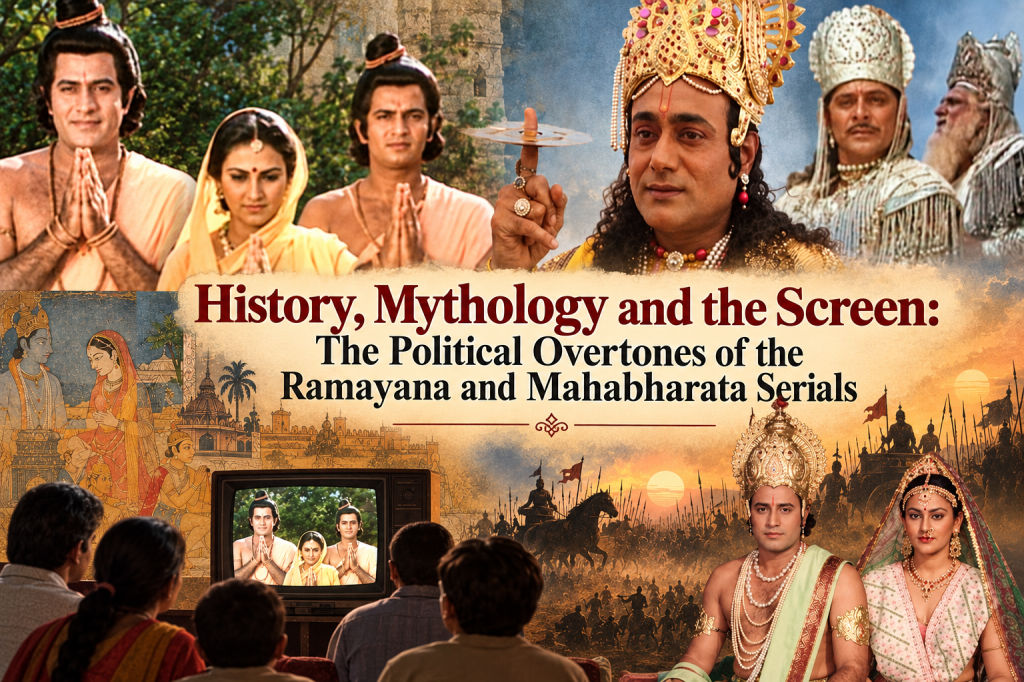
Continuing this discussion, we now turn to two television productions that profoundly influenced India’s popular imagination: Ramanand Sagar’s Ramayan (1987–88) and B. R. Chopra’s Mahabharat (1988–90). Unlike the Turkish serials, these drew upon ancient religious epics rather than the lives of identifiable historical personalities. Yet they raise a similar question: what happens when the many narratives belonging to a society’s cultural inheritance are compressed into a single, seemingly authoritative representation, particularly when religious identities are acquiring new political meanings?
The two serials were extraordinary successes. On Sunday mornings, streets reportedly emptied, markets fell silent and families gathered around television sets. In many homes, watching Ramayan became almost a religious observance. Some viewers offered prayers before the television, while actors portraying divine figures acquired an unusual degree of reverence. But something more consequential was happening. Millions of Indians were encountering the same visual representations of Rama, Krishna, Sita, Draupadi and other epic characters simultaneously. Television was creating a shared religious imagery on a scale that traditional storytelling had never achieved.
From Many Ramayanas to One Televised Rama
Perhaps the most significant cultural consequence of Ramanand Sagar’s Ramayan was the elevation of one particular telling of the Rama story into what many viewers came to regard as its definitive representation. This was a remarkable departure from the historical character of the Ramayana tradition.
In his celebrated essay, Three Hundred Ramayanas: Five Examples and Three Thoughts on Translation, A. K. Ramanujan drew attention to the extraordinary multiplicity of Rama narratives across South and Southeast Asia. Originally presented in 1987 and subsequently published in Paula Richman’s edited volume Many Ramayanas (1991), the essay demonstrated that the Rama story had never existed as a single, unchanging narrative.
Ramanujan referred to the hundreds of tellings identified by the scholar Camille Bulcke, but his argument went considerably beyond their number. The stories differed not merely in language or literary style, but frequently in their characters, relationships, moral assumptions and even the course of events. In Valmiki’s Sanskrit Ramayana, Rama is presented with a complexity that differs from the more explicitly divine Rama of Kamban’s Tamil Iramavataram or Tulsidas’s Ramcharitmanas. Jain traditions offer strikingly different interpretations. In Vimalasuri’s Paumacariya, Rama does not kill Ravana; Lakshmana does. Ravana himself emerges as a more complex and, in certain respects, tragic personality. Some traditions identify Sita as Ravana’s daughter. Others give her a much more active role than the familiar image of the obedient and suffering wife. In the Adbhuta Ramayana, Sita assumes a formidable warrior form and destroys an adversary whom Rama cannot defeat. The Thai Ramakien, meanwhile, reshapes the narrative in accordance with the cultural and literary traditions of Southeast Asia.
These are not insignificant variations around an otherwise identical story. They reveal fundamentally different ways of imagining its characters and interpreting its moral universe. Ramanujan therefore preferred the term tellings rather than versions, since the latter could imply that all other narratives were merely imperfect copies of a single original. His central insight was that the Ramayana tradition had flourished precisely because successive generations, regions and communities continually reimagined it. There were Ramayanas in Sanskrit, Tamil, Bengali, Awadhi, Kannada, Telugu, Odia and numerous other languages. Buddhist, Jain and Hindu traditions had their own narratives, while oral performances, village theatre, paintings, puppetry and local storytelling preserved still more variations. The Ramayana was not one fixed story repeated for centuries. It was a living family of narratives, constantly being retold, questioned and transformed.
It was this extraordinary plurality that the televised Ramayan, however unintentionally, tended to compress into a single nationally recognisable narrative. Ramanand Sagar drew particularly upon devotional traditions familiar in northern India, notably Tulsidas’s Ramcharitmanas, alongside other sources. His production was artistically legitimate as one interpretation among many. The difficulty arose when the enormous reach of Doordarshan gave that interpretation an authority disproportionate to its place within the larger tradition. For millions of viewers, the television serial became the Ramayana. Its characters acquired fixed faces, its dialogues became familiar, and its narrative choices increasingly shaped popular expectations of what the story ought to contain. Other tellings, especially those that differed substantially in their treatment of Rama, Sita or Ravana, became less visible within the nationally dominant television culture.
The irony was striking. A tradition that had survived and flourished through its capacity to accommodate multiple interpretations was now being encountered by a vast audience through one relatively standardised representation. This did not mean that the other Ramayanas disappeared. They continued to be read, performed and transmitted. But the televised narrative possessed something they generally lacked: the ability to reach millions simultaneously through a state-controlled national broadcaster.
The consequences were not merely literary. Once a particular telling acquired the appearance of religious authenticity, alternative interpretations could more easily be perceived as distortions rather than legitimate parts of the tradition. What had historically been a field of creative diversity could become a subject of arguments over authenticity and religious authority. The controversy surrounding Ramanujan’s essay itself is revealing. Its removal from Delhi University’s undergraduate history syllabus in 2011, following objections to its treatment of the Ramayana tradition, demonstrated how the scholarly recognition of multiple tellings could become politically contentious. Here, then, lies one of the central problems of the televised epic: the transformation of a plural literary inheritance into a comparatively uniform public image, subsequently available for political appropriation.
Religion, Television and the Politics of the 1980s
The timing of the broadcasts made this transformation particularly significant. Ramayan began in January 1987, when Rajiv Gandhi’s government was confronting contentious questions concerning religion and secularism. The Shah Bano controversy had exposed tensions between personal law, gender justice and political accommodation. In February 1986, the locks at the disputed Babri Masjid site in Ayodhya had been opened following a court order, permitting wider Hindu worship. Meanwhile, the Ram Janmabhoomi movement was gathering momentum.
Against this background, a state-controlled broadcaster began presenting a devotional narrative of Rama to a national audience. The government’s justification was cultural and educational. After all, the epics were an important part of India’s literary inheritance. But the distinction between cultural representation and religious mobilisation was not always easy to maintain. The televised Ramayan did not create the movement for a Ram temple at Ayodhya. Nevertheless, it helped establish a familiar and emotionally powerful visual vocabulary around Rama at precisely the moment when his image was becoming central to political mobilisation. In 1989, the Bharatiya Janata Party formally embraced the temple issue. The following year, L. K. Advani undertook his Rath Yatra from Somnath towards Ayodhya.
Arvind Rajagopal, in Politics after Television: Hindu Nationalism and the Reshaping of the Public in India (2001), has examined how television contributed to this transformation of the public sphere. The importance of his argument lies in recognising that political influence need not operate through explicit propaganda. A television programme may help create the cultural environment within which religious symbols acquire new political meanings. The Ramayan was not produced as a political advertisement. Yet its imagery could subsequently be appropriated by organisations pursuing objectives quite different from those publicly associated with the original broadcast. The reduction of many Ramayana traditions to one dominant televised representation was especially consequential in this context. A shared religious symbol was now accompanied by a widely recognisable narrative and visual identity, making it easier to employ in mass political communication.
The Mahabharata: From Kurukshetra to Karbala
B. R. Chopra’s Mahabharat, which began in October 1988, presented a rather different world. Unlike the relatively straightforward idealisation of Rama as the embodiment of righteous kingship, the Mahabharata was filled with morally ambiguous personalities. Bhishma’s loyalty to the throne perpetuates injustice. Karna combines generosity and courage with participation in questionable actions. Yudhishthira’s commitment to righteousness does not prevent disastrous decisions. Even Krishna’s interventions raise difficult questions about the relationship between political necessity and moral principles.
Yet one of the most remarkable aspects of the television adaptation was its dialogue, written by Rahi Masoom Raza, the distinguished Urdu poet, novelist and former teacher at Aligarh Muslim University. Raza, whose novels Aadha Gaon and Topi Shukla remain powerful explorations of communal identities and the shared social world of northern India, brought to the serial a literary sensibility shaped by Urdu poetry, regional speech and his own Shiʿi cultural background. Listening to his dialogues, particularly those depicting the tragedy of war, the anguish of mothers, the deaths of young warriors and the destruction of entire families, one is reminded of the classical Urdu marsiya and the narratives of Karbala.
The resemblance is striking. The marsiya, perfected by poets such as Mir Anis and Mirza Dabir, was much more than an elegy commemorating the martyrdom of Imam Husain and his companions at Karbala in 680 CE. It developed into a sophisticated narrative form combining heroic speeches, descriptions of battle, familial affection, moral confrontation and heartbreaking lamentation. Something of this emotional movement can be heard in Raza’s Mahabharat. The tragedy of Abhimanyu, the lamentations of Gandhari and Kunti, the anguish surrounding Karna and the destruction of entire lineages evoke themes familiar to those acquainted with the literary traditions of Karbala. At moments, the solemn cadence of the dialogues and their movement between heroic resolve and impending tragedy recall the rhetorical conventions of the Urdu marsiya.
This does not suggest that Raza simply transplanted the Karbala narrative into the Mahabharata. Rather, his literary inheritance enriched his rendering of an epic whose ethical and emotional concerns could be expressed through a vocabulary familiar from another tradition. There is also a recollection that Raza, while composing a scene involving Ganga mourning her sons, drew upon the imagery of a marsiya by Mir Anis. Although the precise textual relationship requires closer examination, the account is consistent with the affinities one notices in his dialogues.
It is worth recalling that Raza’s appointment reportedly provoked objections from those who questioned how a Muslim could write the dialogues for a Hindu epic. He rejected the suggestion that his religious identity disqualified him from interpreting India’s literary inheritance. For him, the civilisation of the Ganga was as much his own as anyone else’s. Here was a writer shaped by the remembrance of Karbala giving voice to the tragedy of Kurukshetra.
The significance extends beyond literary appreciation. At a time when religious identities were increasingly being presented as mutually exclusive, one of India’s most popular televised religious epics owed much of its emotional force to a Muslim writer steeped in Urdu literary traditions. The irony is difficult to overlook. A production that could be appropriated into narratives of exclusive religious identity was itself a product of India’s intertwined cultural inheritance.
When Mythology Begins to Resemble History
There is another problem connecting these serials with the historical productions discussed in our earlier essays: the extraordinary capacity of television to make imagined worlds appear historically authentic. In Ertuğrul and Osman, elaborate sets, costumes and battle scenes create an apparently convincing picture of medieval Anatolia, although much of what viewers encounter is dramatic reconstruction rather than established historical fact. The Indian epic serials operated similarly. Their palaces, costumes, weapons, political assemblies and battlefields were products of artistic imagination, contemporary aesthetic conventions and the practical requirements of television production. Yet repeated exposure could encourage audiences to regard these representations as faithful reconstructions of ancient India.
The Ramayana and Mahabharata are invaluable sources for studying the development of religious ideas, social relationships, political concepts and ethical traditions in South Asia. But their cultural importance does not establish the literal historicity of every event they describe. Historical investigation requires evidence, chronology, comparison and critical examination. A television serial, however convincing, cannot substitute for these methods. The problem becomes particularly serious when dramatised representations begin to function as historical evidence, or when questioning their accuracy is interpreted as hostility towards religious belief.
From Cultural Inheritance to Political Identity
The demolition of the Babri Masjid on 6 December 1992 marked a decisive moment in the political history of independent India. It followed years of organised mobilisation around Ayodhya and was accompanied by widespread communal violence. It would be historically unsound to attribute the demolition to a television serial. Nevertheless, the popularisation of a common visual image of Rama formed part of the cultural environment within which the movement expanded. The longer consequences included the growing prominence of religious symbolism in political communication and the increasing use of mythological narratives in debates about national identity and historical legitimacy.
The consecration of the Ram Mandir at Ayodhya in January 2024 demonstrated how enduring these questions had become. Supporters understood the event as the fulfilment of a longstanding religious aspiration, while critics raised questions about the relationship between political authority, religious ceremony and constitutional secularism. But the larger issue concerns the relationship between cultural plurality and national identity. India’s past includes the Sanskrit epics, Buddhist and Jain literature, Tamil devotional poetry, Persian chronicles, Sufi compositions, Sikh religious writings and innumerable regional traditions. These did not develop in sealed compartments. They interacted, borrowed from one another and contributed to a shared cultural world.
Ramanujan’s many Ramayanas and Rahi Masoom Raza’s Mahabharat illuminate different aspects of this interconnectedness. The former demonstrates the diversity within a tradition often presented as uniform. The latter reveals the cultural exchanges that have enriched literary traditions across religious boundaries. Together, they remind us that India’s cultural inheritance has historically been far more varied and interconnected than any single televised representation can convey.
The Screen and the Making of Historical Memory
What ultimately connects the Indian epic serials with the Turkish historical dramas and Fauda is the power of visual storytelling to influence collective memory. Their purposes and consequences were not identical. Nor should we assume that every historical or mythological production is deliberately designed to manipulate public opinion. Yet all demonstrate that television does more than entertain. It can influence how societies imagine their past, understand their present and identify with particular communities.
This presents a challenge for historians. Historical scholarship proceeds through evidence, criticism and debate. Visual storytelling, by contrast, frequently sacrifices complexity for dramatic coherence. A memorable scene may remain fixed in public imagination long after the historical evidence upon which it was supposedly based has been forgotten. The result is that an imagined past can sometimes become more influential than the historically recoverable one.
The Past on Screen and the Politics of Memory
The Ramayan and Mahabharat serials were remarkable cultural achievements. They introduced ancient literary traditions to enormous audiences and created a shared viewing experience that few Indian television productions have matched. Their artistic importance should not be diminished by the political uses to which their imagery was subsequently put. Nor should their popularity be mistaken for evidence that all viewers embraced a common political outlook. Nevertheless, their broadcasts coincided with, and contributed to, a transformation in the relationship between religious imagery, mass communication and political mobilisation.
The most significant cultural question concerns the narrowing of a remarkably diverse inheritance into a limited number of dominant representations. The many Ramayanas discussed by A. K. Ramanujan remind us that the Rama story had flourished precisely because different communities could interpret and reinterpret it. Television, by contrast, gave one telling an unprecedented degree of authority.
There is a further irony. The Mahabharata, an epic that repeatedly questions the easy distinction between righteousness and wrongdoing, could be employed to legitimise simplified moral divisions. And a serial based upon a Sanskrit epic acquired some of its most memorable dialogues from Rahi Masoom Raza, whose literary imagination had been nourished by the Urdu marsiya and the tragedy of Karbala. Perhaps these two observations tell us more about India’s cultural history than attempts to divide its inheritance into exclusive religious compartments.
The lesson from these serials, as from the historical productions discussed in our earlier essays, is not that cinema and television should avoid the past. Rather, their representations must be approached critically, particularly when they acquire political significance. The danger begins when one telling claims the authority of an entire tradition, when mythology is treated as established history, and when the richness of the past is reduced to the certainties demanded by present-day politics.


