Syed Ali Nadeem Rezavi
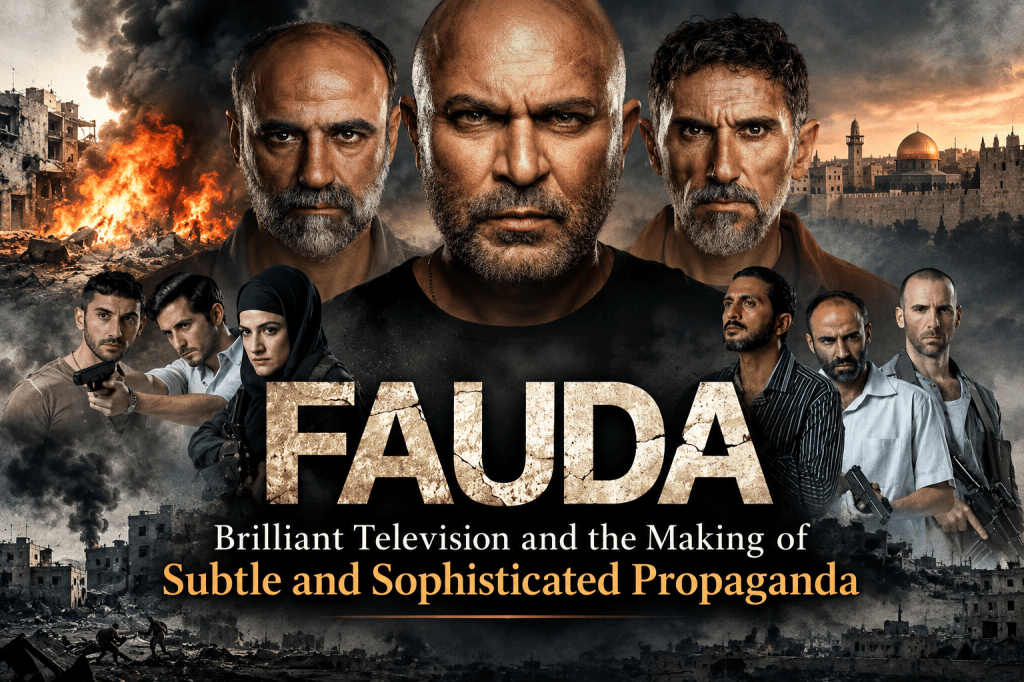
This is the third in the series on Cinema and historical themes. The first part dealt with the Hindi cinema, the second with the popular Turkish mega serials depicting the past, and now this dealing with the narration of the Israel-Palestinian conflicts.
I must begin with a confession. I have been an avid viewer of the Israeli television series Fauda almost from the moment it became internationally available, and I have followed the adventures, tragedies, and extraordinary twists in the lives of Doron Kavillio and his comrades with considerable interest, even as I was fully aware that it is an Israeli serial, and I am against Zionism and whatever they represent. When the recently released fifth season became available, I binge-watched that too. It remains extraordinarily gripping television, the sort of series it is difficult to stop after a single episode. What follows, therefore, should be read for what it is: the impressions of a regular and deeply interested viewer who has enjoyed Fauda enormously but who has also become increasingly uncomfortable with the historical and political assumptions embedded within its narrative.
That qualification is important because I do not regard Fauda as crude propaganda. Had it been merely that, it would hardly have held my attention through five seasons. It is precisely because the series is so well made, so convincing in its characterisation, and so successful in creating an appearance of moral complexity that its politics deserve closer scrutiny. Its strength as fiction is inseparable from its effectiveness as a political narrative, and indeed I would describe Fauda as something considerably more interesting than ordinary propaganda: it is subtle and sophisticated propaganda.
Created by Lior Raz and Avi Issacharoff, Fauda first appeared on Israeli television in 2015 before acquiring a huge international audience through Netflix. Raz, who plays its central character, Doron Kavillio, had himself served in an undercover Israeli military unit, while Issacharoff worked for many years as a journalist covering Palestinian affairs. Their familiarity with the Israeli security establishment and the world of Israel–Palestine gives the series much of its extraordinary air of authenticity. The very title is revealing: Fauda, an Arabic word meaning chaos, is used by undercover Israeli personnel when an operation has been compromised and disguise gives way to violence, and the fictional unit around which the series revolves is modelled upon the Israeli mista’arvim, undercover operatives who disguise themselves as Arabs and enter Palestinian communities.
This produces gripping television. Arabic and Hebrew intermingle naturally; Israeli operatives move through Palestinian towns; informers betray neighbours and relatives; intelligence operations go disastrously wrong; militants have families; soldiers suffer psychological trauma; and violence rarely produces the clean resolution anticipated by those who initiate it. The boundary between hunter and hunted repeatedly shifts. One of the great achievements of Fauda is that Palestinians are not invariably reduced to faceless villains: they have parents, wives, husbands, and children; they love, fear, mourn, quarrel, and occasionally question what they are doing. Israelis are similarly denied the comfort of uncomplicated heroism, for Doron himself is impulsive, violent, emotionally damaged, and capable of behaviour that the series does not always invite us to admire. At first sight, therefore, Fauda appears remarkably even-handed. Israelis kill Palestinians and Palestinians kill Israelis. Both bury their dead. Both seek revenge. Both communities contain courageous individuals, frightened families, opportunists, informers, and fanatics, and violence moves backwards and forwards, consuming those who participate in it as well as those unfortunate enough to stand in its path. Yet there is something deeply troubling beneath this apparent equidistance, because humanising individuals on both sides is not the same thing as explaining the historical relationship between them.
Where Does the Story Begin?
This, for me, is the fundamental problem with Fauda: we are repeatedly shown what Palestinian militants do, but are told remarkably little about why Palestinians came to take up the gun in the first place. The Palestinian militant seems almost to enter the story carrying a weapon. We encounter the underground cell, the bomb-maker, the tunnel, the planned kidnapping, the suicide mission, and the preparations for an attack. We are sometimes given immediate explanations for individual acts – one militant wants revenge because his brother has been killed, another has lost a friend, someone has been humiliated by an Israeli operative, another has been recruited by an organisation – but the larger historical question remains remarkably elusive. Why did the Palestinian pick up the gun in the first place?
That question cannot be answered simply by invoking Hamas, Islamic Jihad, or religious fundamentalism, because Palestinian armed resistance predates Hamas by decades. Its history takes us through the displacement and dispossession associated with the 1948 war and the Palestinian Nakba, the refugee camps, the emergence of the Palestine Liberation Organisation, the occupation of the West Bank, East Jerusalem and Gaza after the 1967 war, the First Intifada, the hopes and disappointments surrounding Oslo, the Second Intifada, settlement expansion, imprisonment, repeated Israeli military operations, and, in the case of Gaza, the blockade imposed after Hamas took control there. The legal and political context is not merely a matter of competing narratives: in its advisory opinion of July 2024, the International Court of Justice concluded that Israel’s continued presence in the Occupied Palestinian Territory was unlawful and discussed settlement expansion, annexation, and restrictions upon Palestinian self-determination as structural features of that situation.
None of this justifies deliberately killing civilians, and that distinction is essential. To explain an act historically is not to justify it morally. Historians routinely ask why revolutions, rebellions, insurgencies, and wars occur, and we do not thereby approve of every act committed by revolutionaries, rebels, armies, or insurgents. The problem with Fauda is that it gives us an abundance of immediate causes while largely avoiding the fundamental ones. A Palestinian wants revenge because somebody close to him has been killed; Doron pursues him because Israeli lives are threatened; the operation produces another Palestinian seeking revenge, which necessitates another Israeli operation. Every individual act has a cause, but what remains blurred is the cause of the condition itself.
The Appearance of Equidistance
This is where the apparent balance of Fauda becomes deceptive, because Israel and the Palestinians do not confront one another as two states possessing comparable military, political, and economic power. One side possesses a state, an army, sophisticated intelligence services, prisons, surveillance systems, and control over territory, while the Palestinians have experienced displacement, occupation, and statelessness, even as Palestinian armed organisations have themselves employed violence, including deliberate attacks upon civilians. Once this structural imbalance disappears into the conventions of a thriller, the political relationship is subtly transformed. The Israeli protagonist is pursuing a dangerous militant, and the immediate question therefore becomes whether Doron and his team can discover the bomb, rescue the hostage, or eliminate the cell before somebody is killed. A much more uncomfortable question recedes from view: why are Israeli intelligence officers operating inside Palestinian communities in the first place? This is how occupation can gradually be transformed into counter-terrorism, as checkpoints, raids, surveillance, informers, interrogations, and targeted killings become necessary responses to a danger that appears already to exist, and the possibility that occupation and resistance developed historically in relation to one another becomes much harder to perceive.
The camera contributes enormously to this process. We know Doron’s family, we witness the breakdown of his relationships, we understand the loyalty binding the members of his unit, and we share their grief when one of them dies. Even when Doron behaves brutally, we have usually travelled far enough inside his psychological world to understand how he arrived there. Palestinians certainly receive moments of comparable humanity, and some of these are among the most powerful sequences in the series, yet their political history remains much thinner. Palestinian suffering is visible, but the structures that produced it are less consistently explored. The camera humanises both sides, but history is not distributed equally between them.
Season Five and 7 October
This difficulty becomes much greater in Season Five because Fauda now moves closer to events that remain painfully present in contemporary memory. The creators have acknowledged that the season had to be substantially reconsidered after the Hamas-led attacks of 7 October 2023, and Raz has explained that the intention was not to reproduce those events as documentary history, but to place the fictional characters within situations shaped by them. There is nothing objectionable about Israeli writers attempting to represent Israeli trauma, for the deliberate killing of civilians and taking of hostages on 7 October were horrifying acts, and a United Nations Commission of Inquiry subsequently documented serious violations committed by Hamas and other Palestinian armed groups, including deliberate attacks upon civilians and hostage-taking. But once that horror has been acknowledged, another historical question remains: why did Hamas plan and launch an operation of this magnitude? Once again, Fauda gives us the act more vividly than the history.
There is no single uncontested explanation, and Hamas’s own account of its motives cannot simply be accepted as objective history, yet 7 October did not materialise outside history. The preceding context included occupation, the blockade of Gaza, the unresolved Palestinian refugee question, settlement expansion in the West Bank, repeated military confrontations, the weakening of the Palestinian Authority, the virtual disappearance of meaningful negotiations towards Palestinian statehood, tensions surrounding Jerusalem and al-Aqsa, the issue of Palestinian prisoners, and a changing regional situation in which Arab normalisation with Israel appeared increasingly possible without resolving the Palestinian question. The UN Commission of Inquiry itself placed the violence of 7 October and the Israeli military response within the longer history of occupation, displacement, dispossession, settlement, and denial of Palestinian self-determination, while making clear that violations committed by one party could not justify those committed by another. Context is not absolution, and nothing about occupation, dispossession, or blockade makes the deliberate killing of civilians legitimate, but removing that preceding history produces another distortion, making violence appear inexplicable except through fanaticism, hatred, or some supposed cultural disposition towards violence.
The Explosion and the Fuse
Perhaps the simplest way of describing the problem is that Fauda begins emotionally with the explosion rather than historically with the fuse. Once 7 October becomes the beginning of the story, the questions naturally change: How could this have happened? How did Israel fail to anticipate it? Who organised it? How will the perpetrators be found? How can another attack be prevented? What does such an experience do to Doron and the other characters whom viewers have followed for years? These are legitimate questions, but another set of questions becomes much quieter. What had Gaza become before 7 October? What political future was available to its inhabitants? What had happened to the promise of Palestinian statehood? What had decades of occupation, blockade, settlement expansion, failed negotiations, Palestinian attacks, and Israeli military operations produced? Why did armed organisations continue to find support among sections of Palestinian society despite the terrible price Palestinians themselves repeatedly paid? These questions do not produce comfortable answers, nor do they automatically produce a defence of Hamas; they simply restore causality to a narrative from which causality has been selectively removed.
The omission becomes still more conspicuous when what followed 7 October is considered. The same UN Commission that documented violations during the Hamas-led attacks also investigated serious violations arising from Israeli military operations in Gaza, and the devastation of Gaza therefore belongs to the same historical sequence. It cannot simply disappear once the camera has established Israeli trauma as the emotional centre of the story. Season Five nevertheless keeps much of the subsequent Palestinian experience outside its principal field of vision, and contemporary reviewers have noticed this absence as well, pointing to the striking contrast between the season’s intense engagement with the Israeli experience of 7 October and its limited engagement with Gaza afterwards. That absence matters enormously.
Reversing the Moral Chronology
The consequence is not necessarily the fabrication of events, for something subtler occurs: the chronology of suffering is rearranged. If the story begins with a Palestinian attack, Israeli violence becomes retaliation. If the Palestinian gunman appears without the history that produced him, the Israeli soldier naturally appears as the man required to stop him. If 7 October becomes the great originating trauma, the enormous violence that follows can more readily be understood through the vocabulary of response, security, and revenge. The Palestinian thereby enters history carrying a gun, while the Israeli enters history responding to it.
This is where Fauda, despite its appearance of balance, begins to function as a political narrative. Palestinian violence requires explanation but receives comparatively little historical explanation, while Israeli violence, because it normally follows a threat already established within the narrative, arrives with its explanation attached. Season Five makes the mechanism particularly striking, for the viewer is invited into the trauma experienced within Israeli society after 7 October, experiencing fear, helplessness, bereavement, and the desire for revenge from within, and the concept of tha’r, or blood revenge, itself becomes an important motif in the season. But where is the corresponding journey into Palestinian historical memory? Where are the Nakba, the refugee camp, occupation, settlement, blockade, and the experience of generations living without political sovereignty? These realities occasionally hover around the edges of the Fauda universe, but they rarely receive the narrative weight accorded to Israeli insecurity. One does not need to deny Israeli suffering in order to recognise Palestinian suffering, nor should acknowledging Palestinian dispossession require minimising the murder of Israeli civilians. The historical tragedy lies precisely in the way the suffering of one community is repeatedly used to obscure that of another.
Subtle and Sophisticated Propaganda
It is here that I would describe Fauda as subtle and sophisticated propaganda. The qualification is important because this is certainly not propaganda in its crudest and most recognisable form. There are no spotless Israeli heroes marching across the screen while Palestinians are presented simply as villains. Israeli intelligence makes mistakes, Israeli operatives sometimes behave brutally, and Doron himself is hardly presented as a model of moral perfection, while Palestinians are permitted dignity, courage, affection, grief, and moral complexity. That is precisely what makes the propaganda subtle and sophisticated. Crude propaganda tells us what to think; Fauda does something considerably more effective by constructing a world within which certain conclusions begin to appear natural.
It does not need to tell the viewer that Israeli violence is essentially defensive, because it normally arranges the narrative so that we encounter an Israeli operation after a Palestinian threat has already been established. It does not need to deny Palestinian suffering; it merely gives that suffering less historical depth. Nor does it need to claim that Palestinians are inherently violent, for it can simply introduce them into the narrative at the point at which they have already picked up the gun. The apparent even-handedness consequently becomes part of the persuasive mechanism: because Palestinians are humanised, because Israelis are shown committing questionable acts, and because characters on both sides suffer, viewers can easily believe that they have been shown the conflict in its entirety. But seeing Palestinian characters is not the same thing as seeing Palestinian history.
This is the distinction upon which much of Fauda’s political effectiveness rests. Palestinian grief can be represented movingly while the historical structures behind that grief remain peripheral; the militant can be humanised without the history of militancy being adequately explored; and Israeli violence, meanwhile, usually enters the narrative after a danger has already been established and therefore arrives accompanied by an explanation. The series does not need to falsify individual events, because selection, chronology, and silence can accomplish far more.
Realism and Historical Truth
This is also why simply dismissing Fauda as Israeli propaganda would fail to recognise what makes it such an extraordinary television series. Its effectiveness depends upon its excellence. The acting is convincing, the characters are complicated, the movement between Arabic and Hebrew gives the programme a remarkable authenticity, and violence is often portrayed as morally corrosive rather than glorious. All this creates credibility. The streets look real, the conversations sound real, fear feels real, and the sudden eruption of violence is frightening precisely because it intrudes upon ordinary life. Characters bleed, grieve, love, and betray one another with sufficient emotional conviction for the viewer to surrender to the world that the programme creates. Yet realism of detail is not necessarily truth of structure. A checkpoint may be reconstructed perfectly, an undercover operation may resemble an actual intelligence operation, and the weapons, clothing, accents, and security procedures may all be convincing, yet the historical world containing them can still be selectively organised. This is the difference between authenticity and history.
The History Outside the Frame
To understand the Israeli–Palestinian conflict historically, one therefore has to move repeatedly outside the frame provided by Fauda. History cannot conveniently begin on 7 October 2023, nor can it simply begin in 1967 or 1948, as though nothing preceded those dates. The conflict emerged from a much longer history involving Zionism and Palestinian nationalism, Ottoman and British rule, European antisemitism and the Holocaust, migration and competing claims to land, the establishment of Israel, Palestinian displacement, wars, occupation, settlements, resistance, terrorism, failed negotiations, and conflicting memories of homeland and catastrophe. Nor can Palestinian history be reduced to Hamas, for Palestinians have pursued very different strategies over the decades, ranging from armed struggle to diplomacy, negotiation, popular protest, civil resistance, and international legal action. Israeli society similarly cannot be reduced to its government or security establishment, since Israelis themselves have disagreed profoundly over occupation, settlements, Palestinian statehood, war, and the future relationship between the two peoples.
Fauda occasionally permits some of these complexities to enter its world, yet the conventions of the thriller repeatedly pull it back towards the security narrative. Someone is preparing an attack, someone must discover the plot, and time is running out. Once the clock begins ticking, history becomes an inconvenience. That is why I continue to find Fauda both compelling and troubling. I remain an avid viewer and found Season Five extremely gripping, and my criticism arises not despite enjoying the series, but partly because I have watched it so closely. The better the storytelling, the more important it becomes to ask what kind of story is being told.
The crucial question remains remarkably simple: why did the Palestinian pick up the gun? Asking that question is not an endorsement of the gun. Asking why Hamas planned 7 October does not excuse the killing of civilians. Asking what preceded Israeli military retaliation does not deny Israeli fear or grief. These are questions of historical causation, and without causation we are left with episodes detached from the processes that produced them. Fauda is exceptionally good at showing us consequences, but it is considerably less willing to pursue causes when those causes complicate the Israeli security narrative. That is what makes it such an accomplished example of subtle and sophisticated propaganda. It does not generally rewrite history by inventing an entirely fictitious world; something far more interesting happens. It rearranges emphasis. It determines which suffering receives context, which violence receives explanation, which memories are brought into the foreground, and which are allowed to recede. Most importantly, it decides where the story begins. The Palestinian too often enters that story carrying a gun, while the Israeli enters it responding to the gun. Once the narrative begins there, much of the political argument has already been made before the first shot is fired.
This is why Fauda deserves to be watched rather than dismissed, enjoyed but also interrogated. It is excellent television, powerful fiction, and enormously effective storytelling, but it is also a political narrative in which selection, silence, and chronology quietly perform the work that slogans perform in cruder forms of propaganda. Perhaps that is its greatest achievement and also the reason it needs to be watched with our eyes open. Beneath the disguises, gunfire, betrayals, and breathtaking suspense lies another struggle, quieter but no less important: the struggle over who gets to tell the story, where that story is allowed to begin, whose violence comes supplied with a history, and whose appears to emerge inexplicably from hatred. For a historian, these are not peripheral questions. They are precisely where history begins.


