Syed Ali Nadeem Rezavi
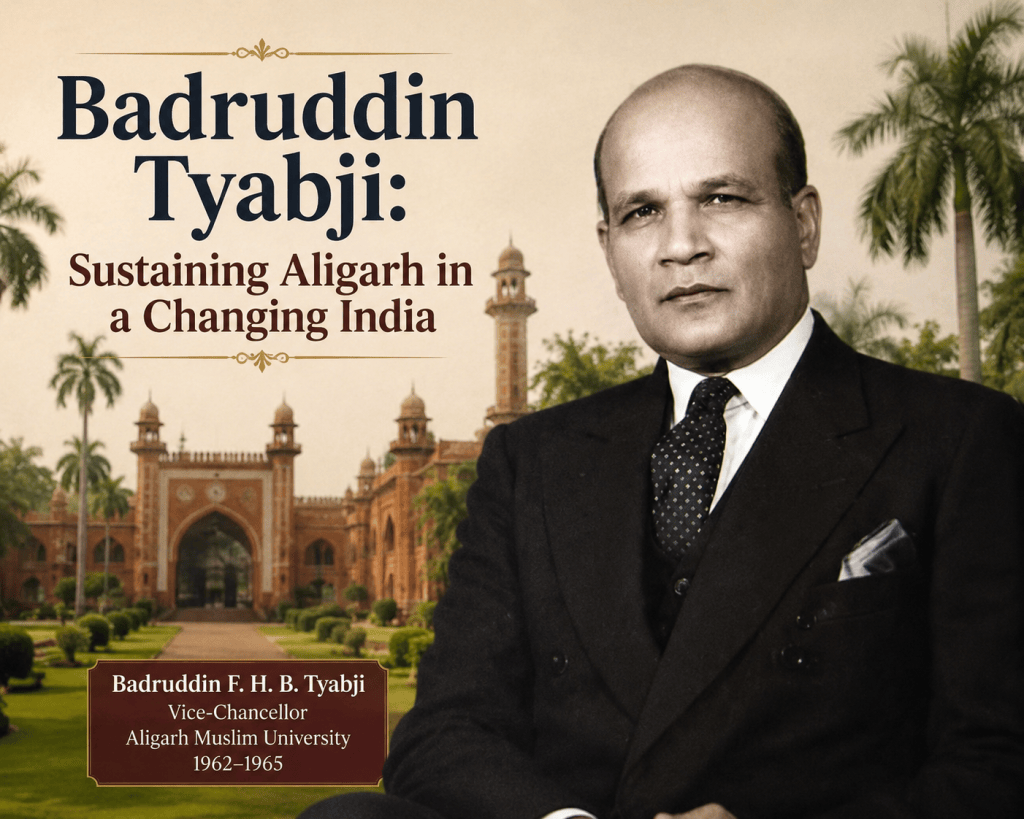
Among the Vice-Chancellors who shaped Aligarh Muslim University during the difficult decades following independence, Badruddin Faiz Husain Badruddin Tyabji occupies an important but somewhat neglected position. He served for barely two and a half years, from November 1962 to February 1965, and his tenure consequently lacks the dramatic longevity associated with some of his predecessors. Yet the brevity of his vice-chancellorship should not obscure its significance. Tyabji came to Aligarh at a particular stage in the University’s post-independence history. The immediate danger that had confronted AMU after Partition had passed, and the great physical expansion undertaken under Colonel Bashir Husain Zaidi had transformed the campus. What the University now required was consolidation: administrative stability, academic confidence, discipline and a clearer relationship with the larger world outside Aligarh.
There is an interesting continuity in the succession of Vice-Chancellors during these years. Dr Zakir Husain had helped save AMU when, in the aftermath of Partition, its very future appeared uncertain. Colonel Bashir Husain Zaidi had subsequently presided over an extraordinary expansion of its physical and institutional infrastructure. Badruddin Tyabji inherited what these two men had secured and built. His task was to sustain it.
Tyabji was not a professional academic. He came to Aligarh from the upper reaches of the Indian administrative and diplomatic establishment. Born in 1907, he belonged to the distinguished Tyabji family of Bombay, whose contribution to Indian public life stretched back into the nineteenth century. The most famous earlier Badruddin Tyabji had been a pioneering lawyer, judge and, in 1887, the third President of the Indian National Congress. The family’s Muslim identity had therefore long existed alongside a deep commitment to Indian nationalism. The younger Badruddin Tyabji entered the Indian Civil Service in 1932. His administrative career subsequently gave way to diplomacy, and after independence he became closely involved in representing the new Republic abroad. He served in Brussels and held important positions in the Ministry of External Affairs before representing India diplomatically in Indonesia, Iran and West Germany. He was thus a man accustomed to government, negotiation and international diplomacy rather than the enclosed routines of university administration.
His family was connected with another powerful symbol of independent India. His wife, Surayya Tyabji, played an important part in the discussions surrounding the final form of the Indian national flag, particularly the version incorporating the Ashokan chakra. The Tyabjis therefore belonged unmistakably to that generation of Indian Muslims whose nationalism did not require them to choose between their cultural inheritance and their Indian citizenship. It was precisely this background that made Tyabji attractive when the vice-chancellorship of Aligarh fell vacant in 1962.
The surviving correspondence of Jawaharlal Nehru is particularly revealing. Education Minister K. L. Shrimali discussed the appointment with Nehru, the President and the Vice-President and concluded that Tyabji appeared to command unusually broad confidence. What is striking is the importance that the highest levels of the Government of India attached to the appointment. Aligarh was not regarded simply as another university requiring another administrator. Shrimali described it as one of the country’s important national institutions and insisted that it required the best possible leadership. Nehru himself was initially reluctant to lose Tyabji from the Ministry of External Affairs. Yet he considered the future of Aligarh sufficiently important to make the sacrifice. Writing to Tyabji on 7 July 1962, he urged him to accept the vice-chancellorship and emphasised the special place AMU occupied in the intellectual life of Indian Muslims and consequently in the future of India. Even more significantly, Nehru informed him that Dr Zakir Husain was among those who strongly favoured his appointment.
That detail is worth emphasising. Zakir Husain knew Aligarh intimately. He had guided it through its most dangerous post-Partition years. If he regarded Tyabji as suitable to succeed Zaidi, it suggests that he saw in him qualities particularly necessary for the next stage of AMU’s development.
There was nevertheless opposition to the appointment. Critics questioned whether a career civil servant without a conventional academic career should head a university. There were also fears that bringing a senior government official to Aligarh might compromise the University’s autonomy. Nehru rejected these objections. Whatever Tyabji’s professional origins, he regarded him as competent, efficient, able and independent. The episode tells us something about the conception of the vice-chancellorship at the time. The question was not simply who was available to occupy the chair. The Government was prepared to release one of its senior diplomats because Aligarh was considered important enough to require a person of national standing.
Tyabji assumed office in the autumn of 1962. From the beginning he made clear that one of his principal concerns was discipline. At his first Sir Syed Day address on 17 October 1962, he invoked the mission of Sir Syed Ahmad Khan and called upon students to cultivate the determination, discipline and confidence required to confront the world around them. This emphasis has sometimes led to Tyabji being remembered primarily as a disciplinarian. There was certainly something of the ICS officer in his administrative manner. He expected rules to be observed and responsibilities to be discharged. But to reduce his approach merely to bureaucratic severity would miss the larger purpose behind it.
Tyabji believed that sections of Muslim youth continued to carry the psychological consequences of Partition. He detected what he described as a sense of despondency and defeatism among students. Too many, in his view, lacked the confidence to venture beyond familiar social and institutional surroundings. This was a perceptive diagnosis of one of the problems confronting Indian Muslims in the decades immediately following Partition. The question was no longer whether they belonged to India. The question was whether a generation shaped by the insecurities of Partition could participate confidently in the opportunities offered by the new Republic. Tyabji wanted Aligarh to prepare them for precisely that participation. In this respect his conception of AMU bore a striking resemblance to Sir Syed’s original educational project. Sir Syed had urged nineteenth-century Muslims to overcome fear of the modern world by acquiring the knowledge necessary to engage with it. Tyabji believed that the Muslims of post-Partition India confronted a comparable psychological challenge. Aligarh should not become a refuge from India; it should prepare its students to participate confidently in India.
One of his most interesting initiatives followed directly from this conception. Tyabji explored closer academic relations between Aligarh Muslim University and Banaras Hindu University. He envisaged faculty exchanges and greater interaction between the two institutions and even considered ways of encouraging more Hindu students to come to Aligarh and Muslim students to study at Banaras. The proposal was remarkably imaginative. AMU and BHU were institutions whose very names had acquired communal associations. Tyabji’s answer was not to abolish their distinctive historical identities but to make those identities less insular through intellectual contact. Muslim students at Aligarh and Hindu students at Banaras should encounter one another not as abstractions belonging to separate communities but as fellow students and scholars. The proposal encountered opposition and never developed on the scale he envisaged. Yet its significance lies as much in its conception as in its implementation. It demonstrated that Tyabji understood the problem of Aligarh after Partition not simply in administrative terms but in psychological and national ones.
There was also continuity here with Zakir Husain. Zakir Husain had described the work at AMU as part of the larger task of constructing integrated nationhood in a secular democratic state. Tyabji was attempting, through different means, to carry that project forward.
His administrative reforms were less dramatic but equally characteristic. Tyabji was disturbed by personal patronage, favouritism and what he regarded as nepotistic tendencies within university administration. His years in the civil service had given him a strong belief in procedure and institutional accountability, and he attempted to apply these principles at Aligarh. This inevitably produced friction. Universities are not government departments, and distinguished academics do not always respond sympathetically to the administrative habits of civil servants. Some contemporaries found Tyabji brusque and believed that he did not sufficiently appreciate the distinctive culture of academic life. Such criticism should not be ignored. His vice-chancellorship was not a period of universal consensus, nor were all his reforms successful. Yet even those who found his manner difficult acknowledged the order that characterised his administration. Tyabji’s insistence upon discipline was directed not only at students but towards the functioning of the institution itself. He wanted appointments, administration and university procedures to operate according to institutional considerations rather than personal relationships.
Beyond questions of discipline and administration, Tyabji’s tenure witnessed several concrete academic developments that reflected his concern with professional training and institutional expansion. A new post of Dean of Students’ Welfare was sanctioned by the University Grants Commission, and a Post-Graduate Diploma Course in Public Administration was instituted from the academic session 1963–64, marking a modest but significant extension of the University’s professional offerings. The UGC also sanctioned a substantial non-recurring grant of Rs 1,53,00,000 during 1963–64 for the establishment of the Medical College, a commitment that underpinned the expansion of medical education in this period. Ten new departments in the Medical College became operational from 1 August 1964, encompassing Pathology, Microbiology, Pharmacology, Medicine, Surgery, Paediatrics, Obstetrics and Gynaecology, Social and Preventive Medicine, Radiology and Electro-Therapeutics, and Forensic Medicine. On the admissions side, Tyabji altered the ratio between internal and external students in favour of Aligarh’s own candidates, raising the internal share for the Engineering College from fifty to seventy-five per cent, a decision that proved popular with students but would later become a point of contention under his successor. These measures, taken together, illustrate that his vice-chancellorship was not confined to disciplinary firmness but also sought to broaden the University’s academic and professional footprint at a formative moment in its post-independence development.
His tenure also coincided with an important phase in the development of medical education at Aligarh. Here again historical precision is necessary. The creation of the Medical College was not Tyabji’s achievement alone. Much of the groundwork had been undertaken during the vice-chancellorship of Colonel Bashir Husain Zaidi. But the institution expanded significantly during Tyabji’s tenure. In 1964, a number of clinical and para-clinical departments became operational, including Medicine, Surgery, Pathology, Microbiology, Pharmacology, Paediatrics, Obstetrics and Gynaecology, Radiology, Forensic Medicine and Social and Preventive Medicine. Tyabji thus helped consolidate one of the most important institutional developments initiated under Zaidi. This distinction between creation and consolidation is important in assessing his entire vice-chancellorship. Tyabji was not primarily a builder in the manner of Zaidi. His contribution was less visible because it lay substantially in sustaining, organising and stabilising what had already been created.
His international experience also gave him a conception of Aligarh extending beyond its immediate environment. He had represented India in foreign capitals and had seen universities and institutions operating within different national settings. He wanted Aligarh students to escape intellectual and psychological provincialism. The world beyond the campus was not something to be feared; it was something for which the University should prepare them. There was consequently a consistent logic connecting apparently different aspects of his administration: discipline, academic standards, administrative reform, cooperation with BHU, professional education and his concern about the lack of confidence among Muslim students. All were parts of an attempt to make Aligarh more outward-looking.
The circumstances surrounding his appointment also reveal the continued importance attached to AMU by the leadership of independent India. Nehru’s correspondence makes clear that he considered Aligarh’s future a matter of national significance. The University was understood to possess a special relationship with Indian Muslims, but that relationship was not conceived as a justification for communal isolation. On the contrary, AMU was expected to help Indian Muslims participate more fully in the life of the Republic. Tyabji understood this delicate balance. He did not believe that Aligarh had to abandon its historical personality in order to become more Indian. Nor did he believe that preserving its Muslim cultural inheritance required withdrawal into a protected enclosure. AMU could remain Aligarh precisely while becoming more confidently part of India.
Tyabji’s tenure was brief. He relinquished office in February 1965 and returned to India’s diplomatic service, subsequently serving as Ambassador to Japan. Only weeks after his departure, the University entered one of the gravest crises of its post-independence history. In April 1965, disturbances culminated in the violent attack upon his successor, Nawab Ali Yavar Jung, and brought AMU once again into national controversy. The proximity of these events inevitably invites comparison with Tyabji’s administration. Contemporary parliamentary discussion after the disturbances recalled that shortly before leaving office Tyabji had publicly expressed satisfaction with the tradition of discipline among AMU students. It would be simplistic to conclude that order prevailed merely because Tyabji was Vice-Chancellor or that the subsequent crisis resulted simply from his departure. The causes of the 1965 disturbances were considerably more complex. Nevertheless, the contrast helps explain why his tenure came to be remembered for administrative firmness.
Tyabji’s larger projects remained unfinished. His proposals for closer AMU-BHU interaction did not develop as he hoped. His attempts to change established administrative habits encountered resistance. His conception of discipline could sometimes appear excessively bureaucratic. And two and a half years were in any case too short a period in which to transform the culture of a large residential university. Yet his importance lies precisely in recognising what Aligarh required at that particular historical moment. There is, in fact, a remarkable progression in the history of AMU under the three Vice-Chancellors who preceded Ali Yavar Jung. Zakir Husain had taken charge when Aligarh needed to be saved. Bashir Husain Zaidi had taken the institution that survived and physically transformed it. Badruddin Tyabji inherited the expanded University and attempted to give it discipline, administrative stability and confidence. Each man’s contribution was different because the needs of the University were different.
Tyabji’s contribution was perhaps the least spectacular of the three. There were no dramatic circumstances comparable to those confronting Zakir Husain in 1948, nor was there the extraordinary building activity that earned Zaidi the affectionate description of the ‘Shahjahan of Aligarh’. Tyabji’s work was quieter. He attempted to make institutions function, to improve discipline, to strengthen professional education, to widen intellectual horizons and, above all, to persuade Aligarh’s students that they had no reason to approach independent India with either fear or a sense of defeat.
There is another aspect of his tenure worth remembering. The man occupying the Vice-Chancellor’s chair had already held important positions in the Government of India and represented his country abroad. After Aligarh he returned to representing India internationally. The vice-chancellorship was not, for him, the culmination of a search for office. It was an interlude of public service undertaken because the University was considered sufficiently important to justify taking one of India’s senior diplomats away from the Ministry of External Affairs. Perhaps nothing better illustrates the stature that the office of Vice-Chancellor of AMU once commanded. Nehru was reluctant to lose Tyabji from his government. Yet he urged him to go to Aligarh because he believed the University needed him. Zakir Husain, who knew better than most what the institution required, supported the choice. Tyabji came, served for a relatively short period, and returned to the diplomatic world from which he had been drawn. His vice-chancellorship therefore deserves to be remembered not for a single monument or spectacular achievement but for something less visible and perhaps equally important: he helped sustain the institution during the transition between its great post-Partition reconstruction and the turbulent years that followed. Zakir Husain had demonstrated that Aligarh could survive in independent India. Zaidi had demonstrated that it could expand. Tyabji wanted it to demonstrate that it could be disciplined, confident, outward-looking and fully at home in the Republic. That, ultimately, was his contribution to Aligarh.


